A Guide to Music Distribution Deals for Artists
So you’ve poured your heart and soul into a track. It’s mixed, mastered, and sitting on your hard drive, ready for the world. But how does it actually get from your computer to the ears of millions on platforms like Spotify, Apple Music, and TikTok?
That’s where a music distribution deal comes in. Think of it as the essential bridge connecting your finished music to a global audience, making sure you get paid for every stream and download along the way.
What Is a Music Distribution Deal Anyway?
Imagine a music distributor as the worldwide shipping and logistics network for your art. Back in the day, artists needed a record label to press vinyl records or CDs and then convince physical stores to put them on the shelves. Today, the storefronts are digital, but the core challenge is the same: how do you get your product in front of customers?
This is exactly what music distribution deals solve. These are the agreements that lay out the terms for a distribution company to take your mastered audio files and deliver them to hundreds of digital service providers (DSPs) across the globe. Without one, your music is basically stuck in digital solitary confinement.
The Distributor's Core Responsibilities
A distributor's job is so much more than just uploading a file. They handle all the complicated technical and administrative legwork that each platform demands, making sure your music is formatted perfectly and delivered with all the right metadata—like your cover art, song titles, and artist info.
Here's a quick look at the main players involved in this process and what each one does.
Key Players in Your Music's Journey
Player | Primary Role | Key Responsibility |
|---|---|---|
The Artist | The Creator | You write, record, and produce the music. |
The Distributor | The Logistics Hub | They deliver your music and metadata to all the digital stores and streaming platforms. |
Digital Service Providers (DSPs) | The Storefronts | Platforms like Spotify, Apple Music, and Amazon Music where listeners stream or buy your music. |
The Listener | The Fan | They discover and play your music, generating streams and revenue. |
In short, the distributor acts as the crucial middleman, ensuring your music flows smoothly from your studio to your fans' headphones.
Their key functions usually boil down to three things:
Global Digital Delivery: Pushing your tracks to the big streaming services like Spotify and Apple Music, plus social media platforms like Instagram and TikTok, and online music stores.
Royalty Collection: Acting as your financial agent, collecting all the money your music earns from streams and sales from every corner of the world.
Data and Analytics: Giving you a dashboard where you can track your streams, see who your listeners are, and understand where your music is catching fire.
The digital music scene is a massive, constantly growing marketplace. The global music streaming market is on track to hit around USD 47.06 billion in 2025 and is expected to explode to USD 143.89 billion by 2032. This insane growth shows just how vital a solid distribution plan is for any artist today. You can discover more insights about the music streaming market forecast and see what it means for creators like you.
A distribution deal is your ticket to the global music stage. It’s not just about access; it’s about infrastructure. A good partner manages the backend logistics so you can focus on creating.
At its core, a distribution deal is the engine that lets independent artists compete on the very same platforms as major-label superstars. It levels the playing field, turning what was once a walled-off industry into a real career path for anyone with a killer song and the hustle to share it.
Exploring Different Types of Distribution Deals
Not all music distribution deals are built the same. Picking the right one can feel like choosing a vehicle for a cross-country tour. Do you just need a reliable van that you drive yourself, or are you looking for a luxury tour bus with a dedicated driver and crew? The right answer depends entirely on where you are in your career, what your goals are, and how much control you want to keep behind the wheel.
Think of it like publishing a book. You can self-publish on an open platform or sign with a major publishing house that handles everything from editing to marketing. Let's break down the main deal structures you'll run into, each offering a different balance of services, creative control, and of course, money.
This visual lays out the core music distribution models, showing the relationship between the level of service and how much of the royalty pie the artist gets to keep.
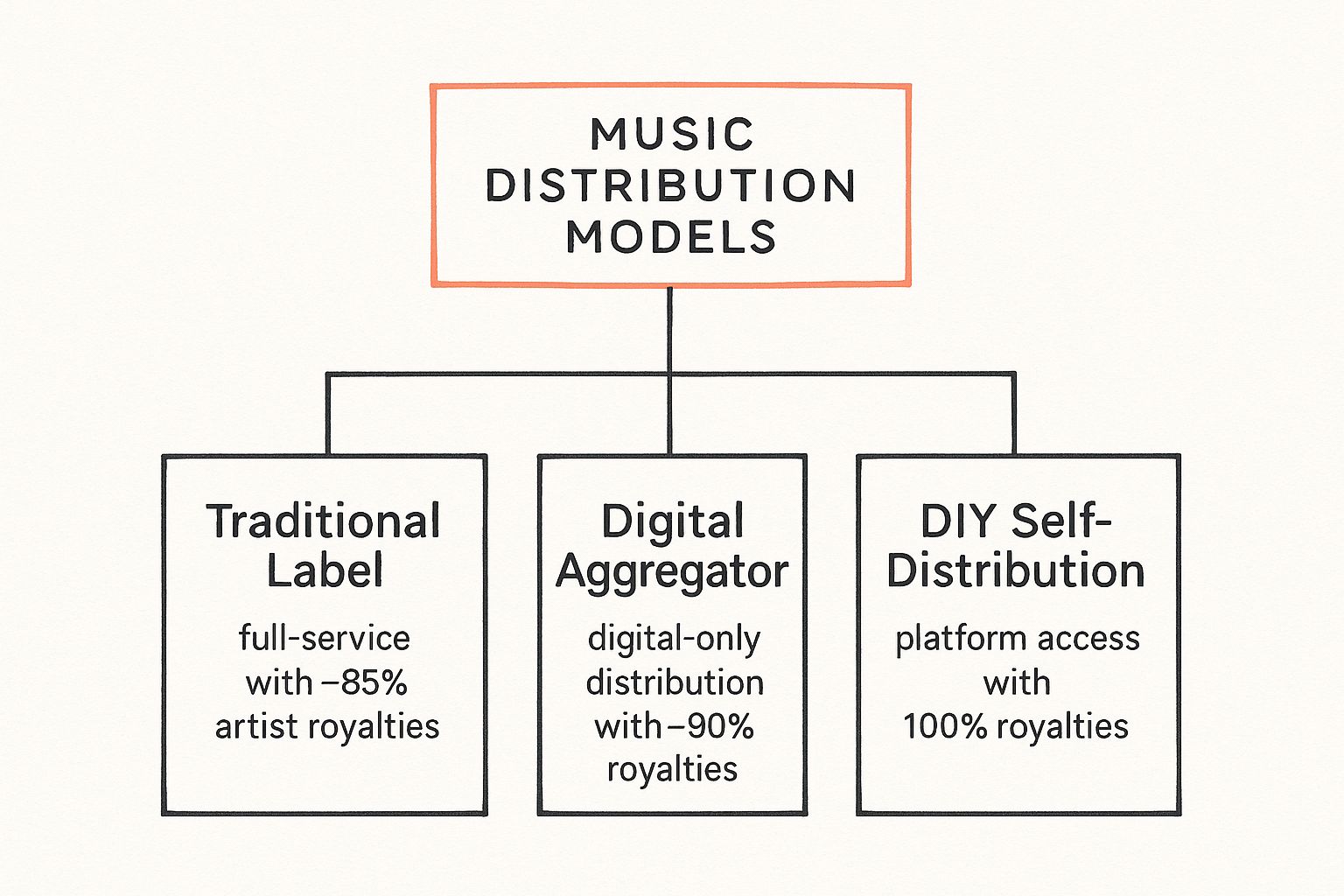
As you can see, there’s a clear trade-off here. The more hands-on help you get from a partner, the smaller your slice of the royalty revenue tends to be.
DIY or Open Distribution
This is the most common on-ramp to the music industry superhighway. Companies like DistroKid, TuneCore, and CD Baby run on a DIY (Do-It-Yourself) model. You pay a small fee—either annually or per release—upload your tracks and artwork, and they blast it out to all the major streaming platforms. It’s that simple.
Artist Control: You keep 100% creative control and, most importantly, you own your master recordings.
Services: The service is purely logistical. They get your music into digital stores and collect the royalties for you.
Revenue Split: You generally keep 100% of your royalties. Some platforms might offer a free plan that takes a small cut, often around 15%, but the paid tiers are usually commission-free.
This path is perfect for new and emerging artists. It’s the fastest way to get your music heard while retaining full ownership and avoiding any long-term commitments.
Distribution-Only Deals
This is a step up from the DIY world, designed for artists who already have some real momentum. These deals come from more selective companies, like The Orchard or Believe, who act more like partners than just simple service providers. You're still independent, but now you've got a more powerful engine under the hood.
Here, you're not just paying a flat fee. The distributor takes a percentage of your revenue. In exchange, they usually offer better analytics, more robust support, and an actual human you can talk to. They're betting on your success, so they're much pickier about who they bring on board.
A distribution-only deal is for the artist who has proven they can drive but needs a professional co-pilot to help navigate the more complex routes to success.
Label Services Deals
This is where the line between distributor and record label starts to get blurry. A label services deal is a modern, flexible alternative to a traditional record deal, offered by companies like AWAL (Artists Without A Label).
With a label services deal, you still own your master recordings, but you essentially hire the company to handle specific jobs a label would normally cover. You can pick and choose what you need. This could include:
Digital and physical marketing campaigns
Playlist pitching and streaming promotion
Radio plugging
Sync licensing for TV, film, and ads
Help securing brand partnerships
These deals are almost always commission-based. The company takes a percentage of your earnings—for example, AWAL takes 15%—in exchange for their expertise and resources. This is a fantastic option for established independent artists who need a professional team to level up but aren’t willing to sign away their masters.
Traditional Record Label Deals
And finally, we have the classic record label deal. This is the most comprehensive, all-in package. When you sign with a major label like Universal, Sony, or Warner, they typically handle everything: funding the recording, marketing, promotion, distribution, and even tour support.
The trade-off, however, is huge. In most traditional deals, the label owns your master recordings for a specified period—sometimes for the life of the copyright. The artist receives a much smaller royalty percentage, often between 15-20%, and only after the label has recouped its entire initial investment (the advance).
This route offers incredible resources and industry muscle that can catapult an artist to mainstream stardom. But it comes at the cost of ownership and a great deal of creative control. It’s a path best suited for artists aiming for the very top and who are comfortable operating within a larger corporate machine.
How You Actually Get Paid From Your Music

Trying to figure out how money gets from a fan’s stream into your bank account can feel like navigating a maze blindfolded. It’s a winding path, full of different companies, various types of payments, and the specific terms buried in your music distribution deals. Let's flip the lights on and make sense of the financial side of your music.
The money you make is built on royalties. Think of a royalty as a small payment that’s triggered every time your music gets used—whether it’s streamed on Spotify, played in a TV show, or spun on the radio. Your distributor is like your personal collection agency, grabbing all these little payments from across the globe and sending them your way.
But it gets a little more complex. Not all royalties are created equal. They flow from two distinct sources tied to every single song you release: the master recording (the actual finished audio file) and the composition (the song itself—the melody and lyrics).
Decoding Your Royalty Streams
To really get a handle on your earnings, you have to know the different royalty streams your music creates. Each one takes a unique route to get to you.
Master Recording Royalties: These are paid to whoever owns the sound recording. As an independent artist, that’s you. When someone streams your track on Apple Music or buys it from a digital store, your distributor collects this money for you right from the platform.
Mechanical Royalties: This royalty gets generated any time the composition of your song is reproduced. That includes digital streams and downloads, as well as physical copies like vinyl or CDs. This money is owed to the songwriter and publisher.
Performance Royalties: Whenever your song is performed in public, it earns a performance royalty. "Public performance" is a broad term—it covers everything from a stream on Spotify and a play on the radio to live shows and even background music in a coffee shop.
Getting these streams straight is a game-changer. You can dive deeper into how it all works in our **complete artist's guide on music royalties**. The more you know, the better you'll be at tracking your money and making sure nothing gets left on the table.
The money trail in music is never a straight line. It's a network of streams flowing from different sources. Your job is to make sure every stream leads back to you, and your distribution deal is the key to building those pathways.
How Distributors Take Their Cut
Alright, let's talk about the splits. How your distributor gets paid has a direct impact on what you actually take home. You'll generally run into two main models in music distribution deals.
Percentage Split (Commission-Based): With this setup, the distributor takes a percentage of the royalties they collect on your behalf. A classic split is 85/15—you keep 85% of the revenue, and they take a 15% commission. This is common with label services deals or more selective distributors.
Flat Fee (Subscription-Based): In this model, you pay a set fee per release or per year. The major upside? You often get to keep 100% of your royalties. DIY platforms like DistroKid and TuneCore made this famous, and it’s a favorite for indie artists who want predictable costs.
There isn’t a single “best” option here. It really depends on your career stage and how much you're streaming. A flat fee can be a no-brainer when you're starting out, but a percentage deal might be worth it if it comes with marketing muscle that dramatically increases your overall earnings.
To see how these different deal structures play out in the real world, let's look at a simple example. Imagine your music generated $1,000 in streaming revenue.
How $1000 in Streaming Revenue Is Divided
Deal Type | Distributor's Cut | Artist's Net Payout (Approximate) | Key Consideration |
|---|---|---|---|
Flat Fee (100% Royalties) | $0 (plus annual fee) | $1,000 | Your main cost is the subscription fee, not a cut of your revenue. |
Percentage (85/15 Split) | $150 (15%) | $850 | The distributor only makes money if you do, which can align incentives. |
Label Services (70/30 Split) | $300 (30%) | $700 | You give up a larger share in exchange for hands-on marketing support. |
Traditional Label (50/50 Split) | $500+ (50%+) | <$500 (after recoupment) | The label fronts costs (advance, marketing) but takes the largest share. |
This table shows just how much your deal type influences your bottom line. An artist keeping 100% of their royalties will see a much different payout than one in a label services deal, even with the same amount of revenue.
The Role of Performance Rights Organizations
So, who’s collecting your performance royalties? That’s where Performance Rights Organizations (PROs) come into the picture. Companies like ASCAP, BMI, and SESAC are responsible for tracking every public performance of your music and collecting the royalties owed to you as a songwriter and publisher.
Your distributor usually doesn't handle this part. It’s on you to sign up with a PRO to make sure you get paid for radio plays and other public uses. Your distributor gets the music out there; your PRO makes sure you get paid when it gets played.
Despite the boom in streaming, the music industry is facing some headwinds. The global music production and distribution market, valued at around USD 39.0 billion in 2024, actually dipped by 2.8% that year. While a slow recovery is expected, it just goes to show how important it is to maximize every single one of your royalty streams.
Ultimately, getting paid in music is about understanding the system. Once you know your royalty types, your deal structure, and the key players like PROs, you can navigate your career with confidence and build a real financial foundation for your art.
Navigating the Fine Print in Your Contract
Getting a music distribution deal can feel like you’re finally at the finish line, ready to get your music out to the world. But hold on—the contract you're about to sign isn't just a formality. It’s a legal document that will dictate the course of your career for years to come.
The language can be a bit of a maze, full of dense legal jargon. It's tempting to skim, but skipping the details is a risk you absolutely can't afford. Understanding a few key clauses is what separates a great partnership from a career-ending mistake.
Think of your contract as the blueprint for your business relationship. You wouldn't build a house without understanding the plans, right? So let's break down the most important terms you’ll run into, what they really mean, and why they matter so much.
The Term: How Long the Deal Lasts
First up is the Term. This clause simply defines how long your agreement with the distributor will last. It's the timeline of your commitment, and it can vary wildly from one deal to the next.
What it means: The Term is the specific period a distributor has the right to release and manage your music. This could be a fixed amount of time, like one or two years, or it might be tied to a certain number of releases (for example, the time it takes to put out one album and two singles).
Why it matters: A long-term contract might seem like a good sign of security, but it can also trap you with a partner who isn't performing. Shorter terms, especially those with renewal options, give you the flexibility to walk away if things aren't working out. Always keep an eye out for automatic renewal clauses—they can lock you into another term without you even realizing it.
Territory: Where Your Music Will Be Available
Next, you'll see a section on Territory. This part of the contract spells out the geographical areas where the company can distribute and sell your music. It's easy to assume "Territory" just means "everywhere," but that's not always the case.
Crucial Advice: Never assume the standard contract is the final offer. Almost everything is negotiable. If a clause feels restrictive or unclear, ask for clarification or propose a change. A good partner will be willing to have that conversation.
Some distributors are powerhouses in Europe or Asia, while others might focus almost exclusively on North America.
What it means: This clause lists the specific countries or regions covered by your deal. More often than not, you'll see broad language like "the world" or even "the universe," which grants the distributor global rights.
Why it matters: If you sign away worldwide rights to a company that's weak in a market where you have a growing fanbase—say, Latin America—you could be leaving a ton of opportunity and money on the table. In some rare cases, an artist might even sign separate deals for different territories to make sure they have the strongest possible team in every region.
Exclusivity and Ownership of Masters
Pay close attention here, because this is easily the most critical part of any music distribution deal. These clauses determine who controls your recordings and whether you're allowed to work with other companies. Getting this wrong can have permanent consequences.
The Exclusivity clause is pretty straightforward. It dictates whether you can use other distributors for the same music while the contract is active. Almost every distribution deal is exclusive, which means you can’t have two different companies distributing the same single or album simultaneously.
But the real heavyweight in this section is the Ownership of Masters clause. This one defines who owns the actual sound recordings of your songs—the master copies.
What it means: If you retain 100% ownership of your masters, you’re simply licensing them to the distributor for a set amount of time. If you transfer ownership, they own your recordings outright, often for the entire life of the copyright.
Why it matters: Owning your masters means you control your legacy. You get to decide how your music is used in movies, TV shows, and commercials. Signing them away means giving up that control and a massive potential revenue stream. The ability to manage different types of royalties a complete guide for artists also gets a lot more complicated when you don’t own the master recordings. This is, without a doubt, the single most important asset you possess as an artist.
How to Choose the Right Distribution Deal
Trying to figure out the world of music distribution deals can feel like a maze. The truth is, there's no single "best" option. The deal that works for a Grammy-winning superstar would be a disaster for an artist just starting out.
The right choice is personal. It all comes down to your goals, your resources, and where you are in your career right now. Forget the one-size-fits-all answers. The key is to get a clear picture of who you are as an artist first.
By asking yourself a few honest questions, you can build a framework that points you straight to the deal that makes the most sense. And the best part? This process is repeatable. As your career evolves, you can come back to these questions to make sure your distribution partner still aligns with your vision.
Start with Self-Assessment
Before you even think about looking at a distributor's website, you need to define what success looks like for you. Your answers will be your compass, guiding you through all the different deal structures out there.
Kick things off with these core questions:
What are my real career goals? Are you shooting for global stardom, or do you want to build a sustainable career in a niche you love? Your ambition sets the stage for the level of support you'll need.
How much control am I willing to give up? Do you need to be hands-on with every little detail, or would you rather hand off marketing to a team in exchange for a piece of the revenue?
What's my current budget? Can you swing a yearly subscription for a DIY platform? Or does a deal with no upfront cost that takes a commission make more financial sense for you right now?
How much music am I releasing? If you're dropping a new single every month, a deal with unlimited uploads for a flat fee will save you a ton of money compared to a pay-per-release model.
Answering these honestly will instantly start to narrow your options. For example, if keeping 100% control is your absolute top priority, you can immediately rule out traditional label deals.
Match the Deal to the Artist Persona
To put this into practice, let's look at a few common artist personas. See which one sounds most like you. Each one has different needs that line up perfectly with specific types of distribution deals.
1. The Bedroom Producer
This is the artist who's just getting their feet wet, making music in their home studio and building an early following on socials. The main goal is simple: get music on Spotify and Apple Music quickly and cheaply, while keeping total ownership.
2. The Touring Indie Band
This group already has a solid local following, plays regular gigs, and has a small but mighty fanbase. They need more than just the basics—they're looking for a partner who can offer better support, deeper analytics, and maybe some light promotional help to get to that next level.
Best Fit: A Distribution-Only Deal or a selective Label Services Deal (like the one offered by AWAL). The commission model means the distributor has skin in the game, and the extra services can help the band capitalize on the momentum they've already built.
3. The Established Independent Artist
This artist has a serious following, generates steady streaming income, and is ready to scale things up. They own their masters and want to keep it that way, but they need the power of a label for a major album launch—we're talking global marketing campaigns, heavy playlist pitching, and sync licensing.
Best Fit: A comprehensive Label Services Deal is practically tailor-made for this artist. It gives them access to a professional team and powerful infrastructure without forcing them to sign away their master recordings. For a deeper dive into these kinds of advanced release strategies, check out our guide on how to publish your music.
Choosing a distribution deal isn't a life sentence—it's a strategic move for the current chapter of your career. The perfect partner for you today might not be the right one in five years. The goal is to find a deal that fuels your immediate growth while keeping the door open for whatever comes next.
The global music market is blowing up, with forecasts predicting it will grow by USD 184.69 billion between 2025 and 2029. This digital-fueled growth means more opportunities are popping up for artists at every level. You can read the full research on the music market's transformation to see how these trends could affect your choices.
By matching your artist persona to the right deal structure, you're putting yourself in the best possible position to ride this wave.
Common Questions About Music Distribution Deals
Diving into music distribution deals always kicks up a lot of questions. Even when you think you have the basics down, specific situations can leave you scratching your head. This section is all about giving you clear, straight-up answers to the most common things artists ask.
Think of it as your go-to guide for those "what if" and "how do I" moments that pop up. We'll cut through the confusion so you can get back to what matters.
Can I Switch Music Distributors If I'm Unhappy?
Absolutely, but you have to be smart about it. You're never shackled to one distributor for life, but switching isn't as simple as flipping a switch. It takes a bit of planning to make sure you don't lose your stream counts or, even worse, have your music vanish from stores, even for a day.
First thing's first: pull up your current agreement and look for the 'Term' clause. This will tell you if you need to ride out a contract period or if you can give them notice and bail early.
Here’s the game plan for a smooth switch:
Pick Your New Partner: Do your homework and get signed up with your new distributor before you even think about pulling your music down from the old one.
Get Your Ducks in a Row: Round up all your assets. This means the original high-quality audio files, your cover art, and most importantly, the ISRC (International Standard Recording Code) and UPC (Universal Product Code) for every single release. These codes are like your music's fingerprints; they're essential for linking the old release to the new one.
Re-Upload Everything: Now, upload your entire catalog to the new service using the exact same metadata—especially those ISRC and UPC codes. This is the secret sauce to keeping all your hard-earned stream counts and playlist spots.
Issue the Takedown: Once you see your music live and kicking through the new distributor, it's time to contact your old one and tell them to take your releases down.
Following these steps methodically will make the transition practically seamless, keeping your momentum going on streaming platforms.
Do I Still Need a Publisher If I Have a Distributor?
Yes. A thousand times, yes. This is easily one of the biggest points of confusion for independent artists, and getting it wrong means leaving a serious pile of money on the table. A distributor and a publisher handle two totally different streams of your income.
Here's the easiest way to think about it: every song you create has two distinct sets of rights.
The Master Recording: This is the actual finished sound file—the .wav or .mp3. Your distributor gets this into stores and collects the money generated from people streaming or buying this specific recording.
The Composition: This is the song itself—the melody, the lyrics, the chord progression. Your publisher (or a publishing administrator) is in charge of collecting the royalties earned whenever this underlying song is used, performed, or reproduced.
Your distributor gets you paid for your recordings. Your publisher gets you paid for your songs. They are two separate, vital jobs. You need both to collect all the cash you're entitled to.
If you don't have a publishing admin, you're literally not collecting your mechanical and performance royalties. It's that simple. The good news is that many distributors, like TuneCore and CD Baby, now offer publishing administration as an add-on service, which is a super convenient way to make sure all your bases are covered.
What Is the Real Difference Between a Distributor and a Label?
The lines have definitely blurred lately, especially with "label services" deals becoming more common. But the classic, fundamental difference boils down to two things: ownership and investment. A distributor is a service provider. A record label is an investor.
Let's break that down.
A Music Distributor:
Their Job: Logistics, pure and simple. They are the pipeline that gets your finished music onto Spotify, Apple Music, and everywhere else, and then they collect the revenue that comes back.
Ownership: You keep 100% ownership of your master recordings, almost without exception. You're just hiring them to do a job.
The Money: You either pay them a fee or they take a percentage of your earnings. They don't give you money upfront to make your record.
A Record Label:
Their Job: They are a full-blown partner who invests in you. They front the money for recording, marketing, music videos, PR, and maybe even tour support.
Ownership: This is the big trade-off. In a traditional deal, the label owns your masters, often for the life of the copyright.
The Money: They pay you an advance (which is basically a loan you have to pay back from your future royalties). They recoup that advance and all their expenses before you see another dime from record sales.
So, a distributor works for you. A record label invests in you, taking ownership of your key assets in exchange for taking on the financial risk to build your career. The modern "label services" deal is a hybrid, where you can pay for label-style marketing without giving up your masters, but that's a different beast than the traditional model.
Ready to take control of your Spotify presence with powerful data? artist.tools offers everything from bot detection to in-depth playlist analysis, helping you make smarter career decisions. Start building your audience on Spotify with artist.tools today.
.png)
.png)
Comments