Earn money with spotify: How to monetize your music
- Jan 26
- 16 min read
If you want to earn money on Spotify, it all comes down to streams. But it’s not as simple as getting paid a few cents every time someone hits play. To really succeed, you have to understand how Spotify pools all its revenue and then pays out artists based on their share of the total streams. It's a system where a few key factors can make a huge difference in your income. Nailing this down is the first real step before you even think about bigger strategies.
Decoding Spotify Royalties: How Artists Actually Get Paid
Let's pull back the curtain on how money actually travels from a fan's headphones to your bank account. The biggest myth out there is that Spotify pays a fixed rate per stream. That's just not how it works.
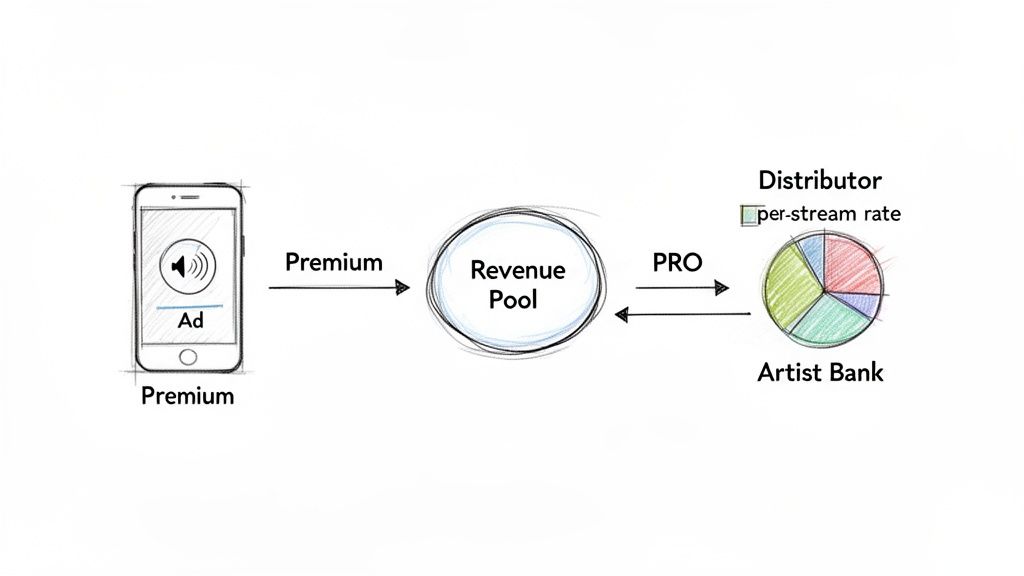
The reality is a "pro-rata" system, which sounds complicated but is pretty straightforward. Spotify takes all the net revenue it generates from Premium subscriptions and ads and dumps it into one giant pot for the month.
From that pot, the money is divided among rights holders—that’s you, your label, your publisher—based on their share of the total streams for that period. So, your earnings aren't just about how many streams you get; it's about what percentage of the total stream pie you own. If your tracks account for 1% of all streams in a month, you get 1% of that month's royalty pool.
The Two Types of Royalties
Every single stream actually generates two different kinds of royalties. You need to know both to see the whole picture.
Recording Royalties (Master Rights): This is the money paid for the use of the actual sound recording—the finished track. It goes to the master rights holder, which is you if you're independent, or your record label. Your distributor (think DistroKid or TuneCore) collects this for you.
Publishing Royalties (Composition Rights): This payment is for the underlying song itself—the melody and lyrics. This gets a bit more complex, as it’s split into performance and mechanical royalties, which are collected by organizations like ASCAP, BMI, and The Mechanical Licensing Collective (The MLC).
This flow is a lot easier to understand with a visual.
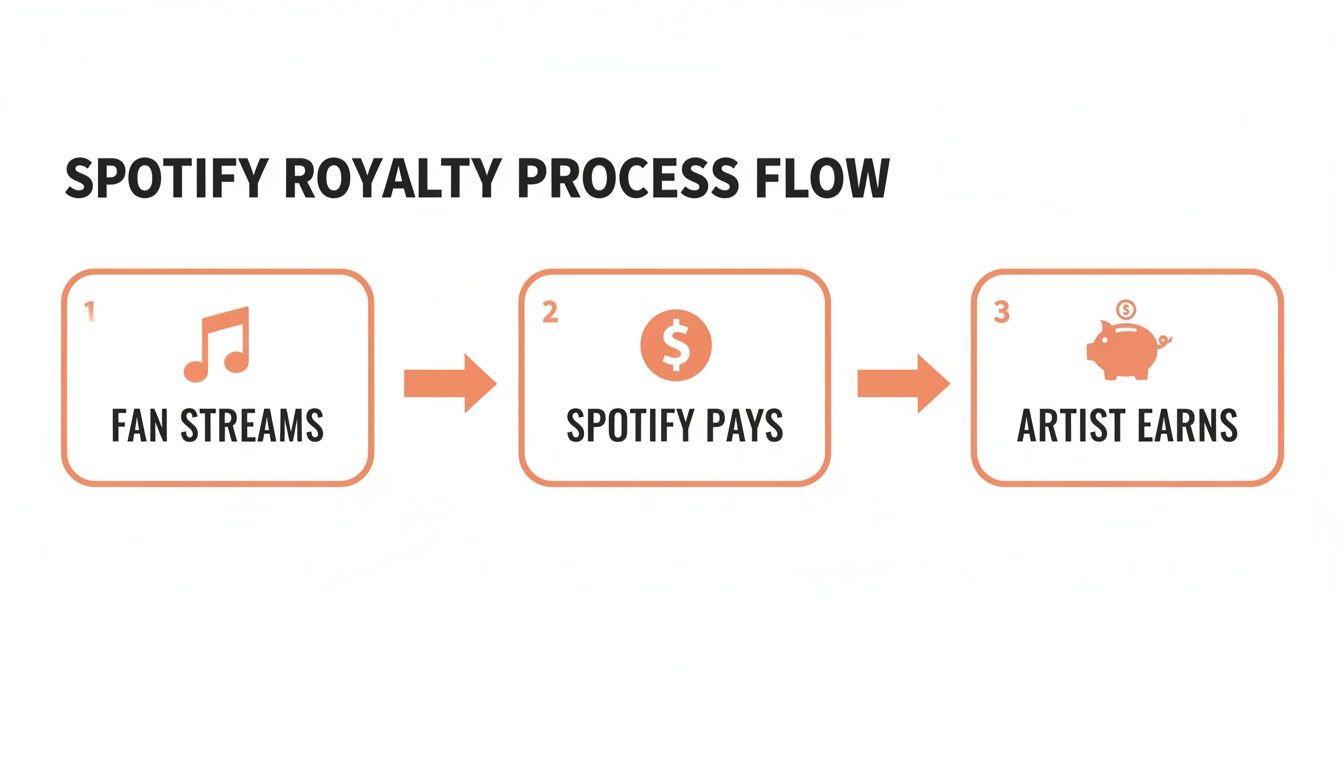
As you can see, your payout is the final step in a chain that involves listeners, Spotify, and a few different rights holders all taking their piece.
Why Your Per-Stream Rate Fluctuates
So, why isn't there a single, reliable "per-stream rate"? Because the two key numbers in the equation—the total revenue pool and the total number of streams—change every single month. This means your effective rate is always in flux.
What you earn from a single stream is influenced by a handful of really important variables. Here's a breakdown of what determines your final payout.
Factor | Impact on Earnings | Why It Matters |
|---|---|---|
Listener's Subscription | High (Premium) vs. Low (Free) | Premium subscribers contribute much more to the revenue pool, making their streams significantly more valuable than ad-supported ones. |
Listener's Location | Varies by country | A stream from a listener in the U.S. or Switzerland, where subscriptions cost more, pays out more than a stream from a country with lower prices. |
Your Distribution Deal | Your final percentage cut | The terms you have with your distributor or label dictate what percentage of the royalties you actually get to keep after they take their fee. |
Understanding these factors is key. It shows you that not all streams are created equal, and your strategy should reflect that.
The big takeaway? Stop chasing a mythical per-stream number. Instead, focus on maximizing your share of high-value streams. Target audiences in high-payout countries and get listeners to save your music, because that drives repeat plays from dedicated (and often Premium) subscribers.
The good news is that the overall pot is growing. With Spotify's user base booming, the platform paid out over $9 billion in 2023. This growth is driven by more people signing up for Premium, which means more high-value streams are flowing into the royalty pool for artists like you.
It can be tough to visualize what all this means for your bottom line. That's where a good calculator comes in handy, turning abstract numbers into a tangible forecast.
To get a clearer picture of what your streams could be worth, it's worth playing around with a Spotify royalties calculator. It helps you set realistic financial goals based on your current stats and future growth.
Building Your Foundation for Spotify Success
Knowing how royalties work is one thing, but actually setting your music up for success from day one is a whole different ball game. Before a single dollar hits your account, you need a professional presence and a solid strategy. That journey starts with picking the right partner to get your music online in the first place.
You can't just upload your music directly to Spotify. You need a digital music distributor. These companies are the essential bridge between your finished track and all the major streaming platforms. They handle the delivery and, just as importantly, make sure you get paid for every stream.
Think of distributors like DistroKid, TuneCore, or CD Baby as your digital logistics team. Each one has a different way of doing things—some charge a flat annual fee for unlimited uploads, others take a cut of your royalties. It’s worth spending time comparing them to see which model fits your career goals best.
Preparing Your Music for a Professional Release
Once you've chosen a distributor, it's time to get your assets in order. This goes way beyond just having an MP3 file ready. You're packaging your song professionally to meet Spotify's standards and, more importantly, to catch a listener's ear. Cutting corners here can make even the best song feel amateur.
Before you even think about hitting 'upload,' make sure you have these three things locked down:
High-Quality Audio: Always, always upload your music in a lossless format like WAV or FLAC. This preserves the sound quality your producer worked so hard on and gives listeners the best possible experience.
Compelling Artwork: Your cover art is your song's first impression. Make it count. It needs to be at least 3000x3000 pixels, look sharp, and visually capture the vibe of your music.
Accurate Metadata: This is all the backend info—artist name, song title, writers, producers. Getting this right is critical for getting paid correctly and ensuring everyone involved gets the credit they deserve.
Nailing these details from the start saves you from massive headaches down the road and presents your work in the best possible light. For any serious artist, this is non-negotiable.
Claiming Your Identity on Spotify
The moment your first track is live on Spotify, the real work begins. Your first move? Claim your Spotify for Artists profile immediately. This is your command center on the platform, giving you control over your brand and access to a goldmine of data.
Claiming your profile unlocks a bunch of tools that are fundamental to growing your audience. You can write your own bio, upload new press photos, and—most crucially—pitch your unreleased music directly to Spotify's editorial team for playlist consideration.
Don't sleep on this. Claim your Spotify for Artists profile the very same day your music goes live. An unclaimed profile signals that you're not actively managing your career on the platform, which is a huge missed opportunity.
Inside Spotify for Artists, you'll find analytics showing you who’s listening, where they are in the world, and how they found you. This data is everything. It helps you make smarter decisions about your marketing, touring, and overall strategy to grow your fanbase and your income.
Pitching Your Music to Editorial Playlists
One of the most powerful features you get with a Spotify for Artists account is the direct line to Spotify's own playlist editors. Landing a spot on an official editorial playlist can be a game-changer, putting your music in front of millions of new listeners literally overnight.
The process itself is simple, but your pitch needs to be thoughtful.
Upload Early: Get your track delivered to Spotify via your distributor at least one to two weeks before your release date. This gives the editorial team enough time to actually listen.
Find the Pitch Form: Inside your Spotify for Artists dashboard, you'll see your upcoming releases. From there, you can select the track you want to pitch.
Craft a Compelling Pitch: This is your shot to tell the story behind the song. Be specific. What's the genre? What's the mood? What instruments are key? Do you have a music video or social media campaign planned? Make it easy for an editor to see exactly where your track fits.
A well-written, passionate pitch can be the difference between getting lost in the thousands of daily submissions and landing on a major playlist like New Music Friday. This is one of the most direct actions you can take to boost your streams and, in turn, earn more from your music on Spotify.
Mastering Playlist Pitching and Avoiding Streaming Scams
Getting your music onto the right playlists is a massive lever for boosting streams and finding new fans. But let's be real—this world is packed with both incredible opportunities and some seriously shady pitfalls. Learning how to pitch legit curators while dodging streaming scams is absolutely critical to growing your audience and protecting your career.
The whole point is to find real, engaged listeners, not just inflated, empty numbers. A solid placement on a good independent playlist can give your track the initial momentum it needs. This signals to Spotify's algorithm that people are digging your music, which can snowball into algorithmic playlist spots like Discover Weekly. That's where the magic really happens.
Finding and Vetting Independent Playlists
First things first: you need to find playlists that actually fit your sound. Pitching your acoustic folk song to a high-octane EDM playlist is a complete waste of your time and the curator's. The goal is to find people who are actively hunting for music just like yours.
This is where dedicated tools become your best friend.
Using a platform with a powerful Playlist Search feature lets you cut through the noise, filtering millions of playlists by genre, mood, and keywords. More importantly, it helps you track down the curator's contact info, which is often the biggest roadblock for artists going it alone.
Once you’ve got a list of potential playlists, the real work begins: the vetting process. This is, without a doubt, the most important step to avoid getting scammed. A fraudulent playlist juiced with bots won't just fail to help you; it can get your music flagged and even removed from Spotify.
Before you even think about sending a pitch, you need to analyze a playlist’s health and history. This is exactly what a Playlist Analyzer tool is for. It gives you a crucial look behind the curtain at a playlist's real integrity.
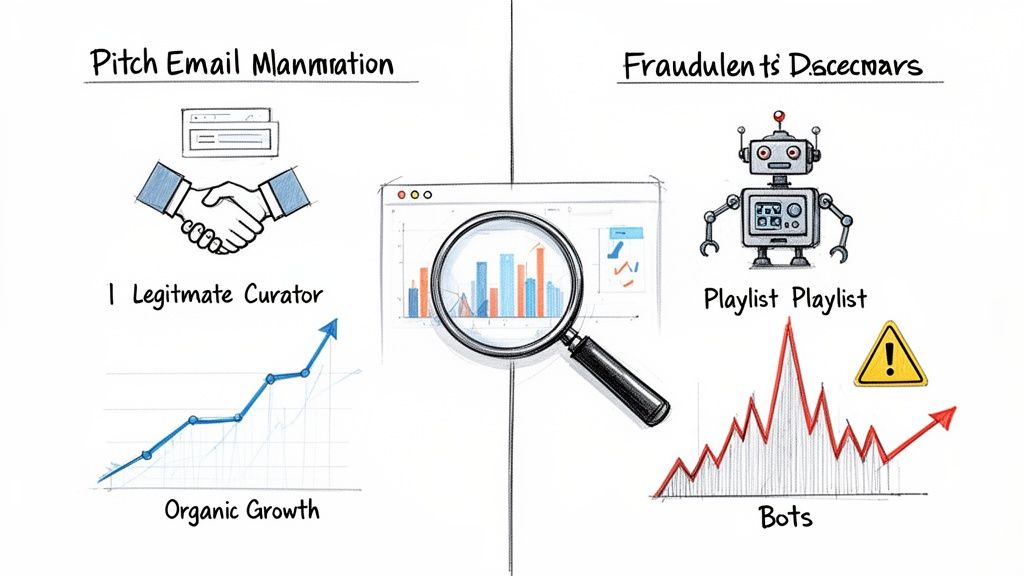
For instance, here’s a look at what a Playlist Analyzer report can show you about a playlist's follower growth.
This simple graph tells a huge story. Is the follower growth smooth and organic? Or are there sudden, massive spikes that look completely unnatural? That's a classic sign of bot activity. Using this data, you can confidently ditch the fakes and focus your energy on authentic opportunities that connect you with actual human beings.
Spotting the Red Flags of Streaming Scams
Fake playlists are often designed to look legit on the surface, but there are always tell-tale signs if you know what to look for. Spotting them will save you money, time, and the health of your Spotify account.
Before you submit your music, use this checklist to scan for any red flags.
Red Flags of a Fake Spotify Playlist
Use this checklist to identify potentially fraudulent playlists before you submit your music.
Red Flag | What It Looks Like | Why It's a Problem |
|---|---|---|
Pay-for-Placement Guarantees | An email or DM asking for money in exchange for a "guaranteed" spot on a playlist. | Legitimate curators vet music based on quality and fit, not payment. This is almost always a scam. |
Suspicious Follower Growth | Huge, overnight jumps in followers (e.g., from 1k to 50k in a week). | Organic playlists grow steadily over time. Sudden spikes are a classic sign of purchased, botted followers. |
Vague or Generic Curator Profiles | The curator uses a generic name, a stock photo, and has no other social media presence. | Real curators are passionate music fans with an identity. Scammers hide behind anonymous, fake profiles. |
Poor Engagement Ratios | A playlist with 100,000 followers, but the songs on it only have a few thousand streams each. | The math doesn't add up. It means the "followers" aren't actually listening, indicating bots. |
Remember, a fake placement doesn't just do nothing for you—it actively hurts you by associating your music with fraudulent activity, which can lead to penalties from Spotify.
The golden rule of playlisting is this: If it seems too good to be true, it almost always is. Real growth is a marathon, not a sprint. Protect your music by being diligent and skeptical.
Crafting the Perfect Playlist Pitch
Okay, so you've found a handful of legitimate, well-vetted playlists that are a perfect home for your new track. Now it's time to write your pitch. Curators get buried in submissions, so your email has to be professional, personal, and straight to the point. A generic, copy-pasted message is a one-way ticket to the trash folder.
Your pitch needs to be a short, compelling intro to you and your song. Make it obvious you’ve actually listened to their playlist and show them why your track belongs there. For a much deeper dive, check out our modern guide to Spotify playlist pitching.
A winning pitch always includes these three things:
A Personal Connection: Name-drop a specific song on their playlist that you genuinely like. It proves you did your homework.
A Clear Description: Briefly describe your track—think genre, mood, maybe a key instrument. Give them context.
A Simple Call to Action: Provide one direct link to your song on Spotify. Don't make them hunt for it.
For independent artists, getting on the right playlists is a true game-changer. Quality tools can help uncover genre-specific lists with curator emails, all while filtering for integrity by analyzing follower history to dodge bots that risk takedowns. The numbers back this up—artists hitting 20-25 million monthly streams can approach $1 million per year, while even a solid 10,000 monthly listeners can yield around $16,500 annually. By focusing on authentic placements, you build a foundation for sustainable career growth.
Monetizing Your Music Beyond the Stream
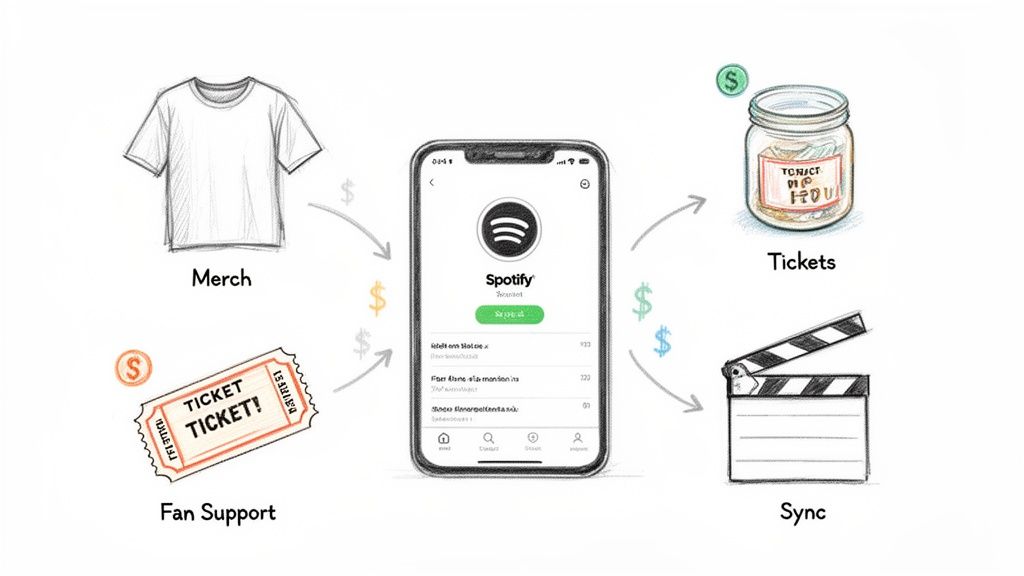
Let's be real: trying to make a living from streaming royalties alone is a tough, uphill battle. While getting more streams is always the goal, your Spotify profile can be so much more than a music player. Think of it as your digital storefront—a powerful hub for turning casual listeners into dedicated fans who support you directly.
To build a sustainable career, you have to move past the cents-per-stream mindset. It's all about building a direct financial connection with the people who truly love your music. The good news is, Spotify has already built the tools you need to make this happen, letting you transform your artist page into a dynamic hub for merch and fan support.
Integrating Merchandise with Shopify
One of the best ways to generate real income is by selling merch directly on your Spotify profile. Imagine a fan is blasting your new single, and right there on the screen, they see a cool t-shirt or an exclusive vinyl. That seamless experience is a powerful way to make a sale.
Spotify's integration with Shopify makes this incredibly easy. If you have a Shopify store, you can connect it to your Spotify for Artists account in just a few clicks. This lets you list up to 250 merch items right on your profile, with your best stuff featured on your main artist page.
Here’s why this is so effective:
Capture the Moment: A fan listening to your track can buy a hoodie without ever leaving the app. You're catching them at their peak excitement.
Keep More Profit: Unlike streaming royalties, which get sliced and diced, you keep the vast majority of the profit from every t-shirt or record you sell.
Build a Real Connection: A digital stream is fleeting, but physical items like vinyl, apparel, or signed posters create a tangible bond between you and your fans.
For any independent artist, this is a total game-changer. You don't need a huge tour or a record label to get started. All you need is killer music and a few well-designed products your audience will love.
Leveraging Direct Fan Support
Sometimes, your biggest supporters just want a way to say "thanks" and show their appreciation directly. Spotify's Fan Support feature (what used to be called the Artist Fundraising Pick) is a simple and effective virtual tip jar.
You can link a payment provider like PayPal.me, GoFundMe, or Cash App straight to your artist profile. A "Fan support" link will appear at the top of your page, making it dead simple for listeners to send you some cash.
Think about it like this: if just 1% of your 10,000 monthly listeners tipped you $5, that’s an extra $500 in your pocket. That's direct, fan-to-artist funding with no middlemen taking a significant cut.
This isn't about begging for money. It's about giving your community a chance to be part of your journey. You can use it to fund a new album, shoot a music video, or just help pay the bills. It's a low-effort, high-reward feature that every artist should have active on their profile.
Driving Revenue with Live Shows and Sync Licensing
Beyond direct sales and tips, your Spotify presence is a launchpad for other major revenue streams. The platform can help you sell concert tickets and even make your music a more attractive option for sync licensing deals.
By integrating with partners like Ticketmaster and Eventbrite, you can list your tour dates directly on your profile. When a fan sees you're playing in their city, they're just one click away from buying a ticket. This works especially well when you use Spotify's data to see where your listener hotspots are and plan your tour accordingly.
On top of that, a professional Spotify profile with solid engagement sends a strong signal to music supervisors. When they're looking for the perfect track for a film, TV show, or ad, seeing healthy stream counts and an active fanbase makes your music a much safer and more appealing bet. This can open the door to lucrative sync placements you might have otherwise missed.
Using Data to Intelligently Scale Your Earnings
If you really want to earn money with Spotify, it’s time to stop guessing. You have to start making data-driven decisions.
Your Spotify for Artists dashboard isn't just a place to check your stream count; it's a treasure map. It shows you exactly where your audience is, what they're listening to, and how they found you. This data is the secret to turning random streams into a predictable, scalable income.
Flying blind by ignoring your analytics is like trying to find your way through a new city without a map. Yeah, you might stumble upon something cool, but you're far more likely to just get lost. By consistently digging into your data, you can double down on what’s working and scale your efforts for the biggest impact.
Turning Data Into Actionable Insights
Let's walk through a real-world scenario. You drop a new single. A week later, you check your dashboard and see a huge spike in listeners from a specific city—let’s say Berlin. This isn't just a fun fact. It's a powerful piece of market intelligence telling you exactly where your music is hitting home.
With just that one data point, you can take immediate, targeted action:
Run Targeted Ads: Launch a low-budget social media ad campaign aimed squarely at listeners in Berlin, pushing your new track or artist profile.
Pitch to Local Curators: Hunt down some Berlin-based independent playlists. Send them a personalized pitch mentioning that you're already gaining traction in their city.
Plan Your Next Tour: If Berlin keeps popping up in your top cities, you now have a data-backed reason to make it a stop on your next tour, knowing you’ve got an audience waiting.
This is how you shift from being a passive artist hoping for streams to an active strategist making calculated moves. When you pay attention, you’re not just reacting to your audience—you’re engaging with them in a way that directly grows your bottom line.
Forecasting Your Earnings and Setting Goals
Beyond geographic goldmines, your data is essential for financial planning. It’s tough to build a career when you have no clue what your next royalty check will look like. This is where tracking and forecasting tools become absolutely indispensable.
Sure, the superstar earnings are mind-boggling. Taylor Swift’s estimated earnings of over $400 million from Spotify streams alone by mid-2025 is a wild example of what a massive, loyal fanbase can generate. Her 82.29 million monthly listeners and 103.08 billion total streams create an insane revenue stream.
While you might not be there (yet), the principles are identical. A royalty calculator lets you plug in your stream counts to get a rough idea of potential earnings. This helps you move from wishful thinking to concrete, actionable goals.
Instead of just saying, "I want to earn more," you can set a specific, measurable target like, "I need to hit 250,000 streams on my next single to fund my new music video." That clarity is what separates hobbyists from professionals.
By diving into your numbers regularly, you can build a smarter, more effective strategy. Check out our deep dive on Spotify artist analytics to boost your music career to learn how to interpret this data like a pro.
This is how you build a sustainable career—not by chasing a viral moment, but by understanding and growing your dedicated audience one stream at a time.
Common Questions About Earning Money on Spotify
Let’s be real: navigating music monetization can feel like you're trying to read a map in the dark. There's a ton of noise online, and it’s tough to separate practical, road-tested advice from wishful thinking.
So, let's cut through the confusion. We're going to tackle the biggest questions artists have about actually making money with their music on Spotify. This isn’t about get-rich-quick schemes; it's about building a real, sustainable strategy from the ground up.
How Many Streams Do I Really Need to Make a Living?
This is the big one, right? The honest, no-fluff answer is: it’s complicated.
There's no magic number. As we've covered, not all streams are created equal. Your per-stream payout swings wildly depending on where your listeners are, if they’re on a Premium plan, and the deal you have with your distributor.
But we can look at some real-world numbers to get our bearings. Some indie artists report earning around $800 per month from roughly 177,000 monthly streams. That’s income coming almost entirely from Spotify, without a big label, touring, or even merch sales factoring in.
The key is to stop chasing a single "living wage" stream count and start building a more holistic strategy. Your goal should be consistent monthly growth in high-value territories and nurturing a loyal listener base that actually saves and replays your tracks.
Instead of getting hung up on hitting a million streams overnight, set smaller, more tangible targets. Maybe your first goal is for streaming to cover your production costs. Then your marketing budget. Those are real, motivating milestones you can actually work towards.
Do I Need a Record Label to Succeed on Spotify?
Absolutely not. In fact, for a lot of artists today, staying independent is the smarter—and more profitable—path.
Sure, major label artists might get a head start with some initial playlist placements. But here’s the catch: they often see only 13% to 20% of their streaming royalties. That’s a massive slice of your hard-earned income going straight into someone else's pocket.
As an independent artist, you keep a much, much bigger piece of the pie. The trade-off? You’re the CEO, the marketing department, and the strategist all in one. But with the right tools and a solid game plan, you have more control over your career and your finances than ever before.
Being independent means you can:
Keep a higher percentage of your royalties. This means you need way fewer streams to earn the same amount as a signed artist.
Maintain total creative control over your music, your brand, and your vision.
Build a direct line to your fans without a label acting as a gatekeeper.
The game has changed. Success on Spotify is now way more about your hustle and strategy than your industry connections.
What’s the Most Effective Way to Promote My Music on a Budget?
You don’t need a massive marketing budget to make a real impact. The most powerful promotion often comes from smart, targeted efforts that barely cost a dime.
Hands down, the single best low-cost strategy is mastering the art of playlist pitching. This means reaching out to both Spotify's official editors and the thousands of independent curators out there.
Getting your track on a big editorial playlist can cause a huge, immediate spike in streams. But the real long-term gold is in the algorithmic playlists like Discover Weekly. These playlists are absolute powerhouses, capable of sending thousands of new listeners your way every single week. Often, a single solid placement on a human-curated list is all it takes to trigger this algorithmic magic.
It's a domino effect. One good placement leads to algorithmic exposure, which grows your monthly listeners, which in turn signals to other curators that your music has heat. It’s a self-sustaining growth cycle that can start with just one well-placed track.
Ready to stop guessing and start making data-driven decisions? artist.tools gives you the insights you need to grow your streams, find legitimate playlists, and build a sustainable career on Spotify. Take control of your music at https://artist.tools.
.png)
Comments