
Explore the longest spotify playlist: record, length, and strategy
The longest Spotify playlist hits the 10,000-song cap and runs about 833 hours. See the record, Spotify's playlist limits and how curators max them out.
TL;DR
The longest Spotify playlist commonly cited is Willis Orr’s “Untitled,” which hits Spotify’s hard cap of 10,000 songs and runs roughly 833 hours and 14 minutes (about 34.7 days of continuous listening).
- Spotify caps every playlist, including Liked Songs, at 10,000 tracks.
- To chase “longest,” curators max out track count, then pile on long-form songs to extend total runtime.
- Willis Orr’s “Untitled” playlist is the widely cited record, with 10,000 tracks and ~833h 14m of runtime (source: Headphonesty).
- “Longest” is unofficial — Spotify does not formally recognize a record holder, so treat claims as user-reported.
- Genre-focused giants like Skoosie’s “Rap,” “Slowsie Indie,” and “Country” also push the 10,000-song ceiling.
- Adding thousands of tracks too quickly can trigger Spotify’s bot detection, risking flags, de-indexing, or removal.
- Mega-playlists hurt usability: shuffle, search, and discovery all break down at scale.
- For artists, vet large playlists for real listeners and bot activity before celebrating a placement.
- Quality and intent beat sheer size for engagement, editorial pickup, and algorithmic growth.
When people ask about the longest Spotify playlist, they usually mean one of two things: the sheer number of tracks, or the total listening time. The strongest contenders push both at once, but every playlist on Spotify plays by the same hard rule the platform sets for everyone.
So, what’s the absolute limit? The longest a Spotify playlist can be is 10,000 songs.
The current record-holder is a playlist by Willis Orr, which pushes this limit right to the edge. His playlist, simply titled ‘Untitled’, has a mind-boggling runtime of over 833 hours. That’s more than a month of non-stop music.
A quick note on the “record”: Spotify doesn’t officially crown a longest playlist, so claims like this are user-reported and tracked by third parties (in this case, Headphonesty). The 10,000-song ceiling, however, is a platform limit that applies to every Spotify playlist and to your Liked Songs library.
Defining The Longest Spotify Playlist
Think of it like a marathon. One runner might finish the race the fastest (total duration), while another might have taken the most steps (track count). To truly hold the title of the “longest,” a playlist needs to max out the track count while also packing in as much listening time as possible.
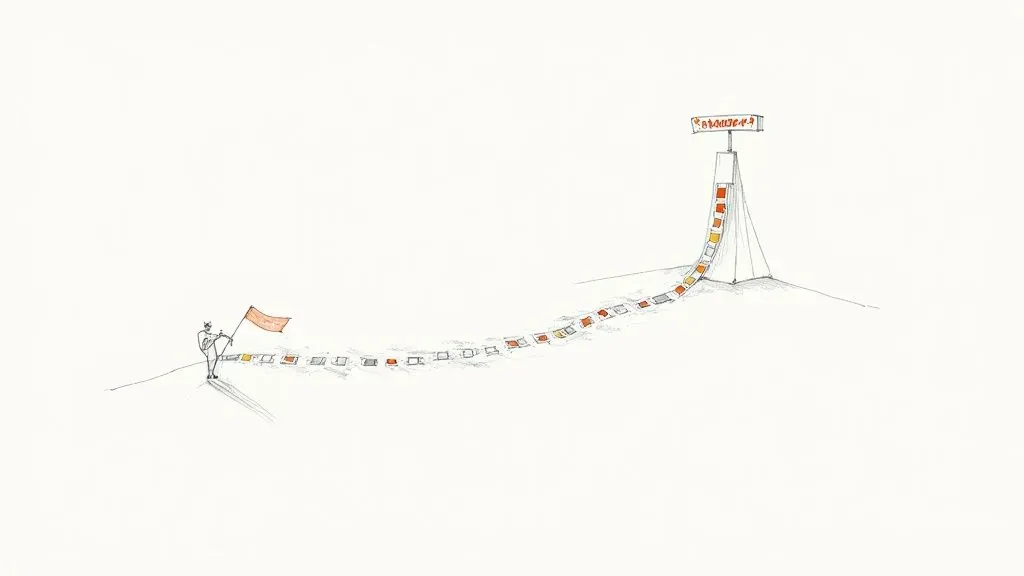
This chase for the longest playlist isn’t just a weird internet hobby. It’s a cool look at how dedicated users bump up against the platform’s technical limits. Curators have to get creative, strategically picking tracks to stretch either the runtime or the song count, all while staying under that 10,000-song cap.
The Reigning Champion of Length
As of now, the crown for the longest Spotify playlist belongs to an unassuming collection named ‘Untitled,’ put together by Willis Orr. This thing is a masterclass in pushing a system to its breaking point. It contains exactly 10,000 songs, hitting the concrete wall Spotify puts up.
The total runtime is just staggering: an incredible 833 hours and 14 minutes. If you hit play and never stopped, it would take you over 34 straight days to hear the whole thing. You can learn more about this beast of a playlist over on Headphonesty.com.
This screenshot shows the playlist right in Spotify, confirming it’s hit that 10,000-song max and showcasing its colossal runtime. It’s less of a playlist and more of a digital endurance project.
The Record-Breaking Spotify Playlist At A Glance
How playlist “length” is measured here: track count is the number of songs in the playlist (capped by Spotify at 10,000), while total runtime is the sum of every track’s duration. A playlist is only a serious “longest” contender when it maxes out tracks and stacks long-form songs to push runtime as high as possible.
To really get a feel for how massive this playlist is, let’s break down the stats. This isn’t just a big list of songs; it’s a monumental archive that shows what’s even possible inside Spotify’s world.
| Metric | Statistic |
|---|---|
| Total Songs | 10,000 Tracks |
| Total Runtime | 833 hours, 14 minutes |
| Equivalent Days | ~34.7 Days |
| Curator | Willis Orr |
These numbers really drive home the insane dedication it takes to not only discover but manually add thousands upon thousands of songs to one list. It’s a project that tests your patience just as much as it tests the platform’s own infrastructure.
Understanding Spotify’s 10,000 Song Limit
Anyone who’s tried to build a truly epic Spotify playlist has eventually slammed into the same wall: the 10,000-song limit. This isn’t just some random number Spotify picked out of a hat. It’s a critical technical guardrail put in place to keep the app running smoothly for hundreds of millions of people. Getting your head around this cap is the first step to understanding the strategy behind those massive, marathon playlists.
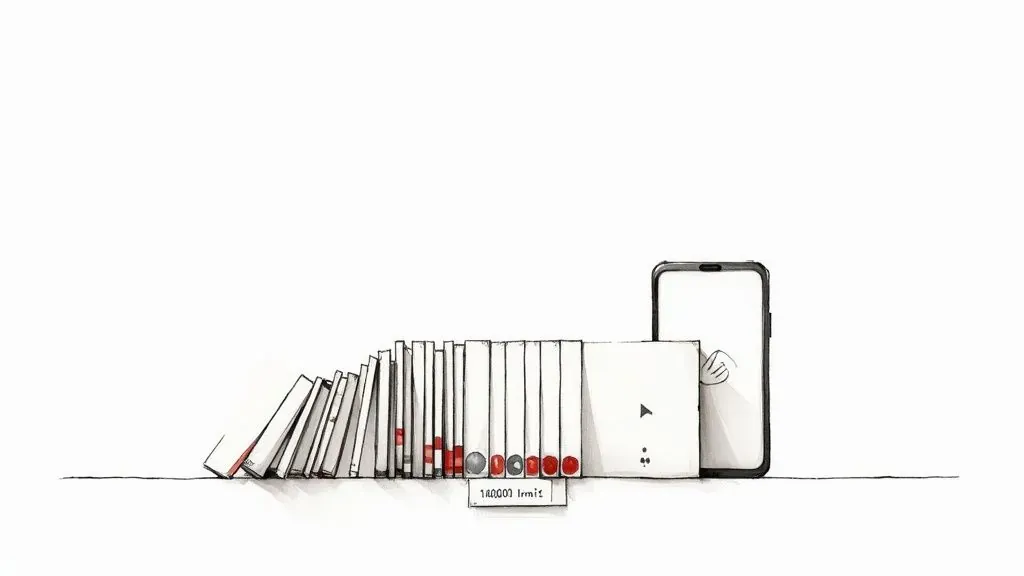
Think of a playlist like a digital bookshelf. It might seem like you can add books forever, but every shelf has a breaking point. If you keep stacking, the structure will eventually start to buckle, making it slow and clumsy to find the book you want. In the same way, a playlist without a cap would bog down the app, leading to slow load times, crashes, and a genuinely frustrating experience for everyone.
This limit is all about striking a balance between giving users freedom and keeping the platform stable. Spotify’s engineers have to make sure that core features—like downloading for offline listening, shuffling, and searching—stay zippy and reliable, even for the most ambitious music collections out there.
Why The Limit Exists
At its core, the 10,000-song cap is all about data management and app stability. Every single track you add to a playlist carries its own metadata: the artist’s name, the song title, album art, and a bunch of other info. Forcing the app to load tens of thousands of songs at once would chew up a huge amount of your device’s memory and processing power.
This limitation is in place to maintain a good user experience across all devices, from high-end PCs to older smartphones. It prevents performance degradation that could result from managing excessively large data sets within the app.
Here’s a quick breakdown of the key technical reasons for the cap:
- App Performance: It makes sure the Spotify app stays responsive and doesn’t lag when you open or scroll through a massive playlist.
- Data Syncing: It allows your playlists to sync quickly and reliably across all your devices, like your phone, laptop, and smart speaker.
- Offline Downloads: This keeps the download process manageable, stopping it from hogging all your storage or failing because it’s trying to handle too many tracks at once.
This is a hard limit, and it’s universal across the entire platform. It doesn’t just apply to the playlists you build yourself; your personal “Liked Songs” library is also capped at 10,000 tracks.
The Strategic Game It Creates
This technical boundary turns playlist creation into a bit of a strategic game. If you want to build the “longest” playlist, you can’t just keep adding songs indefinitely. You have to hit that 10,000-track ceiling and then shift your focus to maximizing the total runtime.
This means a curator might pick a 15-minute progressive rock epic instead of five shorter punk songs just to push the playlist’s total duration higher. The real challenge becomes a careful dance between the number of tracks and the length of each track. It turns playlist curation into an art form shaped by its constraints, and it’s the fundamental rule every single “longest Spotify playlist” contender has to play by.
Meet The Contenders In The Playlist Marathon
Willis Orr’s massive playlist might hold the record for sheer runtime, but he’s not the only one in the race. There’s a whole community of what you might call “playlist maximalists” out there, all pushing the platform’s boundaries in their own unique ways.
For a lot of these curators, it’s not just about cramming as many songs as possible into one list. It’s about building the most complete archive imaginable for a specific sound or genre.
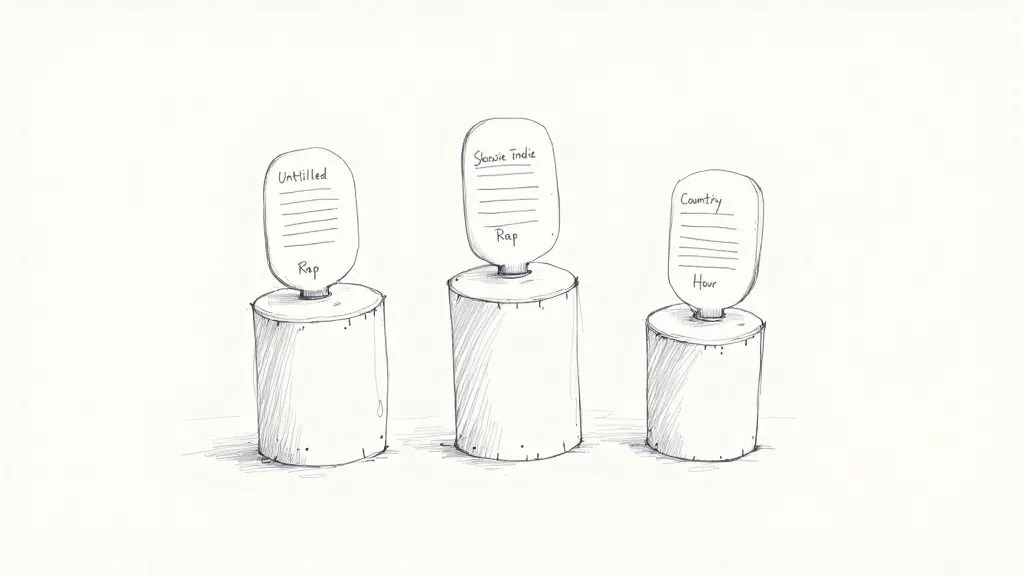
This flips the script entirely. Suddenly, it’s not just a numbers game; it becomes an act of intense, dedicated curation. Instead of just a random jumble of tracks, these playlists are exhaustive libraries, each one a deep dive into a single musical world. It’s a different kind of marathon—one focused on depth and a love for the niche.
Genre-Specific Giants
A perfect example of this is the curator Skoosie, who’s put together several colossal genre-specific playlists that all bump right up against Spotify’s 10,000-song limit. These aren’t just long; they’re incredibly thorough archives that fans of a particular style could get lost in for weeks.
Some of Skoosie’s most well-known creations include:
- “Rap”: An exhaustive collection that feels like a definitive library of the genre, spanning different decades and countless subgenres.
- “Slowsie Indie”: A sprawling list dedicated to the massive world of indie music, capturing everything from quiet acoustic songs to atmospheric rock anthems.
- “Country”: Another beast of a playlist that serves as a complete anthology of country, from the classic hits to today’s chart-toppers.
Playlists like these show a different motivation. The real achievement isn’t just hitting a technical limit; it’s about building a resource that feels bottomless for a true fan. It’s creating the ultimate listening experience within a single genre.
The existence of these diverse, marathon-length playlists shows that ‘longest’ is subjective. For some, the most impressive playlist isn’t just the one with the highest runtime, but the one that offers the most complete journey through a specific musical landscape.
This dedication to genre-specific curation really shines a light on the diversity within the playlisting community. While some are chasing the absolute record, others are on a mission to build the most definitive collections possible. It’s a great reminder that exploring different types of playlists is a fantastic way to find new music, and you can find some of the best playlists on Spotify to discover in 2025 in our own curated guide.
These thematic giants prove that even with a 10,000-song cap, creativity and a clear purpose can lead to something just as impressive.
The Art of Curating a Massive Playlist
Building a playlist that bumps up against Spotify’s 10,000-song limit is less about music and more about a strategic endurance test. Right out of the gate, curators have to make a choice. Do you go for sheer duration, or is it all about the track count?
One strategy is to create an epic of listening time. This means hunting down long-form tracks—think prog-rock odysseys, sprawling jazz solos, or endless ambient pieces—to pump up the total runtime. The other path is pure volume, rapidly adding thousands of short, punchy songs to hit that 10,000 cap as fast as possible.
Usability Trade-offs at 10,000 Songs
No matter which path you choose, giant playlists are a usability disaster. Seriously, try listening to a 10,000-song collection. The shuffle button, even with Spotify’s tweaks to make it feel more random, becomes a black hole. The chances of hearing that one song you actually want to hear are practically zero.
And good luck finding a specific track. Scrolling through a list that long is a test of patience that almost no one will pass. These digital monsters are less like usable playlists and more like monuments to an obsession. They’re impressive to look at, but a nightmare for casual listening. They exist to be an achievement, not a tool for enjoying music.
Risks of Building a Massive Playlist Too Fast
Beyond the awful user experience, curators of the world’s longest Spotify playlists walk into a minefield of technical risks. The biggest danger? Accidentally triggering Spotify’s automated bot detection systems. Slamming thousands of songs into a playlist in a short amount of time just doesn’t look human.
This can have some pretty serious consequences:
- Account Flagging: Your account can get flagged for a manual review, which could lead to temporary restrictions.
- Shadow Banning: The playlist might get de-indexed from search, making it completely invisible to new followers.
- Removal: In the worst-case scenario, Spotify could just delete the playlist for violating their terms of service on automated activity.
The real trick is to build a massive collection without looking like you used a script to do it. Pacing your additions and curating thoughtfully over time is the only way to stay off the radar of systems designed to catch fake engagement.
On top of all that, these mega-playlists are guaranteed to be ignored for official editorial features. Spotify’s editors are looking for tight, thematic, and digestible playlists that offer a great listening experience. A sprawling 10,000-song list is the exact opposite of what they want. It’s a crucial thing to remember if you’re trying to make a name for yourself—we cover what it really takes in our guide on how to become a playlist curator in the streaming age. The real art of curation is often about knowing when less is more, a lesson that’s completely lost when the goal is just to be the longest.
How Artists Can Leverage Large Playlists

For an artist, getting placed on a massive playlist—maybe even one of the longest Spotify playlists out there—can feel like hitting the jackpot. But a slot on a 10,000-song list is a classic double-edged sword. Is it a real discovery tool packed with listeners, or just a digital graveyard where your music goes to die?
Visibility is the name of the game, but you have to look past the shiny follower count and see what’s really going on. A huge playlist with zero actual listeners is worthless. Worse, if it’s full of bots, it could actively damage your artist profile.
Artists and their teams need a game plan. You have to learn how to tell the difference between a golden opportunity and a placement that just offers vanity metrics. That means vetting playlists for real engagement and making sure every placement translates into genuine, career-building streams.
Vetting Playlists for Real Engagement
Think of every potential playlist like a crime scene—you need to look for clues. A high follower count is easy to fake. Signs of real, human listening activity? Not so much. This is where you need to bring in the right tools for the job.
The flowchart below gives you an idea of what goes into building a quality playlist. It’s also a great lens for artists to evaluate whether a curator knows what they’re doing.
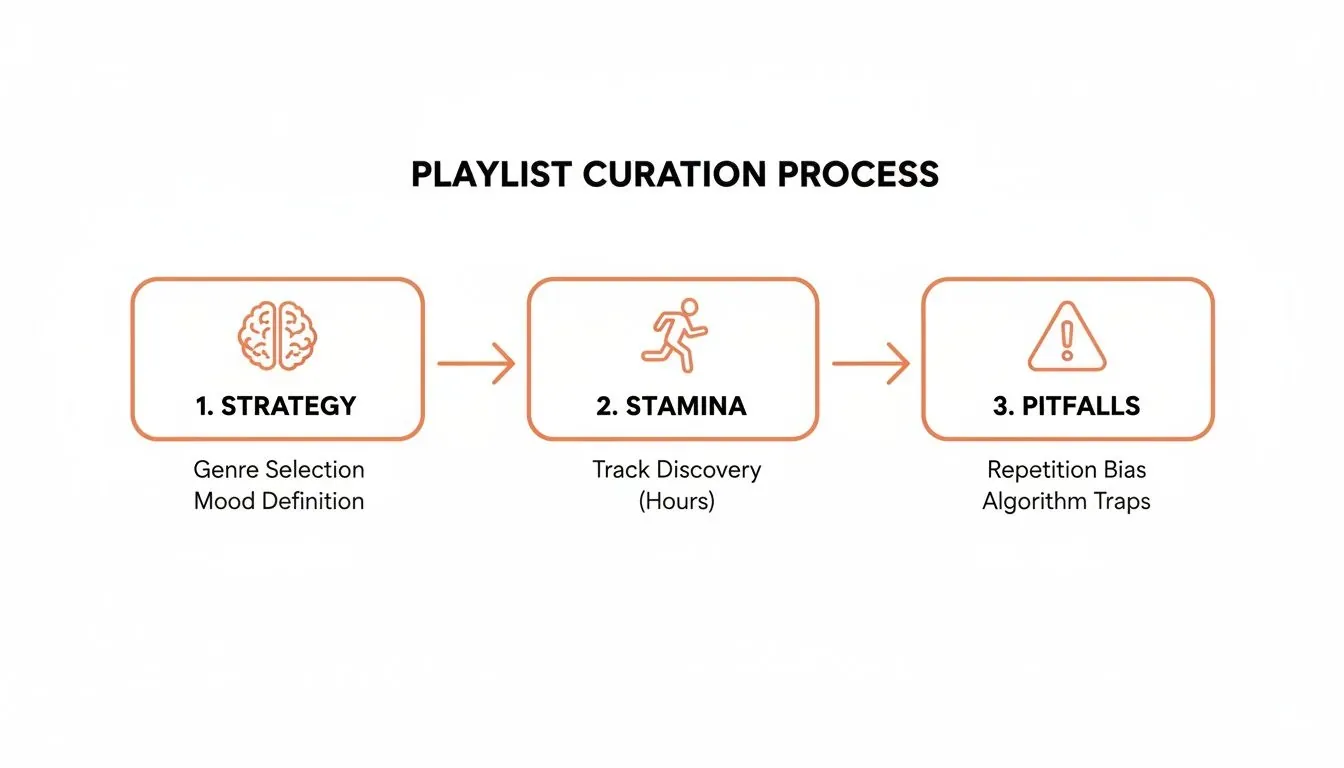
As you can see, a good playlist takes real strategy and work. A curator who puts in that effort is far more likely to have a real, engaged audience.
A placement on a 10,000-song playlist only matters if real humans are listening. Without genuine streams, your track is just another number in a sea of data, contributing nothing to your monthly listeners or algorithmic growth.
This is exactly why a Playlist Analyzer is non-negotiable. By digging into a playlist’s history, you can get a clear picture of its health. Here’s what you should be looking for:
- Follower Growth: Is it growing slowly and steadily, or did it suddenly jump by thousands overnight? Those sudden spikes are a massive red flag for purchased followers.
- Listener Estimates: Forget follower counts. Good tools can estimate the number of active listeners, which tells you way more about a playlist’s actual reach.
- Track History: How often are songs added or removed? A playlist that hasn’t been touched in months is probably a dead one.
Identifying Quality and Avoiding Bots
Okay, so you’ve found a playlist with real listeners. The next step is making sure it’s quality. Bot activity is a huge problem on Spotify, and getting placed on a botted playlist can get your music flagged or even taken down.
This is where a specialized tool like the artist.tools Playlist Analyzer becomes your best friend. It gives you a detailed dashboard to break down a playlist’s real integrity.
Using a Bot Detection feature is an absolute must. It scans playlists for the tell-tale signs of fake, artificial streams, keeping your music safe from bad associations.
By focusing your energy on verified, high-quality playlists—even if they aren’t the absolute longest playlist on Spotify—you make sure every single placement actually has a chance to move the needle and connect your music with real fans.
Length Isn’t Everything: What Actually Matters
The whole phenomenon of creating the “longest” Spotify playlist is really a wild testament to digital endurance. You could even call it a weird, modern form of art. It’s a fascinating corner of internet culture, this idea of “playlist maximalism,” where curators are deliberately pushing the platform to its breaking point.
As we’ve seen, it all comes down to two simple but firm limits: the 10,000 song track count and the total runtime. The real game is the balancing act between those two numbers. Curators are basically building digital monuments that are as much about the flex of creating them as they are about the actual music. It’s a level of dedication to curation most people would never even think to attempt.
Whether a playlist has ten songs or ten thousand, thoughtful curation is what creates a truly engaging listening experience. Quality and intent will always matter more than sheer size.
When you boil it down, these extreme playlists teach a valuable lesson for everyone in the music game. They’re a powerful reminder that even the biggest, most impressive-looking playlists are useless if there’s no real human engagement behind them.
For artists, this drives home just how critical it is to vet every single playlist opportunity. You have to understand the risks of botted Spotify playlists and make sure every placement is actually going to help your career, not hurt it. After all, real curation is about making a connection, not just collecting a bunch of tracks.
FAQ: Spotify Playlist Length and Song Limits
After diving deep into the world of extreme music curation, a few questions always seem to surface. Let’s clear up some of the common points of confusion around building the biggest Spotify playlist possible.
What Happens When You Hit the 10,000 Song Limit?
So you’ve painstakingly added song after song and finally hit the magic number. What happens when you try to add track 10,001?
Nothing dramatic, actually. Spotify will simply stop you. There’s no big warning pop-up; the app just won’t let you add the song. If you want to add something new, you’ll have to make room by deleting something old first.
This 10,000-track hard cap isn’t just for playlists you build yourself—it also applies to your personal “Liked Songs” library. It’s a firm boundary that Spotify keeps in place to make sure the app runs smoothly for everyone.
Is It Better to Have More Tracks or a Longer Runtime?
This really comes down to what you’re trying to accomplish. If your goal is to hold the unofficial title of the longest Spotify playlist, you have to play by the rules. First, you hit the 10,000-song limit. After that, the game becomes about maximizing the total runtime by strategically picking longer tracks.
But for almost every other practical purpose—like getting your music discovered or keeping listeners engaged—a shorter, well-curated playlist is infinitely better. Nobody enjoys scrolling through a massive, unfocused list. It’s a terrible user experience and makes it nearly impossible for people to actually find and appreciate the music.
The chase for the longest playlist is more of a technical challenge and a niche hobby than a practical way to share music. For artists and most curators, quality beats quantity every time.
Can You Get Banned for Having a 10,000 Song Playlist?
Simply reaching the playlist limit won’t get you banned. The real danger lies in how you build it. If you try to add thousands of songs in an unnaturally short amount of time, you’re going to raise some red flags.
Spotify’s automated systems are always on the lookout for bot-like activity. A sudden, massive playlist expansion looks exactly like a script at work. This could get your playlist hidden from search results or, in some rare cases, lead to restrictions on your account. The key is to build your massive collection over a reasonable period, just like a real human would.
Ready to analyze playlists like a pro and make sure your music lands on high-quality, bot-free lists? artist.tools gives you the data you need to make smarter marketing decisions. Explore our suite of features and start building your career on Spotify. Learn more at artist.tools.