How Do I Get Into the Music Industry A Modern Playbook
- Dec 28, 2025
- 17 min read
If you're wondering how to break into the music industry today, let's get one thing straight: the old rules are out. Gone are the days of waiting around for a lucky break or a scout to discover you in some smoky bar. The modern music career is a business you build yourself, with you as the CEO. And your primary marketplace? Spotify.
This guide is the new playbook. It’s for artists ready to take control.
Your Modern Roadmap for the Music Industry
The path forward is about creating a professional-grade product (your music), mastering the Spotify ecosystem to find your real audience, and then turning that momentum into a career that actually pays the bills. It takes more than just talent now; you have to be a savvy marketer of your own art.
Before we dive deep, let's lay out the framework. I've broken down this entire journey into four core pillars to give you a clear, high-level view of what it takes to succeed today.
The Four Pillars of a Modern Music Career
This table sums up the essential stages for breaking into the music industry with a Spotify-first strategy. Think of it as your cheat sheet for the road ahead.
Pillar | Key Objective | Essential Action |
|---|---|---|
Product Readiness | Create professional, release-ready music and a compelling artist brand. | High-quality recording, mixing, mastering, and cohesive visual branding. |
Spotify Foundation | Optimize your Spotify presence for discovery and fan engagement. | Master Spotify for Artists, nail your profile, and understand platform SEO. |
Audience Growth | Build a genuine, engaged fanbase using data-driven strategies. | Strategic playlist pitching, running targeted ad campaigns, and converting listeners. |
Career Launch | Scale your audience into a sustainable, long-term music business. | Monetize streams, build a professional team, and handle legal/admin tasks. |
Each pillar builds on the last, creating a logical progression from making music to making a living from it.
A Three-Stage Rocket Launch
It’s easy to get overwhelmed, but when you zoom out, it's really a three-stage launch sequence.
Stage 1: The Product. This is your music, and it has to be undeniable. That means professionally crafted, mixed, and mastered, all wrapped up in a cohesive artist brand that tells a story. No cutting corners here.
Stage 2: The Audience. This is your fanbase. You don't just hope they find you; you build your audience strategically on Spotify by targeting the right listeners through smart playlisting and triggering the algorithm.
Stage 3: The Career. This is your business. This is where you scale that audience into a real enterprise through smart monetization, building a team, and long-term planning.
Lots of artists get stuck on the idea that they need a record deal from day one. The truth is, labels aren't looking for raw talent anymore—they're looking for proof of concept. They want to see artists who have already built an audience and are generating streams on their own.
The modern music industry isn't about getting discovered; it's about building a business that's impossible to ignore. Your Spotify data—monthly listeners, stream sources, and audience demographics—is the new currency that attracts managers, agents, and labels.
This Spotify-first strategy is your biggest advantage. It's not just a place to host your music; it's a powerful engine for audience development and a goldmine of data.
The chart below shows you exactly how this works.

It’s simple: a great product is the foundation you need to build an audience. That audience, in turn, is what launches your career. Each step fuels the next. The rest of this guide will break down every single phase with the specific tactics, tools, and workflows you need to get it done.
Before you even think about hitting that big Spotify playlist, we need to have a real talk about the essentials. The stuff that's absolutely non-negotiable. Breaking into the music industry today means your music, your brand, and your business have to be locked in from day one. This isn't just a friendly suggestion; it's the foundation your entire career will be built on.
Forget being just a musician for a second. Think of yourself as a complete artistic product. A single song, no matter how good, isn't going to cut it. The real goal is to build a small, tight catalog of high-quality tracks that tell a story about who you are. And yes, that means every single song needs to be professionally recorded, mixed, and mastered. There are no shortcuts here.
Defining Your Artistic Identity
Beyond the music, your brand is how people recognize and connect with you. It’s the visual and narrative wrapper around your sound, the thing that makes you memorable in a sea of new artists flooding Spotify every single day.
Let's nail down the basics:
A Memorable Artist Name: Is it unique? Easy to say? More importantly, is it available everywhere—socials, streaming platforms, the works? If people can't find you easily, they won't find you at all.
Compelling Press Photos: These are your visual handshake. Ditch the blurry selfies and invest in a professional shoot that actually captures your vibe and personality.
A Connecting Bio: Your bio is your story. It needs to sell your sound, your influences, and what makes you different in a way that hooks fans, curators, and industry folks from the first sentence.
Your artist bio is often the very first impression a playlist curator or A&R scout gets. It needs to do more than just list your accomplishments; it has to tell a story so good it makes them need to hear your music.
Crafting a bio that pops is a skill in itself. For a much deeper look, check out our guide on how to write an artist bio that truly connects and leaves a real mark.
When you have this package—a unique name, pro photos, and a killer story—you're not just another name on a release radar. You're a fully-formed artist, ready for the spotlight.
Handling the Business Behind the Music
Making music is the creative part, but building a career is all business. So many artists sabotage their own success by ignoring the administrative stuff. Getting these details sorted isn't glamorous, but it’s what ensures you’re legally protected and—crucially—that you actually get paid for your work.
You need to get this sorted before a single note goes live.
Here’s your essential admin checklist:
Register with a Performing Rights Organization (PRO): Get signed up with a PRO like ASCAP, BMI, or SESAC. They're the ones who collect and pay out your performance royalties when your song gets played on the radio, streamed online, or even used in a coffee shop. This is a must for any serious songwriter.
Secure Your ISRCs and ISWCs: The International Standard Recording Code (ISRC) is a unique fingerprint for a specific recording, while the International Standard Musical Work Code (ISWC) identifies the song itself (the composition). Your distributor usually handles assigning ISRCs, but knowing what they are is key to tracking your music and getting paid correctly.
Choose the Right Digital Distributor: This is your pipeline to Spotify, Apple Music, and everywhere else. Companies like DistroKid, TuneCore, or CD Baby get your music onto the platforms. Do your homework on their fees and features to find the one that fits your budget and goals.
Ticking off these boxes transforms your music from a hobby into a real business asset. You're no longer just a creator; you're a business owner ready to operate in the music industry. With a polished brand and a solid administrative foundation, you’re actually ready to make your mark.
Mastering Your Release Strategy in the Spotify Ecosystem
You’ve got a killer brand and music that's ready for the world. Now comes the make-or-break moment: the release. How you launch your music on Spotify can mean the difference between instant momentum and a debut that nobody hears. Your goal is to make as much noise as possible, right from day one.
The single biggest mistake I see independent artists make is rushing this process. Uploading your track a week before it's set to go live is a surefire way to get ignored by both Spotify's algorithm and its human editors. You have to give the system—and yourself—enough runway.
The Four Week Rule and Your Editorial Pitch
Plan to get your music to your distributor at least four to six weeks before your release date. This isn't just some arbitrary number. It’s the minimum window you need to properly submit your track for editorial playlist consideration through your Spotify for Artists dashboard.
This pitch is your one and only shot to tell Spotify’s editors why your song deserves a spot. It's where you share the story behind the track, your marketing game plan, and the overall vibe. Trust me, a generic, last-minute pitch gets completely lost in the thousands they see every single day.
So, what actually makes a pitch stand out?
The Story: What’s the song about? What inspired it? Editors are people, and they connect with a compelling narrative.
Your Marketing Plan: Are you running ads? Pushing a pre-save campaign? Creating tons of social content? Mention it. This proves you’re serious about your own success.
Key Details: Don't gloss over the metadata. Tag the genre, mood, and instrumentation accurately. This is how editors find exactly what they're looking for.
Let's be real: getting into the music industry today means mastering Spotify playlists. Streaming is the whole game, pulling in $20.4 billion globally and making up 69% of the recorded music market. Landing on the right editorial and algorithmic playlists can explode your monthly listeners overnight.
Crafting a Winning Pitch with AI
Staring at a blank pitch form can be intimidating. How do you say something new when editors have seen it all? This is where a little strategic help from technology can give you a massive edge.

For instance, the AI Editorial Pitch Generator from is designed to structure your pitch based on what has actually worked for other artists. It walks you through the key info—your song's story, your promo efforts, similar artists—and then builds a narrative modeled on hundreds of successful pitches. It’s a smart way to use data to up your chances.
Optimizing Your Spotify for Artists Profile
While you’re waiting to hear back on your pitch, it’s time to polish your digital storefront. Your Spotify for Artists profile is your home base, and way too many artists neglect it. A clean, professional profile makes a huge first impression on fans, curators, and A&R reps.
Make sure your profile is completely updated before release day. It’s a simple signal to Spotify that you’re an active, professional artist.
Here’s your pre-release checklist:
Update Your Bio and Images: Your bio should be current, and your press photos need to be high-resolution and on-brand.
Add Social Links: Connect your Instagram, Twitter, Facebook, TikTok—everywhere you live online. Make it easy for a new listener to become a true follower.
Select an Artist Pick: Use the Artist Pick to feature your new single the second it goes live. You can also use it to highlight tour dates or new merch.
Doing this, along with a solid pre-save campaign, creates that crucial burst of activity on release day. When your core fans save and stream your track right away, it lights up Spotify's algorithm. That's what gets you onto algorithmic playlists like Discover Weekly and Release Radar. For a deeper dive, you should learn more about how to pre-save on Spotify and boost your release. This initial push is what turns a simple release into a launchpad for your career.
Growing Your Audience with Data-Driven Playlist Pitching
Landing a spot on an official Spotify editorial playlist is a massive win, no doubt. But let's be real—it's like catching lightning in a bottle. It's an incredible boost, but it’s not a sustainable, long-term growth strategy on its own.
Real, lasting growth comes from consistently getting your music onto the right third-party playlists. This is where you stop hoping for a lucky break and start strategically building your audience, one listener at a time. The world of independent playlists is a wild west, though—full of amazing opportunities but also some serious dangers. The key to navigating it successfully? Data.
Finding Playlists That Actually Matter
First things first: you have to find playlists that are a genuine fit for your music. Pitching your indie rock track to a Top 40 pop playlist is a complete waste of your time and the curator's. You've got to be surgical. The goal is to connect with curators who are actively looking for a sound just like yours. This is how you find your niche and, more importantly, your superfans.
A tool like the Playlist Search inside artist.tools lets you cut through the noise, filtering millions of playlists by genre, mood, keywords, and even the number of followers. It's not about finding the biggest playlists; it's about finding the right ones. Trust me, a placement on a small, hyper-engaged niche playlist will bring you more dedicated fans than a spot on a huge, unfocused list.
Even better, these tools can uncover the one thing you can't find just by browsing Spotify: the curator's contact information. Getting a direct line to the people who control the playlists is a game-changer for any artist serious about building a career on their own terms.
The Critical Step: Verifying Playlist Quality
Here's a hard truth about the industry: not all playlists are created equal. The dark side of playlisting is riddled with "payola" scams and botted lists that deliver nothing but fake streams. Getting caught up in that world can be catastrophic. A sudden, fake stream spike can get your music flagged by Spotify, potentially leading to its removal and derailing your career before it even gets going.
You absolutely must verify the legitimacy of any playlist before you even think about pitching to it. This isn't just a suggestion; it's non-negotiable.
So, how do you spot a fake? The data tells the story. Botted playlists have unnatural growth patterns that stick out like a sore thumb if you know what you're looking for.
Fake streams do more than just waste your money. They contaminate your data, confuse the algorithm about who your real audience is, and can put your entire artist account in jeopardy. Vetting playlists isn't just a best practice—it's essential self-preservation.
You can use a Playlist Analyzer to dig into the historical data of any playlist, revealing its follower growth over time. A healthy, legitimate playlist tends to grow steadily, with occasional organic spikes. A botted one? It often shows massive, sudden jumps in followers out of nowhere, with zero real engagement to back it up.
Here’s a simple visual of how a release workflow should look, factoring in the time needed for pitching and for the algorithm to do its thing.
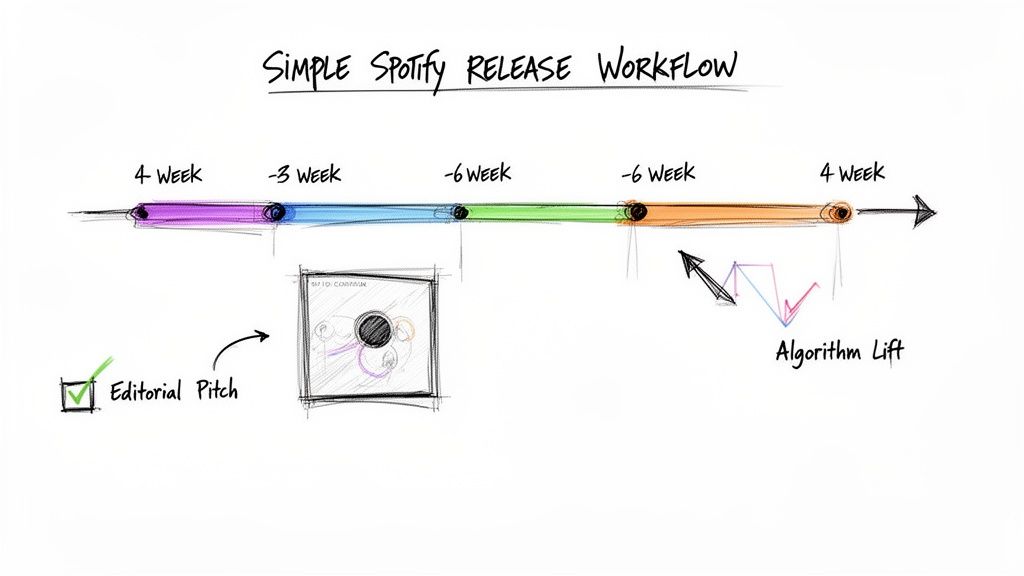
This kind of analysis gives you a clear picture of a playlist's health, helping you dodge the ones with sketchy, non-human growth and focus your energy on curators with real, engaged listeners.
To make it even clearer, here’s a breakdown of what to look for when you're vetting a playlist.
Legit vs. Botted Playlist Red Flags
Use this table as a quick reference when analyzing a playlist's data. Metrics found in tools like artist.tools' Playlist Analyzer can help you quickly distinguish between a valuable opportunity and a dangerous scam.
Metric | Legitimate Playlist Indicator | Potential Bot Activity Indicator |
|---|---|---|
Follower Growth | Steady, organic growth over time with occasional natural spikes. | Sudden, massive, vertical jumps in followers overnight. |
Listener-to-Follower Ratio | A healthy ratio of monthly listeners to total followers. | Extremely low listeners compared to a massive follower count. |
Audience Skew | A mix of premium and free listeners. | An unusually high percentage of free listeners (90%+). |
"Save Rate" | A reasonable number of saves relative to streams. | Almost no saves, indicating passive, non-engaged listening. |
Artist Profile Impact | Placement leads to new followers and saves on your artist profile. | A huge spike in streams but zero growth in followers or other playlists. |
Track Diversity | A mix of well-known and emerging artists. | Filled with unknown artists or artists with suspicious stream counts. |
Remember, a healthy playlist ecosystem is built on real engagement from real fans. By learning to spot the red flags, you protect your music and your career.
Crafting Personalized Outreach That Works
Once you've vetted a list of high-potential, legitimate playlists, it's time for outreach. Firing off a generic, copy-paste email is the fastest way to land in the trash folder. Curators are passionate music fans who are buried under hundreds of pitches a day. Your job is to stand out by proving you've done your homework.
A successful pitch is always a personal one.
Use their name. Seriously, never start with "Dear Curator." Find their name and use it.
Mention their playlist. Tell them which playlist you're pitching to and why you love it. Mention a specific song or two you genuinely enjoy.
Explain the fit. Keep it short and sweet. Briefly describe your track's vibe and connect it directly to the sound of their playlist.
Make it easy. Always include a direct Spotify link to your song. Don't make them hunt for it.
This is all about building relationships. A thoughtful, personalized email shows that you respect the curator's work and starts a real conversation. Even if they don't add your song this time, a good interaction can open the door for your next release. For a deeper dive into outreach strategy, check out this complete guide to Spotify curator playlist pitching.
This whole process—discovery, verification, and personalized outreach—creates a repeatable system for growing your audience. It's methodical, it's driven by data, and it puts you squarely in control of building a real, engaged fanbase, one playlist at a time.
Analyzing Performance and Monetizing Your Momentum
So, your music is finally getting some traction. The streams are climbing. This is where the real work begins. The question shifts from "how do I get listeners?" to "who are these listeners and how do I find more of them?"
Momentum is great, but without understanding what’s driving it, it’s just a fleeting moment. The game now is about digging into your data to make smarter career moves—the kind that turn a temporary stream spike into a sustainable income.
This is the point where you stop being just an artist and start becoming the CEO of your own music business. It's not enough to just see the numbers go up. You need to know why they went up. Was it that one playlist placement? A random shoutout on social media? A specific ad you ran? Answering these questions is how you build a repeatable formula for success.
Turning Data Into Decisions
First thing's first: you need to get granular with your metrics. Checking your stats daily is the only way to connect cause and effect. Using a Stream Tracker lets you see your performance in near real-time, making it dead simple to link a sudden jump in plays to a specific promo you launched that same day.
This isn't about vanity. It's about actionable intelligence. You see a huge spike right after a TikTok video starts gaining views? That tells you exactly which sound clips are hitting the mark and where you should be doubling down on content. This data-first approach takes the guesswork out of your marketing.
Context is also everything. Your growth isn't happening in a vacuum. A Monthly Listeners Tracker helps you benchmark your progress against similar artists in your genre. Seeing how your growth curve stacks up against other rising acts shows you if you're on the right path or if your strategy needs a major pivot. It gives you a realistic view of where you stand.
Forecasting Your Financial Future
As your streams grow, so should your business sense. Making it in the music industry starts with getting a real handle on royalties. In the U.S. alone, paid subscriptions hit 105 million accounts, driving $3.2 billion in revenue. But you only earn fractions of a cent per stream.
A Spotify Royalties Calculator from artist.tools is your new best friend. It lets you forecast potential earnings—for example, you can estimate around $4,000 from one million streams after splits. This is critical for setting realistic financial goals. For a deeper dive into the numbers, you can find out more about music industry revenue reports.
Understanding what you could actually earn is a massive step toward building a real career. It turns streaming from an abstract numbers game into a tangible business model. Suddenly, you can budget for marketing, new gear, or even your next tour.
A royalties calculator lets you run different scenarios. What happens if you land a playlist that drives an extra 500,000 streams? What's the financial target for your next release? This kind of foresight is what separates serious artists from hobbyists.
The image below gives you a clear idea of how a Spotify Royalties Calculator breaks down potential earnings.
This visual makes it easy to see how different stream counts translate into actual revenue, helping you set concrete targets for your next campaign.
Diversifying Your Income Streams
Streaming royalties are a foundational piece of the puzzle, but they can't be your only source of income. Real stability comes from diversification. Your Spotify data is a goldmine for creating new revenue opportunities that live outside the platform.
Here are a few ways to start monetizing your momentum:
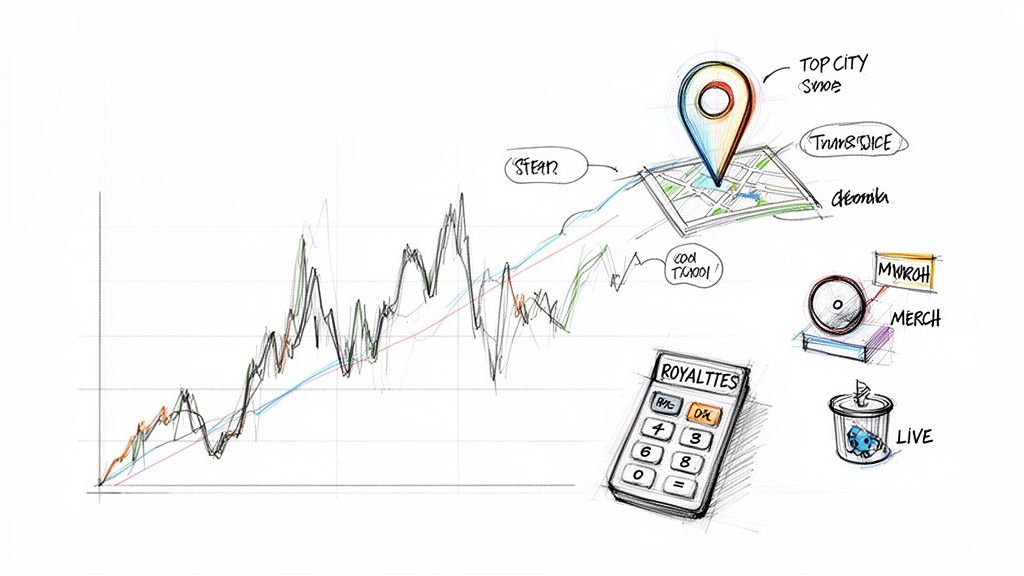
Plan Profitable Live Shows: Your Spotify for Artists dashboard shows you the top cities and countries where your listeners are. This isn't just cool trivia; it's a literal road map for booking a tour that actually makes money. Go play where you know you already have an audience waiting.
Launch Targeted Merchandise: Knowing your audience demographics (age, gender) helps you design and sell merch that people will actually buy. If your listeners are clustered in a specific region, you can even create location-specific items to build a stronger connection.
Pursue Sync Licensing: As your music gets more visible, it becomes way more attractive for sync opportunities in films, TV shows, commercials, and video games. A single sync placement can often bring in more cash than millions of streams. Having solid streaming data and an engaged audience makes your music a much easier pitch to music supervisors.
By analyzing your performance and strategically diversifying your income, you build a resilient career. You're no longer just chasing streams; you're building a real, sustainable business around your art.
Building Your Team and Scaling Your Music Career
The DIY grind is a powerful start, but let's be real—you can't do everything yourself forever. To really scale, you need to shift your mindset from solo artist to a full-fledged business, and that means bringing on a professional team. But timing is absolutely everything.
It’s a common myth that you need a manager or a label deal the second you have a good song. The truth is actually the complete opposite. The best time to start looking for representation is when you don’t really need it—when you’ve already built something valuable on your own.
When to Start Building Your Team
The right moment to start hunting for a manager, agent, or publisher is when you have a success story backed by cold, hard data. Industry pros aren't just scrolling for raw talent; they’re looking for a proof of concept. They want to partner with artists who have already shown they can connect with an audience and build real momentum.
Forget the old demo tape. Your best pitch is your Spotify for Artists dashboard.
Leverage in today's music industry isn't about who you know—it's about what your data says. Strong, consistent streaming numbers, an engaged and growing fanbase, and a clear growth trajectory are the metrics that make serious managers and labels sit up and pay attention.
Before you even think about sending that first email, you need a solid answer to the question, "What have you done on your own so far?"
Attracting the Right Partners
When you have the numbers to back you up, the whole dynamic shifts. You're no longer asking for a favor; you're presenting an investment opportunity. You're the CEO of a small but growing company, and you're looking for partners to help you take it to the next level.
Here’s what you need to get in order:
A Professional EPK (Electronic Press Kit): This needs to be a sharp, concise package with your bio, high-quality press photos, links to your best tracks, and—most importantly—your key performance metrics.
A Data-Driven Narrative: Don't just send links. Show them your monthly listener growth, your stream sources (especially if you have strong organic discovery), and your audience demographics. Highlight big wins like getting on a major playlist or selling out local shows.
Clear Goals and Vision: Know exactly where you want to go. A potential manager will be much more invested if you have a clear artistic and business plan that they can help you execute.
What to Look For in a Team Member
Finding the right team is like a business marriage. A bad partnership can be far worse than no partnership at all.
You need people who don't just "get" your music but who also understand your brand and share your long-term vision. Do your homework. Check their track record and, if possible, talk to other artists they work with.
And one final, non-negotiable point: never sign anything without a lawyer. An experienced music attorney is the most important first hire you'll make. They'll protect your interests and make sure any deal you sign is fair and sets you up for a sustainable, long-term career.
Common Questions from Artists on the Rise
How Much Do Artists Actually Make from Streaming?
Let's get real about the money. The payout for a single stream is tiny—we're talking fractions of a penny. To put it in perspective, a song that hits a million streams on Spotify might only bring in around $4,000. And that's before you split it with your co-writers, producers, label, or publisher.
This is exactly why you can't build a career on stream royalties alone, especially at the beginning. Think of streams as a powerful tool to build an audience—a real, engaged fanbase that you can then monetize through touring, merch, sync licensing, and other channels. The streams are the top of the funnel, not the bank account.
Do I Still Need a Record Label to Make It?
The short answer? Absolutely not. In fact, chasing a label deal too early is one of the biggest mistakes I see artists make.
The game has completely changed. Labels aren't in the business of discovering raw talent anymore; they're in the business of investing in artists who have already proven they can build an audience on their own. Your job is to create that leverage yourself. Get your streaming numbers up, grow your social media, and build a compelling story backed by real data. When you walk into a meeting with a proven track record, you're a partner, not just another artist asking for a handout.
What’s the Big Deal with Sync Licensing?
Sync licensing is when your music gets placed in visual media—think films, TV shows, commercials, or even video games. It can be a massive game-changer for an artist's career and finances.
Honestly, a single sync placement can often pay more than millions of streams combined. It's an incredibly powerful revenue stream. And here's the kicker: having a strong, professionally managed Spotify profile makes your music far more discoverable and attractive to the music supervisors who are constantly digging for the next perfect track. A great Spotify presence is like a business card for the sync world.
Ready to stop guessing and start building? artist.tools is the analytics suite that turns your Spotify data into a real career strategy. From deep playlist analysis to royalty calculators, we give you the insights smart artists use to grow their business. Start making data-driven moves today at https://artist.tools.
Mình có lần lướt đọc mấy trao đổi trên mạng thì thấy nhắc tới NK88, nên cũng tò mò mở ra xem thử cho biết. Mình không tìm hiểu sâu, chỉ xem qua trong thời gian ngắn để nhìn bố cục và cách sắp xếp nội dung tổng thể. Cảm giác là trình bày khá gọn, các mục rõ ràng nên đọc lướt cũng không bị rối, với mình như vậy là đủ để nắm thông tin cơ bản rồi.
Awesome! Block Blast is addictive; the challenges in each level make everyone want to experience this block-stacking challenge.