How Much Per Stream Spotify Really Pays Artists
- Jan 18
- 13 min read
Let's be real: trying to nail down exactly what Spotify pays per stream is like trying to catch smoke. You’ll hear numbers thrown around, but the truth is, it’s not a fixed rate.
On average, you can expect Spotify to pay out somewhere between $0.003 and $0.005 for a single stream. But that number is constantly shifting, influenced by a whole cocktail of factors that change month to month.
Decoding Your Spotify Payouts
The biggest mistake artists make is thinking of Spotify payouts as a simple price-per-stream. It just doesn't work that way. A much better way to think about it is like a giant, worldwide pizza party.
Every month, Spotify takes all the money it made from subscriptions and ads and bakes one massive "revenue pizza." Every artist who got streamed that month gets a slice. The size of your slice depends on your share of the total streams.
If your music made up 1% of all the streams on the platform in a given month, you get 1% of that total revenue pie.
This is what the industry calls a "pro-rata" system. Because both the size of the pizza (total revenue) and the number of slices being cut (total streams) are different every single month, your per-stream rate will never be exactly the same.
The Key Variables That Actually Matter
So what determines how much you really take home? A few key things come together to decide the final value of your streams. Getting a grip on these is the first step to painting a realistic financial picture for your music.
Where Your Listeners Are: This one is huge. A stream from a fan in the U.S. pays a lot more than a stream from a fan in a country with lower subscription costs.
Premium vs. Free: Streams from paid Premium subscribers are worth more than streams from listeners on the free, ad-supported tier.
Your Distribution Deal: The cut your distributor or record label takes from the top directly slices into your final earnings.
These are just the big ones. They all blend together to create a unique payout rate for every artist, every single month.
Quick Guide to Spotify Payout Factors
To break it down even further, here's a quick cheat sheet of the main variables that determine your final earnings per stream on Spotify.
Factor | Impact on Payout | Example |
|---|---|---|
Listener's Country | High | A stream from a high-cost market like the U.S. pays significantly more. |
Subscription Type | High | Premium streams are worth more than ad-supported (free) streams. |
Pro-Rata System | High | Your share of the total revenue pool, which changes monthly. |
Royalty Splits | High | Your deal with your label, publisher, or distributor determines your cut. |
Collection Societies | Medium | Fees and processing by PROs (like BMI, ASCAP) take a percentage. |
Understanding these factors is crucial because they explain why your earnings reports can look so different from one month to the next, even with similar stream counts.
How Much Is a Million Streams Really Worth?
Alright, let's put some real numbers to this. Hitting that magic milestone of one million streams is a huge deal. So what does it mean for your bank account?
Based on that average payout range, a million streams could net you anywhere from $3,000 to $5,000. But that’s the gross revenue—the total amount before anyone else takes their cut.
Geography makes a massive difference here. For example, streams from the US might average around $0.0039, while a stream from Portugal could be worth only $0.0018. This is exactly why building a strong fanbase in high-value markets can be a game-changer for your revenue.
The money that finally hits your account is the end result of this pretty complex equation. Of course, before you can collect a dime, you have to have your payment info set up correctly. To make sure you’re ready to go, check out our complete guide on how to get paid by Spotify.
Understanding The Spotify Royalty Pool System
If you want to really get your head around how much Spotify pays per stream, you first need to ditch the idea of a simple, fixed rate. It just doesn't work that way. Spotify doesn't pay artists a few fractions of a cent every time a song gets played. Instead, their entire model is built around a massive monthly fund called the royalty pool.
Think of it like a giant pot of money. Every month, Spotify collects all the revenue it earns from two main sources: paid Premium subscriptions and ads played to free users. They take a huge chunk of that total pot—about two-thirds of it—and set it aside specifically to pay music rights holders. That is the royalty pool.
Your Share Of The Pie
So, how does any of that money actually make it to you? Your payout is all about your "streamshare," which is just a fancy way of saying your percentage of the total streams on Spotify for that month.
If your songs accounted for 0.01% of all streams across Spotify in a given month, you are entitled to 0.01% of that month’s royalty pool.
This "pro-rata" system is exactly why the per-stream rate is always changing. Its value is tied to two moving targets: the total cash in the pool and the total number of streams across the entire platform that month. It's a bit counterintuitive, but if revenue goes up while the total number of streams goes up even faster, the per-stream value can actually drop.
This flowchart breaks down how the money travels from Spotify's bank account to an artist's.

As you can see, it's a cycle of collecting all the revenue and then divvying it up proportionally. It's not a direct payment for each stream.
The Scale Of The Payout Pool
And this royalty pool is absolutely massive. In 2024, Spotify announced it paid a record-breaking $10 billion to the music industry—a figure that’s larger than any single retailer paid out, even back in the glory days of CDs. That enormous fund is fueled by a constantly growing subscriber base, which helped Spotify hit full-year profits of €1.4 billion in 2024.
Since it first launched, Spotify has paid out over $36 billion to rights holders, which gives you a sense of the sheer scale of this system. You can dig into more of these numbers over on Spotify's Loud & Clear website.
Understanding the pool system is the first step, but it's only half the battle. Once Spotify pays out that money, the cash starts another long journey through different rights holders before it ever gets to you. To see how that works, check out our complete artist's guide on how music royalties work. The whole process involves a ton of different splits and cuts that ultimately decide what you actually take home.
The Key Factors That Influence Your Earnings Per Stream
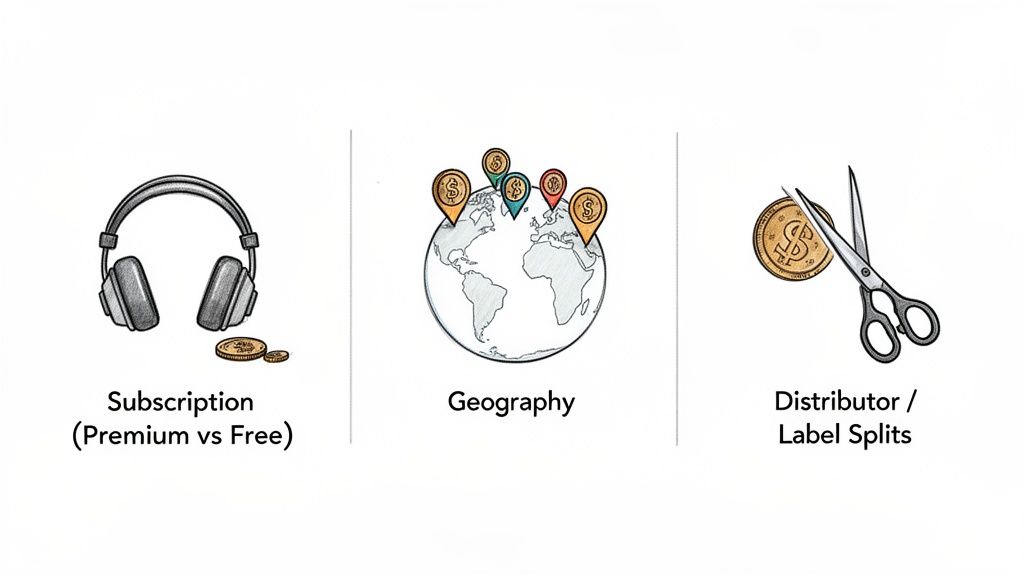
If you've ever stared at your royalty statement, confused why two months with almost identical stream counts paid out completely different amounts, you've hit on one of the music industry's biggest headaches. The truth is, not all streams are created equal.
The simple answer to "how much does Spotify pay per stream?" is... there isn't one. Instead, a handful of key factors mix together to decide what a single play is actually worth. Getting a grip on these variables is the key to turning a fuzzy guess into a real financial forecast for your career.
Let's break down exactly what moves the needle on your earnings.
H3: Premium Listeners vs. Free Users
The biggest piece of the puzzle is who's doing the listening. Spotify makes its money in two ways: monthly subscription fees from Premium users and the ads they play for everyone else. Because a paid subscriber chips in more to the monthly revenue pool, their streams are simply worth more. A lot more.
Think of it this way: a stream from a Premium account is like a direct cash deposit into the royalty fund. A stream from a free account, on the other hand, is funded by ad revenue, which is a much smaller slice of the pie. This is why a loyal fanbase of paying subscribers can generate way more income than a casual, ad-supported audience, even if the stream numbers are the same.
H3: The Geographic Lottery
Where your listeners live matters—big time. The value of any single stream is directly tied to what Spotify charges for subscriptions and ads in that listener's country. It costs more to be a Premium subscriber in the United States or the UK than it does in a developing market.
Because of that, streams from higher-revenue countries pay out more. The difference can be huge. For example, a stream from the U.S. might pay around $0.0039, while the same stream from Portugal could be worth just $0.0018. It really shines a light on why targeting your marketing to high-value territories is so important.
The global music streaming market hit a staggering $20.4 billion in 2024, but that money is spread unevenly across the map. As these global streaming trends and statistics show, building a fanbase in a country like the U.S. can have a massive impact on your bottom line.
To see this in action, check out how the exact same stream can have wildly different values.
How Different Factors Impact a Single Stream's Value
Here's a quick comparison showing how the same stream can earn different amounts depending on who's listening and where they are.
Listener Profile | Estimated Payout per Stream | Why It's Different |
|---|---|---|
Premium User in the USA | $0.0039 | Higher subscription fees in the U.S. market create a larger revenue pool, making these streams the most valuable. |
Free User in the USA | $0.0025 | This stream's value is based on ad revenue, which is lower than subscription fees but still strong in a major market. |
Premium User in Portugal | $0.0018 | Subscription costs are lower in Portugal, leading to a smaller per-stream payout compared to the U.S. |
Free User in Portugal | $0.0012 | This stream combines the lower ad revenue of a free user with the lower market value of the region. |
As you can see, the difference is real. A dedicated U.S. fan on a Premium plan is generating more than three times the revenue of a free listener in Portugal.
A single stream's value is a blend of who is listening (Premium vs. Free) and where they are listening. Focusing on markets with higher subscription costs is a direct path to increasing your average payout per stream.
H3: Your Agreements and Splits
The final part of the equation is what happens to the money after Spotify pays it out. The gross revenue from your music doesn't go straight to you. First, it goes to your distributor or record label, and that's where your contracts kick in.
Distributor Fees: If you're an independent artist, you're likely using a service like DistroKid or TuneCore. They'll either charge you a flat annual fee or take a percentage cut of your royalties, often around 15-20%.
Label Royalty Splits: Signed to a label? Your contract lays out the split. A standard deal might give the artist anywhere from 15-50% of the net earnings after the label has recouped all its expenses (like marketing and production costs).
These agreements are the last filter your money passes through. No matter how much your streams generate on Spotify, your actual take-home pay is what's left after your partners get their share. This is the one area where you have the most direct control, whether through negotiating a better deal or choosing the right distributor for your needs.
Calculating Your Actual Take-Home Pay From Spotify
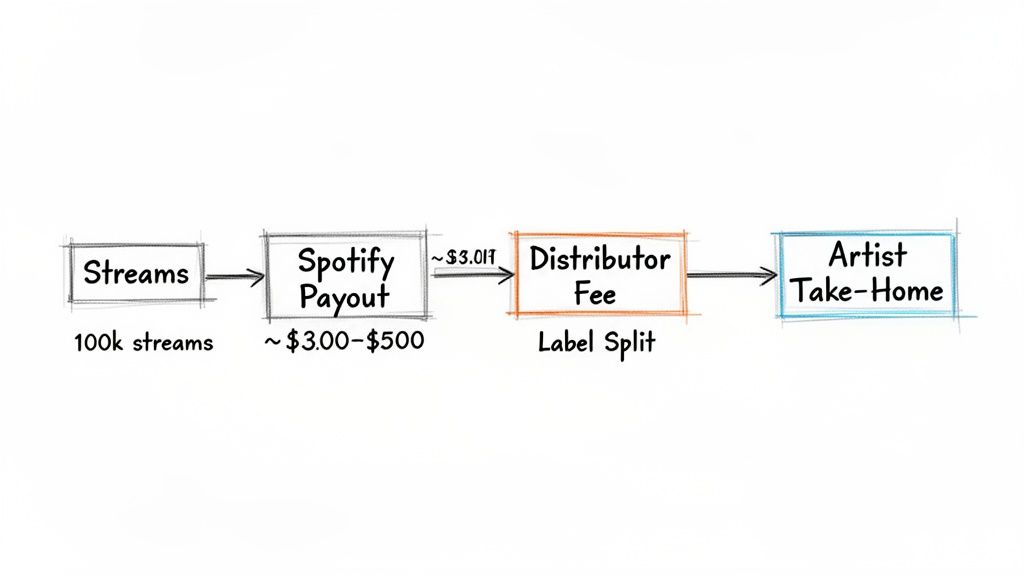
Knowing the royalty pool and what makes one stream more valuable than another is half the battle. Now, let's follow the money trail to see what actually ends up in your bank account. The path from gross revenue to cash-in-hand has a few stops, and the final amount really depends on your specific deal.
Let’s walk through two common scenarios to see how it all plays out.
For both examples, imagine your music pulled in 100,000 streams this month. We’ll use a realistic average payout of $0.004 per stream, which gives us a starting pot of $400 in gross revenue.
Now, where does that $400 go?
Scenario 1: The Independent Artist
If you're an indie artist, you have way more control over your money, but you still have partners to pay. Your main partner is your music distributor (think DistroKid, TuneCore, etc.), who takes a slice for putting your music on Spotify in the first place.
Gross Revenue: $400 (from 100,000 streams @ $0.004)
Distributor's Cut: Let's say they take a 15% commission. That’s $400 x 0.15 = $60.
Your Take-Home Pay: $400 - $60 = $340.
In this setup, your effective per-stream rate isn't $0.004 anymore. After your distributor gets paid, it's actually closer to $0.0034. This is a pretty standard calculation for artists who are managing their own releases.
Scenario 2: The Label Artist
Things get a bit more complicated if you’re signed to a record label. Labels usually front the cash for recording, marketing, and promotion, and they get that money back—or "recoup" it—from your earnings. Your royalty split only applies after those initial costs are covered.
Let’s say you have a 25% royalty deal, which is pretty typical for a newer artist.
Gross Revenue: $400
Label's Share (75%): $400 x 0.75 = $300. This goes back to the label to cover their investment and turn a profit.
Your Take-Home Pay (25%): $400 x 0.25 = $100.
With a label deal like this, your effective per-stream rate drops to just $0.001. It’s a stark reminder of just how much your contract terms can impact what Spotify actually pays you.
The journey from gross streaming revenue to your actual earnings involves multiple steps. Your final take-home pay is what's left after distributors, labels, publishers, and co-writers all get their piece of the pie.
Trying to figure this all out with a spreadsheet can be a massive headache. If you want a quick, personalized estimate based on your own numbers, using a dedicated tool is the way to go.
Here's a look at how simple the calculation can be with an online tool.
Tools like these cut through the confusing math. You can easily plug in your stream counts and royalty splits to model different scenarios with our free Spotify Royalties Calculator and get a much clearer picture of your potential earnings.
Actionable Strategies To Increase Your Spotify Revenue
Knowing the numbers behind Spotify payouts is one thing. Actually using that knowledge to grow your bank account is a completely different ballgame. It’s time to move from theory to practice with a clear strategy—one that’s all about attracting the right listeners and making sure every single stream is working for you.
This isn't just about getting more streams; it's about getting the right kind of streams. A smart, targeted approach can seriously boost your revenue without needing to go viral overnight. Let's get into working smarter, not just harder.
Find And Vet Legitimate Playlists
Playlists are the engine of discovery on Spotify, but landing on the wrong one can be a disaster. Getting placed on a playlist pumped full of bots or fake followers won’t just earn you nothing—it could get your track flagged and even removed from the platform. The goal is to find playlists with real people who are genuinely engaged.
This is where a dedicated tool becomes non-negotiable. For example, the artist.tools Playlist Analyzer lets you pop the hood on any playlist before you even think about pitching your music. You can see its follower growth over time, check for red flags of bot activity, and analyze its listener-to-follower ratio.
Here's a look at the artist.tools Playlist Analyzer, digging into a playlist's history and health.
By looking at historical data, you can instantly spot sketchy patterns like sudden, massive follower jumps, which almost always scream "bots!"
A healthy playlist grows organically over time with consistent track updates. If you see a playlist gain 50,000 followers in a day and then flatline, that’s a huge red flag. Those fake streams are worthless.
Target High-Value Geographic Markets
As we’ve covered, a stream from a Premium user in the U.S. is worth a whole lot more than a stream from a free user somewhere else. This is where strategic targeting becomes your secret weapon for raising your per-stream payout.
Focus your promo efforts on markets that have higher payouts:
United States: Almost always at the top of the list for per-stream value.
United Kingdom: Another powerhouse market with high subscription rates.
Australia & Western Europe: Countries like Germany, France, and the Netherlands are also top-tier territories.
Whether you're running ads or pitching to curators, make sure you're aiming for these regions. Even a small, focused campaign targeting American listeners can deliver a much bigger ROI than a scattergun approach that hits everyone, everywhere.
Optimize Your Profile For Organic Discovery
Finally, don't sleep on the power of Spotify's own algorithm and search features. A little optimization on your artist profile can go a long way in attracting organic listeners who are already looking for your kind of music.
Put yourself in a fan's shoes. What words would they type into the search bar to find your genre or vibe? Sprinkle these keywords naturally into your artist bio and the descriptions of your own playlists. A killer pitch in Spotify for Artists is also your ticket to landing on editorial playlists, which can put your music in front of a massive, dialed-in audience. One good editorial placement can generate a flood of high-quality streams faster than anything else.
Common Myths About Spotify Payouts Debunked
The music industry runs on rumors, and when it comes to how much Spotify pays per stream, the myths can be even more confusing than the truth. Getting bad information can lead to dead-end career moves and totally unrealistic expectations. It's time to cut through the noise.
By separating fact from fiction, you can build a strategy based on reality, not on something you overheard from another artist. Let's tackle some of the biggest misconceptions head-on.
Myth 1: Spotify Has a Fixed Pay-Per-Stream Rate
This is the most persistent myth out there. So many artists believe there's a set number, like $0.004, that Spotify pays for every single stream. As we've already covered, this just isn't true.
Spotify's system is a "pro-rata" model. Think of it like a big pot of money collected each month. That pot is then divided up by the total number of streams across the entire platform. Your per-stream rate is a direct result of that calculation, and it changes every single month because the total revenue and total streams are never the same. A stream’s value is all about who listened, where they listened from, and how much money was in the pot that month.
Myth 2: All Playlist Placements Are Good for Your Career
Landing on a popular playlist feels like a massive win, but not all placements are created equal. There's a dark side to the playlist world: "bot farms." These are shady services that use fake accounts to generate millions of artificial, worthless streams. Not only do you earn nothing from them, but they can get you in serious trouble.
Spotify has sophisticated systems to detect fraudulent activity. Getting caught with botted streams on your track can lead to your song being removed, your royalties being withheld, or even a ban from the platform.
A playlist with 100,000 followers but zero real listeners is worse than useless—it's a liability. Real success comes from getting on playlists with genuine, engaged audiences who will actually save your music and become long-term fans.
Myth 3: I Should Focus Only on Getting More Streams
While a higher stream count is obviously a good thing, it's not the only metric that matters. Chasing quantity over quality is a classic mistake. For example, 10,000 streams from Premium subscribers in the United States will earn you a lot more than 30,000 streams from free users in a lower-paying market.
Your strategy needs to be twofold:
Increase Overall Streams: Yes, you need volume to grow.
Target High-Value Listeners: Actively promote your music in markets like the US, UK, and Australia to increase your average per-stream payout.
Focusing your marketing efforts on high-value regions is one of the most direct ways to boost your income without needing millions of new listeners. Understanding these nuances is what separates the artists who get by from the ones who get ahead.
Ready to move beyond myths and make data-driven decisions for your music career? artist.tools provides the essential data you need, from bot detection to in-depth playlist analysis and SEO insights, helping you build a real strategy on Spotify. Start making smarter moves today at https://artist.tools.
.png)
Comments