How to Build a Music Career Today
- Aug 3, 2025
- 17 min read
Let's be real for a moment. The old-school dream of "getting discovered" by a suit in a corner office is a myth. It’s a fairy tale we were told, but the music world just doesn't work that way anymore.
Today, you have to think like an entrepreneur, not just an artist. Your success hinges on a powerful mix of incredible music, a brand that people connect with, smart digital strategy, and finding creative ways to get paid. This guide is your answer to the biggest challenge artists face: you have to build a business around your art.
Your Blueprint for a Modern Music Career
Platforms like Spotify have thrown the gates wide open for anyone to release music, which is amazing. The flip side? It's incredibly crowded. With over 120,000 new tracks hitting the platform every single day, just making great music isn't enough to get heard.
You need a plan. A real, deliberate strategy.
Think of yourself as the CEO of your own music startup. Your product isn't just your songs—it's your entire brand, your story, and the connection you build with your listeners. This mindset shift is everything. It takes you out of the passenger seat, waiting for a lucky break, and puts you firmly in control of your own destiny.
The Five Pillars of a Sustainable Career
A lasting music career isn't built on one thing; it's a structure supported by several key pillars. If one is weak, the whole thing can feel wobbly. It’s crucial to see how these pieces fit together from the very beginning.
Here are the core foundations we'll be diving into:
Creation & Identity: This is about more than just writing songs. It’s about carving out a unique sound and building a brand that tells your story.
Digital Distribution: Making your music available is the first step. Optimizing it for platforms like Spotify to actually get seen and heard is the next.
Audience Growth: You can't just release music and hope people find it. You have to actively find them through smart playlisting, engaging content, and building a real community.
Data-Driven Decisions: Analytics aren't just for tech companies. Using tools to understand who's listening and where they are is your secret weapon for making smarter moves.
Monetization Strategy: Relying on streaming royalties alone is a tough road. We'll look at building multiple income streams to create real financial stability.
The modern music industry doesn’t reward artists who wait around. It rewards those who take control, learn the business, and execute a solid plan day in and day out.
This guide is that plan. It's a roadmap designed to cut through the noise and break down the overwhelming task of building a career into clear, actionable steps.
We'll walk through everything from locking in your artistic identity to mastering the often-confusing world of streaming analytics and playlist pitching. We'll also show you how specific tools, like [artist.tools](https://www.artist.tools/), can help you execute every part of this blueprint.
To build a truly sustainable career, you need to treat each of these areas as essential parts of your business. This table summarizes the core pillars that will support your journey as an artist-entrepreneur.
The Modern Music Career Pillars
Pillar | Core Focus | Key Outcome |
|---|---|---|
Creation & Identity | Developing a unique sound and cohesive visual brand. | A memorable artistic persona that resonates with a specific audience. |
Digital Distribution | Optimizing releases on Spotify and other platforms. | Maximum visibility, reach, and algorithmic support for your music. |
Audience Growth | Strategic playlisting, content, and community building. | A loyal, engaged fanbase that actively supports your career. |
Data-Driven Decisions | Analyzing listener data and performance metrics. | Informed strategies that lead to more effective marketing and growth. |
Monetization Strategy | Creating diverse revenue streams beyond streaming. | Financial stability and the ability to reinvest in your music career. |
By focusing on these five pillars, you move from simply releasing songs into the void to building a scalable and resilient career. Now, let's get into the specific tactics you'll need to master each one.
Crafting Your Sound and Artistic Identity
Before you ever worry about pitching a playlist or checking your stream count, the real work begins. We're talking about laying the foundation of your entire career: your artistic identity. This is the magic blend of your sound, your story, and your style that makes you you.
Without a rock-solid identity, your music is just another drop in an ocean of over 120,000 tracks uploaded to Spotify every single day. It’s a staggering number, but it highlights a crucial truth: great songs aren't enough. You need to build a world around them.
Think about the artists you love. They didn’t just release tracks; they created a whole vibe. Billie Eilish's dark, moody aesthetic is completely intertwined with her sound. Lil Nas X’s bold, internet-savvy visuals are as vital to his art as the music itself. This is the stuff that turns a casual listener into a true fan.
Pinpointing Your Signature Sound
Okay, so "find your unique sound" can feel like impossible advice. The pressure is on to be totally original, but honestly, it’s more about being authentic than inventing a new genre from scratch. Forget trying to be something the world has never seen before. Just focus on what actually gets you excited.
A great way to start is by breaking down your own influences. Go beyond just listing your favorite bands and dig into the why.
What are they saying? Do you gravitate toward raw, honest storytelling? Abstract poetry? Straight-up party anthems?
How does it sound? Are you a fan of gritty, lo-fi textures, or do you prefer polished, massive soundscapes?
What does it make you feel? Does the music you love make you want to dance, think deeply, or feel like you can take on the world?
The answers here are the building blocks of your own sound. Maybe you love the raw, unhinged energy of punk but also can't resist a killer pop hook. Boom. Your signature sound could live right there in the middle. Don't box yourself in. The most interesting music often comes from mashing different things together.
Your artistic identity isn't about fitting into a pre-existing box. It's about building your own box, defining its shape, and inviting listeners inside. Authenticity is the only rule.
Once you’ve got a handle on your sonic direction, it's time to make it something people can see and feel. This is a non-negotiable step if you want to learn how to build a music career that actually goes the distance.
Translating Sound Into a Visual Brand
Your brand is simply the visual language you use to express your music's identity. It’s the cover art, the vibe of your Instagram feed, the fonts you use—everything that tells your story before someone even presses play. A strong brand isn't about being slick or corporate; it's about being consistent and instantly recognizable.
Think of it like creating a simple "brand kit" for your music. This doesn’t have to be some massive design document. It's just a quick guide to keep your look and feel on point across the board.
Key Elements of a Music Brand Kit
Element | Description | Example |
|---|---|---|
Color Palette | 3-5 core colors that match your music's mood. | A folk artist might lean into earthy tones like forest green and warm brown. |
Typography | 1-2 go-to fonts for your artist name, track titles, and posts. | A metal band might choose a sharp, aggressive font. |
Logo/Wordmark | A unique design for your artist name. | This can be as simple as your name in a specific, stylized font. |
Imagery Style | The vibe of your photos and videos—vintage, futuristic, candid, etc. | An R&B artist might favor moody, high-contrast photography. |
When you nail this consistency, you build recognition. A fan should be able to see a post with your colors and fonts and instantly know it's you, even before they see your name.
Building Your Brand Story
Your story is the glue that holds everything together. It's your "why." It's the journey, the values, and the core message behind the music. This is what helps listeners connect with you as a person, turning them from passive streamers into a real community.
Ask yourself a few hard questions:
What am I really trying to say with my music?
What personal experiences have led me here?
How do I want people to feel when they listen to my songs or come to a show?
Your story doesn't have to be some dramatic, world-changing epic. It just has to be yours. It could be about overcoming a personal struggle, celebrating your hometown, or finding beauty in the mundane. Weave this narrative into your Spotify bio, your social media captions, and how you talk to fans.
This cohesive package—a distinct sound, a killer visual brand, and an authentic story—is what sets you up for a sustainable career. It ensures that when someone discovers your music, they don't just hear a song; they discover an artist. This is the bedrock you'll build everything else on.
Taming the Global Streaming Beast
Forget the concert hall for a minute. For today's artist, the biggest stage in the world isn't made of wood and steel—it's Spotify. This isn't just a place to park your music anymore; it's the primary engine for finding new fans and actually building a career. If you're not taking it seriously, you're already falling behind.
The numbers are staggering, but they tell a story of massive opportunity. In 2025, music streaming makes up about 84% of all music industry revenue. That's a $17.5 billion market, with a global audience expected to hit 827 million subscribers this year. You can dig into these music streaming statistics to see just how much this shift is reshaping careers.
This data isn't just trivia; it's a giant, flashing sign. The question is no longer if you should be on Spotify, but how you can master it. It’s time to stop just uploading tracks and start thinking like a platform strategist.
Your Spotify Profile: More Than Just a Pretty Face
Your Spotify for Artists profile is your digital storefront, your business card, and your fan club headquarters all in one. When a potential fan lands on your page—maybe from a playlist, an ad, or a friend's share—you have just seconds to convince them to stick around. A half-baked profile tells them you're not serious.
Start with the basics, but make them count. Your bio isn't just a resume; it's a chance to tell your story. Pull people into your world. Why do you make this music? What's the vibe? Connect with them.
From there, nail every detail:
Artist Pick: This is prime real estate. Pin your latest single, a playlist you love, or your next tour dates. Keep it fresh to show you're active and engaged.
High-Quality Images: Your profile and header photos need to be crisp, pro, and aligned with your brand. No blurry selfies from last night.
Social Media Links: Don't make new fans hunt for you. Link your Instagram, TikTok, website, and anything else right on your profile.
Think of your Spotify profile as your digital press kit, album liner notes, and fan club hub all rolled into one. Every single element is an opportunity to convert a casual listener into a dedicated follower.
A complete profile does more than just look professional. It signals to Spotify’s algorithms that you're an active artist, which can help get your music recommended more often.
Feeding the Algorithmic Fire with Canvas & Release Radar
Consistency is king on Spotify, especially when it comes to Release Radar. This is the personalized playlist that lands in every user's app on Friday, and it’s one of your best shots at discovery. It’s packed with new music from artists that a user already follows or listens to.
Getting on your followers' Release Radar is simple in theory: release music consistently. This doesn't mean you need a new album every month. A "waterfall" release strategy—dropping a series of singles before an EP or album—is perfect for this. Each single is a new signal to the algorithm, keeping you on your fans' radar.
But don't just release the music; make it pop with Spotify Canvas. These are the short, looping videos that replace static album art.
Boost Your Metrics: A great Canvas can increase track shares by up to 200% and playlist adds by 20%.
Tell a Visual Story: Use it for behind-the-scenes clips, cool animations, or anything that extends the world of your song.
Canvas isn't just a gimmick. It’s a powerful tool that makes your music stickier and more shareable.
Tapping into New Fanbases Across the Globe
While it's easy to get tunnel vision on markets like the US and Europe, some of the biggest growth is happening elsewhere. Regions like Latin America, Southeast Asia, and Eastern Europe have massive, untapped audiences hungry for new music.
Targeting these emerging markets can be a total game-changer. Let's say you're looking at your data in [artist.tools](https://artist.tools/) and see a small but growing pocket of listeners in Brazil or the Philippines. That's your cue.
Start digging for popular playlists in those countries. Think about collaborating with a local artist. You could even run targeted ads specifically to those fans. Building a real foothold in these high-growth regions can explode your global audience and create loyal fanbases in places you'd never expect.
Driving Growth with Strategic Playlist Pitching
Alright, once your track is live on Spotify and your artist profile is looking sharp, it's time for the real push. In the world of streaming, visibility is everything, and playlists are the most powerful currency you have.
Getting your track on the right playlist can feel like winning the lottery, but a sustainable music career is built on skill and data, not just blind luck. This isn't just about chasing massive, million-follower lists either. It's about finding the right audiences, no matter their size. A placement on a small, hyper-engaged genre playlist can often bring in more dedicated fans than a spot on a huge, passive list where your track just gets lost in the noise.
Mastering the Official Spotify Pitch
Your first and most important stop is the official submission tool inside your Spotify for Artists dashboard. This is your direct line to Spotify's in-house editorial team—the people who actually curate iconic playlists like New Music Friday, Lorem, and RapCaviar.
Submitting here is non-negotiable, and here’s why:
It Fuels the Algorithm: Even if you don't land on a big editorial playlist, a well-written pitch gives Spotify's algorithms crucial data. It helps them understand your song's genre, mood, and influences, which directly feeds into algorithmic playlists like Release Radar and Discover Weekly.
It Guarantees a Listen: This is the only official way to get your music in front of the editors. Skipping this step is like hoping to win the lottery without buying a ticket.
It Levels the Playing Field: Everyone from bedroom producers to major label superstars uses this exact same tool. It’s your shot.
When you're writing your pitch, get specific. Don't just say your song is "upbeat." Describe the instruments, the lyrical themes, and the specific vibe. Mention a few similar artists and any marketing plans you have. The more context you provide, the easier you make it for an editor to see exactly where your track fits.
For a deeper dive, our complete guide on [how to submit to Spotify playlists](https://www.artist.tools/post/how-to-submit-to-spotify-playlists-a-simple-artist-s-guide) breaks down every single step.
Reaching Independent Curators
Beyond the official channels, there's a huge world of independent playlist curators. These are the passionate music fans, DJs, and bloggers who have built dedicated followings around very specific sounds. Getting on one of their playlists can be just as impactful as an editorial add.
But this is where you need to be strategic. Blasting your track to every curator you can find is a complete waste of time and will probably just get you marked as spam. Your approach has to be targeted and personal.
The real goal of playlist outreach isn't just to get streams; it's to find your tribe. A genuine connection with a curator who truly loves your sound is infinitely more valuable than a temporary spike in plays from a mismatched playlist.
Start by researching playlists that perfectly match your niche. If you make ambient techno, don't waste time pitching to house or future bass curators. This targeted approach is especially vital in genres with massive, engaged communities. The global electronic music industry, for example, has exploded into a powerhouse, hitting a record economic value of $12.9 billion. That shows you that even niche genres have huge, dedicated audiences just waiting to find you. You can see more on this in the [latest IMS Business Report](https://www.beatportal.com/articles/913865-ims-business-report-2025-the-global-electronic-music-industry-hits-a-record-12-9-billion).
Using Data to Pitch Smarter, Not Harder
Pitching blindly is a recipe for frustration. To focus your efforts, you need data. This is where a platform like [artist.tools](https://www.artist.tools/) becomes your secret weapon, turning guesswork into a calculated strategy. It lets you properly vet playlists before you even think about sending an email.
Here’s a look at how you can analyze a playlist's health using the Playlist Analyzer in artist.tools.
This dashboard shows you everything from historical follower growth and listener estimates to suspicious bot activity. It ensures you're pitching to lists with real, engaged listeners.
By using these insights, you can quickly spot red flags and focus your energy only on curators who can actually move the needle for your music. A quick check can save you from wasting your time on a list that, despite a high follower count, is packed with fake accounts.
When you're ready to pitch, keep your email short, respectful, and to the point. Introduce yourself, explain why your track is a perfect fit for their specific playlist, and drop in a clear link to listen. A simple, personalized message will always outperform a generic template. This focused, data-backed approach is how you turn playlisting from a game of chance into a core pillar of your career growth.
Building Diverse and Sustainable Revenue Streams
A lasting career in music is about much more than just racking up stream counts. While those numbers are great for getting your name out there, real sustainability comes from building a smart, diversified financial strategy. You have to start thinking like a business owner, which means never putting all your eggs in one basket. Relying only on streaming royalties is a tough, slow climb to financial stability.
The artists who thrive today are the ones building multiple income streams. This approach creates a financial safety net, helping you ride out the slow months and, more importantly, giving you capital to reinvest back into your next creative project. It’s what separates a hobbyist from a professional who understands how to build a music career that can actually last.
Industry forecasts show global recorded music revenues hitting a massive $110.8 billion by 2032. That number covers everything from streams and publishing to merch and sync deals. This incredible growth highlights a huge opportunity for artists who know where to look. It’s a clear signal that you need to be actively pursuing every potential income source available to you.
Beyond the Stream: The Core Revenue Sources
Your financial strategy needs to branch out into a few key areas. Each one offers different potential and requires its own approach, but when you put them together, they create a seriously powerful financial foundation. Let's break down the main ways you can get paid for your art.
Publishing Royalties: This is the money your original songs earn when they get used, and it's probably the most overlooked income stream for independent artists. Every single time your song is streamed, played on the radio, or performed live, you're owed publishing royalties.
Live Performances: From headlining your own shows to playing festival slots or even small acoustic gigs, playing live is still a cornerstone of an artist's income. It's also the number one driver of merch sales.
Merchandise: Selling branded items—t-shirts, vinyl, hats, posters—is a classic way to generate revenue. It also gives your biggest fans a tangible way to support you and turns them into walking billboards for your brand.
Sync Licensing: This is when you get your music placed in films, TV shows, commercials, or video games. A single good sync placement can be incredibly lucrative and introduce your music to a whole new world of listeners overnight.
The trick is to work on several of these at once. Don't wait to max out one stream before you start building another.
A diversified income portfolio isn't just a safety net; it's a growth engine. The revenue from a successful merch drop can fund your next music video, while a sync placement can finance your next tour.
This chart breaks down a common metric—monthly listeners—across major platforms. It’s a great visual for why you can’t just focus on one platform.
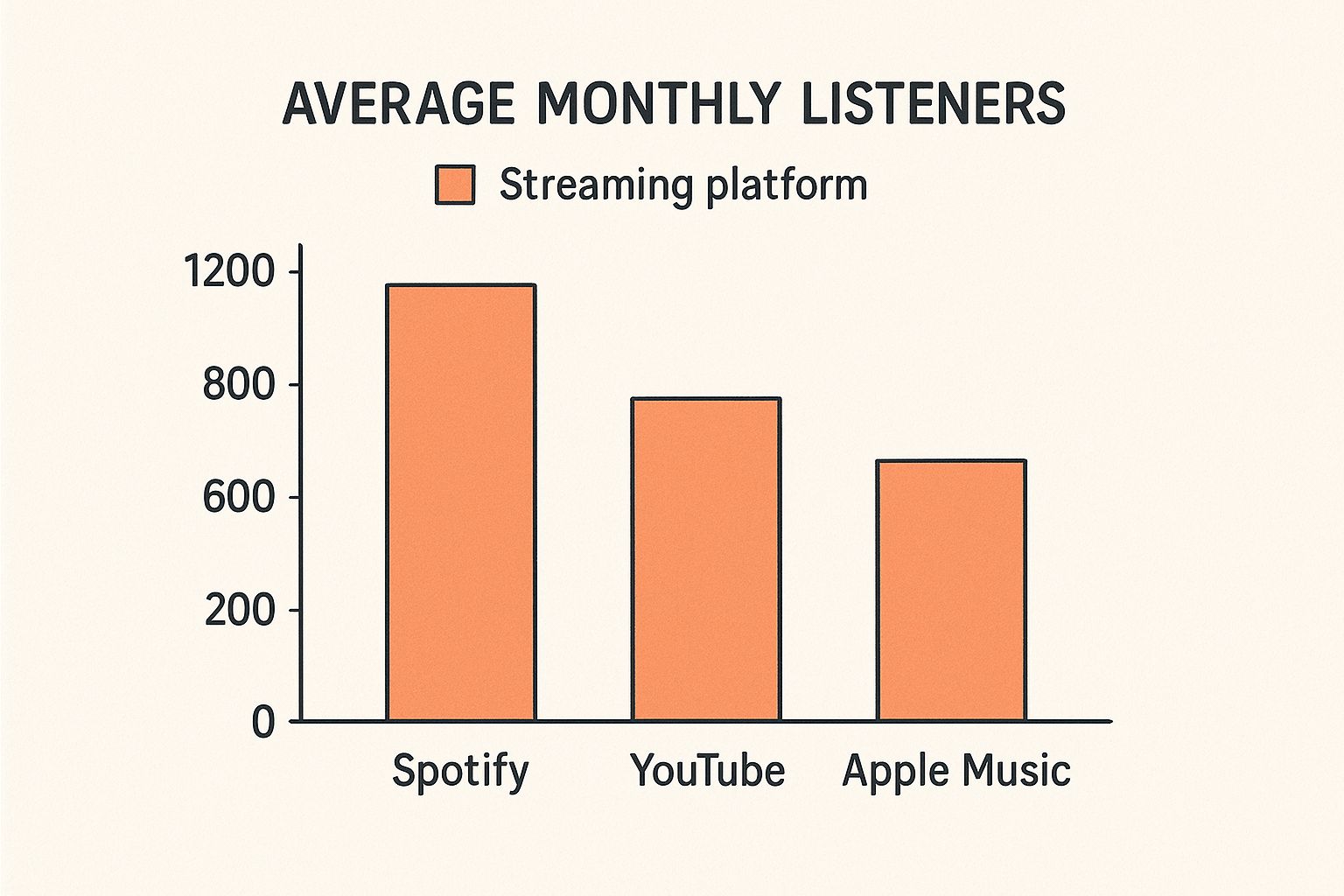
You can see that even if Spotify leads in this example, there's a huge audience on other platforms. This just reinforces the need for a presence and a monetization plan everywhere your fans are.
A solid income strategy involves more than just one or two of these streams. Here’s a quick look at how different revenue sources stack up against each other.
Artist Revenue Stream Comparison
Revenue Stream | Income Potential | Effort Level | Scalability |
|---|---|---|---|
Streaming Royalties | Low to High | Low (Passive) | High |
Publishing Royalties | Low to High | Medium (Admin) | High |
Live Performances | Medium to High | High (Active) | Medium |
Merchandise | Medium to High | Medium (Logistics) | Medium |
Sync Licensing | High to Very High | High (Networking) | Low |
Each stream plays a unique role. While sync licensing can bring in huge one-off payments, streaming provides a more consistent (though initially small) baseline. It's the combination that creates a stable career.
Activating Your Income Streams
Okay, so you know what the revenue streams are. Now, how do you actually turn them on? Each one requires specific, actionable steps to get the money flowing.
When it comes to publishing royalties, your first move is to join a Performance Rights Organization (PRO) like ASCAP, BMI, or SESAC. They are the ones who collect performance royalties for you. You'll also want to sign up with a publishing administrator like Songtrust to collect your mechanical royalties from all over the world. To really get a handle on this, check out our guide on the music publishing revenue blueprint.
To build your live performance income, start in your own backyard. Get your live set tight, build a local following, and put together a sharp electronic press kit (EPK) to send to bookers. Even small, paid gigs create momentum and give you invaluable experience on stage.
For merchandise, you don't have to sink a bunch of cash upfront. Services like Printful or Printify let you sell products on-demand through a store on your website. This means zero inventory risk—you only pay for the items that you actually sell.
Finally, to get into sync licensing, start by getting your tracks professionally mixed and mastered. Always have instrumental versions ready to go, as they're frequently requested. From there, you can start submitting your music to music libraries and sync agents who specialize in placing songs in media. The long game here is building relationships with music supervisors directly.
Common Questions from Emerging Artists
Let's dive into some of the most common hurdles we see emerging artists face. These are the real-world concerns we hear all the time from musicians getting serious about their craft. Getting these points straight can save you a ton of time, stress, and wasted effort.
How Often Should I Release New Music?
This is the big one. The pressure to stay on everyone's radar is real, but there's no single "right" answer. The two most common release strategies are the "waterfall" method and the traditional album cycle.
The Waterfall Strategy: This means you're dropping a new single every 4-6 weeks, building up to a bigger project like an EP or album. This approach is fantastic for consistently feeding the Spotify algorithm, keeping your music on your followers' Release Radar, and maintaining momentum.
The Album Cycle: This is the classic approach—pouring all your energy into a full body of work and releasing it all at once. It's an incredible way to make a major artistic statement and give your fans a deep, immersive experience. The downside? It can mean long stretches of silence between projects.
For most independent artists I talk to, a hybrid model seems to be the sweet spot. Use the waterfall strategy to build buzz and stay top-of-mind, then hit them with a cohesive EP or album to create a milestone moment your fans can get excited about.
Are Social Media Followers More Important Than Streams?
It's so easy to treat these as two separate metrics, but that's a mistake. They're deeply connected, fueling each other in a powerful loop.
Think of it this way: streams on platforms like Spotify are your proof of concept. They show that people are actually connecting with the music itself. High stream counts get you on the radar of playlist curators, booking agents, and A&R reps. In today's industry, streams are currency.
Your social media followers, however, are your community. These are the people who will buy your merch, show up to your concerts, and tell their friends about your new song. A million streams from a passive listener on a playlist is great, but 1,000 true fans on Instagram or TikTok are the foundation that will actually sustain your career.
Your goal isn't just to rack up plays; it's to turn listeners into dedicated followers. Use your Spotify profile to point fans to your socials, and use your socials to get your community hyped for your next Spotify release.
How Much Money Do I Really Need to Start?
The fear of startup costs can paralyze artists before they even record their first track. But the truth is, you can get a lot done with a surprisingly modest budget if you're smart about it.
Your initial costs really break down into two main buckets: production and marketing.
Production Costs:
Recording: This can be anything from free (if you learn to self-produce in a home studio) to thousands for a high-end studio. A realistic middle ground is finding a local producer or studio that charges a few hundred dollars per song.
Mixing & Mastering: This is non-negotiable. To compete, you need a professional sound. You should budget around $200-$500 per track for a quality job from an engineer who knows what they're doing.
Marketing Costs:
Distribution: Services like DistroKid or TuneCore are incredibly affordable, usually just a small annual fee.
Visuals: You absolutely need high-quality cover art and press photos. You can often find talented local photographers or designers for a few hundred bucks.
Promotion: This is where you have the most flexibility. You can start small, with an ad budget of just $5-$10 per day on Instagram or Facebook to see what messaging and audiences connect with your music.
You don’t need a massive loan to get started. Focus on getting one song done right—professionally produced, mixed, and mastered. Then, use smart, low-cost marketing to get it in front of the right people. As soon as you see a return, reinvest it into the next project.
Ready to put these insights into action? artist.tools gives you the essential data and analytics you need to make smarter career decisions. From vetting playlists to tracking your growth, our platform is built to help you succeed. Start your journey with artist.tools today.
.png)
.png)
Comments