How to Get in the Music Industry A Modern Guide
- Nov 26, 2025
- 17 min read
Getting into the music industry these days isn’t about waiting for some lucky break—it's about methodically building a career from the ground up with a smart, modern strategy. The path forward is a blend of raw artistic skill, sharp digital marketing, genuine networking, and a straight-up entrepreneurial mindset.
Forget the old world of mailing demo tapes. We're now in an era defined by streaming, direct-to-fan engagement, and building a powerful personal brand that cuts through the noise.
Charting Your Path in Today's Music Business
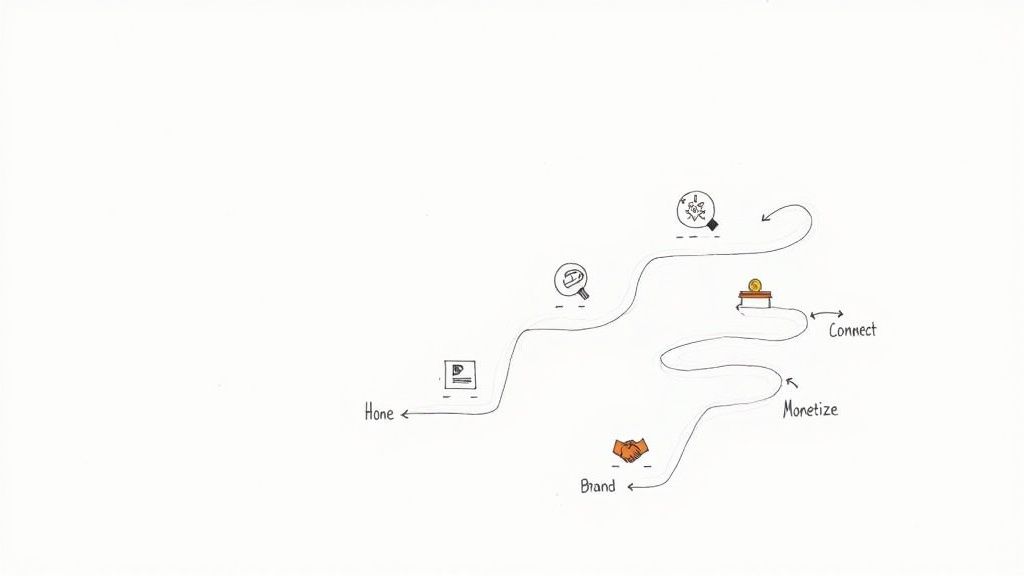
Breaking into music used to feel like searching for a secret, unmarked door. Today, that one door has been replaced by countless windows of opportunity, but you absolutely need a map to find them. The core of the journey is no longer just about getting signed; it’s about building a sustainable business around your art, piece by piece.
This guide is that map. We’re going to break down the essential pillars you need to master, moving beyond vague advice to give you actionable steps. We’ll show you how to get in the music industry by focusing on what you can actually control, empowering you to build momentum all on your own.
To give you a clearer picture of what this journey involves, here's a breakdown of the core pillars you'll need to build your career on.
The Modern Artist's Career Pillars
Pillar | Core Objective | Key Actions |
|---|---|---|
Craft & Brand | Develop a unique sound and compelling artist identity. | Skill development, songwriting, defining your visual aesthetic, storytelling. |
Digital Releases | Launch music effectively to maximize reach and engagement. | Choosing a distributor, Spotify for Artists setup, strategic playlist pitching. |
Networking | Build authentic relationships within the industry. | Collaborating with artists, connecting with curators, engaging with fans. |
Monetization | Create multiple income streams to build a sustainable career. | Streaming royalties, merchandise sales, live performances, sync licensing. |
These aren't just sequential steps but intertwined skills you'll develop simultaneously. Think of them as the foundation upon which your entire career rests.
The modern music industry is fundamentally digital. Your success hinges on your ability to navigate the platforms where listeners actually live, and streaming is the dominant force.
The entire landscape has been reshaped by how people consume music. By 2024, global recorded music revenues hit a staggering $29.6 billion, with subscription streaming services alone accounting for over $20 billion of that total.
In fact, streaming now represents 84% of all music industry revenue. That's a loud and clear signal of where artists need to focus their energy. You can read more about these trends in the latest IFPI Global Music Report findings from Sony Music.
This roadmap gives you the 30,000-foot view. In the sections that follow, we'll dive deep into the specific actions you can take within each of these pillars, giving you the tools and insights to build your career from the ground up.
Honing Your Craft and Building Your Brand
Before you even start thinking about playlists, managers, or scoring that opening slot, you need a product that’s undeniable. Great music is the absolute price of entry.
But just being a talented musician isn't the whole story. You have to become a professional artist with a distinct vision. This is the part where you shift from casual practice into a phase of deliberate, goal-oriented skill development.
Your unique sound is so much more than a creative choice—it’s the foundation of your entire brand. It's that sonic signature that makes someone stop mindlessly scrolling and actually listen. This is where focused practice, a real-world grasp of music theory, and solid home recording skills become non-negotiable. You don't need a million-dollar studio, but your demos have to sound clean and professional enough to compete.
From Musician to Marketable Artist
Making the jump from a hobby to a career means building a cohesive brand that gives your music context. Your brand is the story that wraps around your sound, making it stick. It’s the combination of your visuals, your online vibe, and the narrative you share with the world. Think about your favorite artists—you don't just love their songs; you're bought into their entire world.
Not too long ago, getting noticed was a different game. Artists would grind it out playing live shows, building a regional following and hoping to catch the ear of an A&R scout who could offer a record deal. Today, that battle has moved online, where a strong brand and high-quality digital assets are your best tools for building a dedicated community. For a deeper look, check out this report on the evolution of the music business from the World Intellectual Property Organization.
This shift means your first move should be creating a compelling package around your music.
Professional Photos: You absolutely need high-resolution press photos. Make sure they reflect your musical style and personality.
Consistent Visuals: Lock in a consistent color palette, font style, and general aesthetic across your socials, website, and cover art.
A Compelling Story: What’s your angle? Your brand narrative has to be authentic and give fans and industry pros a reason to connect with you on a deeper level.
Building Your Essential Toolkit: The EPK
Think of your Electronic Press Kit (EPK) as your professional resume. It's a digital one-sheet that pulls all your essential info into one place, making it dead simple for promoters, bloggers, and playlist curators to figure out who you are. A sharp EPK screams professionalism and shows you’re serious about your career.
It should be a clean, easily accessible webpage or PDF with everything someone would need to feature or book you. Trust me, a messy or incomplete EPK is an instant turn-off for busy industry contacts.
Your EPK isn’t just a folder of links; it’s a curated presentation of your brand. It should tell your story visually and textually, making a powerful first impression before anyone even clicks play.
So, what goes into a standout EPK? Make sure you have these key elements locked down:
Your Artist Bio: This is the heart of your story. Keep it concise, engaging, and make sure it highlights what makes your sound and journey unique.
High-Quality Photos: Include a mix of professional headshots and live performance shots that are easy to download.
Your Best Music: Don't make them hunt for it. Embed links to your top 2-3 tracks on Spotify or SoundCloud.
Links to Socials and Website: Provide clear, direct links to all your relevant online platforms.
Contact Information: Include a professional email for your manager or a dedicated booking contact.
Your artist bio is especially critical. It's often the very first thing an industry pro reads, so it needs to grab their attention immediately. We put together a detailed guide on how to write an artist bio that truly connects with both your audience and the industry. Nailing this narrative is a foundational step in building a brand that lasts.
Getting Your Music Out There: Your Digital Release and Spotify Game Plan
A great song is just the beginning. The real test is how you get it to the world. A smart digital release strategy is what separates a track that makes waves from one that gets lost in the flood of new music. And today, the heart of that strategy beats on Spotify. If you're serious about making it in music, you absolutely have to get this part right.
First things first, you need a way to get your finished track from your computer onto Spotify, Apple Music, and all the other streaming platforms. That's where a digital distributor comes in. Think of them as the bridge connecting your music to the rest of the world.
Services like DistroKid, TuneCore, and CD Baby are the big players here. They all do the same basic job, but how they charge for it differs. Some have a yearly fee for unlimited uploads, which is great if you're prolific. Others charge you per single or album. Take a look at your release plans and budget to figure out which model makes the most sense for you.
Don't Rush the Release
Once you pick a distributor, the next step is crucial, and it’s where so many new artists stumble: timing. Whatever you do, don't upload your music a few days before you want it to go live. This is a rookie mistake that can kill your track's potential before it even has a chance.
You need to give yourself a runway. I'm talking at least four weeks before your official release date.
A well-planned release isn't just about getting your music online; it's about building a campaign. The time between uploading your track and its release date is your promotional window, and you need to use every second of it effectively.
That lead time is your golden window. It's when you get all your ducks in a row and, most importantly, pitch your song to Spotify's own editorial team. Rushing this means throwing away your best shot at getting discovered on the platform.
This whole process is a natural progression. You start with your art, build your brand around it, and package it all up for the industry.
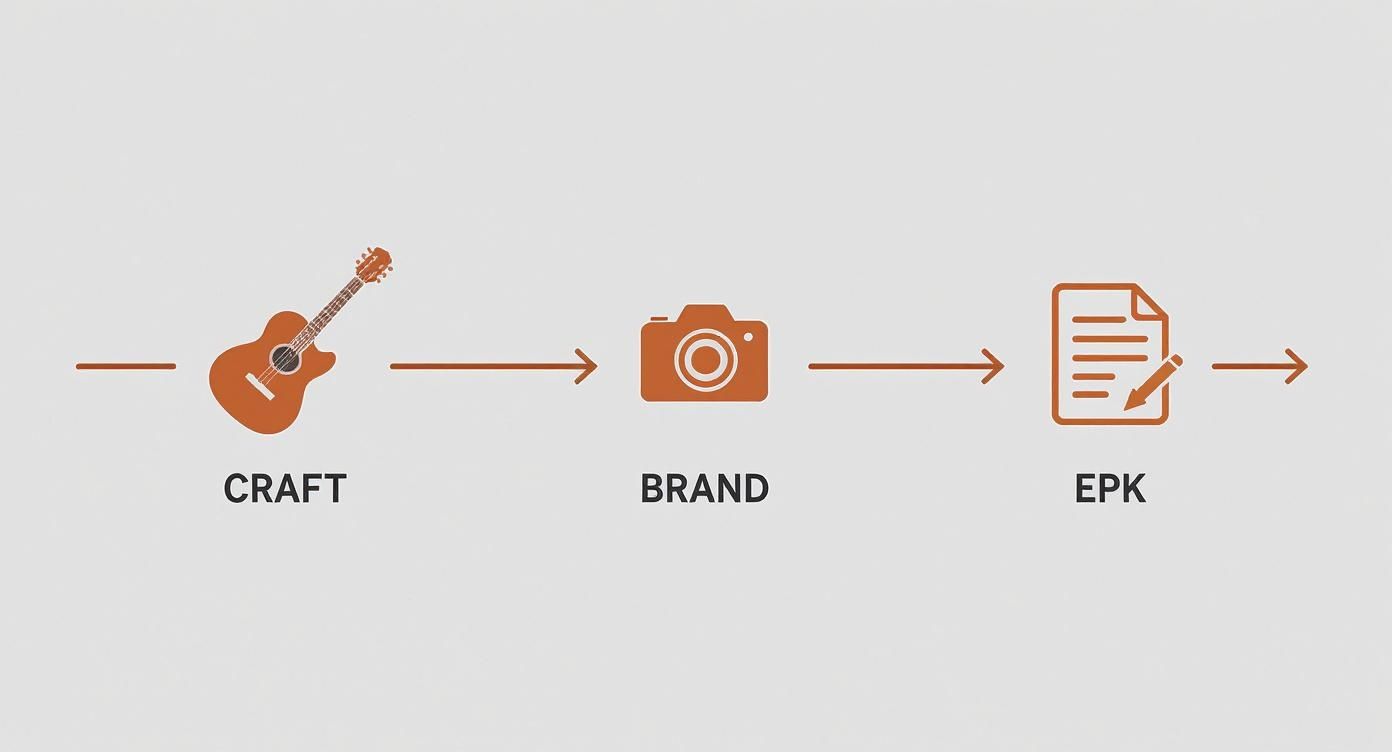
As you can see, everything flows from the music you create. Your brand, your EPK—it all serves to support the release.
A successful launch doesn't just happen. It's the result of careful planning and executing a series of key tasks in the weeks leading up to release day. Here’s a checklist to keep you on track.
Pre-Release Campaign Checklist
Timeframe | Task | Goal |
|---|---|---|
4 Weeks Out | Upload track via distributor. Claim your Spotify for Artists profile. | Get your music into Spotify's system and gain access to your artist dashboard. |
3-4 Weeks Out | Submit your editorial playlist pitch via Spotify for Artists. | Tell your song's story to Spotify's curators to be considered for official playlists. |
2-3 Weeks Out | Research and contact independent playlist curators. | Secure placements on user-curated playlists to drive initial streams. |
1-2 Weeks Out | Prepare social media content, pre-save links, and email newsletters. | Build hype and activate your existing fanbase for release day. |
Release Week | Promote heavily across all channels. Monitor initial data. | Drive as much traffic as possible to your new release in the critical first few days. |
Following a timeline like this ensures you're not scrambling at the last minute and gives your music the best possible chance to make an impact right from the start.
Your Mission Control: Spotify for Artists
Your Spotify for Artists dashboard is your command center. The very first thing you need to do is claim your profile. This unlocks a whole suite of tools, but the most important one is the ability to pitch your music directly to Spotify's editorial team.
This pitch is your one shot to make a case for your song. You get to add tags for genre, mood, and instrumentation, plus write a description about the track, the story behind it, and any marketing you have planned. You have to submit this pitch at least seven days before your release, but the earlier, the better. For a full breakdown of this, check out our guide on how to get your songs on Spotify.
Beyond the pitch, your dashboard is a goldmine of data:
Audience Demographics: Find out who's listening—their age, gender, and where they are in the world.
Source of Streams: See if people are finding you through your profile, their own playlists, or big editorial ones.
Listener Engagement: Keep an eye on how many people are saving your song or adding it to their personal collections.
This isn't just numbers on a screen. This data tells you what's resonating with people, so you can lean into what's working for your next release.
Pitching to Independent Curators
Landing on an official Spotify playlist is a game-changer, but don't sleep on the power of independent curators. These are music lovers who have spent years building loyal followings around very specific tastes and genres. A spot on the right user-created playlist can send a huge wave of new listeners your way.
The tricky part is finding them. Sifting through millions of playlists to find the right ones can feel impossible. That’s where a good tool becomes your best friend. For example, the Playlist Search feature inside artist.tools lets you slice through the noise and find playlists that are a perfect match for your sound. It helps you zero in on curators who are actually looking for music just like yours.
Once you have a list of potential playlists, you have to do your homework. Check for red flags like sudden, massive jumps in followers—that often signals bot activity. A healthy playlist shows steady, organic growth and has listeners who are genuinely engaged. A Playlist Analyzer can do this detective work for you, vetting the playlist's metrics before you waste your time pitching, and more importantly, protecting your music from being associated with fake streams.
This is a cycle. You release a track, pitch it, analyze the data, and use those insights to make the next release even stronger. It's how you turn a single song into a sustainable career.
Building Genuine Industry Connections
That old saying, "it's who you know," still hangs in the air of the music business, but what it means has completely shifted. Getting your foot in the door isn't about schmoozing your way into exclusive parties anymore. Today, it’s all about building a real, supportive community—a network built on mutual respect, not just asking for favors.
Forget the idea of collecting contacts like they're trading cards. The real goal is to forge genuine relationships with managers, booking agents, music bloggers, and especially other artists. This is a slow burn, not a shortcut. Industry people are constantly bombarded with requests, so a cold email asking for something is almost guaranteed to get deleted.
The modern way to break in is to lead with value. Before you even think about asking for anything, figure out what you can offer first. It’s about building a reputation as someone who is collaborative, professional, and actually passionate about the music scene.
Mastering Digital Outreach
Your online presence is your new handshake. Social media platforms like Instagram and X (formerly Twitter) have torn down the old walls, giving you a direct line to people who used to be impossible to reach. But with that access comes a responsibility to be cool, professional, and respectful.
Don't just slide into a manager's DMs with a link to your Spotify. That’s the digital version of screaming your demo at them in a coffee shop. It just doesn't work. Instead, engage with their content thoughtfully over time. Share their artists' wins, comment on a post they wrote, or reply to a story with a genuine thought.
This shows them you see them as a person with valuable insights, not just a ladder for your career. When you finally do reach out, your name will already ring a bell.
"The golden rule of networking is simple: give more than you take. When you consistently offer support, share other artists' work, and engage genuinely, people will naturally want to be a part of your journey. Your network becomes a community, not just a list of contacts."
When you're ready to send that crucial first email, personalization is everything. A generic, copy-pasted message is easy to spot and even easier to ignore.
Do Your Homework: Mention a specific artist they work with or a recent project they were a part of. Show them you’ve done more than just find their email address.
Keep It Short: Industry pros are busy. Get to the point quickly and clearly. A few short, powerful paragraphs are way more effective than a wall of text.
Have a Clear Ask (When It’s Time): If you’re asking for feedback or an intro, make it specific and easy for them to act on. Don't make them do the work for you.
Navigating Real-World Events
While digital connections are key, nothing beats a face-to-face interaction. Industry conferences, local music showcases, and workshops are goldmines for meeting people. But again, the goal isn't to hand out as many business cards as you can. It’s to have meaningful conversations.
If you meet a booking agent at a show, don't immediately launch into your pitch. Start a conversation about the artist who just performed or the venue itself. Find some common ground first.
The follow-up is just as crucial as the meeting. A simple, personalized email the next day can cement the connection you just made.
Example Follow-Up Email:
Subject: Great to connect at the [Event Name]!
Hi [Name],
It was great chatting with you last night after [Artist]'s set. I really enjoyed what you had to say about the local scene in [City].
As I mentioned, my project is [Your Artist Name], and we have a similar vibe. If you have a moment, here’s a link to our latest single.
Thanks again for the conversation. Hope to cross paths again soon!
Best,[Your Name]
This approach is respectful, it references your actual conversation, and it gives them a low-pressure way to check out your music. It turns a quick chat into the potential start of a real professional relationship. Building your network is a marathon, not a sprint, and every genuine connection you make is a solid step toward a sustainable career.
Monetizing Your Music Beyond Streaming
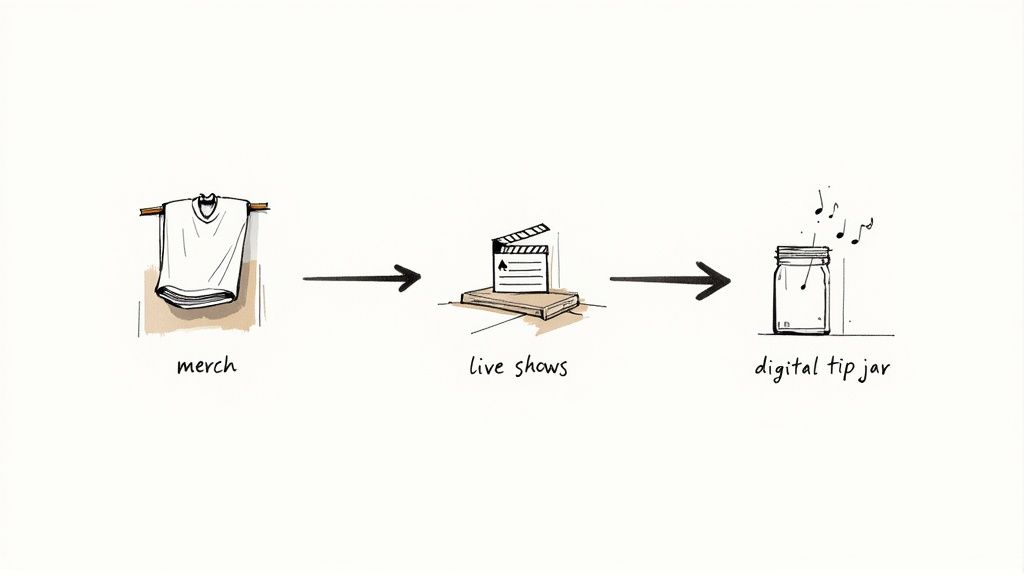
Trying to build a music career on streaming royalties alone is a slow, painful grind. Think of it like trying to fill a swimming pool with a garden hose—sure, it's possible, but you'll be waiting forever.
While streaming is absolutely essential for getting discovered and building an audience, the per-stream payouts just aren't enough to pay the bills for most emerging artists. To actually make it in the music industry, you have to start thinking like an entrepreneur and build a financial foundation with multiple income streams.
This approach creates a safety net. When one income source slows down, another can pick up the slack, giving you the stability you need to keep creating music. It's all about moving fans from passive listening to active support, creating real value they're excited to pay for.
Your Merch Is More Than Just a T-Shirt
Merchandise is one of the most direct and powerful ways to make money from your music. It literally turns a listener into a walking billboard for your brand while putting cash directly in your pocket. A great piece of merch isn't just a product; it’s a physical token of the connection a fan feels with your art.
But please, don't just slap your band name on a generic black tee. Think about what makes your brand and your sound unique.
Design with Your Brand in Mind: Does your music have a certain vibe, color palette, or recurring lyrical theme? Weave those elements into your designs to make them feel authentic.
Offer More Than Apparel: T-shirts are great, but think bigger. What about enamel pins, signed posters, custom guitar picks, or even a limited-run vinyl pressing?
Use Print-on-Demand Services: Getting started with merch can feel risky. Platforms like Printful or Printify let you create a whole store without buying a single item upfront, which means zero inventory and zero risk.
Your merchandise isn't just a product; it's an extension of your artistic world. Every item you sell should feel authentic to your brand and give your fans a piece of that world to own.
When you're ready to launch, platforms like Bandcamp and Shopify give you everything you need to build a professional online store. Bandcamp is a huge favorite among independent artists because of its artist-friendly revenue splits and how seamlessly it integrates music and merch sales.
The Power of Live Performances
Playing live is where the magic happens. It's where you forge the strongest, most lasting connections with your audience. It's also a massive income source, not just from the tickets but from the merch you sell right after you walk off stage. Even small, local gigs can be surprisingly profitable if you play your cards right.
Start by booking shows at local venues, hitting up open mic nights, or trying to land an opening slot for a more established local act. Your payment might be a flat fee, a percentage of the ticket sales (the "door"), or a mix of both. For your first few shows, honestly, the experience and exposure are just as valuable as the money.
But here’s a pro tip: the real money at those early gigs often comes from the merch table. After an energetic set, fans are buzzing and ready to buy something to remember the night. Make your merch table easy to find, well-lit, and have a friendly face running it. Offering a simple bundle deal, like a t-shirt and an EP for a slight discount, can seriously boost your sales.
Unlocking Sync Licensing Opportunities
Synchronization licensing—or "sync"—is when your music gets placed in a TV show, movie, commercial, or video game. It can be a massive financial game-changer. A single sync deal for an independent artist can range from $500 for a small TV placement to over $20,000 for a major ad campaign.
So, how do you land one of these placements? The people who choose the music for these projects are called music supervisors, but they almost never take unsolicited music directly from artists. They work with trusted sources like sync agents and music libraries who manage catalogs of pre-cleared music.
Your job is to get your music in front of those agents.
Get Your Music "Sync-Ready": This is non-negotiable. You need high-quality instrumental versions of your tracks and proof that you own 100% of your rights (both the master recording and the publishing).
Research Sync Agencies: Find agents that work with music in your genre. A targeted, personal pitch to the right person is a thousand times better than spamming a hundred generic emails.
Network and Build Relationships: Get to know local filmmakers, content creators, and even music supervisors in your scene. A real connection can open doors that cold emails never will.
Building multiple revenue streams is a fundamental part of being a modern musician. For a deeper look, check out our guide on proven strategies for how to make money as a musician.
Ultimately, diversifying your income means thinking globally. While the US market is huge, some of the fastest-growing music markets are elsewhere. The Middle East and North Africa, for instance, saw a 22.8% jump in recorded music revenues in 2024. These emerging markets, along with timeless income sources like sync, offer incredible opportunities for artists who look beyond their local scene. You can read more about these global trends over at Music Business Worldwide.
Common Questions About Starting a Music Career
Getting started in music is a minefield of unknowns. It's way too easy to get stuck on the practical questions that feel like giant roadblocks before you've even begun. Let's tackle some of the most common things new artists ask, with some straight-up answers to get you moving.
How Much Money Do I Need to Start?
There's no magic number here. The budget for launching your music career can be whatever you make it, and it really depends on your approach. The good news? You can get a surprising amount done with very little cash if you're clever about it.
If you're bootstrapping, you can genuinely get the ball rolling for under $500. Seriously. That could cover:
Basic Recording Gear: A decent USB mic and a free DAW (Digital Audio Workstation) like GarageBand or Cakewalk.
Distribution Fees: An annual subscription to a distributor like DistroKid usually runs less than $40.
DIY Marketing: This is more about your time than your money. It means grinding on social media and personally reaching out to blogs and playlist curators.
Got a bit more to invest, maybe in the $2,000-$5,000 range? Now you can seriously level up your quality and your reach. That kind of budget opens the door to professional mixing and mastering for a single, a small budget for targeted social media ads, or even a professionally shot music video or press photos. The trick is to put the money where it'll have the biggest impact—and that's almost always on making your final product sound incredible.
Do I Still Need a Record Label to Succeed?
Short answer: Nope. The days when a record label was the only gatekeeper to success are long gone. The explosion of independent artists proves you can build a real, sustainable career completely on your own terms. That said, the choice between staying indie and signing is a big one, and there are real pros and cons to both paths.
As an independent artist, you have total creative control and you keep a much bigger piece of the royalty pie. You call all the shots: what to release, when to release it, and how to build your brand. The flip side is you're responsible for everything. Funding, marketing, distribution, admin... it's a huge undertaking that demands an entrepreneur's mindset.
A record label is a powerful amplifier. They can pour gasoline on a fire that’s already burning, but they rarely start the fire for you. Success today is about building your own momentum first.
Signing with a label gives you access to a team of pros, serious financial backing, and a promotion machine that can blast your music out to the world. They can unlock doors to radio play, major press, and big-name collaborations that are insanely hard to get on your own. What's the trade-off? You give up a hefty chunk of your income and some of your creative freedom. At the end of the day, a label should be viewed as a potential partner, not a savior.
How Often Should I Be Releasing New Music?
In the world of streaming, consistency is everything. For new artists, the old model of vanishing for two years to craft an album just doesn't work anymore. Listeners have short attention spans, and the algorithms on platforms like Spotify absolutely favor artists who drop music regularly. This doesn't mean you have to burn yourself out and release a subpar track every week.
The goal is to find a release rhythm that's both sustainable for you and engaging for your fans. For most new artists, this means leaning into a singles strategy.
Dropping a new single every 6-8 weeks is a really effective sweet spot. It keeps your audience hooked and gives you a constant stream of new content to promote. This approach also syncs up perfectly with the "waterfall strategy," where each new release is bundled with the previous ones on streaming services. It's a smart way to drive traffic to your older tracks and keep your Spotify profile looking fresh and active. Once you've built a solid following with consistent singles, you can make a bigger splash with a larger project like an EP or album.
Building a career in music is about more than just talent; it requires smart, data-driven decisions. artist.tools provides the essential data and insights you need to navigate Spotify, find the right playlists, protect your music from fraud, and grow your audience. Take control of your career and make your next release your most successful one yet by visiting https://artist.tools.
block blast online is really engaging, combining block stacking with logic puzzles.