
A 2026 List of Songs in the Public Domain: 7 Resources
Our 2026 list of songs in the public domain. Discover 7 key resources to find, verify, and legally use public domain music on Spotify and beyond.
9
- 1. Public Domain Information Project
- 2. Library of Congress National Jukebox
- 3. Musopen
- 4. IMSLP
- 5. CPDL Choral Public Domain Library
- 6. Internet Archive Great 78 Project
- 7. Duke University Center for the Study of the Public Domain
- 7-Source Public-Domain Song Comparison
- Treat Public Domain as a Strategic Asset
In the United States, artists can now draw from a large and growing pool of familiar repertoire without licensing the underlying composition first. Songs published in 1930 or earlier are generally in the public domain, and sound recordings released in 1924 or earlier are as well. That distinction matters in practice. A public domain song does not automatically make every existing recording of that song free to use.
Serious release planning starts there. Artists who separate composition rights from master rights avoid the most common public domain mistake, which is assuming an old song and an old recording carry the same clearance status. They do not. If you record your own version of a qualifying work, you may be using public domain material lawfully while still avoiding the legal and distribution risks tied to someone else’s master. If you need a refresher on what protection applies to your new recording and arrangement choices, this guide to how to copyright a song and protect your music covers the basics.
The commercial value is real. Public domain repertoire includes standards, folk material, hymns, seasonal songs, early blues, and older pop titles that listeners already recognize. For artists, that creates a practical advantage. Familiar songs can lower the audience education burden while giving you more room to compete on arrangement, performance, production, and positioning.
The hard part is not finding a song title. The hard part is building a repeatable workflow that answers four questions before release. Is the composition public domain in the territory that matters? Is the score or lyric source reliable? Are you creating a new recording from clean source material? Can you document your chain of reasoning if a distributor, DSP, or rights administrator asks for proof?
That is the lens for this guide. Instead of giving you a flat list of songs in the public domain, it lays out the working system artists use to find candidates, verify status, source usable materials, and turn public domain works into release-ready assets for platforms like Spotify.
1. Public Domain Information Project
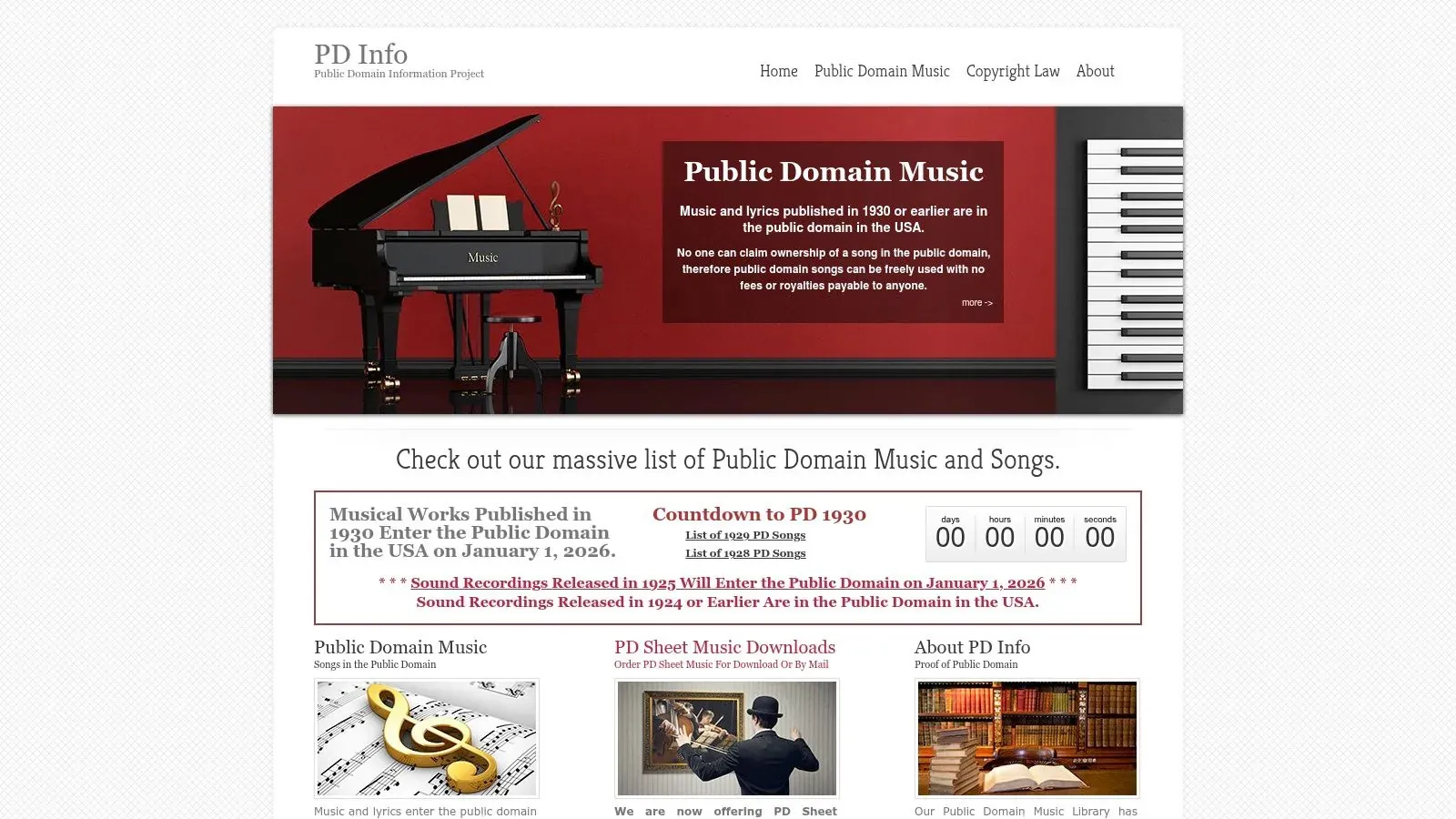
Public Domain Information Project is the first site I’d hand to a U.S. artist who needs a practical list of songs in the public domain, not an academic lecture. It’s built around the question artists ask. Can I use this song, and what do I need to prove it if a distributor flags the release?
PDInfo is strongest when you’re researching compositions. That means the melody and lyrics. It organizes public domain material by year and title, includes frequently searched songs, and gives plain-English explanations of U.S. copyright timing. That U.S. focus is a strength, not a limitation, if you distribute primarily in the American market and need your paperwork to line up with U.S. rules.
What PDInfo does better than broad archives
PDInfo reduces the most common public domain mistake. Artists often assume a public domain song and a public domain recording are the same thing. They aren’t. A composition may be free to use, while a specific commercial recording of that composition is still controlled, unavailable, or attached to a separate rights question.
PDInfo helps you stay on the composition side of the analysis. That makes it useful before you arrange, track, or upload anything. It also points artists toward optional sheet-music reprints that can help document why a work is public domain if a distributor or rights reviewer asks for backup.
A few practical uses stand out:
- Year-based verification: PDInfo’s year lists help you confirm whether a song’s publication date falls within U.S. public domain status.
- Distributor support: Original sheet music references are useful when a release gets questioned during delivery.
- Fast shortlist building: The site’s curated popular-title pages help you move from legal research to repertoire selection quickly.
Where PDInfo stops
PDInfo isn’t where you go for a polished audio archive. It’s not a streaming database of ready-to-sample masters, and it doesn’t replace legal advice for edge cases like later revisions, translations, or new editorial additions. It’s a research hub.
That said, it’s an excellent first pass before you spend money on production. Artists who are creating new arrangements should pair this kind of research with a basic rights hygiene process on their own catalog too. If you’re releasing original material alongside public domain adaptations, this guide to copyrighting your own song is the right companion read.
For serious artists, PDInfo works because it solves the first problem cleanly. It tells you whether you’re even in the right legal lane before you start being creative.
2. Library of Congress National Jukebox
Library of Congress National Jukebox matters because release mistakes often start with the wrong source material, not the wrong song title. Artists regularly find an old performance online, assume the track is safe, and build an arrangement around it without checking the actual record they used. National Jukebox helps prevent that error by tying recordings to catalog data, historical context, and item-level rights information.
That makes it useful for a different job than PDInfo. PDInfo helps with composition research. National Jukebox helps you inspect the recording history around a song before you decide what to quote, arrange, or imitate.
For Spotify-focused artists, that distinction has real business value. A public domain composition can support a new release, but an old recording still needs its own review. National Jukebox gives you a documented way to study early interpretations without treating every archival audio file as interchangeable.
Why artists should use it before arranging
Early recordings contain decisions that sheet music does not capture cleanly. Tempo shifts. Lyric substitutions. Spoken intros. Musical fills. Formal cuts. Those details shape the version listeners recognize, and they also affect whether your arrangement feels informed or generic.
I use National Jukebox to answer a practical question: am I arranging the song itself, or am I unconsciously copying a specific historic performance? That line matters. Artists who miss it can end up reproducing phrasing, structure, or signature moments from one famous recording when their goal was to create a fresh version of a public domain work.
The item page is the center of that process. Review the recording date, performer, label, catalog details, and rights statement for the specific entry you are hearing. Do it every time. Rights review happens track by track, not collection by collection.
National Jukebox works especially well for:
- Performance-practice research: Hear how singers and players handled the song close to its commercial life in the early recording era.
- Version control: Compare competing recordings to separate common elements of the composition from choices unique to one performance.
- Documentation: Save the item page details for your release notes, arranger files, and distributor support if questions come up later.
The trade-off with National Jukebox
National Jukebox favors accuracy over speed. Some recordings are easier to stream than to download, and the archive is built for research first. That can frustrate artists who want production assets immediately. It serves a better purpose. It slows you down at the point where mistakes are expensive.
That slowdown is useful. If a song is worth releasing, it is worth documenting properly. Build your workflow in this order: verify the composition status, study period recordings, write a new arrangement, record your own master, then map the revenue paths for the release. If you need a clean explanation of what you can still earn from a public domain adaptation, this guide to music royalties for artists covers the payment side clearly.
National Jukebox is the source to use when you need evidence, not just inspiration.
3. Musopen
Musopen is the most production-friendly option on this list if your work leans classical, purely musical, cinematic, or educational. It combines public domain scores with public domain and royalty-free recordings, which solves a problem that pure score libraries don’t solve. You can move from verification to listening to downloading without stitching together five different sites.
That combination makes Musopen useful for artists building intros, interludes, sample-based textures, backing arrangements, or neoclassical releases. It’s less useful if you’re hunting Tin Pan Alley, country standards, or early popular vocal repertoire. Its catalog skews heavily toward classical literature.
Why Musopen is practical
Musopen’s value is clarity. It tells users what’s public domain, what’s royalty-free, and how its usage model works. For artists, that’s a major advantage over looser archives where the burden of interpretation is entirely on you from the first click.
The site is also structured around the way musicians search. Composer, instrument, work, and score are all first-class entry points. That’s a better workflow than relying on title-only searching, especially when works circulate under alternate names, opus numbers, or translated titles.
Here’s where Musopen works best in practice:
- Arrangement prep: Download a score, check the harmonic structure, and build a fresh recording from a reliable text.
- Reference listening: Compare recordings before deciding whether to make a literal interpretation or a more radical adaptation.
- Content pipelines: Pull from stable, known repertoire for ambient, study, meditation, or non-vocal playlist strategies.
What doesn’t work as well
Musopen isn’t where I’d start for broadly recognizable popular songs. If your strategy depends on cultural familiarity from standards, holiday songs, folk songs, or early jazz repertoire, Musopen can feel narrow. It’s excellent within its lane. It’s not a universal public domain browser.
Its freemium model also means download convenience can be limited on the free tier. That’s not a legal issue. It’s a workflow issue. If you’re moving fast, usage limits can become friction.
Still, for artists who treat public domain music as raw material for modern production, Musopen is one of the few sites that feels built for actual reuse rather than passive reading.
4. IMSLP
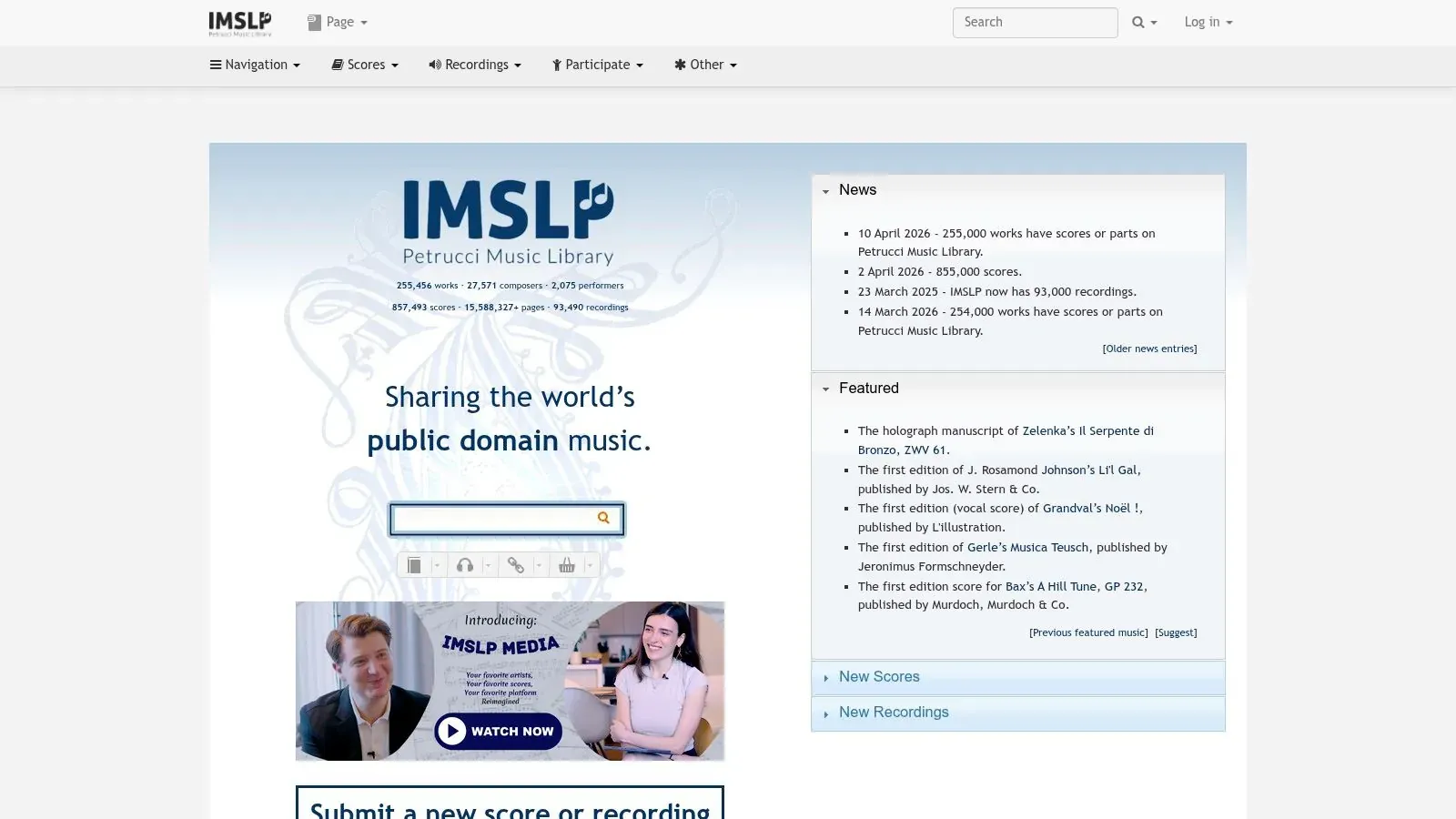
IMSLP is the deepest score library in this list. If your job is to verify a composition, compare editions, extract parts, or prepare a real arrangement, the work gets serious at this resource.
Most artists think of public domain in terms of songs. Arrangers think in editions. That’s the shift IMSLP forces, and it’s useful. A composition may be public domain while a later critical edition, editorial realization, fingering system, translation, or newly engraved publication is not the safest source to copy from directly.
Why IMSLP matters for release safety
IMSLP’s metadata and rights notices make it easier to distinguish the underlying work from a specific edition. That distinction matters whenever you’re adapting older music into a commercial release. The melody may be free. The modern editorial packaging around it may not be.
For artists making piano recordings, orchestral adaptations, chamber recordings, choral reductions, or hybrid electronic arrangements, IMSLP often becomes the source of truth for the actual written material. It’s the standard reference many music directors and engravers use because it has depth, alternate versions, and enough detail to catch mistakes before they become release issues.
Don’t copy from the first PDF you find. Check whether you’re looking at the original work or somebody’s later editorial treatment.
A practical IMSLP workflow looks like this:
- Confirm the composer and work identity: Many titles overlap or exist in multiple versions.
- Check edition notes: Prefer older source materials when you need the cleanest public domain footing.
- Use multiple uploads: Compare versions when articulation, voicing, or text differs.
The main limitation
IMSLP is score-first. If you need a simple “download this public domain audio file and move on” experience, it won’t feel straightforward. It also requires more musical literacy than a casual song list. That’s why it’s valuable.
The artists who get the most from IMSLP are the ones willing to do arrangement work, not just browse titles. If that’s you, IMSLP is less a list and more an infrastructure layer for building recordings from old repertoire with precision.
5. CPDL Choral Public Domain Library
CPDL solves a specific problem. It helps artists find public domain vocal repertoire in usable performing formats, not just title-level references.
That distinction matters if the release depends on singers. Choir directors, vocal arrangers, church music producers, early music ensembles, and a cappella groups need more than confirmation that a song is old enough to use. They need voicing, text underlay, translation options, range awareness, and material that can get a rehearsal off the ground without rebuilding the score from scratch.
CPDL is strongest with repertoire that lives or dies on vocal writing. Hymns, motets, madrigals, masses, part songs, and seasonal sacred works are easier to assess here because the library is organized around how people perform them. A generic public domain song list rarely tells you whether a piece exists in SATB, SSA, or TTBB, or whether a practical edition is already available. CPDL often does.
For release planning, that saves real time.
A strong use of CPDL starts with repertoire filtering, not downloading. Search by voicing, language, composer, and liturgical or historical category. Then inspect the actual materials. If the piece fits the ensemble, compare the score, any available MIDI, and the text source before arranging or tracking vocals. That workflow is especially useful for artists building holiday catalogs, sacred releases, or ensemble projects that need multiple public domain titles prepared on a deadline.
Useful use cases include:
- A cappella releases: Search by voicing to find repertoire your group can record without major rewriting.
- Choir production prep: Use notation files and MIDI as rehearsal references, then clean up the arrangement for session use.
- Seasonal recording strategy: Build around traditional Christmas and sacred works that audiences already recognize, while shaping a distinct arrangement and master.
CPDL’s trade-off is quality control. It is community-edited, so engraving standards, editorial consistency, and source documentation vary from file to file. Some scores are clean enough to move straight into rehearsal. Others need correction, reformatting, or source comparison before they are safe for commercial use.
That is the legal and production checkpoint serious artists cannot skip. A public domain composition can still appear in a newer edition with editorial additions that create separate rights questions. Before release, confirm what is public domain, what was added by the editor, and whether your final arrangement is based on the underlying work rather than someone else’s protected preparation.
Used that way, CPDL is more than a choral archive. It is a practical sourcing tool for artists who want to turn public domain vocal music into recordable, platform-ready releases with fewer avoidable mistakes.
6. Internet Archive Great 78 Project
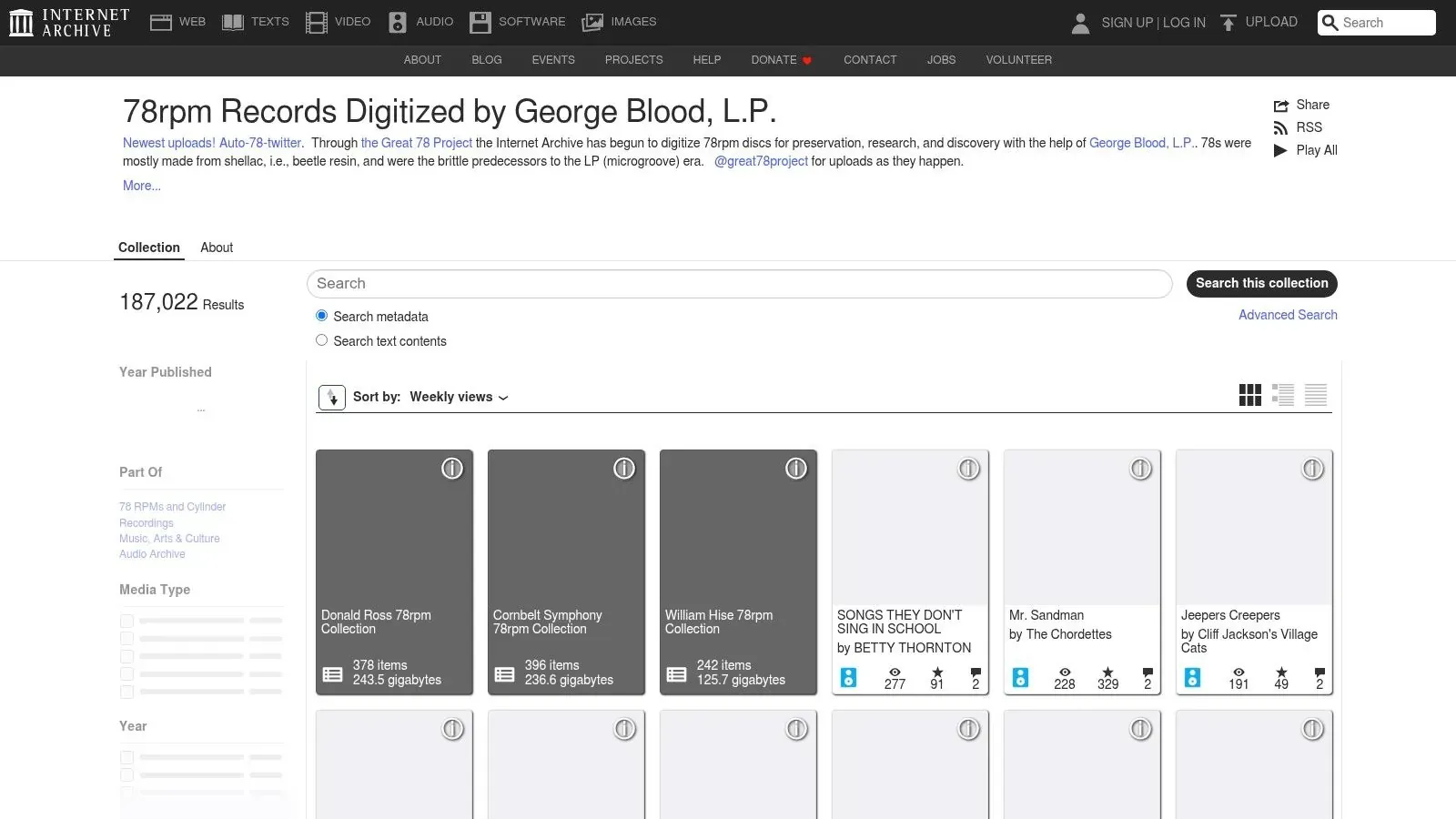
Internet Archive’s Great 78 Project contains hundreds of thousands of historical recordings. For artists, that scale changes the job. You are no longer scanning a short list of familiar standards. You are researching actual recorded repertoire, performance habits, alternate titles, and period-specific arrangements that can turn a generic cover into a differentiated release.
This source is strongest at the idea stage. It exposes the recorded culture around public domain material, not just the song names. Search a title and you may find regional versions, changed lyrics, different tempos, or performances that point to a stronger arrangement concept than the version everyone already knows.
That matters if your goal is commercial use, not historical curiosity. A strong public domain release often starts with a better angle on an old composition. The Great 78 Project helps artists hear that angle.
Why artists use it
Producers working in folk, blues, country, jazz, Americana, lo-fi, sample-based hip-hop, and archival electronic music get real value here because the archive preserves context. You hear vocal phrasing, accompaniment choices, room sound, label copy, and sequencing habits from the era. Those details shape arrangement decisions, artwork direction, metadata choices, and audience positioning.
I use archives like this to answer practical questions before a session. Which version feels familiar enough to attract listeners? Which version is obscure enough to avoid sounding interchangeable? Which title variant is historically accurate, and which one will create metadata confusion on streaming platforms?
Those are release questions, not museum questions.
The trade-off
The Great 78 Project is rich, but it is not a rights-clearance database. An old recording on Internet Archive does not automatically mean the composition, the sound recording, or the specific edition behind it is safe for your intended use.
Use the archive to find candidates. Then verify each one through the copyright-status sources in this article. Check the underlying composition date, publication history, renewal status where relevant, and whether you are dealing with a public domain song, a later arrangement, or a recording that raises separate issues. Artists planning film, TV, or ad placements should also understand how public domain repertoire fits into a broader music sync licensing strategy, because the composition may be free to use while your new master still becomes a licensable asset.
The archive is excellent for discovery and reference. Legal clearance still requires a separate check.
Use it for three jobs:
- Repertoire research: find lesser-used songs and trace how titles or lyrics changed across releases.
- Arrangement reference: study tempo, instrumentation, intros, endings, and phrasing before building your own version.
- Catalog positioning: identify material with enough listener recognition to market, but enough creative room to justify a new recording.
Used with discipline, the Great 78 Project becomes more than an archive. It is a scouting tool for artists who want to find public domain material with recording potential, confirm it properly, and turn historical repertoire into platform-ready releases.
7. Duke University Center for the Study of the Public Domain
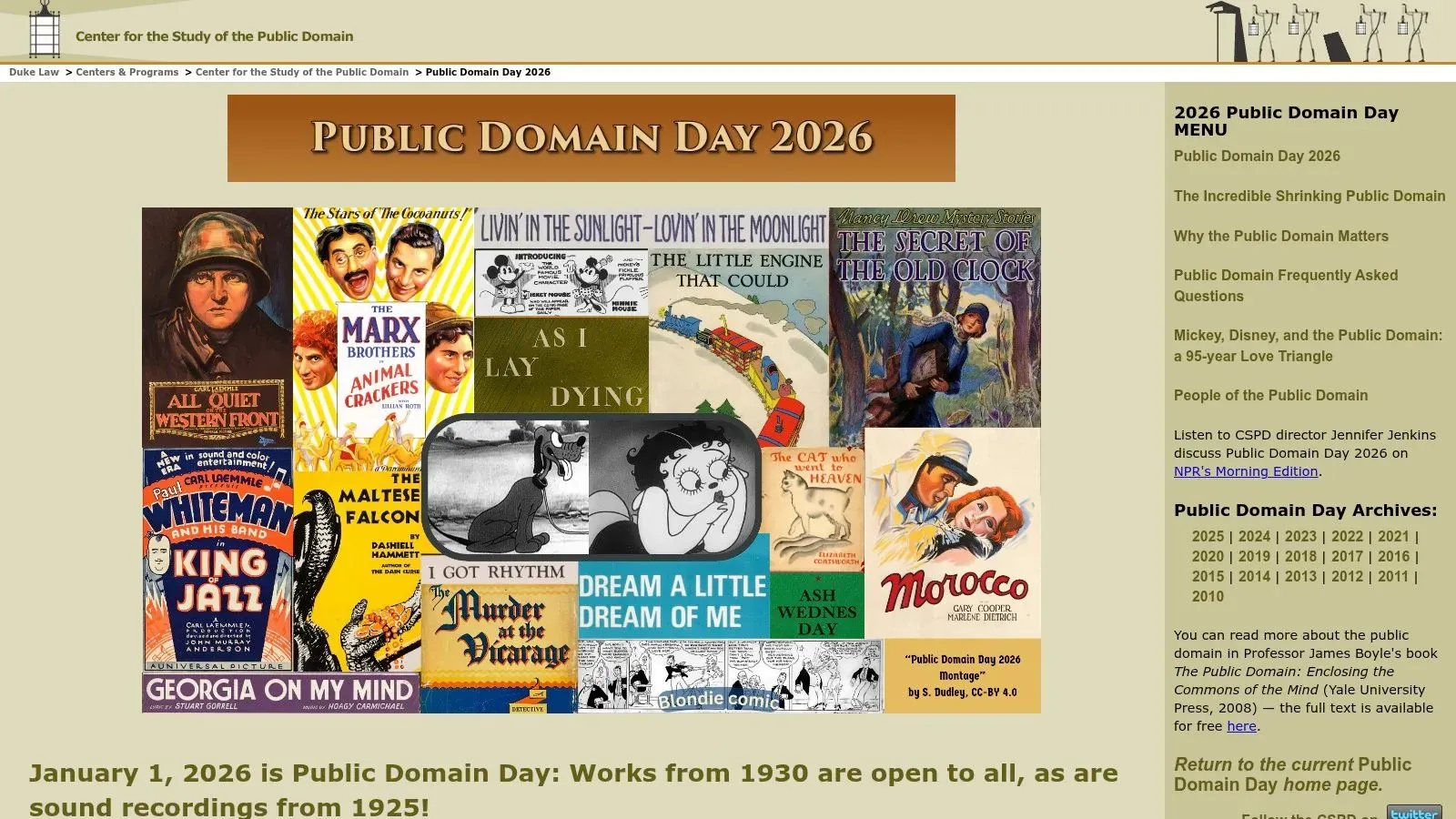
Duke University’s Public Domain Day pages are the best planning resource in this list. They don’t host scores or downloadable masters. They explain what enters the U.S. public domain each year and why, which makes them ideal for release calendars, catalog planning, and internal rights notes.
That annual cadence matters because public domain strategy is time-sensitive. In 2019, 1923 works entered the U.S. public domain after a 20-year freeze that began in 1998, and that same period saw U.S. song consumption reach a record $5.8 billion in 2018, up 27% year over year, according to Exploration’s summary of 1923 works entering the public domain and U.S. song consumption. Duke helps artists map that yearly legal change to actual release opportunities.
Why Duke is strategically important
Most public domain mistakes happen because artists work from stale assumptions. They remember that a song “must be old enough by now” and never check the specific January cutoff. Duke’s annual lists force precision.
They’re also useful when you need language for internal documentation. Managers, labels, and distributors often need a plain explanation of why a work is newly usable. Duke’s public-facing academic summaries are clear enough to anchor that conversation.
For serious catalog planning, Duke helps with:
- Public Domain Day scheduling: Build release concepts around annual January entries.
- Team communication: Give collaborators a reliable explanation of composition versus recording status.
- Documentation: Support your internal notes before delivery or pitching.
A smart pairing with audience data
Duke tells you what’s legally opening up. It doesn’t tell you what listeners want. That’s the gap artists should close with search and platform data.
The underserved question is demand. Static catalogs tell you what exists, but they don’t show which public domain songs Spotify listeners actively search for, which arrangements attract attention, or where competition is weak. That’s where artist.tools becomes useful. Its Autocomplete, Keyword Search, and Spotify SEO Research are built for finding live search behavior around songs, titles, and playlist concepts rather than relying on dead lists. If your end goal includes sync positioning too, this music sync licensing guide fits naturally into the workflow once you’ve confirmed the repertoire.
Duke is the calendar. Your data stack decides whether the calendar turns into streams.
7-Source Public-Domain Song Comparison
| Source | Complexity 🔄 | Resource requirements ⚡ | Expected outcomes 📊 | Ideal use cases 💡 | Key advantages ⭐ |
|---|---|---|---|---|---|
| Public Domain Information Project (PDInfo) | Low, simple lookup and FAQs | Minimal, free site, optional purchases (reprints) | Clear U.S.-focused composition verification; reduces release risk | U.S. covers, distributor audits, pre-release checks | U.S.-specific guidance and practical proof options ⭐ |
| Library of Congress – National Jukebox | Moderate, browse + check item-level rights | Low cost (free) but download availability varies | Access to authoritative early-20th‑century recordings with provenance | Research historical PD recordings; sourcing notable period performances | Library-of-Congress authority with item rights statements ⭐ |
| Musopen | Low–Moderate, straightforward search; freemium model | Freemium (daily limits) or paid membership for unlimited/lossless | Obtain classical PD audio and scores ready for reuse or adaptation | Classical backing tracks, sampling, education, reference recordings | Clear licensing posture; audio + scores in one nonprofit catalog ⭐ |
| IMSLP (Petrucci Music Library) | Moderate, navigate editions and edition-specific rules | Free access; optional membership to streamline access | Deep, authoritative scores for performance, arrangement, engraving | Arrangers, conductors, performers needing original scores | Largest public-domain score library; comprehensive metadata ⭐ |
| CPDL (ChoralWiki) | Low–Moderate, volunteer uploads, variable quality | Free; downloads in multiple formats (PDF, MIDI, notation) | Practical choral parts and scores usable for rehearsal and performance | Choral arranging, hymnals, a cappella projects | Specialized choral focus with multi-format downloads ⭐ |
| Internet Archive – The Great 78 Project | Moderate, large archive; user must verify rights | Free downloads and rich metadata; no legal clearance provided | Rich historical recordings discovery; many PD-era items but legal status must be checked | Historical research, sourcing period recordings, inspiration for sampling | Unique depth in 78s across genres; extensive download archive ⭐ |
| Duke University – Public Domain Day Lists | Low, annual curated lists and explanatory notes | Free academic resource (no media provided) | Clear identification of works entering U.S. PD each year; planning tool | Timed release planning, citation for marketing/distributor notes | Trustworthy, citable academic guidance on PD timing and distinctions ⭐ |
Treat Public Domain as a Strategic Asset
Millions of streams still go to songs whose underlying compositions no longer require the same composition licensing workflow as current copyrighted works. Serious artists use that fact to lower rights friction, speed up release planning, and build catalog around repertoire that listeners already know.
The strategic value is not the song list itself. The value is the system behind it.
Each of the seven resources above serves a different job. The Public Domain Information Project and Duke help confirm status and timing. The Library of Congress National Jukebox and the Internet Archive Great 78 Project give historical recordings, context, and repertoire leads. Musopen, IMSLP, and CPDL supply the scores and practical materials needed to produce new versions. Used together, they form a working pipeline from idea to release.
That pipeline starts with verification. Confirm the composition status first. Then check the recording separately if archival audio is part of the plan. Artists who skip that split often create avoidable distributor issues, metadata disputes, or takedown risk. Artists who handle it early can brief collaborators, document their release files, and move faster when release day gets close.
The next step is selection. A long public domain list is not a strategy. Strong choices usually come from one of four angles: audience familiarity, seasonal demand, arrangement headroom, or catalog fit. A hymn with stable search demand may support a clean vocal release. An old folk song may support multiple genre treatments. A neglected classical work may work better for sync, study playlists, or branding with music alone than for direct search traffic. The trade-off is simple. Familiar titles face more competition, while obscure titles often need stronger packaging and positioning.
Arrangement is where public domain material becomes defensible as a modern release. The underlying composition may be free to use, but the market does not reward copycat versions. New harmony, pacing, instrumentation, language choices, structure, and production framing are what turn old repertoire into a distinct asset. For choir, chamber, piano, and early music projects, score quality matters more than many artists expect. That is why source choice matters. IMSLP may be better for authoritative editions. CPDL may be faster for practical choral use. Musopen may be the cleaner path when audio reference and score access need to live in one place.
Historical recordings also have strategic value beyond direct reuse. They show phrasing norms, tempo habits, lyric variants, and period style. That research can improve a new master even when no old recording is sampled or distributed. The best releases often use archives for interpretation, then build a fresh recording that is easier to clear, market, and monetize on Spotify and other DSPs.
Demand research decides whether the release has a real commercial lane. Static databases answer, “Is this work available?” They do not answer, “Do listeners search for this title now?”, “Which variant wording appears in playlists?”, or “Is the demand tied to a season, mood, or instrument?” Those questions affect title formatting, artwork, playlist pitching, and whether a release should stand alone or be part of a themed series.
Cost control is another advantage. Public domain repertoire does not erase production, marketing, or distribution costs. It does remove one major layer of composition-side friction. That changes the economics for niche releases, educational catalogs, music works without lyrics, and recurring seasonal campaigns. For independent artists and small labels, that margin difference can be the reason a project gets made at all.
The artists who get consistent results treat public domain works as catalog infrastructure. They verify the rights position, choose titles with real audience logic, create a version with a clear artistic reason to exist, and document the release in a way distributors can review without confusion. That approach is harder than posting a quick cover. It is also far more durable.
artist.tools helps you do the part that static public domain lists can’t. You can verify whether listeners search for a song title, spot keyword gaps with Keyword Search, monitor Spotify autocomplete behavior with Autocomplete, analyze playlist integrity and curator history with Playlist Analyzer, and track how your release performs over time with Stream Tracker and Monthly Listeners Tracker. If you’re turning public domain repertoire into a real Spotify growth strategy, artist.tools is the platform built for that job.