Royalties on Spotify: A Clear Guide to royalties on spotify Earnings
- Jan 6
- 17 min read
Staring at your Spotify for Artists dashboard, trying to figure out what those stream counts actually mean for your wallet? It’s a common frustration. The simple truth is, Spotify doesn't pay a fixed rate per stream. It's not like a vending machine where one stream equals a set amount of cash.
Instead, picture all the money Spotify pulls in each month from subscriptions and ads. It all goes into one massive global pot. Your earnings are simply your slice of that pot, determined by your share of the total streams that month.
Unlocking Your Spotify Earnings
Getting a real grip on how Spotify royalties work is the first step toward building a music career that actually pays the bills. So many artists watch their stream numbers climb, only to feel completely disconnected from the money that's supposed to follow. We're here to break down that complex system into simple, understandable pieces, giving you a clear map of how money travels from a listener's finger tap all the way to your bank account.
The first concept you absolutely have to grasp is Spotify's pro-rata model.
Think of it like a giant pizza made from all the revenue Spotify collects in a month. The size of your slice isn't a fixed amount—it depends entirely on how many streams your music got compared to every other song on the platform in that same period.
This is exactly why the per-stream rate is always changing. It's not a static number, which is why understanding the bigger picture is so critical. To really get it, you need to know who gets a piece of the pie.
Rights Holders: These are the owners of the music. This breaks down into two main parts: the master recording (usually the label or the independent artist) and the composition (the songwriter and their publisher).
Distributors: Think of companies like DistroKid or TuneCore. They act as the middleman, getting your music onto Spotify and then collecting the master recording royalties for you.
Publishers & PROs: These are the folks who collect the money owed to the songwriter. Organizations like ASCAP, BMI, and services like Songtrust make sure the creators of the song itself get paid.
Before we dive deeper, let's get a quick overview of the key numbers and terms you'll encounter.
Spotify Royalties At a Glance
This table provides a snapshot of the most important figures and concepts we'll be breaking down. Think of it as your cheat sheet for understanding Spotify payouts.
Metric | Average Figure or Concept | Why It Matters to You |
|---|---|---|
Average Per-Stream Payout | $0.003 - $0.005 | This is a rough estimate; your actual rate will vary based on many factors. |
Payout for 1 Million Streams | $3,000 - $5,000 (before splits) | A tangible example of potential gross earnings before your team gets their cuts. |
Total Payouts Since Inception | Over $60 Billion | Shows the massive scale of the streaming economy and its importance to the industry. |
Payout Model | Pro-Rata System | Your earnings are your share of a collective revenue pool, not a fixed rate. |
Key Payout Recipients | Rights Holders (Master & Publishing) | The money is split between the recording owners and the songwriters. |
These figures highlight the potential but also the complexity of the system. Your final take-home pay is influenced by many moving parts.
The Scale of Spotify Payouts
The streaming world has exploded, and it's now the main way the music industry makes money. Since it started, Spotify has paid out over $60 billion to rights holders. That pace is only getting faster—in 2024 alone, Spotify dished out more than $10 billion.
While that often-quoted $0.003 to $0.005 per stream is a decent starting point, it's just an average. Hitting one million streams could mean a payout between $3,000 and $5,000, but remember, that’s before your distributor, label, and publisher take their shares. You can get more details on Spotify's financial impact from their 2025 music industry report.
This is where tools designed for artists become so valuable. For instance, you can use a Spotify Royalties Calculator to get a solid estimate of your potential earnings. It helps turn those abstract stream counts into real-world financial forecasts. By understanding these fundamentals, you can shift from just passively watching your streams to actively building your revenue.
The Journey From a Single Stream to Your Bank Account
When someone hits play on your song, that single tap kicks off a surprisingly complex financial journey. The money doesn't just zip from Spotify straight into your account. Instead, it gets pooled together, sliced up, and sent down a winding path with several stops along the way. Getting a handle on this process is the first step to truly understanding what you earn and why.
Think of it like this: every month, Spotify collects all the money it makes—from every Premium subscription and every ad played on its free tier, all over the world. This massive pile of cash gets dumped into one giant royalty pool. This is the total pot of money that will be paid out to artists, labels, and songwriters for that month.
So, how does your slice get carved out of that global pot?
The "Big Pizza" Model: Understanding Pro-Rata Royalties
Spotify uses a system called pro-rata, or what you can think of as a "streamshare" model. The easiest way to wrap your head around it is to imagine that monthly royalty pool is one enormous pizza.
Every single stream on Spotify in that month—whether it's for Drake or an indie artist's debut single—is one tiny bite taken from that pizza. To figure out your payout, Spotify calculates what percentage of the total bites (streams) belongs to you. If your tracks accounted for 0.01% of all streams that month, you get 0.01% of the pizza. Simple as that.
This chart breaks down the basic flow, showing how the money moves from the initial revenue pool to your eventual payout.
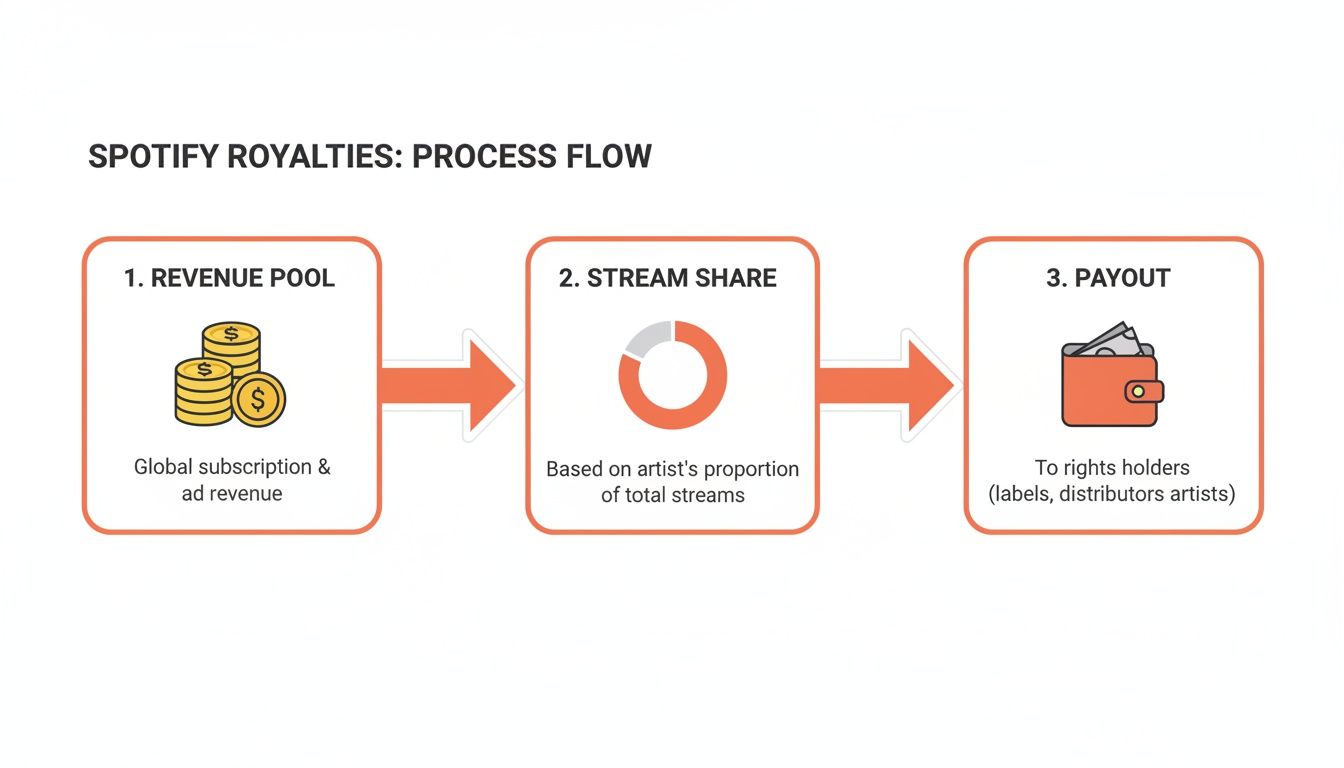
As you can see, your earnings aren't a flat rate per stream. They're a proportional slice of a much bigger pie, which is why the per-stream value changes every single month.
Key Takeaway: Your payout isn’t based on a fixed rate per stream. It's determined by your share of the total streams on the platform, which is why the effective per-stream rate fluctuates monthly.
But before that money even thinks about reaching you, it gets split into two very different types of royalties, tied to two separate copyrights that exist in every song.
The Two Halves of a Song: Master vs. Publishing Royalties
Every song you release is actually two distinct legal properties smashed together, and each one earns its own kind of money:
Master Recording Royalties: This is for the actual recording—the final audio file of your song. These royalties go to whoever owns that master, which is usually a record label or, if you're independent, you.
Publishing Royalties: This is for the underlying composition—the melody, the lyrics, the song's DNA. These royalties are paid out to the songwriters and their publishers.
Spotify pays out both, but they travel down completely different roads and are collected by different organizations before they find their way to the right people.
Who Gets Paid Before You Do?
The path from Spotify's giant pizza to your bank account is lined with a few key players who all take a cut for the work they do. Knowing who's in this chain helps explain why the number you see in your statement isn't the same as the gross amount your streams generated.
Here’s who gets a slice:
Your Distributor: Companies like DistroKid or TuneCore are your on-ramp to Spotify. They deliver your music and collect the master recording royalties for you, taking a small fee or commission for their services.
Your Record Label (if you have one): If you're signed, the label owns the master recording. They'll collect the royalties from the distributor, take their cut according to your contract, and then pay you the rest.
Your Publisher: A publisher's job is to manage your compositions and collect your publishing royalties. They take an administrative fee for handling all the licensing and paperwork.
Performance Rights Organizations (PROs): Groups like ASCAP and BMI collect a specific type of publishing royalty (performance royalties) from Spotify. They then split it, paying half to the publisher and the other half directly to the songwriter.
Each one of these partners is essential for getting you paid, but their fees and splits directly affect your final take-home pay. For a deeper dive into the nuts and bolts, our complete guide on how to get paid by Spotify breaks it down step-by-step. This whole chain of command is exactly why the money trail is so complicated.
How Spotify Calculates Your Royalty Payments
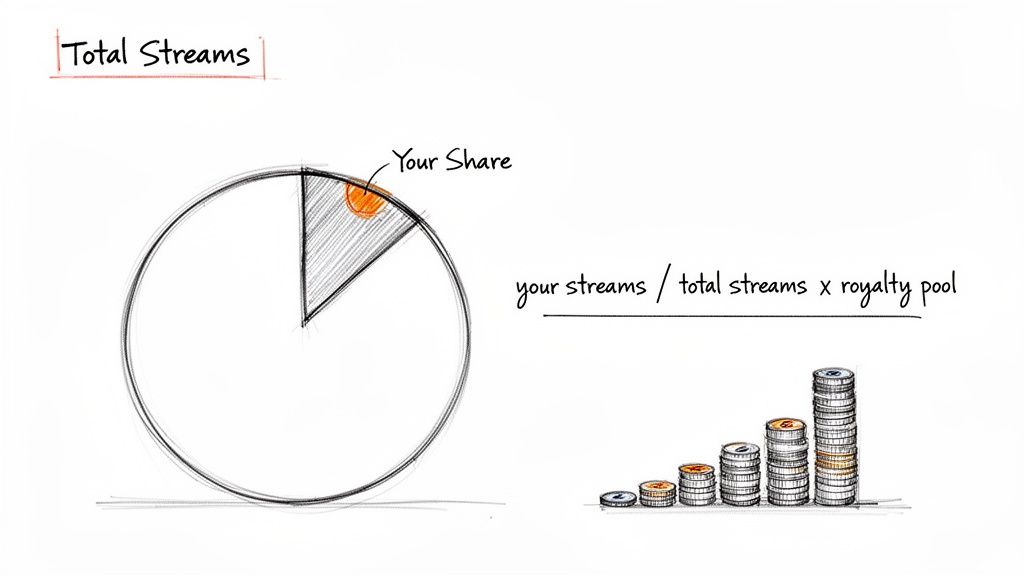
Alright, let's pull back the curtain on how the money actually gets from Spotify into your pocket. Understanding this isn't just for music business nerds; it's mission-critical for any artist trying to make a living. The whole system is built on what's called the pro-rata model, which basically means your payout is a direct slice of a much, much bigger pie.
Every month, Spotify collects all the revenue from Premium subscription fees and the ads they run for free listeners. This cash gets dumped into one massive global royalty pool. From there, Spotify allocates about 65–70% of that pool to rights holders—that's everyone from labels and distributors to publishers and songwriters.
So, how do they figure out your slice? It comes down to your "streamshare," or your percentage of the total streams on the entire platform for that month.
The Streamshare Calculation in Action
Let's make this real with a quick example. Imagine one month, Spotify's total royalty pool for rights holders is a clean $100 million. And during that same month, a whopping 50 billion streams happened across every song on the platform.
Now, say your tracks racked up a solid 1 million streams. First, we need to find out what percentage of the total pie your streams represent.
(Your Streams / Total Streams) x 100 = Your Streamshare Percentage
(1,000,000 / 50,000,000,000) x 100 = 0.002%
Your music accounted for 0.002% of all listening activity. That means you're entitled to 0.002% of the royalty pool.
Your Streamshare Percentage x Total Royalty Pool = Your Gross Payout
0.002% x $100,000,000 = $2,000
This $2,000 is the total pot of money generated by both your recording and your songwriting rights. It’s the gross figure that gets paid out before your distributor, label, or publisher takes their cut. If you want to dive deeper into how those different income streams work, check out our guide on the types of royalties in music.
Why Your Payout Is Never the Same
This is the big question artists always ask: why does the per-stream rate always change? The pro-rata model is a moving target. 1 million streams might earn you $2,000 in January, but that same number of streams could bring in $1,800 or $2,200 in February.
This isn't random. It’s a direct result of two variables constantly shifting: the size of the total royalty pool and the total number of streams happening on Spotify.
If Spotify’s revenue grows but the number of total streams grows even faster, the value of each individual stream actually goes down. On the flip side, if revenue holds steady but total streams take a dip, each stream is suddenly worth a tiny bit more.
Exploring Alternatives to the Pro-Rata System
The pro-rata model has its fair share of critics. Many argue it overwhelmingly benefits superstars whose massive stream counts soak up a huge portion of the royalty pool, leaving less for everyone else. This has sparked a lot of conversation around different payment models, with the user-centric model being the leading alternative.
Here’s the fundamental difference:
Pro-Rata Model: All subscription money is thrown into one giant pool. Your monthly fee helps pay artists you've never even heard of.
User-Centric Model: Your individual subscription fee (minus Spotify's cut) is paid out only to the specific artists you actually listened to that month. If you only streamed 10 artists, your money would be split just between them.
While platforms like SoundCloud have started experimenting with user-centric payments, Spotify still relies on the classic pro-rata model for the vast majority of its payouts. Still, knowing the alternative helps you understand the bigger conversation happening around fairness in streaming. For now, your best move is to master the system we have and work to maximize your earnings within it.
Why Your Per-Stream Rate Is Never the Same
If you've ever looked at your royalty statements and wondered why your per-stream payout changes from month to month, you're not going crazy. It's one of the biggest misconceptions in the music business: the idea that Spotify has a single, fixed rate for every stream.
The truth is, there's no such thing. The value of a single stream is a moving target, shifting based on a whole cocktail of factors. That's why a million streams in March can pay out differently than a million streams in April. It boils down to a simple fact: not all streams are created equal.
Subscription Type: The Premium vs. Free Divide
The single biggest piece of the puzzle is how your listeners are actually using Spotify. A stream from a paying Premium subscriber is worth a whole lot more than a stream from someone on the free, ad-supported tier.
Premium users pump their monthly subscription fees directly into the revenue pool that gets paid out to artists. Think of it as a more direct line from their wallet to yours. On the flip side, free listeners generate revenue from ads, which is a much smaller and less consistent source of cash. So, a month with a higher ratio of Premium listeners will always boost your average payout rate.
Why this matters: Building a fanbase of dedicated, paying subscribers is the key to generating sustainable income. It’s all about turning those casual listeners into super-fans who are invested enough to pay for a subscription, which in turn supports you directly.
Understanding this split is the first step to a smarter growth strategy. If you focus on markets where Premium subscriptions are common, you'll see a real impact on your bottom line.
Geographic Location: Where Your Listeners Live
Just like subscriptions, not all countries are equal when it comes to royalty payouts. Where your listeners are physically located plays a huge role in what their streams are worth.
It all comes down to local economics. The price of a Spotify Premium subscription and the rates advertisers are willing to pay vary massively from one country to another.
Here’s a quick look at how it works:
High-Payout Regions: Streams from listeners in countries with strong economies and higher subscription costs—like the United States, the UK, Norway, and Switzerland—generate the most revenue.
Lower-Payout Regions: Streams from developing markets will contribute less to the global royalty pool. In these areas, subscription prices are lower to match the local cost of living and purchasing power.
This means 100,000 streams from the US will earn you a lot more than 100,000 streams from a region with lower subscription fees.
Here’s a table that breaks down how different factors can push your royalty rates up or down.
How Listener Type and Location Impact Your Royalties
This table gives you a clear comparison of what makes a stream more or less valuable to your final payout.
Factor | Higher Royalty Impact | Lower Royalty Impact | Why It Matters |
|---|---|---|---|
Listener Subscription | Premium Subscriber | Free Tier User | Premium subscriptions directly fund the royalty pool with cash, making these streams significantly more valuable. |
Listener Location | Developed countries (e.g., USA, UK, Switzerland) | Developing countries (e.g., India, Brazil) | Payouts are tied to regional subscription costs and ad rates, which are higher in stronger economies. |
Engagement Type | Direct, intentional streams | Programmed, passive streams | While harder to track, active listening from fans often correlates with higher-value user segments. |
Ultimately, cultivating a dedicated fanbase in high-value markets is the most direct path to increasing your Spotify earnings.
Your Unique Distribution Deal
Finally, the contracts you've signed have the last say on what actually hits your bank account. The gross amount Spotify calculates isn't what you get; it first goes to the rights holders.
Your specific deal with your distributor or record label dictates their cut. A distributor might take a flat fee or a percentage, usually somewhere between 10% and 25% of your master recording royalties. A record label deal is a different beast entirely, often involving a much larger split depending on the terms you negotiated.
Because every artist's deal is unique, two artists with the exact same number of streams from the same places can walk away with wildly different net earnings. This is just part of how the industry works, and it’s why knowing the ins and outs of your agreements is absolutely critical to understanding your royalty payments.
Strategies for Maximizing Your Spotify Earnings
Knowing how royalties on Spotify work is one half of the battle. The other half? Actually making those numbers go up. This is where you switch from just being an artist to being the architect of your own streaming career. Releasing great music is the price of entry—real success on Spotify demands a smart, data-driven plan to grow your audience and protect the money you earn.
Forget guesswork. You need tools that translate all that complex streaming data into a clear roadmap. That means forecasting what you might earn, watching your performance in real time, and—this is a big one—making sure every stream is legit. The music world has its share of traps that can drain your earnings, which makes being proactive more important than ever.
Forecast Your Earnings with Precision
Trying to budget as an artist can feel like reading tea leaves. How much will that new single really bring in? Will that marketing push actually pay for itself? Flying blind with rough estimates just doesn't work when you're trying to build a sustainable business.
This is exactly why a dedicated Spotify Royalties Calculator is such a game-changer. By simply plugging in your stream counts, you can turn abstract numbers into concrete financial projections. It’s the difference between wishful thinking and having a real strategy, allowing you to set tangible goals for your next tour, new gear, or ad spend.
With a few clicks in the artist.tools Spotify Royalties Calculator, you can see how stream volume translates into potential revenue. This direct line between streams and dollars helps artists set clear targets and truly grasp the financial impact of their growth.
A data-driven approach finally lets you answer the big questions: "If my new single hits 100,000 streams, what does that actually mean for my bank account?" This kind of foresight is what separates artists who hope for success from those who plan for it.
Using a tool like this regularly helps you see the direct ROI of your promotional efforts. It gives you a clear benchmark to measure what’s working and helps you put your time and money where it counts.
Protect Your Royalties from Artificial Streams
Heads up: not all streams are created equal. In fact, some can seriously hurt your career. Artificial streaming—usually from bots or shady "promotion" services—is a massive problem that can have disastrous consequences. Spotify is always on the lookout for this kind of activity, and they don't mess around.
If your tracks get flagged for fake streams, you could be looking at:
Frozen Royalties: Any money generated by those streams gets locked up.
Track Takedowns: Spotify can pull your songs right off the platform.
Account Strikes: Too many offenses can get your entire Spotify for Artists account penalized.
These aren't just empty threats. Plenty of artists get duped by scammy playlisting services that use bots to inflate numbers. Falling for one of these can wipe out months of genuine hard work, wrecking your reputation and your income stream in one fell swoop.
That’s why stream legitimacy is everything. Protecting your royalties on Spotify means making sure your growth comes from real people who are genuinely discovering your music.
Use a Playlist Analyzer to Verify Placements
So how do you spot a fake playlist before you pitch your music to it? You have to look at its behavior. A sudden, massive jump in followers out of nowhere is a huge red flag for bots. Same goes for a playlist with tens of thousands of followers but almost no real, engaged listeners.
A Playlist Analyzer gives you the power to vet these placements before you even think about submitting. By digging into historical follower data, listener engagement, and other crucial metrics, you can spot the authentic playlists run by actual curators. This bit of homework is absolutely essential for safeguarding your career.
It lets you focus your energy on high-quality, legitimate playlists that will connect you with real fans—not just a bunch of bots. This not only protects your account from getting flagged but also drives the kind of organic growth that builds a lasting career and a reliable royalty check. At the end of the day, maximizing your earnings is as much about protection as it is about promotion.
Taking Control of Your Streaming Career
The world of royalties on Spotify can feel like a tangled mess, but it’s not an unbreakable code. Hopefully, this guide has shown you that getting a solid grip on the mechanics is the single most important step you can take toward empowering yourself as an artist. It’s all about taking ownership of your career path.
The biggest takeaway here is to shift your mindset. Stop being a passive earner and start acting like the active manager of your own music business. Knowledge is the foundation, sure, but the right tools are what let you build something that actually lasts.
From Knowledge to Actionable Strategy
Information alone won't pay the bills. You need a way to bridge the gap between understanding a concept like the pro-rata model and making choices that actually grow your income. This is where the real magic happens—when insights from this article meet practical, everyday tools.
By pairing what you've learned here with the features inside artist.tools, you can start building a more secure future for your music. It's time to stop guessing and start strategizing.
This active approach isn't just about promotion; it's also about protection. Guarding your music against fake, botted streams and properly vetting anyone you work with for promotion are non-negotiable parts of being a professional. You have to make sure every stream you earn is legitimate and actually contributes to your bottom line.
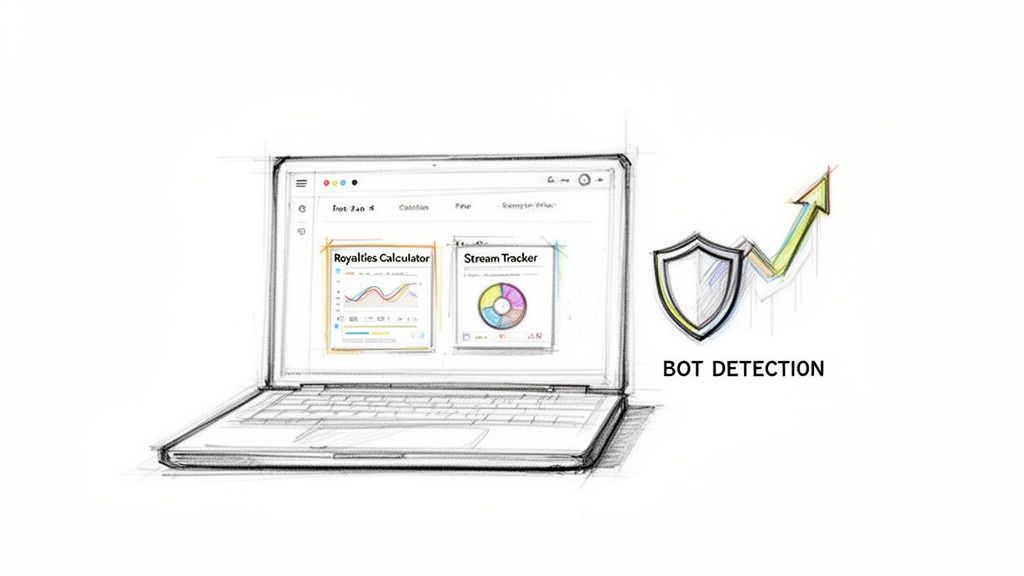
Using tools like a Spotify Royalties Calculator to forecast potential earnings, a Stream Tracker to monitor your music's real-time performance, and a Playlist Analyzer to vet opportunities gives you a complete toolkit. This data-driven approach means you can invest your time and money where it counts, focusing only on the things that produce real results.
You're no longer just hoping for success—you're engineering it.
Got Questions? We've Got Answers.
When you're trying to figure out Spotify royalties, a million little questions can pop up. Let's tackle some of the most common ones artists run into, so you can get a clearer picture of how your money moves.
How Often Does Spotify Actually Pay Out?
Spotify settles up with rights holders every month. But—and this is a big but—that doesn't mean cash hits your bank account on the 1st of every month. There's a bit of a lag.
Typically, Spotify finalizes and sends payments to distributors and labels about 60 to 90 days after the month the streams happened. So, the money you earned from your January streams might not even reach your distributor until March or April.
From there, your distributor (think DistroKid or TuneCore) takes over. They process the payment, take their cut, and then pass the rest on to you based on their schedule, which is usually also monthly. The final step is all on them, so it's always smart to check your distributor's terms to know exactly when to expect your earnings.
Why Does My Per-Stream Rate Change Every Single Month?
This is probably one of the biggest head-scratchers for artists. Your per-stream rate isn't set in stone; it's practically guaranteed to change from one statement to the next. This all comes down to Spotify's pro-rata system, where all the money is dumped into a big pot and then divided up based on who got what share of the total streams.
A few key things make this number jump around:
The Size of the Pie: Spotify's total revenue from subscriptions and ads changes every month. A great month for Spotify means a bigger pie for artists to share. A slow month means the opposite.
Total Streams on the Platform: The total number of streams across all of Spotify is always in flux. If the platform's total streams grow faster than your streams, your slice of the pie gets smaller, dropping your per-stream rate.
Who's Listening: Not all streams are created equal. The value of a stream depends on the listener. A stream from a Premium subscriber in the US is worth way more than a stream from a free, ad-supported user in a country with lower subscription fees.
Do I Really Need a Publisher to Get All My Royalties?
Short answer: yes. If you want to collect every single cent you're owed, you absolutely need a publisher or a publishing administrator. Here's why: your music actually generates two different kinds of royalties on Spotify—master recording royalties and publishing royalties.
Your distributor handles the master recording royalties. That's their job. But they don't touch the publishing side of things, which comes from the song itself—the melody and the lyrics you wrote.
Publishing royalties get complicated fast. They're split into performance and mechanical royalties, and they're collected by a whole web of organizations around the world. A publishing administrator like Songtrust exists specifically to chase down this money for you. They register your songs everywhere they need to be and collect what you're owed. Without one, you're pretty much guaranteed to be leaving songwriter money on the table.
Stop guessing what your streams are worth. artist.tools gives you the analytics and forecasting you need to track, protect, and grow your Spotify income. Explore the tools at artist.tools.
.png)
Comments