Your Guide to Getting on Spotify Playlists
- Jul 29, 2025
- 12 min read
For any artist trying to build a career today, getting on Spotify playlists isn't just a goal—it's a critical part of the game. It’s a mix of pitching your music directly through Spotify for Artists, smart outreach to independent curators, and keeping your artist profile sharp. The real key, though, is building momentum with a targeted approach that shows Spotify's algorithm your music is catching on.
Why Spotify Playlists Are Your Biggest Amplifier
Getting your track on the right Spotify playlist can feel like striking gold. But it’s so much more than a fleeting jump in your stream count. When done right, it plugs you into a powerful discovery engine that drives real, lasting audience growth. Think of it less like a lottery ticket and more like a cornerstone of your entire music marketing strategy.
Strategic placements don't just find you listeners; they find you the right listeners. When your song lands on a playlist that perfectly matches its genre and mood, the strong engagement—like saves and shares—sends all the right signals to Spotify’s algorithm. This is what can kickstart a powerful snowball effect, potentially landing your music on huge algorithmic playlists like Release Radar and Discover Weekly.
This chart really drives home how essential playlists are, showing exactly where most artists get their streams.
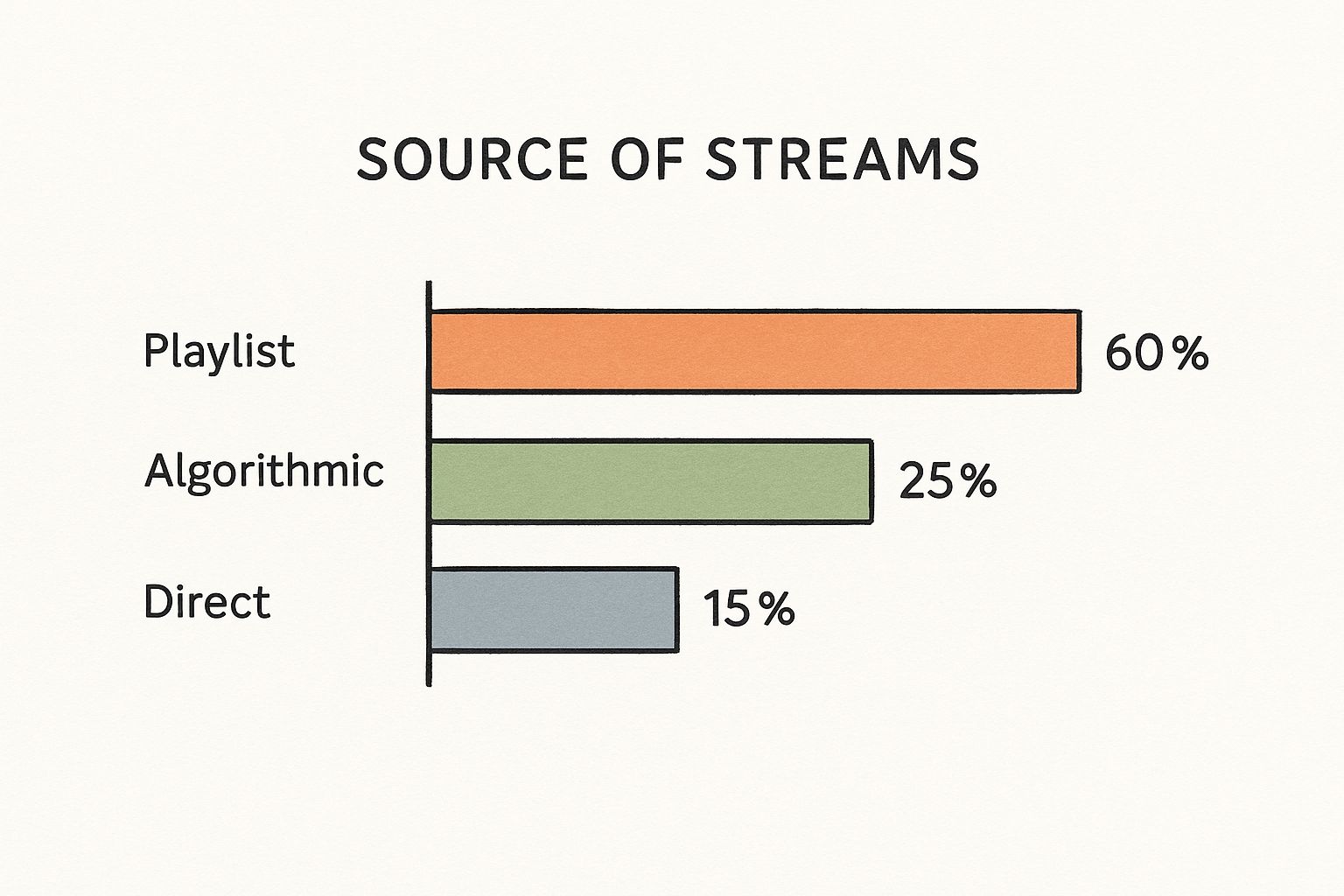
As you can see, playlists absolutely dominate music discovery, blowing past direct streams from artist profiles or fan searches.
The Power of Placement
The sheer scale of this is massive. Spotify is home to over 8 billion playlists worldwide, covering every imaginable niche and community. This highlights both the incredible opportunity and the fierce competition. Just look at a top-tier editorial playlist like 'Today's Top Hits'—it boasts over 34 million followers, making it an unbelievably powerful discovery channel. If you want to dig deeper, checking out the latest Spotify statistics can really put the numbers into perspective.
Securing a spot on even a small, niche playlist can be a significant win. It provides valuable data, proves your music resonates with a specific audience, and acts as a stepping stone to larger, more influential playlists.
Ultimately, every playlist placement helps build a solid foundation for your long-term success. Each one validates your music, expands your audience, and adds more fuel to the algorithmic engine that can carry your career forward, one stream at a time.
Building Your Foundation for Success
Before you even think about researching playlists or drafting a pitch, you need to get your house in order. Playlist curators are the gatekeepers to massive new audiences, and trust me, they make snap judgments based on what they see. Your Spotify for Artists profile is your digital storefront, and it better be ready for visitors.
Think about it like this: you wouldn't invite guests over to a messy apartment, right? The same logic applies here. A polished, professional-looking profile signals to curators that you’re serious about your music and that you respect their time. This foundational work isn’t just a nice-to-have; it’s non-negotiable if you genuinely want to get on Spotify playlists.
Optimize Your Artist Profile
Your profile is often the first—and only—impression you get to make. A few simple tweaks can completely change how you're perceived.
Start with your visuals. Get high-quality, professional press photos. Blurry selfies or low-res graphics are an instant red flag and scream "amateur."
Next, write a compelling bio. This isn't just a list of your accomplishments; it's your chance to tell your story. Who are you? What’s the story behind your music? Keep it concise but make it engaging. Give curators and potential fans a reason to connect with you beyond just a single song.
Finally, make smart use of the Artist Pick feature. This lets you pin your newest release, a specific playlist you’re proud of, or even a Countdown Page for an upcoming album. According to Spotify, artists who add video Clips to their Countdown Pages see an average of 2x more pre-saves. That’s a powerful tool for building momentum before your track even drops.
Professional Production Is a Must
This might seem obvious, but it’s the single biggest hurdle I see emerging artists stumble over. You could have written the greatest song in the world, but if the production quality is subpar, it’s an immediate "no" from any legitimate curator. Nobody is going to risk their playlist's reputation by adding a poorly mixed track.
Investing in professional mixing and mastering isn't a luxury; it’s a core business expense. It’s what ensures your track sounds crisp, balanced, and can sonically compete with every other song on Spotify.
A great song with amateur production is like a sports car with flat tires. It has all the potential, but it's not going anywhere. Curators won't risk their playlist's reputation on a track that sounds unfinished.
Consider this your pre-flight checklist. Before you ever hit "send" on a pitch, make sure your profile is immaculate and your audio is professional-grade. This prep work doesn't just boost your chances; it shows respect for the very people you're asking for support.
Finding the Right Playlists for Your Music
Pitching your music to the wrong playlists is one of the biggest wastes of time and energy you can face as an artist. This is where your real detective work begins. It’s about moving past generic advice and building a repeatable process for discovering playlists that are a perfect match for your specific sound.
Forget trying to land on "Today's Top Hits" right out of the gate. Your first goal should be building real, foundational traction with smaller, more accessible playlists. These are often run by independent curators, fellow artists, or niche music blogs who are genuinely passionate about music discovery. These are the placements that provide the social proof and algorithmic data you need to start climbing the ladder.
Start with Smart Spotify Search
Your first stop is Spotify itself, but you have to think like a power user. Don't just search for your genre. You need to use specific search operators to cut through the noise and find the hidden gems.
Try searching for things like:
"Chill lofi beats" to find playlists with that exact phrase in the title.
"Mood: morning coffee" to find playlists curated around specific activities or vibes.
"Artists like: [Artist Name]" to see what playlists similar artists are getting featured on.
This simple tweak immediately filters out thousands of irrelevant playlists. When you find ones that seem promising, dive in. Look at the other artists included—do they actually sound like you? Check the curator's profile. Are they active and engaged? This initial hands-on research is invaluable. For a deeper dive, check out our complete guide on [how to find Spotify playlists for your new music](https://www.artist.tools/post/how-to-find-spotify-playlists-for-new-music).
Verifying Playlist Quality
Once you've got a list of potential targets, the next step is crucial: verification. Not all playlists are created equal, and some can do more harm than good. You have to learn how to spot the red flags to make sure your hard work leads to real engagement, not just fake streams.
Spotify's massive global audience is a double-edged sword. With its monthly active user base hitting a staggering 640 million in Q3 2024, the platform's reach is undeniable. However, this scale also attracts bad actors who create playlists bloated with botted followers. To connect with genuine listeners, it’s smart to consider regional tastes, especially since users are spread across Europe (28%), Latin America (22%), and North America (18%).
A playlist with 100,000 followers and zero engagement is worthless. A playlist with 1,000 dedicated, active listeners who save and share your music is pure gold. Focus on real engagement, not vanity metrics.
A key red flag is follower growth that looks unnatural—like a sudden spike of 50,000 followers overnight. Legitimate playlists grow steadily over time. Tools like the Playlist Analyzer from artist.tools are built for this exact purpose. They let you examine a playlist's follower history, listener-to-follower ratio, and other health metrics.
This data-driven approach takes the guesswork out of your research. It helps you focus your limited time on legitimate opportunities that will actually help your goal of getting on Spotify playlists that matter.
Crafting a Pitch That Curators Actually Read
Let's be real: your music could be the next global hit, but a lazy, generic pitch will send it straight to the trash folder. Curators are absolutely bombarded with submissions, getting dozens—sometimes hundreds—every single day. If you want to stand out, your outreach needs to feel like a real conversation, not just a demand for a spot on their playlist.
The goal here isn't to just drop a link and run. It's to show a curator you actually respect their work, understand the specific vibe of their playlist, and are offering them something their listeners will genuinely love. That personal touch is what separates artists who get heard from those who get ignored. A killer pitch makes the curator's job easier by handing them a perfect-fit track on a silver platter.
The Anatomy of a Winning Pitch
Every single part of your email matters, and it all starts with the subject line. Forget generic titles like "Music Submission" or "Check out my new song!" They just blend into a sea of identical, low-effort requests. You need to be specific and personal to even have a chance of getting that open.
Think about it from their perspective. Which of these would you click?
Good: Music Submission for "Midnight Drive"
Better: For "Midnight Drive" - A new synthwave track from [Your Artist Name]
Best: [Your Artist Name] - Perfect fit for your "Midnight Drive" playlist
That last one is confident, it names the specific playlist, and it immediately frames your song as a solution for the curator. It screams, "I did my homework."
The secret to a successful pitch isn't making it all about you; it's about the curator and their audience. Frame your music as a valuable addition that enhances their creation and gives their listeners exactly what they came for.
Personalize, Don't Generalize
Once they've opened your email, that first line is your make-or-break moment to prove you're not just another mass email. Generic compliments are totally transparent and just don't work. You have to show you actually listened.
Try referencing a specific song you genuinely enjoyed on their playlist. Something like, "I'm a huge fan of your 'Acoustic Mornings' playlist—especially loved how you transitioned from that new Noah Kahan track into the classic Iron & Wine song. The flow is just perfect." A simple line like this proves you're a real listener, not a bot.
Keep the body of your email incredibly short and to the point. Give a one or two-sentence description of your song, focusing on its mood and feel. It also helps to mention one or two similar artists to give them a quick reference point. Then, provide a single, clean Spotify link. Seriously, do not attach audio files. No one wants to download random files.
Finally, wrap it up with a simple, respectful sign-off. Don't be pushy or demanding. A friendly, "Thanks for your time and consideration" is all it takes. This approach respects their packed schedule, shows you're a professional, and dramatically boosts your odds of landing on those Spotify playlists that can actually move the needle for your career.
Using Spotify’s Official Submission Tool Effectively
Beyond pitching to independent curators, you have a direct line to Spotify's own editorial team. This is done through the official submission tool right inside your Spotify for Artists dashboard, and honestly, it's a non-negotiable part of any serious release strategy. This is your single best shot at landing on the major editorial playlists curated by Spotify’s internal teams.
A lot of artists skip this, thinking it's a long shot, but here’s the secret: a properly handled submission is a guaranteed win. Even if you don't get picked for a massive playlist like "New Music Friday" or "Chill Hits," just by submitting correctly, your song will automatically land on every single one of your followers' personalized Release Radar playlists. That’s an immediate, crucial boost in streams and engagement the second your track is out.
Maximizing Your Submission Impact
Timing is absolutely critical with the official pitch tool. The absolute bare minimum is to submit your track at least seven days before its release date. But if you want to be taken seriously, aim for a window of 3-4 weeks. Giving editors that much lead time is just professional—it shows you’ve planned ahead and gives them plenty of time to actually listen and consider your music.
The details you provide in your pitch are what help editors figure out where your music fits. This isn't the time to be vague. You need to be specific and strategic with every single field.
Genre & Sub-genre: Be precise. Don't just put "Electronic." Is it "Synthwave," "Downtempo," or "Progressive House"? Tell them exactly what it is.
Moods: You get to pick two. Choose moods that genuinely capture the song's feeling. Is it "melancholy," "energetic," or "dreamy"?
Song Description: This is your 500-character elevator pitch. Tell the story behind the track, point out its most unique elements, or mention any big marketing plans you have lined up.
Think of your pitch as your one chance to talk directly to a Spotify editor. Make their job easy. Give them clear, accurate context so they can instantly imagine your song on one of their playlists.
Writing a Pitch That Connects
That 500-character description is your secret weapon. It’s where you can add a human touch and make your track stick in an editor's mind. Don't just write, "This is my new single." Explain what makes it special. Maybe you used a specific vintage synthesizer for the main hook, or the lyrics were inspired by a recent cross-country road trip. Those are the details that grab attention.
When you’re ready to put all this into practice, you'll want to make sure you've covered all your bases. For a complete step-by-step guide, you can learn more about how to submit music to Spotify playlists and master the process.
This is one of the most impactful things you can do for your track before it’s released. It's a low-effort, high-reward move that costs you nothing but a few minutes of your time. By taking it seriously, you guarantee a baseline of visibility and put your music directly into the hands of people who could change its trajectory overnight.
Common Questions About Spotify Playlists
When you start diving into playlisting, the same questions tend to pop up again and again. It's totally normal. As you get deeper into your outreach and try to figure out a solid strategy for getting on Spotify playlists, you're bound to run into some unique situations.
This is your cheat sheet for those tricky moments. Getting these details right can mean the difference between a successful campaign and a lot of wasted time and energy.
How Long Should I Wait to Follow Up?
This is a big one. You've sent your pitch, and now you're just waiting. It's tempting to follow up right away, but patience is a huge part of this game. Remember, curators are often getting slammed with hundreds of submissions every single week. An instant reply just isn't realistic.
A good rule of thumb? Give it at least one to two weeks. After that, it's okay to send a single, polite follow-up. Just one.
If you still don't hear anything back after that second email, it's time to let it go and move on. Bombarding a curator who isn't responding is a quick way to burn a bridge. Your time is much better spent finding new playlists where your track could be a perfect fit.
Should I Pay for Playlist Placements?
Let's be crystal clear on this: no. Paying for a spot on a playlist is a direct violation of Spotify's rules, and it can get you in serious trouble—we're talking about having your music pulled from the platform completely.
Here's the thing: most of the services that "guarantee" placement are feeding you fake engagement from bots or dead accounts. That kind of activity is poison for your artist profile. It wrecks your data, confuses the algorithm about who your real fans are, and can get you flagged by Spotify.
Focus your budget on genuine promotion and building real connections. The organic growth you get from a legitimate playlist placement is always more valuable and sustainable than paying for fake numbers.
What Metrics Should I Track After a Placement?
Landing a spot on a playlist is a huge win, but your job isn't done. The moment you're added, you need to become a data detective. Head over to your Spotify for Artists dashboard to see what's really happening.
Here’s what to look for:
Streams and Listeners: Are you seeing a healthy listener-to-stream ratio? If a single listener is spinning your track multiple times, that's a fantastic sign of real engagement.
Saves: This is one of the most powerful signals you can get. When someone saves your track, they're telling the Spotify algorithm that your music is good enough to come back to. This is gold.
Playlist Source: Jump into the "Playlists" tab for that specific song. You can see exactly how many streams each playlist is sending your way. This is how you find out which curators and playlists are actually moving the needle for you.
Keeping an eye on this data helps you understand what's working so you can double down on the right strategies.
Can I Pitch an Old Song to a Playlist?
Absolutely! This is a seriously overlooked strategy. While Spotify's official editorial submission tool is only for unreleased music, you have free rein to pitch your back catalog to independent curators whenever you want.
Older tracks are often perfect for themed or seasonal playlists. Got a chill, acoustic song? Pitch it to a "Rainy Day" or "Acoustic Coffeehouse" playlist. Have an upbeat anthem? That's a perfect fit for a "Summer Road Trip" mix. The key is to make sure the vibe of your song is a dead-on match for the playlist you're pitching.
For a deeper dive, check out our collection of [tips to boost your music on Spotify](https://www.artist.tools/post/get-on-spotify-playlists-tips-to-boost-your-music).
Ready to take the guesswork out of your playlist research? artist.tools provides the data you need to find legitimate playlists, analyze their performance, and connect with real curators. Stop wasting time on dead ends and start building a real audience. Explore the tools at artist.tools.
.png)
.png)
Comments