10 Proven Strategies for Crafting Unique Names for Music Playlists in 2026
- Jan 5
- 18 min read
In the crowded world of Spotify, a playlist's name is its most critical marketing asset. It’s not just a label; it’s a strategic tool for discovery, branding, and audience growth. A generic title like 'Chill Mix' gets lost in a sea of similar content, while a precisely crafted one can dominate search results and attract a loyal, engaged following. This guide moves beyond basic lists of ideas, offering ten proven strategies for creating powerful names for music playlists.
We will explore core naming frameworks that you can implement immediately, covering everything from mood and genre hybrids to niche micro-trends and community-focused branding. Each category is designed to provide a specific, actionable approach to curation that resonates with a target audience. You will learn how to create names that are not only clever and memorable but also highly functional for search and discovery.
More importantly, we will show you how to validate your creative ideas with data. This article provides practical guidance on using powerful platforms like artist.tools to analyze keywords, explore search suggestions, and research existing playlists. This crucial step ensures your chosen name has real search volume and a competitive edge. Prepare to transform your curation efforts from a simple hobby into a targeted strategy for measurable growth on streaming platforms. This is about building playlists that are not only well-curated but also built to be found.
1. Mood-Based Playlist Names
Tapping into a listener's emotional state is one of the most powerful ways to create a successful playlist. Mood-based names for music playlists organize tracks around a specific feeling, atmosphere, or mental state, making them highly intuitive and discoverable. Listeners don't just search for genres; they search for music that matches how they feel or want to feel, like "focus music" or "sad songs."
This approach works because it directly answers the listener's immediate need. Playlists like Spotify's official 'Peaceful Piano' or the iconic independent 'Lofi hip hop music - beats to relax/study to' have built massive followings by consistently delivering a specific, reliable mood. The name itself acts as a promise of the emotional experience within.
How to Implement Mood-Based Naming
To create effective mood-based titles, you must be specific and tap into user search behavior. Vague terms like 'Happy Tunes' are less effective than hyper-specific concepts like 'Dopamine Boost serotonin pop hits'.
Identify Core Emotions: Start with broad moods (e.g., happy, sad, calm, energetic) and then drill down into more nuanced feelings (e.g., nostalgic, melancholic, confident, rebellious).
Use Keyword Research: Leverage a tool like artist.tools Keyword Explorer to find high-volume mood-related keywords people are actively searching for. For example, you might discover that "morning coffee acoustic" has more search traffic than a more generic term.
Analyze Competitors: Use the Playlist Analyzer to see how other successful mood-based playlists are named. Note their use of adjectives, emotional triggers, and formatting. This insight helps you find a unique angle in a crowded space.
Key Insight: The best mood-based names are not just descriptive; they are evocative. A name like 'Late Night Drive' instantly conjures a specific scenario and emotional landscape, making it far more compelling than 'Driving Songs'.
By aligning your playlist's name and content with a specific emotional context, you create a powerful tool for listener discovery and retention. For a deeper dive into curating these types of lists, you can learn more about creating successful mood-based playlists on artist.tools.
2. Genre + Descriptor Hybrid Names
Combining a core genre with a specific descriptor is a highly effective strategy for creating targeted, discoverable names for music playlists. This hybrid approach adds a layer of context that helps listeners understand not just what they’re listening to (the genre), but also the specific vibe or use case (the descriptor). It strikes a perfect balance between broad search appeal and niche specificity.
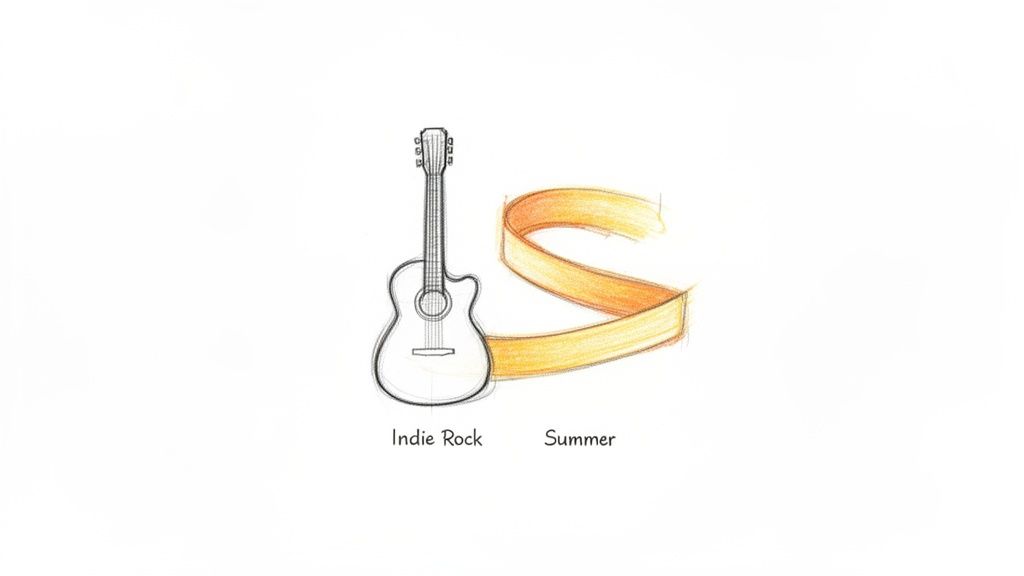
This method works because it caters to how listeners naturally search for music. A fan of trap music might not just search for "trap"; they might look for something more specific like 'Dark Trap Instrumentals' or 'Motivational Trap Beats'. By including both the genre and the descriptor, your playlist can capture both broad and long-tail searches, significantly improving its visibility. Examples like 'Indie Rock Summer Anthems' or 'Chill Synthwave Sunset' immediately communicate a precise experience.
How to Implement Genre + Descriptor Naming
To master this technique, you need to identify powerful descriptor keywords that align with your chosen genre and resonate with listener intent. The goal is to find a popular yet ownable niche within a larger genre category.
Identify Core Genre: Start with a well-defined genre that has a dedicated audience, such as Indie Pop, Deep House, or Classic Rock.
Research Descriptors: Use artist.tools Search Suggestions to find emerging trends and popular descriptors people pair with your genre. Typing in "Indie Pop" might reveal suggestions like "Indie Pop study," "Indie Pop driving," or "Indie Pop morning."
Analyze Competing Hybrids: Use the Playlist Search tool to investigate successful genre + descriptor combinations. Note which descriptors appear most frequently in top-ranking playlists and identify gaps where you can introduce a unique angle. For instance, if "Chill House" is saturated, you might try "Jazzy Deep House."
Key Insight: The descriptor is what gives your playlist its unique identity. While the genre provides a foundation for search, the descriptor ('Summer Anthems', 'Deep Cuts', 'Instrumentals') is what differentiates your playlist from hundreds of others and promises a curated, specific experience.
By strategically combining a genre with a powerful descriptor, you create a playlist name that is both optimized for search algorithms and highly appealing to human listeners seeking a particular sound.
3. Activity-Based Playlist Names
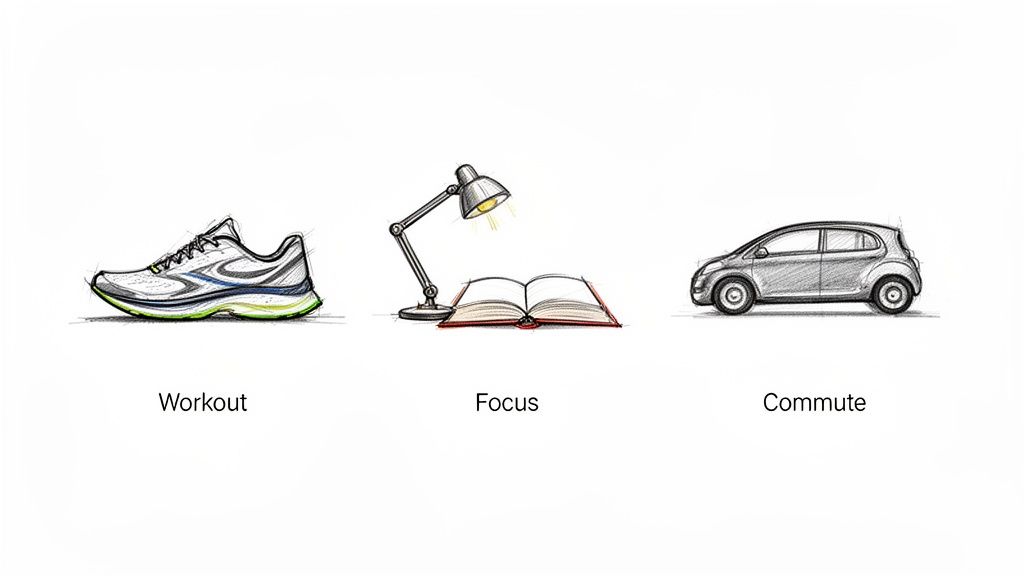
Connecting music to daily activities is a highly effective strategy for creating indispensable playlists. Activity-based names for music playlists frame the listening experience around a specific task, event, or routine, making them incredibly practical and habit-forming. Listeners actively seek out soundtracks for their lives, searching for terms like "workout music" or "dinner party jazz" to enhance their experiences.
This approach succeeds by providing a functional solution to a listener's contextual need. Official Spotify playlists like 'Workout Twerkout' and user-generated hits such as 'Late Night Gaming' attract loyal followers because they are built for a specific purpose. The name clearly communicates the playlist's utility, promising the perfect audio companion for a given activity and boosting listener retention.
How to Implement Activity-Based Naming
To create winning activity-based names, you need to think like your listener and identify the moments where music plays a crucial role. The goal is to become the go-to soundtrack for a recurring part of their day or week.
Identify High-Intent Activities: Brainstorm common user routines like commuting, studying, cooking, or exercising. Think about more niche activities as well, such as 'Coding Late Night' or 'Sunday Morning Cleaning'.
Use SEO Search Suggestions: Type a core activity like "workout" or "focus" into the artist.tools Playlist Search to see what related terms and long-tail keywords listeners are using. This can uncover underserved opportunities like "Treadmill Power Walk" or "Deep Work Ambient."
Analyze Niche Competitors: Use the Playlist Analyzer to study other activity-based playlists. Look at their naming conventions, track selection, and cover art to understand what resonates with a target audience and how you can differentiate your playlist.
Key Insight: The most successful activity-based names are both descriptive and aspirational. A title like 'Productive Morning' doesn't just describe a time of day; it sells a desired outcome, making it much more compelling than a generic 'Morning Mix'.
By integrating your playlist into a listener's daily routine, you move beyond simple discovery and foster genuine loyalty. For more strategies on creating playlists that stick, you can explore our guide on building engaged Spotify audiences on artist.tools.
4. Time-Period & Era Playlist Names
Tapping into nostalgia is a profoundly effective way to connect with listeners, and time-period names for music playlists do exactly that. This strategy organizes music by a specific decade, era, or cultural moment, leveraging the powerful emotional pull of the past. Listeners often search for music that reminds them of a certain time in their lives, making these playlists highly discoverable.
This approach works by creating a musical time capsule. Playlists like '90s Alternative Essentials' or 'Y2K Pop Nostalgia' aren't just collections of songs; they are curated experiences that transport listeners back to a specific period. The name itself sets a clear expectation, promising a journey into the sounds and memories of a bygone era, which drives both clicks and long-term loyalty from listeners seeking that specific retrospective vibe.
How to Implement Time-Period Naming
To create a successful era-based playlist, you need to go beyond simply listing a decade. Specificity and an understanding of nostalgia trends are key to standing out and attracting a dedicated audience.
Pinpoint a Specific Era: Start with a broad decade (e.g., the '80s) and then narrow your focus to a sub-genre or specific cultural window (e.g., '80s New Wave Deep Cuts' or 'Early 2010s Indie'). This precision helps target passionate niche audiences.
Research Search Volume: Use a tool like artist.tools Keyword Explorer to see which decades and eras people are searching for. You might find "70s Soul Classics" has higher search interest than a more generic term, guiding your naming strategy for maximum impact.
Monitor Nostalgia Cycles: Analyze historical data on other era-based playlists with the Playlist Analyzer. This can reveal which decades are currently in a "nostalgia peak" and help you capitalize on rising trends before they become oversaturated.
Key Insight: The most compelling era-based names often blend a time period with a genre or mood. A title like 'Summer of '69' is far more evocative and emotionally resonant than a simple '60s Rock Hits', as it creates a specific scene in the listener's mind.
By anchoring your playlist to a distinct time period, you tap into a powerful, built-in marketing tool: nostalgia. This makes your playlist a go-to destination for listeners looking to relive their favorite musical moments.
5. Artist/Influence-Based Playlist Names
Centering a playlist around a specific artist, or artists with a similar sound, is a highly effective strategy for attracting a dedicated fanbase. Artist/influence-based names for music playlists tap directly into user search behavior, as listeners often search for their favorite artists or for music that sounds like them. This method leverages an artist's established brand equity to build an audience.
This approach works because it targets listeners who already know what they like. Playlists such as 'If You Like Tame Impala' or 'Fans of The Weeknd' immediately signal the sonic landscape and appeal to a specific taste profile. The name creates a direct pathway for fans of an artist to discover new, similar music, positioning the curator as a trusted source for discovery within that niche.
How to Implement Artist-Based Naming
To succeed with this strategy, you need to align with an artist's existing ecosystem and demonstrate a deep understanding of their sound and influence. This requires careful artist selection and competitive research.
Identify Anchor Artists: Choose an influential artist whose sound defines a specific niche or "vibe." This could be an established icon or a rising star with a passionate following. Use the Monthly Listeners Tracker to monitor an artist's growth and identify peak relevance windows to launch your playlist.
Research Competitor Playlists: Use the Playlist Search tool to see how many "fans of" or "sounds like" playlists already exist for your target artist. Analyze their names, track counts, and follower growth to identify opportunities to create something more compelling or specific.
Analyze Curation and Outreach: Once you identify successful competitor playlists, use the Playlist Analyzer to study their curation choices and look for curator contact information. This can reveal patterns in their track selection and potential outreach strategies for your own music.
Key Insight: The most successful artist-based playlists go beyond just including the artist's hits. They curate a journey that includes deep cuts, influences, and similar-sounding new artists, providing genuine value and discovery for dedicated fans.
By building a playlist around a well-known artist, you are not just creating a list of songs; you are building a community hub for fans. This makes it one of the most powerful strategies for creating targeted and highly engaging names for music playlists.
6. Curated Collection & Narrative-Based Names
Moving beyond immediate moods or activities, narrative-based names for music playlists position the curator as an expert, telling a story or presenting a specific musical thesis. These playlists attract listeners who are actively seeking discovery, context, and a human-guided journey through music, offering a powerful alternative to purely algorithmic recommendations. This approach builds a strong brand identity for the curator.
Playlists like 'The Evolution of House Music' or 'Women of Electronic Music' succeed because they offer more than just a collection of songs; they provide an educational or historical perspective. The name itself signals a high level of curation and expertise, promising listeners a deeper, more intentional experience that enriches their understanding of a genre, artist, or movement.
How to Implement Narrative-Based Naming
Creating an effective narrative-based playlist requires a clear concept and a title that communicates your unique perspective. The goal is to frame your collection as an essential guide or a definitive story that listeners need to hear.
Define Your Thesis: What story are you telling? Is it the history of a genre, the influence of a specific producer, or a collection of underrated gems from a particular decade? Your concept must be clear and compelling.
Use Authoritative Language: Titles like 'Jazz Music 101', 'The History of Rap Production', or 'Underrated Indie Gems' use language that conveys authority and a curated viewpoint. This builds trust with potential listeners.
Analyze Successful Curators: Use the Playlist Search tool to find curators who specialize in narrative playlists. Study their naming conventions, playlist descriptions, and track selection to understand what resonates with their audience. This can reveal patterns in how they establish their expertise.
Key Insight: Narrative-based names excel at building a loyal, long-term audience. Listeners who discover and love your 'History of...' playlist are far more likely to seek out your other curated collections, trusting your taste and expertise.
By crafting a strong narrative, you transform a simple playlist into a valuable piece of content that educates and entertains. For a deeper look into developing this curatorial skill, you can learn more about building your brand through Spotify playlist curation.
7. Seasonal & Event-Based Playlist Names
Capitalizing on the calendar is a powerful strategy for creating relevant and timely names for music playlists. Seasonal and event-based playlists tap into the predictable listening habits that revolve around holidays, seasons, and cultural moments. Listeners actively seek out music to soundtrack these specific times, creating built-in demand windows for curators.
This approach is effective because it aligns with real-world context and user search intent. A playlist titled ‘Summer Hits 2024’ is immediately relevant in June, just as ‘Spooky Season’ becomes a go-to search term in October. By curating content for these moments, you meet listeners exactly where they are, offering a soundtrack that enhances their current experiences and celebrations.
How to Implement Seasonal & Event-Based Naming
Success with this strategy depends on timing and relevance. The goal is to anticipate listener demand and have a well-positioned playlist ready before the peak interest period begins.
Plan Ahead: Start promoting your seasonal playlist 4-6 weeks before the event or season. Use a tool like artist.tools Search Suggestions to see when related search terms begin trending, helping you pinpoint the optimal launch window.
Research Keywords: Use the Keyword Explorer to analyze search volume variations for seasonal keywords. You might find that "Christmas Pop" has a different search trend than "Cozy Christmas," allowing you to target a more specific niche.
Update and Archive: Instead of creating a new playlist each year, archive and refresh your existing one (e.g., update 'Summer Hits 2023' to 'Summer Hits 2024'). This allows you to retain your existing followers and build momentum year after year.
Key Insight: Seasonal playlists benefit from a "scarcity" effect. Their relevance is temporary, which drives urgency and engagement during their peak season. A name like 'Back to School Jams' has a defined window of high impact, making it a powerful discovery tool during that specific time.
8. Quality Indicator & Curation Philosophy Names
Positioning your playlist as a source of high-quality, carefully selected music is a powerful way to attract discerning listeners. Quality indicator names for music playlists communicate a specific curation philosophy, signaling that the tracks within are not just a random assortment but a collection of "hidden gems," "deep cuts," or "underrated classics." This approach builds trust and appeals directly to listeners seeking to discover new or overlooked music.
This strategy works because it promises value beyond simple genre or mood matching; it promises discovery. Playlists like 'Undiscovered & Brilliant' or 'Underground Essentials' succeed by establishing the curator as an expert taste-maker. The name itself becomes a badge of quality, assuring listeners that every track has earned its place and is worth their time.
How to Implement Quality-Indicator Naming
To create a successful quality-focused title, you need to clearly define and communicate your unique selection criteria. Your name should reflect a specific curatorial promise, such as highlighting undiscovered artists, rare tracks, or critically praised songs.
Define Your Curation Niche: Determine what "quality" means for your playlist. Is it technically brilliant production ('Producers' Choice Beats'), overlooked songs from famous artists ('Deep Cuts'), or masterpieces from new artists ('Hidden Gems')?
Use Precise Language: Choose words that convey exclusivity and expertise. Terms like "Essential," "Critically Acclaimed," "Rare Finds," and "Curator's Pick" immediately set expectations for a high-caliber listening experience.
Verify Competitor Quality: Use the Playlist Analyzer to research competing "deep cuts" or "hidden gems" playlists. Leverage its Bot Detection feature to ensure you are analyzing authentic playlists and identify opportunities where you can offer superior, human-led curation.
Key Insight: A strong quality-indicator name isn't just a label; it's a mission statement. A title like 'Critically Acclaimed Indie' tells a story of meticulous selection, attracting listeners who value expert opinion and are looking for music that has been vetted for excellence.
By branding your playlist around a philosophy of quality and discovery, you cultivate a loyal audience that trusts your taste and repeatedly returns for your expert selections.
9. Emerging Genre & Microgenre Names
Focusing on emerging genres and hyper-specific microgenres is a high-reward strategy for playlist curators who want to be seen as tastemakers. These names for music playlists, such as 'Hyperpop Rising' or 'Phonk Scene,' capture listeners actively seeking the cutting edge of music. By building a playlist around a new sound, you can establish authority and grow an audience before the genre becomes saturated.
This approach is powerful because it taps into the discovery-oriented behavior of highly engaged music fans. Listeners exploring new sounds are often more loyal and evangelistic, sharing playlists that define emerging trends. Official playlists like Spotify's 'lofi beats' started by capturing a microgenre and grew into a cultural phenomenon. Similarly, curator-led playlists like 'Wizard Trap Beats' attract a dedicated niche audience looking for a very specific sound.
How to Implement Emerging Genre Naming
To succeed with this strategy, you must identify rising trends before they peak and use precise terminology that resonates with the genre's early adopters. Generic titles won't attract a niche audience.
Identify Rising Trends: Use a tool like artist.tools Search Suggestions to see what emerging genre terms users are actively looking for. Real-time data can reveal a new microgenre, like "drift phonk" or "dark hyperpop," as it gains momentum.
Monitor Keyword Volume: Leverage the Keyword Explorer to track the search volume of potential microgenre names. A steady increase in searches for a term like "Afrobeats Next" signals a growing audience and an opportunity to create a definitive playlist.
Analyze Early Adopters: Use the Playlist Search to find playlists featuring emerging artists. Examining how other curators are categorizing and naming these new sounds can help you refine your own playlist title and find a unique angle.
Key Insight: The success of an emerging genre playlist hinges on timeliness and authenticity. A name like 'Psybass Evolution' feels more credible and current to insiders than a broad title like 'New Electronic Music', positioning your playlist as an essential guide to the genre.
By positioning your playlist at the forefront of a new musical movement, you capture an audience of passionate fans and establish yourself as a key voice in that scene. To learn how to spot these trends early, you can explore artist.tools' features for monitoring emerging artist growth.
10. Listener Demographic & Community-Based Names
Curating music for a specific listener demographic or community creates a powerful sense of identity and belonging. These names for music playlists signal that the content is tailor-made for a particular group, fostering a dedicated and engaged listener base. This approach moves beyond broad moods or genres to connect with listeners on a cultural, social, or generational level.
This strategy is effective because it builds a loyal following by reflecting a community's unique identity and shared experiences. Playlists like Spotify's official 'POLLEN', which targets a specific psychographic of genre-fluid listeners, or community-driven lists like 'Women of Hip-Hop' succeed by creating a space where listeners feel seen and understood. The name itself is a declaration of solidarity and cultural relevance.
How to Implement Community-Based Naming
To create authentic community-focused playlists, you need to be deeply attuned to the group you're targeting and use language that resonates with them. It requires a blend of cultural awareness and data-driven strategy to ensure your playlist name is both respectful and discoverable.
Identify a Niche Community: Focus on a specific demographic (e.g., Gen Z, Latinx, LGBTQ+) or a community built around shared interests (e.g., female producers, Black artists). Authenticity is paramount.
Research Relevant Keywords: Use a tool like artist.tools Keyword Explorer to find search terms specific to your target community. You might discover high-volume keywords like "LGBTQ+ anthems" or "Asian artists rising" that can guide your naming convention.
Analyze Successful Community Playlists: Use the Playlist Analyzer to study how established community-focused playlists are named and curated. Pay attention to the artists they feature and the language they use in their descriptions to understand community expectations.
Key Insight: A strong community-based playlist name does more than just describe its contents; it serves as a banner for a cultural movement or identity. A title like 'Music for Black Lives' is a powerful statement that resonates far more deeply than a generic genre list.
By aligning your playlist with a specific demographic, you can build a highly loyal audience. For more insights into optimizing your playlist for discovery within these communities, you can learn more about mastering Spotify playlist SEO on artist.tools.
10-Category Comparison of Playlist Naming Styles
Playlist Type | 🔄 Implementation Complexity | ⚡ Resource Requirements | ⭐ Expected Outcomes | 💡 Ideal Use Cases | 📊 Key Advantages |
|---|---|---|---|---|---|
Mood-Based Playlist Names | Moderate — ongoing mood consistency 🔄 | Moderate — editorial time + SEO tools ⚡ | High retention & discoverability ⭐⭐⭐ | Broad discoverability; mood-driven search targets 💡 | Strong SEO performance; recurring listeners 📊 |
Genre + Descriptor Hybrid Names | Moderate — pairing genre with descriptor correctly 🔄 | Moderate — research, testing, naming tweaks ⚡ | Good targeted discovery; higher conversion ⭐⭐ | Niche targeting while retaining broad appeal 💡 | Balances specificity and searchability; multi-keyword reach 📊 |
Activity-Based Playlist Names | Low–Moderate — align to contexts and behaviors 🔄 | Low — straightforward curation; analytics tracking ⚡ | High repeat engagement and loyalty ⭐⭐⭐ | Workouts, study, commute, travel playlists 💡 | High retention; clear use-case positioning; partnership fit 📊 |
Time-Period & Era Playlist Names | Low — clear temporal labels but needs accuracy 🔄 | Low–Moderate — era research and timely updates ⚡ | Strong nostalgia-driven loyalty; predictable spikes ⭐⭐ | Decade fans; nostalgia marketing campaigns 💡 | Demographic targeting; steady decade/year SEO volume 📊 |
Artist/Influence-Based Playlist Names | Moderate — artist relevance & naming care 🔄 | Moderate — monitor artist trends; legal awareness ⚡ | High relevance to fanbases; editorial pitch strength ⭐⭐⭐ | Fan-targeted curation; artist discovery & cross-promo 💡 | Direct fan reach; strong collaboration potential 📊 |
Curated Collection & Narrative-Based Names | High — develop thesis and maintain coherence 🔄 | High — deep research, storytelling, curation time ⚡ | High perceived editorial value; niche but loyal audience ⭐⭐⭐ | Educational series; curator branding and media features 💡 | Authority building; high editorial credibility 📊 |
Seasonal & Event-Based Playlist Names | Low — calendar-driven setup; timely launches 🔄 | Moderate — planning, promotion, annual refreshes ⚡ | Strong seasonal spikes; time-limited relevance ⭐⭐ | Holiday, seasonal campaigns, event tie-ins 💡 | Predictable marketing windows; sponsor/brand alignment 📊 |
Quality Indicator & Curation Philosophy Names | High — strict selection and consistency 🔄 | High — deep listening, verification tools ⚡ | High engagement from discovery-focused listeners ⭐⭐ | Tastemaker channels; industry pitching and artist outreach 💡 | Perceived authority; attracts engaged discovery audiences 📊 |
Emerging Genre & Microgenre Names | High — rapid trend monitoring and agility 🔄 | Moderate–High — scouting, trend tools, testing ⚡ | Variable — first-mover wins; high engagement if trend sticks ⭐⭐ | Trend leadership; influencer and media attention 💡 | First-mover advantage; lower competition initially 📊 |
Listener Demographic & Community-Based Names | Moderate — requires cultural competency & authenticity 🔄 | Moderate — community outreach, localized research ⚡ | High loyalty and engagement within communities ⭐⭐⭐ | Identity-driven curation; advocacy and community building 💡 | Strong community ties; partnership and advocacy potential 📊 |
From Naming to Dominating: Your Action Plan for Playlist Success
We have journeyed through an extensive landscape of strategies, moving far beyond a simple list of potential names for music playlists. From the foundational pillars of mood and genre to the nuanced tactics of narrative-building and community engagement, the central theme is clear: a playlist's name is its single most important marketing tool. It’s the first impression, the search query, and the promise of a specific listening experience all rolled into one.
The difference between a playlist that languishes with a handful of followers and one that dominates search results often comes down to intentionality. An effective name is not a lucky guess; it is a calculated decision rooted in listener psychology and validated by hard data. It anticipates a user's search query, reflects a deep understanding of a niche, and clearly communicates the value within.
Synthesizing Strategy with Data-Driven Action
The ten categories we explored, from Activity-Based Names like "Coding Focus Lofi" to Microgenre Names such as "Post-Rock Ambiance," serve as your strategic blueprint. They are the creative frameworks for connecting with a specific audience. However, creativity alone is not enough to break through the noise on a platform as saturated as Spotify.
This is where the practical application of data becomes non-negotiable. Your true advantage lies in combining these naming conventions with powerful analytical tools. The process transforms from abstract brainstorming to a precise, repeatable system for growth.
Key Takeaway: A winning playlist strategy is a hybrid approach. It marries a creative, listener-centric naming concept with rigorous, data-informed validation to ensure it meets an existing demand in the marketplace.
Your Immediate Next Steps for Playlist Growth
To translate this knowledge into tangible results, you must take decisive action. Your goal is to move from passive learning to active implementation. Here is a focused, step-by-step plan to begin building playlists that not only sound great but also perform exceptionally well in search.
Identify Your Niche: Begin by using a tool like the Keyword Explorer on artist.tools. Instead of guessing, input broad terms related to your musical taste (e.g., "sad indie," "workout rap," "ethereal vocals"). Analyze the search volume and competition scores to pinpoint underserved keywords that represent a genuine opportunity.
Develop Your Naming Concept: Select one of the ten strategies discussed in this article that best fits your identified niche. Is it a Curated Collection ("Indie Sleaze Revival") or a Quality Indicator ("Certified Banger Factory")? Draft 3-5 potential names for music playlists that align with this strategy and your target keywords.
Validate and Refine: Use the Search Suggestions feature to see what real users are actively typing into Spotify's search bar. Does one of your drafted names align more closely with these auto-complete phrases? This step confirms that you are targeting actual user behavior, not just an assumed interest.
Analyze the Competition: Before finalizing your name, use a Playlist Search tool to see what the top-ranking playlists for your target keyword are called. Look for weaknesses. Are their names too generic? Are their brands unclear? Find the gap in the market and position your playlist to fill it.
Mastering this cycle of ideation, validation, and execution is what separates amateur curators from professional brand builders. It empowers you to create assets that consistently attract organic streams and followers, building a sustainable foundation for your artist project or curation business. The perfect name for your music playlist is out there; you just need the right process to find it.
Ready to stop guessing and start ranking? The strategies in this article are your map, and artist.tools is your compass. Use our suite of data tools, from the Keyword Explorer to the Playlist Analyzer, to validate your names for music playlists and uncover hidden opportunities for growth. Sign up and build your next successful playlist with confidence at artist.tools.
.png)
.png)
Comments