A Guide to BMI Music Royalty for Independent Artists
Updated: Sep 8
Think of a BMI music royalty as the paycheck your song earns every time it gets played in public. Whether it’s spinning on the radio, streaming on Spotify, setting the mood in a TV show, or just playing in the background at a local coffee shop, BMI is the one collecting that money for you.
What Is BMI and How Do They Pay You?
Let's say you write a banger. Suddenly, it's all over the radio, racking up millions of streams, and even gets synced in a new Netflix series. How on earth do you track down every single one of those plays and get paid? Trying to do it yourself would be a full-time nightmare.
That’s exactly where BMI (Broadcast Music, Inc.) comes in. Don't think of them as some faceless industry giant; picture them as your personal collections team, working around the clock, all over the world. Their entire job is to make sure you, the songwriter, get paid whenever your work is performed publicly. They’re what’s known as a Performing Rights Organization (PRO), and they're one of the biggest players in the game.
Your Music's Financial Manager
BMI's model is pretty straightforward but incredibly powerful. They sell licenses to businesses that use music—from major broadcasters to your local gym—and collect fees from them. Then, they divvy up that money and send it back to songwriters and composers like you. That’s your BMI music royalty. This system is how millions of tiny "public performances" turn into a real income stream.
A "public performance" isn't just a live gig. It’s any time your music is broadcast or transmitted to the public. That means every radio spin, every Spotify stream, and every play in a restaurant absolutely counts.
In short, BMI handles the messy, complicated stuff so you don't have to. Instead of you trying to get a few bucks from a bar in another state, BMI already has a licensing agreement with them. You don't have to negotiate with Spotify; BMI does it for you. This collective approach is the backbone of how songwriters get paid.
The Scale of BMI's Operation
The sheer scale of what they do is massive. BMI is a financial powerhouse for over 1.3 million songwriters, composers, and publishers across the globe. They track more than 20 million musical works, and in a recent fiscal year, they collected a jaw-dropping $1.57 billion in royalties. As detailed on amworldgroup.com, this shows just how vital performance royalties are.
This network ensures that everyone, from a chart-topping superstar to an indie artist just starting out, has a way to earn money from their songs.
When you join BMI, you’re plugging your music directly into this global payment grid. They take care of the tracking, the collecting, and the distributing, letting you focus on what actually matters: making more music.
How Your Music Earns Money with BMI
So, you've registered your song with BMI. Great. But how does that turn into actual money in your bank account? It's a two-step dance of licensing and distribution, where BMI acts as both a global sales team and a seriously efficient accounting department for your music.
First off, BMI sells access to its massive library of songs. Imagine a local radio station or your favorite coffee shop trying to track down and negotiate a deal with every single songwriter for every song they play. It would be impossible. Instead, they pay BMI a fee for a blanket license. This license is like an all-access pass, giving them the legal green light to play any of the 20 million+ musical works in BMI's catalog.
This is the engine that drives the whole system. Thousands of businesses, from giants like NBC and Spotify to the corner bar down the street, pay these licensing fees. This creates a huge pool of money, all of it earmarked for songwriters and publishers like you.
The Global Tollbooth for Your Songs
Think of your song as a car on a global highway. Every time it gets played on the radio, streamed on Apple Music, or performed live at a venue, it passes through a metaphorical tollbooth. BMI’s job is to sit in that booth, collecting a tiny fee every single time your song drives by.
This flow is pretty straightforward at its core.
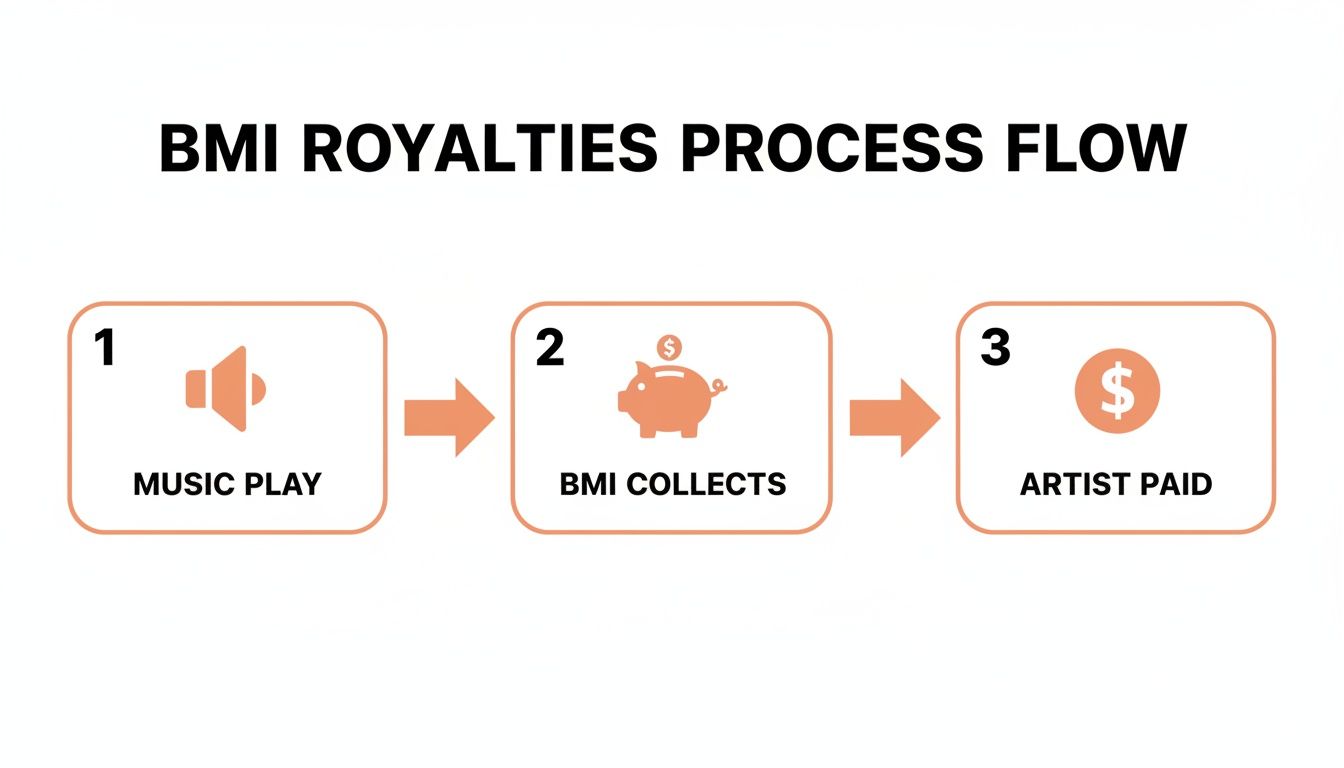
Your music gets used, BMI collects the cash on your behalf, and then that money finds its way back to you. Simple, right?
The real magic—and the complexity—is in tracking the insane volume of these "plays." BMI has to process trillions of performances every year, a job that takes a serious combination of high-tech data crunching and old-school statistical analysis.
How BMI Tracks Billions of Performances
BMI doesn't use a single method to track everything; their approach changes based on where your music is getting played.
Digital Data Reporting: For streaming services like Spotify or digital radio like Pandora, it's all about the data. These platforms send BMI massive, detailed reports that list every single song played. It’s a census-level count, making it super accurate for the digital world.
Broadcast Surveys: It’s just not practical to monitor every song on every single AM/FM station, 24/7. So for traditional radio, BMI uses a mix of electronic monitoring and statistical sampling. They survey a representative chunk of stations to build a reliable model of what's being played nationwide. A recent agreement means these plays are becoming more valuable, too—the rates paid by commercial radio stations are climbing to 2.20% of their revenue by 2026.
Live Performance Reporting: When your music is played live in concert, BMI relies on setlists submitted by venues and, critically, by artists themselves. This is why every touring artist needs to be using BMI Live to submit their setlists after shows. It's you directly telling BMI, "Hey, I played my songs here. Pay me."
Critical Takeaway: BMI's payout isn't a fixed per-stream rate like you see with mechanical royalties. It's a share-based system. All the license money goes into one big pot, and your cut is determined by how many times your music was detected by their tracking systems.
After all this data is collected and chewed on, BMI figures out what each song earned. They then send out payments on a quarterly basis to their affiliated songwriters and publishers. This whole cycle underscores why accurate registration is everything. If your song title, writer names, or ownership splits are wrong, your music is basically invisible to the system, and those royalties will never find their way home to you.
Performance Royalties vs Mechanical Royalties
Trying to get a handle on music royalties can feel like learning a whole new language. For most artists, the biggest hurdle is wrapping your head around the difference between the two main royalties your actual song—the composition—generates: performance and mechanical.
Nailing this is absolutely critical. It’s the only way you’ll collect all the money your music is actually earning.
Let’s use a simple analogy to make it click. Think of a performance royalty as the money you get paid for the broadcast of your song. It's for the public performance—that moment your music hits an audience's ears. On the flip side, a mechanical royalty is payment for a copy of your song, even the temporary digital one made when someone streams it.
BMI lives exclusively in the world of performance royalties. When your song gets played on the radio, streamed on Spotify, or performed at a venue, BMI is the one collecting that "broadcast" fee for you.
The Key Players in Your Royalty Puzzle
To get paid properly, you have to know who’s responsible for each piece of the royalty puzzle. There are three totally separate organizations you need to be working with, and none of them do the same job. If you miss one, you're just leaving cash on the table.
BMI (or ASCAP/SESAC): This is your Performing Rights Organization (PRO). They collect performance royalties whenever your composition is performed publicly. This money goes to you (the songwriter) and your publisher.
The Mechanical Licensing Collective (The MLC): In the US, The MLC is your go-to for mechanical royalties from digital streaming services. When your track is streamed on Spotify, The MLC collects the "copy" royalty for the songwriter and publisher.
SoundExchange: This is a different beast altogether. SoundExchange collects digital performance royalties for the sound recording—the master track. This money gets paid out to the recording artist and the master rights owner (which could be your label, or you if you're indie).
This separation is so important to understand. Just registering your song with BMI is only one-third of the battle. If you aren't also signed up with The MLC and SoundExchange, you are literally missing out on huge chunks of your income every single time someone hits play.
You can get a much deeper dive into this specific income stream in our ultimate guide to mechanical royalties.
The Three Main Music Royalty Streams for Artists
Getting these distinctions straight is the key to tracking your money and spotting when something’s missing. Each organization pays different people for different rights, so let’s lay it out clearly.
Royalty Type | What It Pays For | Collected By | Paid To |
|---|---|---|---|
Performance Royalty | The public "broadcast" or performance of a song's composition. | BMI, ASCAP, SESAC | Songwriters & Publishers |
Mechanical Royalty | The "copy" or reproduction of a song's composition (e.g., a digital stream). | The MLC (in the US) | Songwriters & Publishers |
Digital Performance Royalty | The digital "broadcast" of the master sound recording (e.g., on Pandora). | SoundExchange | Recording Artists & Master Owners |
Seeing it broken down like this makes it obvious why you need to be registered with all three. They aren't competitors; they're all essential parts of your revenue collection system.
And while BMI is a powerhouse in the US, it's worth remembering just how much clout independent music has on a global scale. A recent analysis showed that indie publishers grabbed 26.3% of the global market, which amounts to a massive €2.57 billion of the total €9.8 billion pie. That's a mind-blowing 105.6% jump since 2018, proving that indie artists are a bigger force than ever. Discover more insights on the independent music publishing market here.
This incredible growth just hammers home why you need to master every single royalty stream available. By making sure you're set up with BMI for performance rights, The MLC for mechanicals, and SoundExchange for your master, you're building a system that ensures every play turns into a payday.
A Step-By-Step Guide to Getting Paid by BMI
Knowing what a BMI music royalty is and actually getting that money in your bank account are two very different things. The process demands precision, but it's not rocket science. This is your playbook for turning your songs into a real income stream and making sure every single performance royalty finds its way home to you.
Think of your royalty flow like a pipeline. If any part of it is leaky or disconnected, the money just won't make it through. We’re going to focus on three critical steps to seal those connections and get your royalties flowing.
Action 1: Affiliate with BMI Correctly
First things first: you need to officially join the BMI family. You have to affiliate as a songwriter (or composer). This is a one-time step that registers you as a creator in their system, which is how they track and pay out your "writer's share."
But if you stop there, you're leaving a huge chunk of your money on the table. Performance royalties are always split into two equal halves: the writer's share (50%) and the publisher's share (50%). To collect it all, you need a publishing entity.
For independent artists, this doesn't mean you need to sign a deal with some big-shot publisher. You can just be your own.
Create a Publishing Company: This is as simple as picking a name for your publishing company (e.g., "My Awesome Songs Publishing").
Affiliate Your Publisher with BMI: You'll register this new company with BMI separately from your songwriter account. This is what allows you to collect the publisher's half of the money.
If you skip setting up a publisher, BMI will only ever pay you the writer's share. The other 50% will just sit there, uncollected. Taking this extra step ensures you're set up to receive 100% of the performance royalties you earn.
Key Insight: Most indie artists wear two hats: songwriter and publisher. By affiliating both yourself and your own publishing company with BMI, you position yourself to collect both halves of your BMI music royalty.
Action 2: Register Every Song with Perfect Metadata
This is it. This is where most royalty problems start. BMI's entire system runs on data. If you feed it incomplete or wrong information, you won't get paid correctly. It’s the ultimate "garbage in, garbage out" situation.
For every single song you release, you must log into your BMI account and register the work. This is how you officially tell BMI, "Hey, this song exists, and here's who you need to pay when it gets played."
Here’s your registration checklist for every song:
Accurate Song Title: Make sure it matches the title on your release exactly.
All Songwriters: List every single person who contributed to the composition, along with which PRO they belong to (e.g., BMI, ASCAP, etc.).
Correct Ownership Splits: You have to declare the exact percentage splits for each writer and each publisher. The writer shares must add up to 100%, and the publisher shares must also add up to 100%.
Let's say you co-wrote a song 50/50 with a friend. Your writer registration would show you at 50% and your friend at 50%. On the publishing side, your company would be listed at 50%, and their company would be at 50%. If those numbers don't add up perfectly, BMI flags the registration, and nobody gets paid until it's fixed. To see how all these pieces fit into the bigger picture, check out our complete revenue blueprint for music publishing.
Action 3: Verify Your Catalog Publicly
Once your songs are registered, don't just walk away and assume it's all good. The final, crucial step is to double-check your work in BMI's public catalog. This is a simple quality control check that can save you from massive headaches later on.
Head over to the BMI Repertoire search on their website and look up your own songs.
Check for Typos: Are all the writer and publisher names spelled correctly? A simple typo can derail payments.
Confirm Shares: Does what you see online match the ownership splits you submitted?
Verify All Works: Is every single song you've released actually showing up in the search?
If you spot a mistake, you can submit a correction request right through your BMI online portal. Auditing your catalog like this a few times a year ensures your data foundation is solid. That way, when your music starts to take off, your BMI music royalty payments will be accurate and on time. Catching one small error early can prevent thousands in lost or delayed income down the road.
How to Maximize Your BMI Royalties from Streaming
For most artists grinding it out today, platforms like Spotify are more than just a place to be discovered—they're the engine that drives your BMI royalty checks. But how do all those tiny, fractional streams add up to actual money in your pocket? It’s not magic. It takes a hands-on approach that goes way beyond just uploading your track and crossing your fingers.
To really max out your earnings, you have to actively manage your song’s data and make sure every single play is tracked and credited back to you.
Think of it like a data chain connecting your distributor, Spotify, and BMI. If any link in that chain is weak or broken—maybe because of a typo in the song title, wrong writer splits, or a missing ID number—your money gets stuck in limbo. The secret is to treat your metadata with the same care and attention you give your final mix.
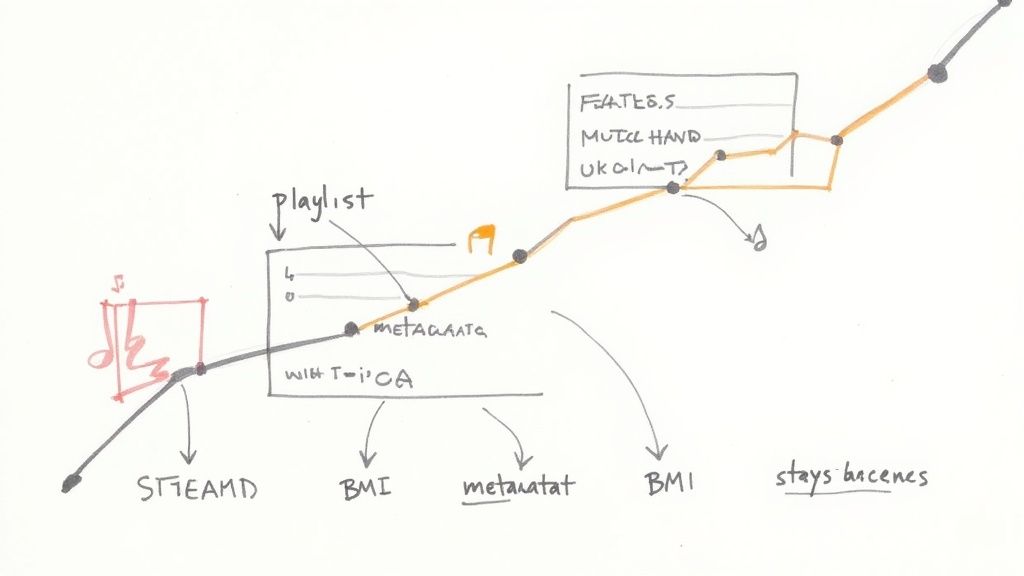
This sketch maps out how your song’s information is supposed to flow smoothly from you, the creator, all the way through the system to get you paid. A single piece of bad data can jam up the whole works.
Aligning Your Data for Maximum Payout
First things first: you need perfect alignment across every platform. The metadata you give your distributor (like DistroKid or TuneCore) has to be an exact mirror of what you register with BMI. Seriously, even a tiny mistake—a typo in a co-writer's name or a slightly different song title—can cause a massive payment delay or, worse, prevent a match altogether in BMI's system.
This idea of “data hygiene” is everything when it comes to getting paid.
Consistent Song Titles: Make sure the title is identical everywhere. To a computer, "My Song (feat. Artist B)" is a completely different track than "My Song."
Accurate Writer & Publisher Info: Double and triple-check that every songwriter, their PRO (BMI, ASCAP, etc.), and their publisher are listed correctly on both your distribution upload and your BMI work registration.
Precise Ownership Splits: This is a big one. The percentages you tell your distributor have to match the splits you register at BMI. If they don't add up to 100% on both the writer and publisher side, the song gets flagged and nobody gets paid.
Using Data Tools to Verify Your Earnings
Okay, so your data is clean. Now what? You can't just trust that every stream is being counted. This is where data platforms become your secret weapon. Tools like artist.tools let you see what's happening on Spotify with incredible detail, giving you the ammo you need to check it against your BMI statements.
By keeping a close eye on your streaming performance and playlist adds, you can turn raw numbers into real intelligence. It’s how you spot problems early and make sure your BMI royalty statements actually reflect your music's real-world performance.
For example, you can see exactly which playlists are blowing up a particular track. If you see a huge spike in plays from a popular playlist but your next BMI check looks disappointingly flat, that’s a major red flag. It’s a sign that there's a data mismatch somewhere that needs fixing.
It also helps to know what each stream is actually worth. You can get a better handle on this by diving into a detailed guide to music streaming royalty calculators and seeing how they help forecast your earnings.
When you take an active role in managing and checking your data, you stop leaving money on the table. You shift from being someone who just passively accepts whatever royalties come in to becoming the savvy manager of your own catalog, ensuring every single stream helps your bottom line.
Troubleshooting Common BMI Royalty Problems
Staring at a BMI statement that looks wrong is a familiar, frustrating feeling for a lot of artists. A song might be missing completely, or the payment just seems way too low. It’s easy to assume the worst, but most of the time, these issues come down to a few common data problems you can actually fix yourself.
The number one question we hear is, "Why haven't I been paid yet?" Before you panic, remember how BMI's system works. They pay out quarterly, but there's a significant lag—usually six to nine months between a song getting played and the money hitting your account. Plus, you have to hit a minimum payment threshold before they send anything out.
If you’ve waited long enough and you're sure you've met the threshold, the problem is almost always in your data. The whole royalty pipeline runs on accurate information, and just one tiny error can bring everything to a grinding halt.
Common Royalty Roadblocks
When a payment goes missing, you've got to play detective. Start with the usual suspects. These are the handful of issues that cause the vast majority of royalty hiccups, and the good news is, they're all within your power to correct.
Incorrect Song Registration: Is the song title you registered with BMI exactly the same as what's on Spotify? A small mismatch, like forgetting to add "(feat. Artist)," is enough to prevent a match.
Inaccurate Writer Splits: Did you and your co-writers all agree on and register the exact same ownership percentages? If the splits don't add up to a perfect 100%, BMI puts a freeze on all payments until everyone gets on the same page.
Missing Publisher Information: If you're self-published, did you actually register your publishing entity? Forgetting this step means you're leaving the publisher's share on the table—that's half of your potential earnings.
These details are everything. When data pours in from Spotify, radio stations, and bars, BMI's system tries to connect it to a song in its database. If your registration is messy, incomplete, or conflicts with a co-writer's, that match fails. Your money doesn't disappear, but it gets stuck in a holding account for unmatched royalties.
Think of it like a letter with a smudged address. The post office knows it has a package for someone, but without clear information, it can't deliver it. Clean metadata is the clear, correct address for your BMI music royalty.
Stay Ahead of the Game with Proactive Data Management
The best way to deal with these problems is to prevent them from happening in the first place. Make it a habit to regularly audit your catalog using the BMI Repertoire search. Double-check that every song is listed, all your co-writers are there, and the splits are correct.
It's also worth remembering that royalty rates themselves can change, which will naturally affect your statements. For example, BMI recently secured a huge rate increase from US terrestrial radio stations. In a landmark deal, the blanket license rate is set to climb from 1.78% of gross revenue to 2.20%. This is a big win for creators, with about 85% of these royalties going straight to songwriters and publishers. You can read up on the details of this radio royalty settlement on musicbusinessworldwide.com.
By treating your song data with the precision it deserves, you make sure every single play is credited and paid out. You turn potential headaches into on-time payments.
A Few Common Questions About BMI Royalties
Diving into the world of BMI royalties can definitely bring up some practical questions. Let's clear the air on a few of the most common things artists run into, so you can make sure you're getting paid correctly and on time.
How Long Does It Take to Receive My First BMI Payment?
This is one area where patience is a virtue. BMI pays its members on a quarterly schedule, but there's a pretty significant delay baked into the process. For instance, music that gets played between January and March might not actually hit your bank account until September.
It's pretty standard to wait 6-9 months from the time your music starts getting real public plays to the day you see your first royalty statement. And that's assuming you've already met BMI's minimum payment threshold, which is a requirement before they send out any funds.
Do I Need a Publisher to Collect My BMI Royalties?
Technically, no. As a songwriter, you can collect your "writer's share" of royalties directly from BMI without needing a publisher. That share makes up 50% of the total performance royalty your song earns.
But here’s the catch: to get the other 50%—what's known as the "publisher's share"—you either have to sign with a music publisher or do what most independent artists do: create your own publishing company and affiliate it with BMI. This is an absolutely critical step if you want to collect 100% of what you're owed.
What Happens If I Co-Wrote a Song with an ASCAP Writer?
This happens all the time, and the PROs have a system for it. When you register your song with BMI, you just need to be meticulous about listing all the co-writers and their PROs (for example, Jane Doe - ASCAP).
BMI will do its job and collect all the performance royalties the song generates. From there, they'll pay you your designated cut and then send the rest of the money over to ASCAP, who then pays their writer. This is precisely why declaring accurate writer splits when you register a song is non-negotiable. It's the only way to make sure everyone gets paid what they're due.
Ready to stop guessing and start knowing where your money is? artist.tools gives you the data you need to track your Spotify performance, spot missing streams, and make sure your metadata is rock-solid. See how artist.tools can lock in your earnings today.
.png)
.png)
Comments