A Guide to Royalties from Spotify and How to Get Paid
If you've ever wondered how you actually earn royalties from Spotify, the first thing to know is there's no magic, fixed number for what a stream is worth. The real system is a bit more involved, but once you get it, you'll see how your earnings are a direct reflection of your music's performance across the entire platform.
Your Quick Guide to Spotify Royalties
Let's get one common myth out of the way: Spotify doesn't pay artists a simple, flat rate for every stream. Instead, it operates on a "pro-rata" model, which sounds complicated but is actually pretty straightforward.
Think of all the money Spotify pulls in each month from both Premium subscriptions and ads. Now, imagine all that cash gets dumped into one giant pool. Every single eligible stream on Spotify—from every artist, in every country—is counted. Your payout is your proportional share of that massive revenue pool.
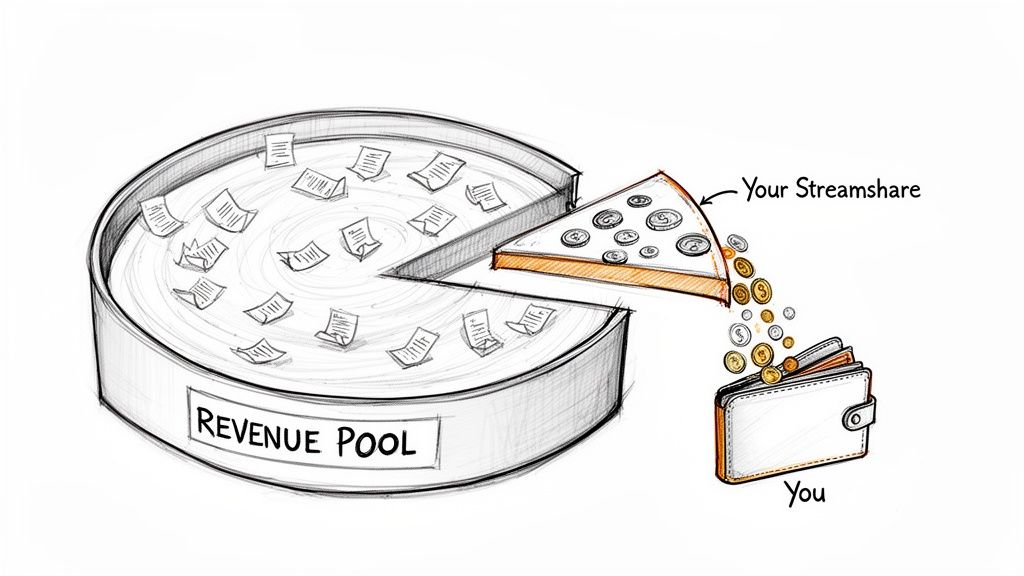
This "streamshare" system means you aren't just earning in a vacuum. Your royalties are directly tied to how your music stacks up against every other track on Spotify for that month.
Key Factors Influencing Your Earnings
So, if it's all about your share of the pie, what makes your slice bigger or smaller? It turns out not all streams are created equal. The actual cash value of a single stream fluctuates based on a few critical factors, which is why your royalty statements can look so different month to month.
Here are the three main things that determine how much a stream is worth:
Listener's Subscription Type: A stream from a Spotify Premium subscriber puts more money into the revenue pool than a stream from someone on the free, ad-supported tier. It's simple math—premium listeners contribute more, so their streams are worth more.
Listener's Geographic Location: Where your listeners are matters. A lot. Royalties vary by country because subscription prices and ad revenue aren't the same everywhere. A stream from the US or UK, for example, will typically generate more revenue than one from a country with lower subscription fees.
Your Distribution Agreement: Spotify doesn't cut a check directly to you. Payments go to the rights holders—that means your distributor (like DistroKid or TuneCore) or your record label. The deal you have with them determines what percentage they take before the money hits your bank account.
Before we move on, let's trace the journey of a single payment from Spotify to your pocket. It's not a direct deposit; there are a few stops along the way.
The Journey of a Spotify Royalty Payment
This table gives you a simplified look at how the money flows.
Revenue Source | Intermediary | Rights Holder | Final Recipient |
|---|---|---|---|
Spotify (Subscriptions & Ads) | Distributor / Label | You (as the Master Rights Holder) | Your Bank Account |
Spotify (Subscriptions & Ads) | Publisher / PRO | You (as the Publishing Rights Holder) | Your Bank Account |
As you can see, different types of royalties travel through different channels, but they all start from the same revenue pool.
The core concept is simple: The more high-value streams you get, the larger your share of the revenue pool becomes. Your strategy should focus not just on stream volume, but on the quality and origin of those streams.
Ultimately, getting a grip on these fundamentals is a game-changer. It takes you from being a passive artist just watching a stream counter tick up to an informed musician who understands the mechanics behind their career. With this knowledge, you can start making smarter decisions to genuinely grow your royalties from Spotify.
How Spotify Payouts Actually Work
If you want to understand royalties from Spotify, the first thing you need to do is forget the idea of a fixed "pay-per-stream" rate. It just doesn't exist. Instead, Spotify uses what's called a pro-rata model, which most of us in the industry just call "streamshare." It’s less like getting paid a set wage and more like entering a massive, month-long lottery.
Picture this: for one month, Spotify gathers up all the money it made—every Premium subscription, every ad that played—and dumps it into one giant global pot. Now, think of every single eligible stream on the entire platform during that month as one lottery ticket. The more streams your music racks up, the more tickets you're holding.
At the end of the month, Spotify takes that huge pot of money and divides it by the total number of streams (all the tickets). This simple calculation sets the value of a single stream for that specific month. Your payout is just that value multiplied by the number of streams your songs got. Simple, but complicated.
The Two Main Royalty Buckets
This big pot of money is split to pay out two different kinds of royalties. You absolutely need to know the difference, because they go to different people for different reasons. Every song actually has two copyrights tied to it: one for the specific recording and one for the song itself.
Recording Royalties (The Master): This is for the master recording—the actual audio file you hear on Spotify. These royalties get paid to whoever owns the master rights. That's usually the artist's record label or, for independent artists, a digital distributor like DistroKid or TuneCore. This is where the bulk of the money goes.
Publishing Royalties (The Song): This is for the underlying musical work—the melody and lyrics. This money is owed to the songwriters and their publishers. Spotify pays these royalties to collection societies—think Performing Rights Organizations (PROs) and mechanical rights organizations—who then get the money to the right songwriters and publishers.
It’s a classic mistake for indie artists to only collect their recording royalties. They often leave a ton of publishing money on the table simply because they haven't registered their songs correctly.
Why Your Payouts Change Every Single Month
The pro-rata model is exactly why your earnings can feel so unpredictable. Your payout isn't just about your stream count; it’s about what percentage of the total streams on the platform you captured.
Think of it like a pizza. If the pizza (Spotify's total revenue) stays the same size but more people show up to eat (more total streams on the platform), everyone’s slice gets smaller. But if the pizza gets bigger and the number of people stays the same, everyone gets a fatter slice.
Things are constantly changing the size of that pizza and the number of people eating it, which is why your royalties from Spotify will fluctuate month to month.
Not All Streams Are Created Equal
Let's build on that idea. The value of each stream—each lottery ticket—actually changes depending on who's listening and where they are. This is a critical piece of the puzzle if you want to build a smart streaming strategy. A stream is not just a stream.
Premium vs. Free Listeners: A stream from a Premium subscriber is worth a lot more than a stream from someone on the free, ad-supported tier. Why? Because Premium users throw more money into the monthly pot, so their listens carry more financial weight.
Listener Location: Where your listeners are physically located also makes a huge difference. A stream from a country with a high subscription cost and a strong ad market, like the United States or the UK, will generate way more revenue than a stream from a region where subscription prices are lower.
This means 10,000 streams from Premium listeners in the US will earn you a hell of a lot more than 10,000 streams from free-tier listeners in a lower-revenue market. Getting this is fundamental. It shifts your goal from just getting more streams to attracting high-value listeners who fatten up the revenue pool and, in turn, increase your piece of the pie.
How Much Spotify Actually Pays Per Stream
Alright, let's cut to the chase and answer the question every artist has on their mind: what is a single stream actually worth? While there's no magic, fixed number, the industry has landed on a general average that gives us a solid starting point.
The most widely-cited figure for royalties from Spotify is somewhere between $0.003 and $0.005 per stream. Think of this less as a guarantee and more as a reliable benchmark. It’s what things usually shake out to be after the platform’s complex pro-rata system does its thing. Sure, it’s a tiny number, but it’s the key to turning your stream counts into something tangible.
This rate comes from Spotify's well-known 70/30 revenue split. Roughly 70% of all the money Spotify makes from subscriptions and ads gets thrown into a big pool that’s paid out to rights holders. Spotify keeps the other 30%. Your exact slice of that pie will always move around based on where your listeners are, whether they’re on a Premium or Free plan, and the specifics of your distribution deal.
Putting Per-Stream Rates Into Perspective
Seeing a number with a bunch of zeros after the decimal point is one thing. But what does it actually mean for your bank account? Let's run some numbers to see how it adds up.
Using that average range, here’s what the gross revenue could look like at a few different milestones:
1,000 Streams: This will net you about $3 to $5. It's a humble beginning but a crucial first step.
100,000 Streams: Now you're looking at $300 to $500. This is often the point where you start to feel a real return.
1,000,000 Streams: Cracking the million-stream mark could mean a payout of $3,000 to $5,000. It really drives home the reality that volume is king on Spotify.
If you want to play around with these numbers yourself, a tool like the artist.tools Spotify Royalties Calculator can give you a much clearer picture.
This screenshot shows just how fast those earnings can scale up. It makes it easier to set real, tangible goals for your next release and see how even small shifts in stream counts can change your financial outlook.
The New Rules for Royalty Eligibility
Heads up—in early 2024, Spotify rolled out new policies designed to get royalties to working artists and clamp down on fraud. To even qualify for royalties now, a track has to hit a minimum threshold of 1,000 streams within the previous 12 months.
Why the change? Spotify wanted to stop tiny royalty payments from being spread thin across millions of tracks with hardly any plays. Instead, that money now goes back into the main royalty pool for active artists. It also throws a major wrench in the works for anyone using bots to artificially inflate their stream counts.
Key Takeaway: If your track doesn't get 1,000 real plays in a year, it won't earn a dime. This makes growing an authentic audience more critical than ever.
This is exactly why you need to keep an eye on the health of your streams. The artist.tools Bot Detection feature is built for this, constantly scanning your profile for any hint of fake streams from botted playlists. Catching this early is your insurance policy—it protects your tracks from getting flagged or taken down and ensures your real streams stay eligible for payment. To dig deeper into how the math works, check out our full guide on how to calculate Spotify royalties accurately.
Following the Money to Get Paid Correctly
Getting your music on Spotify is one thing, but making sure the money actually follows is a whole other beast. The path your royalties from Spotify travel is rarely a straight line. It's more of a winding road with a few crucial pit stops, different payment channels, and several key players you absolutely need to link up with to get paid what you're owed.
Think of it like two separate pipelines flowing from Spotify's massive revenue pool. One pipeline is for the master recording (the actual audio file), and the other is for the songwriting (the melody and lyrics). As an indie artist, you probably own both, but you have to collect from each pipeline separately.
This chart gives you the high-level view, breaking down how Spotify's total revenue gets sliced up before it even starts heading toward the rights holders.
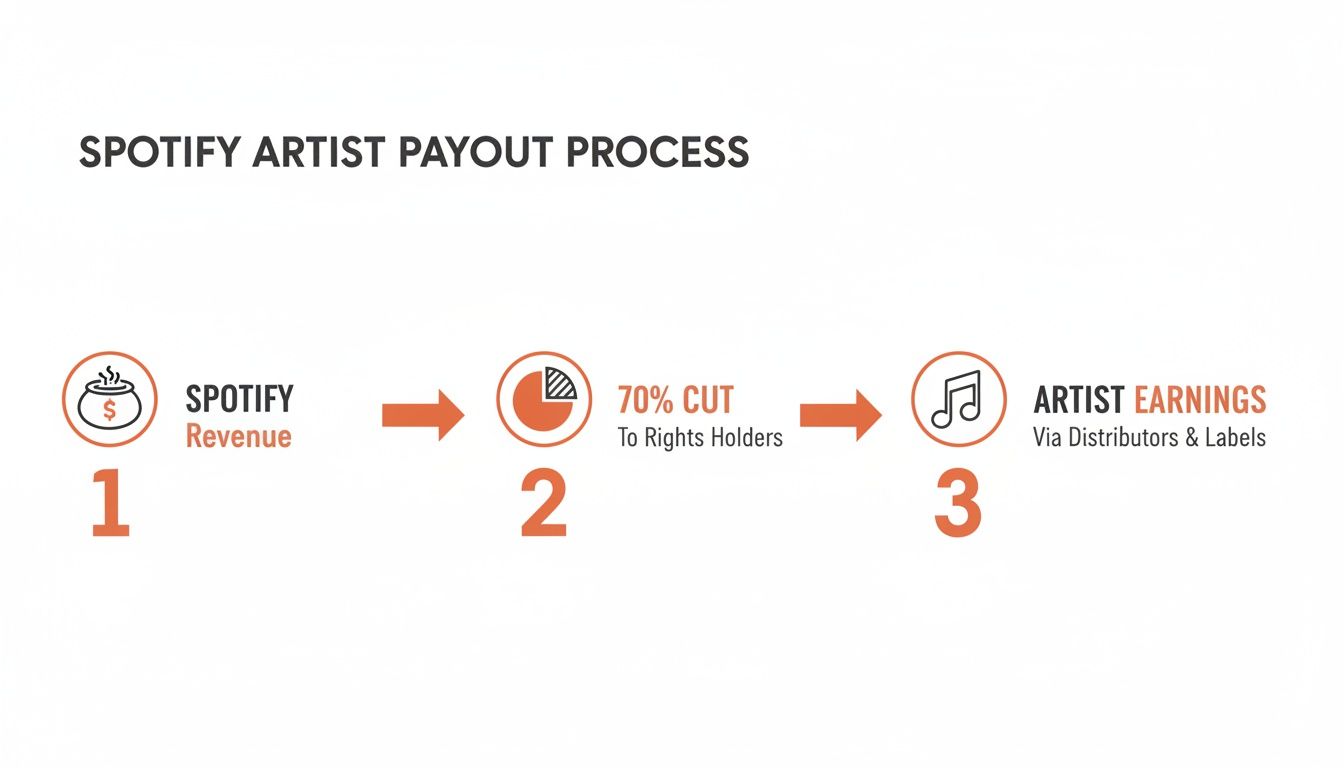
As you can see, after Spotify takes its share off the top, the rest is divided among all rights holders based on how many streams they racked up.
Tracking Your Master Recording Royalties
This is the most straightforward piece of the puzzle. The cash you earn for the actual sound recording—the "master"—is handled entirely by your digital distributor.
Spotify Pays Your Distributor: Every payment cycle, Spotify crunches the numbers, figures out your share of the revenue pot, and sends a single payment to your distributor, whether that's DistroKid, TuneCore, or CD Baby.
Your Distributor Processes and Pays You: Your distributor then takes its fee. This could be a percentage of your earnings or a flat annual fee, depending on your deal. The rest hits your account, ready for you to withdraw.
This part is pretty clean because you're only dealing with one middleman. But here's the catch: it only covers half of the money you've earned.
Collecting Your Songwriting and Publishing Royalties
This is where so many independent artists accidentally leave a ton of money on the table. The royalties for the underlying composition—the lyrics and melody you wrote—are split into two buckets: performance royalties and mechanical royalties. And they’re collected by completely different organizations.
You cannot collect publishing royalties through your distributor alone. If you wrote your own songs, you have to register with the right collection societies to get paid everything you've earned.
Here’s who you need to have in your contacts:
Performing Rights Organizations (PROs): These are groups like ASCAP, BMI, and SESAC in the US. They collect performance royalties, which are generated anytime your song is publicly "performed"—and yes, that includes every single stream on Spotify. You must be affiliated with a PRO to see a dime of this money.
Mechanical Rights Organizations (MROs): In the US, the big one is The Mechanical Licensing Collective (The MLC). These organizations collect mechanical royalties, which are earned whenever your song is technically "reproduced." In the digital age, a stream counts as a reproduction.
To collect all your royalties from Spotify, you have to be signed up with both a PRO and an MRO. For a lot of songwriters, bringing on a publishing administrator is a game-changer. They can handle all these registrations and collections for you, making sure no money gets lost in the system.
Getting a handle on this payment maze is essential to your financial success as an artist. You can play around with different scenarios and see what you might earn with our handy Spotify Royalties Calculator.
Actionable Strategies to Increase Your Spotify Royalties
Knowing how royalties from Spotify work is one thing. Actually making them grow is another game entirely. To move from theory to action, you need to stop chasing just any stream and start attracting the right kind of streams—the ones with more financial weight that tell Spotify's algorithm your music is worth pushing. It's about strategy, not just volume.
This has never been more critical. The scale of Spotify's payout system is massive, hitting a staggering $10 billion in 2024 alone and roughly $60 billion since it all began. The money is there. Music publishing royalties have even climbed past $4.5 billion in just the last two years. But with over 550 million monthly users, your slice of that pie depends entirely on your share of the total streams. To claim a bigger piece, you need a plan built on data.
Target High-Value Playlists and Avoid Royalty Killers
Not all playlists are created equal. Some are legitimate launchpads packed with real, engaged listeners. Others are royalty dead zones, filled with fraudulent streams from bots that can get your music kicked off Spotify. Knowing the difference is everything.
Fake streams pay you exactly zero and are a direct violation of Spotify's rules. They poison the royalty pool and put your entire catalog at risk. This is where you have to be surgical with your playlist pitching.
That’s exactly what the artist.tools Playlist Analyzer was built for. Before you even think about pitching a curator, you can run their playlist through the tool to vet its authenticity. It digs into follower growth history, flags suspicious activity, and gives you a clear verdict on a playlist's health. This way, you're only spending time and energy on placements that will actually earn you royalties and build a real fanbase.
Master Your Playlist Pitching Game
Once you’ve found the legit playlists, you need to reach out the right way. Blindly spamming your track to every curator you find is a complete waste of time and just gets you ignored. A targeted, personal approach works wonders.
Using a tool like the artist.tools Playlist Search helps you zero in on relevant playlists in your niche and—most importantly—find the curator's contact info. This lets you send a personalized email instead of a generic, copy-paste message. One thoughtful, well-crafted pitch to the right person is worth a hundred automated submissions.
Your goal isn't just to get on any playlist; it's to get on the right playlists. These are lists with real, engaged listeners whose streaming habits will positively impact your streamshare and, consequently, your royalties.
Optimize for the Algorithm to Drive Discovery
Spotify's algorithm can be your most powerful promoter. It’s the engine behind features like Discover Weekly, Radio, and Autoplay that can drive a ton of organic streams. But to get it on your side, you have to give it the right signals.
It all starts with your track metadata and artist profile. With the artist.tools Keyword Explorer, you can see what terms, moods, and genres are actually trending in different countries. By weaving these keywords into your track tags, descriptions, and even your artist bio, you’re essentially telling Spotify who your music is for. That makes it way more likely to get recommended to the listeners who will actually love it.
Artist Tools for Royalty Growth
To bring it all together, here's a quick look at how specific tools in the artist.tools suite can directly pump up your royalty checks.
Tool Feature | Action | Impact on Royalties |
|---|---|---|
Playlist Analyzer | Vet playlists for bot activity and engagement before pitching. | Avoids royalty-ineligible fake streams and focuses efforts on placements that pay. |
Playlist Search | Find curator contacts for relevant, niche playlists. | Increases chances of getting on quality playlists, driving high-value streams. |
Keyword Explorer | Identify optimal keywords for track metadata and profile. | Improves algorithmic discovery, leading to more organic streams from ideal listeners. |
AI Pitch Generator | Craft compelling pitches for Spotify's editorial team. | Secures placements on major editorial playlists, causing a massive surge in streams. |
And when you're ready to submit to Spotify's own editors through Spotify for Artists, your pitch has to be on point. The artist.tools AI Editorial Pitch Generator can help you craft a persuasive submission by analyzing your track and marketing info, then suggesting the best editorial playlists to aim for.
Ultimately, boosting your royalties from Spotify comes down to smart promotion, data analysis, and consistent optimization. For an even deeper dive, check out our guide on 7 proven strategies to increase your Spotify streams. By putting these tactics to work, you can stop passively watching your stream count and start actively building your career on the platform.
Learning from the Best: What Spotify's Top Earners Can Teach You
Taking a look at the artists sitting at the top of the Spotify food chain is like a masterclass in how to maximize your royalties. Sure, their numbers might seem completely out of reach, but the strategies they use are built on principles that any artist can start applying today. It's not about a lucky break; it's about building a massive, engaged global audience through smart, consistent work.
The sheer scale of their earnings really shows you the potential locked inside Spotify's pro-rata model. Taylor Swift is leading the pack with an estimated $426 million from over 106.6 billion streams as a lead artist. Right behind her are Bad Bunny at $369.6 million and The Weeknd at $359 million. These numbers point to a "winner-takes-most" reality, where a handful of superstars claim a huge slice of Spotify's $10 billion royalty pie. You can dive deeper into these figures with a full breakdown of the highest-earning Spotify artists.
But the real takeaway isn't just gawking at the giant numbers. It's about spotting the patterns that create them.
Replicating Winning Strategies
Top-tier artists absolutely dominate because they are masters in three key areas: consistency, global reach, and playlisting. They're on a relentless release schedule, which keeps their audience hooked and signals to Spotify's algorithm that they're a priority. They also build a worldwide fanbase, making sure their music pulls in high-value streams from many different premium countries. And finally, they consistently land on major editorial playlists, which works like pouring gasoline on a fire for discovery and streams.
Success leaves clues. When you start analyzing the growth patterns of top artists in your genre, you can reverse-engineer a roadmap for your own career. You can pinpoint the exact moves that lead to real growth in monthly listeners and streams.
Modeling Your Career Trajectory
This is where data becomes your best friend. You can go from just admiring another artist's success to actively modeling it. This is exactly what tools like the artist.tools Historical Data and Monthly Listeners Tracker were built for. Instead of just guessing, you can track the listener growth of a successful artist in your niche and see precisely how their numbers shot up after a new single or a crucial playlist add.
This kind of analysis helps you answer the questions that actually matter:
How often are the big artists in my genre really dropping new music?
Which specific playlists were their big breakout moments?
What was the real impact of that collaboration on their listener count?
When you start using these insights, you turn those high-level success stories into a personal, actionable game plan for boosting your own royalties from Spotify. It’s all about learning from the best to build a career that lasts.
Your Spotify Royalty Questions, Answered
Let's be real, navigating streaming payments can feel like a maze. To clear things up, here are some straightforward answers to the questions we see artists asking all the time about their royalties from Spotify. Think of this as your cheat sheet for managing your music finances.
How Often Does Spotify Pay Artists?
Spotify settles up its royalty payments every month. But here’s the catch: you won't get a check directly from them. Instead, Spotify sends the total earnings to your distributor (like DistroKid or TuneCore) or record label, usually about 30 to 45 days after the month the streams actually happened.
From there, your distributor has to process that payment, take out any fees or commission they're owed, and then finally deposit the rest into your account. This extra step means you’ll probably see the money from your January streams land sometime in March or even April.
Why Do Royalty Rates Vary So Much?
You've probably noticed that the value of a single stream is never the same from one month to the next. That's not a mistake; it's just how Spotify's pro-rata payout model works. The per-stream rate is always shifting based on a few key factors.
Here are the three biggest reasons your rates are always changing:
Listener’s Plan: A stream from a Premium subscriber is worth a lot more than a stream from someone on the free, ad-supported tier. Premium users simply put more money into that month's total revenue pot.
Listener’s Country: Not all countries pay the same for subscriptions or generate the same ad revenue. A stream from a listener in the U.S. or the UK will almost always earn more than one from a market with lower subscription prices.
Total Monthly Streams: You're getting a slice of the total revenue pie. If Spotify's revenue for the month stays flat but the total number of streams across the entire platform goes up, the value of each individual stream goes down.
What Steps Must I Take to Collect All My Royalties?
Just getting your music on Spotify through a distributor isn't enough to collect everything you're owed. To get paid correctly, you need to be registered with several different organizations that handle both your master recording and your publishing royalties.
To capture every cent you’ve earned from your royalties from Spotify, you must register your works as both a recording artist and a songwriter. Missing a step means leaving money on the table.
Here's your essential checklist to make sure you're covered:
Sign with a Distributor: This is your primary way to collect royalties from your master recordings.
Join a Performing Rights Organization (PRO): You need to affiliate with a PRO like ASCAP or BMI to collect the performance royalties you earn as a songwriter.
Register with a Mechanical Rights Organization (MRO): In the U.S., you'll need to sign up with an organization like The MLC to collect your mechanical royalties.
Ready to turn these insights into action? artist.tools provides the data and features you need to analyze playlists, track your growth, and build a real strategy to increase your Spotify earnings. Start making smarter decisions for your music career today.
.png)
.png)
Comments