
Advertising Music on Spotify: A Practical Guide
Learn how to master advertising music on Spotify. This guide covers Ad Studio, Marquee, setup, targeting, and integrating ads with playlisting for real growth.
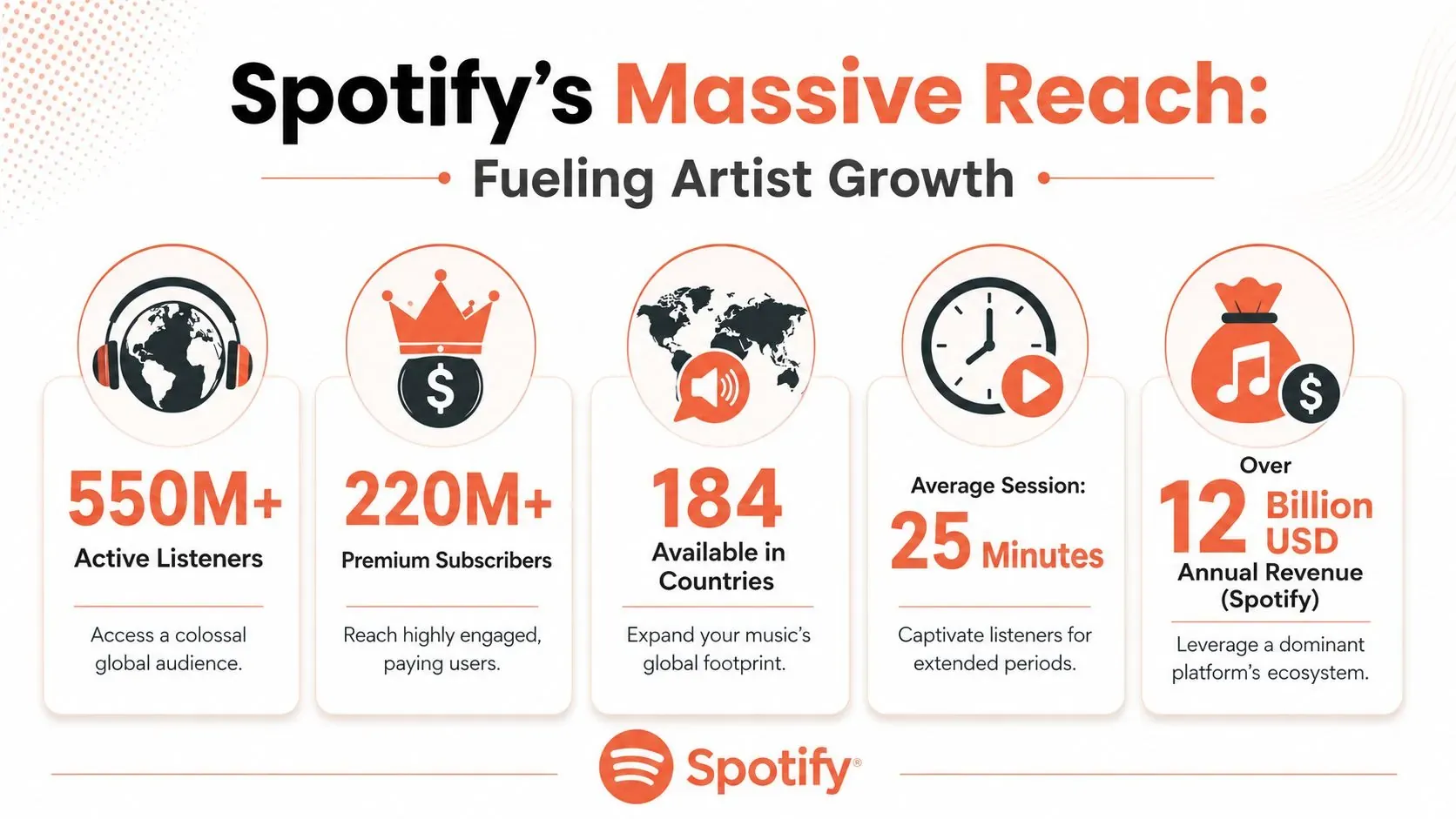
Spotify isn’t a niche channel for artist promotion. It sits at a scale that changes how release strategy works. Business of Apps reported 626 million unique users in 2024, including 246 million subscribers, and €15.6 billion in revenue with €1.1 billion in annual net profit, while Spotify says it has over 700 million passionate music fans around the world (Spotify statistics from Business of Apps). If you’re serious about advertising music on Spotify, the question isn’t whether the platform is big enough. It’s whether your campaign is built to turn attention into repeat listening.
Most artists waste money by treating Spotify ads like a vanity play. They buy traffic, count streams, and call it a win. That’s the wrong frame. Good Spotify campaigns support a larger system: release planning, audience testing, playlist pitching, and post-release analysis. Done properly, paid promotion helps you identify who responds, which song earns intent, and where organic growth has a real chance to compound.
Why Advertising on Spotify is a Core Growth Lever
Paid Spotify promotion matters because it can shorten the path from discovery to a qualified listen. On social platforms, a user may watch, like, and disappear. On Spotify, the ad runs inside a listening session, so the jump from attention to playback is smaller and easier to measure.
That changes how I treat spend.
For indie releases, Spotify ads are not just a distribution add-on. They are a way to buy an early signal. If a track gets saves, repeat listens, and strong completion from paid traffic, that usually tells you something useful about the song, the audience, or the positioning. If it does not, the campaign still gives you feedback before you waste weeks pushing the wrong creative or pitching the wrong angle.
Paid traffic creates a signal you can build on
The biggest mistake artists make is judging Spotify ads only by cheap streams. Cheap streams are easy to buy and easy to misread. The better question is whether paid listeners behave like future fans. Do they save the song, visit the artist profile, come back to the catalog, and give Spotify enough engagement data to keep testing the track with more listeners?
That is why paid and organic work should be planned together. Ads can create the first wave of listener activity. Organic playlist pitching and catalog optimization determine whether that wave turns into durable growth. A release with no paid push often struggles to generate momentum early. A release with paid spend but no follow-through usually gets a short spike and then fades.
A useful workflow is to run ads early, then compare paid listener quality against playlist and profile data using tools that track audience and playlist movement, such as this guide to running ads with music data from artist.tools. The goal is not to force streams at any cost. The goal is to find the songs, audiences, and markets that can hold attention after the ad impression is gone.
Spotify offers different tools for different jobs
Spotify’s paid products sit at different points in the funnel, and that distinction affects both strategy and expectations. Ads Manager is useful for reaching cold or lightly aware listeners and testing which message gets attention. Marquee and Showcase are closer to conversion because they put a release in front of people who already have some reason to care.
The trade-off is simple. Broader ad campaigns can teach you faster, but the traffic is colder and results are less predictable. On-platform promotion to warmer audiences usually converts better, but it depends on having enough existing listener history to make those campaigns worth the spend.
Good campaign planning respects that split. Use paid reach to learn what earns attention. Use Spotify’s warmer-audience products, plus playlist pitching and release follow-up, to turn that attention into repeat listening.
Understanding Spotify’s Advertising Options
Most confusion around advertising music on Spotify comes from using the wrong tool for the wrong outcome. Spotify’s own artist guidance separates fanbase-building tools like Marquee and Showcase from Ads Manager formats that run audio or video ads to free listeners. Those are different jobs, and they should be judged against different goals.
Spotify ad formats compared
| Ad Format | Target Audience | Primary Goal | Format | Cost Model | Best Use Case |
|---|---|---|---|---|---|
| Ads Manager audio ads | Free listeners | Reach and awareness | Audio | Platform-managed ad spend | Testing song-market fit with broad top-of-funnel traffic |
| Ads Manager video ads | Free listeners | Attention and click-driven discovery | Video | Platform-managed ad spend | Driving listeners from visual creative into a release |
| Marquee | Listeners likely to engage with the release | Stream growth and re-engagement | Display campaign | Campaign spend inside Spotify | Pushing a new release to warm audiences |
| Showcase | Listeners likely to press play | Catalog or release discovery | Display campaign | Campaign spend inside Spotify | Keeping priority music visible on-platform |
Spotify’s support guidance is useful here because it highlights the strategic split that many tutorials blur. Ads Manager reaches free listeners with audio and video. Marquee and Showcase are for promoting music inside Spotify’s listening environment to people with stronger likelihood to act (Spotify artist guidance on promoting music).
Choose the format by business goal
If your actual goal is pre-save or off-platform conversion, Ads Manager-style thinking tends to be cleaner because the campaign can be built around a defined action. If your goal is stream growth from people already adjacent to the artist, Marquee or Showcase is usually the more natural fit.
If your goal is follower growth, be careful. That’s where a lot of campaigns drift into weak measurement. A play isn’t a follower. A click isn’t a fan. For follower growth, the song, the artist profile, and the release context all have to work together. The ad can only get the listener to the door.
Public advice around Spotify promotion often talks about reach or awareness, but artists need to decide whether they’re buying discovery, stream growth, fanbase growth, playlist traction, or an off-platform action before they spend.
That’s also why skepticism about Spotify ads isn’t entirely wrong. Ads don’t automatically fix the platform’s recommendation loops or listener behavior. A weak song still underperforms. A mismatched audience still skips. Paid spend can amplify demand, but it can’t manufacture it.
For artists running traffic from outside Spotify into Spotify, artist.tools’ guide to ads with music is useful because it focuses on campaign structure rather than platform hype. That’s the right lens. The format only works when it matches the job.
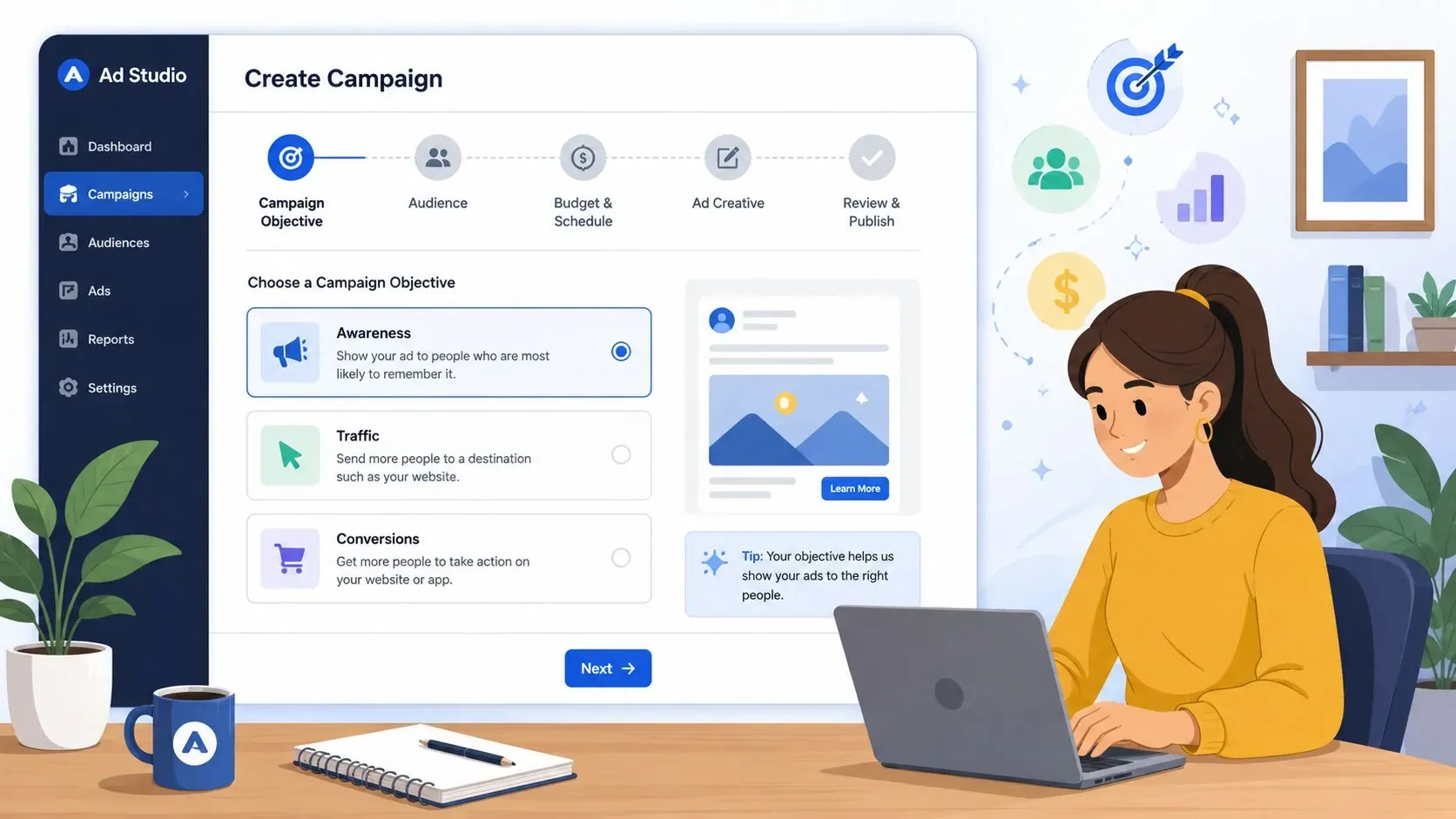
Setting Up Your Campaign in Ad Studio
A Spotify campaign usually fails before launch, not after. The problem is almost always setup. Artists target too narrowly, mix multiple goals into one ad set, or launch with one creative and no real testing plan.
Start with the conversion event
Define the action before you touch audience settings. That’s the cleanest way to avoid a messy account structure. For advertising music on Spotify, that action might be a track listen, a landing page click, or another specific downstream event tied to the release plan.
Campaign setup should follow the objective, not the other way around. If you start with targeting ideas instead of the conversion event, you end up building campaigns around assumptions. Then every result is harder to interpret.
A good launch checklist looks like this:
- Pick one primary action: Don’t mix stream growth, profile visits, and pre-save traffic in the same learning phase.
- Choose the release asset: Send traffic to the exact track, release page, or destination you want to evaluate.
- Write down the decision rule: Decide in advance what result earns more budget and what result gets cut.
Build targeting wide enough to learn
One experienced advertiser recommends building toward at least 50 million reachable users before tightening filters, especially when the goal is driving Spotify listens from paid social workflows (video discussion of broad audience testing). The principle carries over well to music campaign setup more broadly. Start broad enough for the platform to find signal, then narrow only after the data tells you who’s responding.
Over-targeting is one of the fastest ways to ruin learning. Artists love stacking genre interests, niche behaviors, and demographic filters because it feels precise. Most of the time it just makes delivery worse. You aren’t helping the algorithm. You’re starving it.
Broad targeting is not lazy targeting. It’s a testing choice that gives the system room to identify who actually responds.
The practical build is straightforward:
- Locations first: Choose countries or regions that match your release plan, language, and catalog priorities.
- Audience breadth second: Keep the pool wide enough to generate meaningful delivery.
- Creative testing third: Run multiple variations in parallel instead of assuming one ad tells the story.
Later in the process, video can sharpen your message testing.

Separate budget targeting and creative decisions
The same experienced workflow recommends campaign-level budget, ad-set-level targeting, and creative-level testing, plus clear calls to action like Listen Now or Learn More. That structure matters because it isolates variables. If performance drops, you can tell whether the issue is the audience, the budget, or the message.
Keep your setup diagnostic. Don’t change everything at once. If you swap creative, shrink the audience, and move spend on the same day, you won’t know what caused the result.
Common mistakes in Ad Studio setup are usually operational:
- Too many audiences at launch: You split data before the campaign can learn.
- One creative only: You force the whole test to rise or fall on one message.
- Unclear CTA: The listener has no obvious next step.
- Premature narrowing: You reduce signal before the system has enough of it.
That’s why disciplined setup beats clever targeting. Clean structure produces useful data. Useful data is what makes scaling possible.
Creative and Budgeting Best Practices
Creative is the lever most artists underestimate. They obsess over targeting and ignore the ad itself. But if the hook is weak, the targeting can be perfect and the campaign will still stall.
Creative has one job
The ad must earn the next action. Not every ad needs to explain the artist’s story, summarize the EP, and prove credibility. For most campaigns, the job is simpler: get the right listener interested enough to play.
For audio ads, write like a person speaking between songs, not like a press release. Short copy wins because Spotify is a listening environment. The script should name the artist, create curiosity, and deliver one clear instruction. If the voiceover sounds stiff, the ad feels like an interruption.
A stronger pattern looks like this:
- Lead with the release: Name the song or project early.
- Give one reason to care: Mood, moment, or sonic identity.
- Finish with one action: “Listen now” works because it’s clear.
For video ads, the first visual needs to communicate before the viewer thinks about skipping. Use motion, performance, lyrics, or an instantly recognizable mood. Don’t assume they’ll wait for context.
Weak ad copy usually tries to sell the artist. Strong ad copy sells the click, the play, or the first listen.
Budgeting is a testing system
Budgeting should follow uncertainty. When you don’t know which audience or creative wins, spend should stay in testing mode. When a campaign produces a consistent signal, then you scale.
That means your early budget decisions are less about “how much should I spend” and more about “how much data do I need to make a clear call.” A small test across multiple creatives is usually smarter than dumping spend into one asset because it feels like your favorite.
Use this budgeting logic:
| Situation | Better move | Bad move |
|---|---|---|
| New release with no paid learnings | Test several creatives | Put all spend behind one ad |
| Broad audience launch | Let delivery stabilize | Narrow audience immediately |
| One creative clearly underperforms | Cut it and reallocate | Keep it running out of hope |
| Strong message-market fit | Increase spend gradually | Double spend and change targeting at the same time |
Profitable Spotify promotion usually looks boring from the inside. It’s structured testing, controlled changes, and budget discipline. The artists who lose money tend to behave the opposite way. They chase the dashboard every day, rebuild the account mid-flight, and scale before they’ve found a working ad.
Measuring ROI and Optimizing for Growth
Spotify’s ad ecosystem has matured beyond impression counting. That’s good news for artists because it means you can evaluate whether a campaign is creating actual listening intent, not just cheap exposure.
Watch the metrics that map to listener quality
Spotify Advertising says music-marketing reporting includes the number of listeners, number of new listeners, listener conversion rates, new listener conversion rates, and an intent rate that captures actions suggesting someone may stream again, such as liking a track or adding it to a playlist. Spotify also says these reporting metrics were built on Spotify First Party Data 2019, which marks the shift toward behavior-based attribution (Spotify Advertising on streaming conversion metrics).
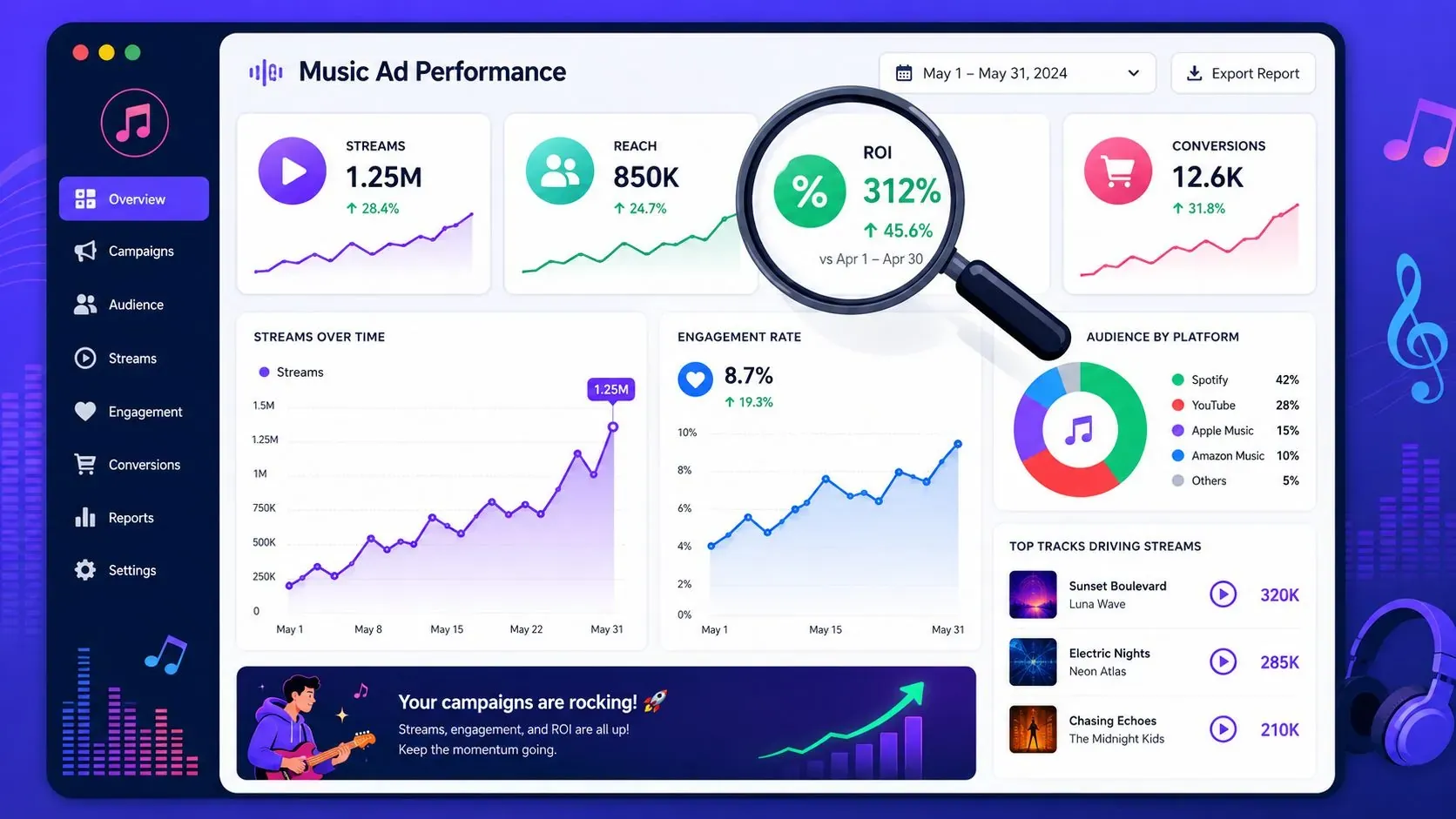
That changes how you should read campaign performance. Reach matters, but only as a top-line delivery measure. The key question is whether the campaign creates new listeners and signs of repeat behavior.
A useful measurement stack for Spotify audio or video campaigns centers on six metrics:
- Reach: How many people saw or heard the ad.
- Completion rate: Whether the ad was consumed fully enough to matter.
- CTR: Whether the ad motivated immediate action.
- CPCL: Cost per completed listen as an efficiency check.
- Conversion rate by attribution window: How outcomes vary by timing.
- Brand lift: Helpful when available for awareness evaluation.
Use attribution windows on purpose
Attribution is where most artist campaigns get misread. A direct click isn’t the only path to value. Spotify campaign analysis should separate 1-day post-click, 7-day post-click, and 7-day post-impression windows, because different creatives do different jobs.
If you only judge on clicks, you’ll underrate upper-funnel ads. Some campaigns work because listeners hear the ad, don’t click immediately, and come back later. That’s still impact. It just isn’t visible in a shallow reporting view.
Don’t optimize awareness inventory like direct response inventory. First check exposure quality, then compare conversions across attribution windows.
Turn dashboard data into campaign decisions
Optimization works when each metric triggers a specific response. Keep it operational.
- If reach is strong but completion is weak: The ad isn’t holding attention. Fix the opening, pacing, or message.
- If completion is strong but CTR is weak: The creative may be memorable but the CTA is soft or the offer is unclear.
- If CTR is healthy but conversion is poor: Check the destination. The track, landing page, or release framing may be losing people after the click.
- If new listener conversion is solid but intent is weak: You’re buying first listens without building repeat behavior. The song fit or audience fit may be off.
- If post-impression conversion beats post-click logic: Treat the campaign as upper funnel and stop forcing it into a traffic mindset.
For a more detailed framework that connects paid promotion to broader release analysis, this data-driven Spotify promotion playbook for artists is worth reading. The key discipline is the same either way. Don’t ask whether the campaign got streams. Ask whether it produced the kind of listener behavior you can build on.
Combining Paid Ads with Organic Playlist Strategy
Paid ads are useful. Paid ads alone are fragile. If you want sustainable Spotify growth, the campaign has to feed your organic systems instead of replacing them.
Paid ads create the first signal
The best use of advertising music on Spotify is to create early listener data that informs everything else. Paid traffic helps you learn which creative angle gets attention, which markets respond, and which release has enough pull to justify more support. That information makes your organic work sharper.
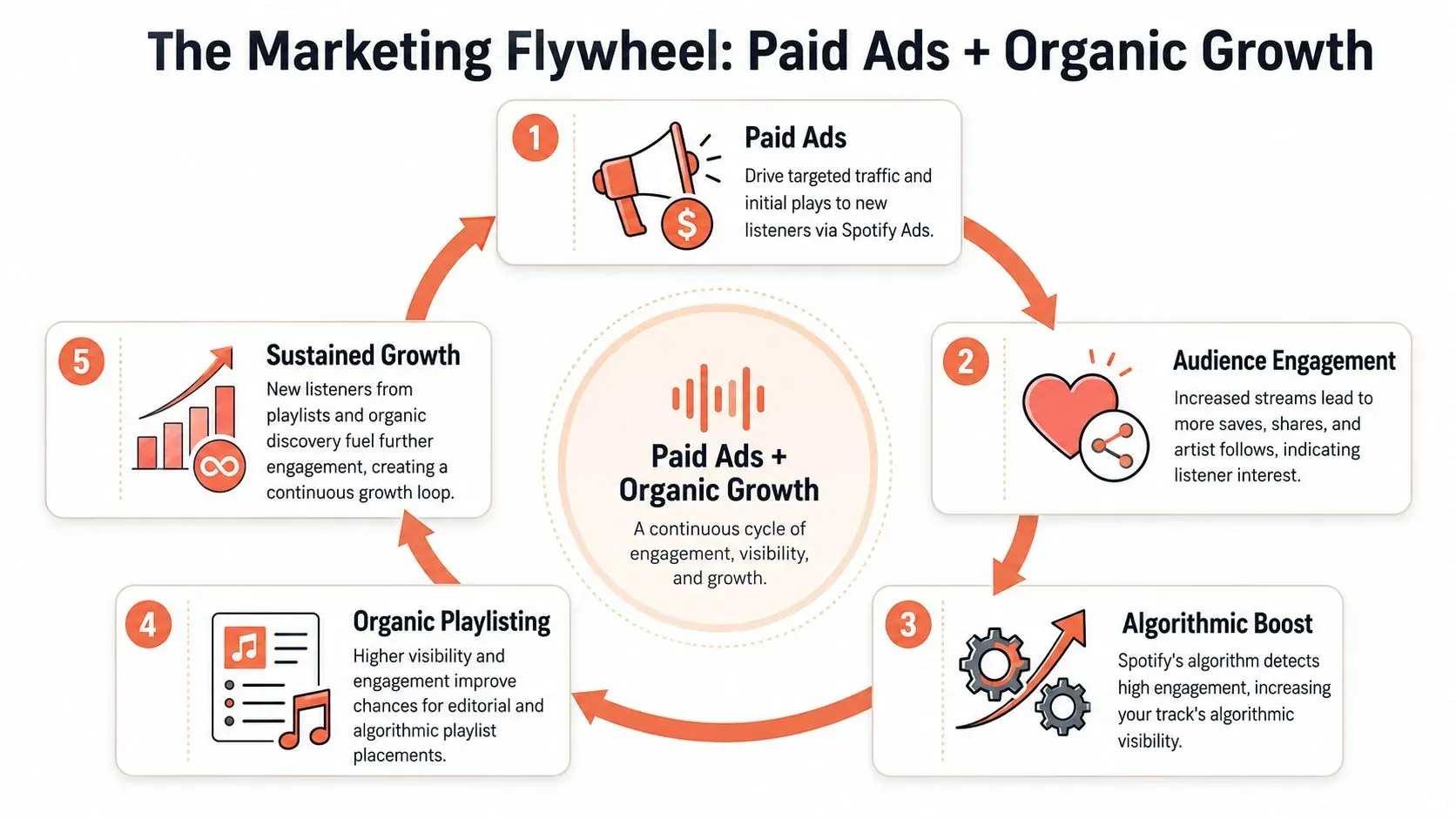
Think of it as a flywheel, not a funnel. Ads generate the first wave of qualified listens. Those listeners produce engagement signals. Stronger engagement improves the odds that Spotify surfaces the song more widely. Then organic playlists, algorithmic recommendations, and repeat listener behavior can extend the life of the release.
That’s also why bad paid campaigns can be so costly. They don’t just waste money. They produce noisy data that sends you in the wrong direction. If you buy the wrong audience, the playlist strategy built on top of that data won’t be reliable.
Playlist work determines whether growth sticks
Playlist strategy matters most after you’ve identified a song and audience worth pushing. At that stage, you need to find legitimate playlists, vet their quality, and prioritize placements that match the track instead of chasing inflated follower counts.
Tools can help with that due diligence. One option is artist.tools, which includes Playlist Search for finding relevant playlists, Playlist Analyzer for checking playlist integrity and curator data, Bot Detection for monitoring suspicious activity, and trackers for monthly listeners and streams. Used correctly, those tools help artists avoid low-quality playlist placements and compare ad timing with audience movement.
For playlist research itself, this guide to Spotify playlists and how they grow your music is a practical companion to paid promotion. The important point is strategic sequencing:
- Run ads to test demand: Learn which song and message pull in the right listener.
- Watch engagement quality: Saves, adds, and repeat behavior matter more than raw activity.
- Pitch playlists that fit the data: Use what the campaign taught you about genre, mood, and market.
- Track the combined effect: Measure whether paid traffic and playlist adds are reinforcing each other.
- Reinvest only where the loop is working: Scale the song, market, and playlist lane that compounds.
The strongest release campaigns don’t force paid and organic into separate silos. They let each side validate the other. Ads tell you what deserves amplification. Playlists test whether that attention can turn into durable discovery.
If you’re building release campaigns around real listener signals instead of vanity metrics, artist.tools can support the organic side of the workflow with playlist research, bot checks, and Spotify performance tracking. That makes it easier to connect ad activity with what happens next on your artist profile.