
Figurative Language in Song Lyrics: A Strategic Guide
Learn to use figurative language in song lyrics not just for art, but to boost engagement and improve Spotify playlisting outcomes. A guide for modern artists.
Spotify rewards songs people can describe in a sentence and remember after one listen. Figurative language helps create that memory. A sharp metaphor, image, or symbol gives a track a clearer emotional identity, which makes it easier for listeners to replay, share, and mention in playlist conversations.
That has real commercial value.
Songs with vivid lyrical framing tend to travel better because they give fans and curators better language for the feeling the record delivers. In practice, that affects more than artistic perception. It can strengthen a pitch, sharpen audience targeting, and give a release a more distinct profile in a crowded streaming market.
The mistake is treating figurative language as a classroom term instead of a release strategy. Strong writing does more than sound good. It helps a song stick, and songs that stick earn more saves, more word-of-mouth, and more repeat listens.
Why Lyrical Craft Is Your New Marketing Tool
Marketing starts inside the lyric.
On Spotify, the songs that travel fastest usually give listeners a clean phrase, image, or emotional code they can repeat in a caption, playlist title, comment, or pitch email. Figurative language helps create that code. It turns a broad theme into a usable identity.
That changes how a release gets positioned. A line built around gravity, smoke, summer heat, or broken glass gives your team better material for preview clips, canvas copy, press notes, and playlist outreach. It also makes audience targeting sharper because the song carries a clearer emotional and visual profile from the start.
I see the same trade-off on release campaigns all the time. Literal writing can be easy to understand, but it often gives the marketing team nothing distinctive to work with. Overwritten lyrics create the opposite problem. They may impress on paper and still fail in market because the central image is muddy, private, or impossible to summarize in one sentence.
Strong commercial writing sits between those extremes. One memorable figurative thread, repeated with control, gives the song a stronger spine across the chorus, short-form content, and editorial pitching. Curators do not need a literature lesson. They need a fast read on the feeling, setting, and listener fit.
What this changes for a release
A good lyric supports the record. A good figurative lyric also helps package it.
If the chorus frames heartbreak as cold weather, running out of air, or a house going dark, the release instantly has stronger creative direction. Visual assets become easier to align. Teaser copy gets sharper. Fan conversation becomes more consistent because people keep reaching for the same words and images when they describe the track.
That consistency matters. Spotify’s ecosystem runs on classification as much as taste. Editorial teams, recommendation systems, and listeners all respond better when a song presents a clear emotional signal.
One practical example is controlled exaggeration. Hyperbole can raise the emotional ceiling of a chorus without making the writing confusing, if the line still points to a recognizable feeling. Artists working on that technique can study how hyperbole works in song lyrics and apply it where the record needs one unmistakable peak.
What tends to work in market
- Recurring imagery tied to one emotional theme
- One central metaphor that survives from verse to chorus
- Figurative language with visual value that the art, video, and social rollout can use
- Exaggeration at the right moment so the chorus feels bigger without losing clarity
- Language fans can quote without needing the full backstory
What usually weakens the campaign
- Unrelated symbols piled together with no central idea
- Generic heartbreak wording that could belong to any song in the genre
- Dense private references that block playlist pitching because the premise is hard to explain
- Lyrics and marketing assets pulling in different directions so the release feels less defined
Artists who grow on streaming usually build this into the writing phase, not the post-release scramble. The lyric gives the song emotional precision. The figurative choices give the campaign language people can recognize, remember, and pass on.
The Major Figurative Language Types in Modern Hits
A lyric device is not just a writing choice. It changes how fast a listener understands the song, what line they remember, and what phrase ends up in a playlist pitch, a caption, or a short-form clip.
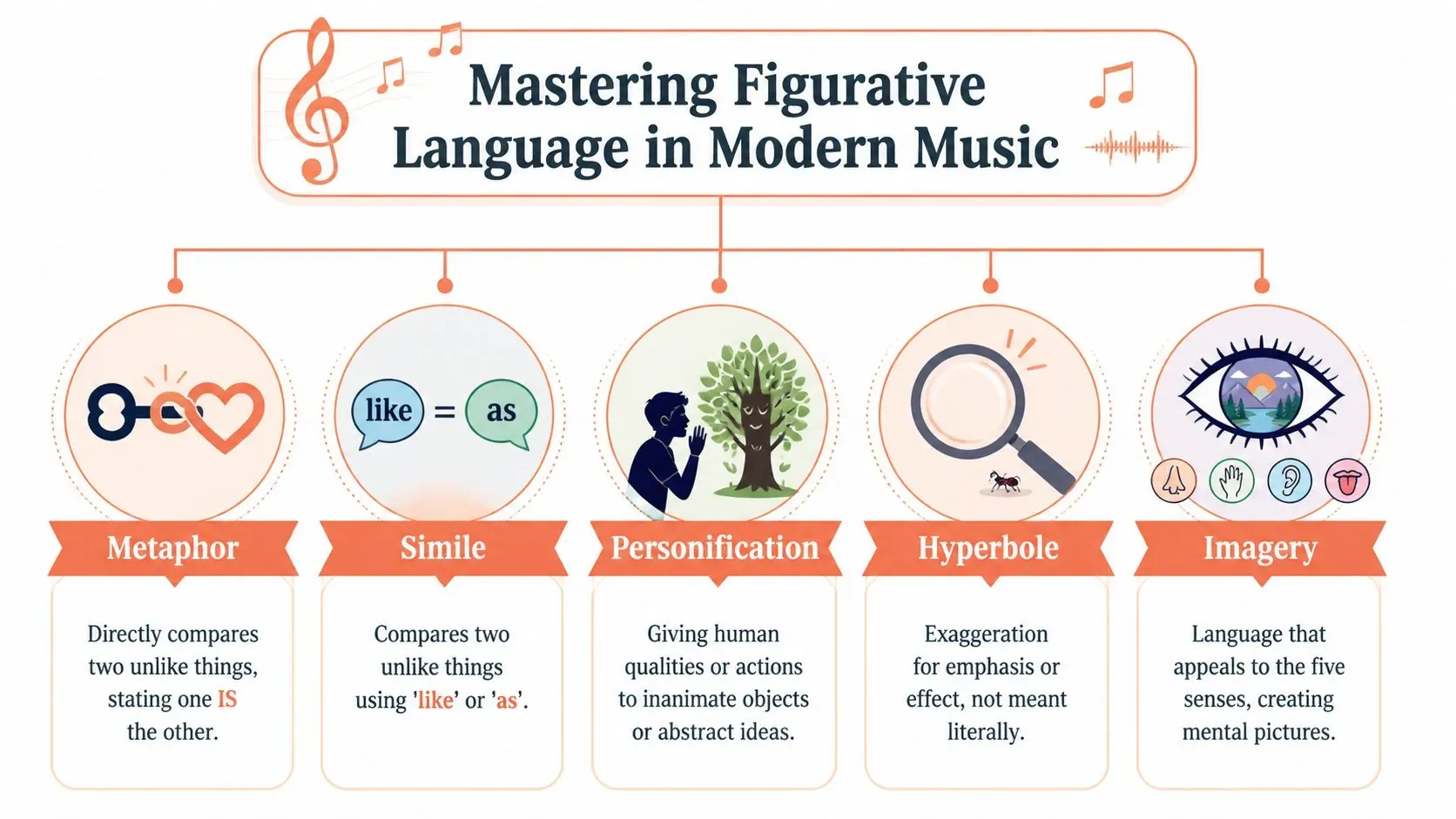
The useful question is not “what is a metaphor?” The useful question is “which device helps this record stick on first listen without flattening the artist’s point of view?” Modern hits usually win with figurative language that is easy to process, emotionally sharp, and flexible enough to support the release story across Spotify, social, and editorial pitching.
Metaphor
Metaphor states that one thing is another. For songwriters, that makes it one of the most efficient tools in the catalog. A strong metaphor gives the track a central frame, so the lyric feels cohesive instead of scattered.
That matters commercially. If the song’s premise can be reduced to one compelling image, the team has a cleaner pitch for editors and a clearer message for marketing assets. Metaphor also tends to produce the lines fans quote back because it condenses a feeling into something concrete.
The trade-off is clarity. Push the metaphor too far and the song starts sounding clever instead of moving.
Simile
Simile compares using “like” or “as.” It usually lands faster than metaphor because the lyric announces the comparison instead of asking the listener to infer it.
That speed has value in streaming. If a verse needs an immediate image before the pre-chorus turns, simile can do the job without slowing the record down. It is especially useful in songs built for strong first-pass comprehension, where the listener needs to catch the emotional setup before deciding to stay.
The risk is familiar writing. If the comparison sounds inherited from a hundred older songs, it will not help retention.
Hyperbole
Hyperbole uses exaggeration to increase emotional scale. In practical songwriting terms, it is a hook device. It tells the listener, fast, that the feeling is bigger than ordinary speech can carry.
In one analysis of Billie Eilish’s album When We All Fall Asleep, Where Do We Go, hyperbole was a major device, accounting for 7 of 25 identified figurative language instances, or 28%, according to this study of the album’s lyrics.
Used well, hyperbole gives choruses lift and makes key lines easier to remember. Used badly, it sounds unearned. Writers who want to study that balance can review these examples of hyperbole in song lyrics.
Personification
Personification assigns human behavior to non-human things. Regret knocks. Silence screams. Summer leaves. The device works because it turns a vague emotion into an active force.
That can improve a song’s visual identity. Personification often creates lines that are easy to translate into artwork, visualizers, and video treatments because the image already contains motion and character.
It can also drift into melodrama if every object in the song starts performing.
Imagery
Imagery uses sensory detail to make the listener feel present in the song. Temperature, color, texture, smell, pressure, distance. This is often the difference between a lyric that communicates an idea and a lyric that creates a scene.
On Spotify, that distinction matters more than writers sometimes admit. Songs with vivid imagery give listeners more to attach to on repeat plays, and they give editorial teams a more concrete story to place inside mood, activity, and narrative-driven playlist contexts.
A practical summary:
| Device | Best use in a song | Common risk |
|---|---|---|
| Metaphor | Building a central emotional frame | Becoming too abstract |
| Simile | Fast, accessible comparison | Sounding generic |
| Hyperbole | Raising intensity in hooks | Feeling melodramatic |
| Personification | Animating invisible emotions | Turning theatrical |
| Imagery | Making scenes feel lived-in | Overdescribing |
The strongest songs do not stack every device into one verse. They choose the device that matches the record’s job, then repeat that logic consistently enough that listeners remember the line and the algorithm gets clear engagement signals from the response.
Annotated Examples From Pop Rock and Hip Hop
Songs usually earn their second and third streams because one line sticks. The replay trigger is often a compact image the listener can quote, caption, or attach to a moment in their own life.
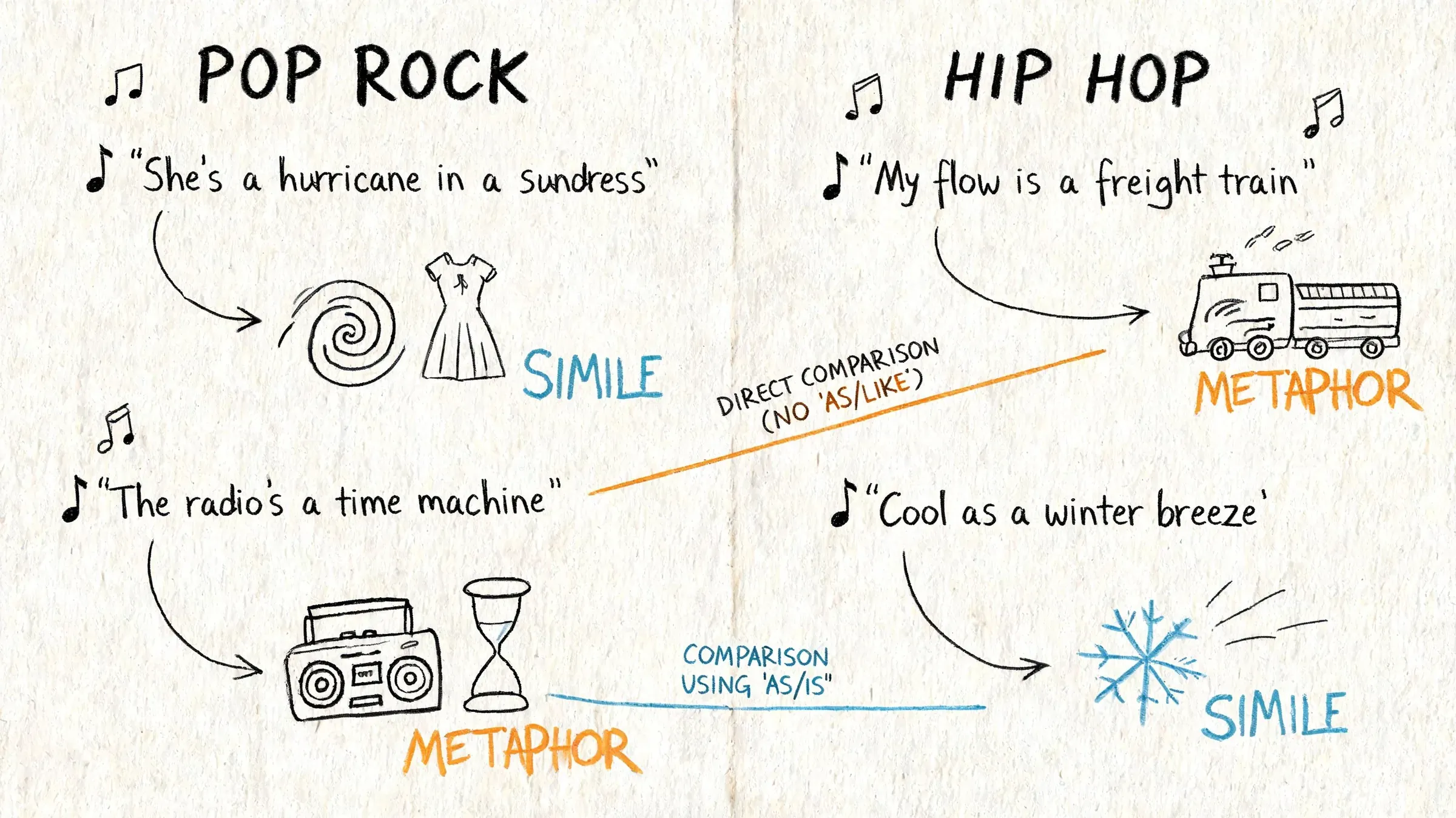
Strong figurative writing proves its value under commercial pressure. It has to survive melody, pacing, tone, and audience attention spans that are getting shorter, not longer. For Spotify, that matters. Memorable lines help with saves, shares, UGC captions, and playlist pitch language because the song already contains a clear story in miniature.
Pop example
“You drew stars around my scars”
This line succeeds because the contrast is immediate and clean. “Scars” gives the listener pain. “Stars” recasts that pain as beauty, attention, and repair. The image lands on first listen, which is one reason pop writers chase this kind of compression.
It also has strong repeat value. A listener can remember it after one chorus and reuse it in conversation, a post caption, or a text. That portability is good business. Lyrics that travel outside the song often help the song travel with them.
Rock example
“My love has concrete feet, my love’s an iron ball”
The metaphor is heavy in every sense. Concrete feet suggest paralysis. An iron ball suggests punishment, drag, and no clean escape. You do not need to study the line to feel it.
That fit between lyric and sound is what rock gets right when it works. Dense guitars, live drums, and forceful vocals can carry blunt physical imagery better than delicate abstractions. If the track feels massive and the lyric feels weightless, retention drops because the emotional message splits in two.
Hip hop example
“Life’s a bitch”
It is concise, figurative, and brutally efficient. The line turns life into an antagonistic character, which gives the record attitude and point of view in three words.
Hip hop rewards that economy. Listeners in rap care about phrasing that hits fast and carries meaning. Decorative language without pressure behind it gets skipped. A durable rap metaphor usually does at least two jobs at once. It frames the worldview and strengthens the hook.
What these examples have in common
Each line passes a practical listening test I use with developing artists and catalog reviews:
- Name the literal feeling. Hurt, entrapment, resentment, desire.
- Identify the image doing the work. Stars, concrete, iron ball, a hostile person.
- Test recall after one listen. Could a fan quote the image back without checking the lyric sheet?
- Check format fit. Does the line still hit in a 15-second clip, playlist pitch, or social caption?
- Match it to the production. The words and the track need to belong to the same emotional world.
That fourth test matters more than writers admit. Some lyrics are beautiful on paper and weak in distribution. If the image cannot survive a short-form snippet or a playlist editor’s quick scan, it loses marketing value even if it wins workshop praise.
A commercially strong figurative line is vivid, easy to repeat, and broad enough for listeners to map onto their own lives. That is why metaphor keeps showing up in breakout records across genres. It gives artists emotional specificity without trapping the song inside one narrow interpretation.
For writers who want more sensory-reference points, this roundup of songs that have imagery is useful because it shows how scene-based lyrics create stronger listener attachment.
Weak figurative language usually fails in one of two ways. It is generic enough to disappear, or so private that nobody can carry it forward. The middle ground is where streams tend to build. The listener gets a clear image, and the song gets a line worth replaying.
Songwriting Techniques to Sharpen Your Lyrics
Better figurative language rarely comes from waiting for inspiration. It comes from forcing stronger options onto the page and rejecting your first obvious line. Most writers don’t have a talent problem. They have an editing problem.
Use sense writing before line writing
Don’t start with the statement. Start with the room.
Write the emotion you’re chasing at the top of the page, then list what it smells like, sounds like, feels like on skin, looks like in weather, and tastes like if it had a taste. This moves you away from generic lines about heartbreak, longing, or rage and toward language that belongs to your song.
For example, “I miss you” is a statement. “Your side of the bed stayed cold through July” is a scene.
Build one metaphor map
Pick one concept in the song and force ten possible metaphor families for it. If the song is about jealousy, don’t stop at fire. Try rust, surveillance, mold, static, sirens, gravity, broken glass, floods, engines, or hunger.
Then test each family against the track’s production and vocal style. A spare indie record may want weather or distance. A high-energy pop record may want combustion or velocity.
Here’s a compact version of the exercise:
- Step one: name the core emotion in plain language
- Step two: write ten non-literal objects or systems that behave the same way
- Step three: keep the family that gives you chorus language, not just one clever verse line
- Step four: cut any image that belongs to a different world
Escalate with controlled hyperbole
Hyperbole is useful when the song needs lift, but it only works if the exaggeration arrives at the emotional peak. If every line is maxed out, nothing feels important.
A clean drill is to write three versions of the same line:
- Version one: literal
- Version two: heightened
- Version three: almost too far
Then sing all three over the track. Usually the strongest line is the one just before absurdity.
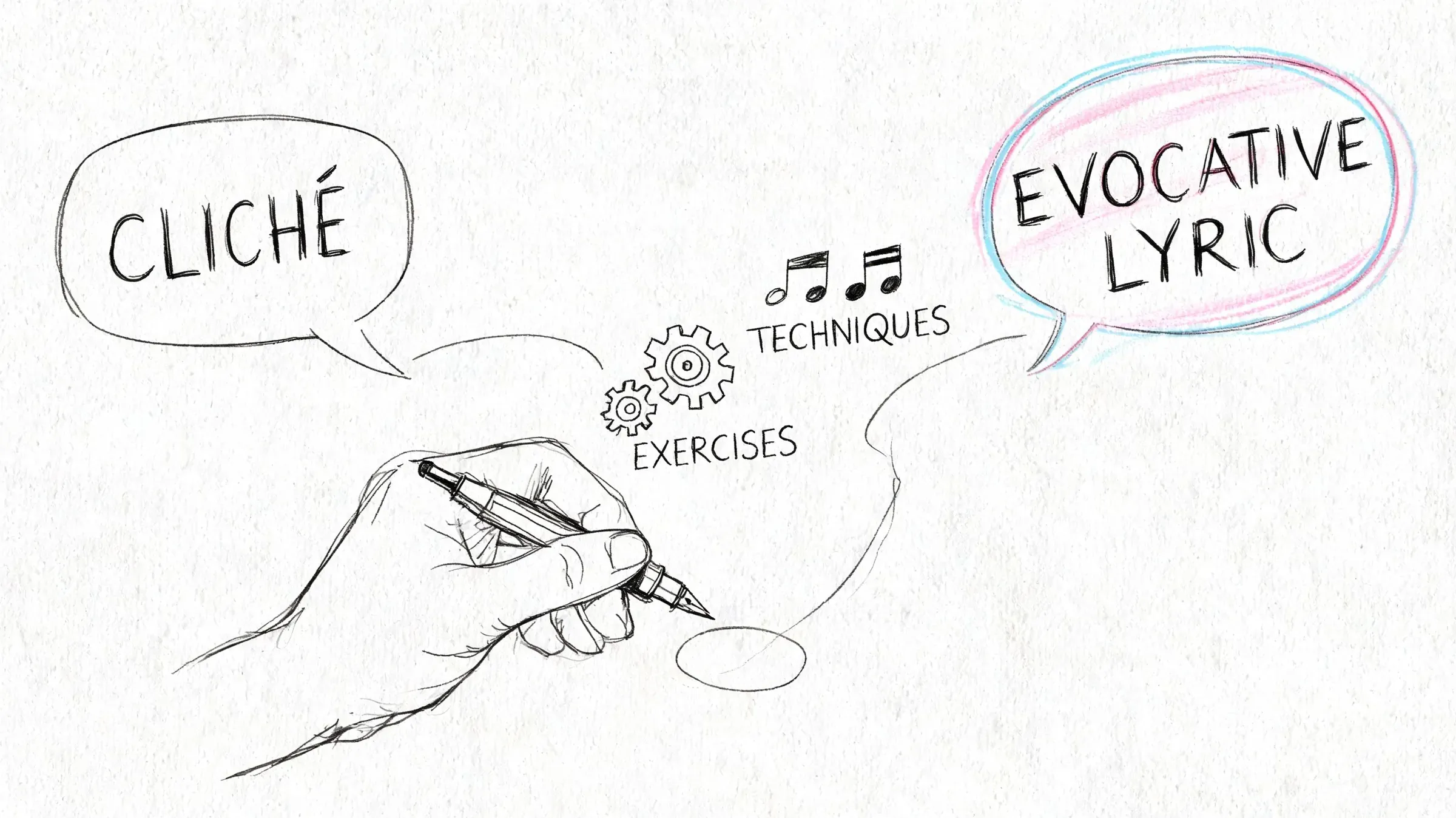
Audit every cliché
Every songwriter has stock phrases. Heart of gold. Lost in your eyes. Drowning in love. Cold as ice. Some clichés still work if the melody and delivery are undeniable, but most weaken the song because they don’t give the audience a new image to hold onto.
A simple filter helps. Circle every phrase you’ve heard in other songs. For each one, ask whether you can replace it with a physical detail, a stronger comparison, or a stranger verb.
If you want a broader craft framework for modern records, this guide on how to write great songs and craft modern hits pairs well with these lyric exercises.
How Evocative Lyrics Impact Spotify Outcomes
Spotify doesn’t need your song to be “literary.” It needs your song to be legible. Curators need a fast emotional handle. Listeners need language they can search, save, and share. Figurative language helps create that handle when it’s doing real work instead of ornamental work.
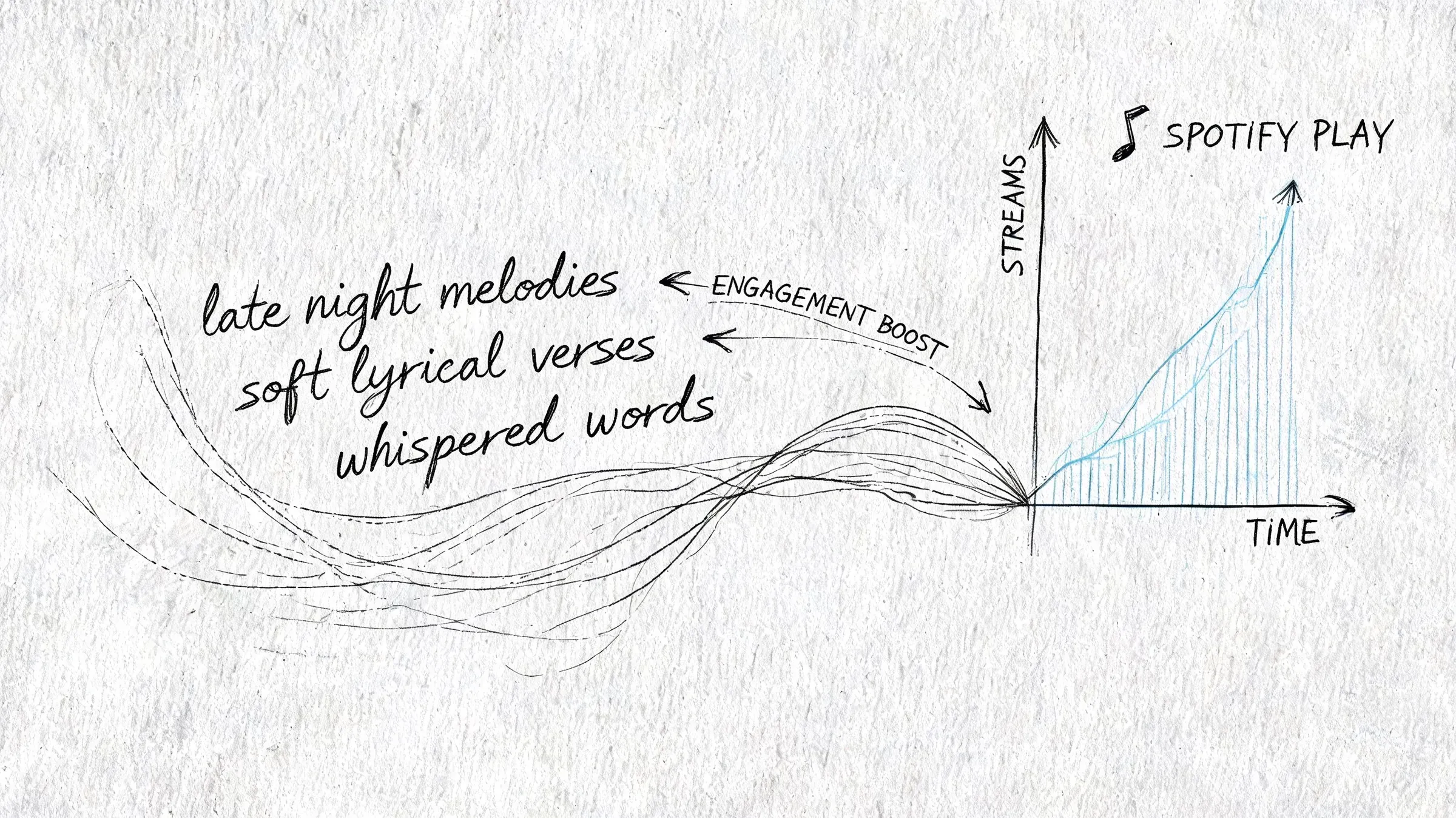
Figurative language creates searchable meaning
A lot of Spotify discovery happens through concepts. People don’t only look for artist names. They look for moods, scenes, identities, and emotional shorthand. That’s where figurative writing becomes operational.
An image cluster around falling, burning, ghosts, pressure, oceans, or gravity can make a track easier to position for heartbreak, obsession, grief, longing, or release. That doesn’t mean a metaphor alone guarantees traction. It means the lyric gives everyone in the chain a stronger way to describe the song.
The industry gap here is clear. Existing research catalogs which devices appear in songs, but it does not explain why songwriters choose certain devices for playlist strategy or audience segmentation. One review of that gap argues that artists would benefit from understanding whether different playlist environments reward different figurative profiles, including the possibility that indie playlists may lean toward hyperbole while editorial curators may respond better to subtler metaphor, as outlined in this discussion of the strategic gap in figurative language research.
Why curators respond better to images than themes
A pitch that says “this song is about heartbreak” is weak because thousands of songs are about heartbreak. A pitch that says “this song frames heartbreak as drowning in slow motion” is stronger because it gives the curator an angle.
The same principle applies to playlist fit. “Sad pop” is broad. “Late-night breakup songs with ocean imagery” is specific. The more distinct the emotional packaging, the easier the song is to place mentally.
A useful internal checklist for any release looks like this:
| Question | Weak answer | Strong answer |
|---|---|---|
| What is the song about? | Love, pain, loss | Loss framed as weather, distance, or collapse |
| What can a curator say about it? | Emotional and honest | A vivid breakup record built around sinking imagery |
| What will fans remember? | The feeling | The feeling plus the image |
What helps a track and what hurts it
- Helps: one dominant image system that appears in title, hook, and pitch language
- Helps: lyrics that are emotionally specific without becoming private code
- Helps: metaphors that can be paraphrased cleanly in playlist descriptions and social captions
- Hurts: mixed imagery that makes the song hard to summarize
- Hurts: abstract language with no sensory anchor
- Hurts: “deep” lyrics that force the listener to work before they feel anything
If a curator can’t describe the song in one sentence, the song is harder to place.
The real trade-off
There is a limit. Hyper-specific writing can become non-transferable. If every reference requires personal context, the song may feel authentic but still underperform in discovery because nobody outside the room can classify it.
That’s why the strongest commercial lyricists usually anchor one private truth inside one public image. The story is theirs. The image belongs to everyone.
Where artists miss the opportunity
Most independent artists still separate writing from release strategy. They write the song first, then scramble for metadata, playlist language, and pitch copy later. That’s backwards. The best release campaigns start when the song is written because the lyric itself already contains the positioning language.
A record with a strong figurative center gives you cleaner pitch copy, better visual branding, stronger snippets for short-form content, and a clearer lane for playlist targeting. That’s not a side benefit. That’s one reason certain songs feel easier to market from day one.
Turn Your Lyrical Skill into Career Growth
Figurative language in song lyrics matters because it improves more than the page. It sharpens recall. It clarifies positioning. It gives listeners a phrase to keep, a curator a frame to use, and the song a stronger identity in a crowded catalog.
The overlooked advantage is searchability through meaning. The case isn’t that Spotify only reads literal keywords. The case is that listeners think in concepts. A song built around images of falling can connect naturally to heartbreak language, and that creates a real strategic opening for artists who treat lyrical themes as part of discovery, as described in this discussion of figurative language as a searchability signal.
That’s why better lyric writing has business value. It helps you write songs people don’t just hear once. They describe them, quote them, and file them into emotional categories they return to later.
Career growth usually starts there. Not with more adjectives in the bio. With better language in the song.
If you want to connect lyrical craft to actual Spotify strategy, artist.tools gives you the infrastructure to do it. You can research playlist positioning, study search behavior, monitor performance, and turn the emotional language inside your songs into a more precise release plan.