How Much Does Spotify Pay Per Stream?
- Dec 26, 2025
- 13 min read
Updated: May 29
TL;DR
Spotify doesn't pay a fixed per-stream rate, but most estimates land around $0.003–$0.005 per stream in gross royalties—what you actually keep depends on your distributor, label, and publishing splits.
Common estimate: roughly $0.003–$0.005 per stream in gross royalties, or about $2.38 per 1,000 streams on average.
Spotify uses a pro-rata model: your share of the monthly royalty pool depends on your share of total platform streams.
Per-stream value varies by listener subscription tier (Premium vs. ad-supported) and country.
Spotify pays rights holders (distributors, labels, publishers)—not artists directly—so your take-home is a fraction of gross.
Tracks need at least 1,000 streams in a 12-month period to qualify for royalties, and plays under 30 seconds don't pay.
To estimate your own payout, try the artist.tools Spotify Royalties Calculator.
So, how much does Spotify pay per stream—and how much of that do you actually make from a stream?
Let's get right to it. The number you see thrown around most often is somewhere between $0.003 and $0.005 per stream. That's a useful benchmark, not a fixed rate—on the high side, a million streams could generate gross royalties of roughly $3,000 to $5,000.
But that's the gross in gross royalties—the total generated before distributors, labels, publishers, or collaborators take their share.
How Much Does Spotify Pay Per Million Streams?
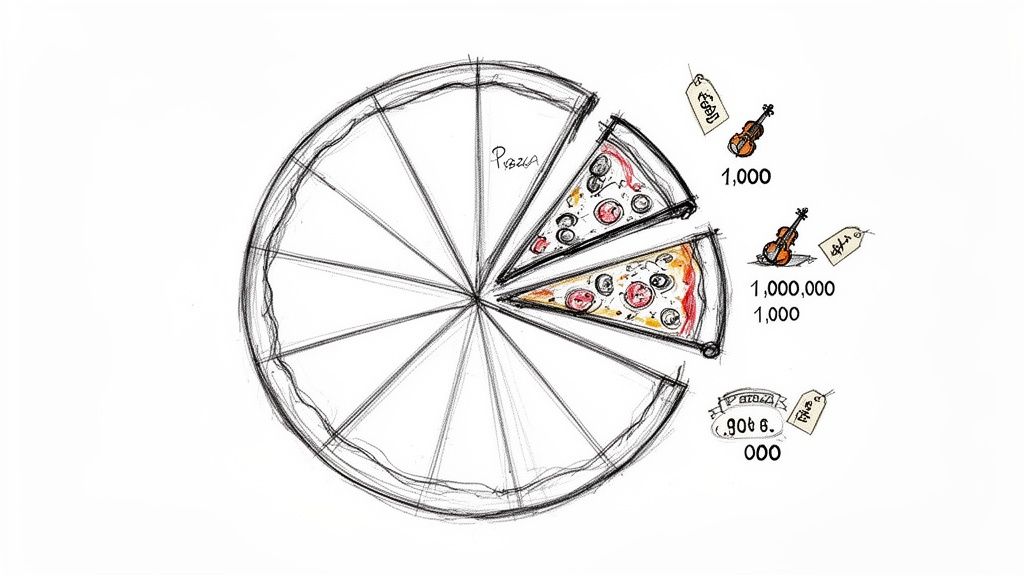
That per-stream figure is a solid starting point, but it's not the whole story. Why? Because there's no fixed, universal rate for a single stream. Instead, Spotify and other platforms use what's called a “pro-rata” system.
It’s a fancy term for a simple concept: they pool all the money from subscriptions and ads each month, and then they carve it up.
Think of it like a giant, shared pizza that changes size every month depending on how much revenue Spotify brings in. Your slice isn't a fixed size; it depends entirely on your share of the total plays across the whole platform. If your songs made up 0.01% of all streams that month, you get 0.01% of that royalty pool.
How Spotify Calculates Per-Stream Payouts
This model is exactly why the answer to "how much does an artist make per stream" is always a range. The value of each stream shifts based on a ton of factors we'll get into later, like where your listeners are and whether they're on a Premium plan.
Still, we can work with some realistic benchmarks.
That average payout of $0.003 to $0.005 per stream generally holds true, fueled by a massive revenue pool from over 276 million Premium subscribers and millions more free listeners. For a more real-world figure, the artist.tools Spotify Royalties Calculator crunches the numbers to find an average of around $2.38 per 1,000 streams.
Do the math, and 100,000 streams would bring in roughly $238 before anyone else takes a cut. You can learn more straight from the source about Spotify's payout structure and its growing subscriber base.
The key takeaway is this: A "per-stream rate" is an average calculated after the fact, not a price set beforehand. Your job is to understand what influences that average so you can maximize your earnings.
To give you a clearer picture of what this looks like for your music, here’s a quick table showing potential earnings before distributors, labels, or publishers take their share.
Estimated Spotify Earnings at Different Stream Counts
This table provides a quick look at potential pre-split earnings based on the average per-stream payout rates.
Stream Count | Potential Earnings (Low-End $0.003/stream) | Potential Earnings (High-End $0.005/stream) | artist.tools Average ($2.38/1000 streams) |
|---|---|---|---|
1,000 | $3 | $5 | $2.38 |
100,000 | $300 | $500 | $238 |
1,000,000 | $3,000 | $5,000 | $2,380 |
As you can see, even with a million streams, we're talking about a few thousand dollars in gross revenue. This is why understanding your splits and the factors driving your per-stream rate is so critical.
Does Spotify Pay Artists Directly?
Short answer: no. Spotify pays the rights holders—typically your distributor or record label for the master recording, and publishers or collecting societies for the songwriting. Those parties then pay you according to your agreements. That's why two artists with the same stream count can end up with very different take-home pay, and why you can't reliably estimate earnings from a single "per-stream rate" alone. To model your own splits, try the artist.tools Spotify Royalties Calculator.
Why Every Stream Has a Different Value
Thinking every stream pays the same is one of the biggest myths in the music business. The truth is way more complicated. The value of a single stream can swing wildly depending on who is listening, where they are, and how they’re doing it. Answering "how much does an artist make per stream?" means we have to look past a simple average.
Think of your streams like different kinds of currency. A stream from a Premium subscriber in the United States is like a crisp dollar bill. A stream from an ad-supported user in a developing market? That might be more like a handful of foreign coins. Both have value, but they are absolutely not equal.
A few key factors are always at play, shaping the final payout for every single stream your music gets. Getting a grip on these variables is the first step to building a smarter streaming strategy.
The Listener’s Subscription Tier
The biggest piece of the puzzle is the listener's subscription type. Spotify basically has a two-tier system: free, ad-supported listening and paid Premium subscriptions.
Premium Subscribers: These are the people paying a monthly fee, which goes directly into the big royalty pot. Streams from these accounts are worth a whole lot more.
Free Users: These listeners bring in revenue through the ads they hear between songs. That ad revenue is less predictable and generally lower, making their streams less valuable.
A stream from a Premium account can easily be worth 2-3 times more than one from a free account. This is exactly why building a loyal fanbase of paying subscribers is so important for boosting your income.
A stream isn't just a play; it's a tiny piece of a listener's financial contribution to the platform. The more a listener contributes, the more valuable their streams are to you.
Geographic Location of the Listener
Just like subscription tiers aren't all the same, the value of a stream changes from country to country. A listener's location is a huge deal because subscription fees and ad revenue are different in every market.
For instance, a Premium subscription in the United States or Norway costs a lot more than one in India or Brazil. As a result, a stream from a high-paying market like the U.S. might pay out $0.0039, while one from Portugal could be down around $0.0018. This is a perfect example of why targeting your promotion to high-value markets can directly pump up your earnings.
The Ever-Changing Royalty Pool
Spotify uses what’s called a “pro-rata” model, which basically means you’re getting a slice of a monthly revenue pie. The size of that pie changes every single month based on two things:
Total Platform Revenue: All the money Spotify brought in from subscriptions and ads that month.
Total Number of Streams: The total number of plays across the entire platform in that same month.
If revenue goes up but total streams stay the same, the per-stream rate gets a nice bump. But if streams go through the roof while revenue stays flat, that rate drops for everyone. This constant push and pull is why a fixed, predictable per-stream payout will never be a thing.
Your Royalty Splits
Finally, the initial gross payout you see from Spotify is just the starting line. That money has to travel through a whole chain of rights holders, with each one taking their cut before it ever gets to you. This includes different types of royalties that are split between multiple parties. To really wrap your head around this system, check out our complete guide to the different types of royalties in music.
Distributor/Label: They'll take a percentage for their services.
Publisher: They collect royalties for the songwriters.
Songwriters: They get their share of mechanical and performance royalties.
Only after all those splits happen does the leftover amount actually land in your bank account. This process is why your final take-home pay is always just a fraction of the initial gross earnings.
Calculating Your Actual Take-Home Pay
Knowing the variables is one thing, but watching the money actually move is where it all clicks. Let's follow a hypothetical payout from Spotify all the way to an artist's bank account. You'll quickly see how that exciting gross number gets sliced up by different players along the way.
To put $1,000 in your pocket, you’ll typically need somewhere between 200,000 and 333,000 streams. This assumes the standard $0.003-$0.005 per-stream range. If your rate is on the low end, you'll need 333,333 plays. If it's higher, 200,000 streams might just do it.
This is why those big stream counts are so important. A smaller milestone, like 10,000 streams, might only net you $30-$50 before anyone else takes their cut. For a more detailed look at these numbers, check out this realistic breakdown of Spotify artist earnings.
Following the Money Trail
Let's say you're an independent artist, and your track just hit a massive milestone: one million streams. Awesome. Based on our estimates, that generates a gross payout of around $3,000. But that full amount doesn't land in your account. The money has to pass through a few hands first.
This visual gives you a simple look at how the money flows from the gross payout, through the distributor, and finally to you.

As you can see, the artist is at the end of the line, getting their share only after everyone else gets paid.
First up, your distributor takes their fee. This is usually a percentage of your earnings, but some charge a flat annual rate instead.
Scenario 1 (Distributor Fee): If your distributor takes a 15% commission, that’s $450 right off the top ($3,000 x 0.15).
What's Left: You're now looking at $2,550.
But we're not done yet. That $2,550 has to cover both the master recording royalties and the publishing royalties.
The Publishing Split
Next, the songwriters and publishers need to be paid. These publishing royalties are paid out from the gross earnings and cover both mechanical and performance rights.
In the U.S., the Copyright Royalty Board (CRB) sets the mechanical royalty rate for on-demand streams. For 2023-2027, the rate is 15.1% of a platform's revenue, and it's set to go up.
Let's bring this back to our example. A chunk of that initial $3,000 goes to the publishing rights holders. After your distributor’s fee and the publishing cuts are accounted for, what's left for you (the master owner) is quite a bit less. In a simplified scenario, your take-home pay from one million streams is probably closer to $2,000 - $2,500.
If you're signed to a label, it gets even more complicated. A label could take anywhere from 50% to 85% of your master royalties after they recoup their expenses. This is exactly why you need to know your deal terms inside and out to have any hope of forecasting your income.
Trying to calculate this manually is a huge headache. With all the variables—distributor fees, label splits, publishing, and changing per-stream rates—getting a clear picture is almost impossible.
This is where a good automated tool becomes a lifesaver.
Using the artist.tools Spotify Royalties Calculator cuts through all the noise. Just plug in your numbers, and you'll get a personalized, realistic estimate of your actual take-home pay in seconds. No more guesswork.
Understanding the Streaming Economy Divide
If you've spent any time in the music industry, you know it feels like two completely different worlds running in parallel. On one side, you have global superstars pulling in fortunes that are hard to even wrap your head around. On the other, you have millions of independent artists grinding day in and day out, just trying to turn their passion into a paycheck.
Getting a grip on this massive gap is step one to setting realistic goals for what you can actually earn per stream.
The numbers at the very top are staggering—they're both inspiring and, frankly, statistical anomalies. Just look at the projections for 2025. Based on the average $0.003-$0.005 per stream rate, Taylor Swift is on track to earn something like $426 million from over 106.6 billion streams. Drake is right there with her, with projections around $369 million from 92.4 billion plays. You can read more about these projections and streaming payout differences if you want to see just how high the ceiling can be.
But while these figures show the incredible potential at the peak, they don't paint a picture of the daily reality for most working musicians.
The 1,000 Stream Hurdle
To understand the other side of the coin, you have to look at a recent, game-changing policy from Spotify. Now, a track has to hit at least 1,000 streams in a 12-month period before it can even qualify to earn royalties. It used to be that any play over 30 seconds generated a tiny payment, but those days are gone.
Spotify says this new rule is meant to fight stream fraud and make sure money goes to "real" artists. But for the independent music community, the impact has been immediate and painful.
This single policy change effectively cut off the income for a massive part of the platform's library. Some music unions estimate this affected a jaw-dropping 86% of tracks on Spotify, which suddenly stopped generating any revenue at all for their creators.
Why This Matters for Your Strategy
This winner-takes-most economy makes one thing crystal clear: you can't just upload your music and hope for the best anymore. Having a smart, data-driven strategy isn't a "nice-to-have"—it's a requirement for survival.
The game isn't just about getting streams; it's about getting the right kind of streams. You need engaged listeners who will come back for more, helping you push past that critical 1,000-stream line and keep climbing. It’s all about building momentum, track by track, in an intelligent way.
This is where having the right information becomes your biggest weapon. Tools like artist.tools were built to help level the playing field by giving you the deep insights you need to grow, no matter what stage you're at. By truly understanding your audience, vetting playlists properly, and making sure your streams are legit, you can navigate this divided economy and build a career on your own terms.
Strategies to Increase Your Streaming Revenue
Knowing how streaming payouts work is one thing, but making the system work for you is the real goal. It's time to shift your focus from just chasing a bigger stream count to maximizing the value of each stream. This is how you build a real, sustainable income from your music.
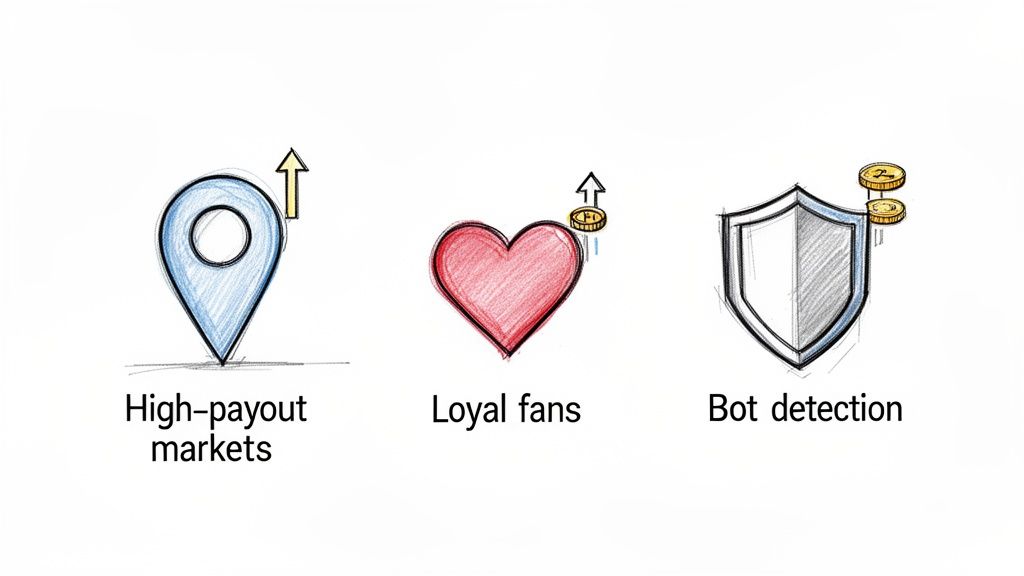
It all comes down to being strategic about where your streams are coming from and making sure every single one is legit. Instead of a scattergun approach, you need to zero in on markets with higher payout rates. Think about it: a stream from a Premium subscriber in the U.S. or the U.K. is worth a lot more than one from an ad-supported listener in a lower-revenue country.
Smart, targeted marketing isn't just about getting more plays—it's about getting higher-quality plays that directly boost what you make per stream.
Cultivate a Loyal Fanbase
The bedrock of any solid streaming strategy isn’t just grabbing new listeners; it's about turning them into a dedicated fanbase. Your loyal fans are the ones most likely to be Premium subscribers, the ones who save your tracks, add them to their own playlists, and hit repeat.
These aren't just vanity metrics. These actions generate more valuable streams and send powerful, positive signals to Spotify's algorithm. That's what gets you noticed and landed on huge algorithmic playlists like Discover Weekly.
Your goal should be to build an audience that actively seeks out your music. A smaller, highly engaged fanbase of Premium listeners will always be more profitable than a massive, passive audience of free-tier users.
If you want to dig deeper into building that kind of momentum, check out our guide on the 7 proven strategies to increase Spotify streams in 2025 for more practical tips.
Protect Your Career from Artificial Streams
Let's talk about the biggest threat to your streaming income: bots. It can be tempting to see your numbers jump from a botted playlist, but those artificial streams are worthless. Worse, they put your entire career at risk.
Spotify is constantly cracking down on this stuff. Getting caught can lead to track takedowns, withheld royalties, and even strikes against your artist profile that can be impossible to recover from.
Making sure your streams are legitimate is non-negotiable for long-term growth. This is where you have to be proactive.
The artist.tools Bot Detection feature is built for this. It scans your profile for any sign of fake activity, helping you spot fraudulent playlists so you can get your music off them before they do serious damage.
By regularly checking playlists and monitoring your profile's health, you ensure every stream you get is authentic, profitable, and actually helps build a sustainable career in music.
Got Questions About Artist Payouts? We've Got Answers.
Jumping into the world of streaming royalties can feel like trying to read a foreign language. It's totally normal to have questions even after you've got the basics down. Let's walk through some of the most common things artists ask about what they actually make per stream and clear up a few points that can seriously impact your career.
Why Do Different Sources Report Different Spotify Per-Stream Rates?
Because there is no fixed Spotify per-stream rate. Each reported figure is an average calculated after the fact from a specific pool of streams, listeners, and countries. A label with mostly U.S. Premium listeners will see a higher average than an independent artist with mostly ad-supported plays in lower-revenue markets. Reports also differ on whether they show gross royalties paid to rights holders or net take-home after splits. When comparing numbers, always check what's being measured.
Think of this as your go-to guide for making smarter, more informed decisions with your music.
Which Streaming Service Pays Artists the Most?
This one comes up constantly, and the answer isn't as clean-cut as just picking the platform with the highest per-stream rate. While it's true that services like Tidal and Apple Music often show higher average payouts than Spotify, that's not the whole picture. The sheer scale of Spotify's user base completely changes the math.
Spotify's massive global audience means that even with a lower average payout per stream, it can often generate more total revenue for artists. Why? Because it delivers a much, much higher number of streams overall. The best strategy isn't to pick one, but to be on all major platforms. Use your data to see where your listeners are actually hanging out, and point your promotional fire hose in that direction.
How Can I Accurately Track and Estimate My Earnings?
Your distributor's dashboard is the official record for your royalty statements, but let's be real—those reports are often delayed by several months. That lag makes it incredibly tough to budget or see if that new release or marketing push is actually paying off in real-time.
For more immediate insights, you need specialized tools. Spotify for Artists gives you the basics, but a dedicated platform like the artist.tools Stream Tracker offers much deeper, more useful analytics. When it comes to looking ahead, our artist.tools Spotify Royalties Calculator is a game-changer. It lets you project potential income based on current data, helping you turn vague hopes into concrete financial goals for your music.
Do I Get Paid for Plays Under 30 Seconds?
Nope. Not a cent. For a stream to actually make you money and count towards your official stats on Spotify, someone has to listen for a minimum of 30 seconds. Anything less than that is invisible to the payment system.
This rule is exactly why a killer intro that hooks the listener is so important. On top of that, Spotify now requires tracks to hit at least 1,000 streams within a 12-month period from a minimum number of unique listeners just to be eligible for any royalties at all.
What Is the Biggest Royalty Mistake Artists Make?
The single biggest, most costly mistake is chasing a high stream count without caring where those plays come from. Millions of streams from botted playlists or listeners in super low-payout countries can lead to a shockingly small check. Even worse, it puts your music at risk of being flagged and pulled down from Spotify entirely.
The smarter play is to focus on organic growth from real people. Using a tool like the artist.tools Playlist Analyzer to vet playlists before you submit is a non-negotiable first step. From there, keeping a close eye on your profile with our Bot Detection feature ensures your growth is real, sustainable, and actually translates into predictable income you can build a career on.
Ready to stop guessing and start taking control of your streaming strategy? artist.tools gives you the data and insights you need to protect your music, connect with genuine listeners, and accurately forecast what you'll earn. It's time to grow with a platform built for artists who are serious about their craft.
.png)
Comments