
What Does Monthly Listeners Mean on Spotify: 2026 Guide
Monthly listeners counts unique people who streamed an artist for 30+ seconds in a rolling 28-day window. How it's counted and how to grow it without bots.
7
- The Core Definition of Spotify Monthly Listeners
- Monthly Listeners Versus Streams and Followers
- Why Monthly Listeners Are a Critical Artist Metric
- Understanding Fluctuations in Your Monthly Listeners
- Advanced Interpretation with Deeper Metrics
- A Practical Guide to Monitoring and Growth with artist.tools
- Frequently Asked Questions on Spotify Monthly Listeners
Spotify monthly listeners is not a fan metric. It’s a reach metric. One person who plays one song past the qualifying threshold counts the same as one person who loops your catalog all month. That distinction matters because Spotify puts this number in public view, industry people use it as a shortcut for momentum, and artists often optimize for it in the wrong way.
The better question isn’t only what does monthly listeners mean on spotify. The better question is what this number tells you, what it hides, and how to use it without getting fooled by vanity spikes, weak playlist traffic, or outright bot activity.
The Core Definition of Spotify Monthly Listeners
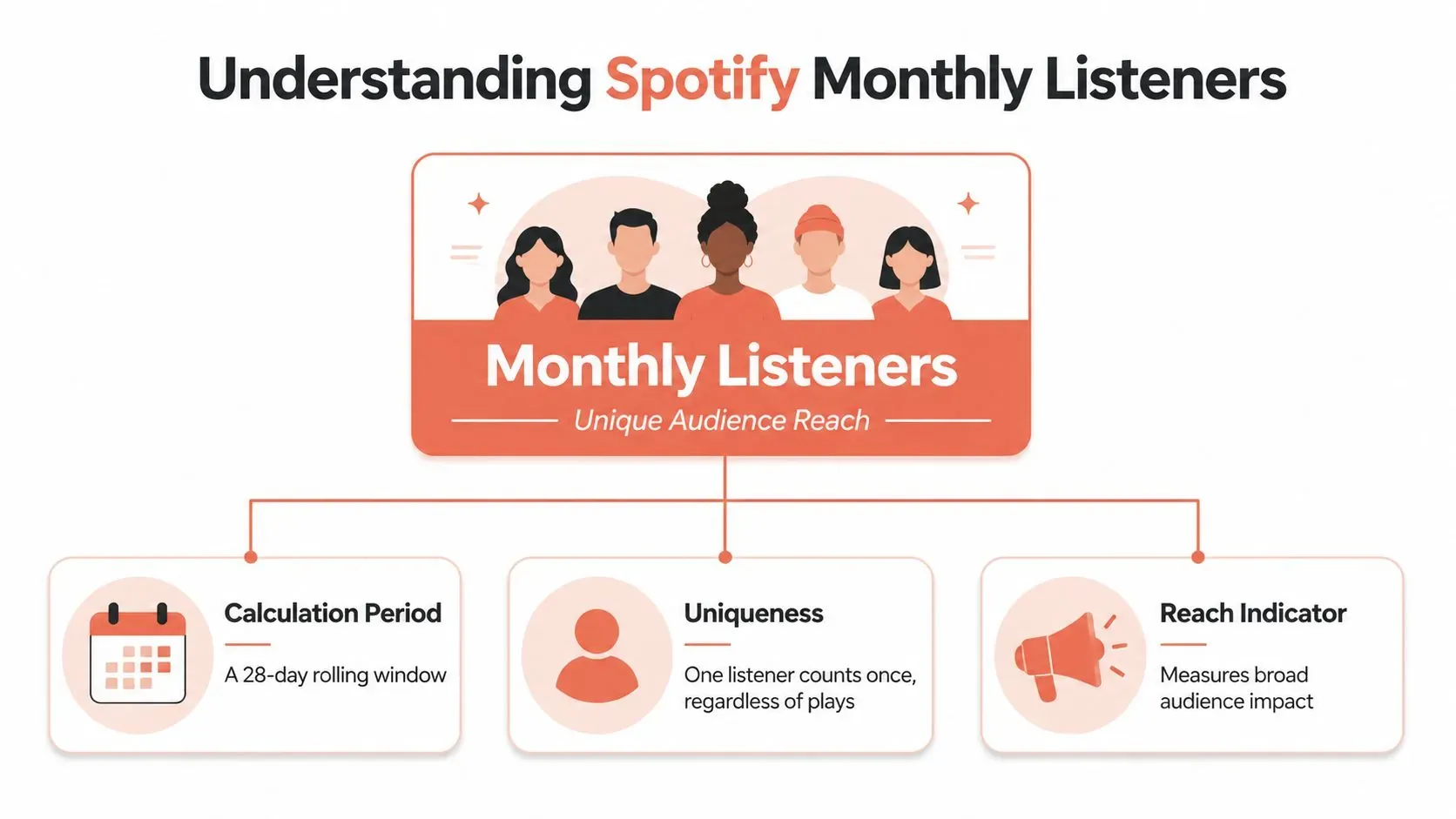
Spotify monthly listeners means the number of unique users who streamed an artist at least once during a rolling 28-day period. Spotify counts a listener when a stream qualifies, and the qualifying threshold is at least 30 seconds. Spotify uses a rolling 28-day window, not a calendar month, so the number updates daily and reflects exactly 4 weeks of audience reach, as explained by Daily Playlists’ breakdown of Spotify monthly listeners.
What Spotify is actually counting
Monthly listeners measures unique audience reach across your catalog. If one user streams three different songs, that still counts as one monthly listener. If that same user streams from multiple devices or sessions, the metric is still deduplicated at the user level.
That makes monthly listeners distinctly different from stream counts. A stream metric answers, “How many qualifying plays happened?” Monthly listeners answers, “How many distinct people did you reach in the last 28 days?”
Why the 28-day window matters
The rolling window changes how artists should read rises and drops. Because Spotify isn’t using a fixed calendar month, your number can climb or fall every day based on what happened exactly 28 days earlier. A playlist add can lift the metric fast. A playlist removal, campaign ending, or release cooling off can drag it down just as fast once those older listening days roll out of the window.
This is also why artists get confused when nothing “new” seems to happen but the number still falls. The metric is always aging out old activity.
Here is the cleanest way to understand it:
| Metric | What it measures | Reset behavior |
|---|---|---|
| Monthly listeners | Unique users reached | Rolling 28-day window |
| Streams | Total qualifying plays | Accumulates over time |
| Followers | People who chose to follow you | Persistent fanbase signal |
Monthly listeners is broad by design. It tells you how many people touched your music recently. It doesn’t tell you whether they came back, cared strongly, or even explored beyond one track.
Monthly Listeners Versus Streams and Followers
These three Spotify metrics answer three different business questions. Monthly listeners tells you how wide your reach is. Streams tell you how much listening volume you generated. Followers tell you how many people raised their hand and said they want an ongoing relationship.
The clearest comparison
Followers are your subscriber layer. They don’t reset every 28 days, and they usually say more about durable audience intent than a temporary spike in monthly listeners. If you’re actively trying to strengthen that base, this guide on how to get Spotify followers is the more relevant playbook than chasing reach alone.
Streams are listening depth. One person can create many streams. That’s useful for royalty forecasting and for understanding whether listeners are replaying songs, but it can blur together strong fans and passive traffic.
Monthly listeners sits between exposure and engagement. It’s more meaningful than raw impressions because a user had to stream long enough to qualify, but it’s still much closer to discovery than loyalty.
What healthy metric relationships look like
A strong profile usually shows movement in all three, but not at the same speed.
- Monthly listeners rising first: This often happens after playlist adds, algorithmic pickup, press, or social virality.
- Streams rising faster than listeners: That usually signals stronger repeat listening and deeper engagement.
- Followers climbing behind both: This is slower, but it’s often the best sign that discovery is converting into an owned audience.
A playlist can make you look big in monthly listeners long before it makes you strong in followers.
That trade-off matters. Artists often celebrate a jump in monthly listeners while ignoring flat followers and weak repeat listening. In practice, that usually means the campaign generated sampling, not fan growth.
The mistake artists make
The most common mistake is treating monthly listeners as a score of artist quality. It isn’t. It’s a public snapshot of how many unique users interacted with your music recently.
That number can rise because your release connected. It can also rise because you landed in a playlist full of casual listeners who never return. Without context, the number is easy to overvalue.
Why Monthly Listeners Are a Critical Artist Metric
Monthly listeners matters because Spotify uses it as a live popularity signal inside its recommendation and playlist ecosystem. According to Musosoup’s explanation of Spotify monthly listener thresholds, artists crossing 10k-50k monthly listener thresholds gain 3-7x higher chances of editorial playlist inclusion. That makes the metric more than cosmetic. It affects distribution inside Spotify.
Why the number opens doors
Spotify rewards evidence of broad reach. If more unique users are touching your music, Spotify has a stronger signal that your songs may travel beyond your current base. That can improve the odds of algorithmic recommendation, radio inclusion, and editorial consideration.
For working artists, that changes what the metric means in practice. A&R teams, managers, promoters, and collaborators don’t always start with a full catalog deep dive. They often start with the public profile, and monthly listeners is one of the fastest signals they can read.
Reach creates leverage, but only at the right kind of reach
Not all monthly listener growth is equally valuable. The best growth increases discovery and creates downstream actions. Those actions include more saves, more repeat listening, more followers, and stronger post-release retention.
Weak growth looks different. It creates a visible spike but little else. The profile looks hotter than the audience is.
A useful way to frame it is this:
- Broad reach helps you get seen
- Repeat listening helps you get paid
- Follower growth helps you stay relevant between releases
Why artists shouldn’t dismiss it as vanity
Some artists push back and say the metric is superficial. They’re only half right.
Monthly listeners is superficial when it’s isolated. It’s powerful when it’s interpreted in context. If you’re pitching playlists, seeking management, trying to prove release traction, or watching whether a campaign expanded your audience beyond the core, this number is useful. It gives you a public, recent, easy-to-read picture of reach.
What it doesn’t do is tell you whether that reach is sticky. That’s where most mistakes happen. Artists either obsess over the metric or dismiss it entirely. The professional approach is neither. Use it as an entry signal, then verify quality with deeper engagement data.
Understanding Fluctuations in Your Monthly Listeners
Monthly listener swings usually have a concrete cause. The hard part isn’t noticing the move. The hard part is reading whether the move came from healthy discovery, temporary exposure, or traffic you shouldn’t have touched in the first place.
What usually drives increases
A new release is the cleanest reason for a rise. Playlist placements can do it too, especially if a track reaches listeners who haven’t heard you before. Strong short-form content, press coverage, and sync moments can all widen reach fast.
Those are not equal forms of growth. A release-led rise often reflects intent because listeners sought out the artist or responded to promotion around the song. A playlist-led rise can be excellent, but it needs verification. Some playlists deliver engaged listeners. Others deliver one-and-done sampling.
What usually drives drops
A falling monthly listener count isn’t automatically a problem. It often means old listening days are aging out of the rolling window and not being replaced at the same pace.
Common reasons include:
- Release decay: The launch period fades and fewer new users enter the top of the funnel.
- Playlist removal: A major source of recent discovery disappears.
- Seasonality: Some music has obvious peaks and softer periods.
- Campaign ending: Paid or organic promotion stops creating fresh audience entry points.
If your monthly listeners drop while your core engagement stays stable, the issue isn’t always audience loss. It may just be reduced top-of-funnel inflow.
How bot activity shows up
Bot activity often looks like a spike that doesn’t behave like real audience growth. The number jumps, but the rest of the profile doesn’t strengthen in a believable way. Then the spike disappears after a purge, a playlist drop, or a fraud cleanup.
This is where historical tracking matters. When you compare rises and falls over time, patterns become obvious. A healthy increase usually lines up with a release, media moment, or playlist add you can identify. An unhealthy one often arrives out of nowhere and leaves just as abruptly.
For a deeper workflow on reading those curves, use this guide on tracking Spotify monthly listeners over time.
What real interpretation looks like
Professionals don’t ask, “Did the number go up?” They ask:
- What caused the change
- Did streams, followers, and retention support it
- Did the growth hold after the first wave
- Did the listener quality look normal
That last question matters more than most artists think. The public number is only the start of the diagnosis.
Advanced Interpretation with Deeper Metrics
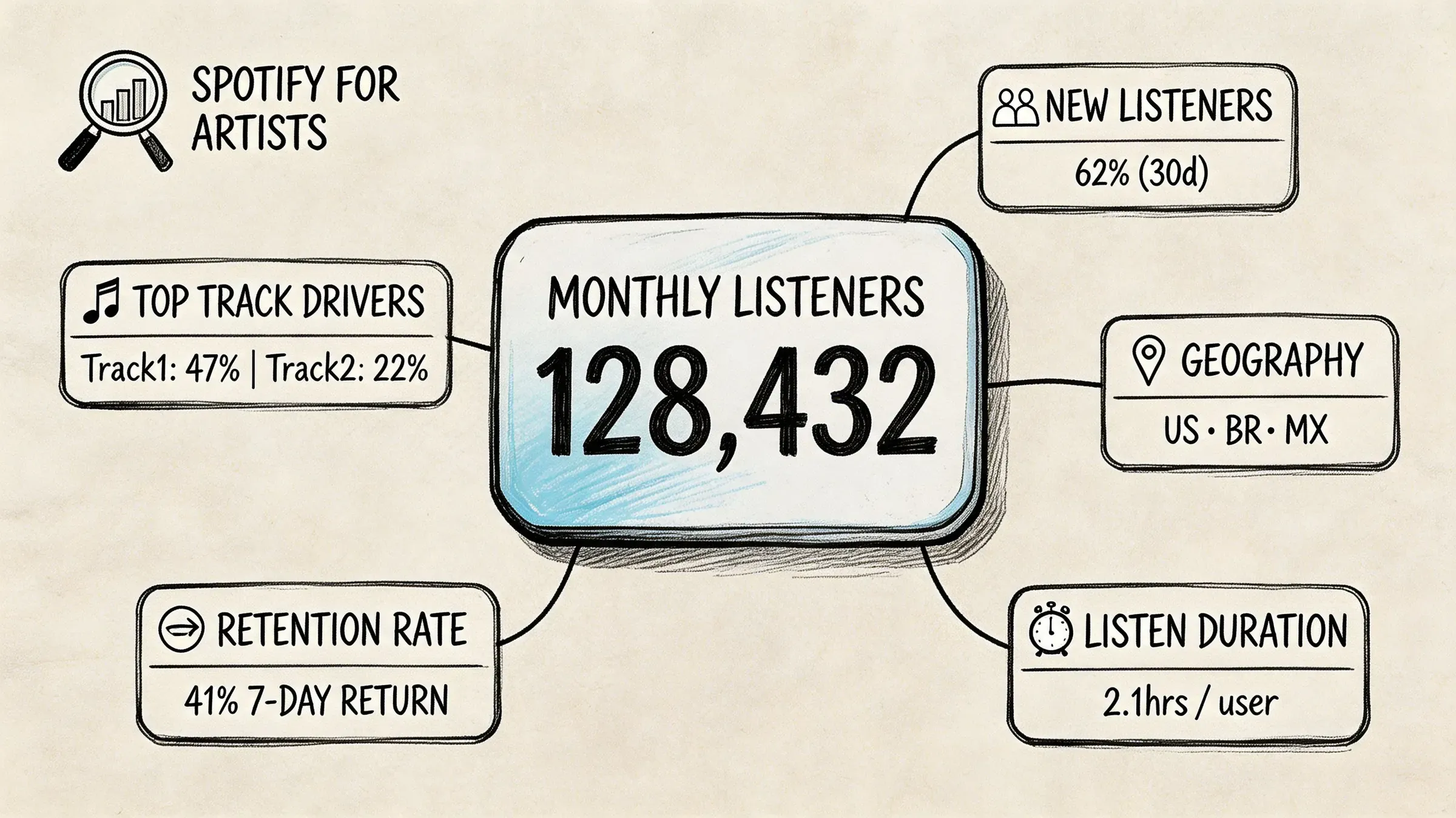
The professional read on monthly listeners starts where the public profile stops. Once you move inside Spotify for Artists and compare adjacent metrics, you can separate broad reach from actual loyalty.
Audience segments matter more than most artists realize
Spotify’s audience segmentation gives you a far better picture of listener quality than the headline number does. Spotify for Artists breaks monthly active listeners into super listeners, moderate listeners, and light listeners, with super listeners defined as users with 15+ intentional streams in 28 days, moderate listeners at 3-14, and light listeners at 1-2, as documented in Spotify for Artists audience segments.
That segmentation changes the strategy completely.
- Super listeners are your core. They are the most likely to return, stream repeatedly, and support future releases.
- Moderate listeners are the easiest audience to develop. They already show enough intent to become core fans.
- Light listeners are still useful, but they are mostly a conversion opportunity, not proof of loyalty.
If your monthly listeners are growing while your super-listener layer stays thin, you are building reach faster than you are building career stability.
Streams per listener is the metric that keeps hype honest
Streams-per-listener tells you whether reach is turning into actual consumption. A big monthly listener count paired with weak replay is often a sign of shallow discovery. In some cases, it’s also an early warning sign for inorganic traffic.
A 2025 framing from Spotify-focused analysis highlighted a stronger emphasis on this ratio, and noted that a ratio below 1.5 streams-per-listener can flag inorganic growth, discussed in this YouTube breakdown on streams-per-listener and bot detection.
Here’s the clean read:
| Pattern | Likely meaning |
|---|---|
| High listeners, healthy replay | Real discovery with engagement |
| High listeners, weak replay | Casual or low-intent traffic |
| Spike in listeners, ratio weakens sharply | Possible bad playlist traffic or bot exposure |
| Listeners stable, ratio improving | Smaller but stronger audience |
Strong careers are built by converting light listeners into moderate listeners, and moderate listeners into super listeners.
What to optimize for instead of vanity
The goal isn’t the biggest monthly listener number. It’s the healthiest listener mix. Artists who last tend to improve the relationship between reach and depth. That means each release shouldn’t just introduce new listeners. It should give existing listeners reasons to come back.
When monthly listeners rises, ask whether the rise improved your audience quality. If it didn’t, the number may still look impressive, but it didn’t strengthen the business.
A Practical Guide to Monitoring and Growth with artist.tools
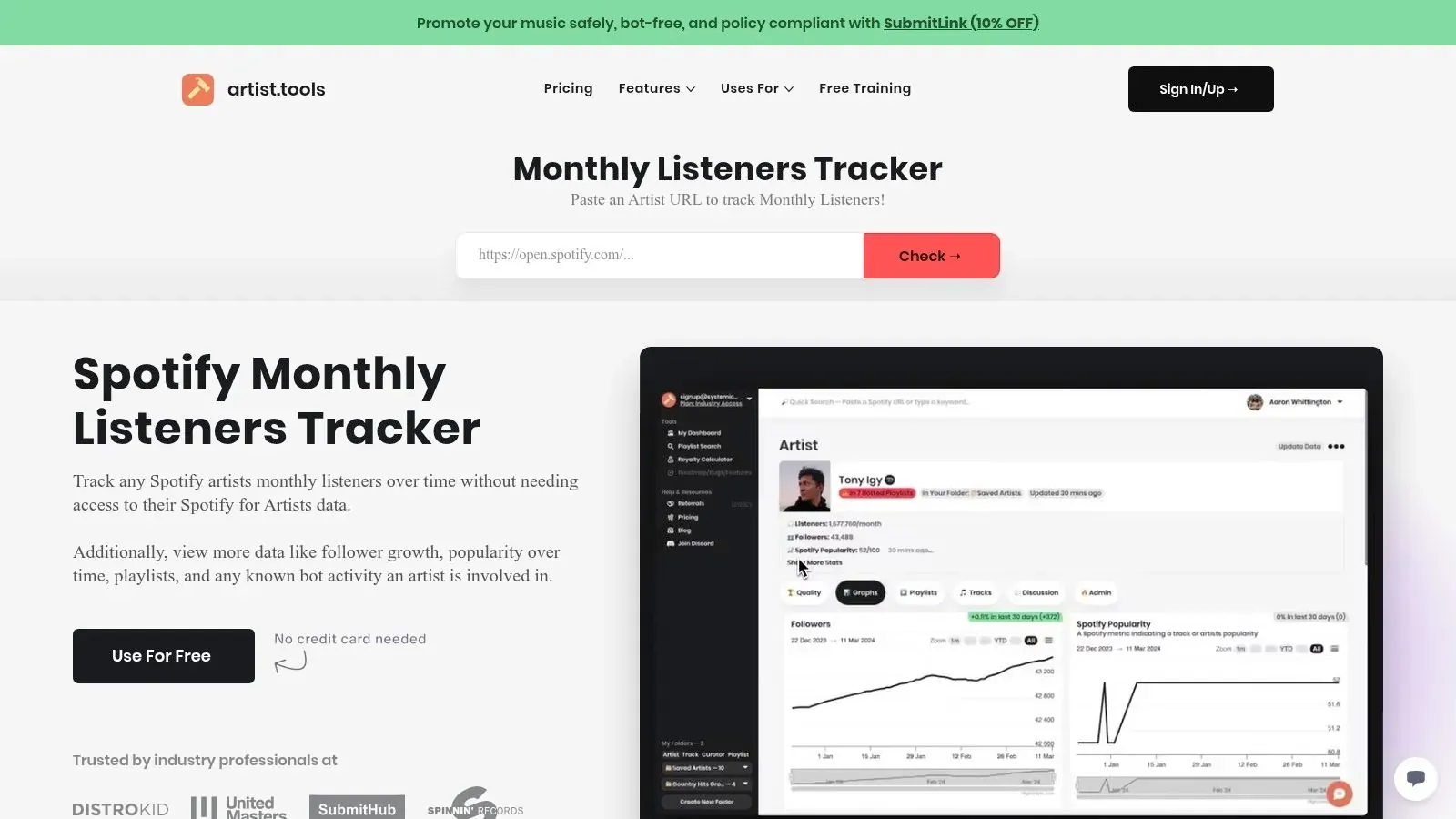
Monthly listeners becomes useful when you track it historically instead of staring at the live number. Daily snapshots let you see whether a rise started with a release, a playlist add, an editorial pickup, or a suspicious source that doesn’t fit the rest of the profile.
Start with historical baselines
Use the Monthly Listeners Tracker to establish your normal pattern before you try to judge any spike. You want to know what your listener curve looks like during release weeks, off-cycle periods, and playlist-driven moments.
That baseline makes the next move interpretable. Without it, every jump feels exciting and every decline feels alarming. With it, you can tell whether the profile is behaving normally.
A practical baseline review usually includes:
- Pre-release floor: What your listener count settles at when no campaign is active.
- Release lift shape: Whether your gains arrive immediately or build over several days.
- Decay speed: Whether new audience enters consistently enough to offset the 28-day rolloff.
- Follower response: Whether broader reach translates into stronger long-term audience signals.
Vet playlists before they touch your profile
Playlist quality should be checked before outreach, not after damage appears. This is where Playlist Analyzer matters. You can review follower growth patterns, historical adds and removals, search presence, and broader playlist behavior before you pitch.
That changes the risk profile. Instead of asking whether a playlist is large, ask whether it behaves like a real discovery source. Some playlists produce healthy listener increases. Others inflate monthly listeners, weaken streams-per-listener, and leave artists cleaning up the fallout.
Watch the ratio, not just the headline number
A sudden increase in monthly listeners is only good if adjacent metrics stay healthy. With Spotify-focused analysis pointing to stronger emphasis on streams-per-listener and noting that below 1.5 can signal inorganic growth, the workflow has to include ratio checks, playlist review, and bot screening together.
Later in the process, this video adds useful context on how the metric is being interpreted operationally:

Build a practical monitoring routine
A useful weekly workflow looks like this:
- Check monthly listener trend lines against release dates and known promotion.
- Review stream behavior to see whether reach came with replay.
- Inspect playlist sources if the change was abrupt or unusually large.
- Run bot detection signals before the issue compounds into takedown risk.
- Compare follower movement to determine whether discovery is converting.
artist.tools is most useful not as a vanity dashboard, but as an operating system for spotting anomalies early, validating playlist opportunities, and protecting your catalog from bad traffic.
Frequently Asked Questions on Spotify Monthly Listeners
How often does Spotify monthly listeners update
It updates daily because the metric uses a rolling 28-day window. That means a large playlist add can affect the number quickly, and a decline can also appear quickly once older listening days fall out of the window.
If someone streams on multiple devices, do they count more than once
No. Monthly listeners is a unique-user metric, so Spotify deduplicates listening at the user level across sessions and devices.
Why can monthly listeners be higher than followers
Because monthly listeners measures recent reach, while followers measure people who explicitly chose to follow. Plenty of people will hear a song once through search, playlists, radio, or recommendations without becoming a follower.
Does one stream count as one monthly listener
Only if it qualifies. The play must pass the qualifying threshold, and then the user counts once inside the rolling window, not once per track.
Is a high monthly listener count always good
Not by itself. The useful read comes from context. If the number rises alongside healthy replay, stronger audience segments, and follower growth, that’s productive reach. If it rises without those supporting signs, you may be looking at weak discovery or suspicious traffic.
What’s the best way to use this metric
Use it as a reach indicator, then confirm quality with deeper metrics. Monthly listeners tells you how many people you touched recently. It does not tell you whether those people are becoming real fans.
artist.tools helps musicians do more than watch Spotify numbers move. Use artist.tools to track monthly listeners over time, analyze playlists before pitching, monitor for botted activity, estimate royalties, and turn raw Spotify data into better release decisions.