What Is a UPC Code and Why Musicians Need It? what is upc code
- Jan 8
- 16 min read
Let's break down what a UPC code really is. Think of the Universal Product Code as your music's official ID card for the entire retail world. It's a unique 12-digit number that gets assigned to a specific product you're selling—whether that's a new single, a five-track EP, or your full-length album.
Essentially, it’s the digital fingerprint that separates your release from the millions of others out there. Like a VIN on a car, it ensures everyone knows exactly which product they're dealing with.
Your Music’s Digital Fingerprint: What Is a UPC Code?
A lot of artists get this wrong. They see the scannable barcode on the back of a CD and think that's the UPC. While the barcode is the visual part, the real power is in the 12-digit number it represents.
This code is absolutely non-negotiable if you plan to sell your music. It doesn't matter if you're dropping a track on Spotify and Apple Music or pressing a limited run of vinyl for your local record store—you need a UPC.
That simple string of numbers is the fundamental piece of data linking your art to the cash register. When someone streams your song, buys it on iTunes, or picks up a physical copy, the UPC is what tells the system exactly which product just got sold. Without it, there’s no reliable way for stores and streaming platforms to track your sales and, more importantly, pay you the royalties you've earned.
The UPC’s Role in the Music Industry
The UPC isn't new; it's been around for over 45 years, originally created to make life easier for grocery stores. It was designed to encode a Global Trade Item Number (GTIN) and quickly became the standard for pretty much everything. Today, 95% of grocery products in the US have one.
In the music world, its job is just as vital. It acts as your release's "digital birth certificate" and is a critical piece of your music's metadata.
Here's why it's so important:
Accurate Tracking: It guarantees every stream and sale gets credited to your specific release. No more mix-ups with artists who have a similar name.
Royalty Payments: Platforms use the UPC to connect commercial activity back to you and your distributor. This is how you get paid.
Chart Eligibility: Official charts like Billboard depend on UPC-based sales data to compile their rankings. If you want to chart, you need a UPC.
Global Identification: It’s a universal standard that every retailer and distributor on the planet recognizes.
In short: if you want to sell your music, it needs a UPC. This number is what allows your creative work to exist in the global commercial ecosystem, turning your art into revenue.
To help you get a quick handle on it, here's a simple breakdown of what makes up a UPC and why each part is so important for your release.
UPC Code At a Glance
Component | What It Is | Why It Matters for Your Music |
|---|---|---|
The Code Itself | A unique 12-digit number for one specific release (e.g., a single or an album). | It’s your release’s primary identifier for all sales and streaming tracking worldwide. |
The Barcode | The scannable, visual version of the 12-digit number. | This is what physical retailers scan at checkout to log a sale of your CD or vinyl. |
Product Association | The code is tied directly to a single product version (e.g., the standard album vs. the deluxe version). | Each version of your release needs its own unique UPC to ensure sales are tracked correctly. |
Metadata Link | The UPC connects your music to essential data like artist name, track titles, and label info. | It ensures that when your music is played or sold, all the right information travels with it. |
Getting a grip on the UPC is the first step toward managing your releases like a professional. It might seem like a small detail, but it has massive implications for your career.
If you're ready to dive deeper into the data that fuels your music's success, our essential guide for artists and labels is a great place to continue your journey.
How UPC Codes Power Your Music Career
That 12-digit number might seem like a small technical detail, but it’s the invisible engine driving the entire business side of your music. Let’s pop the hood and see how this simple code turns your art into a product that can be tracked, sold, and ultimately, get you paid.
Think of it like shipping a package. Before you can send anything, it needs a unique tracking number. Your distributor—whether it’s TuneCore, DistroKid, or another service—is the post office in this scenario. When you set up a new release, they assign a UPC to your single or album, effectively stamping it with that critical tracking ID.
This code isn't just slapped on top; it's embedded deep inside your release's metadata. This is the digital DNA of your music, containing everything from your artist name and track titles to the artwork. The UPC is the master key that locks all this information together.
From Your Distributor to Global Stores
Once you hit "submit," your distributor blasts this data package out to hundreds of digital stores and streaming platforms (DSPs) worldwide. We're talking the big players like Spotify and Apple Music, but also countless smaller regional services. Each one of these platforms takes your metadata and logs the UPC into its massive database.
Just like that, your music officially exists on the global market. The UPC is the universal language that every single store understands. When a listener in Tokyo streams your song on Spotify, or a fan in London buys your album on Apple Music, their systems don’t see an artist name first—they see a UPC code.
That identifier is what triggers a transaction. The platform’s system reads the UPC, confirms the product is your specific release, and logs the stream or sale. This is exactly how they know who to pay.
Making Sure You Get Paid Correctly
Without a UPC, the entire system falls apart. Imagine trying to get paid for a song called "Sunrise" by an artist named "Alex." There are probably thousands of songs and artists with those names. It’s the UPC that cuts through the noise, ensuring the royalty from your specific track gets routed back to your distributor and, finally, into your pocket.
A UPC guarantees that every single stream and sale is tracked with pinpoint accuracy. It’s the difference between your royalties ending up in your account or getting lost in a sea of data, credited to the wrong artist, or disappearing entirely.
This isn't some small-scale operation. The barcode system is so fundamental to global commerce that over 10 billion GS1 barcodes are scanned daily around the world. It’s an incredibly reliable way to track products, and your music is one of them.
This precision is also crucial for tracking your performance. Data platforms like artist.tools rely on these unique codes to pull accurate streaming numbers and playlist analytics. As you prep your next single, our guide on how to upload your music to Spotify can walk you through making sure your metadata is set up perfectly for maximum impact.
At the end of the day, a UPC is far more than a requirement. It’s the bridge connecting your creative work to the global economy, ensuring you get proper credit for every listen and turning your passion into a real career.
Untangling The Alphabet Soup Of Music Codes
Stepping into the music industry can feel like learning a whole new language, especially with the dizzying number of acronyms thrown around. When you start asking "what is a UPC code," you'll quickly stumble into ISRC, EAN, and GTIN. It’s confusing, but let's break it down in a way that actually makes sense for an artist.
Think of GTIN (Global Trade Item Number) as the big, universal family name for all product codes. It’s not a code you'll use directly, but it's the system that everything else belongs to. Both UPCs and EANs are just specific types of GTINs, designed for tracking items for sale anywhere in the world.
UPC vs EAN: The North American and European Cousins
The two most common product codes you'll see are UPCs and EANs. The main difference is simply geography.
A UPC (Universal Product Code) is a 12-digit number. It's the standard barcode you see on products sold in North America (the U.S. and Canada).
An EAN (European Article Number), which is now officially called an International Article Number, is a 13-digit number. It's used pretty much everywhere else—Europe, Asia, South America, you name it.
But here's the good news: they basically do the same job. Any modern scanner that can read a 13-digit EAN can also handle a 12-digit UPC by just adding a zero to the front. As an artist, you don't really need to sweat this part; your distributor will automatically assign the right code for a global release.
UPC vs ISRC: The Product vs The Song
This is the most important distinction you need to nail down. Getting this wrong can cause major headaches for your release and mess up your royalty tracking.
While a UPC identifies your entire product for sale, an ISRC (International Standard Recording Code) identifies one specific sound recording.
Here's an easy way to think about it: Imagine your new album is a physical book. That entire book needs one UPC barcode on the back so a store can sell it. But each individual chapter inside that book also needs a unique page number so you can find it—that's what an ISRC does for each individual song.
You absolutely need both. The UPC is for the commercial package (your single, EP, or album). The ISRC is for the individual master recording (the actual .WAV or MP3 file).
This diagram shows you exactly how a UPC is put together.
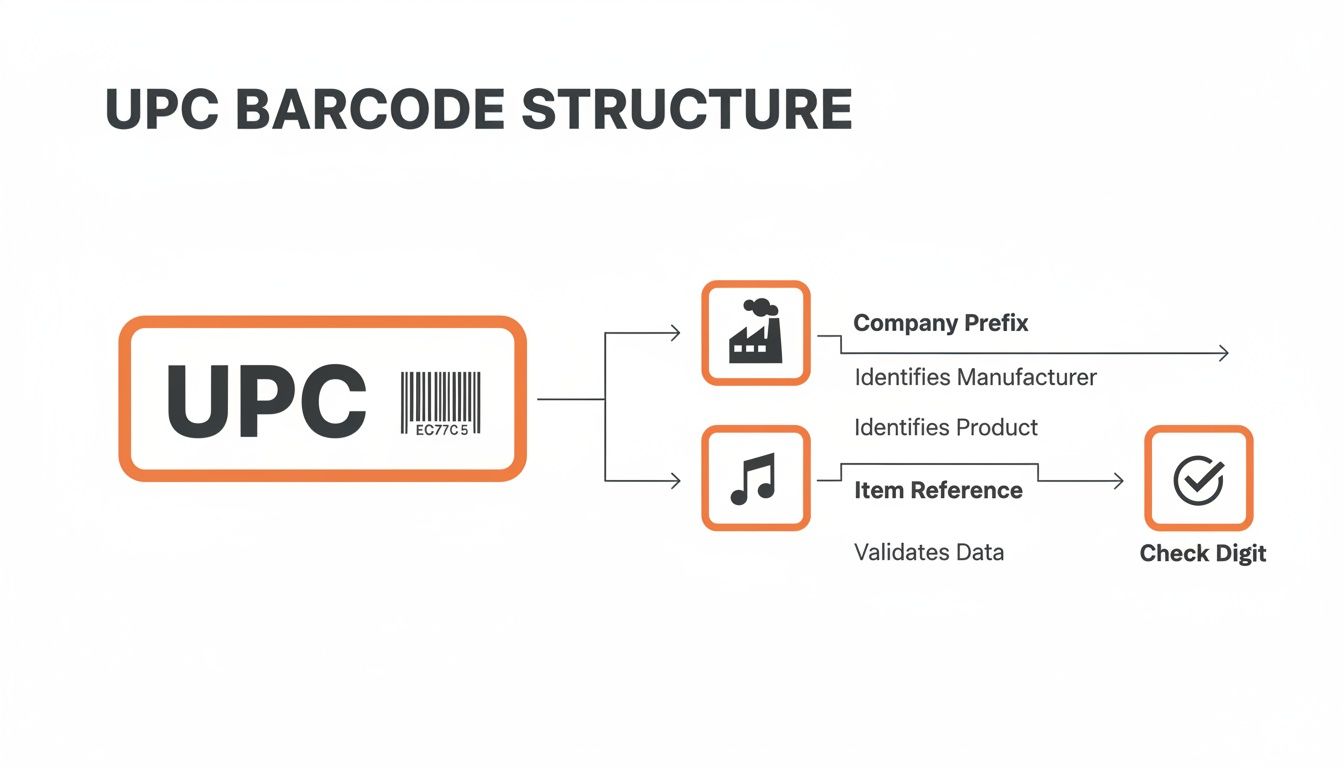
As you can see, the Company Prefix and Item Reference create a totally unique ID for your release, and the Check Digit makes sure the number is valid.
Let’s look at a real-world example:
You're about to release a 3-song EP. That EP, as a single product, needs one UPC code.
Each of the three individual songs on the EP needs its own unique ISRC.
So, for that one release, you'll end up with one UPC and three ISRCs. This two-code system is crucial. It ensures the entire product is tracked for sales and that each individual track is tracked for streams, radio plays, and other uses.
Key Music Industry Codes Compared
To tie it all together, here’s a quick-glance table to help you keep these codes straight. Each one has a very specific job in getting your music out into the world and making sure you get paid for it.
Identifier | What It Identifies | Primary Use Case | Example |
|---|---|---|---|
UPC | A complete commercial product (single, EP, album) | Tracking retail sales (physical and digital) in North America. | A 12-digit code for your new album. |
EAN | A complete commercial product (single, EP, album) | Tracking retail sales (physical and digital) outside North America. | A 13-digit code for the same album. |
ISRC | A specific, unique sound recording (one song) | Tracking streams, downloads, and radio plays of an individual track. | A unique code assigned to the master .WAV file of "Track 1." |
GTIN | Any trade item globally | The umbrella system that includes UPCs and EANs. | Not a code you assign directly, but the family they belong to. |
Understanding how these pieces fit together is a fundamental step in avoiding distribution errors that can stall your release and complicate collecting the money you've earned. It might seem technical, but getting it right from the start saves a world of trouble later on.
How to Get a UPC Code for Your Next Release
Okay, so you're sold on the fact that a UPC code is a non-negotiable piece of the puzzle for your release. The next logical question is a big one: where do you actually get one?
This is a critical fork in the road for any artist. The path you choose now can seriously impact your flexibility and control over your music catalog down the line. You’ve really only got two main options, and each comes with its own set of trade-offs. Let's break them down so you can make the right call for your career.
Path 1: The Distributor-Provided UPC
The most common route, especially for artists just starting out, is simply getting a UPC from your digital distributor. Services like DistroKid, TuneCore, and CD Baby all offer to generate a UPC for your release, often for free or a small one-time fee, right inside their upload process.
This is the path of least resistance. You’re uploading your tracks, you see a checkbox that says something like "I need a UPC," and boom—the system assigns one to your release instantly. It’s quick, painless, and gets your music out the door with zero extra legwork. It’s the perfect “get it done” solution.
But there’s a catch. That convenience comes with a major string attached. The UPC your distributor gives you isn't truly yours. It's technically owned or licensed by them, meaning their company prefix is baked into the code. The UPC is permanently tied to their service.
While you can almost always take your individual track ISRCs with you if you switch distributors, a distributor-issued UPC usually cannot be transferred. This means moving your album to a new service would require getting a brand new UPC, which can complicate your release's history and analytics.
Path 2: Buying Your Own UPC from GS1
Your second option is to go straight to the source: GS1 (Global Standards 1). GS1 is the official, global non-profit that manages and assigns every legitimate UPC and barcode on the planet. When you buy a code from them, you're getting the real deal.
Going this route gives you total ownership and control. You are establishing yourself or your record label as the official publisher in the global retail database. It’s the most professional, long-term way to manage your music catalog. The UPC belongs to you, and you can take it to any distributor or retailer you want, today or ten years from now.
This independence is the real prize here. If you find a better distribution deal or want to switch services for any reason, you can move your entire release—original UPC and all—without a hitch. This is huge because it preserves all the sales history, stream counts, and chart eligibility tied to that specific product code. If you're mapping out your release strategy, our complete guide on how to distribute music and get heard by millions can give you a bird's-eye view of the entire process.
Comparing Your Options Head-to-Head
So, which is it? Distributor UPC or GS1 UPC? The decision really boils down to a trade-off between immediate cost and long-term control. Neither one is wrong—it just depends on where you are in your career and where you plan to go.
To make it crystal clear, here’s a direct comparison.
Feature | Distributor-Provided UPC | GS1-Purchased UPC |
|---|---|---|
Cost | Usually free or a small one-time fee (e.g., $5). | Higher upfront cost (starting around $30 for one) with potential annual renewal fees for larger bundles. |
Ownership | The distributor owns or licenses the UPC. It’s tied to them. | You (or your label) own the UPC outright. It's yours forever. |
Convenience | Insanely easy. It's generated automatically during your upload. | Requires a separate registration on the GS1 site and manual entry into your distributor's system. |
Flexibility | Low. You can’t transfer the UPC to another distributor if you switch. | High. Use the same UPC with any distributor or retailer, anytime. |
Best For | Artists just starting out, those on a tight budget, or musicians releasing music casually. | Serious independent artists, record labels, and anyone building a catalog for the long haul. |
Ultimately, if your goal is just to get your music online as fast and cheap as possible, a distributor-provided UPC is a solid choice. But if you’re building a brand, running a label, or simply want to ensure you have maximum control over your own art, investing in your own GS1 codes is a smart business move.
Putting Your UPC to Work for a Release
Alright, you've sorted out the UPC code for your new release. Great. Now for the most important step: actually using it. This is where that 12-digit number becomes the master key for your entire project, officially linking your music, artwork, and metadata into a single, cohesive product ready for digital stores everywhere.
Getting this part right is everything. The magic happens during the upload process with your distributor, whether that’s DistroKid, TuneCore, or another service. As you're filling in all the details—artist name, track titles, release date—you’ll hit a field asking for the UPC. This is your moment to either let the distributor generate one for you or paste in the one you bought directly from GS1.
Think of it like giving your product an official name. Once you enter that code and submit the release, you're telling every digital store on the planet, "This specific collection of songs, with this artwork and this artist name, is identified by this exact number."
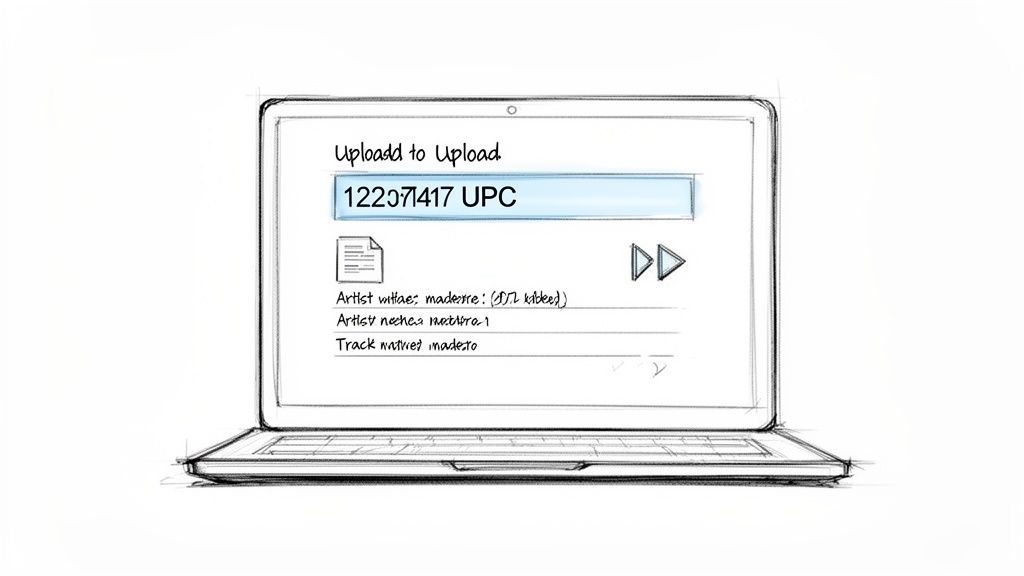
This is what that moment typically looks like. You're inputting the UPC right alongside all the other critical info. Consistency here is non-negotiable; the UPC permanently locks all this data together, so it has to be perfect.
The Role of Metadata Consistency
Here’s the thing: a UPC is only as good as the data it’s tied to. You have to be meticulous during the upload. Even a tiny typo in your artist name or a track title can create massive headaches down the road.
Before you even think about hitting that submit button, double- and triple-check these details:
Artist Name: Is it spelled exactly the same way it is on all your other releases and platforms?
Track Titles: Check capitalization and spelling for every single song. No exceptions.
Album/Single Title: Does the title perfectly match what's on your cover art?
Artwork: Make sure your cover art file meets all the distributor's specs (pixel dimensions, resolution, etc.).
Any little inconsistency creates a data mismatch. That can get your release rejected by stores or, even worse, cause your sales and streams to be tracked incorrectly. The UPC is the glue, but the pieces it's holding together have to be right from the start.
Fueling Your Analytics and Performance Tracking
Beyond just getting your music onto Spotify and Apple Music, your UPC is the bedrock for tracking your success. It's the primary ID that analytics platforms use to pull all the performance data for your release. A correctly assigned UPC is absolutely essential for getting reliable data.
For example, platforms like artist.tools rely on this unique number to power features like our Stream Tracker. When your UPC is set up properly, these tools can accurately monitor your streams, playlist adds, and overall performance. This is how you see the real impact of your marketing campaigns and figure out how your music is truly connecting with listeners.
Your UPC is the bridge between your creative work and the business data that helps you grow your career. Accurate UPC implementation ensures that every stream is counted, every sale is registered, and every analytic tool has the clean data it needs to provide valuable insights.
While the standard UPC barcode only holds 12 digits, the retail world is already preparing for the next step. An industry-wide initiative called Sunrise 2027, spearheaded by GS1, is pushing for the adoption of enhanced 2D barcodes. These can hold way more information, hinting at a future where product data is much richer. You can read more about this shift over at Future Market Insights.
For now, though, that 12-digit UPC is the most critical piece of commercial data you have. It’s what turns your collection of audio files into a trackable, sellable product in the global music market.
Common UPC Questions for Musicians Answered
As you get deeper into the business side of your music, you're bound to hit some specific snags with UPC codes. Think of this as your go-to guide for those tricky, real-world scenarios. We’re tackling the questions that pop up most often, giving you direct answers to clear up any confusion.
These are the kinds of details that can trip up even seasoned artists. The goal here is to solve these common headaches and give you a page you can bookmark for later, making sure you handle your releases like a pro.
Do I Need a New UPC for a Remastered or Deluxe Album?
Yes, 100%. This isn't just a suggestion; it's a hard and fast rule in music distribution. A UPC is tied to one specific version of a product, and one only. The moment you create a remastered version, a deluxe edition with bonus tracks, or even an instrumental-only mix, you’ve created an entirely new product in the eyes of every store and streaming service.
Each of these versions needs its own unique UPC. This is the only way to make sure sales and streams are tracked separately and accurately.
Think of it like a bookstore. They'd never use the same ISBN for both the hardcover and paperback editions of a book, right? Same logic applies here. Slapping the same UPC on different versions would create a massive accounting mess, confuse digital store databases, and could seriously jeopardize your royalty payments and chart eligibility. Every distinct version needs a fresh UPC.
Key Takeaway: Any change that results in a new version of your product—remastering, adding tracks, creating an alternate mix—demands a brand new UPC. It’s all about keeping your data clean and your money flowing to the right place.
Can I Reuse a UPC Code from an Old Release?
Absolutely not. Once a UPC is assigned to a release, it’s locked in forever. It gets permanently logged in the global retail database with that product's specific metadata: artist name, title, tracklist, artwork. It's basically married to that original release for life.
Trying to recycle an old UPC for a new single or album would trigger a critical data conflict. Imagine the chaos if a store like Spotify saw two completely different products trying to claim the same unique ID.
This will get your new release rejected flat-out by your distributor during the upload process. Or, if it somehow slips through, it will cause serious reporting and payment nightmares down the road. To avoid the headache, just treat every new release like a blank slate. Every new product needs its own fresh, unique UPC.
What Happens to My UPC If I Switch Distributors?
This is a huge one, and the answer comes down to a simple question: where did you get the UPC in the first place? Your ownership of the code determines how much freedom you have.
Distributor-Provided UPC: If your UPC came "free" from a distributor like DistroKid or TuneCore, you don't actually own it. They do. So while you can usually take your song-specific ISRCs with you, you will almost certainly need a new UPC for the album or single when you move it to a new distributor. The old UPC stays behind with the old distributor.
GS1-Purchased UPC: If you bought the UPC yourself directly from GS1, you are the legal owner. This is a game-changer. It means you can take your release—with its original, GS1-issued UPC completely intact—to any distributor you want.
Owning your codes gives you a massive advantage, especially for serious artists and labels. It preserves your product's entire sales history, streaming data, and playlist placements. This creates a continuous historical record for your release no matter who distributes it, which is a key reason why artists building a long-term catalog invest in their own GS1 codes.
Does a UPC Code Ever Expire?
For a specific product, no. The UPC itself is permanent. Once your album "Starlight" is assigned UPC 123456789012, that code will identify that specific album forever. It doesn’t have an expiration date.
However, there’s a small catch if you license codes directly from GS1. To generate your own UPCs, you license a Company Prefix from GS1. This requires an annual renewal fee to keep your membership active.
If you stop paying that fee, you lose the right to use that prefix for any new products. The UPCs you already assigned to existing releases remain valid, but you can't create any more. If you just get your UPCs through a distributor, this isn't something you need to worry about, since they're the ones managing the GS1 membership fees.
Ready to turn data into career growth? artist.tools offers a powerful suite of analytics to track your Spotify performance, find the right playlists, and protect your music from fake streams. Take control of your career and start making smarter decisions today by exploring our tools at https://artist.tools.
.png)
.png)
Comments