Your Guide to the Streaming Royalty Calculator
- Jan 20
- 16 min read
Ever wondered what 100,000 streams on Spotify actually translates to in your bank account? A streaming royalty calculator is designed to answer that exact question.
Think of it as a financial flight simulator for your music. It offers a quick forecast of what a certain number of plays might be worth, helping to demystify the often-confusing world of digital music earnings. By punching in your stream numbers, you can get a ballpark figure of your potential revenue long before your official statements from your distributor even land.
This tool isn't magic; it's just running a simple but powerful formula. It takes your total stream count and multiplies it by an estimated pay-per-stream rate for a specific platform, like Spotify or Apple Music. The result is a projection of your gross earnings, giving you a tangible number to work with for financial planning and setting career goals.
The Pro-Rata System Simplified
To really get what a streaming royalty calculator is doing, you need to understand the fundamental concept behind streaming payouts: the pro-rata system.
Picture this: every month, Spotify collects all its subscription and ad revenue into one giant pot of money.
Instead of paying a fixed rate for every single song played, Spotify first figures out the total number of streams across its entire service for that month. Your payment is then determined by your share of that total.
Key Takeaway: You aren't paid a fixed price per stream. You're paid a proportional slice of the total revenue pie, based on how many streams your music got compared to everyone else's on the platform.
This is a cornerstone concept in the world of music royalties. If you want to go deeper down the rabbit hole, you can explore our full guide on how music royalties are explained for artists, which breaks down the entire ecosystem.
Why Per-Stream Rates Are Just Averages
Because of this pro-rata model, the idea of a single, fixed "per-stream rate" is really a myth. The number you see in a streaming royalty calculator is actually a calculated average.
This average rate bounces around from month to month based on a handful of key factors:
Total Revenue: How much cash did the platform actually collect from subscribers and advertisers that month?
Total Streams: How many songs, in total, were streamed globally across the entire platform?
Listener Location: Streams from countries with higher subscription fees (like Switzerland or the U.S.) are worth more than streams from regions with lower fees.
Subscription Type: A stream from a Premium subscriber is worth a whole lot more than a stream from a free, ad-supported user.
A streaming royalty calculator cuts through all this complexity by using a widely accepted average payout rate. This is what makes it such a handy tool for quick estimates, but it also explains why the final number on your distributor's statement might be a little different. It provides a vital snapshot, not a legally binding guarantee.
How Streaming Payouts Actually Work
To really get the most out of a streaming royalty calculator, you have to understand the wild machinery working behind the scenes. The journey from a fan hitting 'play' to money landing in your bank account isn't a straight line. It’s more of a winding road, dictated by a system that pools and splits revenue on a mind-boggling scale.
At the very core of this system is Spotify's pro-rata model. Picture this: every single dollar from subscriptions and ads each month gets poured into one gigantic global pot. Your earnings aren't some fixed rate for each stream. Instead, you get a proportional slice of that pot, based on your share of the total streams across the entire platform for that month.
This is exactly why a universal, precise "per-stream rate" doesn't exist. It's a constantly shifting average, and a good streaming calculator uses that fluctuating number as the baseline for its estimates.
This diagram helps visualize the hierarchy—how that massive revenue pool gets chopped up until it trickles down to your share.
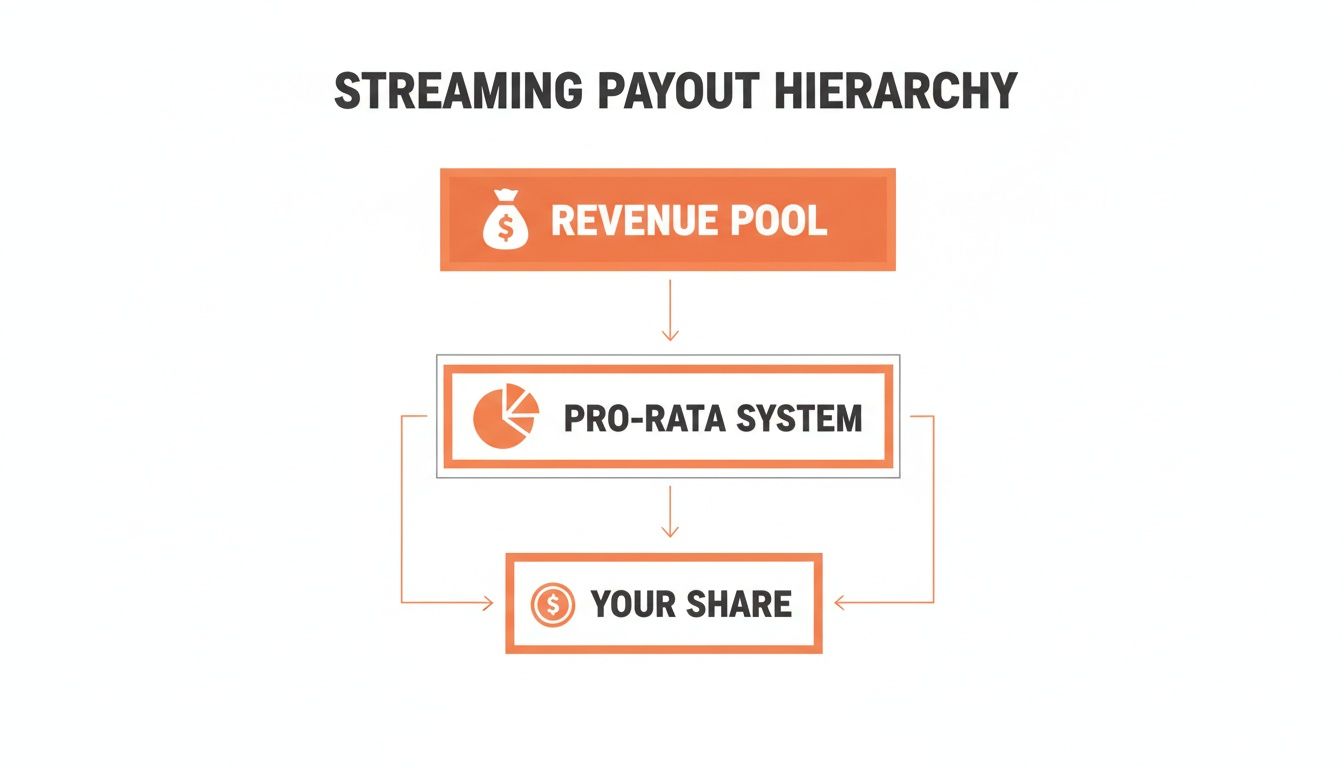
As you can see, what you ultimately get paid is a tiny fraction of a much larger system. That’s why knowing how each step works is so important for keeping your expectations realistic.
The Two Core Royalty Types
When someone streams your song, it actually generates two different kinds of royalties. Figuring out who gets paid for each one is key to seeing the whole financial picture.
Master Recording Royalties: This is for the specific recording of a song—the "master" track. These royalties go to whoever owns the master rights, which is usually the record label or, if you're independent, the artist who paid for the recording.
Mechanical Royalties: This is for the underlying musical composition—the actual lyrics and melody. These royalties are paid out to the songwriter(s) and their publisher.
If you wrote and recorded your own song, you're entitled to both. The catch is that the money flows through completely different channels and gets subjected to different splits along the way.
So, Who Actually Gets Paid?
The total revenue from a single stream never goes to just one person. It’s divided among a whole cast of characters, which is why your take-home pay is always just a piece of the gross earnings you see on a streaming royalty calculator.
One of the biggest myths is that artists get the full per-stream payout directly. The reality is, the money first goes to the rights-holders and is then divvied up based on complex agreements, with a lot of people taking their cut before it ever reaches the artist.
Platforms like Spotify pay out a huge chunk of their revenue to these rights-holders. Just recently, Spotify's annual royalty payout hit a record $10 billion, with the company sending about 70% of its revenue back to the music industry. But even with these massive numbers, the average per-stream rate is still tiny, which just goes to show how critical stream volume and smart promotion are.
The typical royalty chain includes these players:
The Streaming Platform: They keep a slice of the revenue (usually around 30%).
The Record Label/Distributor: They get the master recording royalties and then pay the artist based on their contract (artists often see between 15-50% of this).
The Publisher: Their job is to collect the mechanical royalties for the songwriter.
Performance Rights Organizations (PROs): Think ASCAP and BMI. They also collect and distribute performance royalties.
The Artist/Songwriter: They're at the end of the line, receiving whatever percentage they negotiated after everyone else has been paid.
To illustrate just how many hands are in the pot, let's look at a hypothetical breakdown for a major label artist.
Typical Royalty Splits for a Major Label Artist
This table shows how $1,000 in gross streaming royalties might get carved up among the different rights holders. Keep in mind, this is just a simplified example—real-world splits can be much more complex.
Recipient | Percentage Share | Amount from $1,000 |
|---|---|---|
Streaming Platform (e.g., Spotify) | 30% | $300 |
Master Rights Holder (Record Label) | 55% | $550 |
Publishing Rights Holders (Songwriter/Publisher) | 15% | $150 |
Artist's Share (from Label's Cut at 20%) | (11% of Total) | $110 |
Total Distributed | 100% | $1,000 |
As you can see from the table, the artist's final take-home amount is a fraction of the initial $1,000 generated.
Because of this tangled web of splits and deductions, the number a streaming royalty calculator gives you is really just a starting point. It's the gross revenue your streams generated, which then gets sliced and diced. For a much deeper dive, check out our guide on how to calculate Spotify royalties accurately.
The Key Variables That Impact Your Earnings
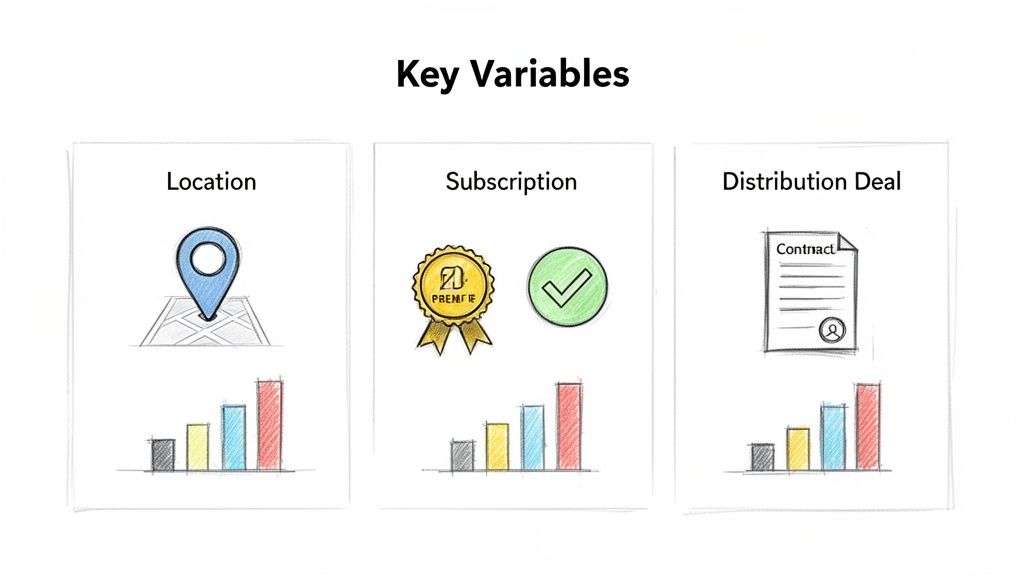
Not all streams are created equal. It's a classic mistake to think that a million streams will always cash out the same, but the reality is way more complicated. A streaming royalty calculator gives you a fantastic ballpark figure, but the final number on your payout statement gets pushed and pulled by several critical variables.
Think of it like this: your song is a product. Selling that product in a high-end New York City boutique is going to bring in more cash per unit than selling it at a small-town market. The product is the same, but the context—the market, the customer's wallet—changes what it's worth. Your music works the exact same way.
Getting a handle on these variables is everything. It turns a calculator from a simple forecasting tool into a strategic weapon, showing you why certain listeners are more valuable and how to aim your marketing for the biggest financial impact.
Listener Location and Market Value
The single biggest factor messing with your per-stream payout is where your listeners live. Every country is its own market with different subscription prices, ad revenue, and currency values. The difference in what a stream is worth can be massive.
A stream from someone in Switzerland or the U.S., where premium plans cost more, will generate way more revenue than a stream from a country with cheaper subscriptions. It's just simple economics.
Let's say you hit a million streams on Spotify. Sounds good, right? Well, according to the detailed models in artist.tools' Spotify Royalties Calculator, that million streams brings in about $2,380 at the global average of $0.00238 per stream. That number is an average because Spotify pools royalties by country. High-premium markets like the US and Canada (where a subscription is $10.99/month) pull the average up, while lower-cost markets like India pull it down.
For indie artists, this is a huge deal. It means that landing on a popular playlist in a premium market is the key to maximizing your return on investment. A viral hit in the right country can be a financial game-changer, while the same number of streams spread thin across lower-payout regions will barely move the needle.
Subscription Tier: The Premium vs. Free Divide
Next up is what kind of account your listener has. A stream from a paying, premium subscriber is worth a whole lot more than a stream from someone on a free, ad-supported plan.
Premium Streams: These are paid for by the listener's monthly subscription fee. Because this revenue is higher and more consistent, the royalties are much bigger.
Ad-Supported Streams: These are funded by the ads that play between songs. Ad revenue is all over the place and much lower per person, which means a tiny payout per stream for you.
Here's a common scenario: an artist sees a huge spike in streams but gets a surprisingly small check. Nine times out of ten, it's because most of those new listeners were on the free tier. It's a perfect example of why you need to focus on the quality of your streams, not just the raw number.
Your Distribution Deal and Royalty Splits
Finally, we get to the fine print: your deal with your distributor or record label. A royalty calculator shows you the gross earnings—the total amount of money your streams generated. But that's not what actually hits your bank account.
Before you see a dime, that money gets sliced and diced according to your contracts.
Distributor's Cut: Most distributors take a percentage of your royalties as their fee. For independent artists, this can be a small commission or a more significant chunk.
Record Label Splits: If you're signed, the label takes the lion's share of the master recording royalties. Artists are often left with just 15-50% of what the label collects.
Collaborator Splits: If you co-wrote the song, the publishing royalties are split between all the songwriters based on whatever percentages you agreed on.
Each of these splits shrinks your final take-home pay. It's absolutely vital to plug your specific royalty percentage into a calculator to get a realistic picture of your net earnings, not just the gross revenue.
Alright, we've gone deep into the theory behind how streaming payouts work. Now it's time for the fun part: putting that knowledge to work and seeing what it means for your wallet.
This is where you move from theory to practice. Let's walk through how to use the artist.tools Spotify Royalties Calculator to turn a simple stream count into a real financial forecast. This isn't just about plugging in numbers; it's about asking the "what if" questions that can define your career. What would a big playlist placement actually earn you? How much is that viral TikTok moment worth in dollars and cents?
Let's dive in.
Getting Started: A Step-by-Step Walkthrough
We designed this calculator to be dead simple, giving you a clear financial picture in just a few seconds. The whole point is to take those abstract stream numbers and turn them into solid estimates you can use to plan your next single, tour, or marketing push.
Here’s the main interface you'll be working with:
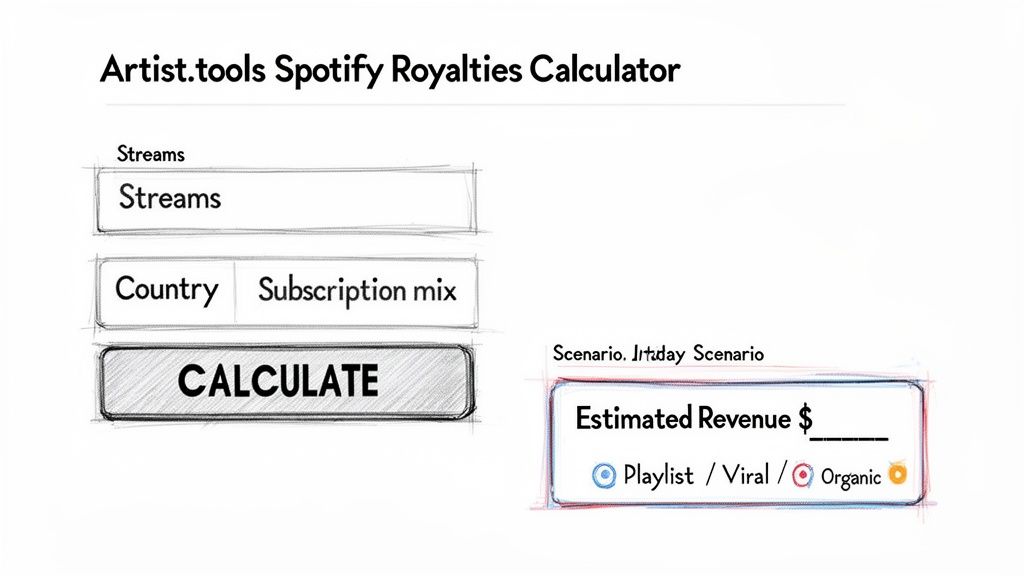
As you can see, it's a clean layout. Just a field for your stream count, a dropdown for the country, and an instant estimate of your gross royalties.
Follow these quick steps to run your first calculation:
Enter Your Stream Count: Pop the number of streams you want to check into the "How many streams do you have?" field. You can use your current monthly total, a goal for your next release, or a hypothetical number you hope to hit with a promo campaign.
Select the Listener's Country: This is a huge one. Use the dropdown to pick where your streams are coming from. As we covered, the payout rates from different countries are wildly different. Choosing a specific market like the "United States" will give you a much sharper estimate than just picking "Global (Average)."
Check Your Estimated Gross Royalties: The tool will instantly show you the Gross Royalties—the total amount Spotify pays out for those streams before anyone else takes a piece of the pie.
Calculate Your Net Earnings: Now for the most important part: your take-home pay. Find the "Royalty Share (%)" field and enter the percentage you actually get to keep after your distributor or label takes their cut. If your distributor has a 15% commission, you'd enter 85%. The calculator then shows you the Net Royalties, which is the money that actually hits your bank account.
Running Scenarios for Strategic Planning
The real magic happens when you stop using the calculator to just check past earnings and start using it to forecast the future. Playing with hypotheticals helps you set realistic, data-backed goals for your career.
Pro Tip: Use the calculator to compare the financial upside of different promo opportunities. It stops being a rearview mirror and becomes a tool for steering your career forward.
Here are a few scenarios to get you thinking:
Playlist Placement Goal: A curator for a big US-based playlist thinks they can get you 250,000 new streams. Set the country to "United States," plug in that number, and see the potential gross revenue. Now you can figure out if paying for that promotion makes financial sense.
Global Viral Hit: Your track is blowing up in India. Punch in 1,000,000 streams and set the country to "India." Now, run the same number but switch the country to "Germany." Seeing the massive difference in earnings will show you exactly where to focus your international marketing budget.
Negotiating a Distribution Deal: You're stuck between two distributors. One offers an 85% royalty share, the other 90%. Run your average monthly streams through the calculator with both percentages. Seeing the difference in your net pay over a year will make the decision crystal clear.
By experimenting with these variables, the artist.tools Spotify Royalties Calculator becomes more than just an estimator. It becomes an essential part of your financial toolkit, helping you navigate the streaming world with a lot more clarity and a lot less guesswork.
What a Royalty Calculator Can't Tell You
A streaming royalty calculator is an incredible tool for turning abstract stream counts into real financial forecasts. It gives you a crucial snapshot of what you might earn, but it’s vital to remember it's a high-quality estimate, not a crystal ball. These calculators are powerful, but they work with averages and assumptions, which means the final check from your distributor will almost certainly look a little different.
Understanding their limits isn't about distrusting the tool—it's about using it smarter. When you know what a calculator can't tell you, you can set more realistic expectations, sidestep common mistakes, and build a much stronger financial strategy for your music.
The Myth of the Fixed Per-Stream Rate
One of the biggest misunderstandings in streaming is the idea of a single, fixed "per-stream" rate from platforms like Spotify. The truth is, that number is a constantly moving target. A calculator uses a solid global or regional average to make its projection, but it can’t possibly account for every tiny variable that shifts the final payout.
It's a bit like a weather forecast. It can give you a really good idea of the temperature, but it can't predict the exact path of every single raindrop. In the same way, a royalty calculator can't see whether every single one of your listeners is on a Premium plan or where they're located.
Key Insight: A royalty calculator works with aggregated data to give you an estimate. It's built for strategic planning, not for matching your official royalty statements down to the last cent.
This is why your actual earnings might be higher or lower than the estimate. If most of your streams came from premium subscribers in a high-payout country, your check will likely be bigger. If they came from free-tier listeners, it will be smaller.
It's easy to get tangled in misconceptions about how these payouts work. Let's clear up some of the most common myths.
Common Royalty Calculation Myths vs Reality
Common Myth | The Reality |
|---|---|
"There's a single, universal pay-per-stream rate." | Payouts are calculated from a country-specific revenue pool. A stream in Switzerland pays more than a stream in India because subscription costs are different. |
"1,000 streams equals a fixed dollar amount." | The value of 1,000 streams changes monthly based on ad revenue, subscription numbers, and listener location. It’s a dynamic figure. |
"All streams are counted and paid for." | Spotify now requires a track to have at least 1,000 plays in a year to earn royalties. Also, streams from bots or fraudulent sources are never paid out. |
"The calculator's estimate should match my distributor statement." | The calculator provides a gross estimate. Your final payout will have distributor fees, taxes, and other splits deducted. It’s a planning tool, not an accounting statement. |
Thinking in terms of averages is great for goal-setting, but knowing the nuances is what helps you build a sustainable career.
The Growing Problem of Fraudulent Streams
One massive factor a standard royalty calculator can't account for is fraud. Bot streams, which are generated by automated programs instead of real people, are a huge problem for artists. These fake plays might pump up your stream count on your Spotify for Artists dashboard, but they generate zero royalties.
Even worse, if a platform spots significant bot activity on your music, it can trigger serious consequences:
Track Takedowns: Your music could be pulled from the platform completely.
Withheld Royalties: Any legitimate earnings you've built up could be frozen.
Account Strikes: Your artist profile could get flagged, putting your entire presence on the platform at risk.
This is why having clean data is so critical. Using a tool like artist.tools' Bot Detection is essential for making sure your streams are legitimate, monetizable, and safe from platform penalties. It helps you catch and deal with fraudulent playlists before they can do lasting damage to your career.
New Platform Policies and Monetization Thresholds
The streaming world is always evolving as platforms update their policies to fight fraud and balance the payout system. A perfect example is Spotify's recent policy change. With over a quarter-billion tracks on streaming services, new rules were rolled out in early 2024 to make sure royalties go to active artists.
Now, tracks must get at least 1,000 plays within a 12-month period just to become eligible for royalties. This move was designed to stop payments for non-music "noise" tracks and fraudulent uploads. While this demonetizes a huge chunk of the catalog, it redirects that money to the tracks that 99.5% of listeners are actually playing. You can read more about how these changes impact the industry and get more insights from Music Business Worldwide.
This is something a basic streaming calculator won't automatically factor in. If your track has 900 streams, a calculator might show a small potential earning, but under the new rules, that earning is actually zero. It’s a perfect reminder to look beyond the simple math and stay on top of the rules that govern your revenue.
Beyond the Calculator: Turning Insights Into Action
A streaming royalty calculator gives you a powerful peek into your potential earnings, but its real value isn't just seeing a number. The magic happens when you use that number to make smarter career moves. This is where you close the loop between estimation and execution, turning raw data into a real-world strategy that actually grows your career.
Think of it like this: if your calculator shows that 100,000 streams from the United States pull in way more cash than the same number from another country, your next step becomes pretty clear. You can start zeroing in on American playlist curators and aiming your marketing campaigns at that specific, higher-payout market. It's a data-driven approach that makes every dollar in your promo budget work that much harder.
Turning Projections Into Strategy
Instead of just waiting for your monthly statements and reacting, you can start proactively shaping your own financial future. The insights you get from a calculator let you draw a direct line between specific actions and tangible results.
Inform Your Next Release: Keep an eye on listener trends and regional stream growth to decide exactly where to push your next single.
Measure Campaign ROI: Run a marketing campaign and watch the stream count climb. A calculator helps you translate that lift into a dollar amount, showing you exactly what your return on investment looks like.
Set Realistic Financial Goals: Use your projections to set achievable income targets for the next quarter or year. This turns a vague ambition into a solid financial plan you can work towards.
By connecting your stream data to financial outcomes, you stop guessing and start strategizing. Every playlist pitch, ad campaign, and collaboration becomes an informed business decision aimed at maximizing your income.
Ultimately, this whole process is about taking control. By regularly looking at your potential earnings and understanding the "why" behind the numbers, you can make moves that count. To go even deeper, learning how to interpret your Spotify analytics for artists can boost your music insights and really supercharge this whole process.
Still Have Questions? Let's Clear a Few Things Up
Even with a great streaming royalty calculator in your corner, a few questions are bound to pop up. The world of digital royalties can be a maze, and it's totally normal to feel a bit lost sometimes. Let's tackle some of the most common questions artists ask so you can get a better handle on your finances.
"Why Doesn't My Payout Statement Ever Match the Calculator?"
This is the big one, and the answer comes down to one key difference: a gross estimate versus your net earnings. A streaming calculator gives you the big-picture number—the total revenue your streams generated before anyone else gets a piece of the pie. Think of it as a forecasting tool, not your final bank statement.
Your official payout, on the other hand, is the money that actually hits your account after all the hands have been in the cookie jar. Those deductions usually include:
Your distributor or label's cut: They take their commission right off the top.
Taxes: Yep, Uncle Sam gets his share before you do.
Bank Transfer Fees: Small charges for the actual process of sending you the money.
Splits with collaborators: If you wrote the track with others, the royalties are sliced up before your portion is sent out.
So, the calculator shows you the starting line. Your statement is what's left after the long race of deductions is over.
"How Often Does the Per-Stream Rate Actually Change?"
It’s not a fixed number. In fact, it's a moving target that changes every single month. Spotify and other platforms use what's called a pro-rata system. In simple terms, they throw all their monthly revenue into one giant pot and then divide it by the total number of streams that happened globally that month.
Because both the revenue pool (from new subscribers and ads) and the total stream count are always changing, the average payout per stream is constantly shifting. This is the main reason why nailing down a precise, long-term prediction is basically impossible.
A good calculator uses the most recent averages available, but you have to remember it's just a snapshot of a moment in time.
"Can I Factor My Specific Royalty Splits into the Calculator?"
Absolutely, and you should. This is the most important step for getting an estimate that actually means something to you. A basic calculation just shows the gross revenue for the song, which isn't all that helpful.
A quality tool like the one from artist.tools lets you plug in your specific royalty share percentage.
For instance, if your distribution deal says you get 85% of the earnings, you can punch that number in. Suddenly, you'll see a much more accurate projection of your net, or take-home, pay. Always use this feature—it’s how you move from a vague, pie-in-the-sky number to a real-world estimate you can actually plan around.
Ready to stop guessing and start forecasting? The artist.tools Spotify Royalties Calculator is built to give you the clarity you need to map out your music career. Give it a try for free and start making smarter, data-driven decisions today.
.png)
Comments