Music Royalties Explained for Artists
Ever wondered how a song actually turns into money? It’s simpler than you might think.
Think of a music royalty as rent for your song. Every single time someone 'uses' it—by streaming it, playing it on the radio, or dropping it into a YouTube video—you get paid. This is the bedrock of how artists and songwriters make a living from their craft.
How Your Song Becomes Your Paycheck
To really get how music royalties work, you first have to understand a fundamental secret of the music business: every song you create is actually two separate things, each with its own copyright. This split is the key to the entire industry’s payment system. Get this right, and you're on your way.
The global music industry is booming, hitting $29.6 billion in 2024 and marking a solid decade of growth. This explosion is almost entirely thanks to streaming, which now accounts for more than half of all global music revenue. You can dig into the specifics in the IFPI Global Music Report. This isn't just trivia; it shows exactly how vital these royalty streams have become.
The Two Sides of Your Song
Every piece of music has two copyrights attached to it. It’s a non-negotiable part of the business. If you don't manage both sides, you’re definitely leaving money on the table.
To make it crystal clear, here’s a simple table breaking down the two core copyrights tied to every song you’ll ever write or record.
The Two Sides of Your Song's Copyright
Copyright Type | What It Covers | Who Owns It |
|---|---|---|
Composition | The song's intellectual property: its melody, harmony, and lyrics. The song's blueprint. | The Songwriter(s) and their Publisher. |
Master | The specific sound recording of that song. The final audio file people actually hear. | The Recording Artist and/or the Record Label. |
Let’s break that down a bit more.
The Composition Copyright: This is the song itself—the melody you hum, the chords you play, the words you sing. It's the intellectual property, the song's very DNA. This belongs to the songwriter(s) and their publisher.
The Master Copyright: This protects one specific recording of that song. It’s the final, mixed, and mastered audio file that gets uploaded to Spotify. This is usually owned by the artist or the record label that paid for the studio time.
This division is absolutely critical. Think about it: a single song composition, like "Hallelujah," can have hundreds of different recordings (masters)—from Jeff Buckley's iconic version to a local band's live take. All of those different recordings point back to Leonard Cohen's one, original composition.
Understanding this split is your first real step into the industry. It’s what determines who gets paid for what. When that song gets streamed, one piece of the money goes to the master owner (the artist/label) and another piece goes to the composition owner (the songwriter/publisher). Without this foundation, trying to navigate the maze of music royalties is pretty much impossible.
The Four Royalty Streams You Must Know
Okay, so you've got the two copyrights—master and composition—locked down. That's the first big hurdle. Now, let's get to the good part: how those copyrights actually make you money.
It’s not just one big paycheck. Your music generates income from four completely different streams. Each one is triggered by a specific use, collected by a different organization, and paid out on its own schedule. Getting a grip on these is like learning to read the financial map of your music career. Let's break down the big four.
1. Mechanical Royalties
Think of a mechanical royalty as a reproduction fee. Anytime a copy of your song's composition is made, a mechanical royalty gets paid out. The name is a bit of a throwback to when player piano rolls were physically manufactured, but the concept is more critical than ever in the streaming era.
These "copies" can be physical or digital.
Physical copies are the classics: vinyl, CDs, and cassette tapes. For every unit made, the record label pays a mechanical royalty to the songwriter.
Digital copies include downloads from stores like iTunes and, crucially, interactive streams on platforms like Spotify and Apple Music.
That's right—every single stream on Spotify counts as a tiny reproduction, generating a tiny mechanical royalty. While one stream pays next to nothing, millions of them add up to a serious income source.
Key Takeaway: Mechanical royalties are tied to the composition copyright. They are paid to songwriters and their publishers whenever a song is reproduced, whether on a vinyl press or a smartphone screen.
2. Performance Royalties
Next up are performance royalties. These are generated whenever your music is performed or broadcast in public. This is probably the most common type of royalty out there, and it’s paid to the songwriter and publisher for the use of the composition.
So, what counts as a "public performance"? The list is surprisingly long:
Old-school AM/FM radio
TV shows, commercials, or just background music in a scene
Interactive streaming on Spotify, Apple Music, and Tidal
Live shows (yes, you even earn royalties when you perform your own songs live)
Music playing in businesses like bars, restaurants, gyms, and stores
These royalties are tracked and collected by Performance Rights Organizations (PROs). You've probably heard of them: ASCAP, BMI, and SESAC are the main players in the U.S. They license businesses, collect the money, and get it into the pockets of their affiliated songwriters and publishers. If you’ve written a song, joining a PRO isn't just a good idea—it's essential.
3. Synchronization Royalties
Synchronization royalties, or "sync" for short, are often the most lucrative but can be the hardest to land. A sync royalty is earned when your music is paired up with visual media. Just think of it as synchronizing your sound to a picture.
Getting a sync deal actually requires two different licenses, one for each copyright:
A sync license for the composition, paid to the songwriter/publisher.
A master use license for the sound recording, paid to the artist/label.
You'll find sync royalties in movies, TV shows, video games, commercials, and even big-time YouTube videos. The fees can be anything from a few hundred bucks for a small indie film to six figures for a major Super Bowl ad. For independent artists who own both their composition and master copyrights, sync deals are a massive opportunity.
You can get a more detailed breakdown by exploring the various types of royalties in our complete guide for artists.
4. Digital Performance Royalties
Finally, we have digital performance royalties. This is a special category of performance royalty that pays for the sound recording, not the composition. It’s triggered specifically by non-interactive digital services—the kind where you can't pick the exact song you want to hear.
The main sources are satellite radio like SiriusXM and internet radio stations like Pandora.
In the United States, these royalties are collected exclusively by one organization: SoundExchange. Their payout structure is unique: they pay 50% to the owner of the master recording (usually the label, but it could be you!), 45% directly to the featured artist, and the final 5% to a fund for session musicians and backup vocalists. This is a critical income stream for recording artists that many people overlook.
Decoding Your Streaming Royalty Statement
For a lot of artists, streaming has become the main way they earn a living. But when that first royalty statement hits your inbox, the numbers can look like a foreign language. It's time to pull back the curtain and see how platforms like Spotify and Apple Music actually figure out what you get paid.
Right off the bat, let's bust a common myth: there is no single, fixed "per-stream rate." It just doesn't exist. The cash you earn from one stream is always shifting based on a handful of key factors.
That’s why just multiplying your stream count by some magic number you found online will give you a totally wrong idea of your earnings. The real system is a bit more involved, but it's actually much fairer once you get the hang of it.
The Pro-Rata System Explained
Streaming services run on what's called the pro-rata system. The easiest way to think about it is like a giant, country-sized pizza party. Every month, a platform like Spotify gathers up all the money it made from subscriptions and ads in a specific country. That's the pizza.
Your music's job is to grab as many slices as you can. The size of your slice is based on your "streamshare"—basically, the percentage of total streams your music got in that country, for that month.
So, if your tracks pulled in 1% of all streams in the U.S. during May, you're owed 1% of the U.S. royalty pool for May. That "pool" is all the money collected from American users after the platform takes its cut.
This is exactly why that per-stream rate is constantly changing. Your payout isn't just about how many streams you got. It's also about how many total streams happened across the entire platform and how much money was actually in the pot to begin with.
Factors That Change Your Payout
A few different things can make that revenue pool—and your earnings—bigger or smaller. It's never a one-size-fits-all situation.
Listener's Location: A stream from a paying subscriber in the U.S. or Switzerland is going to be worth more than a stream from a country where subscription fees are lower.
Subscription Type: A stream from someone on a Premium plan pays out way more than a stream from a free, ad-supported user. Makes sense, right?
Your Distributor's Deal: The specific agreement your distributor has with the streaming platform can also influence the final payout percentages.
This global, variable system is actually creating a more diverse music economy. Spotify's 2024 data revealed that the group of artists earning over $100,000 a year were creating music in more than 50 different languages. It just goes to show how important it is to understand these regional differences in payouts. You can dive deeper into these trends in Spotify's recent industry analysis.
The wide variance in payouts across different platforms is also a huge factor. While one platform might require a certain number of streams to hit a revenue goal, another could require double or triple that amount.
Estimated Streams to Earn $1,000
Streaming Platform | Estimated Per-Stream Payout | Approximate Streams for $1,000 |
|---|---|---|
Tidal | $0.013 | 77,000 |
Apple Music | $0.01 | 100,000 |
Amazon Music | $0.004 | 250,000 |
Spotify | $0.003 - $0.005 | 250,000 - 333,000 |
YouTube Music | $0.002 | 500,000 |
Disclaimer: These are rough estimates and can change based on the factors discussed above.
As you can see, the platform itself makes a massive difference. Getting to that $1,000 milestone looks very different on Tidal compared to YouTube Music.
Tracing The Money From Stream To Statement
So, what does this actually look like when the money starts moving? Let's follow a hypothetical $1,000 royalty payout generated by your song.
The Initial Split: First, that $1,000 is split between the two main copyrights: the master (the recording) and the composition (the song itself). The master side gets the lion's share—around 80-85%, which is $800-$850. The composition gets the remaining 15-20%, or $150-$200.
The Master Payout: The $800 master share is sent to your distributor, like TuneCore or DistroKid. They'll take their fee, and the rest goes to the master rights holder. If you're independent, that's you. If you're signed, it's your label.
The Composition Payout: The $200 composition share gets split again. Half of it goes to the publisher, and the other half is sent directly to the songwriter(s) through their PRO, like ASCAP or BMI.
This breakdown makes it crystal clear why getting all your registrations sorted out is so crucial. If you don't have a publisher or a publishing administrator, a huge chunk of your songwriter royalties can end up lost in the system, waiting to be claimed.
The Essential Partners Who Collect Your Money
Let's get one thing straight: you don't just get a check from Spotify in the mail. A whole ecosystem of organizations works behind the scenes, tracking every single play and making sure your royalties find their way to you.
Think of it like building a specialized financial team. Each member has a very specific job, and you need all of them working together to collect every dollar you've earned. Without them, it's estimated that nearly $1 billion in royalties goes unclaimed every year. That's a staggering amount of money left on the table.
Performance and Mechanical Royalty Collectors
First up, you need partners for your composition royalties—the money you earn as a songwriter. This is where two key types of organizations come into play:
Performance Rights Organizations (PROs): These are the detectives for your performance royalties. In the U.S., you've got groups like ASCAP, **BMI**, and **SESAC**. Their job is to track down every public performance of your song—from radio spins and TV shows to the background music playing in a coffee shop. They collect licensing fees from all these places and pay you your songwriter share.
The Mechanical Licensing Collective (The MLC): Here in the United States, The MLC has a very specific and crucial role. It collects mechanical royalties directly from digital streaming services (think Spotify, Apple Music, etc.) on behalf of songwriters and publishers. If your music is streamed in the U.S., you absolutely must be registered with The MLC to get paid your mechanicals.
It’s a common mistake for new artists to think that joining a PRO is all you need to do. It’s not. PROs do not collect mechanical royalties from streams. You have to be affiliated with The MLC (or have a publishing administrator who is) to collect all the money you're owed as a songwriter.
Your Distribution and Publishing Team
Next, you need partners to handle the master recording and help manage the business side of your compositions.
Your digital distributor (like TuneCore or DistroKid) is your direct pipeline to the digital stores. They take your actual sound recording and get it onto hundreds of platforms like Spotify, Apple Music, and Amazon Music. Their main job is to collect the royalties generated by your master recording and pay them out to you.
Then there's your music publisher or publishing administrator. These partners work on behalf of your composition—the song itself. They register your songs with collection societies all over the world, ensuring that both your performance and mechanical royalties are tracked and collected from every single territory. For an independent artist, a good publishing administrator is a powerful ally for grabbing income that would otherwise just disappear into the ether.
This flowchart gives you a simple visual of how a single stream actually turns into a payment, including the small fee the collection society takes.
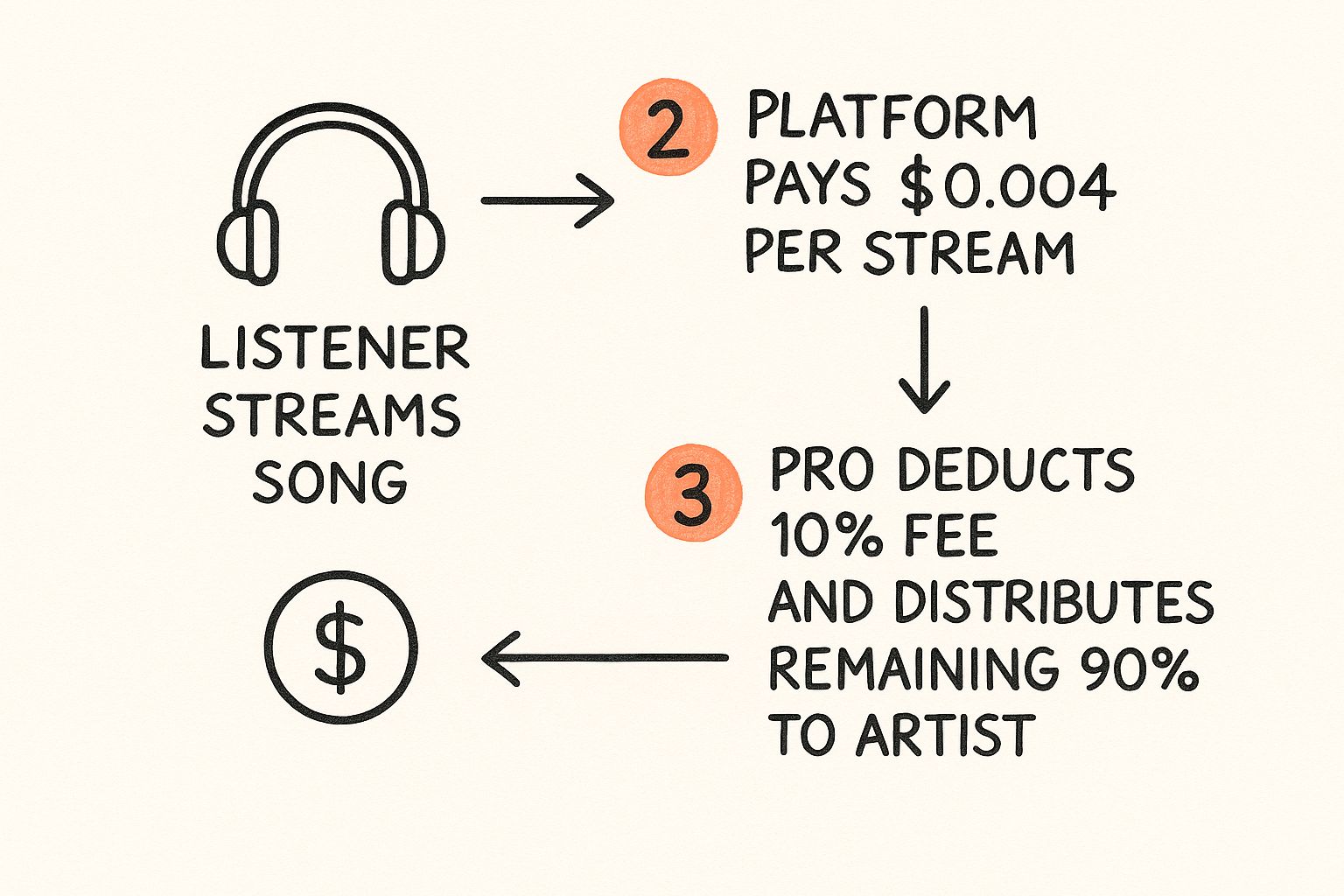
As you can see, even though the per-stream rate is tiny, each partner in this chain plays an essential role. They all take a small commission before passing the majority of the earnings to you, the rights holder. Navigating this world seems complex, but understanding who does what is the first step to getting paid properly.
Your Action Plan for Maximizing Royalties
So, you now know the difference between mechanical and performance royalties. That’s the first big step. The next one is actually building a system to collect every single dollar you're owed. This isn't something that just happens automatically; it takes a deliberate, hands-on strategy to turn your music into a real business.
Think of it like setting up nets to catch different kinds of fish. If you only put out one net, you're going to miss out on everything else swimming in the sea. This action plan is your guide to setting up every net correctly, so nothing slips through the cracks.
Laying the Groundwork
Before we even talk about maximizing your earnings, you've got to get the fundamentals in place. These are the absolute non-negotiables for any artist or songwriter who's serious about getting paid. Skipping these steps is like trying to drive a car without an engine—you just won’t get anywhere.
Your first move is to affiliate with a Performance Rights Organization (PRO). If you're in the U.S., that means choosing between ASCAP, BMI, or SESAC. These organizations are basically your personal detectives for performance royalties, tracking down every public play of your song and making sure you get the songwriter's share.
The second critical step is registering every single song you write with your chosen PRO. An unregistered song is completely invisible to the royalty collection system. This one simple administrative task can be the difference between getting paid and earning absolutely nothing for your work.
Your Secret Weapon: The Publishing Administrator
Here's a costly mistake a lot of independent artists make: they think joining a PRO is all they need to do for their songwriter income. It’s not. PROs only collect performance royalties, which leaves a huge chunk of your money on the table—specifically, your mechanical royalties from streams.
This is where a publishing administrator becomes your most valuable partner. Think of companies like Songtrust or TuneCore Publishing. They act as your global publishing department, hunting down money you can't get on your own.
A publishing administrator is essential for independent artists because they collect royalties from sources your PRO cannot touch. This includes mechanical royalties from global streaming services and performance royalties from outside your home country.
Without one, you are almost certainly leaving cash in the bank accounts of collection societies all over the world. Yes, they’ll take a commission, usually around 15%, but collecting 85% of something is a whole lot better than collecting 100% of nothing.
Expanding Your Revenue Streams
Once your collection foundation is solid, you can start actively creating new income opportunities. Don't just sit back and wait for the stream counts to tick up; go hunt for the bigger paydays.
Pursue Sync Licensing: Getting your music placed in a film, TV show, or commercial is one of the most lucrative moves you can make. You need to actively look for sync agents who can pitch your music to supervisors. If you own both your master and composition rights, you become a "one-stop shop," which is incredibly attractive to music supervisors working on a tight deadline.
Leverage Different Platforms: Not all streams pay the same. As we've covered, the payouts can vary wildly between platforms like Tidal, Apple Music, and Spotify. While being everywhere is smart, you need to understand where your audience lives and focus your promo efforts there. You can use a Spotify royalties calculator to get a much clearer picture of your potential earnings on that specific platform.
Create More Content: Honestly, the most straightforward way to increase your royalties is to increase your catalog. More songs mean more potential streams, more sync opportunities, and more data points for algorithms to recommend your music to brand-new listeners.
Common Questions About Music Royalties
The world of music royalties can feel like a tangled mess, but most artists bump into the same handful of questions. Let's clear up the most common points of confusion with some straight answers. Getting these right will save you countless headaches and—more importantly—lost income down the road.
One of the very first questions on every artist's mind is about timelines. When do you actually see the money?
Patience is a virtue in the music business, to say the least. Royalty payments aren't instant; they operate on a pretty significant delay. Typically, you can expect to receive royalties 3 to 9 months after your music is streamed, sold, or played in public. Each royalty type and collection society has its own payment schedule, so checks tend to arrive at different times throughout the year.
Do I Need a Publisher to Get Paid?
This is a critical point that trips up a ton of independent artists. The short answer is yes, but maybe not in the way you're thinking.
While you don't need a traditional, old-school publishing deal where you sign away your copyrights, you absolutely need a publishing administrator to collect all of your songwriter royalties. Without one, you are guaranteed to leave significant streams of income on the table.
Your PRO (like ASCAP or BMI) is fantastic at collecting performance royalties, but they don't touch the mechanical royalties from streams. A publishing administrator fills this gap, making sure you get paid for every single time your song is reproduced on platforms like Spotify and Apple Music, both in the US and internationally.
Key Insight: Think of a publishing administrator as your song's global financial agent. They chase down money from sources and territories that are nearly impossible for an individual artist to access alone, ensuring you don’t leave cash unclaimed.
Can Unsigned Artists Really Collect Royalties?
Yes, 100%. Being an unsigned or independent artist has zero bearing on your right to earn royalties. The system is available to everyone, as long as you take the right steps to set yourself up for payment.
The process is straightforward and it's the foundation for building a sustainable career. For a more detailed walkthrough, you can check out our complete guide on what music royalties are and how to claim them.
Here’s the essential checklist for any independent artist:
Affiliate with a PRO: Pick one organization like ASCAP or BMI and sign up as a songwriter.
Register with a Mechanical Rights Organization: In the U.S., this means signing up with The MLC to collect your digital mechanicals.
Use a Digital Distributor: A service like DistroKid or TuneCore is necessary to get your music onto streaming platforms and collect your master recording royalties.
Partner with a Publishing Administrator: This is the final piece of the puzzle, catching all the remaining songwriter royalties from around the globe.
By following these steps, you build a complete royalty collection network. It ensures that no matter where your music gets played, the money has a clear path right back to you.
At artist.tools, we build data-driven software to help artists, managers, and playlist curators succeed on Spotify. From bot detection and playlist analysis to royalty calculators and AI-powered editorial pitching, our platform provides the insights you need to grow your career. Explore the full suite of tools at artist.tools.
.png)
.png)
Comments