Promote your music safely, bot-free, and policy compliant with SubmitLink (10% OFF)
Detect artificial streams earlier
TL;DR
Artificial streaming is fake or manipulated listening activity that can make a song look like it is growing while creating risk for takedowns, royalty holds, bad campaign data, and wasted promotion spend. Prevent it by checking playlists and curators in artist.tools before you pitch, avoiding placements marked Likely Botted or Possibly Botted, monitoring your artists and tracks for risky playlist exposure, and using bot detection alerts so you can act quickly when suspicious activity appears.
The Short Version
Artificial streaming is music streaming activity that does not come from real listener intent.
It can come from Spotify bots, fake playlist networks, paid stream farms, suspicious traffic sources, or promotion campaigns that quietly use low-quality placements.
It usually becomes a problem because fake growth can look good at first:
What You See | What Might Be Happening |
Streams jump overnight | A playlist may be sending bot traffic |
Monthly listeners rise fast | The listeners may not be real or repeatable |
A playlist has lots of followers | The playlist itself may have fake followers |
A campaign looks cheap and effective | The promotion may rely on artificial streams |
Streams later disappear | Spotify or a distributor may have filtered them |
The safest move is to check playlist quality before you pitch, monitor placements while a campaign is running, and act quickly if a track starts getting suspicious traffic.
Artificial Streaming Is Not Always Obvious
Most artists do not discover artificial streaming because something looks suspicious on day one. They discover it because the numbers stop making sense.
A track gets placed on a playlist. Streams rise. The campaign report looks promising. Then the usual signs of real audience growth do not follow.
Saves stay low.
Followers barely move.
Repeat listening is weak.
Listener geography feels random.
Monthly listeners spike, then vanish.
Royalties are delayed or questioned.
A distributor flags suspicious activity.
Spotify removes streams from the track.
That is what makes artificial streaming dangerous. It often looks like progress before it looks like risk.
What Counts as Artificial Streaming?
Artificial streaming means plays, listeners, saves, follows, or playlist activity that has been manipulated instead of earned from real listeners.
People describe the same problem in different ways:
artificial streaming
artificial streams
Spotify artificial streams
Spotify bot streams
Spotify bots
fake Spotify streams
Spotify fake streams
botted streams Spotify
Spotify streaming fraud
Spotify playlist bot checker
check Spotify playlist for bots
The wording changes, but the underlying concern is the same: are these streams coming from real people who chose to listen?
Where Fake Spotify Streams Usually Come From
Artificial streams can come from obvious scam services, but they can also come through indirect channels. An artist does not need to personally buy Spotify streams to end up exposed to fake activity.
Source | Why It Creates Risk |
Paid stream services | Often use bots, click farms, or incentivized traffic |
Low-quality playlist pitching | May place songs on playlists with fake followers or fake listeners |
Suspicious curators | One curator may control multiple risky playlists |
Playlist save or follower bots | Make a playlist look more valuable than it is |
“Guaranteed results” vendors | May prioritize cheap volume over real audience quality |
Random unsolicited adds | A song can be added to a risky playlist without the artist asking |
This is why “I did not buy streams” is not always enough protection. Platforms and distributors look at the activity attached to the music, not only the artist’s intent.
Why Playlists Deserve the Most Attention
A large playlist can look like an opportunity. But follower count alone is a weak quality signal.
A playlist may have 50,000 followers and still be risky. It may have grown through fake followers, stopped receiving real engagement, or become part of a network that repeatedly drives artificial streams. Some playlists look active on the surface but show signs of abnormal follower growth, sudden purges, or weak listener behavior.
Before treating a playlist placement as valuable, ask:
Does the playlist show steady, believable follower growth?
Has it had sudden spikes or drops?
Does the curator own other suspicious playlists?
Do tracks added to the playlist show real downstream engagement?
Is the playlist connected to known botting patterns?
Would this placement make sense for the artist’s genre, audience, and market?
artist.tools helps answer those questions faster by surfacing playlist quality signals directly.

Common Red Flags of Botted Playlists
No single signal proves a playlist is fake. But several weak signals together can point toward artificial streaming risk.
Red Flag | What It Can Suggest |
Massive follower spike | The playlist may have bought followers or been manipulated |
Sudden follower drop | Fake followers may have been removed or purged |
Stagnant growth | The playlist may no longer have real audience activity |
Weak engagement | Followers may not be real listeners |
Suspicious curator history | The curator may own or operate other botted playlists |
Datacenter-heavy traffic | Plays may not reflect normal consumer listening |
Low-quality track adds | The playlist may be selling placements broadly |
No clear audience fit | Streams may not come from real fans of the genre |
artist.tools turns these signals into practical labels like Likely Botted, Possibly Botted, Undetermined, and Likely Bot-free, with context around why a playlist may have been flagged.
What To Do Before You Pitch a Playlist
The best time to detect artificial streaming risk is before the song is added.
Use this simple pre-pitch checklist:
Check | Good Sign | Warning Sign |
Playlist quality | Likely Bot-free or no major red flags | Likely Botted, Possibly Botted, or unclear history |
Growth pattern | Steady, believable follower movement | Sharp spikes, drops, or long stagnation |
Curator history | Curator has healthy playlists | Curator owns multiple risky playlists |
Audience fit | Playlist matches the artist’s genre and market | Playlist accepts unrelated tracks |
Engagement | Placement seems likely to reach real listeners | Large follower count but weak listener signals |
Vendor transparency | Clear placement strategy | Vague “guaranteed streams” language |
If a playlist fails several of these checks, it is usually better to skip it. A risky placement is not just a bad marketing spend. It can create problems for the artist later.
What To Do If You Already Suspect Fake Streams
If a song is already receiving suspicious activity, do not start by guessing. Start by documenting.
Identify the likely source.Look at recent playlist adds, campaign dates, stream spikes, geography, and save rates.
Save the evidence.Keep playlist URLs, screenshots, dates, vendor messages, campaign reports, and distributor notices.
Pause risky promotion.If a vendor or campaign may be involved, stop the activity while you review it.
Avoid repeat exposure.Do not pitch the same curator, playlist network, or service again until you understand the risk.
Contact the relevant party when needed.Depending on the situation, that may be your distributor, your marketing vendor, playlist curator, or platform support.
Keep monitoring.Artificial streaming issues can evolve. A playlist that looks safe today can become risky later.
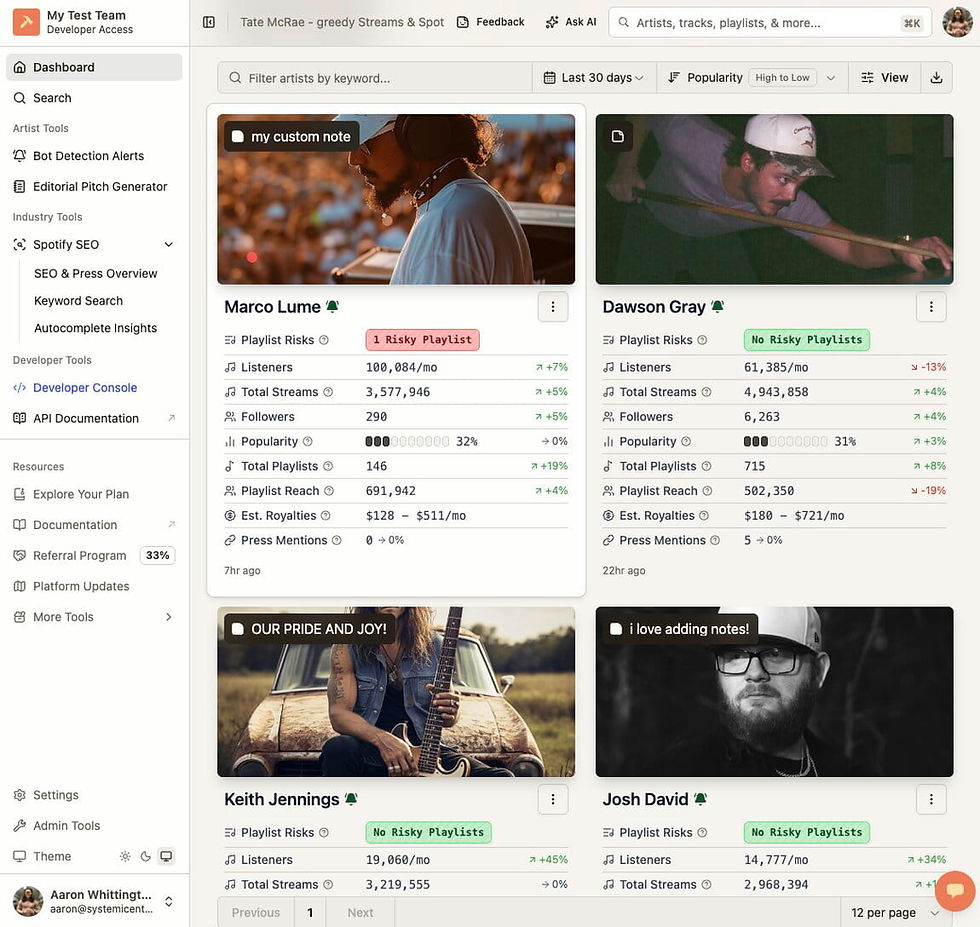
How artist.tools Helps Protect Artists
artist.tools is built to catch artificial streaming risk earlier, especially around playlists and curators.
You can use it to:
check Spotify playlists for bots
review whether a playlist is Likely Botted or Likely Bot-free
understand why a playlist was flagged
monitor artists and tracks for risky playlist exposure
evaluate curators before pitching
receive bot detection alerts when risk changes
audit playlist quality across a roster or campaign
For artists, that means fewer blind spots. For managers and labels, it means playlist risk can be reviewed before it becomes a royalty, takedown, or reporting problem.
Real Growth Leaves More Than Streams Behind
The easiest way to think about artificial streaming is this:
Real listeners usually leave fingerprints. Fake activity usually leaves numbers.
Healthy streaming growth tends to create supporting signals.
People save the song.
Some follow the artist.
Repeat listening appears.
Geography makes sense.
Engagement continues after the playlist add.
The audience looks like an audience.
Artificial streaming often does the opposite. The stream count rises, but the rest of the data feels hollow.
That does not mean every spike is fake. A real playlist, editorial add, influencer moment, or fan-driven event can move quickly.
But if the growth comes from a playlist with botting red flags, suspicious curator history, or abnormal follower behavior, it deserves a closer look.
A Simple Protection Workflow
Use this workflow whenever you are evaluating playlist promotion:
Stage | What To Do |
Before pitching | Check playlist and curator quality in artist.tools |
During campaign | Watch for suspicious stream spikes or risky playlist adds |
After placement | Review whether engagement matches the stream growth |
If risk appears | Document the source and pause questionable promotion |
Long term | Keep alerts on for artists, tracks, playlists, and curators you care about |
Artificial streaming is easiest to manage when you catch it early.
Once streams are already removed, royalties are held, or a distributor starts asking questions, your options narrow.
FAQ
What is artificial streaming?
Artificial streaming is streaming activity that does not come from genuine listener intent.
It can include Spotify bots, fake streams, stream farms, manipulated playlist traffic, or other methods used to inflate plays, listeners, saves, or followers.
Are fake Spotify streams always intentional?
No. Artists can be exposed to fake Spotify streams through bad playlist placements, low-quality marketing vendors, suspicious curators, or unsolicited playlist adds.
Even if the artist did not knowingly buy streams, the activity can still create risk.
How can I tell if a Spotify playlist is botted?
Look for abnormal follower spikes, sudden follower drops, weak engagement, suspicious curator behavior, unrelated track adds, and other signs that the playlist’s audience may not be real.
artist.tools helps by labeling playlist quality and surfacing key red flags.
What is a Spotify playlist bot checker?
A Spotify playlist bot checker helps identify playlists that may be using bots, fake followers, or artificial listener activity.
artist.tools checks playlist quality signals so artists and teams can avoid risky placements before pitching.
What should I do if my song gets fake streams?
Start by identifying the likely source. Review recent playlist adds, campaign timelines, listener geography, save rates, and stream spikes.
Document everything, pause suspicious promotion, and contact your distributor or relevant platform support if needed.
Can Spotify remove bot streams?
Yes. Spotify and distributors can filter, remove, or discount streams they believe are artificial.
In some cases, suspicious streaming activity can also lead to royalty holds, warnings, takedowns, or account-level issues.
Can artist.tools guarantee a playlist is bot-free?
No tool can guarantee that a playlist is completely bot-free.
artist.tools helps identify risk signals and classify playlists based on available evidence, but playlist quality should always be treated as a probability-based assessment rather than an absolute verdict.
Advanced Analytics, Charts, & Playlist History over 4+ years
Analyze how artists, tracks, playlists, or curators have evolved over time, and whether that evolution is artificial.
.jpg)
.jpg)
Detect Playlist Placements likely to deliver Artificial Streams
Get notified when your music is discovered in playlists likely to deliver artificial streams, the most common source of fraud.
.jpg)
.jpg)
Granular search across 20M+ Spotify assets
Source curator emails, trending artists, AI-generated tracks, & more using highly-granular search filters.
Contacts
Listeners
| >200K
Demographic
| Phillipines
Grow bigger & better playlists with Spotify Search Traffic
Discover underserved search intents that shape your playlist strategy.
meditation mix
12K searches/month
Highly competitive
meditation for adhd
2.9K searches/month
Low competition
Discover where you're being talked about online
Detect online mentions; like press articles, social mentions, & more.
_.jpg)
PRICING
Unlimited artists. Every plan.
bot detection, analytics, & more, on 20M+ assets

GET STARTED
Protect your music career
start for free, upgrade as your career evolves
.png)
artist.tools
A data platform providing comprehensive bot detection, playlist analysis, and curator contact info for artists, labels, and distributors to build & maintain safe & successful careers in the music industry
See why industry leaders like
DistroKid, UnitedMasters, TooLost, ReverbNation, and Ditto recommend artist.tools to their users.
Sister projects:
SubmitLink | PlaylistScaler | SERPclimber
Enterprise Solutions
Trusted Marketing Services
Resources & Free Tools
© 2026 ALW Holdings Inc. All rights reserved.

.png)