7 Essential Music Artist Biography Example Templates for 2026
Your artist biography is more than just a summary of your career; it’s a critical marketing tool that can open doors to editorial playlists, press features, and dedicated fans. A generic, uninspired bio gets you ignored. A powerful, strategic one gets you heard. This isn't just about listing your accomplishments; it's about crafting a narrative that connects with listeners, journalists, and industry professionals on a deeper level. A well-written bio is your first impression, your professional handshake, and your most concise sales pitch rolled into one.
This guide moves beyond generic advice to provide an in-depth breakdown of seven essential music artist biography example templates. Each one is designed for a specific strategic purpose, from building an emotional connection with new listeners to presenting hard data to industry gatekeepers. We will dissect what makes each template effective, provide actionable tips for immediate implementation, and show you how to tailor your story for maximum impact across different platforms like Spotify, your website, and press kits.
You will learn how to:
Structure a narrative that highlights your unique artistic identity.
Select the right tone and information for different audiences.
Integrate keywords and SEO principles for better discovery.
Use data from tools like artist.tools to craft a narrative that is both compelling and verifiable.
We will analyze templates covering your origin story, discography, genre-specific identity, major achievements, collaborations, personal brand, and data-driven growth. Let's move beyond the cliché and build a bio that truly represents your art and accelerates your career.
1. The Origin Story & Early Career Template
The Origin Story & Early Career template is a foundational music artist biography example that frames your journey for new listeners. It chronicles your path from initial inspiration and early experiments to formative experiences and breakthrough moments. This narrative structure is powerful because it humanizes your artistic persona, allowing fans to connect with the person behind the music, not just the final product.
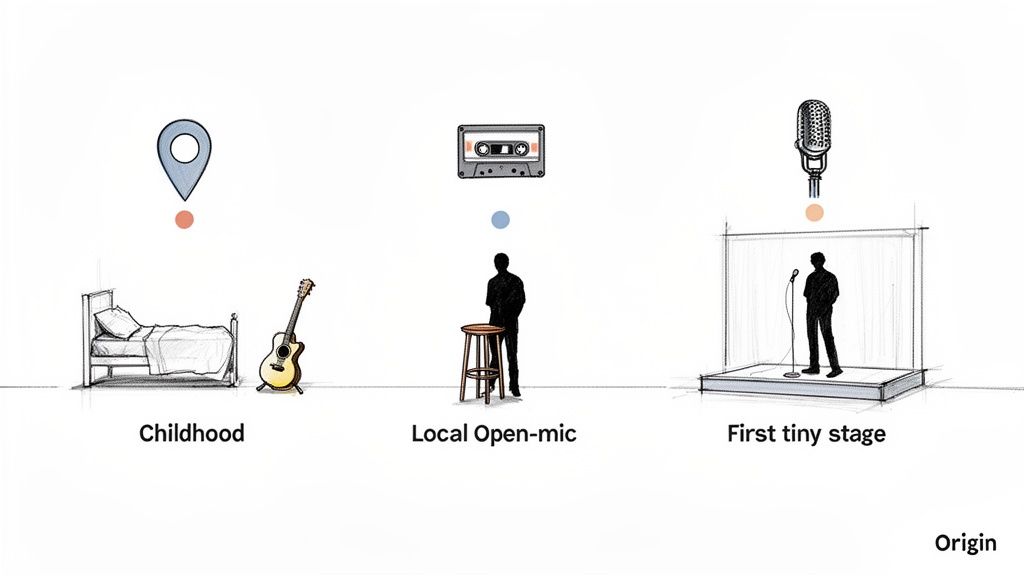
This bio style moves chronologically, highlighting the key milestones that shaped your sound and identity. It’s particularly effective for emerging artists on Spotify or press kits, as it builds credibility and provides a compelling narrative for journalists, bloggers, and playlist curators to latch onto.
Strategic Breakdown & Analysis
An effective origin story isn't just a list of facts; it’s a curated narrative. Think of Drake's well-documented transition from acting on Degrassi in Toronto to his mixtape dominance, or Billie Eilish's story of recording her debut album with her brother in a bedroom, which became central to the "bedroom pop" movement. These stories are sticky because they are specific, authentic, and relatable.
Human Connection: The core goal is to forge an emotional bond. Sharing early struggles, the "aha!" moment you found your sound, or the specific local scene you emerged from makes your journey feel real and aspirational.
Credibility & Context: Mentioning specific locations (e.g., "the DIY punk scene in Austin"), dates ("began producing in 2019"), and formative influences ("inspired by the synth-heavy sounds of the 80s") adds layers of authenticity and context.
Genre Alignment: Your story should subtly reinforce your genre. A folk artist might detail their travels through rural landscapes, while an EDM producer could describe their discovery of underground rave culture.
Actionable Takeaways & Implementation
To craft your own compelling origin story, focus on specificity and progression.
Map Your Milestones: Identify 3-4 pivotal moments. This could be your first instrument, a life-changing concert, the release of your first SoundCloud track, or getting your first local gig.
Inject Keywords Naturally: Weave in your genre, location, and key influences. For example, instead of "I make electronic music," try "Crafting atmospheric synthwave from a small studio in Berlin..." This helps with SEO on platforms like Spotify.
Show, Don't Just Tell: Instead of saying you're a hard worker, describe the late nights spent learning production. This creates a more vivid picture for the reader.
Keep It Current: An origin story is a living document. As you achieve new milestones, update the "Early Career" portion quarterly to reflect your growth and momentum.
This template is the perfect starting point for any artist looking to build a narrative. To explore this concept further, you can find a comprehensive guide on how to write an artist bio that truly connects and captivates your audience.
2. The Discography & Project Evolution Template
The Discography & Project Evolution template is a powerful music artist biography example that showcases your growth through your body of work. It moves beyond a simple origin story to detail the sonic and thematic progression across your albums, EPs, and singles. This data-driven approach appeals to industry professionals, journalists, and dedicated fans who want to understand your artistic trajectory.
This bio style is structured chronologically or thematically around your releases, highlighting the evolution of your sound. It’s perfect for an official website, an EPK (Electronic Press Kit), or platforms like AllMusic, where context is crucial. It positions you as a serious artist with a clear creative vision and demonstrable growth over time.
Strategic Breakdown & Analysis
An effective discography bio isn’t just a list of releases; it’s a narrative told through music. It connects the dots between projects, explaining how one era led to the next. Think of Tyler, The Creator's evolution from the raw aggression of Goblin to the introspective, genre-bending soundscapes of IGOR and Call Me If You Get Lost. Each album is a distinct chapter, and the bio's job is to be the narrator guiding the listener through that journey.
Demonstrates Artistic Growth: The primary goal is to illustrate your development. Highlighting shifts in production, lyrical themes, or collaborative choices shows you are a dynamic artist, not a static one.
Provides Context for Curators: For playlist curators and A&R reps, understanding your sonic evolution is key. This template helps them identify which era of your music best fits their needs, whether it's your early indie sound or your more polished, recent work.
Builds a Deeper Fan Connection: This narrative invites superfans to revisit your back catalog with a new perspective. By explaining the "why" behind your creative shifts, like SZA's methodical progression from Ctrl to SOS, you enrich the listening experience.
Actionable Takeaways & Implementation
To build your own project evolution narrative, focus on connecting your releases with clear thematic or sonic threads.
Group Releases into Eras: Instead of listing every single, group your projects into distinct eras defined by a particular sound or theme. For example, "The Acoustic Beginnings (2018-2020)" or "The Synthwave Exploration (2021-Present)."
Highlight Key Tracks and Data: For each era, mention 1-2 standout tracks that define its sound. Use data to add credibility, such as, "The lead single 'Midnight Drive' from the Neon Dreams EP landed on three major Spotify editorial playlists and marked a 50% increase in monthly listeners."
Explain the "Why" Behind Each Shift: Briefly explain the creative motivation for each new direction. Did a new collaboration inspire a different sound? Did a life event change your lyrical focus? This adds a compelling human element to your discography.
Keep It Focused on the Music: While personal stories are important for an origin bio, this template should remain centered on your work. The music is the main character here; let it tell the story of your evolution.
This template is ideal for established artists with a few releases under their belt, providing a comprehensive overview that validates their artistic journey.
3. The Genre-Specific & Sonic Identity Template
The Genre-Specific & Sonic Identity template is a music artist biography example designed to precisely define and contextualize your unique sound. It moves beyond a chronological story to focus on your sonic fingerprint: the specific production techniques, instrumentation, vocal characteristics, and genre-blending that make your music distinct. This narrative is crucial for communicating your artistic vision to industry professionals like playlist curators, A&Rs, and music journalists who need to quickly understand where you fit in the musical landscape.
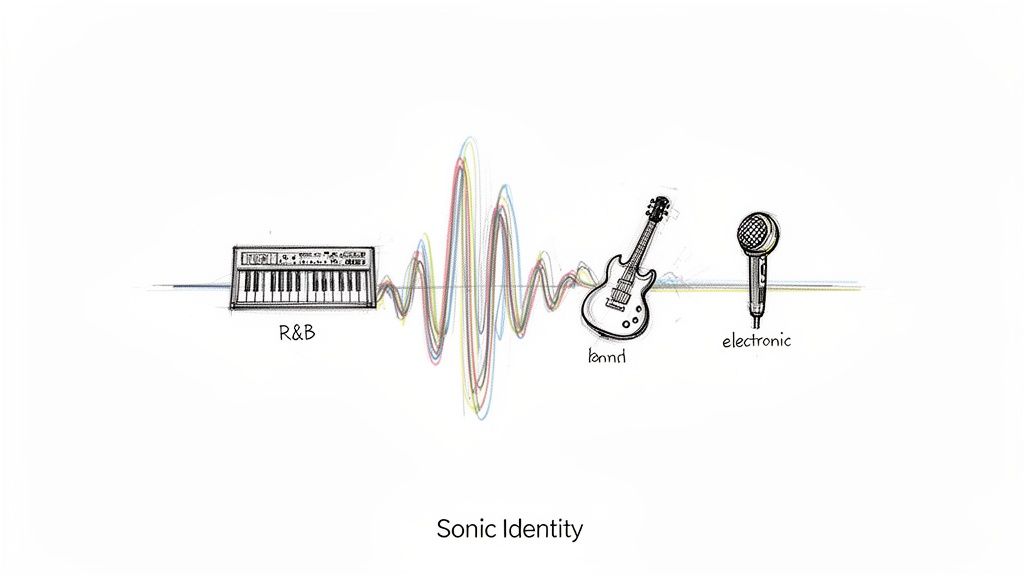
This bio style is invaluable for Spotify SEO and playlist pitching. It uses descriptive, genre-specific language to attract curators and algorithms looking for a particular sound. By clearly articulating your sonic identity, you make it easier for the right audience and industry gatekeepers to find and champion your work.
Strategic Breakdown & Analysis
An effective sonic identity bio doesn't just list genres; it explains how you inhabit and innovate within them. Think of FKA twigs, whose bio often details the fusion of avant-garde electronic production with ethereal R&B vocals and contemporary dance influences. Likewise, Playboi Carti's sound is contextualized by its "mumble rap" origins, minimalist ad-libs, and experimental, "rage" trap production. These descriptions are powerful because they give the reader a clear auditory expectation.
Curator & Algorithm Appeal: This is about signaling. Using specific terms like "lo-fi drum machines," "ethereal vocal layers," or "808-heavy trap" immediately communicates your sound to curators using playlist search tools to fill sonic gaps in their playlists.
Artistic Authority: Defining your sound with confidence establishes you as a credible and self-aware artist. It shows you have a clear vision and can articulate the technical and creative choices behind your music, which is appealing to collaborators and industry professionals.
Niche Audience Targeting: This template helps you connect with listeners searching for specific micro-genres. Describing your music as "psychedelic neo-soul" rather than just "R&B" helps you attract a more dedicated and engaged fanbase looking for that exact sound.
Actionable Takeaways & Implementation
To craft a bio that effectively communicates your sonic identity, get specific and technical.
Deconstruct Your Sound: List your core sonic components. What instruments are prominent? What production techniques define your tracks (e.g., side-chained compression, analog synth pads)? What are the key characteristics of your vocals (e.g., breathy, raw, auto-tuned)?
Use Genre & Micro-Genre Keywords: Research relevant genre keywords. Instead of "electronic," specify if it's "synthwave," "dark techno," or "future bass." This precision is critical for platforms like Spotify, where algorithms categorize music based on these descriptors.
Name Your Influences Strategically: Mention 2-3 artists who inform your sound, but explain how. For example, "Fusing the lyrical introspection of Frank Ocean with the distorted soundscapes of Tame Impala..." This gives a direct and understandable reference point.
Highlight Your "X-Factor": What makes your sound unique? Is it your unconventional song structures, your use of a rare instrument, or your specific thematic focus? Make this the centerpiece of your sonic description.
This template is essential for any artist wanting to stand out in a crowded genre. To master keyword research for your bio, explore how a Playlist Analyzer can reveal curator preferences and optimize your positioning.
4. The Milestone & Achievement Highlight Template
The Milestone & Achievement Highlight template is a powerful music artist biography example designed to communicate success and momentum quickly. It prioritizes quantifiable achievements like streaming numbers, chart positions, awards, and sold-out tours over a chronological narrative. This structure builds immediate credibility and social proof, making it ideal for press kits, grant applications, and industry-facing communications.
This bio style is less about telling a personal story and more about presenting a compelling business case for your artistry. By leading with hard data, you frame your career in terms of tangible impact and market validation. It’s particularly effective for artists with significant traction who need to convey their scale to gatekeepers like booking agents, labels, and brand partners.
Strategic Breakdown & Analysis
An achievement-focused bio translates artistic merit into the language of the industry: numbers. Think of Olivia Rodrigo's narrative, which is inseparable from her record-breaking debut album streams and chart dominance, or Bad Bunny's bio, which often leads with his status as Spotify's most-streamed artist. These facts aren't just trivia; they are strategic assets that signal commercial viability.
Social Proof & Authority: The primary goal is to establish authority. Highlighting "10 million+ streams," "a sold-out North American tour," or "a #1 position on the Hype Machine charts" acts as an undeniable validator of your music's appeal.
Industry Language: This template speaks directly to industry professionals. Metrics are the currency of the modern music business, and presenting your achievements clearly demonstrates that you understand your market position and are a serious contender.
Momentum Narrative: By curating specific milestones, you create a narrative of upward momentum. Showing consistent growth in streaming numbers or an increase in venue size on subsequent tours tells a story of an artist on the rise.
Actionable Takeaways & Implementation
To build your own achievement-focused bio, you need to gather and frame your data effectively.
Quantify Everything: Compile a list of your top achievements. Use specific numbers: "over 5 million Spotify streams," "charted in 15 countries on Apple Music," or "headlined a 500-capacity sold-out show."
Lead with the Biggest Win: Start your bio with your most impressive statistic. This immediately grabs the reader's attention and sets a professional tone. For instance, "Garnering over 20 million streams and landing placements on Spotify's 'Lorem Ipsum' playlist..."
Provide Context: Don't just list numbers; frame them. Mentioning that your debut single achieved 1 million streams independently adds a layer of entrepreneurial credibility.
Update Regularly: This bio is dynamic. Update it after every major release, tour, or significant press mention to ensure it always reflects your latest and most impressive accomplishments.
This template is essential for any artist ready to engage with the industry on a professional level. For a deeper dive into leveraging your data, you can learn more about tracking your streaming performance and turning analytics into opportunities.
5. The Collaborations & Cultural Impact Template
The Collaborations & Cultural Impact template positions an artist within a broader musical ecosystem. Instead of focusing solely on a solo journey, this music artist biography example highlights strategic partnerships, featured appearances, production credits, and influence on larger movements. This narrative shifts the focus from "who you are" to "who you work with and influence," which is incredibly powerful for curators and industry professionals.
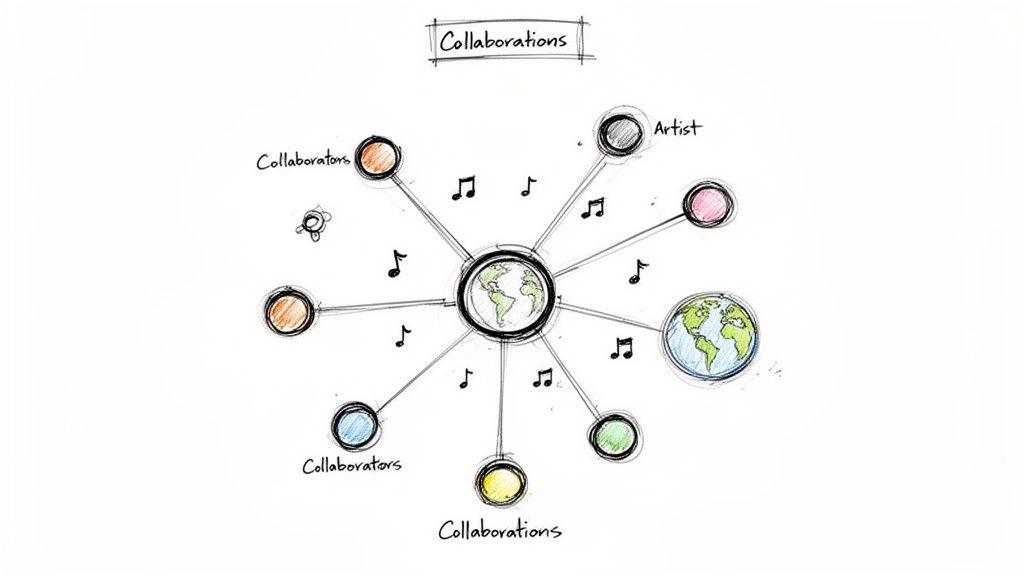
This bio style is essential for producers, featured vocalists, and artists whose careers are defined by their network. It demonstrates credibility by association and maps out your creative network, making it easier for playlist editors and A&R scouts to understand your position and potential audience crossover within the Spotify ecosystem.
Strategic Breakdown & Analysis
An effective "Collaborations" bio tells a story of creative synergy and influence. Think of Pharrell Williams, whose bio could be a map of modern pop music, connecting his work with Clipse and N.E.R.D. to his production on landmark albums like Beyoncé's Lemonade. Similarly, The Weeknd's strategic partnerships with Daft Punk, Metro Boomin, and Ariana Grande are central to his narrative of genre-bending superstardom.
Credibility by Association: Featuring names of respected artists you've worked with immediately elevates your status. It’s a powerful form of social proof that validates your talent and professionalism.
Audience Crossover: This template explicitly signals to curators which audiences you appeal to. A collaboration with a popular lo-fi artist tells a curator you fit well on their "Chill Beats" playlist.
Demonstrates Versatility: Listing collaborations across different genres showcases your adaptability and creative range, opening doors to a wider variety of playlisting and feature opportunities.
Actionable Takeaways & Implementation
To build your own collaborations-focused bio, you need to map your network and highlight its value.
List Your Top 3-5 Collaborations: Choose partnerships that are most recognizable or best represent your desired sound. Mention the artist's name and the project (e.g., "featured on the track 'Stardust' by indie-pop artist Luna").
Integrate Spotify Data: Use your bio to guide curators. Mentioning a collaboration increased your monthly listeners or led to a specific playlist placement provides concrete evidence of your partnership's success.
Link Directly to Your Work: Embed Spotify URLs for your features or co-produced tracks. This makes it effortless for a busy curator to click and listen, removing friction from the discovery process.
Frame Your Role: Clearly state your contribution. Were you the producer, the featured vocalist, the songwriter? For example: "Co-wrote and produced the breakout single for emerging artist [Artist Name]..."
This approach transforms your bio from a static summary into a dynamic map of your influence. For deeper insights on leveraging your network, explore how to use the Playlist Analyzer to find playlists where your collaborators are already featured, identifying warm leads for your next pitch.
6. The Personal Brand & Lifestyle Template
The Personal Brand & Lifestyle template is a modern music artist biography example that positions you as a cultural architect, not just a musician. It integrates your visual aesthetic, fashion sense, and social media presence to build an immersive world around your music. This narrative is crucial in an era where fans connect with an artist's entire 'culture' across platforms like Instagram, TikTok, and Spotify.
This bio style focuses on the story behind the brand, explaining how your lifestyle, values, and artistic vision inform your sound. It’s highly effective for press kits targeting culture-focused publications like Complex or Highsnobiety, and it helps curators on Spotify understand your appeal beyond genre, placing you in mood-based and 'aesthetic' playlists.
Strategic Breakdown & Analysis
An effective lifestyle bio weaves together music and culture into a single, cohesive narrative. Look at Tyler, The Creator, whose bio often touches on his Golf Wang fashion line and directorial vision, or Bad Bunny, who is positioned as a global ambassador for Latin culture. These brand stories are powerful because they offer fans multiple entry points into their world.
Cultural Positioning: The primary goal is to establish your niche within a broader cultural context. Are you a champion for sustainability, a voice for Gen Z, or a tastemaker in avant-garde fashion? Your bio should make this clear.
Multi-Platform Cohesion: This bio connects the dots between your Spotify profile, your Instagram feed, and your live shows. It signals to industry professionals that you have a consistent and marketable brand identity.
Audience Resonance: By highlighting lifestyle elements, you attract fans who share your values and aesthetic. This builds a more dedicated community that engages with your brand beyond just streaming numbers.
Actionable Takeaways & Implementation
To craft a compelling personal brand bio, you must think like a creative director.
Define Your Brand Pillars: Identify 3-4 core elements of your brand outside of music (e.g., vintage fashion, minimalist design, skate culture, activism). These are the keywords of your brand identity.
Connect Lifestyle to Music: Explicitly link your brand pillars to your sound. For example, "Inspired by the raw energy of NYC's skate scene, [Artist Name] crafts gritty, lo-fi beats that..."
Quantify Your Influence: If you have a strong social media presence, include relevant metrics. Mentioning "a community of over 100k on TikTok" adds tangible proof of your cultural impact for agents and labels.
Align Your Visuals: Ensure your Spotify artist image, banner, and Canvas videos reflect the aesthetic described in your bio. Consistency is key to making the brand feel authentic and believable.
This template is essential for artists who want to build a lasting and multi-faceted career. To see how other artists have mastered this, you can review 8 essential music bio examples to inspire your story and elevate your brand.
7. The Data-Driven Analytics & Growth Narrative Template
The Data-Driven Analytics & Growth Narrative is a modern music artist biography example that swaps subjective storytelling for verifiable metrics. It frames your career trajectory through empirical data points like streaming growth, audience demographics, and geographic reach. This template is exceptionally persuasive because it demonstrates momentum and market validation, making it highly effective for industry professionals like A&Rs, managers, and data-savvy playlist curators.
This bio style moves beyond anecdotal claims to provide a transparent, evidence-based case for your music. It's ideal for press kits, one-sheets, and grant applications where proving your viability and audience engagement is crucial. By showcasing your growth, you shift the narrative from "I'm a promising artist" to "I am an artist with a documented, growing audience."
Strategic Breakdown & Analysis
An effective data-driven narrative isn't just a list of numbers; it’s a story told through analytics. Think of Lil Nas X's viral explosion, where his team could point to specific TikTok metrics and Spotify velocity to prove a cultural moment was happening in real-time. Similarly, Olivia Rodrigo's team could document her rapid ascent from thousands to billions of streams, creating an undeniable narrative of a superstar's birth.
Proof of Concept: The primary goal is to provide undeniable proof of your music's impact. Citing a 300% monthly listener increase after a key playlist placement is more powerful than simply saying the song "did well."
Industry Language: This approach speaks the language of the modern music business. Managers, labels, and publishers make decisions based on data, and presenting your story in this format shows you understand the industry's mechanics.
Targeted Pitching: You can tailor the data to the recipient. When pitching to a Latin music blog, highlight your streaming growth in Mexico and Spain. When talking to a brand, emphasize your audience demographics.
Actionable Takeaways & Implementation
To build your own data-driven bio, you need to leverage analytics tools and connect the dots between your actions and their results.
Track Your Growth: Use a tool like artist.tools' Monthly Listeners Tracker to pull 12-24 months of historical data. Identify your peak listener counts and align them with specific releases or promotional campaigns.
Quantify Your Impact: Instead of "my new single is getting traction," use specific metrics. For example, "Following its placement on the 'Lorem Ipsum' playlist, 'My Song' saw a 40% spike in stream velocity and a 15% increase in followers."
Verify Your Audience: Include Bot Detection verification to assure curators and potential partners of your audience's authenticity. This builds trust and shows you are a serious, professional artist.
Connect Data to Strategy: Weave your analytics into a narrative. State how your SEO keyword strategy led to placements on specific niche playlists, demonstrating intentional, strategic growth rather than just luck.
This template transforms your bio from a creative summary into a compelling business case. For those looking to dive deeper, you can find a comprehensive guide on mastering music industry data analytics to build a truly undeniable narrative.
7-Point Artist Bio Template Comparison
Template | 🔄 Implementation Complexity | ⚡ Resource Requirements | 📊 Expected Outcomes | 💡 Ideal Use Cases | ⭐ Key Advantages |
|---|---|---|---|---|---|
The Origin Story & Early Career Template | 🔄 Medium — needs careful, authentic narrative | ⚡ Low–Medium — artist anecdotes, dates, occasional listener data | 📊 Strong emotional engagement and listener loyalty | 💡 Emerging artists seeking editorial placement and brand humanization | ⭐ Builds authenticity and fan investment |
The Discography & Project Evolution Template | 🔄 Medium–High — cataloging plus thematic framing | ⚡ Medium — release metadata, credits, chart/stream stats | 📊 Demonstrates consistent output and catalogue depth | 💡 Artists with multiple releases; curators researching trajectories | ⭐ Verifiable credibility for multi-track playlisting |
The Genre-Specific & Sonic Identity Template | 🔄 Medium — requires precise sonic description | ⚡ Low–Medium — production notes, genre keywords, examples | 📊 Improves playlist matching and genre discoverability | 💡 Niche artists and producers targeting specific sonic playlists | ⭐ Clear sonic positioning and SEO for genre terms |
The Milestone & Achievement Highlight Template | 🔄 Low–Medium — straightforward but must be accurate | ⚡ Medium — up-to-date streaming, chart, award data | 📊 Immediate credibility and strong social proof | 💡 Established artists or those with notable metrics for competitive pitches | ⭐ Concrete proof points that are easy to verify |
The Collaborations & Cultural Impact Template | 🔄 Medium — mapping networks and cultural context | ⚡ Medium — collaborator credits, links, audience overlap data | 📊 Signals network strength and cross-audience discovery | 💡 Artists with features/producers or cross-genre projects | ⭐ Highlights creative range and industry relationships |
The Personal Brand & Lifestyle Template | 🔄 Medium — needs cohesive visual + narrative alignment | ⚡ Medium–High — visuals, social metrics, partnership details | 📊 Strong brand affinity and cross-platform engagement | 💡 Artists courting brand deals, lifestyle playlists, visual audiences | ⭐ Differentiates artist beyond music; boosts marketability |
The Data-Driven Analytics & Growth Narrative Template | 🔄 High — technical analysis and interpretation required | ⚡ High — analytics tools, historical streaming and demographic data | 📊 Objective, verifiable credibility and predictive insights | 💡 Tier‑1 editorial pitches, managers, investors and data-driven curators | ⭐ Provides strategic, evidence-based verification and ROI insights |
Your Story, Your Strategy: Putting It All Together
We've explored a wide array of templates and strategic frameworks, from detailing your origin story and discography to highlighting genre identity and data-driven growth. The core lesson is clear: a music artist biography is not a one-size-fits-all document. It’s a dynamic, modular tool that you must adapt and reshape for different platforms, audiences, and career goals. The journey from a promising new artist to an established name is narrated through these carefully constructed stories.
The most potent biographies don't just list facts; they weave a compelling narrative that resonates emotionally while simultaneously proving your professional viability. This is where a hybrid approach becomes essential. Your Spotify bio might lean heavily on the Genre-Specific & Sonic Identity Template to capture casual listeners, while the bio in your Electronic Press Kit (EPK) should be a powerful fusion of the Milestone & Achievement Highlight Template and the Data-Driven Analytics & Growth Narrative Template to impress industry gatekeepers.
Key Takeaways: From Template to Triumph
Let's distill the most critical insights from each music artist biography example we've covered:
Modularity is Power: Your biography is not a single, static text. Create different versions: a short, punchy one for social media; a medium-length, narrative-focused one for Spotify; and a comprehensive, data-rich version for your EPK and website.
Audience dictates Form: Always consider who is reading. A fan wants to connect with your story and personality. A playlist curator or A&R representative needs to see tangible proof of your momentum, market position, and professional trajectory.
Authenticity Backed by Data: The most compelling narratives are those that feel genuine but are supported by verifiable achievements. Blending the Personal Brand & Lifestyle Template with hard numbers creates a story that is both relatable and respectable. Your unique journey is your greatest asset, but its impact is amplified by measurable success.
Your Actionable Next Steps
Feeling empowered is one thing; taking action is another. Here is a clear, step-by-step plan to transform these concepts into a powerful asset for your music career.
Conduct a Bio Audit: Gather all existing versions of your artist bio from every platform (Spotify, SoundCloud, social media, website). Analyze them against the templates we've discussed. Where are the gaps? Is your story consistent?
Identify Your Core Narrative: What is the central theme of your career right now? Is it the release of a new album (Discography & Project Evolution)? Is it a recent surge in streaming numbers (Data-Driven Growth)? Is it a high-profile collaboration (Collaborations & Cultural Impact)? Define this core narrative first.
Build Your Modular Bios: Using your core narrative as the foundation, start writing. Draft a one-liner, a 150-word version, and a full 400-word bio. For each one, ask: "Who is this for, and what do I need them to know?"
Integrate Keywords Naturally: Revisit your bios and strategically place keywords related to your genre, "sounds like" artists, and mood. This simple step is crucial for discovery on platforms like Spotify and for general SEO. Each music artist biography example in this guide serves as a model for how to do this effectively.
Ultimately, mastering your biography is an exercise in strategic self-awareness. It's about understanding not only who you are as an artist but also how to communicate that value to the world. It’s the bridge between your art and your audience, between your talent and your opportunities. A well-crafted bio doesn't just describe your music; it sells the entire experience of you as an artist. It's your handshake, your elevator pitch, and your professional resume all rolled into one. Treat it with the same care and creativity you pour into your music, and it will become one of the most powerful tools in your arsenal.
Ready to back your compelling story with undeniable proof of your momentum? artist.tools provides the essential streaming data and playlist analytics that industry professionals use to vet artists. Use it to find verifiable achievements for your bio and build the credibility you need to stand out. Explore your data on artist.tools today.
.png)
.png)
Comments