A Modern Guide to Independent Music Promotions
- Jan 4
- 18 min read
Independent music promotion is all about the hustle—the strategies and tactics you, the artist, use to build an audience and rack up streams without a major label calling the shots. It means taking the reins of your own career, from figuring out Spotify's algorithm to forging a real, direct connection with your fans. And honestly, this approach has never been more powerful or accessible.
The New Blueprint for Independent Music Promotions
Gone are the days when you needed a gatekeeper to get your music heard around the world. Today, the tools to build a real, sustainable career are right there in your hands. This guide is your roadmap for navigating the music world as it is now, not ten years ago. We're cutting through the old, outdated advice and focusing on what actually moves the needle. This is for the artist who's ready to turn their passion into their profession.
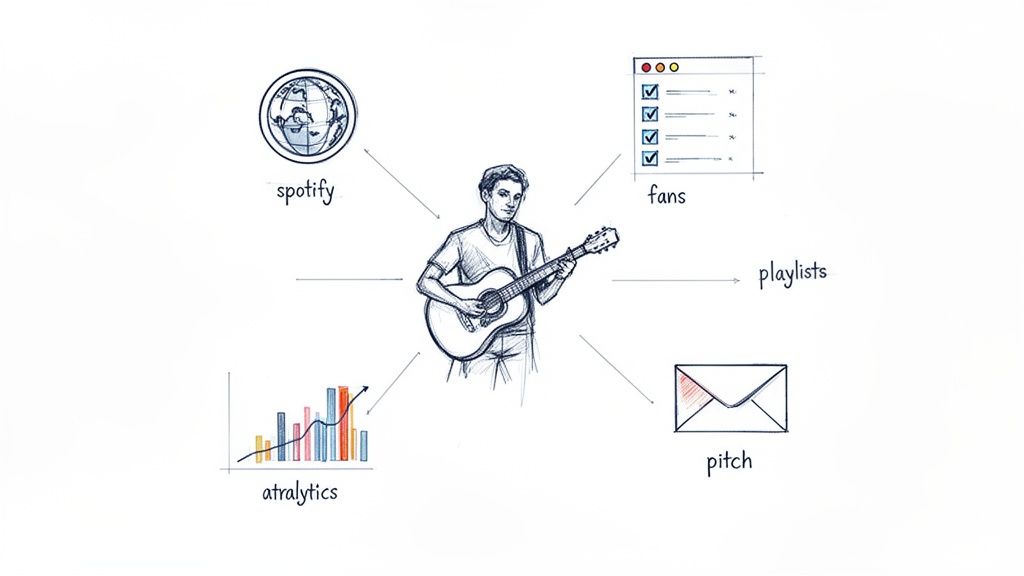
This isn't just a feeling; it's a massive shift in how people listen to music. A huge change happened in 2025, when for the first time, over 50% of all music consumed on the big platforms came from independent or unsigned artists. That stat is a game-changer. It proves that distributors like DistroKid and direct-to-fan sites like Bandcamp have leveled the playing field for good. You can learn more about this industry transformation and what it really means for artists trying to make it.
The heart of modern independent music promotion isn't about getting lucky—it's about building a repeatable system. It's a mix of smart data analysis, creative outreach, and genuine fan engagement that creates predictable, steady growth.
A Modern Promotional Framework
To really break through, you need a strategy where every piece works together. Think of it like a machine: each part supports the others, creating momentum that just keeps building. This guide is built around the core pillars that every single effective promotional campaign needs.
To give you a clear picture of what we're about to dive into, here's a breakdown of the essential strategies that form the foundation of a successful indie music career today.
Core Pillars of Modern Music Promotion
Pillar | Objective | Key Tactic |
|---|---|---|
Audience Research | Know exactly who your fans are and where to find them. | Building a data-backed listener persona to target your marketing efforts precisely. |
Playlist Pitching | Get your music on playlists with real, engaged listeners. | Identifying quality playlists, spotting fakes, and crafting pitches that get noticed. |
Spotify SEO | Make your music easily discoverable to new fans on Spotify. | Optimizing your artist profile, track titles, and playlists for the algorithm. |
Data & Protection | Make informed decisions and protect your artist profile. | Tracking key metrics, detecting bots, and forecasting potential stream revenue. |
PR & Social Media | Build buzz and a community around your music. | Securing press features and creating engaging content that drives listeners to Spotify. |
Paid Promotion | Accelerate your growth and reach a wider, targeted audience. | Using targeted ad campaigns on platforms like Meta and TikTok to find new fans. |
These pillars are the building blocks. Master them, and you'll have a complete system for growing your music career on your own terms.
Here’s a quick look at what we'll be breaking down:
Audience Discovery: We're going way beyond guesswork. You'll learn how to use data to create a detailed profile of your ideal listener, making sure every bit of your promotional energy hits the right target.
Strategic Playlist Pitching: You’ll get the skills to find high-quality playlists, instantly spot the fraudulent ones, and write compelling pitches for both independent curators and Spotify's own editorial team.
Spotify SEO Mastery: We're going to pull back the curtain on how Spotify’s algorithm really works. You'll get clear, actionable steps to optimize your profile and playlists so people can find you organically.
Beyond Spotify Tactics: Your promotion doesn't stop at Spotify. We’ll explore how to use social media, PR, and smart ads to create a full promotional engine that constantly drives traffic back to your music.
Data and Protection: You'll learn to track the stats that actually matter, how to detect bot activity to keep your streams clean, and even how to forecast potential earnings to build a sustainable career.
This entire blueprint is designed to be put into action immediately. It'll give you the knowledge and the tools you need to finally take control of your music's destiny and connect with the listeners who are out there waiting to discover you.
Finding Your Audience Before You Spend a Dime
Let's be real. Effective music promotion isn't about shouting into the void and hoping someone hears you. It's about finding the right ears and whispering directly into them. Before you blow your budget on ads or sink countless hours into outreach, you have to know exactly whose ears you're looking for.
Guessing who might like your music is a surefire way to waste time, money, and momentum. The real magic happens when you let the data do the talking.
Your existing listeners, even if you can count them on two hands, are a goldmine. They're the blueprint for building your ideal fan profile—not just their age and location, but their habits, their passions, and how they find new artists to obsess over.
Digging into Your Data
Your first stop should always be your Spotify for Artists dashboard. This isn't just a vanity board for checking stream counts; it's your mission control for audience intelligence. Hop over to the "Audience" tab and start connecting the dots.
Top Cities and Countries: Where is your music already getting some love? This tells you where to focus your energy, whether it's targeting social media ads to specific cities or looking for local gig opportunities.
Age and Gender: This gives you a baseline. Are you hitting home with college kids, or is an older, more established crowd digging your sound?
Listeners Also Like: This is pure gold. Spotify is literally handing you a list of other artists your fans are listening to. This is your road map for finding your sonic peers and, by extension, your future fans.
Just from this, a picture starts to form. Maybe you discover your core listener is a 24-year-old guy in London who also has Tame Impala, Glass Animals, and Still Woozy on heavy rotation. Suddenly, you're not guessing anymore. You have a data-backed starting point for every single promotional move you make.
Identifying Similar Artists and Their Fans
That "Listeners Also Like" list is your new best friend. Your mission, should you choose to accept it, is to reverse-engineer what's working for them. These artists aren't just your competition; they're case studies. Look for artists who are a few steps ahead of you—their fanbases are the fertile ground where your music can grow.
Find artists who share your sonic DNA. If you make dreamy indie pop, don't just look at the biggest names; find others in that specific micro-genre. Then, put on your detective hat and analyze their whole operation.
What kinds of playlists are they featured on? Look at both the big editorial ones and the smaller, user-curated gems.
How do they use social media? What's their content like, and more importantly, how do they talk to their fans?
Which music blogs or publications have covered them?
This process isn't about stealing their fans. It's about introducing your music to people who have already raised their hands and said, "I love this style." You're finding the communities where your future fans are already hanging out.
Think of it like this: if a bunch of people are obsessed with a specific, niche flavor of ice cream, they're probably going to be open to trying another brand that tastes similar. Your music is that new brand, and similar artists' audiences are the people already lined up at the ice cream shop.
Finding Your Micro-Genre and Keywords
Once you have a clear picture of your audience and your artistic peers, you can get laser-focused on your niche. You don't just make "rock music"—maybe you make "post-punk revival with synth-heavy undertones." That level of specificity is your secret weapon for Spotify SEO and playlist pitching.
Start brainstorming all the keywords that fit your sound, vibe, and influences.
Genre: "Dream Pop," "Lofi Hip Hop," "Indie Folk"
Mood: "Late Night Drive," "Chill Study Beats," "Summer Vibe"
Instrumentation: "Synthwave," "Acoustic," "808 Bass"
These keywords become the language you use everywhere—in your Spotify bio, on your social profiles, and in your pitches to playlist curators. When you nail your micro-genres and keywords, you make it incredibly easy for the algorithm (and new listeners) to find you. This is the foundational work that turns your promotion from a scattergun mess into a targeted strategy that attracts the right fans from day one.
Getting Your Music on the Right Spotify Playlists
Landing your music on the right playlists is one of the most powerful moves you can make as an independent artist. I'm not just talking about racking up streams; this is about connecting with engaged listeners—the kind of people who will actually save your track, follow your profile, and become real fans. But getting there isn't about luck; it's about having a sharp, repeatable strategy.
Think of it as a skill. You need to blend a bit of data analysis with genuine human connection to find the right playlists, check them for quality, and write a pitch that actually gets a response. The good news is, you don't have to figure this out on your own.
Finding Quality User-Curated Playlists
First things first, you need to find playlists that are a perfect match for your sound. While getting on Spotify's official editorial playlists is a huge goal, don't sleep on the thousands of influential user-curated playlists out there. These are often run by passionate music lovers, bloggers, and even other artists who have built dedicated followings around specific genres or vibes.
Start by digging around on Spotify using keywords that describe your music. Go deeper than just broad genres. Get specific with moods, activities, or artists you sound like.
Genre: Instead of "Pop," try "Dream Pop," "Indie Folk," or "Lofi Hip Hop."
Mood: Think about how people would listen to your music. Search for "Late Night Drive," "Chill Study Beats," or "Summer Vibe."
"Similar To" searches: A search like "Fans also like [Artist Name]" can be a goldmine for finding playlists that feature your peers.
This will probably give you hundreds, maybe even thousands, of potential playlists. Now comes the real work: separating the gems from the junk.
Before you even start searching, you need to know who you're trying to reach. This simple workflow is key.
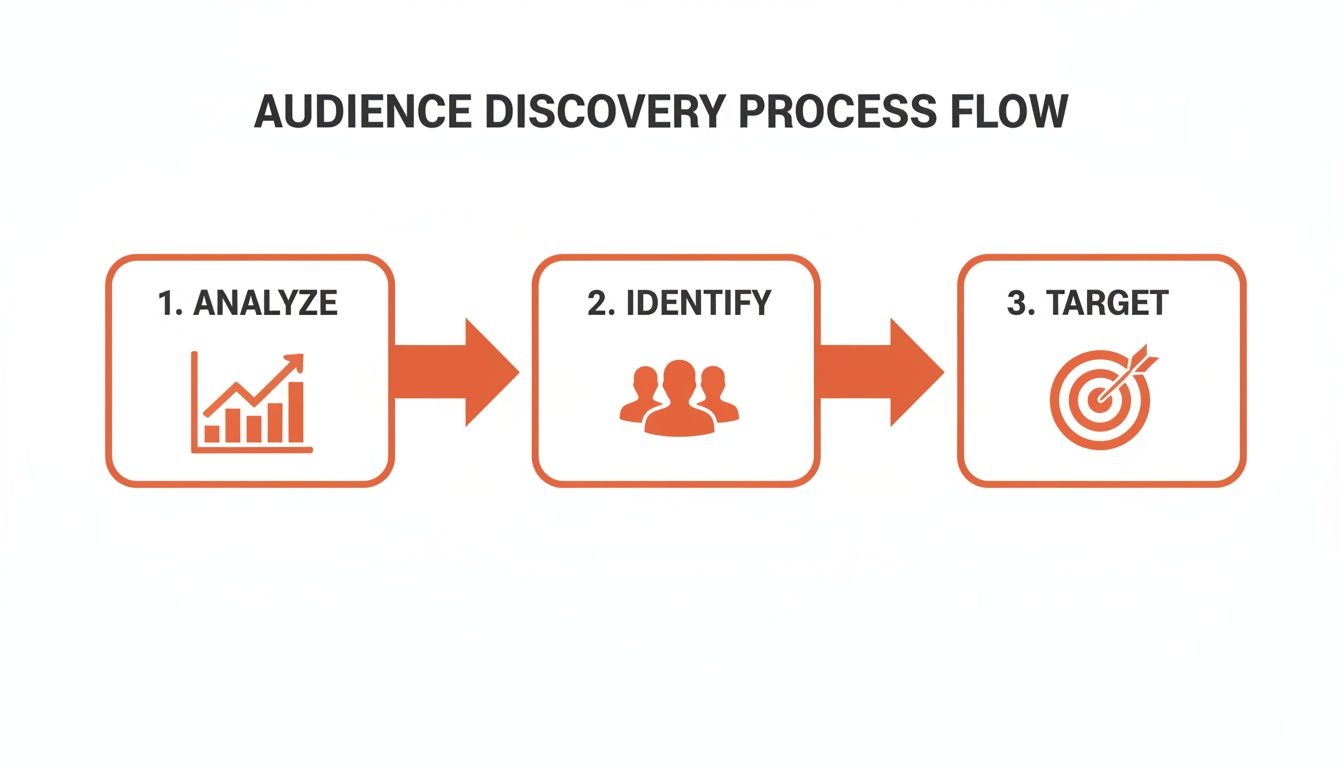
This Analyze, Identify, and Target process makes sure your search is guided by data, not just guesswork. It points you toward curators whose listeners are already primed to love what you do.
Spotting the Fakes (And Avoiding Them)
Here’s the dark side of playlisting: fake, botted playlists are everywhere. Getting on one of these can do way more harm than good. It can get your music flagged for fraudulent activity and potentially even removed from Spotify. You absolutely have to learn how to spot the red flags.
A playlist with 100,000 followers that only generates a handful of streams is a classic sign of bot activity. Follower counts are easy to fake; real engagement is the only metric that matters.
Keep an eye out for weird growth patterns. If a playlist suddenly jumps by tens of thousands of followers overnight, it's almost certainly fake. Real playlists grow slowly and organically over time. Also, check out the curator's profile. If it looks generic, has no social media links, or just feels off, it's best to walk away.
This is where specialized tools become essential. A platform like artist.tools can analyze any playlist's history, showing you its follower growth over time and automatically flagging signs of bot activity. It saves you an incredible amount of time and protects your artist profile.
How to Write a Pitch That Actually Gets Opened
Once you've got a solid, vetted list of high-quality playlists, it's time to write your pitch. Curators are often drowning in hundreds of submissions every single week. A generic, copy-pasted email is going straight to the trash. Personalization is everything.
Here’s a simple structure that I've seen work time and time again:
A Clear Subject Line: Get straight to the point. Something like "Music Submission: [Your Artist Name] - [Your Song Title] for [Playlist Name]" is perfect. It's professional and shows you've done your homework.
The Personal Touch: Start by mentioning their playlist by name. Then, explain why your track is a great fit. Mention a specific song already on their list to prove you’ve actually listened to it and understand the vibe.
A Quick Intro: Keep it short. A sentence or two describing your sound is plenty. Maybe mention one or two similar artists to give them a quick reference point.
The Link: Always provide a direct, private link to your song. SoundCloud is great for this before release day. Never, ever attach an MP3 file.
A Professional Sign-Off: Thank them for their time. Include links to your Spotify profile and maybe one key social media account.
If you want to go even deeper on the art of the pitch, check out our comprehensive guide to Spotify curator playlist pitching, which has more detailed strategies and examples.
Pitching to Spotify's Editorial Team
While you're reaching out to independent curators, you should always pitch directly to Spotify's editorial team. This is done right through your Spotify for Artists dashboard and it's your only official way to get considered for huge playlists like New Music Friday, Lorem, or the big genre-specific lists.
The key here is timing. You need to submit your track at least one to two weeks before your release date—the earlier, the better. The form will ask for details about the song's genre, mood, instrumentation, and your marketing plans. Fill this out with as much detail as you can. This data is what helps the editors find the perfect home for your music. A thoughtful, well-prepared pitch shows you're a professional and makes your track a much more compelling choice for their coveted slots.
How to Win with Spotify SEO
Most artists see Spotify as just a place to park their music. That’s a mistake.
The artists who are actually getting somewhere see Spotify for what it is: a massive, complex search engine. Every single day, millions of people are typing keywords into that search bar, looking for the perfect vibe for their workout, their study session, or that late-night drive. Winning your indie promotion game means showing up right when they search.
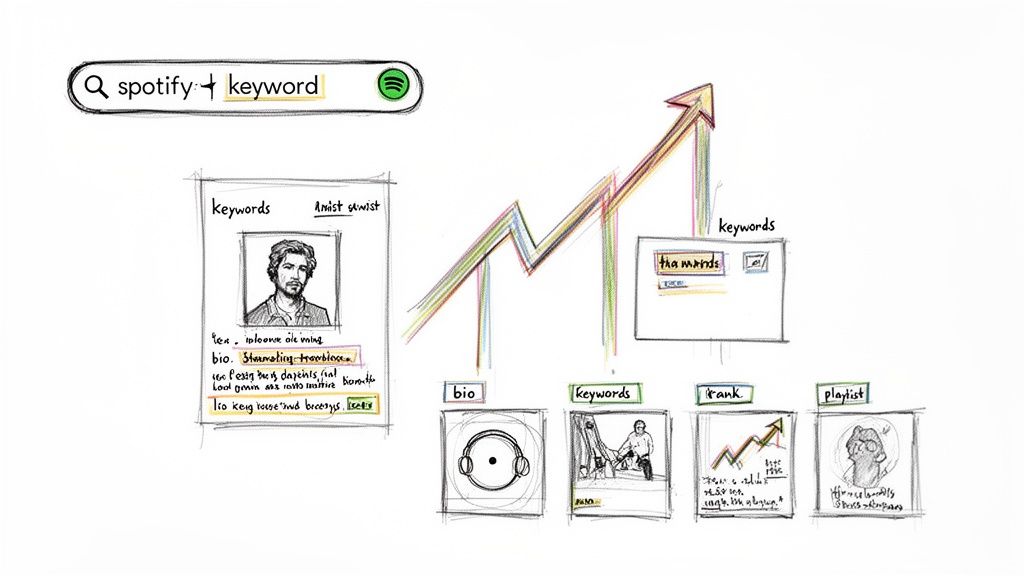
This isn't about trying to game the system. It's about understanding how it works. Spotify's algorithm has one job: connect listeners with music they’ll fall in love with. Your job is to feed it the right signals so it knows exactly who you are, what your music sounds like, and who needs to hear it.
Think of keywords as the language the algorithm speaks. When you strategically place the right ones in your profile and playlists, you’re basically giving Spotify a map that leads directly to your music.
Optimizing Your Artist Profile for Discovery
Your Spotify for Artists profile is your digital storefront. It needs to be search-friendly. A huge mistake I see all the time is artists writing a creative but totally vague bio. It’s a massive missed opportunity for SEO.
Instead of just telling your life story, weave in the keywords that actually describe your sound, your genre, and your mood. If you make dreamy indie pop that sounds like The 1975 meeting Tame Impala, then those names and genres need to be in your bio. You have to use the terms that real listeners are already searching for.
Your artist bio isn't just for fans; it's for the algorithm. A well-optimized bio rich with relevant keywords can directly influence how often you appear in search results and algorithmic playlists like Radio and Discover Weekly.
Here's a quick checklist to get your profile in shape:
Artist Bio: Don't be vague. Include your primary genre, any sub-genres, moods, and at least 2-3 similar artists.
Artist's Pick: This should never be stale. Keep it updated with your latest single or a track you want to push. Add some context to pull fans in.
Images: First impressions matter. Use high-quality, professional images that match your brand. It’s not a direct SEO factor, but it absolutely impacts whether someone sticks around.
Making these small tweaks signals to Spotify that your profile is active and relevant. It's a subtle push, but it can give you a meaningful boost in visibility.
Turning Your Playlists into Discovery Engines
Creating your own playlists is one of the most underrated promo strategies out there. Seriously. It lets you control the narrative, support other artists in your scene, and build a powerful SEO asset that drives listeners right to your tracks. The trick is to treat your playlist like its own product.
Give your playlist a descriptive, keyword-rich title. A title like "Late Night Lofi Beats for Studying & Chill" is going to crush "John's Cool Tracks" every time. Why? Because the first one targets a specific activity and mood that people are actually searching for.
The playlist description is just as important. Use that space to expand on the vibe and pack in more related keywords. Mention a few of the artists featured (including yourself!) and describe the feeling the playlist is meant to create. For a deep dive on this, you can master Spotify playlist SEO with our complete guide and learn the exact steps to boost followers today.
Tracking Your SEO Performance
Optimizing without measuring is just guessing. How do you know if your keywords are doing anything? This is where tracking your playlist's search ranking becomes critical. You need to see where your playlist shows up in Spotify search results for your target keywords in different countries.
For instance, your "Late Night Lofi" playlist might be ranking in the top 10 for that search in the US but be completely invisible in Germany. That data tells you where your SEO is hitting and where you need to adjust your strategy. Monitoring these trends helps you tap into what listeners are doing and refine your keywords to stay ahead of the curve.
By strategically building and optimizing playlists, you're not just crossing your fingers for discovery—you're engineering it. You’re creating a valuable resource for listeners that also happens to be a constant, organic promotion engine for your own music.
Expanding Your Reach Beyond Spotify
Look, getting your Spotify game on point is absolutely essential, but you can't stop there. The biggest mistake I see artists make is treating Spotify like an island. The truth is, the most explosive campaigns build a web across multiple platforms, creating an entire ecosystem that constantly pulls new listeners back to your music.
Think of it as building bridges. Your social media, blog features, and ads aren't just separate to-do list items; they're interconnected gears. Each piece works together to create the kind of buzz that translates into real, lasting stream growth. You have to meet fans where they already live.
Build an Authentic Community with Video
Let's be blunt: short-form video is no longer optional. Platforms like TikTok and Instagram Reels are pure discovery gold. A single 15-second clip can literally introduce your music to millions of people overnight. The trick is to stop thinking like a musician and start thinking like a creator.
Your goal isn't just to slap a snippet of your song online. It's about forging a genuine connection that makes people curious enough to actually go find you.
Show the Process: Pull back the curtain. Share the messy, unfiltered creative journey—the mistakes, the late nights, the breakthrough moments. People connect with the story, not just the glossy final product.
Tell a Story: What’s the real meaning behind your lyrics? Create a short video that brings that narrative to life. It makes the song hit so much harder.
Jump on Trends (Your Way): Don't be afraid to use trending sounds or formats, but always put your own unique artistic stamp on them. This shows you're in the loop while still showcasing what makes you, you.
And for the love of all things holy, your call-to-action is everything. Make it stupidly simple for people to take the next step. A clear "Song link in bio" or using the platform's built-in music sticker is often all it takes to turn a passive viewer into a dedicated Spotify listener.
Master Modern Music PR
Getting your music featured on blogs and online zines is still one of the most powerful forms of social proof you can get. A great review is a third-party stamp of approval, telling the world your music is worth their time. But the old-school method of blasting out a generic press release? Dead. Buried.
Your pitch has to be personal, targeted, and offer real value. Stop asking, "Can you feature my music?" and start framing it as, "I have a story your readers will absolutely love." See the difference? It shifts the focus from what you want to what you can give their audience.
Do your homework. Find the blogs and influencers who live and breathe your specific niche. If you make dark synthwave, trying to get a premiere on a massive indie-pop blog is a waste of everyone's time. A feature on a smaller, dedicated synthwave blog, however, puts you directly in front of an audience that's already wired to love what you do. Read their past coverage and tailor your pitch to prove you actually get it.
Run Smart, Targeted Ad Campaigns
Paid ads can feel like a black box, but they're one of the most direct ways to find your perfect listener. Platforms like Meta (Facebook and Instagram) let you get incredibly granular with targeting, putting your music right in front of people who are already fans of artists just like you.
Start small. You don't need a huge budget—even $5-$10 per day can give you a ton of valuable data. The goal of your first few campaigns isn't to go viral; it's to learn.
A great starting point is to create a "lookalike audience" based on your existing Instagram followers or people who've engaged with your posts. This tells the platform to find new users with similar tastes and online habits. From there, run a simple video ad showing off the most potent 15-30 seconds of your song and send that traffic straight to your Spotify profile. This razor-focused approach ensures your ad dollars are reaching the people most likely to become actual listeners, driving real streams instead of just empty clicks.
Keeping Score and Protecting Your Music
Pushing your music out into the world is only half the battle. If you're not measuring the results, you're essentially flying blind. It's like shouting into the wind—you have no idea who heard you or how far your voice traveled. To build a career that lasts, you have to connect your promotion to real, tangible results while also protecting the streams you fought so hard to get.
This is about looking past the vanity metrics. Sure, a big spike in streams feels good, but knowing why it happened is where the real power lies. Was it that blog feature? A specific playlist placement? When you track your data closely, you can see what's actually working. That lets you double down on the winning strategies and cut the ones that are just wasting your time and money.
Spotting and Dodging Stream Fraud
Unfortunately, where there's streaming, there's stream fraud. Getting caught up in botted playlists—even by accident—can have disastrous consequences. We're talking about having your tracks pulled from Spotify or even getting your artist account flagged. A huge part of protecting your music is learning to spot the red flags of fake engagement before they can do any damage.
One of the most obvious signs is a playlist with a massive follower count but suspiciously low activity. If a playlist boasts 50,000 followers but the tracks on it are barely getting any plays, something's not right. Real playlists are built on active, engaged listeners who generate consistent streams.
You can actually use specialized tools to check out a playlist's health before you even think about pitching to it. Take a look at this screenshot from a bot detection tool analyzing a playlist's follower history.
Those sharp, unnatural spikes in followers are a dead giveaway of artificial inflation. Legitimate playlists grow organically over time, not in giant, overnight leaps. If you want to go deeper on this, it's worth your time to learn about uncovering fake Spotify streams to protect your music and keep your artist profile safe.
Turning Your Streams Into a Real Career
Beyond just protecting your music, your data is the key to planning your future. Getting a handle on your numbers is the first step to building a legitimate business around your art. The financial reality for independent artists in 2025 is pretty stark: 77.8% of indie artists earned less than $15,000 from their music last year, and for 63% of them, streaming royalties were their main source of income. It's tough out there—on Spotify, 67% of artists have fewer than 1,000 monthly listeners, making it a real challenge to turn that exposure into actual earnings. You can read the full report about these music industry findings to see the complete picture.
This data isn't here to discourage you—it's here to arm you with knowledge. Understanding the financial landscape is what allows you to set realistic, achievable goals for your own music promotion.
This is exactly where a tool like a royalties calculator becomes so important. By plugging in your current stream counts and projecting your growth, you can start forecasting what you might actually earn. This turns abstract stream numbers into concrete financial data. Suddenly, you can budget for your next release, plan a small tour, or decide when it’s the right time to invest in a bigger marketing push. It’s all about making smart, strategic decisions that turn your passion into a profession—one measured and protected stream at a time.
Common Questions About Promoting Your Music
Let's tackle a couple of the most common questions I hear from independent artists.
First up: how much should a real promotional campaign actually cost? This is the big one, right? The honest answer is there's no magic number. A budget can be anything from a few hundred bucks for a super-targeted ad campaign to several thousand for a full-blown PR push.
If you're just starting out, a good benchmark is to set aside $200-$500 for your first single. This gives you enough runway to test the waters with some smaller playlist pitching efforts and run a few social media ads to see what sticks.
The other big question is about timing. When should you even start promoting a new song? My advice is to start planning at least four to six weeks before your release date. This isn't just arbitrary; it gives you the necessary breathing room to properly pitch your track to Spotify's editorial team and start building relationships with independent playlist curators and bloggers without being in a last-minute panic.
How Long Does It Take to See Real Results?
This is where you need to be patient. Sure, a big playlist placement can give you an immediate spike in streams, which is always exciting. But building a genuine, sustainable fanbase? That’s a slow burn.
True, organic growth isn't about one viral moment. It's the result of consistent, strategic effort over many months. Focus on steady progress, not overnight success.
You should expect to see meaningful traction after you've been consistently promoting your music for three to six months. This timeframe is crucial because it allows you to build real relationships, dial in your audience targeting, and let the algorithms start to work in your favor.
Remember, every small win—every playlist add, every new follower, every blog mention—compounds over time. You're laying the foundation for a long-term career. It’s a marathon, not a sprint.
Ready to stop guessing and start making data-driven decisions? artist.tools gives you the insights you need to find the right playlists, sniff out bots, and actually track your growth. Make smarter moves for your music career at https://artist.tools.
.png)
.png)
Comments