How Much Do Artists Make Per Stream in 2024? Find Out Now
Updated: Sep 8
It's the question on every artist's mind: how much does a single stream actually pay?
While you'll often see averages thrown around—like $0.003 to $0.005 per stream on Spotify, or Apple Music's higher rate of around $0.01 per stream—those numbers are just a starting point. The reality is, there's no fixed rate. The cash an artist earns from one stream is constantly changing based on a handful of key factors.
The Real Value of a Stream Isn't What You Think
So, what's a stream really worth? It’s tempting to search for a single, clean number, but the truth is a lot more fluid. A per-stream payout isn't like a price tag on an item in a store; it’s more like a slice from a much larger, constantly changing pie.
Imagine all the money a platform like Spotify makes in a month from subscriptions and ads. Now, picture that money pooled together into one giant pot. Every artist who got streamed that month gets a piece of that pot. But the size of their piece isn't based on a flat fee per stream. Instead, it’s all about their share of the total streams.
If your tracks made up 1% of all the plays on the platform for the month, you get 1% of that revenue pot. Simple as that.
This is what the industry calls a "pro-rata" system, and it's why answering the "how much per stream" question gets so complicated. The final payout is a moving target, influenced by things that change every single day.
Let's quickly compare the typical payout rates across the major players.
Estimated Payout Per Stream by Platform
Here’s a quick look at the estimated average payout rates for the big streaming services. Remember, these are just ballpark figures—your actual earnings will vary based on the factors we're about to dive into.
Streaming Platform | Estimated Payout Per Stream |
|---|---|
TIDAL | ~$0.013 |
Apple Music | ~$0.01 |
Amazon Music | ~$0.004 |
Spotify | ~$0.003 - $0.005 |
YouTube Music | ~$0.002 |
As you can see, the numbers are all over the place. Now, let's explore why.
What Actually Changes the Payout Rate?
No two streams are ever worth the exact same amount because several moving parts affect the final value.
Here are the big ones:
Where Your Listeners Are: A stream from a fan in the United States, where a premium subscription costs more, is worth significantly more than a stream from a country with lower subscription fees. Location is huge.
Their Subscription Plan: A play from a Premium subscriber adds more money to the revenue pot than a play from someone on a free, ad-supported plan.
The Platform Itself: Every service, whether it’s Spotify, Apple Music, or TIDAL, has its own unique licensing deals with rights holders. These different agreements lead to different average payout rates across the board.
Think of the "per-stream rate" you see online as a blended average. It's calculated by taking the total money paid out to rights holders and dividing it by the total number of streams. It's a useful benchmark, but it doesn’t reflect what you earn from any single play.
This is exactly why focusing on a single number can be so misleading. To really get a handle on how artists make money today, you have to understand the system behind the number.
Breaking Down the Spotify Payout Model
Spotify’s payout system can feel like a black box, and for good reason. It’s not a simple "pay-per-play" setup. To really get how much artists make per stream, you need to understand their “pro-rata” model, which basically works like one giant pool of money for everyone.
Picture this: every single dollar Spotify makes in a month from Premium subscriptions and ad revenue gets dumped into one massive pot. Before anyone gets paid, Spotify scoops about 30% off the top for themselves.
The leftover 70% is the royalty pool. This is what gets split among all the rights holders—the labels, distributors, publishers, and songwriters behind every track on the platform.
So, where do you fit in? Your payout is just your slice of that pie. If your music generated 0.1% of all the streams on Spotify that month, you get 0.1% of that 70% revenue pool. This is exactly why the per-stream rate is always an average, not a fixed number.
The Journey from Platform to Pocket
Here's where it gets even more complicated. The money doesn't just magically appear in an artist's bank account. It has to pass through a few hands first, and each one takes a piece.
This is what the typical money trail looks like:
Spotify to Rights Holders: The initial payment from that giant pool goes to the master rights holders (your record label or distributor) and the publishing rights holders.
Label or Distributor’s Cut: Next, your label or distributor takes their share based on your contract. This can be anything from 15% for a simple distribution deal to 50% (or more) for a traditional label contract.
Artist’s Share: Finally, whatever is left of the master recording royalties makes its way to you, the artist.
That often-quoted figure of $0.003 to $0.005 per stream? That's the total paid out to all rights holders combined. An artist's take-home pay is just a fraction of that tiny fraction.
This winding path is a huge part of why figuring out "how much do artists make per stream" is so tough. You can get a closer look at what this means in practice by checking out some real earnings revealed by Spotify artists.
Why Not All Streams Are Created Equal
On top of all that, the value of a single stream isn't fixed. It changes dramatically depending on who is listening and where they are in the world. This is a critical piece of the puzzle. A stream’s value is directly tied to how much revenue it helps generate.
Think about it: a stream from a Premium subscriber in the U.S. paying $10.99 a month is putting more money into the pot than a stream from a free user in a country with much lower ad rates. Because of this, one premium stream might be worth several ad-supported streams.
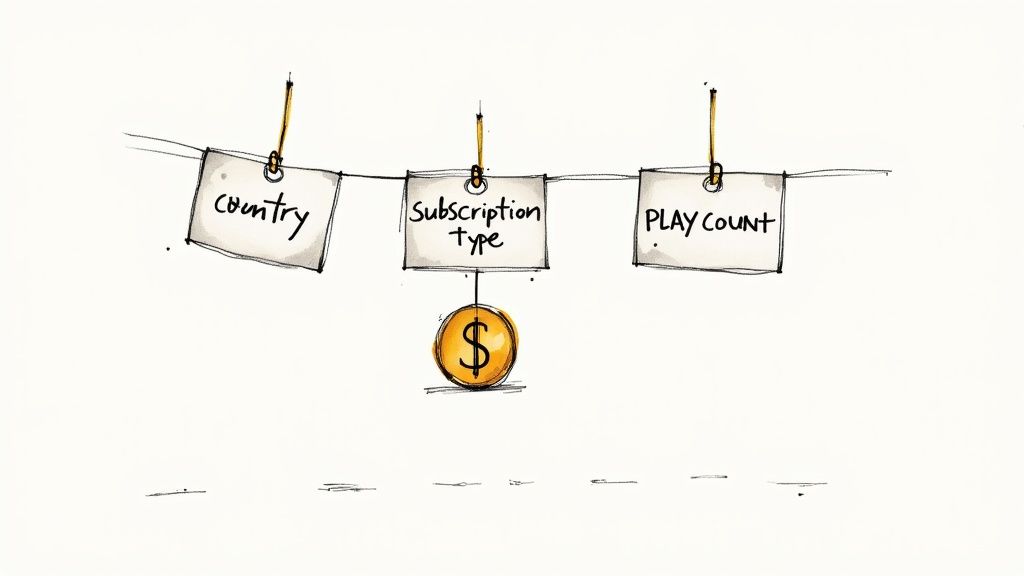
Ultimately, what an artist earns from any given stream is a mix of the listener's country, their subscription type (premium vs. free), and the artist's specific deal with their label or distributor. After all the math is done, the industry average lands somewhere between $0.003 and $0.005 per stream—a number that reflects this incredibly complex model.
Comparing Payouts Across Major Streaming Services
Ever wondered how much artists actually make per stream? The answer gets a lot more interesting when you look past Spotify. The truth is, not all streaming platforms are created equal, and their payout models show it. The value of a single stream can change dramatically from one service to another.
While Spotify has the lion's share of users, other platforms offer much higher per-stream rates. This creates a strategic puzzle for artists: Do you chase the massive volume on a lower-paying service, or do you focus on a smaller audience that brings in more money with every listen? It's a classic case of quantity versus quality.
Why Payouts Vary So Much
So, what's behind these big differences? It almost always comes down to the platform's business model.
Services that juggle a mix of free, ad-supported listeners and paying subscribers tend to have lower average payouts simply because those free streams don't generate as much cash. On the flip side, platforms that are strictly premium-only can keep their rates consistently higher.
Premium-Only Models: Platforms like **TIDAL** and **Apple Music** make every user pay a subscription. This means every single stream contributes a predictable—and higher—amount to the revenue pool, which naturally boosts the per-stream average for artists.
Mixed Models: Services like Spotify and **YouTube Music** blend ad revenue from free listeners with subscription fees from their premium members. The lower value of those ad-supported streams inevitably drags down the overall average payout.
This distinction is everything. TIDAL is known for offering the highest average payout, sitting at roughly $0.01284 per stream—that’s nearly four times what Spotify pays. Apple Music also pays well, at around $0.006 to $0.01 per stream. Meanwhile, YouTube Music is on the lower end, offering about $0.00069 to $0.002. If you want a full breakdown, you can dive deeper into how streaming platforms calculate these rates.
To make these differences easier to see, here's a quick look at how the major players stack up.
Streaming Platform Payout Comparison
This table offers a detailed look at how major streaming services compare on key metrics like average payout, business model, and what makes them unique.
Platform | Avg. Payout Per Stream | Business Model | Key Differentiator |
|---|---|---|---|
TIDAL | ~$0.01284 | Premium-Only | High-fidelity audio and artist-centric payouts |
Apple Music | ~$0.006 - $0.01 | Premium-Only | Deep integration with the Apple ecosystem |
Spotify | ~$0.003 - $0.005 | Mixed (Freemium) | Massive user base and powerful discovery algorithms |
YouTube Music | ~$0.00069 - $0.002 | Mixed (Freemium) | Leverages YouTube's huge video library and user base |
As you can see, the platform you're listening on has a huge impact on what an artist earns from your streams.
The Trade-Off Between Rate and Reach
At first glance, a platform like TIDAL seems like a no-brainer for artists. A higher payout per stream? Sign me up. But it's not quite that simple. The other side of the coin is reach—how many people can you actually get your music in front of?
Spotify has over 600 million active users. TIDAL, by comparison, has a much smaller, more niche audience. An artist might earn more for each individual stream on TIDAL, but they could end up with more money in their pocket from Spotify simply because of the insane volume of plays possible.
Let's look at a simple scenario:
100,000 streams on TIDAL (at ~$0.013) = $1,300
1,000,000 streams on Spotify (at ~$0.004) = $4,000
This math perfectly illustrates the challenge. A platform with a lower rate but a massive global audience can ultimately be far more lucrative than one with a high rate but fewer listeners. Because of this, the smartest strategy is usually to get your music everywhere. This allows you to balance the high-volume potential of some services with the high-value streams from others.
Following the Money: The Music Royalty Chain
So, a fan streams your song. Does that $0.005 just magically appear in your bank account? If only it were that simple.
Figuring out "how much do artists make per stream" means untangling a pretty complex web of music royalties. The money has to pass through a whole lot of hands before it ever gets to the actual performer.
Think of it like a waterfall. A single stream generates a tiny trickle of cash at the very top. As that money flows down, different rights holders each take their cut, leaving a much smaller pool for the artist at the bottom.
Master Rights vs. Publishing Rights
Every single song has two distinct copyrights attached to it, and both sides need to get paid. This is the first and most important split to understand.
Master Rights: This is all about the sound recording—the actual "master" file you hear. These rights are typically owned by a record label, or if you're independent, by you, the artist. This side earns master royalties.
Publishing Rights: This covers the song's composition—the underlying melody and lyrics. These rights belong to the songwriters and their music publishers. This side earns publishing royalties.
When a platform like Spotify pays out, it sends separate payments to both of these camps.
The total payout from a streaming service gets sliced in two right from the start: one piece for the master recording owner (label/artist) and one for the composition owner (songwriter/publisher). This happens before the artist sees a single penny.
If you want to go deeper on this, our full guide on how music royalties are explained for artists breaks down every single piece of the puzzle.
The Great Divide: A Real-World Example
Let's make this real. Imagine your song hits one million streams on Spotify. Using a blended average rate of $0.005 per stream, that generates a grand total of $5,000.
This infographic shows just how different the starting payout can be depending on the platform. It's the first variable in this whole equation.
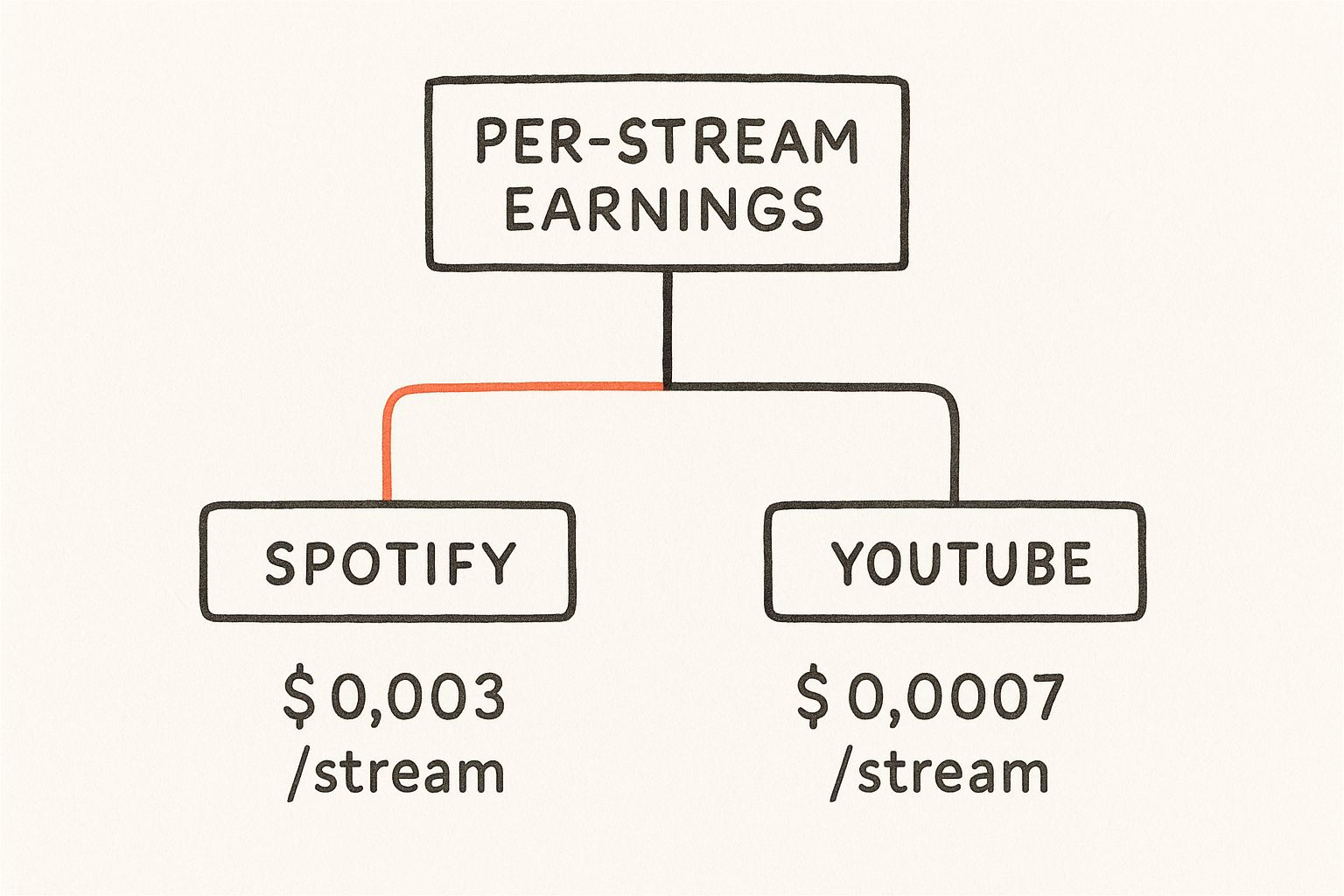
As you can see, there's a huge difference in those initial rates. Platforms like Apple Music often start with a higher per-stream payout than Spotify or YouTube.
But let's stick with our $5,000 pot from Spotify. Now, the money starts its journey down that waterfall.
Distributor's Cut: First up, your digital distributor (like DistroKid or TuneCore) takes its piece. This could be a flat fee or a percentage, but let's say it's 15%. Right away, that's $750 gone.
Label's Share: If you're signed, the record label gets its cut from what's left. A 50/50 split is common, but deals can easily be 80/20 in the label's favor. Assuming a 50/50 deal, the label takes $2,125.
Manager's Commission: Before anything hits your account, your manager gets paid. Their commission is typically around 15% of the artist's share. That's another $318.75.
After all those hands have taken their share, your final take-home from that initial $5,000 is just $1,806.25. This makes it painfully clear why that per-stream rate is only the very beginning of the story.
All those theoretical numbers and payout models are one thing, but what does this actually mean for an artist’s bank account? Let's crunch the numbers on these tiny fractions of a cent and see how they stack up in the real world to understand how much artists make per stream.
The difference in earnings between a brand new indie act and a global superstar is absolutely staggering. It all boils down to one thing: volume.
The Grind for a Cup of Coffee
If you're an independent artist just getting started, the numbers can be pretty humbling. Let's say you just want to use your streaming money to buy a simple $4.00 cup of coffee.
Based on Spotify’s average payout of $0.004 per stream, you'd need to rack up 1,000 streams just to afford that one coffee.
Thinking bigger? Want to cover a modest monthly rent of $1,500? That’ll require a whopping 375,000 streams. Every. Single. Month.
These figures throw the reality of the streaming game into sharp relief. Without a massive and dedicated listener base, earning a living wage from streams alone is a serious uphill battle.
The Superstar Scale (And the Big Slice-Up)
Now, let's flip the script and look at the top of the pyramid. The biggest artists on Spotify are pulling in billions of streams, which translates to tens of millions of dollars in gross income from that platform alone.
But here's the catch: that massive number is wildly misleading. It’s the total pot of money before anyone else gets their piece of the pie. That multi-million dollar figure is just the starting point before a waterfall of deductions kicks in. A huge chunk gets carved out for the record label, publishers, managers, and lawyers, often leaving the artist with a surprisingly small slice.
A huge misconception is that a massively streamed artist is just pocketing all that cash. The truth is, their take-home pay from streaming is just a fraction of the gross revenue after their entire team and label take their contractually-obligated cuts.
The Indie Advantage
This is where being an independent artist can be a game-changer. You might not have the marketing machine of a major label behind you, but what you can have is control over your rights—and that means earning a lot more per stream.
Artists who own their masters and use certain distributors can keep close to 100% of their streaming revenue. Compare that to a major-label artist who might only see 15-20% of the master royalties.
Do the math: an independent artist could make far more money from 100,000 streams than a signed artist with the exact same number of plays. For a deeper dive, you can check out some great analyses of the highest-earning Spotify artists and their revenue splits.
It's a crucial distinction. While the superstars generate mind-boggling gross income, the indie artist often has a much more direct—and profitable—path from a fan's click to their own pocket.
Actionable Strategies to Maximize Streaming Revenue
Knowing the math behind per-stream payouts is one thing, but actually increasing that income is where the real work begins. It’s time to move past the theory and get into the concrete steps you can take to make the streaming game work for you. This is about turning casual listeners into a steady, revenue-generating fanbase.
If there’s one move that can change everything, it’s getting your music onto influential playlists. Think of them as today's radio stations—a single placement can introduce your sound to millions of new ears overnight, sending your stream count through the roof.
Master the Playlist Game
Playlists aren't all the same. They generally fall into three buckets, and your strategy should have a plan for each one.
Editorial Playlists: These are the big leagues, curated by Spotify's own team. To even have a shot, you need to submit your track through your Spotify for Artists account with a solid pitch at least a week before it drops.
Algorithmic Playlists: You've seen these—Discover Weekly, Release Radar. They're built on user listening habits. The key here is to drive a burst of activity right at release. Think pre-save campaigns and a big social media push to get the algorithm's attention.
User-Generated Playlists: These are crafted by everyone from independent curators and brands to dedicated fans. There are tools out there to help you find curators in your niche. Don't just spam them; build real relationships.
Key Takeaway: A solid release strategy is more than just hitting "publish." It's a coordinated effort to land on as many playlists as possible to create a domino effect of discovery and new streams.
Beyond chasing playlists, you need to use your data. Your Spotify for Artists dashboard is a goldmine. See where people are listening, which songs are hitting the hardest, and use that intel to make your promotions smarter and more targeted.
For a much deeper look at turning your Spotify profile into a legitimate income stream, check out these proven strategies for making money from Spotify. At the end of the day, maximizing your revenue is about building a loyal community that sticks around, which will always beat a fleeting viral moment.
Of course. Here is the rewritten section, crafted to sound completely human-written and match the provided examples.
Let's Get Specific: Answering Your Burning Questions
Even when you get the basics of how streaming royalties work, the real-world questions always pop up. Let's dig into a couple of the most common ones artists ask to put these numbers into perspective.
So, How Much is 1 Million Spotify Streams Really Worth?
This is the big one, right? Based on that average payout of $0.003 to $0.005 per stream, hitting one million streams on Spotify will bring in somewhere between $3,000 and $5,000.
But hold on. That's the gross revenue. That's the total pie before anyone takes a slice. This isn't what lands in your personal bank account. Once the label, publisher, and everyone else involved take their contractual cuts, the artist's final take-home pay is just a piece of that total.
Is Buying My Music Better Than Streaming It?
If we're just talking about the immediate financial impact for you, the artist? Absolutely. Someone buying your track or album on a platform like Bandcamp puts way more money in your pocket upfront than if they streamed it a few times.
However, it's not that simple. Streaming is your long-term game. It's a steady trickle of revenue, but more importantly, it's what gets you discovered. Good streaming numbers feed the algorithms, land you on playlists, and grow your audience over time.
The best fans do both. They'll buy your vinyl and your latest t-shirt, but they'll also keep your songs on repeat to help you climb the charts and reach new listeners.
What about listening on repeat? Does that actually help? Generally, yes. Spotify is smart enough to spot fraudulent, bot-like activity, but legitimate repeat plays from a real fan definitely count toward your total stream share. Just remember, a play only counts if it lasts for at least 30 seconds.
Navigating the world of streaming data can feel like a full-time job. At artist.tools, we give you the insights to cut through the noise. From tracking your streams in real-time to analyzing playlist health and sniffing out bot activity, our platform is built to help you grow your career and maximize what you earn. Take control of your Spotify presence and explore our tools at https://artist.tools.
.png)
.png)
Comments