
How to Get on a Playlist on Spotify in 2026
Learn how to get on a playlist on Spotify with data-driven strategies for editorial pitches, curator outreach, and avoiding fake streams. Your guide for 2026.
Securing a spot on a Spotify playlist requires a methodical approach to three distinct systems: Algorithmic, Editorial, and Independent playlists. An effective strategy does not rely on chance; it involves understanding how each system operates and providing the specific inputs needed to trigger a placement. Success in one area often fuels momentum in the others, creating a compounding effect on an artist’s growth.
A placement on a playlist is not the end goal, but a catalyst for listener engagement and data generation. The most successful artists leverage these placements to build sustainable careers, not just to achieve a temporary spike in streams.
The Three Types of Spotify Playlists
The Spotify playlist ecosystem is a tripartite structure, and artists must engage with all three components simultaneously. Algorithmic, editorial, and independent playlists serve different functions but are interconnected. A placement on an influential independent playlist can generate the listener data required to trigger algorithmic playlists, which in turn can capture the attention of Spotify’s editorial team.
This table outlines the fundamental differences between each playlist type.
Spotify Playlist Types at a Glance
| Playlist Type | Curator | Placement Method | Primary Impact |
|---|---|---|---|
| Algorithmic | Spotify’s AI | Data-driven (saves, shares, listener habits) | Long-term fan discovery and personalized reach |
| Editorial | Spotify’s internal team | Official pitch in Spotify for Artists | Massive, immediate exposure and industry validation |
| Independent | Users (bloggers, brands, fans) | Direct outreach and networking | Building initial buzz and signaling to the algorithm |
Mastering the distinct strategy for each of these playlist types is essential for navigating the platform.
Algorithmic Playlists
Algorithmic playlists, such as Discover Weekly and Release Radar, are generated by Spotify’s AI for each individual user. Placement on these playlists is not available through direct pitching; it is earned exclusively through positive listener engagement signals. When a user saves a track, adds it to their personal playlist, shares it, or listens to it repeatedly, they are providing a direct data signal to Spotify that the song has value.
Artists can directly influence their chances of algorithmic placement through specific actions. The primary objective upon a new release is to drive early listeners to save the track to their personal libraries, as this is the strongest positive signal. Maintaining a consistent release schedule signals to the algorithm that an artist is active and worthy of continued promotion. Finally, accurate metadata—including genre, sub-genre, and mood—is critical for the algorithm to correctly categorize the music and serve it to the appropriate audience. These playlists function as a personalized discovery engine, placing music in front of users who have demonstrated a preference for similar artists.
Editorial Playlists
Editorial playlists are curated by Spotify’s internal team of music experts and represent the most significant placement opportunities on the platform. Playlists like Today’s Top Hits, which has over 35 million followers, can fundamentally alter an artist’s career trajectory overnight. The sole method for securing a placement is by submitting an unreleased track through the official pitch tool within the Spotify for Artists dashboard. This submission must be made at least seven days prior to the release date, with no exceptions.
Spotify editors review thousands of pitches weekly. A successful pitch must be concise and compelling, detailing specific marketing plans, confirmed press coverage, and the unique story behind the track. This is an artist’s only direct communication channel with a human editor at Spotify and must be treated with professional gravity.
Independent Playlists
Independent playlists, created by users ranging from music bloggers to brands and individual fans, are a critical but often underestimated component of a release strategy. These user-generated playlists account for 36% of all listening time on Spotify, a figure more than double the combined impact of all of Spotify’s official playlists, according to analysis from Spotify analytics by Soundcharts.
The primary challenge is identifying authentic, high-performing playlists and locating the curators who manage them. This process requires rigorous diligence and data analysis. Platforms like artist.tools are specifically designed to filter millions of playlists, identifying those with genuine engagement and exposing fraudulent playlists that use bots, which can jeopardize an artist’s standing on the platform. Securing placements on these independent lists generates the initial stream velocity and engagement data that are prerequisite for triggering algorithmic consideration.
Build Your Foundation Before You Pitch
A major Spotify playlist placement begins not with a pitch, but with a meticulously prepared artist profile. Both Spotify’s algorithms and its human editors are tasked with sorting through a daily deluge of new music; a polished, professional profile acts as the first critical filter. A complete and professional artist presence signals to Spotify that you are a serious artist, making your music a safer bet for promotion.
The first step is verification through Spotify for Artists, which is a non-negotiable requirement. This provides the blue checkmark of authenticity and, more importantly, unlocks essential backend tools, including detailed analytics and the official editorial pitch tool—the only direct path to playlists like New Music Friday. Following verification, every section of the profile must be populated with high-quality assets, including high-resolution header and profile images that align with the artist’s brand. The artist bio must function as a concise elevator pitch, focusing on current momentum and what makes the music compelling now, not a detailed life story.
This flowchart illustrates the three pathways a song can take to achieve discovery on Spotify.
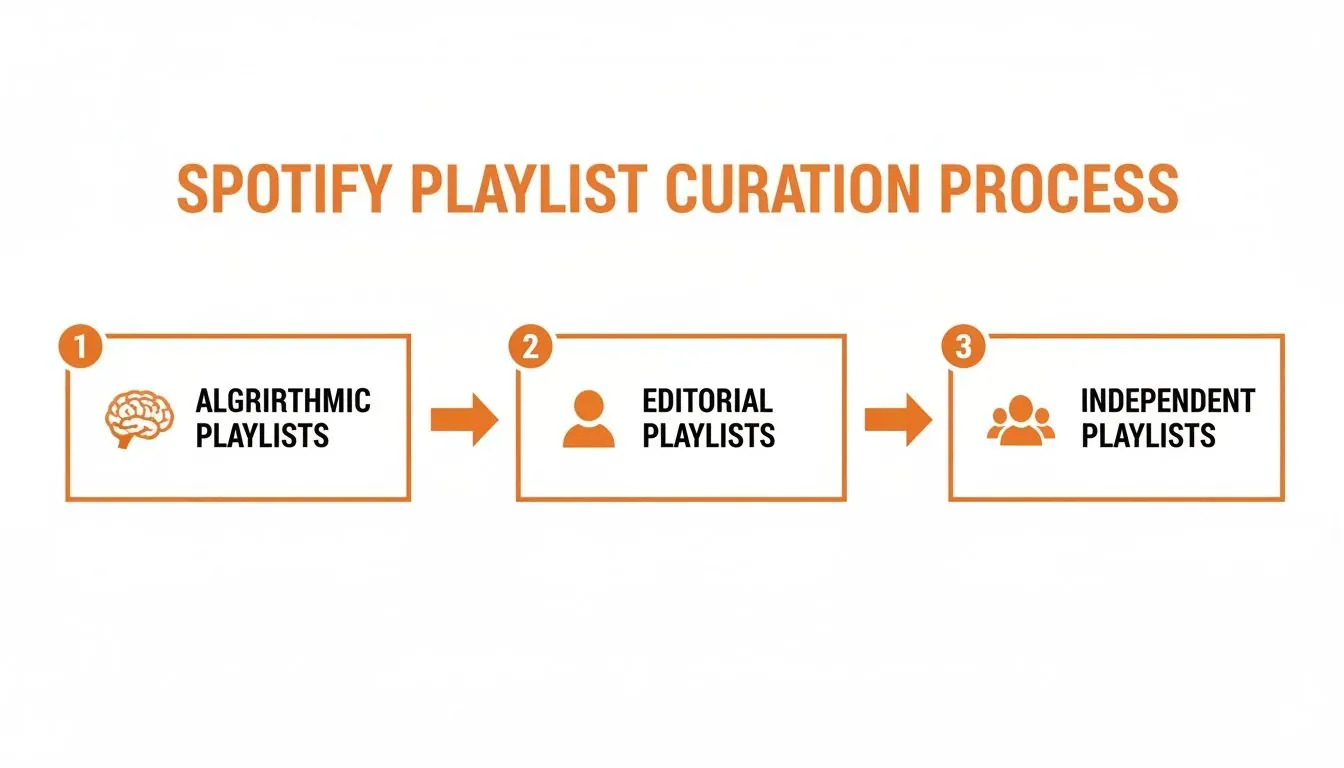
As the diagram shows, a successful playlisting strategy is not about choosing a single lane. It requires a coordinated effort to feed the algorithm with positive data signals, attract the attention of human editors, and cultivate relationships with independent curators simultaneously.
The Importance of a Pre-Release Strategy
A release day strategy that begins on release day is a failed strategy. To be eligible for editorial playlist consideration, a track must be uploaded via a distributor with a release date set at least four weeks in the future. This lead time is essential, as it allows the track to populate within the Spotify for Artists dashboard, making it available for the mandatory editorial pitch.
This pre-release window is the most critical phase for a song’s launch. It is during this period that all marketing and promotional efforts—social media campaigns, press outreach, and independent playlist pitching—must be coordinated to create a singular, powerful impact upon release. Failing to plan this far in advance eliminates the possibility of most official playlist placements before the song is even available to the public. Spotify’s official guideline requires pitching at least seven days before release, but this is the absolute minimum. Data from artists who consistently secure placements shows they are pitching three to four weeks in advance, giving editors adequate time to review submissions amidst the high volume they receive. A last-minute pitch signals that the release is an afterthought; a pitch detailing a well-orchestrated campaign demonstrates an artist’s commitment, making editors more likely to invest in the track’s success.
Nailing Your Track Metadata
The metadata attached to a song during the upload process is one of the most powerful and frequently overlooked tools for discovery. This data—including genre, sub-genre, mood, and instrumentation tags—is not merely descriptive; it is the primary mechanism by which Spotify’s algorithm understands what a song is and who it is intended for. Correctly applied metadata directly increases the probability of landing on algorithmic playlists like Discover Weekly and Release Radar.
Tagging a song as “Dream Pop” with a “melancholic” mood and “synth” instrumentation provides Spotify’s algorithm with a clear roadmap. It instructs the system to surface the track to users who already listen to and engage with similarly tagged artists. The metadata tags function as precise classifiers: genre and sub-genre connect the music to specific fan communities; moods and styles link it to listener activities and contexts (“workout,” “focus,” “sad”); and instrumentation tags like “acoustic” or “808” enable direct sonic comparisons. This process is not about chasing trends but about applying ruthlessly accurate labels to your own music. Artists unsure of how to classify their work can use a platform like artist.tools to research the tags used by comparable artists in their niche. Inaccurate or incomplete metadata renders even a great song invisible to the algorithm.
Mastering the Spotify Editorial Pitch
The 500-character pitch submitted via the Spotify for Artists dashboard is an artist’s sole direct opportunity to secure a placement on a career-defining editorial playlist like New Music Friday. This is a high-stakes submission with limited space, competing for an editor’s finite attention against thousands of other artists. Every character must serve a purpose, conveying the song’s story, outlining the marketing strategy, and providing evidence of existing momentum.

The pitch form itself is a blueprint of the data points Spotify’s editorial team values most. They request this specific information because it is what they use to filter and discover promising new tracks. An artist can only pitch one song per release, and the submission cannot be edited once sent, demanding a locked-in strategy before hitting submit. The selections for genre, mood, and style are arguably the most critical components, as they directly route the pitch to the relevant editorial teams. Tagging a song as “Indie” and “Chill” could place it on the radar for a playlist like Lorem, while “Hip-Hop” and “Confident” might direct it to the RapCaviar team. This classification must be precise and accurate.
The Ingredients of a Pitch That Works
A winning pitch preemptively answers three questions on an editor’s mind: What is this song about? Who is this artist? And why should I care right now? U.S. on-demand song streams surpassed 1.45 trillion in 2023, a 14.6% increase from the previous year (Luminate 2023 Year-End Music Report). In a market with this volume, a pitch must provide a data-backed reason for an editor to choose a specific track from the thousands submitted that week.
A pitch that consistently secures placements follows a clear structure. It begins with a single, potent sentence capturing the song’s narrative or unique sonic quality. It then provides concrete proof of marketing efforts, such as “Confirmed premiere with Complex on release day,” not a vague promise of “doing PR.” Finally, it includes context that builds confidence, such as, “Follow-up to our last single which achieved 100k streams,” providing an immediate benchmark of the artist’s trajectory. Understanding this structure is fundamental for anyone serious about learning how to get on a playlist on Spotify. For a more detailed breakdown, our complete guide to Spotify editorial playlists provides further analysis.
Using AI to Get an Edge
Crafting the perfect pitch within a 500-character limit is a significant challenge, leading many artists to leverage specialized tools for a competitive advantage. The artist.tools AI Editorial Pitch Generator, for instance, does more than generate text. It analyzes a track’s audio and the artist’s provided marketing details, then cross-references this information against a database of pitches that have historically secured major playlist placements.
This tool helps artists identify the most effective genre and mood tags for their specific sound, ensuring alignment with the correct target playlists. It then drafts a 500-character pitch optimized for an editor’s workflow, hitting the key points of story, marketing, and momentum. This data-driven approach removes guesswork from the process, ensuring the pitch is as powerful and effective as possible.
How to Find and Vet Independent Curators
Independent playlists represent the largest accessible pool of potential streams on Spotify, but the landscape is fraught with pay-for-play scams and bot-infested playlists that deliver zero real listeners and can endanger an artist’s account. A successful approach is methodical, using data to identify authentic curators and rigorously vetting every opportunity before outreach.
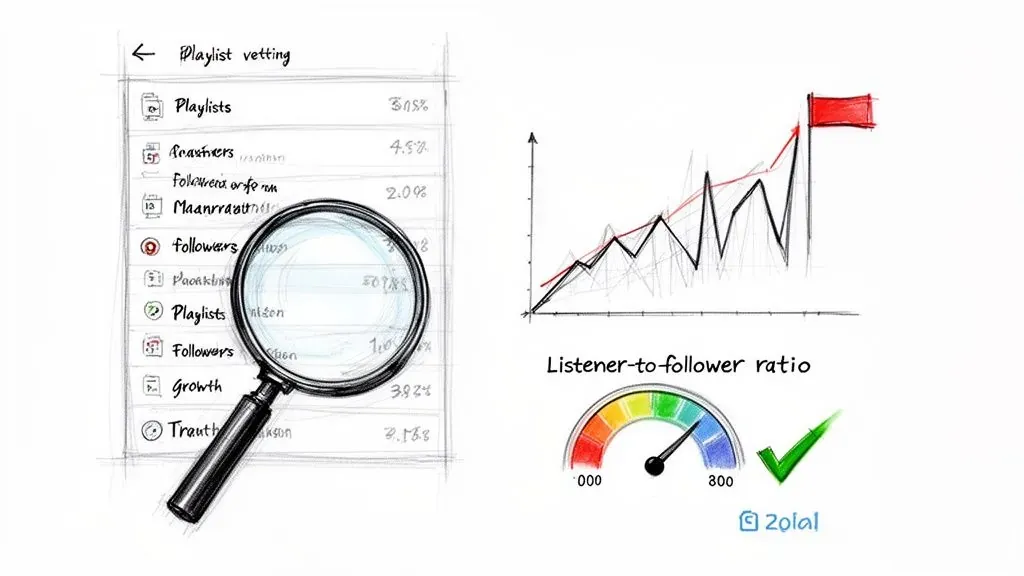
This process is not about mass-emailing anyone with “playlist” in their social media bio; it is a data-driven investigation to uncover playlists managed by real people with genuinely engaged audiences.
Discovering Playlist Opportunities
The discovery phase begins with broad searches before narrowing down to precise targets. Platforms like artist.tools contain databases of millions of playlists that can be filtered by keywords, genre, mood, and other criteria to create a list of potential targets. This initial search should use terms relevant to the track, such as “lo-fi beats,” “Midwest emo,” or activity-based moods like “rainy day” or “gym workout.”
A powerful secondary strategy is to research similar artists. By analyzing where artists with a comparable sound are sourcing their streams, an artist can identify playlists that are already proven to be effective for their specific niche. Examining the playlist placements of artists who are a few steps ahead provides a validated roadmap for growth.
The Critical Vetting Process
After compiling a list of potential playlists, the vetting process begins. It is imperative to never pitch a playlist without first verifying its health and authenticity. Submitting to a fraudulent playlist can result in a track being flagged by Spotify for artificial streaming, which can lead to its removal, or in severe cases, a ban of the artist’s profile. Tools like the artist.tools Playlist Analyzer are essential for this verification step. A major red flag is a playlist with a high follower count but a disproportionately low number of monthly listeners. A healthy, organically grown playlist typically has a monthly listener count that is 10-40% of its total followers; a ratio significantly below this range suggests the followers are either purchased or inactive.
To properly vet a playlist, several key metrics must be analyzed. The follower growth history should show a smooth, steady upward trend; sudden, massive spikes in followers are a classic indicator of bot activity. The listener-to-follower ratio provides a clear snapshot of engagement. An audience authenticity score, a proprietary metric offered by some platforms that estimates the percentage of real listeners, should be above 70%. Finally, the track addition and removal patterns should show consistent, thoughtful curation; playlists that add and drop hundreds of songs every few days are likely automated systems attempting to game platform metrics. Analyzing these data points together provides a definitive picture of a playlist’s legitimacy.
Finding Legitimate Curator Contacts
Once a playlist has been vetted and confirmed as authentic, the final step is to locate the curator’s contact information. Genuine curators open to submissions typically provide a method for contact. The first place to check is the playlist’s description on Spotify, which may contain an email address or a link to a social media profile or submission form. If no contact information is present, a research platform like the artist.tools Playlist Analyzer can often provide it by aggregating contact details associated with the playlist, including emails and links to personal websites or social media. This step alone can save hours of manual research. Our in-depth guide on how to find Spotify playlist curators covers this process in greater detail. The objective is to establish a direct line of communication with a person, as a personalized email to the right individual is far more effective than a submission to a generic portal.
Crafting Outreach That Gets a Response
Independent playlist curators receive an overwhelming volume of submissions daily. To penetrate this noise, outreach must be concise, personal, and direct. Generic, mass-emailed templates are the most common reason for a pitch to be ignored. A thoughtful, targeted pitch respects a curator’s time and significantly increases the probability of securing a listen.
The structure of the outreach message is paramount. It must deliver all essential information without any extraneous content, or “fluff.” Failure to do so will result in the email being deleted before the track is ever played. The primary goal is to make it as easy as possible for the curator to say “yes,” which means removing all friction. Do not attach audio files, link to private streams, or ask the curator to download anything. A direct, public Spotify link is the only acceptable format.
The Anatomy of an Effective Pitch Email
An effective outreach email consists of three distinct parts. It must open with a personal reference, mentioning the specific playlist by name and citing another track on it to demonstrate genuine familiarity. The core of the pitch should introduce the artist and track in a single compelling sentence, immediately followed by a clean Spotify link to the song. Finally, a clear justification must explain precisely why the track is a good fit for their specific playlist, connecting its genre, mood, or style to the curator’s established sound.
This direct, professional approach shows respect for the curator’s work and their time. On-demand song streams in the U.S. surpassed 1.45 trillion in 2023, a 14.6% year-over-year increase (Luminate, 2023 Year-End Music Report), meaning curators are more inundated than ever. A brief, personal pitch is a strategic necessity.
Personalization Is Not Optional
The most common and fatal mistake in playlist outreach is the failure to personalize. Curators can identify a copy-and-pasted template instantly, and such emails are immediately discarded. Personalization goes beyond simply using the curator’s name; it proves an understanding of their specific taste and the audience they have built.
Mentioning a specific song on their playlist, such as, “I’m a big fan of your ‘Midnight Drive’ playlist; the transition from the new Washed Out track into that classic Tycho song is brilliant,” instantly elevates the pitch from a cold request to a warm conversation between two music enthusiasts. Conversely, a long, self-indulgent artist biography is a waste of the curator’s time. The focus must remain entirely on them and their playlist, not on the artist.
A Practical Template for Success
This template incorporates the principles of effective outreach: it is concise, personal, and professional.
Subject Line: Submission for [Playlist Name]: [Your Artist Name] - [Your Song Title]
Body:
Hi [Curator Name],
My name is [Your Name], and I’m an artist from [Your City/Region]. I’m a huge fan of your playlist, “[Playlist Name],” and have had it on repeat lately. The inclusion of [Specific Song by Other Artist] is a perfect fit.
I just released a new track, “[Your Song Title],” that I believe would resonate with your listeners. It’s an [Adjective/Genre] track with [Brief Sonic Description] that shares a similar vibe to the songs you feature.
You can listen here: [Direct Spotify Song Link]
Thank you for your time and consideration.
Best,
[Your Name]
This format provides the curator with everything they need and nothing they do not. It is the most effective structure for crafting outreach that receives a response and a core skill for any artist learning how to get on a playlist on Spotify.
Turn a Playlist Add Into Long-Term Momentum
Securing a playlist placement is not the conclusion of a campaign; it is the beginning. A playlist add generates a stream of valuable data, offering direct insight into what resonates with listeners. This data is the key to informed decision-making for future releases and is how artists build sustainable careers rather than experiencing a single, fleeting moment of success.
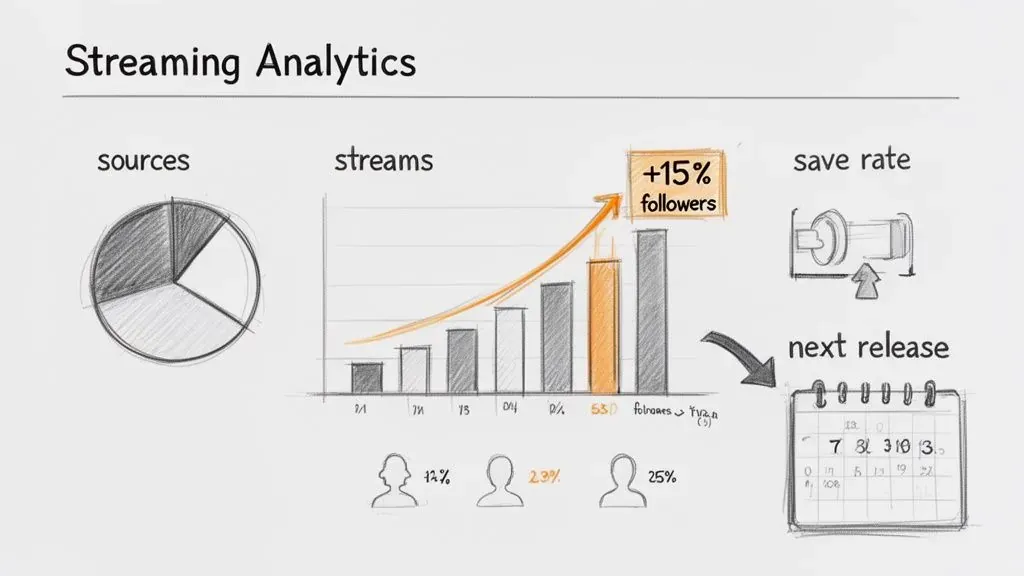
The Spotify for Artists dashboard is where this post-placement analysis occurs. It provides the raw data on how a playlist is impacting an artist’s music and audience growth. Artists who can interpret these metrics are positioned to build upon their success systematically.
What to Look For in Your Stats
Once a track is live on a playlist, the artist’s role shifts from pitching to analysis. Within the Spotify for Artists dashboard, under the “Music” tab, selecting a specific track and then clicking “Playlists” reveals exactly which playlists are driving streams and how listeners are reacting.
Three metrics are of primary importance:
- Streams: The total number of plays generated by a specific playlist.
- Listeners: The number of unique users who heard the track from that playlist.
- Saves: The number of listeners who added the song to their personal library. This is a critical metric, as it provides a powerful positive signal to Spotify’s algorithm.
A high save rate (the percentage of listeners who save a track) is one of the most valuable data points an artist can possess. It is concrete evidence that the music connects with an audience and serves as undeniable proof in future pitches to other curators.
Use Your Data as Your Ultimate Pitching Tool
The data collected from a successful placement becomes the foundation for the next campaign. Instead of making a hopeful request, an artist can now lead with empirical evidence. A pitch that states, “Our last placement on ‘Sad Indie Folk’ generated 50,000 streams and grew our followers by 15% in one month,” is exponentially more powerful than a generic email.
This data-driven approach allows artists to pitch from a position of strength, presenting a business case rather than asking for a favor. It demonstrates to curators that adding the artist’s music is not a risk but a strategic decision that can benefit their own playlist. For more granular, day-by-day insights, specialized tools like the artist.tools Stream Tracker and Monthly Listeners Tracker allow for precise monitoring of a playlist’s impact and historical trends. Analyzing this data is a core artist skill, and our guide on how to see your Spotify stats provides a comprehensive overview. This continuous monitoring also indicates when a track’s performance on a playlist begins to decline, signaling the optimal time to shift focus and resources to the next release.
Straight Talk on Spotify Playlisting
This section provides direct, factual answers to the most common questions artists have about Spotify playlisting.
Can You Pay to Get on a Spotify Playlist?
No. For any official Spotify editorial or algorithmic playlist, paying for placement is impossible. Any individual or service claiming to offer a spot on a major editorial playlist like RapCaviar or Today’s Top Hits for a fee is fraudulent.
Regarding independent playlists, paying a curator for placement is a practice known as payola and is a direct violation of Spotify’s terms of service. If detected, this can lead to severe penalties, including the removal of the track, withholding of royalties, or suspension of the artist’s account. The risk is not justifiable.
How Long Does It Take to Get on a Playlist?
The timeline depends on the playlist type. Independent curators may add a track within a few days of receiving a pitch.
Editorial playlists operate on a much longer timeline. To be eligible for consideration, a track must be pitched via the Spotify for Artists dashboard at least seven days prior to its release. However, the industry standard for artists who consistently secure these placements is a lead time of 3-4 weeks.
Algorithmic playlists like Discover Weekly are data-driven. A song may be added weeks or months after release, but only after it accumulates sufficient organic engagement signals, such as saves and shares.
What Happens If My Song Is Added to a Botted Playlist?
Placement on a playlist that uses bots to generate fraudulent streams is a significant risk. Spotify’s systems are designed to detect this artificial activity, and if a track is flagged, the consequences can be severe. These include the removal of the track, the withholding of all associated royalties, and, in the most extreme cases, the suspension of the artist’s entire profile. It is imperative to vet every playlist before pitching. Use a tool like the artist.tools Playlist Analyzer to check for red flags like suspicious follower growth patterns and other indicators of bot activity.
How Many Playlists Should I Pitch for Each Song?
There is no magic number; the focus must be on quality, not quantity. A scattergun approach of sending hundreds of generic emails is ineffective. Instead, for each release, identify and pitch 20-50 highly relevant and thoroughly vetted independent playlists. A single, well-researched, personalized pitch to a curator whose playlist is a perfect fit is more valuable than a hundred thoughtless, mass-blasted emails.
Ready to stop guessing and start using data to drive your playlisting strategy? artist.tools provides the industry’s most powerful suite of analytics for discovering, vetting, and pitching playlists that get real results. Find your next placement at https://artist.tools.