Money Per Stream Spotify: Decoding Payouts, Revenue, and Strategies
Updated: Sep 8
You’ve probably seen the numbers thrown around: the average money per stream on Spotify is somewhere between $0.003 and $0.005. But here’s the thing—that number isn’t a fixed price. It’s a moving target, an average pulled from a massive, constantly shifting pool of money.
Your real earnings come from a slice of that shared revenue pool, which makes figuring out the true value of a single stream feel like trying to hit a bullseye in the dark.
The Real Value of a Single Spotify Stream
If you've ever stared at your royalty statement completely baffled, you're in good company. Spotify doesn't just pay a flat rate every time someone hits play on your track. The whole system runs on a pro-rata model.
It’s a fancy term, but the concept is pretty simple. Think of it like a giant pizza representing all the money Spotify brought in from subscriptions and ads that month. Every artist on the platform is trying to get a piece of that pizza. Your job is to earn as big a slice as you can, but the size of that slice depends entirely on your share of the total streams across the entire platform.
This model is exactly why money per stream on Spotify feels so unpredictable. Your payout isn't just about how many streams you get; it’s about your streams relative to everyone else's, from Taylor Swift down to the brand-new band that just uploaded their first song.
Before we dive deeper, here's a quick rundown of how this all works.
Spotify Per-Stream Payout At a Glance
This table breaks down the core ideas behind Spotify's complex payment system into simple, easy-to-digest points.
Concept | Brief Explanation |
|---|---|
Pro-Rata System | All revenue is pooled, then paid out based on an artist's percentage of total streams. |
Variable Payout | There's no fixed rate per stream; it fluctuates monthly based on total revenue and streams. |
Listener Value | Streams from Premium subscribers in high-cost countries are worth more than ad-supported streams in lower-cost regions. |
Shared Revenue Pool | You're paid through Spotify from a collective pot, not by Spotify for individual plays. |
Understanding these basics is the first step to really grasping where your money is coming from.
Why Your Payout Rate Varies
So, what causes that per-stream rate to swing up and down? It boils down to a few key variables, but two factors have the biggest impact:
Listener's Subscription Type: A stream from a Spotify Premium user is worth a whole lot more than one from a free, ad-supported listener. That $10.99 monthly subscription fee adds way more to the "pizza" than the few cents generated from a single ad play.
Listener's Geographic Location: Where your listeners are matters. A stream from a country with high subscription costs, like Switzerland or Norway, contributes more to the revenue pool than a stream from a region where subscriptions are much cheaper. This means 1,000 streams from one country could easily earn you more than 1,000 streams from another.
The core concept to grasp is that you are not paid by Spotify for a stream. You are paid through Spotify from a collective pot of money contributed by listeners and advertisers. Your goal is to capture the biggest possible share of that pot.
The Declining Value of a Stream
This pro-rata system has historically created some tough hurdles for independent artists. While Spotify’s total revenue has shot up over the years, the sheer volume of music being uploaded has exploded right alongside it. This massive flood of content dilutes the value of each individual stream.
It’s simple math. The pizza is bigger, but it's being cut into infinitely smaller slices.
Data from ISRC.com shows this trend clearly. Back in 2018, the average payout was around $0.00540 per stream. By 2020, that figure had dropped to just $0.00307—a staggering 43% decline. It's a system that naturally funnels a huge portion of the revenue to mega-artists, leaving smaller acts fighting over the leftover fractions of a cent.
Here’s a look at how a royalty calculator can help you get a quick estimate of your potential earnings.
A tool like this is great for turning abstract stream counts into a more concrete financial forecast. Getting a handle on these foundational concepts of music royalties explained for artists is the absolute first step toward building a real, sustainable strategy on Spotify.
How Spotify Calculates Your Royalty Payments
To really get a handle on the money you make per stream, you need to forget the idea of a fixed rate. Instead, let's pull back the curtain on Spotify's payment engine: the pro-rata system. It might sound a little corporate, but the core idea is pretty simple—it’s all about shared revenue.
Spotify doesn't just pay you a set price every time someone listens to your song. First, they gather up all the money they've made into massive pools. Think of it like a giant pot for each country they operate in. Every month, all the cash from Premium subscriptions and ad revenue in that specific country gets dumped into that pot.
Your payment isn't for a single stream; it's your slice of that shared pot.
Your Share of the Pie
So, how big is your slice? Spotify figures that out by calculating your streamshare. This is just the percentage of total streams in a country that your music generated. If your songs made up 1% of all streams in the United States for May, you get 1% of the total U.S. revenue pot for that month.
That "per-stream rate" everyone obsesses over isn't some number Spotify pulls out of a hat. It's just the final number you get after a massive division problem: the total revenue pot divided by the total number of streams.
Think of it this way: Spotify isn't a record store buying your streams individually. It's more like a co-op. It collects all the money from customers and thendivvies it up among its members (artists and rights holders) based on how much everyone contributed.
This chart gives you a bird's-eye view of how the money flows from Spotify's giant collection pool all the way down to individual payouts.
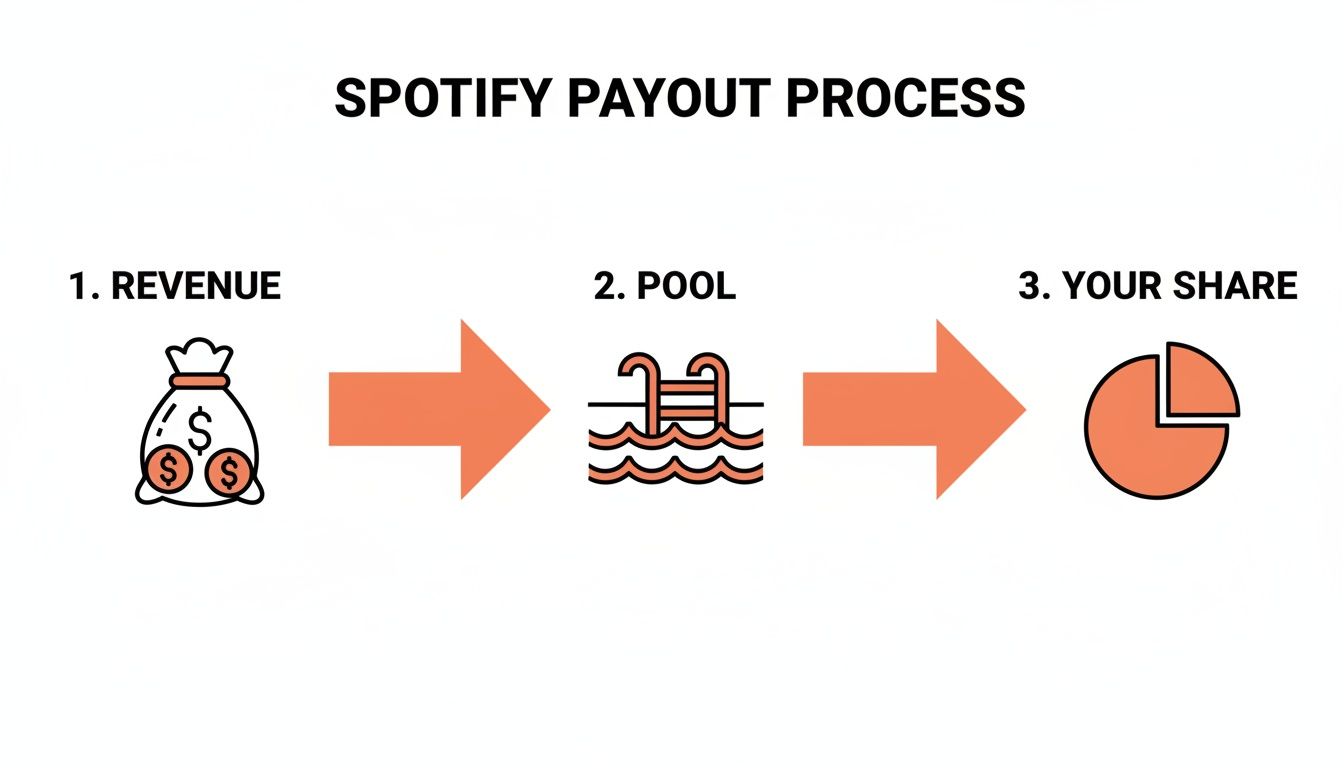
As you can see, it all starts with one large, collective revenue pool. From there, it's broken down into smaller shares based on each artist's streamshare.
A Simplified Payout Example
Let's walk through this with some clean numbers to see it in action.
The Revenue Pool: Let's say Spotify collects $10 million in the United Kingdom in one month.
Total Streams: In that same month, a whopping 3 billion streams happened across all artists in the UK.
Your Streams: Your new single blew up, racking up 3 million streams in the UK.
Calculating Your Streamshare: To find your piece of the pie, we divide your streams by the total: , which is 0.1%.
Calculating Your Gross Payout: You're now entitled to 0.1% of that $10 million revenue pool: .
In this scenario, your $10,000 payout from 3 million streams works out to a per-stream rate of about $0.0033. If the total revenue pot was bigger, or if there were fewer total streams that month, your rate would have been higher. This is the simple math behind why that number is always changing. For a more detailed breakdown, check out our guide on how to calculate Spotify royalties accurately.
The Journey to Your Bank Account
That $10,000 gross payout is just the beginning of the story. The money doesn't magically appear in your bank account. It has to travel through a chain of rights holders first, and each one takes their cut along the way.
Rights Holders: Spotify’s first payment goes to the music's rights holders. This includes the owners of the master recording (usually a record label or the artist if they're independent) and the publishing rights holders (the songwriters and their publishers).
Distributors and Labels: The money for the master recording then goes to your distributor (like DistroKid or TuneCore) or your record label. They'll take their admin fee or contractual percentage right off the top.
Your Final Cut: Whatever is left over after everyone has taken their piece is what finally hits your pocket. An indie artist with a great distribution deal might keep 85-100% of their master recording royalties. On the flip side, an artist signed to a major label might only see 15-20% of it.
Understanding this entire flow is absolutely critical. The "money per stream" figure is a gross number, and your actual take-home pay will always be a fraction of that once everyone in the value chain gets paid.
Key Factors That Change Your Per-Stream Rate
Getting a handle on Spotify’s pro-rata system is the first step. But that system alone doesn't explain why a million streams for an artist in Iceland could pull in thousands more than the same million streams for an artist in Brazil. The real answer is in four powerful variables that are constantly tweaking your payout rate.
Your average money per stream on Spotify isn't some fixed number. It’s a moving target, directly influenced by where your music is played, how it's played, and who is listening. This isn't about luck—it's about understanding the levers that control your earnings so you can stop chasing more streams and start attracting more valuable ones.
Listener Subscription Type
The single biggest factor messing with your per-stream rate is the listener's account type. Plain and simple, a stream from a Spotify Premium subscriber is worth a whole lot more than a stream from someone on the free, ad-supported plan.
Think back to that big pool of money we talked about. A Premium subscriber throws their full monthly fee (like $10.99 in the US) into the pot. Someone listening for free only adds the tiny bit of ad revenue generated while they were listening.
Premium Streams: These are the financial backbone of the royalty pool, backed by cold, hard cash from monthly subscription fees.
Ad-Supported Streams: These generate way less money per listen. You need a massive volume of free streams to even come close to the payout from a single Premium stream.
Bottom line: an audience full of Premium subscribers will always generate a higher per-stream payout than an audience of the same size listening for free.
Geographic Location of Listeners
Next up is geography, and it’s a big one. A stream’s value is directly tied to the country it came from. Why? Because subscription fees and ad rates are wildly different all over the world, which means every country has its own separate, unequal pool of royalty money.
A stream in a country with a high cost of living and expensive subscription plans adds more to its local money pool than a stream from a region where prices are much lower. This can create some massive differences in what you earn, even if the stream count is identical.
Your Spotify earnings are heavily dictated by where those plays come from. One million streams in Norway can net an artist $5,479, whereas the same number of streams in Argentina earns just $850. This disparity is tied directly to regional subscription prices ($12.01 in Norway vs. $1.94 in Argentina) and the resulting revenue pools. The US, a key market, pays around $0.0039 per stream, generating roughly $3,527 per million streams. You can discover more insights about payout variations by country on Ditto Music.
To give you a clearer picture, here’s how drastically payouts can change based on listener location.
Payout Per Million Streams by Country
This table shows just how much estimated artist earnings can vary for the exact same number of streams, depending on where your fans are.
Country | Estimated Payout (USD) |
|---|---|
Iceland | $7,110 |
Norway | $5,479 |
Sweden | $4,581 |
United Kingdom | $4,289 |
United States | $3,527 |
Canada | $3,149 |
Germany | $3,012 |
Mexico | $1,288 |
Brazil | $1,114 |
Argentina | $850 |
As you can see, building an audience in high-payout markets can make a monumental difference to your bottom line.
Your Distribution Deal and Splits
Okay, so Spotify has calculated your gross earnings. But that money still has a long way to go before it hits your bank account. The deal you have with your record label or music distributor determines how much of that cash you actually get to keep.
Your distributor is the company that gets your music onto Spotify in the first place—think TuneCore, DistroKid, or CD Baby. They usually take a small commission or a flat annual fee. A record label, on the other hand, often takes a much bigger slice of the pie in exchange for things like funding and marketing.
An independent artist using a distributor might keep 85-100% of their master recording royalties.
An artist on a major label deal might only see 15-50% of that same revenue.
This split is one of the most important parts of the whole equation. It’s the reason two artists with the exact same stream count and listener base can end up with wildly different bank statements.
Platform Policies and Thresholds
Finally, Spotify’s own rules can decide whether a stream pays you anything at all. In an effort to crack down on fake streams and make sure royalties are going to real, active artists, Spotify has put some new requirements in place.
For example, starting in early 2024, tracks have to get at least 1,000 streams within a 12-month period just to qualify for royalties. While this mostly impacts songs with super low engagement, it’s a perfect example of how platform policies can directly hit your wallet. Keeping up with these rules is crucial if you want to accurately predict what you’ll get paid.
How to Accurately Estimate Your Spotify Earnings
Knowing all the variables is one thing, but actually turning those abstract ideas into a real financial forecast is what gives you power as an artist. Predicting your income shouldn’t feel like a shot in the dark. With the right approach, you can stop crossing your fingers for a decent royalty check and start planning your career like a business.
The first step is to get a simple baseline. Even though the exact money per stream on Spotify is always shifting, using an average rate gives you a rough but handy starting point for some quick math.
Creating a Baseline Estimate
A straightforward formula can give you a quick snapshot of your potential gross earnings—that's the total amount before anyone else gets their piece of the pie. It’s a foundational calculation that helps turn your stream count into actual dollars and cents.
Here’s the basic formula to keep in your back pocket:
Total Streams x Average Per-Stream Rate = Gross Earnings Estimate
Let's say your new single just blew past 100,000 streams. If we use a conservative average rate of $0.0035 per stream, your calculation is simple:
This $350 is the total royalty pool your streams generated. It’s a critical number to know, but it's not what you'll actually see hit your bank account.
Using a Tool for Precise Projections
While that back-of-the-napkin math is useful, it doesn't factor in the heavy hitters we've talked about, like where your listeners are and whether they're on a Premium plan. For a truly accurate forecast, you need a tool that crunches all those complex numbers for you. This is where a dedicated calculator becomes your best friend.
For example, the artist.tools Spotify Royalties Calculator lets you plug in your stream counts and instantly see how your earnings can swing dramatically based on listener location. It takes all the guesswork out of the equation and paints a much more realistic picture.
Here’s a look at the artist.tools calculator doing its thing, estimating earnings based on stream volume.
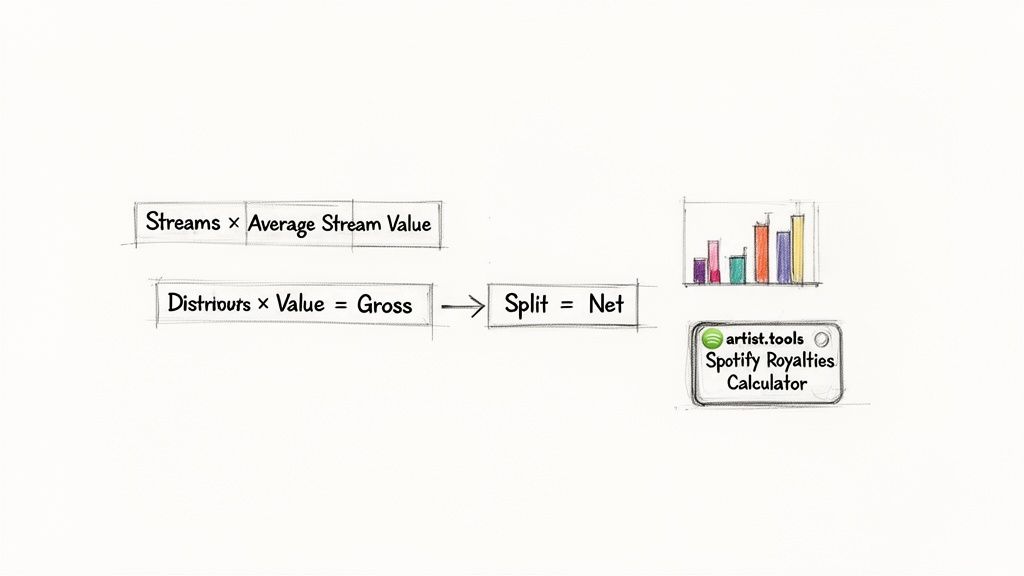
This shows just how fast you can get a data-driven earnings estimate, moving way beyond simple averages to get a more nuanced financial overview. For a full breakdown, check out our in-depth guide on using the Spotify artist earnings calculator to unlock your true revenue.
Calculating Your True Take-Home Pay
Once you have a solid gross earnings estimate, the last piece of the puzzle is to factor in the splits and fees that get taken out before the money ever reaches you. This is the calculation that reveals what you actually get to keep.
The formula gets an upgrade:
Gross Earnings - (Distributor/Label Cut) = Your Net Earnings
Let’s go back to our earlier example. You’ve generated a gross estimate of $350. Now, let's look at your distribution deal:
Distributor Fee: If your distributor takes a 15% commission, they’ll collect .
Your Net Payout: That leaves you with .
That final number, $297.50, is a much more realistic expectation of what you’ll pocket from those 100,000 streams.
It's critical to remember that your distribution or label agreement is one of the single biggest factors in your final payout. An independent artist keeping 90% of their royalties will have a vastly different financial outcome than a signed artist who only receives 20%.
By combining a powerful estimation tool with a clear understanding of your specific royalty splits, you get the financial clarity you need to make smart moves. You can set realistic goals, budget for that next music video, and treat your music career with the professional foresight it deserves.
Strategies to Increase Your Per-Stream Value
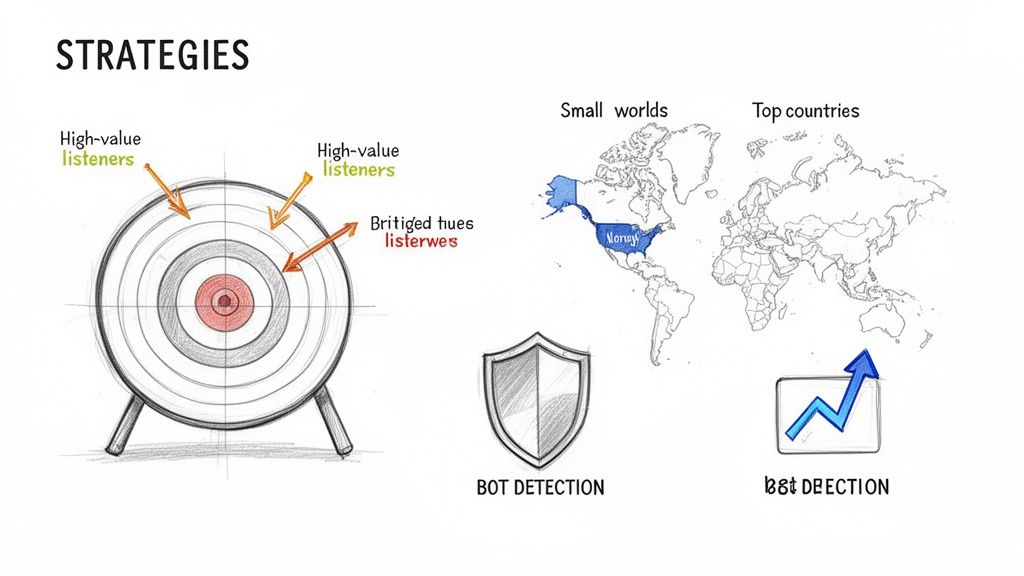
Alright, knowing how Spotify calculates your earnings is half the battle. Now it’s time to move from theory to action. If you really want to grow your revenue, you have to stop chasing more streams and start attracting the right streams. It's about quality over quantity, every single time.
This means getting strategic about where your listeners come from and, just as importantly, protecting your music from fake, worthless activity. By targeting high-value audiences and keeping your streams clean, you can directly boost your money per stream on Spotify and build a much more sustainable income.
Target High-Value Listeners
As we’ve broken down, not all streams are created equal. A single play from a Premium subscriber in the U.S. is worth a whole lot more than an ad-supported stream from a lower-cost region. Your mission, should you choose to accept it, is to connect with these high-value audiences.
The secret? Finding playlists that cater to listeners in these premium markets. Instead of just spraying and praying with your submissions, you need to use data to guide your outreach. This is where having the right tool in your corner makes all the difference.
Think of playlist promotion like fishing. You could just cast a huge net in a random patch of ocean and hope for the best. Or, you could use a fish finder to see exactly where the most valuable fish are swimming. A targeted approach saves a ton of time and gets you way better results.
Using a feature like the artist.tools Playlist Search lets you filter playlists by country, genre, and a bunch of other metrics. This means you can zero in on opportunities in top-tier markets like the US, UK, or Germany, making sure your promotional efforts are aimed at the very audiences that generate higher payouts.
Guard Against Fraudulent Streams
One of the biggest threats to your per-stream value is artificial streams. Bots. These fake plays don't just earn you $0, they can actually get your music flagged and completely removed from Spotify. Protecting your catalog from this is non-negotiable.
Fraudulent streams often come from shady third-party promo services or botted playlists that promise the world. They flood your tracks with fake plays, which might look good for a second, but they ultimately destroy your standing on the platform.
Spotify's algorithms are smart, and they will detect this kind of inorganic activity. When they do, a few things can happen:
Royalties Get Clawed Back: Any money "earned" from fake streams will be taken away.
You Get a Strike: Your account could receive a warning, putting you on Spotify’s radar for all the wrong reasons.
Your Music Gets Taken Down: In serious cases, they can pull your tracks or even your entire catalog from the platform.
This is exactly why you have to be proactive. The artist.tools Bot Detection feature is your shield. It scans your profile for signs of artificial streaming and flags suspicious playlists, letting you report and disavow botted activity before it does any real damage to your career.
Analyze Your Promotional ROI
So, how do you actually know which of your marketing efforts are paying off? To maximize your per-stream rate, you have to understand which campaigns are bringing in valuable listeners and which are just burning through your budget. It all comes down to making data-driven decisions.
When you run a new ad campaign or land a spot on a big playlist, you need to see the results. Did that placement bring in listeners from high-payout countries? Did that social media push lead to a real spike in saves and follows from genuine fans?
This is where detailed analytics are vital. With the artist.tools Stream Tracker, you can monitor your stream counts and historical performance with precision. By connecting the dots between your promotional activities and spikes in your streams, you can see what’s working. This insight lets you double down on effective strategies and stop wasting money on campaigns that attract low-value or fake listeners.
Frequently Asked Questions About Spotify Payouts
Even after you get the hang of the royalty system, a few questions always seem to pop up. Let's walk through three of the most common ones to clear up any confusion and give you some straight answers.
How Often Does Spotify Pay Artists?
Spotify settles up its royalties every month, but that doesn't mean cash instantly hits your bank account. There's a natural delay baked into the system, usually around two to three months.
This lag isn't just Spotify dragging its feet. First, they have to close out the month's books, calculate all the streamshares for millions of artists, and then send that money to distributors and rights holders. Your distributor then takes that payment, processes it, and finally deposits your cut.
So, if you had a great January, you can expect to see that money land sometime in March or maybe even April.
Do Pre-Saves Count Toward Earnings?
This one trips up a lot of artists. The short and sweet answer is no, pre-saves do not directly earn you any money per stream on Spotify. A pre-save is simply a marketing tool that lets a fan automatically add your song to their library the second it drops.
But don't write them off. Pre-saves are an incredibly powerful signal to Spotify's algorithms. A big pre-save campaign tells the system that your track has some serious heat behind it, making it much more likely to land on algorithmic playlists like Release Radar from day one. It's those playlist adds that then go on to generate thousands of actual, royalty-paying streams.
Pre-saves don't earn you money directly, but they are a critical investment in securing the algorithmic support that drives thousands of paid streams on release week. Think of them as setting the stage for your financial success.
Why Did My Rate Go Down When My Streams Went Up?
Seeing your stream count explode while your per-stream rate plummets is maddening, but there's almost always a simple explanation. This scenario drives home the main point of this guide: stream quality matters more than stream quantity.
If your new wave of streams is coming from listeners in countries with lower payout rates or from a bigger chunk of ad-supported (free) users, your average rate is going to drop. It’s simple math.
This is exactly why you have to be strategic about where you're pushing your music. A million streams from a market like Argentina might look amazing on paper, but they'll earn you less than 250,000 streams from listeners in the United States. Always dig into the data to see where your growth is actually coming from.
Ready to move from guessing to knowing? artist.tools provides the essential data you need to track, analyze, and optimize your Spotify revenue with precision. Sign up today and take control of your music career at https://artist.tools.
.png)
.png)
Comments