Music: Master music playlist titles to boost streams and followers
- Jan 12
- 12 min read
Your music playlist title is your single most powerful tool for discovery on Spotify. The best titles aren't just creative; they're strategic. They match the exact moods, activities, and genres that real listeners are searching for every single day.
Why Your Playlist Title Is Your Most Powerful Growth Tool
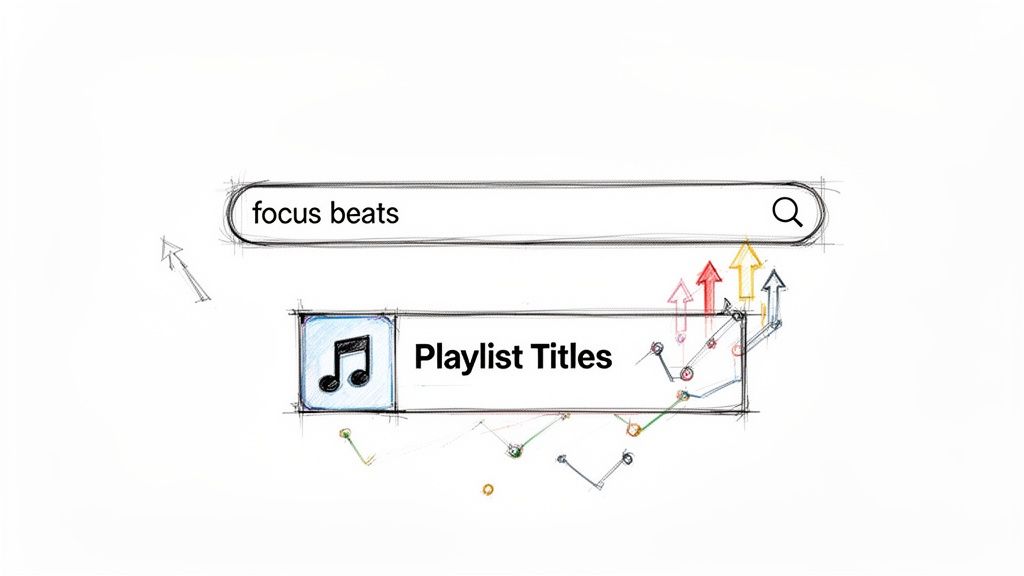
Think about the last time you went looking for a new playlist. Did you type in a clever, abstract name like "Midnight Whispers"? Or did you search for something direct and to the point, like "late night lofi beats"?
Chances are, it was the latter. Modern listeners are driven by intent—we look for music that fits a specific moment. This simple fact has completely changed the game, turning playlist curation from a pure art form into more of a science.
Your title is the number one signal you send to Spotify's algorithm. It tells it exactly what your playlist is about and who it’s for. If your title is too vague or artsy, you’re basically invisible to anyone using the search bar.
The Power of Search Intent
To really win on Spotify, you have to get inside the listener's head and align your playlist with what they're actively looking for. This means ditching the ambiguous names for clear, descriptive, and keyword-focused titles.
It's a huge shift in mindset. You're not just naming a collection of songs; you're building a product designed to be found.
Just think about these common search patterns:
Activity-Based: "gym workout," "focus music," "road trip songs"
Mood-Based: "sad chill piano," "upbeat indie," "relaxing jazz"
Genre-Specific: "90s hip hop," "phonk," "bedroom pop"
Every single one of these is a high-intent search from someone who knows exactly what they want. If your title doesn't contain those keywords, you won't show up. It doesn't matter how perfect your song selection is.
Learning from the Best
This isn't some secret trick; it's the exact playbook Spotify's own editorial team uses to dominate. With over 100 million tracks and 6+ billion playlists on the platform, titles are one of the most important discovery signals.
Spotify's flagship lists like 'Top Tracks of 2025 Global' aren't just popular—they are explicitly built around keywords to rank for massive search terms. This is the same principle that data platforms like artist.tools build on with tools like our Keyword Explorer. It’s all about a descriptive title. For a deeper dive, check out the trends in Spotify's official year-end review.
Your playlist title is your single most important piece of SEO real estate. It’s the hook that catches both the listener and the algorithm, turning a simple search into sustained, organic growth for your playlist.
At the end of the day, treating your title as a strategic SEO lever is what separates hobbyist curators from those who build massive, engaged followings. It’s about meeting listeners right where they are—in the search bar—and giving them the perfect soundtrack for their moment.
Finding The Keywords Real Listeners Are Searching For
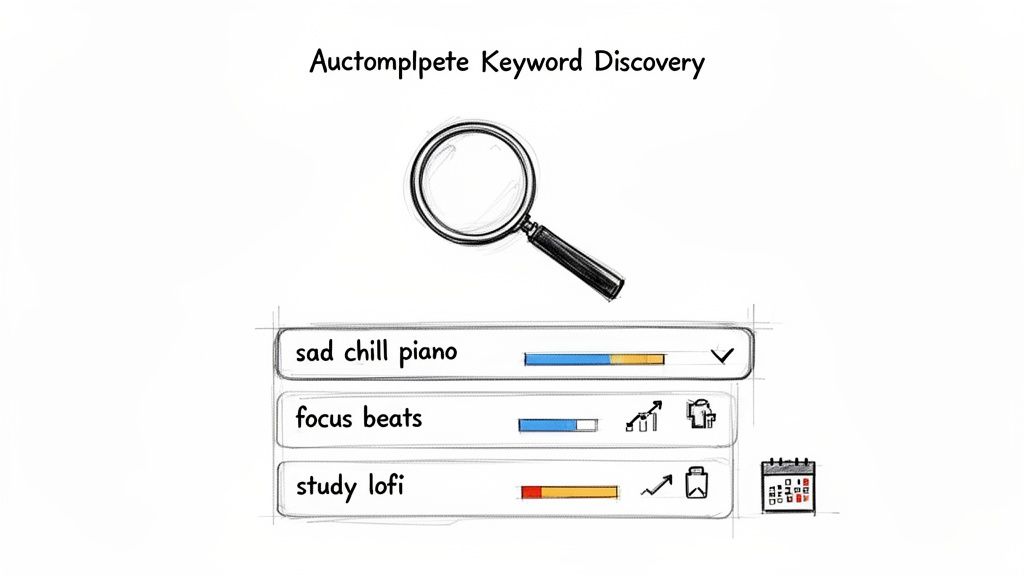
If you want to create a playlist title that actually gets discovered, you have to get out of your own head. It’s less about coming up with something clever and more about digging into what real people are already typing into Spotify’s search bar.
The most straightforward way to start is right inside Spotify. Type a core keyword like "lofi" or "workout" and just watch what the autocomplete suggests. That list isn't random; it's a live feed of the most popular searches related to your term. It’s your first and best clue into what listeners actually want.
Uncovering High-Potential Keywords
While poking around in Spotify is a good start, dedicated tools are where the real magic happens. This is where you turn guesswork into a data-driven strategy. Platforms like artist.tools are built specifically for this, and the Keyword Explorer feature is a game-changer.
Instead of just seeing suggestions, you get the hard data behind them:
Monthly Search Volume: A solid estimate of how many people search for that exact term each month, broken down by country.
Competition: A quick analysis of how many other playlists are already fighting for that keyword.
Search Trend Data: A look at whether a keyword is heating up or cooling down over time.
This combo is what helps you find the sweet spot: keywords with a ton of search traffic but not a ton of competition. You might discover that a phrase like "phonk workout" gets way more searches than you thought, giving you a perfect niche to own.
A keyword isn’t just a word; it’s a direct signal of listener intent. Finding the right ones means you stop chasing an audience and start letting them find you through their own natural search habits.
Using Search Suggestions for Fresh Ideas
Another killer feature is Search Suggestions. Think of it as putting Spotify’s autocomplete on steroids. Instead of you having to manually type in dozens of variations, the tool does the heavy lifting, revealing what listeners are searching for around your main topic.
Let's say your playlist is all about "ambient music." The tool might spit out long-tail keywords you'd never think of, like:
ambient music for deep sleep
ambient study music for focus
dark ambient music for reading
These longer, more specific phrases are gold. They're usually way less competitive, and the listeners searching for them know exactly what they want. If your title perfectly matches "ambient music for deep sleep," you have an incredibly high chance of getting that click and a new follower. Our guide on Spotify playlist SEO tips to boost visibility dives even deeper into how to leverage these insights.
After this process, you should have a solid list of primary, secondary, and long-tail keywords. This is the raw material you'll use to build a title that doesn’t just sound good—it’s engineered to rank and pull in organic listeners day after day.
A Proven Formula For Crafting The Perfect Playlist Title
Alright, you've got your keywords. Now, how do you actually piece them together into a title that works? This isn't just about smashing words together and hoping for the best. The most successful playlist curators I've seen all use a simple, powerful structure.
This isn't about killing creativity; it's about building a solid SEO foundation that lets your creativity shine after people find you. Think of it as balancing pure discoverability with a unique brand identity.
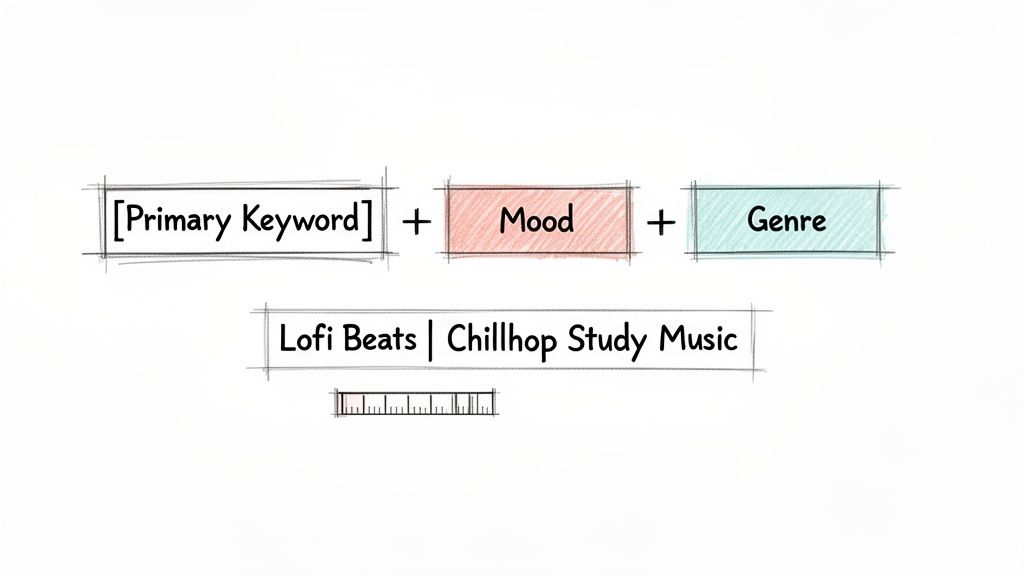
The go-to structure is surprisingly simple: [Primary Keyword] + [Secondary Keyword/Mood] + [Genre/Descriptor].
Each part of that title has a specific job, and when they work together, they can pull in listeners from a huge range of searches. Let's break down how this actually works.
Deconstructing The Title Formula
First up is your Primary Keyword. This is your heavyweight, high-volume term that instantly tells everyone what your playlist is about. It has to be the first thing people read, no exceptions. This is what defines your playlist's core identity.
Next, you add a Secondary Keyword or Mood. This is where you add flavor and context. It helps you show up for those more specific, long-tail searches and connects with what a listener wants to feel or do.
Finally, the Genre or Descriptor adds that last layer of targeting. This could be a specific subgenre, a decade, or any other term that helps narrow down your audience and set the right expectations.
A well-structured title works like a funnel. The primary keyword casts a wide net, while the secondary terms and descriptors capture highly motivated listeners who know exactly what they want to hear.
Let’s look at a classic example: "Lofi Beats | Chillhop Study Music".
Primary Keyword: "Lofi Beats" (targets a huge, core audience)
Secondary Mood: "Study Music" (grabs people looking for an activity-based playlist)
Genre/Descriptor: "Chillhop" (appeals directly to fans of that specific subgenre)
This structure means the playlist can rank for "lofi," "study music," and "chillhop," massively boosting its visibility. That little pipe character (|) is just a clean separator—it keeps things readable for humans without messing with the algorithm.
Playlist Title Component Analysis
To really get this right, you need to understand the role each component plays. This table breaks down the strategic purpose behind each part of the formula.
Component | Purpose | Example |
|---|---|---|
Primary Keyword | The main, high-traffic term that forms the playlist's core identity and attracts a broad audience. | |
Secondary Keyword/Mood | Adds emotional or activity-based context, capturing more specific, long-tail searches. | |
Genre/Descriptor | Narrows the focus to a specific style, era, or subgenre, setting clear listener expectations. | |
Separator | Improves readability for users without negatively impacting the algorithm. | ` |
Final Title | A combination that is highly discoverable and emotionally resonant. | `Sad Songs |
By thinking in terms of these components, you can move beyond just guessing and start building titles with a clear SEO purpose.
Word Order And Character Limits
The order you put these keywords in is non-negotiable. Your most important, highest-volume keyword must go at the very beginning of the title. Spotify’s search algorithm gives more weight to the first few words, so front-loading your primary term is an absolute must.
Also, keep your titles tight. Spotify allows for long names, but they often get cut off in search results and on smaller screens. Aim for something under 60 characters if you can. You want the core message to be crystal clear even if the full title isn't visible.
Putting these pieces together creates a title that's both optimized for Spotify's search engine and genuinely appealing to real people. If you want to dive even deeper, our full guide on how to name playlists for growth and discovery has more advanced strategies.
Common Mistakes That Can Hurt Your Playlist's Rank
Crafting a powerful title isn't just about what you put in; it's also about what you leave out. A few common mistakes can signal to the algorithm that your playlist is low-quality or even spammy, which is a surefire way to get it buried in the search results.
Let’s walk through the pitfalls I see most often so you can steer clear of them.
Keyword Stuffing and Bot-Like Titles
The most frequent mistake, hands down, is keyword stuffing. This is when curators cram every possible related term into their playlist title, hoping to rank for everything at once.
You've seen them: "Lofi Beats | Chillhop | Study Music | Focus | Relax | Hip Hop."
This approach looks completely unnatural to both real listeners and Spotify's algorithm. Instead of helping, you're actually diluting your SEO power and making your playlist look like it was churned out by a bot network. It just screams low quality, and Spotify’s systems are built to filter this stuff out.
The goal is a clean, focused title with a primary keyword and maybe one or two well-chosen descriptors. That’s it.
On a similar note, you have to avoid overly simplistic or generic titles that sound like they belong to a bot farm. Names like "Pop Music," "Chill Songs," or "Rap 2025" are often associated with low-quality, artificially inflated playlists.
Not only are these titles uninspired, but they also lump you in with a sea of spammy content that the algorithm is actively trying to de-rank. A little personality or specificity goes a long way.
Instead of "Pop Music," try "Feel Good Pop | Upbeat Morning Hits"
Instead of "Chill Songs," try "Late Night Chill | Relaxing Indie R&B"
Instead of "Rap 2025," try "New Wave Rap | Fresh Finds & Rising Artists"
Misleading Listeners and Mimicking Brands
Another huge red flag is using misleading terms or trying to mimic official Spotify branding. Adding "Spotify Official" or "Top Hits 2025" to your title is a fast track to getting your playlist flagged and suppressed. The platform aggressively protects its brand and wants to make sure users can easily tell the difference between user-generated content and their own editorial playlists.
Along the same lines, never include an artist's name in a title unless the playlist is exclusively dedicated to that one artist. A title like "Billie Eilish | Sad Indie Pop" is a big problem if it contains tracks from other artists. This creates a terrible experience for listeners who click expecting one thing and get something else entirely. That drop in engagement sends all the wrong signals.
Your title is a promise to the listener. Breaking that promise with misleading information not only damages trust but also sends negative signals to the algorithm, hurting your playlist's long-term growth potential.
By sidestepping these common mistakes, you ensure your playlist title is optimized for discovery without raising any red flags. It’s all about building a clean, trustworthy signal that tells both listeners and the algorithm that your content is high-quality and deserves to be found.
How To Test and Refine Your Title For Maximum Growth
Getting your playlist launched with a keyword-optimized title isn't the finish line—it's the starting block. The curators who really crush it treat their music playlist titles as living, breathing assets that need constant attention. Guessing your way to the top just doesn't work. You need a solid cycle of tracking, tweaking, and repeating.
This whole process kicks off the second you hit 'save' on a new title. The immediate goal is to figure out if that one change actually made a difference in your search visibility. You have to know if swapping from "Lofi Chill" to "Lofi Beats" actually moved the needle.
Tracking Your Search Performance
This is where you stop guessing and start using real tools. The Playlist Search Rankings tracker inside artist.tools, for instance, was built for this exact job. It lets you see precisely where your playlist shows up in search results for specific keywords, in specific countries, and how that changes over time.
You can set up tracking for your main keyword—let's say "phonk"—in a huge market like the United States. After you change your title to feature that term more heavily, you can watch your rank every single day. Did you jump from page five to page one? That’s the kind of hard data that proves your strategy is working.
Before you even start testing, though, make sure you're not making one of these classic mistakes. They can tank your efforts before you even get going.
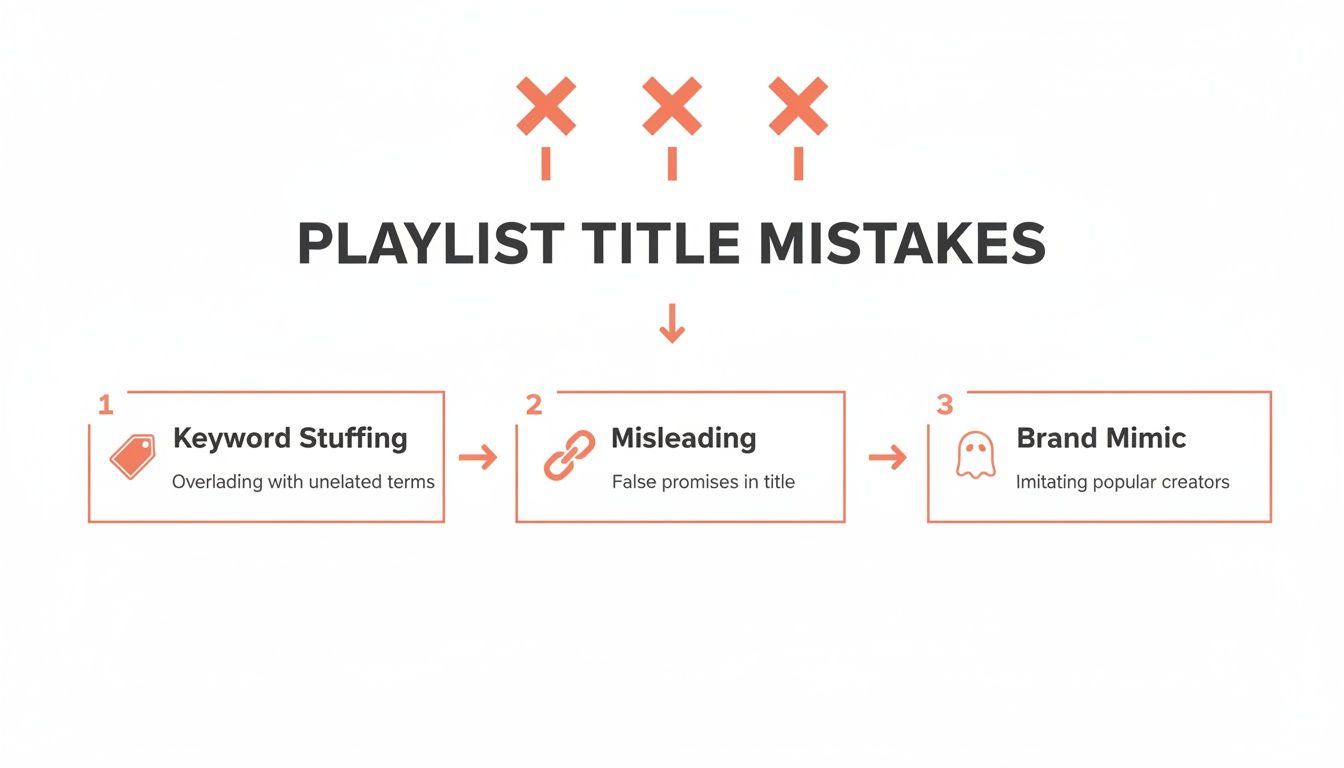
As the visual shows, keyword stuffing, clickbait-y titles, and trying to impersonate official brands will derail your growth fast. Get your foundation right first.
From Rankings To Follower Growth
Connecting better search ranks to more followers is the name of the game. It's a clear, data-backed path: better titles lead to better search performance, which ultimately drives more streams. Just look at the biggest hits. The track that dominated Spotify globally in 2025, 'Die With A Smile' by Lady Gaga and Bruno Mars, soared past 1.7 billion streams, thanks in large part to its placement in major, clearly-titled global playlists.
Even a small jump in your search ranking can translate into huge numbers when you're playing at scale. Tools like the Playlist Search Rankings and Search Suggestions in artist.tools are designed to take advantage of this by letting you run controlled experiments on your titles.
The core of playlist growth isn't about finding one perfect title. It's about a relentless process of forming a hypothesis, making a change, measuring the result, and iterating.
A simple A/B test is a fantastic way to start. Let's say you're debating between a mood keyword and a genre keyword for your playlist.
Test A: For two weeks, name your playlist "Sad Indie | Rainy Day Music". Track its rank for "sad indie" and keep a close eye on your follower count.
Test B: For the next two weeks, switch it to "Rainy Day Music | Sad Indie". Now track its rank for "rainy day music" and see how the numbers compare to Test A.
This kind of methodical approach takes the emotion out of it and replaces it with cold, hard data. You'll see exactly what listeners in your niche are actually searching for and responding to. If you need more inspiration for title variations to test, our free playlist name generator can spark some ideas.
This iterative process is what separates the hobbyists from the pro curators who build and maintain massive audiences on Spotify.
Common Questions About Spotify Playlist Titles
Once you start digging into playlisting, a few questions always pop up. Let's tackle the most common ones we hear from curators trying to get an edge.
How Long Should My Playlist Title Be?
Keep it under 60 characters. That’s the sweet spot.
While Spotify technically lets you write a novel, anything longer usually gets chopped off on mobile screens or in search results. You want listeners to see your main keywords instantly, without having to click. Get straight to the point.
Always jam your most important keyword right at the beginning. Everything after the first few words is just extra flavor.
Can I Use Emojis And Special Characters?
Yes, but don't go crazy with them. A single, well-placed emoji can make your playlist pop in a sea of text-only titles. It adds a bit of personality and can visually hook a listener scrolling through search results.
But overdo it, and you'll look spammy and unprofessional. That can seriously damage your playlist's credibility before anyone even listens to it.
Pro Tip: We've found that one or two relevant emojis at the end of the title works best. Think "Beast Mode Workout 🔥" or "Rainy Day Lofi 🌧️". It adds that visual flair without getting in the way of your keywords.
As for special characters, things like pipes or hyphens are fantastic for creating a clean separation between keywords. On the other hand, accented letters or complex symbols can sometimes throw off Spotify's search indexing or make it tough for a global audience to find you. Simple is almost always better.
Should I Slap The Current Year In My Title?
Putting the year in your title (like "Summer Hits 2025") can be a seriously powerful move, but it comes with a catch. It screams "fresh and relevant," which can drive a ton of clicks, especially for genres that are all about what's new and trending. People actively search for playlists by year.
The downside? You've just given your playlist an expiration date.
If you go this route, you have to remember to update that title on January 1st. Seeing "Workout Hits 2024" halfway through 2025 immediately makes a playlist look dead and abandoned, and your engagement will plummet.
If you're going to use this strategy, set a calendar reminder right now. The SEO boost is only worth it if you stay on top of it.
Ready to stop guessing and start ranking? artist.tools gives you the data-driven insights you need to dominate Spotify search. Use our Keyword Explorer and Playlist Search Rankings to craft the perfect music playlist titles and track your growth.
Explore the tools top curators use at https://artist.tools.
.png)
Comments