Spotify and Royalties A Musician's Guide to Getting Paid
The whole world of Spotify and royalties can feel like a maze, but it all comes down to one simple truth: there's no such thing as a fixed per-stream rate. Instead, Spotify pays out using a "stream share" model. Your earnings are just a slice of a much, much larger revenue pie, and the size of your slice depends on how your music stacks up against every other song on the platform.
How Spotify Royalties Really Work
First, get the idea of a simple cents-per-stream payment out of your head. The reality is more like a giant, shared pizza. Every month, Spotify pools all the money it makes from Premium subscriptions and ad revenue. That pool is the "pizza." Your royalty payment is your slice, and its size is based on your percentage of the total streams across the entire platform that month.
This "pro-rata" system means your earnings are always in motion. They change every single month based on a handful of factors, which makes a fixed rate impossible. For example, if total streams on Spotify shoot up but the revenue pool stays the same, the value of each individual stream actually goes down. This is the bedrock principle of spotify and royalties.
The Two Halves of Your Payout
Every time someone streams your song, it actually generates two completely different kinds of royalties. Think of them as two income streams flowing from the same river, each taking a separate path to get to you.
Recording Royalties: This is the big one, making up about 70% of the total revenue. It pays for the use of the specific sound recording—the master track. This money flows to whoever owns that master, which could be you (if you're fully independent), your record label, or your distributor.
Publishing Royalties: This is the smaller piece of the pie, paying for the use of the song's composition—the actual melody and lyrics. This money is owed to the songwriters and their publishers. It’s their reward for creating the musical work in the first place.
Getting this split right is absolutely critical. You might own 100% of your recording but only 50% of the publishing because you co-wrote the song. If you don't properly register and collect both types of royalties, you're literally leaving money on the table.
Why Your Listener Matters
Here's a crucial detail: not all streams are created equal. The final royalty amount you receive is massively influenced by who is listening and where they are. A stream from a Premium subscriber in the United States is worth a whole lot more than a stream from an ad-supported user in a country with lower subscription fees.
Why? Because Premium users contribute way more to that monthly revenue pool. As a result, their streams are weighted more heavily when Spotify starts slicing up the pizza. This is one of the main reasons why your effective per-stream rate can swing so wildly from one month to the next. Once you wrap your head around this, you can start treating your streaming income as a predictable and manageable part of your music business.
Understanding Your Two Royalty Streams
Every single time your song gets played on Spotify, it doesn't just trigger one single payment. Instead, each stream kicks off two completely separate royalty streams that travel down entirely different paths to get to the right people. Getting a handle on this dual-stream system is the absolute key to making sure you're collecting every last cent you've earned.
Think of it like this: your song is a physical book. One person writes the story (that's the songwriter), and another person records the audiobook version (that's the performing artist and producer). Both of these creations have distinct value, and both need to be paid for when someone consumes them. Spotify royalties operate on the exact same principle, paying for both the underlying song and the specific recording of it.
Recording Royalties: The Master Share
The first, and usually bigger, of the two is the recording royalty, also known as the master royalty. This is the money paid for the use of the actual sound recording—the finished audio file people stream. In our analogy, this is the "audiobook."
This royalty goes to whoever owns the master recording. If you’re an independent artist, that’s probably you. If you’re signed to a record label, they most likely own the masters as part of your deal. The money flows from Spotify to your distributor (like DistroKid or TuneCore) or your label, and they pay you based on your agreement. Simple enough.
Because this stream represents the final product that listeners actually hear and engage with, it commands the lion's share of the money from Spotify's revenue pool.
Publishing Royalties: The Songwriter's Cut
The second stream is the publishing royalty. This payment is for using the song’s composition—the melody, lyrics, and chords that form the musical DNA of the track. This is the "story" in our book analogy. It's super important to remember: even if you performed and recorded the song, you only get publishing royalties if you also wrote or co-wrote it.
This is where things get a bit more complex. Publishing royalties are actually split into two sub-types:
Performance Royalties: These are generated anytime a song is performed publicly. On Spotify, every single stream counts as a public performance.
Mechanical Royalties: These are paid out for the reproduction of the song. In the digital world, every stream creates a temporary copy (or "reproduction") on a listener's device, which is what triggers this royalty.
A huge mistake artists make is assuming their distributor collects everything. Your distributor is great at getting your recording royalties, but they often don't touch your publishing income. You have to be registered with the right organizations to claim this separate pile of money.
This flowchart shows exactly how the money from a single stream splits into these two main paths.
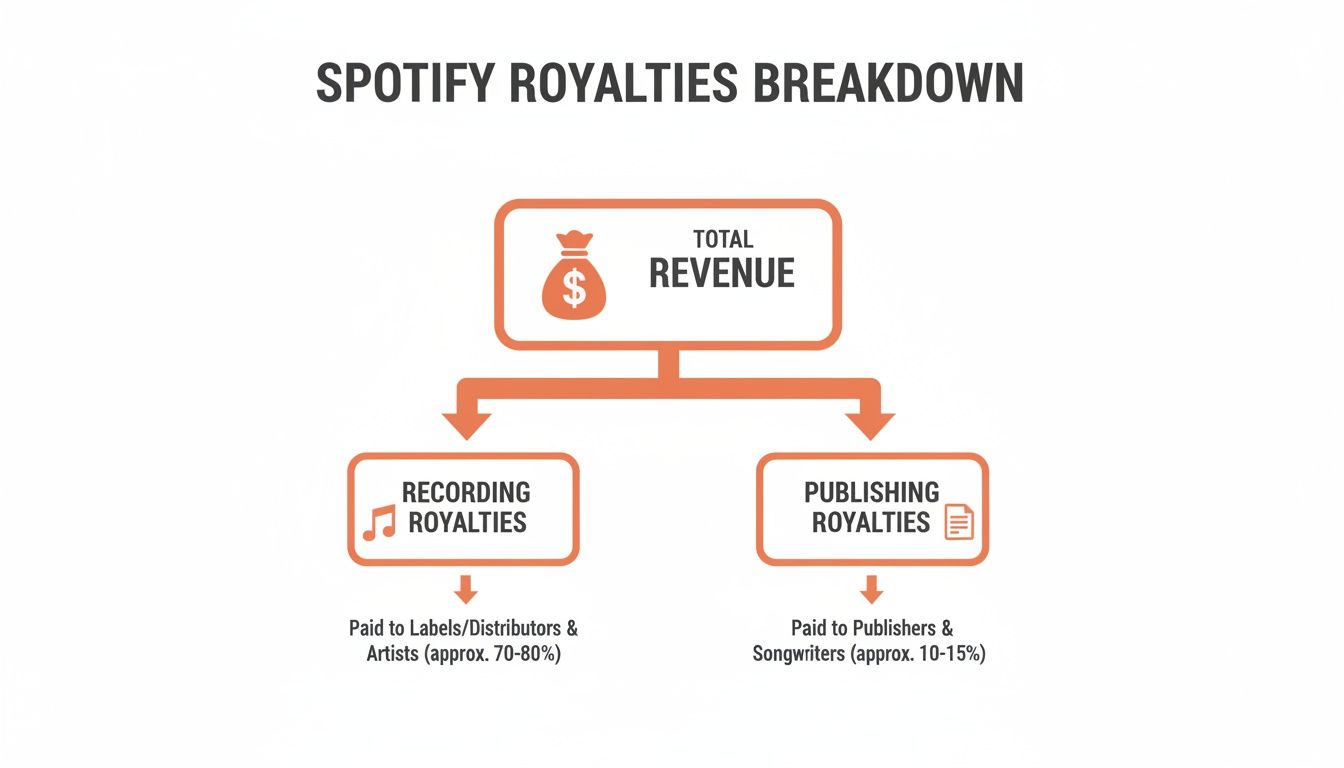
As you can see, the revenue forks immediately, sending money down two different roads to pay the owners of the recording and the owners of the composition.
Who Collects What Money?
Since these two royalty types travel on different roads, they're picked up by different collection agencies. Getting this right is the difference between a nice payday and leaving money on the table. Spotify's impact is massive—the platform now drives over 30% of all global recorded music revenue, making it the biggest engine of growth in the industry.
To make sure you're set up to collect everything, you need to know who handles each piece of the puzzle. The table below breaks it down, but for a much deeper look into this world, check out our complete guide on music publishing.
Breakdown of Spotify Royalty Types
This table lays out the different royalty types generated by a Spotify stream, what they pay for, who they're for, and who actually collects the cash.
Royalty Type | What It Pays For | Paid To | Collected By |
|---|---|---|---|
Recording (Master) | The specific audio recording | Artist and/or Record Label | Your Distributor (e.g., DistroKid) |
Performance (Publishing) | The public performance of the song | Songwriter and/or Publisher | Performing Rights Organization (PRO) like ASCAP, BMI, SESAC |
Mechanical (Publishing) | The reproduction of the song | Songwriter and/or Publisher | The Mechanical Licensing Collective (The MLC) in the U.S. or a Publishing Administrator |
Understanding this structure is your first step. Now you know there are two distinct pots of money, and you know who you need to work with to make sure you get your fair share from both.
Calculating Your Potential Spotify Earnings
Okay, we've established the two different royalty streams. Now, let's get our hands dirty with the "stream share" model. This is where things get interesting. Forget any idea of a fixed per-stream rate—that’s a myth. The only way to really wrap your head around how spotify and royalties work is to picture a giant, shared pool of money. Your payout isn’t a set rate; it’s your slice of the pie.
Let's break it down with a simple example. Imagine for one month, Spotify’s total net revenue pool—the cash they set aside for all royalty payouts—is a clean $1,000,000. In that same month, a total of 100,000,000 streams happened across the entire platform. This is our starting point.
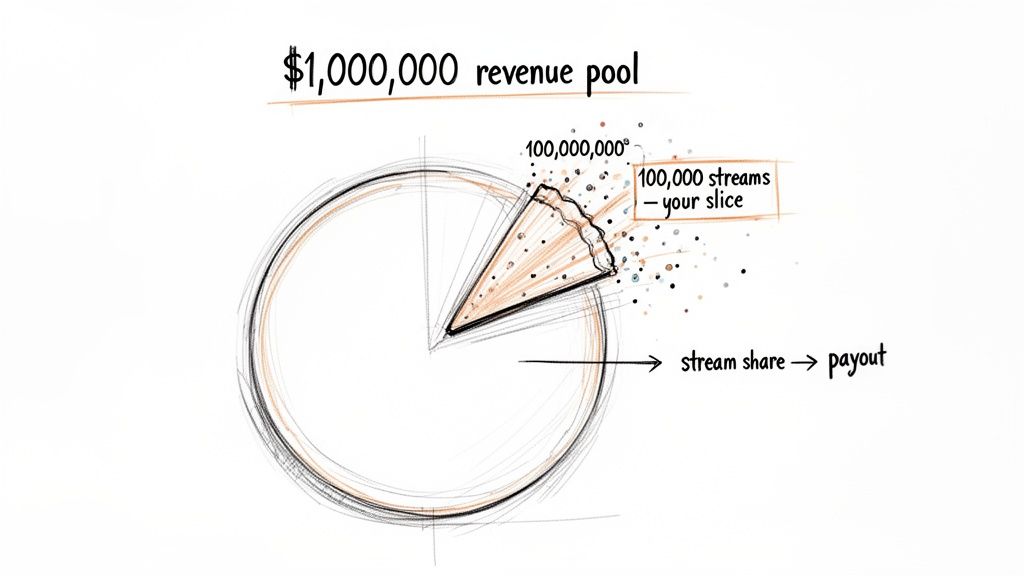
A Practical Walkthrough
Now, let's say your music absolutely crushed it and racked up 100,000 streams that month. To figure out your cut, we first need to see what percentage of the total streams you own.
The math is pretty straightforward:
(Your Streams / Total Streams) 100 = Your Stream Share Percentage
(100,000 / 100,000,000) 100 = 0.1%
So, your music accounted for 0.1% of all streams on Spotify for that period. Now, we just apply that percentage to the big money pot to calculate your gross earnings.
Your Stream Share Percentage Total Revenue Pool = Your Gross Royalty Payout
0.1% $1,000,000 = $1,000
In this scenario, your 100,000 streams generated a gross payout of $1,000. This shows exactly why the "per-stream rate" is a moving target. If the revenue pool was bigger or the total number of streams was lower, those same 100,000 streams would have earned you more. It's all relative.
Heads up: that $1,000 is the gross amount generated by your master recording. From there, it gets split between your label, distributor, and you, based on whatever deal you signed. Publishing royalties? That's a whole separate calculation from a different slice of the pie.
Key Variables That Change Your Payout
Of course, our example is super simplified. In the real world, a few key variables can drastically change how much you actually see in your bank account. Getting a handle on these is crucial for building a smart streaming strategy.
These are the three biggest game-changers:
Listener Subscription Type: A stream from a Spotify Premium user is worth way more than one from someone on the free, ad-supported tier. Premium listeners pour much more money into the monthly revenue pool, so their streams carry more weight.
Listener's Country: This one's huge. Subscription costs and ad revenue are completely different from one country to the next. A stream from a listener in a high-revenue market like the United States will earn more than one from a country where subscription fees are lower.
Your Distribution Deal: Before the money even gets to you, your distributor or label takes their cut from the master royalties. That percentage, which can be anything from 0% to 50% (or even more), is all laid out in your contract and directly hits your take-home pay.
Using a Calculator for Accurate Estimations
Trying to juggle all these variables in your head is enough to make anyone's brain hurt. You don't have to do all this math by hand. This is exactly where a dedicated Spotify royalties calculator becomes an artist's best friend, turning this messy formula into a powerful planning tool.
You can punch in your stream counts, adjust for things like where your listeners are, and get a much more realistic forecast of what you can expect to earn. To get a better grip on this and inform your marketing moves, you can learn more about how to calculate your Spotify royalties accurately and start setting some real, achievable income goals for your music.
The Journey of Your Money from Stream to Bank Account
Once a fan hits play, your royalties begin a long, winding road—not a direct flight. It's a journey with a built-in delay, and knowing the map is key to managing your music career. From that first stream to the cash landing in your bank, there’s a significant waiting period.
This isn't just some random hold-up; it's how the industry machine works. First, Spotify has to wrap up its monthly accounting, tallying up revenue from both subscribers and advertisers. Then, it calculates every single artist's piece of the pie based on their stream share. Only after all that does it report and send payments to distributors, who then have their own process before finally paying you.
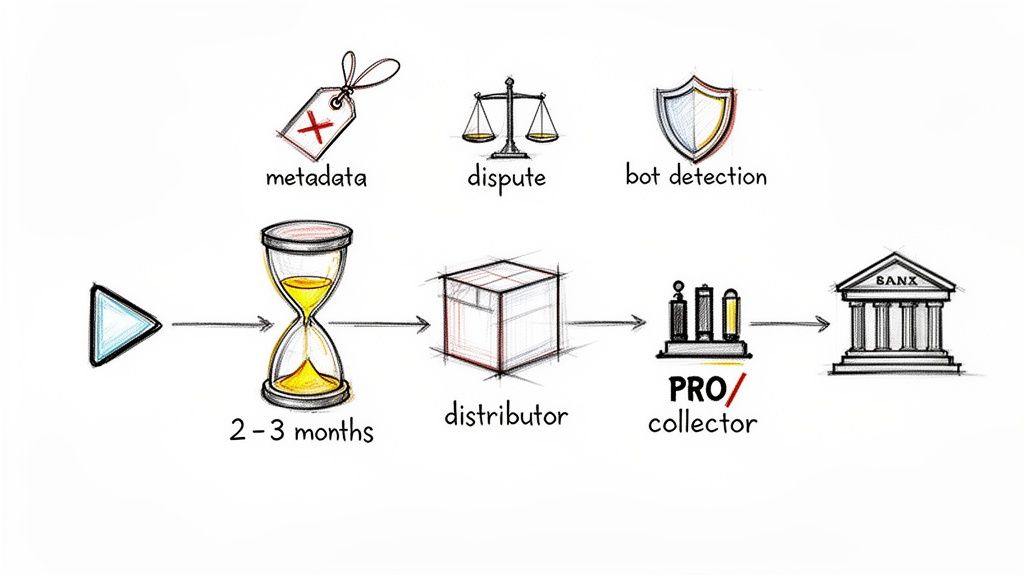
Standard Payment Timelines
When it comes to your recording royalties—the money your distributor handles—you can generally expect a two to three-month delay. So, the cash you earn in January probably won’t show up in your dashboard until March or April.
It gets even longer for publishing royalties, which are collected by PROs and The MLC. These groups often operate on quarterly or even semi-annual schedules. That means you could be waiting six to nine months (or sometimes more) for that money to finally hit your account.
This lag time is just part of the game. You're always looking at earnings from months ago, which is why having a solid grasp on your past performance is so crucial for planning what’s next.
Common Roadblocks That Cost You Money
Unfortunately, the path from stream to payment isn't always smooth. A few common snags can shrink, delay, or even completely stop your earnings. Knowing what to watch out for is your first line of defense.
Watch out for these three major threats to your royalties:
Incorrect Metadata: Think of this as a wrong address on an envelope. Simple mistakes in your song credits, ISRC codes, or publishing info can send your money into a black hole of unclaimed royalties. If the data isn't a perfect match everywhere, the collection societies literally can't figure out who to pay.
Ownership Disputes: This happens all the time. If you and your co-writers have conflicting info registered about the ownership splits, all payments get frozen until it's sorted out. Clear communication and signed split sheets are your best friends here.
Fraudulent Streams: This is a huge and growing problem. Bot-generated streams don't just fail to pay out; they can get your music kicked off Spotify entirely. The platform is constantly hunting for this activity, and if they flag a big chunk of your streams as fake, your payments will be withheld.
These issues show just how important it is to be on top of your business. The digital world has opened up massive income streams, with Spotify’s payouts helping more artists earn over $100,000 annually than were stocked in record stores at the peak of the CD era. And the best part? Independents are now claiming 50% of those royalties.
To protect that hard-earned income, you need tools that can spot artificial activity. The bot detection features in a platform like artist.tools are built for this—they analyze your playlist placements and flag suspicious patterns, giving you a chance to act before it hurts your bottom line. For a deeper dive, check out our guide on how to get paid by Spotify. Taking these steps helps ensure the money you earned actually completes its journey to your bank account.
Actionable Strategies to Maximize Your Spotify Royalties
Getting a handle on how Spotify royalties are calculated is one thing. But the real goal? Turning that knowledge into a bigger payout at the end of the month.
This means you have to stop chasing more streams and start thinking strategically about finding high-value listeners. Not all streams are created equal, and focusing your energy on the right audience can seriously boost your income. The secret is to target listeners in high-payout countries and get more streams from Premium accounts, since they add way more to the monthly revenue pool.
Target High-Value Geographic Markets
Where your listeners live has a massive impact on your royalty checks. A stream from a Premium user in the United States, United Kingdom, or Australia will put significantly more money in your pocket than a stream from a country with lower subscription fees. Your promo efforts need to reflect that.
When you're mapping out your marketing, focus your ad spend and social media push on these top-tier markets. If you’re running a Facebook or Instagram ad campaign, use location targeting to make sure your music is hitting potential fans in countries where their streams are worth the most.
Think of it this way: getting one new fan in a high-payout market could be worth the same as getting five fans in a lower-payout region. It’s all about working smarter, not just harder, to grow your Spotify royalties.
Find and Pitch to Quality Playlists
Playlists are still one of the biggest ways people discover new music on Spotify, but quality beats quantity every single time. Pitching your tracks to legitimate, well-curated playlists with listeners in your target markets is a direct line to higher-value streams.
Use a dedicated playlist search tool to find playlists that fit your genre and have an engaged audience in those key regions. The artist.tools Playlist Search feature lets you filter playlists by country and genre, helping you zero in on the perfect opportunities. A playlist with 10,000 real, engaged followers in the US is way more valuable than a botted list with 100,000 fake ones.
Once you’ve found the right playlists, you need a pitch that stands out. The artist.tools AI Editorial Pitch Generator can help you write a professional submission for official Spotify editorial playlists. It uses your track info and marketing plans to build a pitch based on hundreds of successful examples, upping your chances of getting noticed by editors.
Leverage Spotify for Artists Tools
Spotify's own promo tools are non-negotiable for any serious artist. When you release new music, always use the pitching tool inside your Spotify for Artists account at least a week ahead of release day. This gets your song in front of editorial curators and guarantees it will pop up in the Release Radar playlists for all your followers.
Pushing fans to follow you on Spotify is a simple but incredibly powerful move. Every new follower is another person who will automatically see your new music, driving those crucial early streams that can trigger algorithmic playlists like Discover Weekly.
The platform's growth is directly fueling artist careers. In a huge milestone, Spotify paid out a staggering $11 billion to the music industry in a single year, the biggest annual payment from any single retailer in history. You can read more about this record-breaking payout and what it means for artists.
Analyze Your Data for Growth Opportunities
Your streaming data is a roadmap to higher earnings. A tool like the artist.tools Spotify Royalties Calculator helps you see exactly how different variables can affect your income.
This screenshot from the calculator shows a simulation of potential earnings based on stream count and listener location.
See how the estimated payout changes dramatically when you adjust the percentage of streams coming from top-tier countries versus the rest of the world? This really drives home how important it is to target your marketing geographically to earn more from the same number of streams.
Here’s a quick breakdown of how these strategies connect with the tools available to you.
Royalty Growth Strategies and Supporting Tools
Growth Strategy | Why It Works | Relevant artist.tools Feature |
|---|---|---|
Target High-Value Markets | Streams from countries like the US, UK, and Australia pay significantly more per stream, maximizing your revenue. | Spotify Royalties Calculator to model and forecast earnings based on listener location. |
Secure Quality Playlist Placements | Getting on playlists with engaged, real listeners in your target markets drives high-value streams and triggers algorithmic support. | Playlist Search & Analyzer to find genre-relevant, bot-free playlists in specific countries. |
Craft a Winning Editorial Pitch | A professional, well-written pitch increases your chances of getting noticed by Spotify's editors for major playlist features. | AI Editorial Pitch Generator to create a compelling pitch based on proven successful examples. |
Monitor Your Data | Analyzing listener demographics and stream sources helps you refine your marketing and focus on what's working. | Spotify Royalties Calculator and other profile analytics tools to track performance and identify growth opportunities. |
By combining these smart strategies with the right data tools, you can move from just collecting streams to actively building a sustainable income from your music on Spotify.
Answering Your Biggest Spotify Royalty Questions
Even after you get the hang of how royalties work, a few questions always seem to pop up. Let's dig into the most common ones I hear from artists to clear up any confusion once and for all.
How Much Does Spotify Actually Pay Per Stream?
This is the big one, isn't it? The simple answer is that there is no fixed, universal rate per stream. Spotify doesn't just pay a flat fee every time someone hits play. Instead, it uses a "stream share" model.
Think of it like a big pot of money collected each month from ads and subscriptions. Spotify takes that total pot, and then pays out based on what percentage of the total streams your music accounted for.
Your effective per-stream rate is always shifting because of a few key things:
Where people are listening: Streams from countries with high subscription fees (like the US or Switzerland) are worth more than those from countries with lower fees.
The listener's account: A stream from a Premium subscriber is way more valuable than a stream from someone on the free, ad-supported plan.
Your distribution deal: The cut your distributor or label takes from the top will directly affect what ends up in your pocket.
Why Are My Streams High But My Royalties Are So Low?
It's a frustrating feeling. You see the stream count climbing, but the payout doesn't seem to match the hype. More often than not, this comes down to where your streams are coming from.
A million streams from free-tier users in low-payout territories will earn a fraction of what a million streams from Premium users in the US would. It’s a classic case of quality over quantity.
Another massive issue is fraudulent activity. Spotify is constantly on the lookout for bot streams and will filter them out, which can freeze your royalties or even get your music taken down. This is why keeping an eye on your playlists for any fishy activity is so important to protect your income.
The bottom line is this: stop chasing a raw stream count and start focusing on the quality of your streams. The most sustainable path to a real income from your music is to build a genuine, engaged fanbase in high-value markets.
How Do I Make Sure I'm Collecting All My Royalties?
To get every cent you're owed, you have to collect your recording and publishing royalties separately—they don't come from the same place.
Your distributor, whether it's DistroKid or TuneCore, is usually responsible for getting you your recording royalties. Easy enough.
But for your publishing royalties, you need to do a bit more legwork. You absolutely must be affiliated with a Performing Rights Organization (PRO) like ASCAP or BMI to collect performance royalties. On top of that, you need to register with a publishing administrator or directly with The Mechanical Licensing Collective (The MLC) in the US to get your mechanical royalties. If you skip these steps, you're leaving money on the table.
Ready to take control of your earnings and protect your music? artist.tools gives you the data and insights you need, from bot detection to playlist analysis, to maximize your Spotify royalties. Learn more and sign up at artist.tools.
.png)
.png)
Comments