
What Is a Music Publisher: Understanding Music Publishers
Our 2026 guide explains what is a music publisher, publishing rights, revenue streams, and how to get paid on Spotify. Learn the difference.
6
- What Is a Music Publisher and Why You Need One
- Composition vs Master The Two Copyrights You Must Understand
- How Publishers Make Money The Four Key Royalty Streams
- Publisher vs PRO vs Self-Publishing Choosing Your Path
- Decoding Publishing Deals and Common Red Flags
- Your Action Plan for Publishing Success on Spotify
Music publishing is an industry worth over $11 billion annually across 16 major markets, according to the International Confederation of Music Publishers, and Mordor Intelligence projects it will reach $16.46 billion by 2031. If you write songs and you’re only thinking about streams on the master side, you’re ignoring the business built around the composition itself.
Most artists ask “what is a music publisher” too late. They ask after a release is already live, after splits were handled casually in a text thread, or after money started arriving in fragmented statements that don’t match expectations. By then, the songs may be earning, but the administration is already messy.
A music publisher is the business partner for your songwriting copyright. Not your vocal, not your recording session, not your distributor upload. The publisher’s job is to administer, license, protect, and monetize the underlying composition: the melody, lyrics, and structure of the song.
That distinction changes how serious artists build careers. A record can spike and disappear. A composition can keep paying from streaming, live performance, radio, sync, covers, and international use long after the release cycle ends.
What Is a Music Publisher and Why You Need One
A music publisher manages the copyright in the composition and turns that copyright into income. The job includes registration, licensing, royalty collection, split administration, catalog management, and chasing down money when usage is reported badly or not reported at all.
For a working artist, the practical issue is not definition. It is administration.
A single song can generate money from several sources tied to the composition, and those payments do not collect themselves. If the writer shares are wrong, the metadata is incomplete, or no one has registered the work properly, the song can be performing in the market while part of the publishing income sits unmatched, delayed, or lost.
A label handles the master recording side. A publisher handles the songwriting copyright side. Artists blur those roles all the time, especially once a distributor, manager, or label gets involved. That confusion is expensive.
What a publisher actually does
At a practical level, a publisher makes sure your songs are identifiable, licensable, and payable. That includes registering works with the right parties, confirming splits, issuing licenses, collecting domestic and foreign income, monitoring usage, and enforcing your rights when someone uses the song without permission or without proper reporting.
The best publishers also solve workflow problems. They clean up split sheets before release. They push co-writers to confirm ownership percentages. They keep title variations from creating duplicate registrations. They know when a small sync fee is worth taking and when it creates conflicts with a better long-term use.
That is why serious artists should stop treating publishing like a back-office formality. It is part rights management, part revenue operations.
Why you need one, or at least need the function covered
Here is the common failure case. An artist releases a track, the distributor delivers the master correctly, Spotify streams start building, and the artist assumes everything is covered. Months later, the master royalties arrive, but some composition income is missing, live setlists were never submitted, one co-writer registered a different split, and a sync opportunity stalls because nobody can provide clean ownership information fast enough.
That scenario is ordinary. It is also avoidable.
Publishing matters early because streaming is only one part of the composition business, and even streaming creates more than one royalty path. The artists who collect the most are rarely the ones with the fanciest explanation of publishing. They are the ones with clean metadata, signed split sheets, registered works, and a clear decision about who is administering the catalog.
For an up-and-coming artist, the trade-off is straightforward:
- Handle publishing well: ownership stays clear, royalty collection improves, and licensing conversations move faster.
- Handle publishing poorly: income gets fragmented, co-writer disputes take longer to fix, and opportunities die in admin.
A good traditional publisher can help if you need active creative pitching, sync reach, and global administration. A strong self-publishing admin setup can also work if you have influence, clean operations, and enough catalog activity to justify staying independent. Either way, the need is the same. Someone has to manage the composition side properly.
Composition vs Master The Two Copyrights You Must Understand
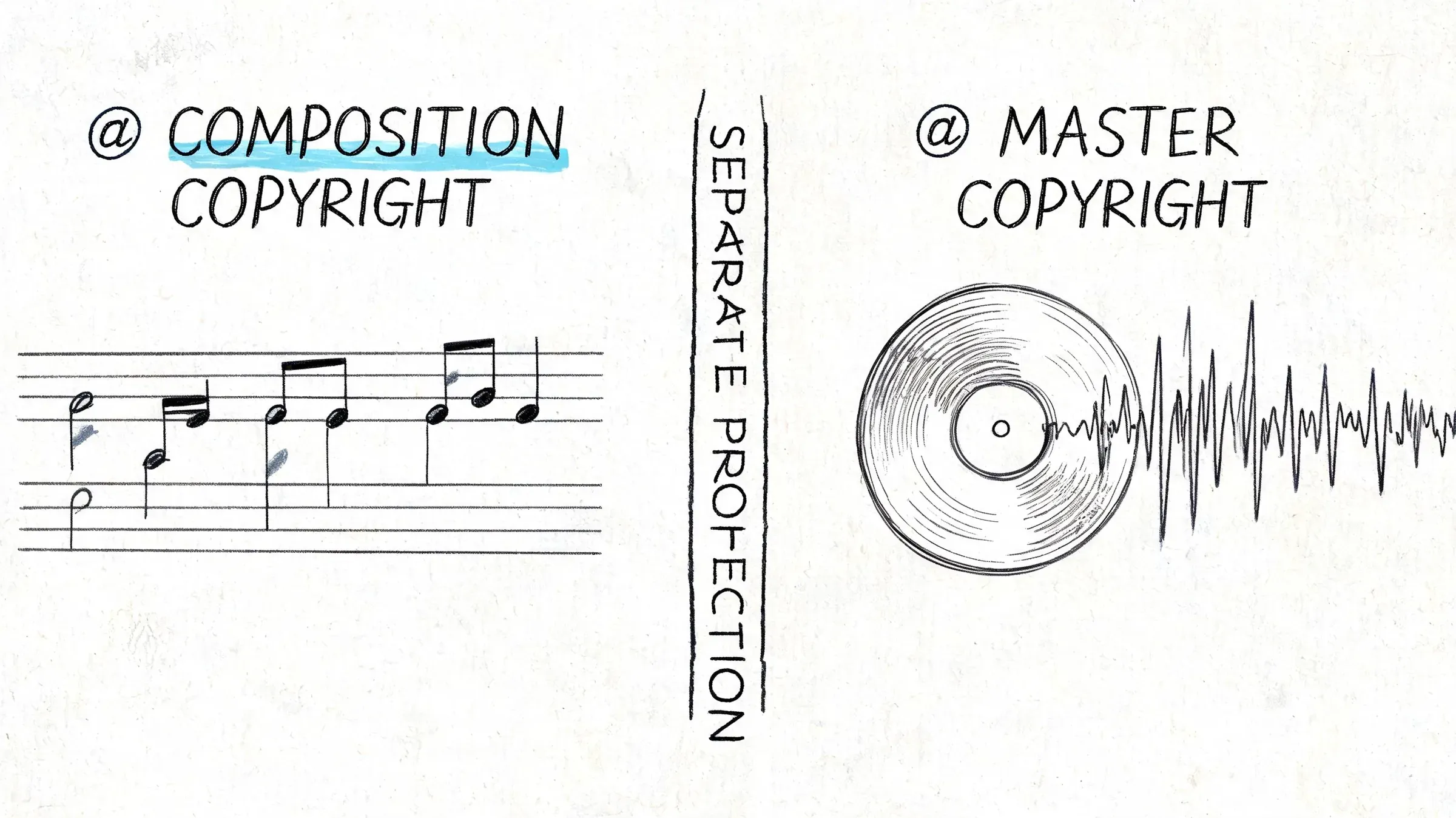
Every released song creates two assets that get paid through different systems: the composition and the master. Artists miss publishing income because they track the recording and ignore the song underneath it.
The composition is the underlying work. The master is the specific sound recording. If five artists record the same song, the market now has one composition and five separate masters.
What the composition covers
The composition includes the melody, lyrics, chord progression, and overall song structure. This is the copyright a publisher or publishing administrator handles. In practice, that means managing the rights tied to copying, distributing, performing, adapting, and displaying the song.
For a Spotify-era artist, that distinction has real cash consequences. A stream does not only exploit the recording. It also uses the underlying composition, which is why publishing administration matters even for artists who never plan to sign a traditional publishing deal.
The operational side is where artists usually slip.
If the song splits are wrong, the titles are inconsistent across registrations, or the work never gets properly registered, collection slows down or breaks entirely. I see this constantly with independent releases that were handled well on the distro side and badly on the publishing side.
Here is what sits inside the composition right in practical terms:
- Reproduction covers making copies of the song, including digital reproductions that feed mechanical royalties.
- Distribution covers the right to distribute the composition.
- Public performance covers income from radio, live performance, TV, and many streaming uses.
- Derivative works covers adaptations, translations, and other approved reworkings of the song.
- Display applies when lyrics or notation are shown visually in qualifying contexts.
If you need a clearer breakdown of how reproduction rights connect to streaming and mechanical income, see this guide to mechanical rights for music.
What the master covers
The master is the recorded performance that listeners hear. If you funded and self-released the track, you may own or control it. If a label funded the release, the label often owns or controls that master.
Master income comes from the use of that recording. Composition income comes from the use of the song itself. Same track title. Different rights. Different money flows.
A short explainer helps if you need to hear this from another angle.

Why the split matters in real life
This is not theory. It affects contracts, registrations, and cash collection every week.
- Co-writing sessions: the composition needs agreed splits in writing, even if one artist is handling the upload and release.
- Producer deals: producer points usually affect the master. They do not automatically give the producer publishing unless the deal says so.
- Sync licensing: music supervisors usually need clearance on both sides. One party for the master, one party for the composition, sometimes more if there are multiple writers or owners.
- Cover songs: the new artist creates a new master, but the original writers and publishers still control and earn from the composition.
- Catalog audits: a track can look fine in DSP dashboards while composition data is still broken across PRO, MLC, and publisher records.
Serious artists treat these as two parallel rights stacks and keep documentation for both. A music publisher does not manage the recording copyright. A music publisher manages the songwriting copyright.
How Publishers Make Money The Four Key Royalty Streams
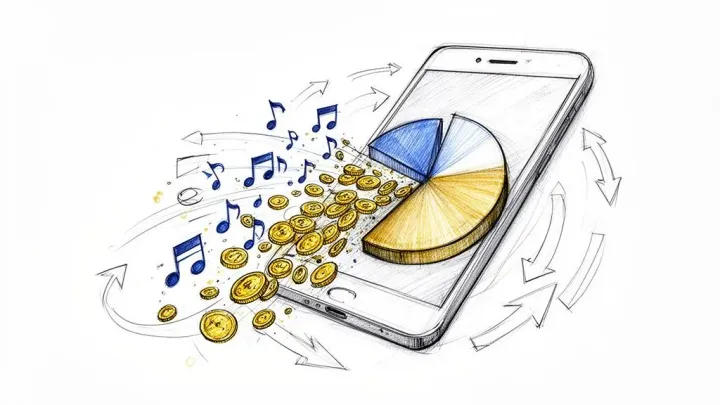
Publishing revenue usually comes from four streams: performance, mechanical, synchronization, and print. Artists who can identify each stream can read statements properly, spot missing income, and judge whether a publisher or admin company is collecting what the catalog earns.
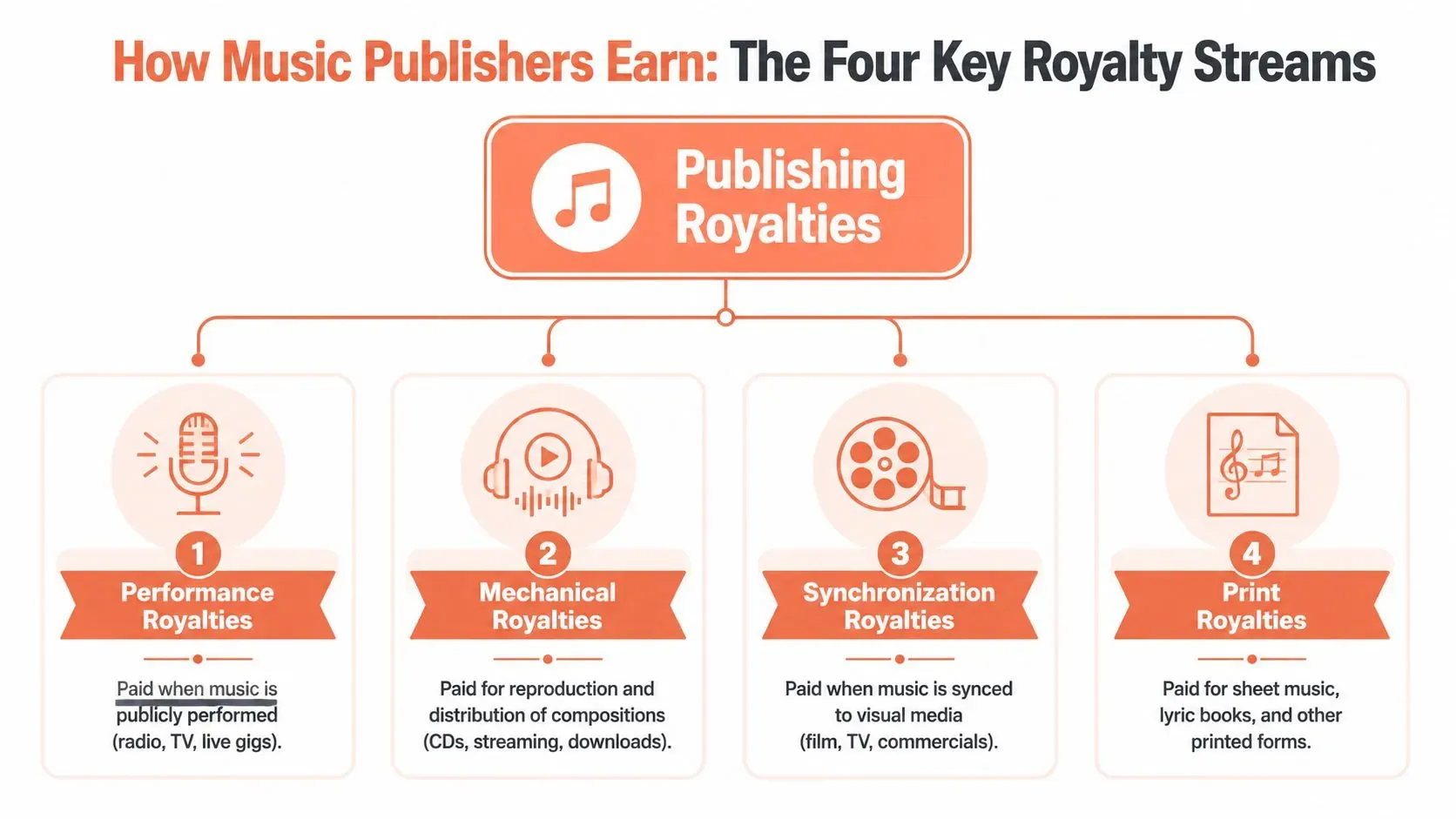
For a streaming-first artist, these streams do not perform equally. Performance and mechanical income usually make up the recurring base. Sync is less predictable but can change the economics of a song fast. Print is niche for many artists, but still matters in the right catalog.
Performance royalties
Performance royalties are paid when the composition is publicly performed or transmitted. That includes radio, TV, live venues, and many digital uses collected through PRO systems and related societies.
In practical terms, this is one of the easiest places to lose money through bad setup. A strong release schedule does not help if writer shares, publisher information, or cue sheet data are wrong. I see this constantly with independent artists who monitor Spotify for Artists every day but leave publishing registrations half-finished for months.
Performance income tends to build over time. It is less flashy than sync, but it is often the most dependable long-tail publishing revenue in an active catalog.
Mechanical royalties
Mechanical royalties are paid when compositions are reproduced and distributed. Physical sales and downloads still count, but the modern issue is streaming. Many artists then discover that releasing music and collecting composition income are two separate jobs.
If you need a clearer breakdown, this guide to mechanical rights for music covers the mechanics in more detail.
The strategic point is simple. Your distributor may deliver the recording to DSPs, but that does not mean your worldwide composition data is fully registered and matched. For Spotify-era artists, mechanicals are the first serious test of whether the back end is set up correctly. If song splits are missing, titles are inconsistent, or registrations do not match across collection societies, money sits unclaimed or gets delayed.
Synchronization royalties
Sync income comes from licensing the composition for use with visual media such as film, TV, ads, trailers, and games. This stream gets attention for a reason. A single placement can outperform months of streaming revenue, especially for developing artists with modest listener numbers.
It is also the stream where administration quality gets exposed fastest.
Music supervisors and agencies usually need fast answers on ownership, split approvals, production track availability, clean metadata, and one-stop or near one-stop clearance. If any of that is messy, the song often gets passed over. In real deals, speed and certainty beat theoretical potential. A publisher earns their keep here by keeping the chain of title clean, clearing approvals quickly, and pitching songs that can close.
Print royalties
Print royalties come from sheet music, lyric reprints, educational materials, and other printed uses of the composition. For many independent pop, rap, and electronic artists, this will be the smallest category. For composers, theatrical writers, worship catalogs, and education-focused repertoires, it can still be meaningful.
The mistake is not ignoring print. The mistake is assuming every song earns from every stream at the same level.
What this means for your strategy
For most up-and-coming artists, the realistic order is straightforward. Performance and mechanical royalties are the foundation. Sync is the upside play. Print is catalog-specific.
That changes how a good publisher, or a good self-publishing admin setup, should be evaluated. Ask harder questions than “Do they collect royalties?” Ask which societies they register with, how they handle conflicts and unmatched works, how quickly they process metadata changes, and whether they can pitch and clear syncs.
Publishing money is fragmented by design. The artists who collect more are usually the ones who treat registration, split management, and royalty tracking as operating work, not paperwork.
Publisher vs PRO vs Self-Publishing Choosing Your Path
A songwriter with streaming traction can still miss a meaningful share of publishing income if the setup stops at a PRO. That is the core decision here. You are choosing between collection only, collection plus administration, or a partner that also creates opportunities.
The right path depends on what is broken in your business. If songs are already coming out regularly and the metadata is clean, self-publishing with an admin service is often enough. If songs are getting cut by other artists, pitched for sync, or written in rooms where access matters, a real publisher may earn their share.
The three roles compared
| Service | Core Function | Typical Cost / Split | Best For |
|---|---|---|---|
| Traditional publisher | Administers, licenses, pitches, collects, and may actively seek syncs or co-writing opportunities | Ownership share or income split, depending on deal structure | Writers who want active exploitation and can justify giving up part of the publishing |
| PRO | Collects public performance royalties in its territory and pays writers and publishers | Membership and registration structure varies by organization | Every songwriter who needs domestic performance collection |
| Publishing administrator | Collects and administers publishing royalties while the writer retains ownership | Service fee or admin commission rather than ownership transfer | Independent artists who want to keep control and collect globally |
What each option actually solves
A traditional publisher helps when administration is only part of the job. Good publishers pitch songs, push for cuts, clear approvals fast, coordinate co-writes, and keep opportunities from stalling because the rights side is messy. The trade-off is straightforward. You give up part of the income, part of the copyright, or both.
A PRO handles one lane: public performance royalties. That makes it necessary, but limited. Joining ASCAP, BMI, SESAC, or another society does not register and collect every royalty stream tied to your compositions.
A publishing administrator handles the gap most independent artists run into. You keep ownership, but outsource registrations, international sub-publishing relationships, royalty collection, and the reconciliation work that gets missed when songs are spread across distributors, DSPs, and multiple co-writers.
Why self-publishing deserves a serious look
Self-publishing is a real first strategy now, not a consolation prize. TuneCore reported that independent artists generated more than $1.5 billion in revenue in 2024, and that broader shift matters because more artists now have enough scale to justify proper administration before giving up rights.
The practical takeaway is simple. Do not sign away publishing just because you finally got offered a deal.
Start by asking what you cannot do yourself. Collection? Fix that with a PRO plus an admin service. Global registrations and royalty matching? Same answer. Actual song exploitation, repeat sync access, and high-level writer development? That is where a publisher can justify a larger share.
If you are still sorting out domestic performance collection, this comparison of BMI vs ASCAP for songwriters clarifies where a PRO fits and where it stops.
Developing artists get in trouble when they treat a publishing deal as proof they are advancing. The better test is whether the publisher can point to specific writers placed, syncs closed, and catalog revenue improved in situations like yours.
A practical decision rule
Use this filter before signing anything:
- Choose a PRO if writer-side performance income is not set up yet.
- Choose an administrator if the catalog is active, ownership matters, and the main goal is collecting more of what is already being earned.
- Choose a publisher if the company can show real results in sync, cuts, writer development, or international exploitation that you are unlikely to create on your own.
For most Spotify-era artists, the sequence is usually PRO first, admin second, publisher later if the value is obvious. That order keeps control in your hands while the catalog is still being priced by the market.
Decoding Publishing Deals and Common Red Flags
A bad publishing deal can cost you years of income control. The biggest mistake I see is artists focusing on the advance and ignoring the clauses that decide who controls the songs, who gets paid first, and when rights come back.
The business is concentrated around a small group of major companies, and that affects negotiating power. Large publishers can offer global staff, sub-publishing relationships, and stronger sync reach. Independent publishers often move faster, take fewer meetings to get something approved, and give developing writers more attention. Neither option is automatically better. The question is whether the company can produce enough new revenue to justify the share it wants.
The common deal structures
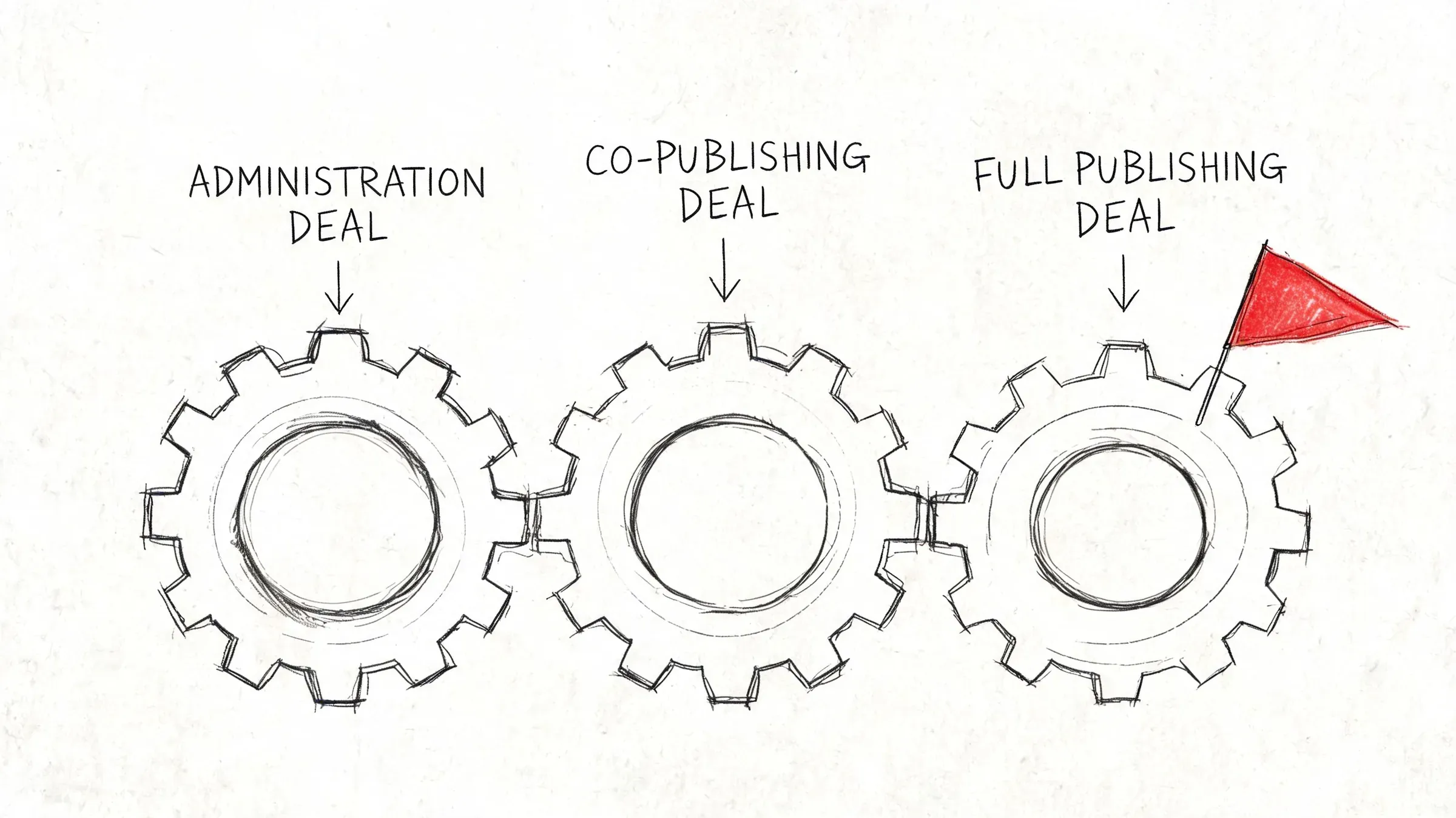
Administration deals are usually the lowest-risk entry point. You keep ownership, and the administrator handles registrations, royalty collection, and often some licensing support in exchange for a fee or limited commission. For a streaming-heavy artist whose main problem is missing composition money, this is often enough.
Co-publishing deals involve a real transfer of rights. You keep your writer share, but part of the publisher share goes to the company. In return, you should expect active exploitation, better sync pitching, stronger international administration, writer development, and faster response than an admin-only relationship.
Full publishing deals give the publisher the most control and the largest economic interest. Those deals can make sense for proven catalogs, established hit writers, or situations where the company is making a meaningful financial and creative commitment. Early-stage artists usually sign them too soon.
If you need a clearer view of how ownership, registration, and royalty collection fit together, this guide on how to publish your music and collect songwriting royalties is a useful reference before you review term sheets.
Red flags that should slow you down
Bad contracts rarely look bad on page one. The trouble sits in the definitions, recoupment terms, and reversion language.
- Cross-collateralization: Your publishing income can be used to recoup advances or losses tied to other songs, other writers, or even other agreements. That can delay your payout far longer than expected.
- Long effective control: A two-year term sounds reasonable until options, collection tails, and slow reversions turn it into six or seven years of practical control.
- Broad grant of rights: If the contract gives the publisher sweeping authority across all media and territories without clear performance obligations, you are taking most of the risk.
- Weak delivery language: If “delivery” is vague, the company can argue you still owe songs and extend the commitment period.
- Poor audit rights: If you cannot inspect statements clearly and on a defined schedule, underpayment gets harder to challenge.
- Unclear reversion terms: Rights should come back automatically under defined conditions. If reversion depends on the publisher’s discretion, expect friction.
- Approval clauses with carve-outs everywhere: If the contract says you have approval but then lists broad exceptions, you probably do not have meaningful approval.
If a publisher avoids clear answers on term, recoupment, approvals, and reversion, treat that as a contract problem, not a communication style issue.
What actually works in negotiation
Negotiating power comes from proof. Bring split sheets, registrations, release history, streaming data, prior syncs, and a clean summary of what the catalog is already doing. Publishers pay more attention when the catalog is organized and the upside is easy to see.
Ask direct questions. Which sync team will handle the catalog? How many active writers does each creative executive carry? What countries are covered directly versus through sub-publishers? How often are works registered, statements issued, and unmatched royalties chased? Serious companies answer those questions without hiding behind prestige.
Advances matter, but structure matters more. A smaller advance with a shorter term, clear performance obligations, and automatic reversion can beat a bigger check tied to broad rights and slow recoupment.
A publishing deal should fix a specific commercial problem. If the company cannot show how it will increase cuts, sync revenue, international collections, or catalog value, keeping control is usually the better business move.
Your Action Plan for Publishing Success on Spotify
A Spotify-era publishing strategy starts with administration discipline, not with waiting for a deal. Most independent artists should build a collection system first, then decide whether a publisher adds enough value to justify a split.
Emerging tools are changing how artists handle this work. The brief’s verified data notes that AI tools are reshaping the industry and that platforms such as artist.tools’ AI Editorial Pitch Generator can help independent artists secure placements that were once more accessible through publishers, while Q1 2026 IFPI data shows a rise in publishing income for self-managed artists using data tools for algorithmic and editorial optimization, as summarized in CSUN’s overview of music publisher responsibilities.
The checklist that matters
Start with the basics and do them in order.
- Join a PRO as a writer. If you haven’t affiliated with a performing rights organization, you haven’t even opened one of the core collection lanes for your composition.
- Register every song with accurate splits. Don’t leave split discussions informal. Confirm songwriter shares, publisher shares if applicable, and titles before release.
- Set up publishing administration if you’re independent. A PRO alone won’t capture the full global picture. If you’re keeping your rights, use an admin solution that can collect beyond domestic performance income.
- Keep metadata clean across releases. Inconsistent writer names, title variations, and split discrepancies create avoidable payment problems.
What to do before and after release
Before release, confirm who wrote what, who owns what, and who is responsible for registration. After release, monitor whether the song is appearing correctly across platforms and whether uses line up with collection.
Operational tools are important. artist.tools can be part of that workflow because it includes a Spotify Royalties Calculator for modeling earnings scenarios, Playlist Search for researching relevant curators, a Monthly Listeners Tracker for audience context, Stream Tracker for performance monitoring, and an AI Editorial Pitch Generator for release pitching. If you want the broader setup process in one place, this guide on how to publish your music and collect songwriting royalties is a useful reference.
What works versus what wastes time
What works is boring and repeatable:
- Clear split sheets
- Consistent writer naming
- Prompt registration
- One source of truth for ownership
- Regular statement review
What wastes time is chasing “industry attention” while your catalog foundation is weak. A publisher, administrator, or sync contact can only move as fast as your rights allow.
Your first publishing win usually isn’t a headline sync. It’s collecting money you already earned but hadn’t properly set up to receive.
The artists who handle publishing well aren’t always the most famous. They’re the ones whose songs are easy to clear, easy to register, and easy to account for. That’s why they get paid more consistently, and why better opportunities tend to find them earlier.
If you’re building your career on Spotify, artist.tools gives you practical data for the parts of publishing and release strategy that artists usually manage blindly, from royalty modeling and playlist research to stream tracking and editorial pitch support.