What Is a Royalty in Music Explained
- Aug 9, 2025
- 14 min read
At its heart, a music royalty is a payment made to creators whenever their music is sold, played, or used in public. Think of it like a usage fee. It’s the system that makes sure everyone who helped create a track—from the person who wrote the lyrics to the one who performed it—gets paid for their work.
Understanding Music Royalties and How They Work
So, what exactly is a music royalty? Let’s use an analogy. Imagine you wrote a hit novel. Every time the publisher sells a copy, you get a small cut. That’s a royalty. Music works on the same basic idea, but it’s a bit more complex because a song can be "used" in so many different ways beyond just being sold.
These payments are the financial lifeblood for musicians, turning artistic passion into a real, sustainable career. And we’re talking about a massive ecosystem. To give you some perspective, Spotify recently announced it paid out over $10 billion in music royalties in just one year. That number alone shows you how much money is flowing through the system, especially from streaming.
To really get how that money finds its way back to artists, you first need to know who the key players are. Each one holds different rights to a song and earns royalties for their specific contribution.
The Main Players in the Royalty Ecosystem
Before we break down the different types of royalties, let's get a clear picture of who's getting paid. It's not just one person collecting a check. A single song involves several key rights holders, each with a specific role and claim to the earnings.
Here’s a quick summary table to help you keep track of who’s who.
Key Music Royalty Players and Their Roles
Rights Holder | Primary Role | What They Earn Royalties For |
|---|---|---|
Songwriter/Composer | Creates the song's melody and lyrics. | The underlying musical composition. |
Recording Artist/Performer | Performs the song for a specific recording. | The actual sound recording (the "master"). |
Music Publisher | Manages and licenses the composition. | Administering the songwriter's composition rights. |
Record Label | Finances, produces, and promotes the recording. | Owning and exploiting the master recording. |
Understanding these roles is the first major step. You've got the people who create the song's core (songwriters), and the people who bring that song to life in a recording (artists). Then you have the business partners—publishers for the song, and labels for the recording—who help manage and monetize those assets.
Key Takeaway: A single song has two distinct sets of rights: one for the composition (the lyrics and melody) and one for the sound recording (the master). This is the most important concept in music royalties.
This fundamental split is why different types of royalties exist and get paid out to different people. To get an even deeper look into this, check out our complete guide explaining music royalties for artists. Once you’ve got this framework down, we can start exploring the specific kinds of royalties a song can generate.
The Two Halves of a Song Copyright
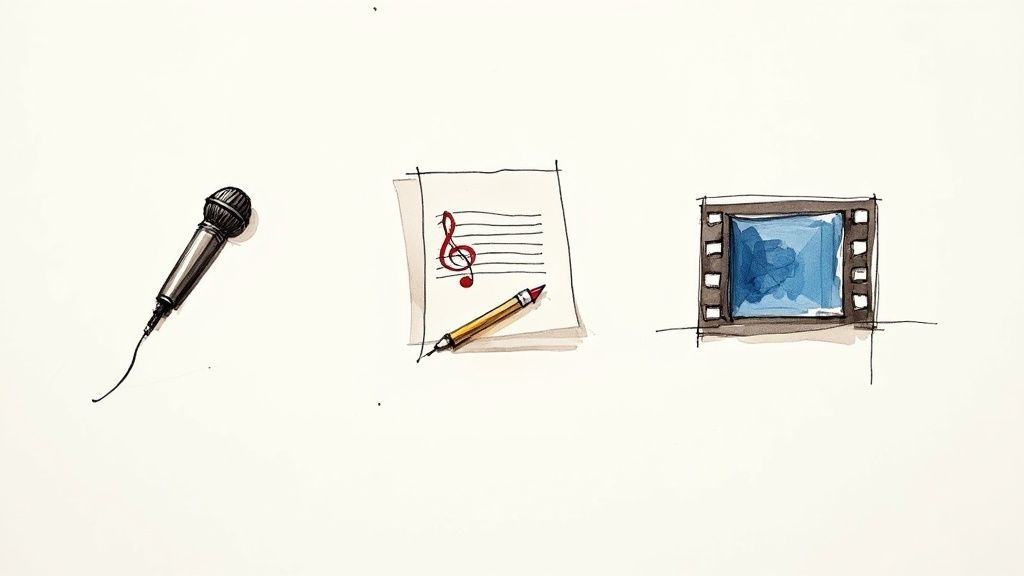
Before we can even start talking about what a royalty is in music, we have to get our heads around the single most important idea in music copyright law: every song is actually two things at once. It’s a dual-sided asset, and this split is the bedrock of the entire royalty system.
Think of it this way: there’s the blueprint for a house, and then there’s the actual house built from that blueprint. In music, one copyright protects the song’s “blueprint,” and another protects the final “build.” These are completely separate assets that earn different kinds of money for different people.
The Composition Copyright: The Song's DNA
First up, you have the composition copyright. This is the song in its purest, most fundamental form—the melody and the lyrics. It’s the sequence of notes and words that makes a song what it is, no matter who’s singing it or how it’s arranged.
Take a classic like Leonard Cohen's "Hallelujah." The composition is the core melody and the incredible lyrics he penned. That intellectual property exists on its own, completely separate from any one recording. This copyright is almost always owned by the songwriter(s) and their music publisher.
The Sound Recording Copyright: The Master
The other half of the puzzle is the sound recording copyright, which everyone in the industry just calls the “master.” This copyright doesn't protect the song itself, but a specific, finished performance of it. It’s the actual audio file you hear on Spotify, pull up on Apple Music, or spin on a vinyl record.
Sticking with our "Hallelujah" example, Jeff Buckley’s legendary cover is one very famous sound recording. The version from the Shrek soundtrack is another. So are the thousands of other covers out there. Each one is a unique "master," and each has its own distinct copyright. This right is typically owned by the recording artist and the record label that funded the studio time.
Key Analogy: Think of the composition as the recipe for a cake. The sound recording is the actual cake you baked from that recipe. You can have one timeless recipe (the composition) but a hundred different bakers can create their own unique cakes (the sound recordings) from it.
This isn't just some legal theory; it's the entire reason different people get paid when a single track gets played. The songwriter gets a check for the use of their "recipe," and the recording artist gets paid for the use of their specific "cake."
This fundamental split is why, for example, a traditional radio station in the U.S. has historically paid royalties to songwriters and publishers (for the composition) but not to the artists and labels who created the recording (the master). It’s a point of major contention, with things like the proposed American Music Fairness Act trying to close that gap.
Getting this concept down is the key. It unlocks your understanding of how different royalty streams, from mechanicals to performance fees, actually work.
Breaking Down The Main Types of Music Royalties
Now that we’ve got a handle on the two fundamental copyrights—the composition and the sound recording—we can start connecting them to how you actually make money. Every single time your song gets used, it kicks off a specific kind of income stream. Answering the question "what is a royalty in music?" is all about understanding these core pillars of revenue.
Think of royalties as different payment methods for different ways your music is used. Each one is triggered by a unique action, making sure the right people get paid for their specific piece of the puzzle, whether it's for the underlying song or the final polished recording.
This infographic breaks down how those revenue streams flow from different uses, how they're calculated, and how they ultimately get split up between everyone who owns a piece of the song.
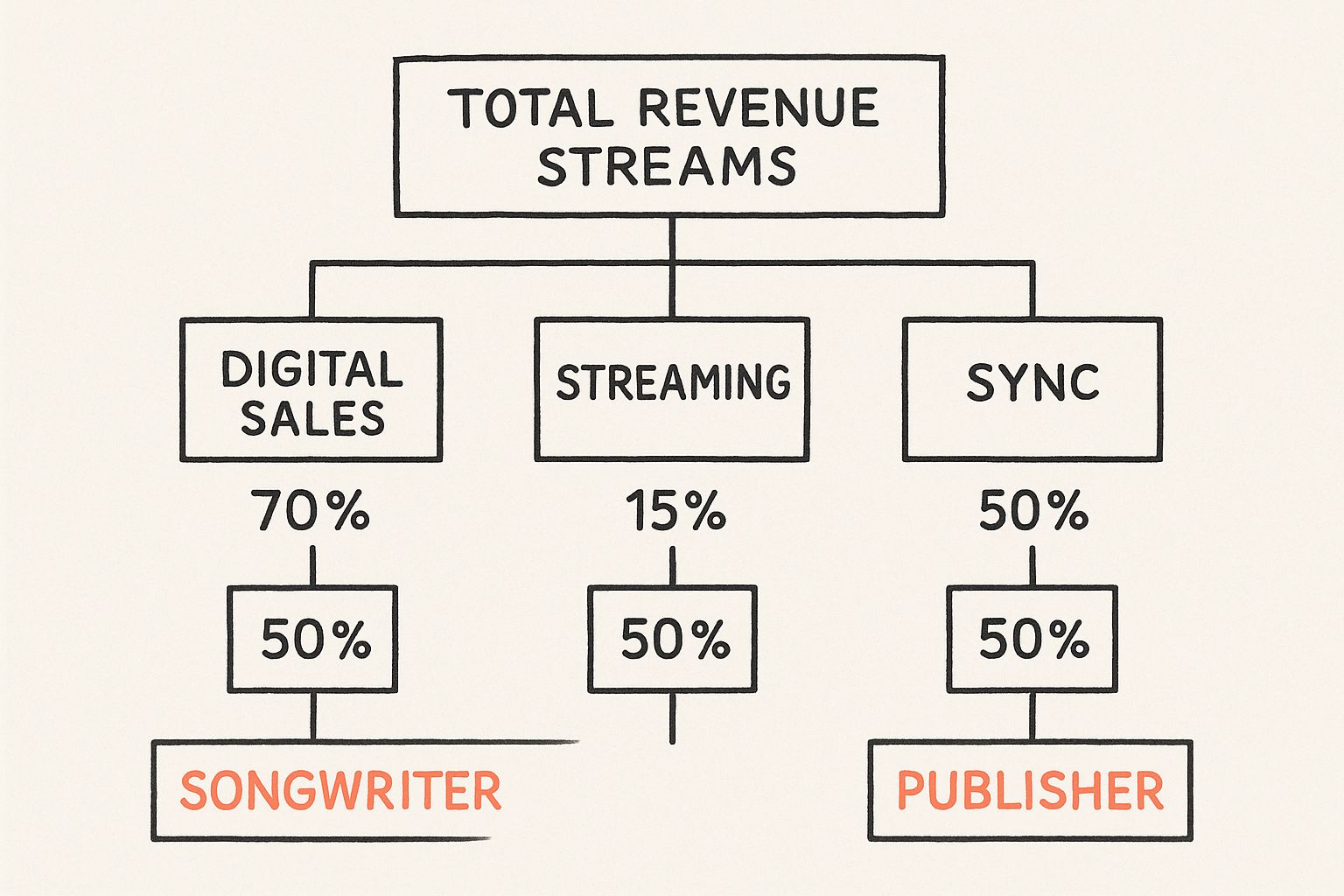
As you can see, every scenario—from a simple Spotify stream to a huge placement in a TV show—triggers a specific royalty payment. Each has its own unique rate and its own path to your bank account.
Mechanical Royalties: The Fee for Copies
First up is the mechanical royalty. This is the money you earn anytime a copy of your song's composition is made and distributed. Back in the day, this was all about physical products: vinyl records, CDs, and cassette tapes.
But today, the definition of a "copy" is much broader. A mechanical royalty is also generated from interactive streams on platforms like Spotify and Apple Music, and from digital downloads on stores like iTunes. Legally, every stream is considered a temporary "reproduction" of the song, and that's what triggers this payment.
Here's a good way to think about it: A mechanical royalty is the fee someone pays to use the blueprint (the composition) to build something, whether that's a physical product like a CD or a digital one like a stream.
These royalties are owed to the songwriter and their publisher for the use of the composition.
Performance Royalties: The Fee for Public Plays
Next, we have performance royalties. These are generated whenever a song is performed or broadcast publicly, and they're one of the most significant and common sources of income for songwriters. The term "public performance" covers a massive amount of ground, including:
Radio Airplay: When your track gets played on terrestrial (AM/FM) or satellite radio.
TV Broadcasts: When your song is featured in a television show, movie, or commercial.
Live Venues: When a song is performed live—by you or a cover band—at a concert, bar, or restaurant.
Streaming Services: For plays on non-interactive services like Pandora radio or interactive ones like Spotify.
Public Spaces: When music is played in the background at businesses like coffee shops, gyms, or retail stores.
Performance royalties are collected by Performance Rights Organizations (PROs) like ASCAP and BMI, who then distribute the money to the songwriters and publishers. If this is new territory for you, exploring how music royalties work in our complete artist's guide can give you a much deeper dive into how these collection societies operate.
Sync Royalties: The Fee for Visual Media
Finally, there are synchronization royalties, usually just called sync royalties. A sync royalty is earned when a song is licensed to be used with any kind of visual media. It gets its name because the music is "synchronized" with the action happening on screen.
This can often be one of the most lucrative income streams for an artist. Common examples include:
Music in a feature film or a popular TV series.
A song used in a Super Bowl commercial or an online ad.
The soundtrack for a blockbuster video game.
Background music in a viral YouTube video.
Sync licensing typically involves a one-time fee, which can range from a few hundred dollars to well over $100,000, all depending on the project's budget and how famous the song is. This sync fee is negotiated directly and is split between the owners of the composition (the songwriter/publisher) and the owners of the master recording (the artist/label).
How Artists and Songwriters Actually Get Paid
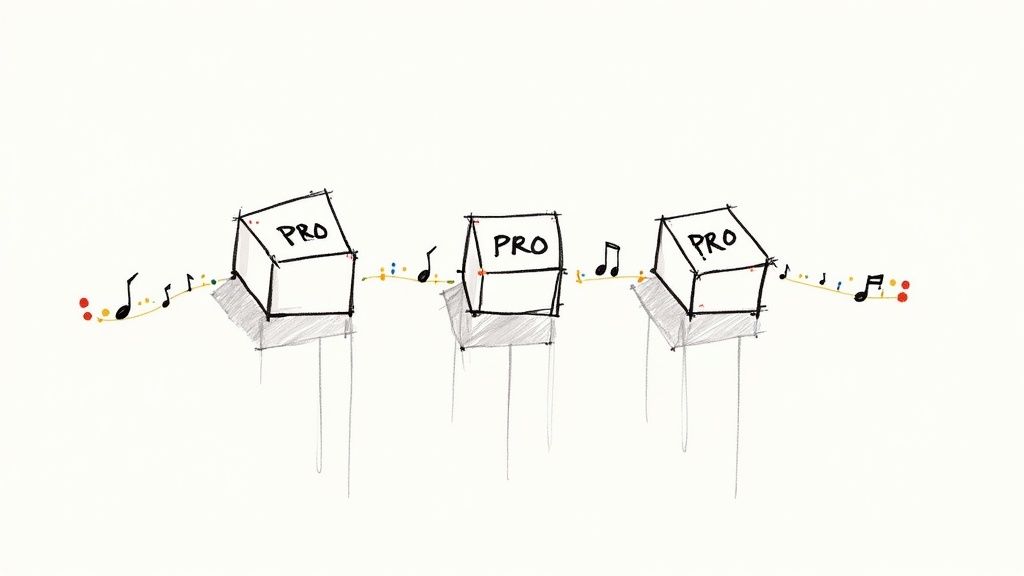
Knowing the different royalty streams is one thing, but how does that cash actually travel from a coffee shop's speakers or a Spotify stream into an artist's bank account?
The short answer is: they don't do it alone. A whole web of organizations works behind the scenes to track, collect, and send out these funds.
Think of these groups as the financial plumbing of the music industry. They create the connection between the millions of places playing music and the millions of creators who made it. Without them, it’d be basically impossible for an independent songwriter to collect a few cents every time their song plays on a radio station halfway across the world.
The Role of Collection Societies
These essential organizations are generally called Collective Management Organizations (CMOs). Their entire job is to manage rights and royalties for creators. Under this big umbrella, you'll find more specialized groups that zero in on specific types of royalties.
Here are the key players every artist and songwriter needs to know:
Performance Rights Organizations (PROs): These are the most well-known collectors. Organizations like ASCAP, BMI, and SESAC in the U.S. focus only on collecting performance royalties. They license radio stations, TV networks, restaurants, and digital services, then pay those earnings to songwriters and publishers.
Mechanical Rights Organizations (MROs): These groups are all about mechanical royalties. In the United States, The Mechanical Licensing Collective (The MLC) is the main MRO, tasked with collecting mechanicals from streaming services and getting them to the right songwriters and publishers.
This system makes sure that when a song gets used, there’s an efficient way to get the money to its rightful owners.
Who Collects What for Whom
It’s easy to get lost in the alphabet soup of acronyms, so here’s a simple way to think about it.
A PRO like BMI is tracking public performances for the songwriter’s composition. At the same time, an MRO like The MLC is tracking digital "reproductions" (aka streams) for that very same song. They’re like two different tollbooths on the same musical highway, collecting money for different types of usage.
To give you an idea of the scale we're talking about, this entire collection infrastructure is a massive global business. Global revenues from music copyrights recently topped $45.5 billion, with over $12.9 billion of that collected by CMOs for public performance and usage alone. These numbers show just how vital these organizations are to the whole music economy.
To make this even clearer, here's a quick guide to which organization handles what.
Who Collects What: A Guide to Royalty Organizations
Organization Type | Examples | Primary Royalty Collected | Who They Pay |
|---|---|---|---|
PRO | ASCAP, BMI, SESAC, GMR | Performance Royalties | Songwriters & Publishers |
MRO | The MLC, HFA | Mechanical Royalties | Songwriters & Publishers |
Distributor | TuneCore, DistroKid | Master Recording Royalties | Recording Artists & Labels |
As you can see, each organization has a very specific job. They don't overlap, but work together to make sure everyone involved in a song gets their fair share.
Key Insight: Artists and songwriters have to actively register their work with these organizations. The money doesn't just find you. If your songs aren't registered with a PRO and an MRO (or a publishing administrator), your royalties will sit unclaimed.
For artists, this means your job isn't done when you finish the music. You also have to manage the business side to ensure you get paid for your work. A huge part of that is understanding how platforms like Spotify calculate these payments.
To get a real sense of what to expect, check out our guide on how much Spotify artists actually make to see a breakdown of the numbers. The journey from a stream to your bank account is complex, but knowing the players involved is the first step toward getting paid correctly and on time.
The Impact of Streaming on the Royalty Landscape
When streaming platforms like Spotify and Apple Music first appeared, they didn't just offer a new way to listen—they completely rewired the financial engine of the music business. The old model was pretty straightforward: you sell a CD or a digital download, and you get paid for that specific sale. Streaming turned that entire concept on its head. We moved from a simple transaction to a system built on billions of tiny, continuous micropayments for every single listen.
This shift created a world of incredible opportunity, but also a ton of new challenges. For the first time ever, an independent artist could record a song in their bedroom and, overnight, have it heard by a global audience without needing a big-time record deal. This democratization of music distribution has been a game-changer, giving creators a direct line to fans everywhere.
But with this new accessibility came staggering complexity. Instead of a clear-cut sale, an artist’s royalties are now calculated from a massive pool of a platform's total revenue, which is then split up among literally billions of streams. This makes answering the question, "what a royalty is in music," more complicated than ever before.
A New Model for Monetization
The streaming economy runs on what’s called a "pro-rata" system. Think of it like this: all the money a platform like Spotify makes in a month from subscriptions and ads gets thrown into one giant pot. That total pot of money is then divided by the total number of streams across the entire platform for that month. This gives you a tiny, fractional value for a single stream. Your earnings are simply your slice of the pie, based on how many streams your music generated.
This model makes one thing crystal clear: an artist's income is now directly tied to listener engagement. It’s no longer about convincing someone to make a one-time purchase. Now, it’s all about keeping them listening, again and again. This has completely changed how artists and labels think about marketing, shifting the focus to getting on the right playlists and building a loyal, long-term audience rather than just aiming for a huge first week of sales.
This move to a consumption model is the single biggest reason the music industry is growing again. The global recorded music market has seen ten straight years of growth, recently hitting $29.6 billion in revenue. Subscription streaming makes up more than half of that total. You can dive deeper into the numbers in the full IFPI Global Music Report summary.
Opportunities and Challenges for Artists
For any creator trying to build a career today, this new world is a double-edged sword.
Global Reach: The barriers to entry have never been lower. Anyone can use a digital distributor to get their music live in over 180 countries.
Complex Payouts: The per-stream rate is notoriously small and fluctuates constantly, often just fractions of a penny. This means you need an enormous number of streams to earn a sustainable income.
Data-Driven Decisions: The upside is that artists now have access to amazing data. You can see exactly who is listening to your music and where they are in the world, which is invaluable for planning tours and targeting your marketing.
The "Attention" Economy: With over 100,000 new tracks uploaded every single day, just getting heard is a massive challenge. Your success often hinges on catching the attention of the right playlist curators and algorithms.
At the end of the day, streaming has made music more accessible for everyone—creators and listeners alike. But it has also introduced a fiercely competitive and often confusing financial system that every artist needs to understand to navigate their career.
Common Questions About Music Royalties
Once you start to get your head around the theory of music royalties, a bunch of practical questions usually pop up. For artists and songwriters, figuring out the answers is the difference between actually getting paid and leaving a pile of your own money on the table.
Let’s tackle some of the most common points of confusion. Think of this as your real-world guide to making the royalty system work for you.
How Do Independent Artists Collect All Their Royalties?
For an independent artist, there’s no single magic button that collects everything. The reality is you have to put together your own team of services to cover all the different royalty streams. It's like building a financial toolkit specifically for your music career.
Your toolkit absolutely needs these three things:
A Digital Distributor: This is your first stop. Services like TuneCore or DistroKid are how you get your music onto Spotify, Apple Music, and other platforms. They are responsible for collecting your master recording royalties and paying them out to you.
A Performance Rights Organization (PRO): You have to personally sign up as a songwriter with a PRO like ASCAP or [BMI](https://www.bmi.com/). This is the only way you'll see your share of performance royalties when your music gets played on the radio, in a coffee shop, or streamed online.
A Publishing Administrator: To get your hands on your mechanical royalties from streams and sales around the world, you need a publishing administrator (like Songtrust) or a publisher. They are the ones who chase down and claim these royalties on your behalf globally—a job that’s basically impossible for an individual artist to do alone.
Key Takeaway: If you’re only using a distributor, you're almost certainly collecting only your recording royalties. You must also join a PRO and sign up with a publishing admin to get all the composition royalties you’re owed.
How Much Is One Stream on Spotify Worth?
This is probably the number one question everyone asks, and the answer is surprisingly slippery: there is no fixed per-stream rate. The value of a single stream literally changes every month based on a whole mess of factors.
Instead of a fixed price tag, think of it like a slice of a pie that keeps changing in size. Each month, Spotify pools all its subscription and ad revenue into one giant pot. They then divide that total pot by the total number of streams across the entire platform that month. That tiny resulting number is the "per-stream value" for that specific month.
A few things can make your slice of the pie bigger or smaller:
Listener's Location: A stream from a fan in a country with high subscription costs, like Switzerland, pays more than a stream from a country with lower fees.
Listener's Account Type: A stream from a Premium subscriber is worth way more than a stream from a free user who is listening with ads.
Your Distribution Deal: The fees and percentage your distributor or label takes will also affect how much cash actually lands in your pocket.
Because of all this, the payout usually ends up somewhere between $0.003 and $0.005 per stream. But it's so important to remember this is just a rough average, not a guaranteed rate.
What Is the Difference Between a PRO and SoundExchange?
This one trips a lot of people up, but the distinction is actually pretty simple once you remember that every song has two separate copyrights.
A PRO (like ASCAP or BMI) is all about the composition—the underlying melody and lyrics. They collect performance royalties and pay them to the songwriter and their publisher.
[SoundExchange](https://www.soundexchange.com/), on the other hand, deals with the sound recording—the specific "master" track that was recorded. They collect digital performance royalties and pay them to the recording artist and the owner of the master (which is often a record label).
Specifically, SoundExchange’s territory is non-interactive digital radio in the U.S. Think services like Pandora or SiriusXM satellite radio. When your song plays on one of these, two separate royalties are generated: one for the song itself (collected by your PRO) and another for the recording (collected by SoundExchange). They handle royalties for different rightsholders from the exact same digital play.
Comments