Your Ultimate Guide to Creating an EPK for Artists
Updated: Sep 8
An Electronic Press Kit (or EPK) is your digital resume for the music industry. It's the slick, professional package you send to venue bookers, journalists, playlist curators, and labels to get their attention and lock in those crucial opportunities.
Think of it as your best foot forward, available 24/7.
Why a Modern EPK Is Your Most Powerful Tool
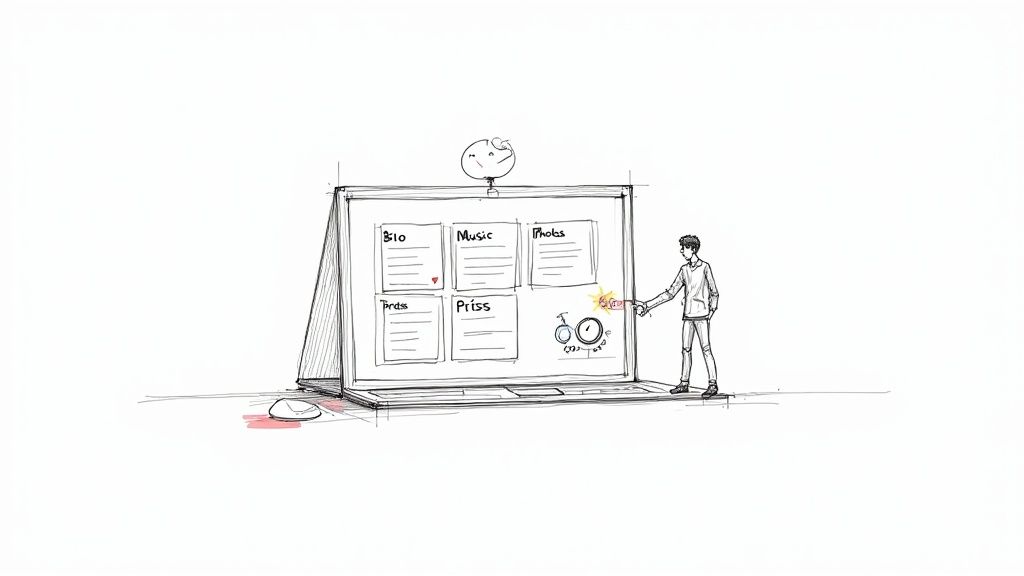
Let's be real. An EPK for artists isn't just a "nice-to-have" anymore—it's your essential handshake in the music world. The days of stuffing envelopes with CDs, printed photos, and a prayer are long gone. Today, you have mere seconds to make an impression.
Picture a busy venue booker on a Tuesday afternoon, drowning in submissions for a weekend slot. They don't have time to dig through your social media for a bio or hunt down your latest single. They need everything in one spot, right now.
A sharp, well-organized EPK gives them exactly what they need, instantly:
What's your sound? Your best tracks are embedded and ready to play. No searching, no extra clicks.
What's your vibe? High-resolution press photos are there, ready to be downloaded for a flyer or a blog post.
What's your story? A compelling bio gives them the narrative they need for promotion.
Are you serious about this? The simple fact that you have a polished EPK screams professionalism. It tells them you're ready to work.
The Shift to Digital and Mobile-First
Moving from bulky physical kits to a streamlined digital format gives you a massive advantage. Promoters, bloggers, and A&R reps can get everything they need with a single click, not a trip to the post office.
This shift has also completely changed how industry pros review your material. Recent data shows that a staggering 67% of music professionals now open promotional materials on their phones. This makes a mobile-friendly EPK that looks great on any screen an absolute must. You can read more about the evolution of EPKs and their impact to see just how critical this has become.
An EPK isn’t just a folder of files; it’s a strategic tool designed to eliminate friction. Every second a booker wastes looking for your info is a second they could be moving on to the next artist. Your job is to make saying 'yes' as easy as possible for them.
Your 24/7 Professional Representative
It shows that you respect an industry professional’s time by giving them a concise, comprehensive, and easy-to-use package. That small act of preparation can be the deciding factor between landing the gig and getting lost in a crowded inbox. It’s not just about showcasing your music; it's about proving you’re ready for whatever comes next.
Assembling the Essential Parts of Your EPK
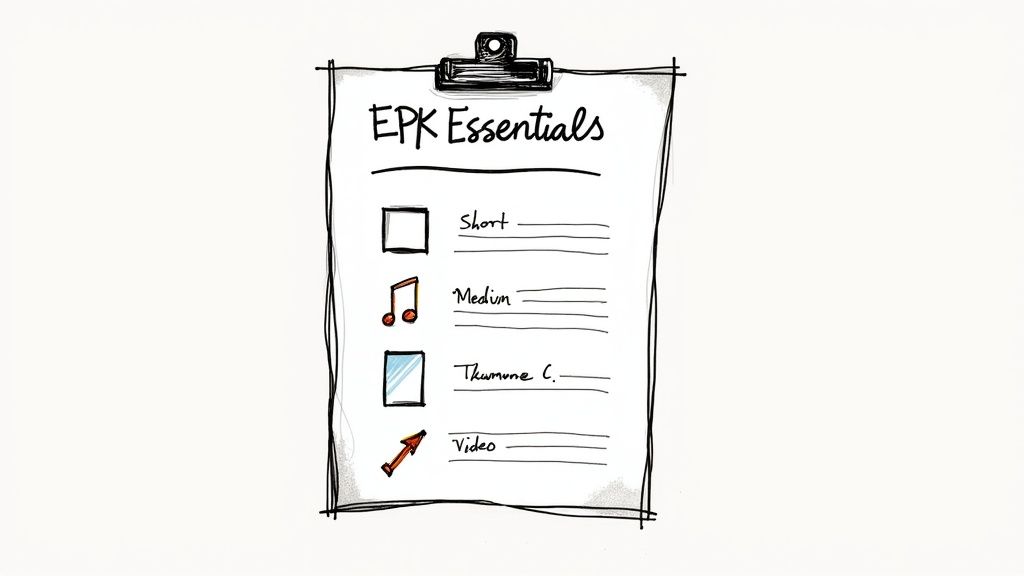
Think of your EPK for artists like a puzzle. It only tells the full story when every piece is perfectly in place. Each section has a job to do, and together, they build a compelling case for who you are and why someone should care.
Your real goal here is to get ahead of every question a promoter, blogger, or A&R rep might have. Answer it before they even think to ask. A complete EPK shows you're not just a talented artist—you're a professional who's ready to work.
Your Artist Bio in Every Flavor
Your bio is often the first real look someone gets into your world. It needs to grab them, tell them something real, and—this is key—it has to be flexible. A festival program has way different space constraints than a deep-dive blog feature, so you absolutely need a few versions ready to go.
A venue might just need a quick blurb for a flyer, while a journalist could be looking for your entire backstory to build an article around. Having these locked and loaded saves everyone a headache.
The Short Bio (1 Paragraph): Your elevator pitch. Who you are, your genre, and what makes your music yours. It’s the hook that gets them to dig deeper.
The Medium Bio (2-3 Paragraphs): This is your workhorse. Use it to expand on your musical journey, key influences, and any recent wins. You'll use this version for most press releases and website pages.
The Long Bio (4+ Paragraphs): This is for the feature stories. Go into your origins, your creative process, and where you're headed next. It gives writers plenty of material to craft a compelling narrative.
Your bio isn't just a list of facts; it's your story. Making that story connect with people is everything. For a much deeper look, check out our complete guide on how to write an artist bio that truly connects.
Music: Your Best Tracks Front and Center
Okay, this is the heart of it all. The music you showcase has to be your absolute best stuff, representing the sound you want to own. Don't throw your entire catalog at them; curate a tight selection of 3-5 standout tracks.
The most important thing is making it effortless to listen. An embedded player from Spotify or SoundCloud is non-negotiable. Industry folks are busy. Making them leave your EPK to find your music is a rookie mistake.
And right alongside that streaming player, include a link to download high-quality audio files (WAV or 320kbps MP3). This is a must for radio programmers or podcasters who need broadcast-ready audio.
Professional Press Photos
Your visual identity is just as crucial as your sound. Grainy phone snaps just won't fly. Seriously, investing in a professional photoshoot pays for itself by instantly communicating your brand and professionalism.
You need to give them options that will work for anything—a square Instagram post, a wide website banner, you name it.
Essential Photo Types to Include:
Photo Orientation | Resolution | Why It's Important |
|---|---|---|
Landscape (Horizontal) | High-Resolution (300 DPI) | Perfect for website headers, banners, and digital flyers. |
Portrait (Vertical) | High-Resolution (300 DPI) | Ideal for magazine features, posters, and social media stories. |
Black & White Option | High-Resolution (300 DPI) | Some publications have specific aesthetic requirements. |
Always make sure your photos are easy to grab in high-res. A simple link to a Dropbox or Google Drive folder works perfectly and is industry standard.
Videos That Capture Your Energy
Video is one of the most powerful tools you have. It shows bookers what you're actually like on stage and gives journalists dynamic content they can embed directly into their articles.
Focus on quality, not quantity. One killer, well-shot live performance video is worth a hundred shaky phone clips.
Live Performance Videos: This is how you get gigs. It proves you can command a room and connect with a real audience.
Official Music Videos: This is where you show off your creative vision and artistic direction, giving people a deeper look into your world.
Embed your top 1-2 videos right in the EPK with a YouTube or Vimeo player. No extra clicks, no friction.
Press Clippings and Key Achievements
This section is all about social proof. If you've got press coverage, this is where you flaunt it. Don't just paste a bunch of links; pull out the most powerful quote and credit the source.
Something like this:
"A truly electrifying performance that commands the stage." – Local Soundcheck Magazine
But what if you're just starting and don't have press yet? Don't just leave this section blank. Reframe it as "Highlights" or "Achievements."
What to Include Without Formal Press:
Notable opening slots for bigger acts
Impressive streaming numbers on a specific song
Playlist placements (even on smaller, taste-making playlists)
Any awards or music competition wins
This is all about showing momentum. It proves other people are already on board, which makes it much easier for the next person to jump in, too.
Using Data to Make Your EPK Irresistible
Let's be real. A great bio, killer photos, and amazing music are the price of entry. That's what gets your EPK opened. But if you want to get a "yes" from a promoter, a label scout, or a busy music journalist, you need to speak their language.
And that language is data.
Numbers are the proof. They take your EPK from a creative pitch and turn it into a solid business case. You're no longer just saying, "I have fans who like my music." You're showing them exactly who those fans are, where they live, and how many of them there are. That's a game-changer.
Go Beyond "People Like My Music"
Put yourself in the shoes of a venue booker. You have two artists in front of you, both equally talented. Artist A sends you some great tracks. Artist B sends great tracks and a one-sheet showing they have 2,500 monthly listeners right there in your city.
Who gets the gig? It’s not even a question.
This is where data becomes your secret weapon. It instantly answers the questions that every industry pro is silently asking:
Who is your audience? Knowing your listener demographics helps a promoter see if your crowd fits their venue.
Where is your audience? Pinpointing your top cities shows a booker you can actually sell tickets and draw a local crowd.
Is your audience growing? Showing a steady climb in streams and followers proves you have momentum. You're not a fluke; you're a growing business.
You don't need to be a data wizard. You just need to use a few simple numbers to build credibility and make it a no-brainer for someone to invest their time, money, or platform in you.
Finding the Story in Your Numbers
The good news is, you don't have to go digging for this data. Platforms like artist.tools were built to give independent musicians the kind of powerful analytics that used to be locked away in major label boardrooms. It translates your Spotify activity into undeniable proof points for your EPK.
The dashboard in artist.tools, for instance, lays it all out for you—no spreadsheets required.
This is the kind of snapshot that makes an A&R person's eyes light up. You can see follower growth, monthly listeners, and even check for bot activity to prove your numbers are legit. It’s a professional, data-backed look at your career trajectory.
An EPK is more than just a resume for an artist; it's a vital part of the entire music industry's engine. As technology evolves with AI-driven analytics and other tools, artists have more power than ever to create compelling, data-rich press materials that cut through the noise. For a broader look at this trend, you can discover more insights about the role of EPKs on meegle.com.
The Key Data Points to Include in Your EPK
You don't need to overwhelm people with a wall of stats. The key is to be selective and highlight the numbers that tell the most compelling story. Here’s what you should focus on when building the data section of your EPK for artists.
1. Listener Demographics
Show them exactly who's listening and where. A clean graphic or a few bullet points is all you need.
Top 5 Cities: This is non-negotiable, especially for booking shows. List the cities where your music is most popular.
Age & Gender: A simple percentage breakdown is perfect (e.g., "Audience: 60% Male, 40% Female, primarily ages 18-24").
2. Verified Playlist Placements
Getting on playlists is a huge win, but proving they’re quality playlists is what really matters. Use a feature like the Playlist Analyzer in artist.tools to check a playlist’s health and engagement before you brag about it.
Playlist Name & Follower Count: Example: "Indie Chill Vibes (15k Followers)"
Add Context: Briefly explain what it is. Is it a "Tastemaker indie blog playlist" or an "Official Spotify editorial"? This detail matters.
3. Organic Streaming Growth
Nothing says "this artist is about to pop" like a growth chart. A simple line graph or a couple of punchy stats showing your momentum over the last 3-6 months is incredibly powerful.
Listener Growth: "Increased monthly listeners by 40% in the last quarter."
Single Momentum: "Our latest single, 'Sunset Drive,' hit 50,000 streams in its first month."
Weaving these data points into your EPK transforms it. It's no longer just a collection of your creative work; it's an active, persuasive pitch that shows you're a serious professional who understands the music business. To get even deeper into this, check out our full guide on mastering music data analytics for artists.
So, you've gathered all the key pieces—the killer bio, the pro photos, your best tracks, and the hard data to back it all up. Now for the big question: where does this all live? The format you choose for your EPK is just as important as what's inside it, directly affecting how easily industry pros can access and act on your info.
Making the right call here ensures all your hard work actually pays off. You want something that looks impressive, sure, but it also needs to be simple for you to manage. The best choice really comes down to your tech skills, budget, and what your goals are right now.
The Dedicated Website Page
This is the gold standard, hands down. Creating a dedicated, unlisted "Press" or "EPK" page on your official artist website is the most professional move you can make. It gives you a central, private hub that you can update in real-time with new press quotes, tour dates, or fresh music.
A web-based EPK lets you embed rich media, which is huge. You can drop your Spotify player and YouTube videos right onto the page. No extra clicks, no sending people away from your world. It keeps them engaged. Platforms like Squarespace and Bandzoogle have made this super straightforward, with templates built specifically for artists.
This approach just screams that you're a serious artist. It keeps everything under your own brand and means your EPK is always just one clean, professional link away.
The Versatile PDF
The downloadable PDF is a classic for a reason. It's a self-contained package that works offline, making it perfect for direct email outreach. When you're pitching a specific blogger or venue booker, attaching a sleek PDF feels personal and direct.
But PDFs have their downsides. They're static. Every time you need to make an update, you have to recreate and re-upload the entire file. Annoying, right? Plus, big files packed with high-res images can get flagged by spam filters or just be a pain for people to download.
If you go this route, keep the design clean and triple-check that all your links to streaming profiles and downloads are live and clickable. A PDF is best used as a sidekick to a web-based EPK, not as your only option.
The Streamlined One-Pager
For those quick pitches where you need to make an impression fast, a one-page EPK is your secret weapon. It’s often a simple landing page or a tidy, one-page PDF that cuts straight to the chase.
Think of it as your EPK’s elevator pitch.
Who you are: A single, punchy paragraph for a bio.
What you sound like: An embedded player with your top two tracks. No more.
What you look like: Your single best press photo.
Key highlights: Three bullet points of your biggest wins.
Contact info: A direct email address.
This minimalist approach is a lifesaver for busy industry contacts who need to make a quick call. It shows you respect their time by giving them the most vital info upfront, making it easy for them to decide if they want to learn more.
Your EPK is a living document, not a one-and-done project. Choosing a format that you can easily and regularly update is the single most important factor. An out-of-date EPK is worse than having no EPK at all.
This infographic breaks down the essential data-driven features your EPK should highlight, no matter which format you choose.
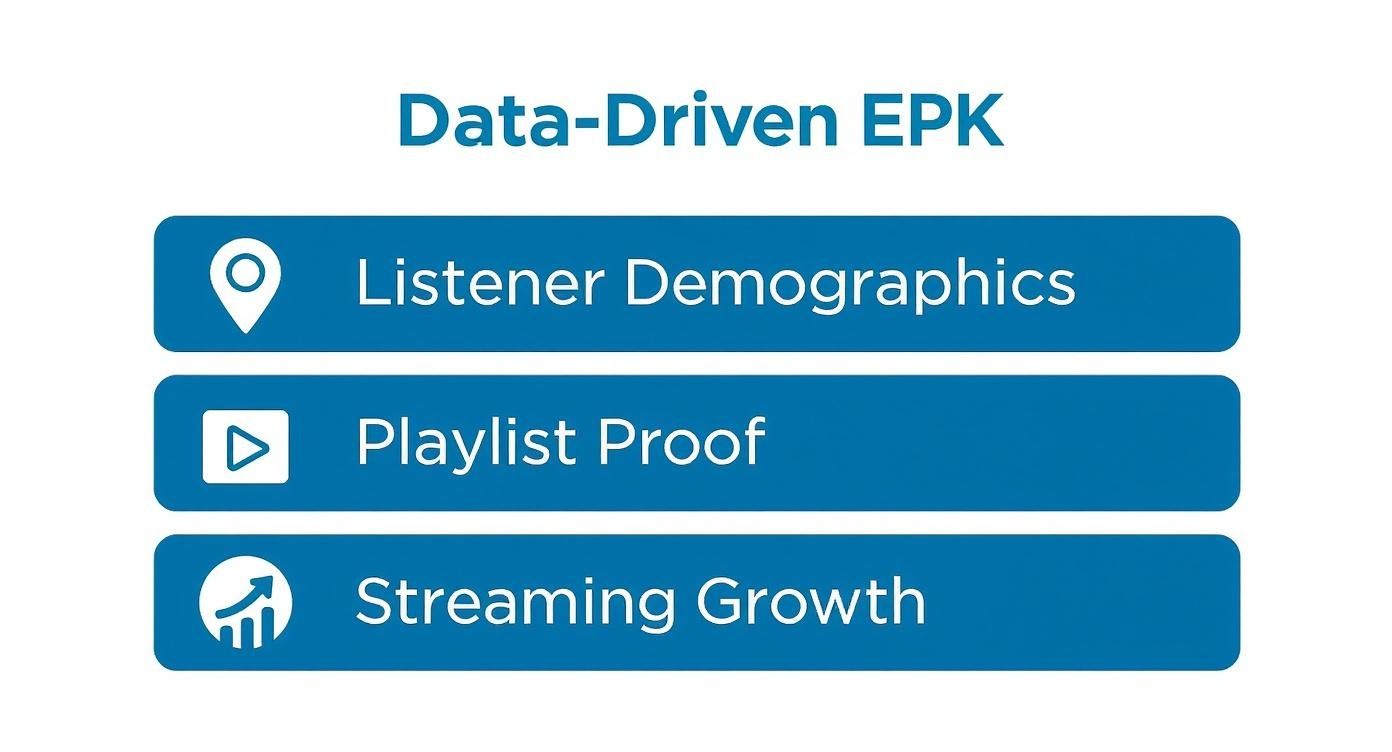
By visualizing listener demographics, playlist proof, and streaming growth, you turn your creative work into a compelling business opportunity.
Ultimately, the best strategy is often a hybrid one. Use a dedicated page on your website as your main, comprehensive EPK. Then, create a streamlined one-page PDF version that you can quickly attach to personalized emails. That way, you’ve got the perfect tool for any outreach scenario.
Getting Your EPK into the Right Hands
So you've built a killer EPK. That’s a massive step, but let's be real—it's only half the job. A perfect press kit collecting digital dust on your hard drive isn't going to book you a single gig or land you on that dream playlist.
Now for the important part: getting it in front of the right people. We’re talking about the venue bookers, music bloggers, and playlist curators who can actually move the needle for your career.
Effective outreach isn't about blasting a generic email to a hundred random contacts and hoping for the best. It's a game of strategy, personalization, and building real connections. Think of every pitch not as a marketing blast, but as the potential start of a professional relationship.
Finding and Vetting Your Targets
Before you even think about hitting "send," you have to do your homework. Firing off your indie-folk EPK to a heavy metal blog is just a waste of everyone's time. Good outreach is targeted and intentional.
Start by building a focused list of contacts. Who are you trying to reach, and why?
For Booking Gigs: Scope out local venues that book artists in your genre. Check their event calendars—who's played there recently? If your sound fits, dig for the direct email of their talent buyer or booker, not the generic "info@" address.
For Press Coverage: Find music blogs and online magazines that actually cover artists like you. Read a few of their recent articles to get a feel for their voice and the kind of music they feature.
For Playlist Placements: This is where precision is everything. Hunt down independent curators whose playlists match your specific sound and vibe. Don't just look at the title; listen to the tracks.
Don't just find a name; understand what they do. A quick glance at their social media or recent work gives you valuable context that makes your pitch feel personal and informed, not like another piece of spam.
Writing a Pitch That Actually Gets Read
Once your target list is ready, it’s time to craft the pitch itself. Your mission is to be concise, personal, and professional. Industry gatekeepers are drowning in emails; they don't have time for your life story.
Keep your subject line clear and to the point. Something like “Pitch: [Your Artist Name] - New Single [Song Title]” works perfectly. Stay away from clickbait or anything too casual.
In the body of the email, get straight to it.
A Simple Pitch Structure That Works:
The Personalized Opener: Start with a sentence that proves you've done your research. "Loved your recent feature on [Similar Artist]" or "I've been following your [Playlist Name] playlist for a while, your taste is incredible." This one line can be the difference between getting read and getting deleted.
The Ask: State exactly why you're reaching out. Are you looking for a show, a review, or a playlist add? Be clear.
The Hook: Describe your music in one compelling sentence. This is your elevator pitch. Make it count.
The Link: Provide a single, clean link to your EPK. A link to a dedicated page on your website is ideal. Never, ever attach large files.
The Polite Close: A simple "Thanks for your time and consideration" is all you need.
This approach respects their time and makes it incredibly easy for them to find what they need. If you're targeting curators specifically, we've got a whole guide on how to contact Spotify curators effectively.
The Art of the Follow-Up
What if you don't hear back? First off, don’t take it personally. Inboxes are chaotic. A polite follow-up about a week later isn't just acceptable; it's often necessary.
Keep it short. Just reply to your original email with something like, "Hey, just wanted to bring this back to the top of your inbox. Let me know if you get a chance to check it out. Thanks!"
One follow-up is standard. Any more than that, and you start to look pushy.
Finally, a pro tip: add a link to your EPK directly in your email signature. This simple move turns every single email you send into a passive promotional tool. You never know when the right person will see it, so make sure you're always prepared.
Got Questions About Your EPK? We’ve Got Answers.
Putting the final touches on your EPK always brings up a few last-minute questions. It’s those little details that can make the difference between a professional pitch and one that falls flat. Let's clear up some of the most common hurdles so you can send your kit out with total confidence.
Think of this as your quick-reference guide for navigating those final decisions and avoiding rookie mistakes.
How Often Should I Be Updating My EPK?
Your EPK is a living, breathing document, not a dusty resume you set and forget. It should always reflect exactly where you are in your career right now. A good habit is to give it a refresh at least once a quarter.
That said, you need to update it immediately after any major career event.
New Music Release: This is a big one. Add your new single or album, update your bio to talk about the new project, and swap in the fresh artwork.
Major Press Feature: Land a great review or an interview? Get that quote and link into your press section ASAP.
New Promo Photos: As soon as you get new professional shots, swap out the old ones. Keep your image current.
Big Show or Festival Booking: Add major upcoming dates to show you're an active, in-demand artist.
An outdated EPK sends the wrong message—it screams that you're not active or taking your career seriously. If a promoter sees a press quote from three years ago and nothing else, they're just going to move on.
What if I Have Zero Press Quotes?
Ah, the classic chicken-and-egg problem. You need press to get more press, but how do you get that first shiny quote? Don't just leave the section blank—that’s a red flag. The key is to reframe it.
Instead of a "Press" section, try calling it "Highlights" or "Achievements." This lets you build momentum and show proof of your progress without needing formal reviews from publications.
Here’s what you can use instead of press quotes:
Industry Shout-Outs: Did a respected local producer, venue owner, or bigger artist say something cool about your music? Use it (with their permission, of course).
Impressive Stats: Numbers talk. Something like, "Debut single hit 10,000 Spotify streams in its first month," is powerful.
Notable Gigs: Showcase your best opening slots. "Opened for the nationally touring act [Band Name] at the legendary [Venue Name]."
Playlist Placements: This is social proof. "Featured on the influential 'Indie Chill' playlist (25k followers)."
Should I Put Cover Songs in My EPK?
Honestly? Probably not. Your EPK is your shot to sell your unique artistic identity and songwriting. A booker, blogger, or A&R wants to hear what you bring to the table, not how well you can play a Tom Petty song.
There are only a couple of rare exceptions. If you're primarily a wedding or event band, then showing off a versatile repertoire is a key selling point. The other exception is if a cover you released went unexpectedly viral and became a legitimate part of your story. Otherwise, stick to your original material. Your EPK is where you sell your vision, nobody else's.
What’s the Single Biggest Mistake I Can Make?
The most common—and most damaging—mistake is simply making things difficult for the person you're sending it to. This covers a whole range of sins: sending massive, uncompressed photo files that crash an inbox, providing broken links, or burying your contact info three clicks deep.
Every extra click, every moment of confusion, every second a busy industry pro has to spend hunting for basic info drastically increases the chance they'll just close the tab and forget about you. Your mission is to eliminate friction entirely. Make your music streamable with one click. Make your photos downloadable in a snap. Make your bio easy to copy and paste.
Above all else, respect their time.
Ready to build an EPK that proves your value with undeniable data? artist.tools gives you everything you need, from listener demographics and verified playlist proof to an AI-powered pitch generator that helps you stand out. Take control of your music career today. Learn more at https://artist.tools.
.png)
.png)
Comments