A Modern Playbook For Managing Music Artists On Spotify
- Feb 15
- 16 min read
Successfully managing a music artist on Spotify is a mix of art and science. It’s about channeling raw talent into a real career by focusing on the right metrics and, most importantly, building a professional foundation from day one. This is the roadmap to making that happen.
Building Your Foundation For Spotify Success
Let's be real: managing an artist on Spotify today means you're operating in a whirlwind of constant change and fierce competition. The climb from obscurity to recognition can be faster than ever, but so is the risk of getting lost in the noise. Guesswork and vanity metrics just don't cut it anymore. Every move has to be informed by solid data.
This is where a platform like artist.tools becomes your secret weapon. It cuts through the abstract numbers and gives you a clear, actionable plan for navigating Spotify’s ecosystem. But before you even think about advanced promotion, you have to get the basics right.
Setting The Stage For Growth
Solid artist management starts with a rock-solid foundation. This means getting every piece of an artist's Spotify profile polished and ready for an audience before you push the big red "promote" button. Think of it like setting up your shop before the grand opening—you want everything to look perfect.
This initial onboarding phase is more than just busy work; it’s your first strategic move. A clean, professional presence makes every dollar you spend on promotion work harder.
To get started, here's a quick rundown of the absolute must-dos.
Initial Onboarding Checklist For Spotify Artists
Action Item | Why It Matters | Key artist.tools Feature |
|---|---|---|
Claim Spotify for Artists | This is non-negotiable. It unlocks analytics, the direct pitching tool, and profile features like Artist Pick. | Not applicable - direct Spotify action. |
Optimize Bio & Images | A compelling bio and high-quality, consistent visuals build a brand identity that connects with potential fans. | Profile analysis and branding insights. |
Organize the Discography | Ensures all releases are correctly listed. A clean catalog encourages new listeners to dig deeper into the music. | Catalog management and release tracking. |
Initial Goal Setting | Define clear, measurable goals (e.g., reach 10k monthly listeners) to guide your strategy from the start. | Goal setting tools and KPI trackers. |
Getting these pieces in place ensures that when new listeners discover your artist, they find a credible and engaging profile that's worth following.
The pace of the industry right now is insane. We're seeing songs hit 1 billion Spotify streams 14 times faster than they did a decade ago, and three times more artists are hitting that 'Superstar' status. The catch? Holding onto that momentum is tougher than ever. It demands sharp, strategic management to not just break through but to stay there. You can get more context on the industry's speed over at artists.badenstock.com.
A successful Spotify strategy isn't about one viral moment. It's about building a series of repeatable, data-informed actions that create sustainable career momentum.
This initial setup isn't just administrative; it's the bedrock of your entire strategy. By establishing this professional baseline, you're making sure that every promotional effort that follows has the best possible chance to succeed.
Translating Spotify Data Into Actionable Insights
Look, effective artist management is all about getting past the vanity metrics. Raw data is just noise; the real magic happens when you can turn those numbers into a story that tells you exactly what to do next. This is where you stop just watching trends and start making them.
By setting a clear performance baseline, you can finally measure the real impact of every single you drop, every playlist you pitch, and every ad you run. Without it, you’re just flying blind, unable to tell the difference between a lucky break and a strategy you can actually repeat.
Setting Your Performance Baseline
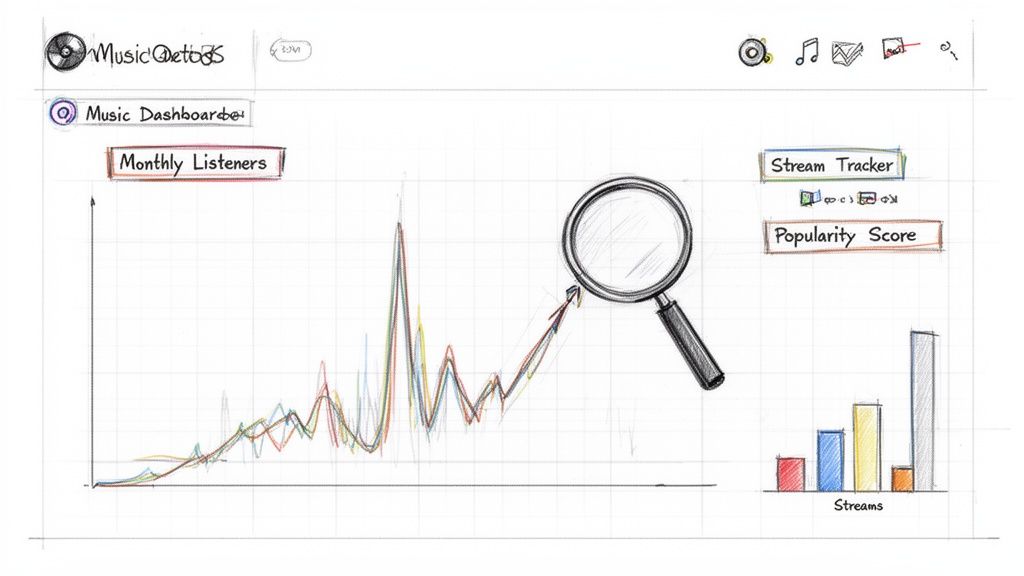
Before you can track growth, you need to know where you're starting from. This baseline is your yardstick for everything that comes after. A tool like the Monthly Listeners Tracker in artist.tools is a game-changer here because it gives you the historical data that Spotify’s own tools just don't show.
Let's play out a real-world scenario. Your artist dropped a new single last Friday. It’s Monday, and you pull up their data to see a nice spike in streams and monthly listeners. Awesome! But the big question is: why?
Was it the email you sent to their 5,000 subscribers?
Was it that small indie playlist that added the track?
Or was it the paid social media campaign you just launched?
When you track data consistently, you can finally connect the dots. The Stream Tracker in artist.tools lets you see performance day-by-day, helping you tie a jump in streams directly to a specific promo effort. Suddenly, abstract numbers become a clear cause-and-effect narrative, which is the absolute foundation of smart management. For a deeper look, check out our guide on Spotify data analytics for modern artists.
Interpreting data isn't just about celebrating the wins; it's about understanding why you won. Replicating success is impossible if you don't know what caused it in the first place.
This process is what shifts managing music artists from a reactive chore to a proactive strategy. You’re not just hoping for growth anymore—you’re engineering it by finding what works and pouring gas on the fire.
Uncovering The Hidden Metric: The Spotify Popularity Score
Beyond the numbers everyone sees, like listeners and streams, there’s a crucial, often-missed metric: the Spotify Popularity Score. This is Spotify’s internal rating, from 0 to 100, that gauges an artist's current momentum and overall health on the platform.
Think of it as an artist's "credit score" for the algorithm. A higher score tells Spotify that an artist is hot right now, making them way more likely to land in algorithmic playlists like Discover Weekly and Release Radar. Those placements are gold for reaching new fans without spending a dime.
The Popularity Score is driven by a few key things:
Recent Stream Velocity: How fast a new track is racking up streams.
Listener Engagement: The rate of saves, shares, and personal playlist adds.
Listener Retention: Are people sticking around for the whole song?
Keeping an eye on this score using the Monthly Listeners Tracker gives you a direct peek into how Spotify’s algorithm sees your artist. A sudden drop might signal listener fatigue or a release that missed the mark, while a steady climb confirms your strategy is crushing it. This score is one of the most powerful leading indicators you have for predicting future algorithmic love.
Ultimately, when you combine insights from listeners, streams, and the Popularity Score, you get the full picture of an artist's performance. This data-driven approach lets you make smart decisions, set goals that are both realistic and ambitious, and build a career that lasts. It’s how modern management moves beyond guesswork and into the realm of predictable, scalable growth.
Protecting Your Artist From Artificial Streams
There’s a silent threat lurking on Spotify that can tank an artist's career faster than you can say "takedown notice": artificial streams. This isn't just some minor annoyance. We're talking about a serious problem that leads to tracks being pulled, royalties getting withheld, and a permanent black mark on an artist's reputation. You simply can't afford to ignore it.
It usually starts with something that looks like a big win. An artist gets added to a third-party playlist, and their stream count suddenly goes through the roof. But that kind of unnatural velocity is exactly what triggers red flags in Spotify's fraud detection system. The consequences are swift and severe, and distributors won't think twice about pulling music flagged for manipulation.
The only real defense here is being proactive. Waiting for that dreaded email from your distributor is already too late. This is where having the right tools in your corner becomes non-negotiable for anyone serious about managing an artist's career.
Identifying Suspicious Activity Proactively
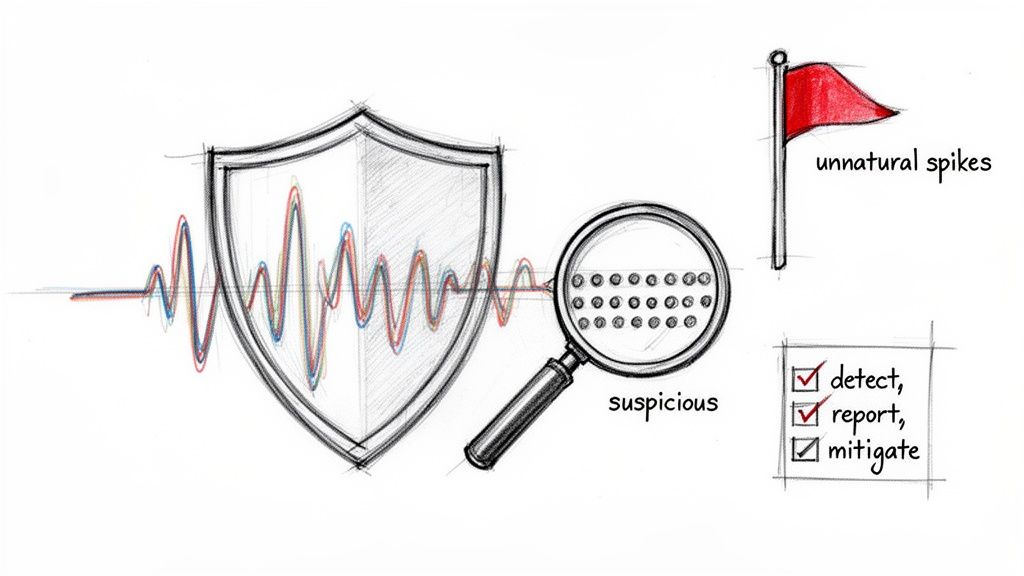
The whole game is about catching bot activity before it spirals into a full-blown crisis. Using the Bot Detection feature in artist.tools, you can scan an artist's profile for any whiffs of fraudulent streams. This can't be a one-and-done check. It needs to be a routine part of your monthly workflow, just like checking listener stats or planning out a content calendar.
Let's say you're managing an artist whose track was chugging along at a healthy 1,000 streams per day. Then, overnight, it jumps to 50,000 with no new press, no big sync, and no major marketing push. That’s a massive red flag. Real, organic growth is almost always gradual or directly tied to a specific, identifiable event.
The tool digs into stream patterns, listener locations, and a bunch of other data points to flag anything that looks out of place. Think of it as your early warning system, giving you a chance to act before Spotify brings the hammer down. We break down the nuances even further in our guide on how to spot fake Spotify streams.
Here’s a look at the artist.tools Bot Detection feature in action, giving you a straightforward risk assessment.
This dashboard gives you an immediate, color-coded verdict on whether an artist's profile is showing signs of bot activity, helping you pinpoint which tracks are at risk in seconds.
Vetting Playlists Before A Crisis
More often than not, the root of the problem is a botted playlist. An artist might pay for a placement or get added without even knowing it, only to find out the "listeners" were a bunch of server farms. You can vet any playlist before you even think about pitching or accepting a placement by running it through the Playlist Analyzer.
Your job as a manager isn't just about getting your artist more streams—it's about getting them real streams. Protecting their integrity is just as crucial as promoting their music.
When you're vetting a playlist, keep an eye out for these tell-tale signs:
Unnatural Follower Growth: A playlist that explodes from 100 to 20,000 followers in a week is almost certainly juiced with bots.
Mismatched Genres: See a chillwave track sandwiched between heavy metal anthems? That’s likely a fraudulent list designed to attract paid placements from unsuspecting artists.
Low Listener-to-Follower Ratio: A playlist boasting 100,000 followers but only generating a few hundred estimated listeners is a dead giveaway for fake engagement.
If you do spot suspicious activity on one of your artist's tracks, don't panic—but you need a crisis plan. The very first step is to contact your distributor and Spotify for Artists immediately. Give them every detail you have, including links to the suspicious playlist and any communication you had with its curator. This shows you're on top of it and being transparent, which can go a long way in mitigating the potential damage.
Mastering Strategic Playlist Pitching And Research
Getting your artist onto the right Spotify playlists isn't about luck. It's about a smart, research-driven strategy. So many artists and managers fall into the trap of just blasting their music out to hundreds of playlists, hoping something sticks. That's not just a waste of time—it can actually hurt an artist's reputation with the curators you really want to reach.
The real goal is to switch from a quantity mindset to a quality one. You need to find those hyper-relevant, niche playlists where your artist's music will actually resonate with listeners. This is how you build a loyal fanbase, not just chase a temporary spike in streams. In today's market, effective playlisting is a cornerstone of successful artist management.
Finding The Right Playlists
Your hunt for the perfect playlist starts with a deep dive into your artist's unique sound. Just searching for "indie pop" is way too broad. You have to get specific. Are they more "dream pop for late-night drives" or "upbeat indie for a coffee shop"?
This is exactly what the Playlist Search feature in artist.tools was designed for. You can use its advanced filters to drill down by genre, mood, keywords, and even follower count to uncover playlists that are a perfect fit. It’s all about building a highly targeted list of curators who are already on the lookout for music just like your artist's.
For example, instead of a generic search for "lofi," you could get granular and look for playlists titled "lofi study beats with rain sounds" that have between 10,000 and 50,000 followers. This sweet spot ensures you're targeting a dedicated audience without getting lost in an oversaturated list.
Vetting Playlists To Confirm Authenticity
Once you have a list of promising playlists, you've reached the most critical step: vetting them. Pitching to a botted playlist is far worse than getting no placement at all. It can put your artist in Spotify's bad graces, potentially leading to track removals or algorithmic penalties.
This is where the Playlist Analyzer becomes your best friend. Before you even think about sending a pitch, run every single playlist through this tool. It gives you a clear, honest look at a playlist's health, from its historical follower growth to its estimated number of real listeners.
With streaming making up 69% of the $29.6 billion global recorded music industry, the stakes are high. Real playlist placements are invaluable, especially with 752 million streaming subscribers worldwide all competing for attention. You can dive deeper into the numbers in the RIAA's mid-year report. Using powerful tools to vet your opportunities isn't just smart—it's essential.
To help you get started, here's a quick reference guide for what to look for when you're analyzing a playlist.
Playlist Vetting Checklist
Metric to Check | What to Look For (Good Sign) | Red Flag (Potential Bots) |
|---|---|---|
Follower Growth | A steady, organic curve over several months or years. | Sudden, vertical spikes where thousands of followers appear overnight. |
Listener Estimate | A reasonable number of listeners relative to the follower count. | A playlist with 50,000 followers but only an estimated 200 listeners. |
Genre Cohesion | The tracks on the playlist all fit within a similar genre or mood. | A random mix of genres, like hip-hop, country, and classical all on one list. |
Track History | Tracks are added and removed at a natural pace. | The entire playlist is wiped and replaced with new tracks frequently. |
Vetting a playlist isn't optional—it's a core responsibility in managing music artists. A few minutes of analysis can save an artist from the devastating consequences of artificial streams.
Crafting A Pitch That Gets Noticed
Okay, so you've found and vetted your target playlists. Now it's time to pitch. For independent playlists, you'll often find curator contact info right in the Playlist Analyzer. For official Spotify editorial playlists, your only way in is through the pitch tool in your Spotify for Artists account.
The secret to a great pitch is making it personal and professional. Curators can spot a copy-pasted email from a mile away. Your message needs to be short, compelling, and clearly tailored to the playlist you're targeting.
To get a huge head start, the AI Editorial Pitch Generator in artist.tools can be a game-changer. You feed it key details about the track—its mood, genre, instrumentation, and your marketing plan—and it generates a polished pitch modeled on submissions that have actually landed on major editorial playlists.
For the best results, give it rich information:
Detailed Track Info: Don't just say "it's a pop song." Describe the synth sounds, the lyrical themes, the overall vibe.
Your Marketing Plan: Mention any social media campaigns, upcoming press, or music videos. This proves to editors that you're serious about promoting the track.
Similar Artists: Listing a few comparable artists gives editors a quick sonic reference point for where your track might fit.
Using a tool like this helps you frame your artist's music in the most professional light, seriously boosting your odds of catching an editor's eye and landing those career-defining placements.
Making Your Artist Discoverable with Spotify SEO
It’s easy to think of Spotify as just a place to play music, but that’s a dangerously outdated view. In reality, Spotify is a massive search engine, and knowing how to play its game is a non-negotiable skill for any serious artist manager. If listeners can't find your artist organically, you’re basically leaving free growth on the table.
The trick is to stop guessing what people are searching for and start using actual data. This means getting your hands dirty with keyword research, figuring out what listeners really want when they type something in, and positioning your artist’s music to meet that need. It's an active strategy, not a passive one.
Uncovering What Listeners Are Actually Searching For
The first step in any good SEO plan is keyword research. You need to know the exact terms people are typing into that search bar. We're not just talking about broad genres like "hip hop" or "indie rock." The real magic is in finding the specific moods, activities, and micro-genres that lead to discovery.
Let's say you're managing a lofi-chillhop artist. Trying to rank for a term like "lofi beats" is like shouting into a hurricane—the competition is just too high. But with a tool like the Keyword Explorer in artist.tools, you can uncover related, high-volume keywords that aren't nearly as crowded. You might find that terms like "late night coding music" or "rainy day focus" have a ton of searches but are way less saturated.
These are your golden tickets. By building and titling your own playlists around these less competitive keywords, you can start climbing the ranks and capturing a steady stream of organic listeners who are looking for exactly that vibe.
Here’s a look at the artist.tools Keyword Explorer searching for "lofi." It breaks down related keywords, their monthly search volume, and a potential score.
As you can see, while "lofi" itself is a tough nut to crack, a related term like "lofi study" has huge search volume and offers a much smarter way in.
Tapping Into Real-Time Search Trends
Music trends move at the speed of light. What people are searching for today might be old news tomorrow. To stay on top, you need a way to see what listeners are looking for right now. This is where you can gain a serious advantage over managers still chasing yesterday's hype.
The Search Suggestions tool gives you a direct peek into Spotify's auto-complete function, showing you what users are searching for in real-time. This is how you catch emerging micro-genres and trending keywords before everyone else does.
Spotting a rising keyword trend early is like finding a shortcut to a new audience. It allows you to position your artist's music in front of listeners just as they begin searching for a new sound.
For instance, you might see searches for "phonk workout" or "cottagecore aesthetic" starting to bubble up. By quickly creating and optimizing playlists around these new trends, you can ride that first wave of interest and establish your artist as a key player in that new space before it gets packed. This is what proactive, modern artist management looks like.
Tracking and Improving Your Playlist Rankings
Just creating an optimized playlist isn't enough. You have to track its performance to make sure your work is actually paying off. If you don't know where your playlist is showing up in search results, you're flying blind.
For any manager or artist curating their own playlists, the Playlist Search Rankings feature is a must-have. It lets you see exactly where your playlist ranks for specific keywords in different countries.
Let's stick with our lofi artist. After you've created a playlist called "Rainy Day Focus & Lofi Coding Beats," you can use this tool to track how it's ranking for "coding music" in the US or "focus beats" in Germany.
If you notice the ranking starting to drop, you know it's time to act. That might mean:
Switching up the playlist title or description with fresh keywords.
Refreshing the tracks to keep listeners engaged.
Pushing the playlist on social media to drive more traffic and signal its relevance to Spotify's algorithm.
This ongoing loop of research, optimization, and tracking is what separates the artists who get a lucky break from those who build a real, sustainable career on the platform. It turns SEO from a one-off task into a core part of your growth strategy.
Building A Sustainable Growth And Royalty Workflow
Connecting data to your artist's bottom line is where management really becomes a business. Sure, abstract stream counts and listener stats are useful, but they don't pay the bills. The real challenge is turning all that performance data into concrete financial projections that can actually guide your strategy.
This is where a tool like the artist.tools Spotify Royalties Calculator becomes indispensable. By plugging in stream counts, you can generate realistic revenue estimates. This helps you set achievable income goals, plan marketing budgets with confidence, and have transparent financial discussions with your artist. It just demystifies the whole earnings process and grounds your strategy in financial reality.
For a deeper look into the nuts and bolts, check out our guide on understanding Spotify royalty payments.
Creating A Repeatable Management Cycle
The core of effective artist management isn't about one-off wins; it's about building a sustainable, repeatable workflow. This is what transforms your approach from constantly putting out fires to driving proactive, strategic growth. It’s a continuous loop that ensures you are always learning from the data and optimizing your next move.
This simple process flow breaks down the core components of a Spotify SEO strategy into a cycle of research, targeting, and tracking.
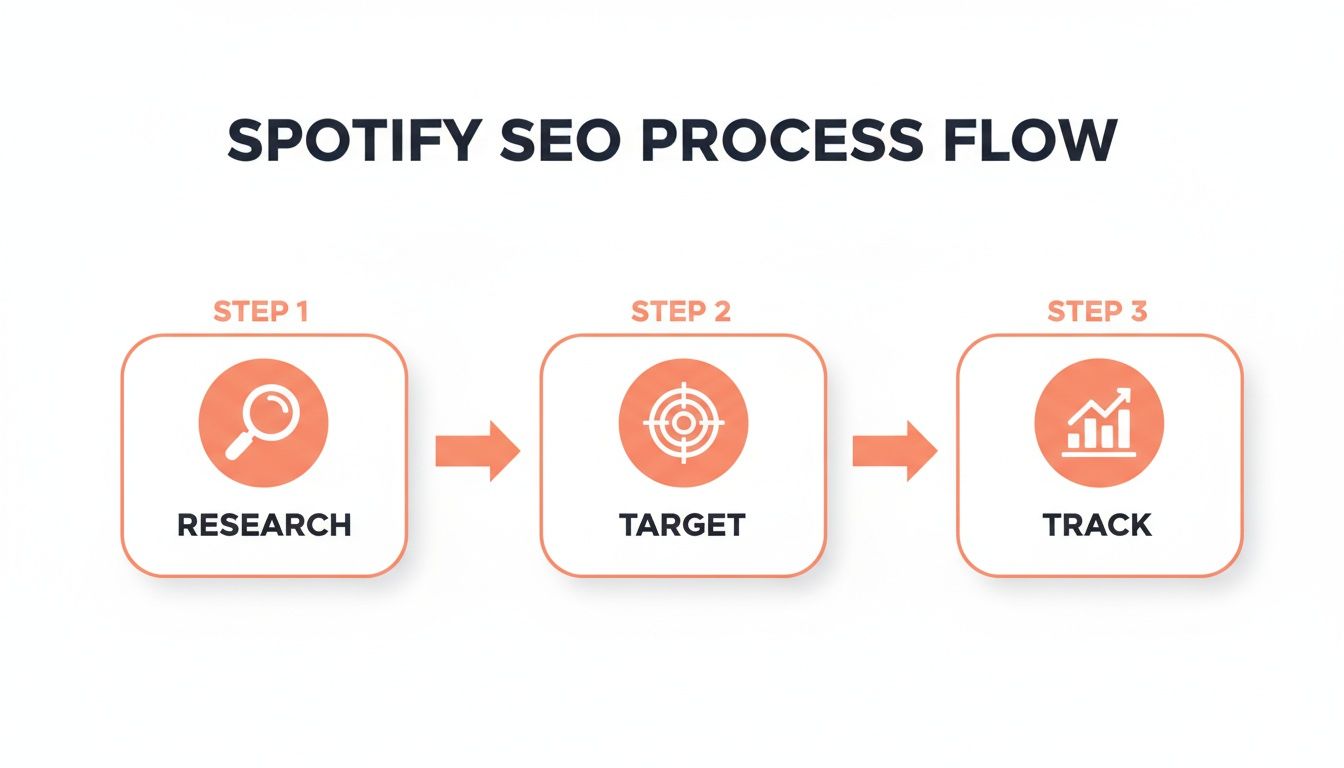
But this workflow isn't just for SEO. You can apply this "research, target, track" model to your entire management strategy, turning insights from past performance into fuel for future growth.
Your monthly cycle should look something like this:
Review Performance: Jump into the listener and stream data from the past month. What worked? What fell flat?
Identify Successes: Pinpoint the specific playlist placements or marketing campaigns that drove the most real engagement.
Scan for Threats: Run a routine bot detection scan. You have to make sure all streams are legitimate to protect the artist’s account from penalties.
Research and Pitch: Use keyword and playlist tools to hunt down new opportunities for the upcoming month.
Forecast and Plan: Update your royalty projections based on the latest data and adjust the marketing budget accordingly.
A proactive workflow stops you from just putting out fires. It’s about building a system that fosters continuous, predictable growth, running your artist's career like the business it truly is.
Your Top Spotify Management Questions, Answered
Let's cut to the chase and tackle some of the most common questions managers and artists have about navigating Spotify. I'll give you the straight answers you need to handle these situations like a pro.
How Often Should I Check For Bot Activity?
You have to be proactive here. A good baseline is to run a bot detection scan at least once per month. Think of it as a routine health check for the artist's profile.
That said, you should drop everything and run a scan immediately if you see a sudden, weird spike in streams or notice the artist has been added to a sketchy-looking third-party playlist. Catching this stuff early is the absolute best way to protect an artist's account from getting flagged.
What Is A Good Spotify Popularity Score?
The Spotify Popularity Score is this ever-changing number from 0-100, and what's considered "good" really depends on where an artist is in their career.
For new and developing artists: Hitting 20-30 is a great sign. It shows you're getting some real initial traction.
For established artists: You want to be in the 40-60 range. This signals consistent growth and solid fan engagement.
For the major stars: Scores of 70+ are usually reserved for the big household names—the ones with massive, undeniable momentum.
Honestly, the real goal isn't just hitting a specific number, but seeing a steady upward trend. A rising score is a powerful signal to Spotify's algorithm that people are paying attention, which dramatically increases the chances of landing on huge algorithmic playlists.
Think of the Popularity Score as your artist's credit score with the Spotify algorithm. A higher score unlocks better opportunities, like placements on Discover Weekly and Release Radar, which are vital for organic growth.
Can I Pitch The Same Song To Multiple Editorial Playlists?
Nope, you can't. When you're in the official Spotify for Artists pitch tool, you get one shot per release. You can only submit one track and pitch it to one genre or mood category.
This is exactly why your research beforehand is so important. You have to figure out which single editorial playlist is the most realistic and impactful target for that specific song before you hit submit. Nailing this is a cornerstone of managing any artist effectively on Spotify.
Ready to stop guessing and start making data-driven decisions? artist.tools gives you the complete toolkit you need for managing music artists on Spotify, from bot detection and playlist research to royalty forecasting. Start your free trial today.
.png)
.png)
Comments