10 Data-Driven Marketing Strategies for Music Artists in 2026
Updated: Sep 8
In today's saturated music landscape, talent alone isn't enough to guarantee success. The artists breaking through are the ones who combine creativity with strategy, treating Spotify not just as a distribution platform, but as a dynamic ecosystem of listeners, curators, and algorithms. This isn't about chasing vanity metrics; it's about making intelligent, data-informed decisions that build a sustainable career.
The difference between a track that fades into obscurity and one that tops the charts often comes down to the marketing strategies for music employed in the critical weeks surrounding a release. A well-executed plan can trigger algorithmic playlists, capture the attention of key curators, and convert casual listeners into dedicated fans. Without one, even the most brilliant song can fail to find its audience. This guide moves beyond generic advice like 'post on social media' to provide a prioritized, actionable roundup of 10 strategies you can implement today.
We'll dive deep into tactical, data-driven approaches that directly impact your growth on Spotify and beyond. You will learn how to:
Secure impactful playlist placements.
Optimize your profile for Spotify's algorithm and search functions.
Protect your data integrity from bot activity.
Craft compelling pitches to editorial curators.
Each strategy is backed by tactical steps, Spotify-focused examples, and specific ways to use platforms like artist.tools to execute with precision. It's time to stop guessing and start leveraging data as your most powerful promotional asset. Let's build your playbook.
1. Spotify Playlist Placement & Curation Strategy
What It Is and How It Works
A targeted method for securing spots on both editorial and algorithmic Spotify playlists, this strategy taps into playlists that drive over 60% of discovery. By analyzing curator profiles and submitting to the right channels, artists can capture sustained audience growth and streaming revenue.For deeper insights, Learn more about Spotify Playlist Placement & Curation Strategy on Artist.Tools.
“Playlist placement is the single most powerful lever for boosting modern streaming counts – small tweaks in targeting can yield 20–50% more plays.”
Why and When to Use This Approach
Ideal at release launch and post-release push phases
Leverages Spotify’s own curation engine for rapid discovery
Complements paid ads and social campaigns by reinforcing listener signals
Actionable Steps with Artist.Tools
Use Playlist Search to filter 200+ public playlists by genre, follower growth, and engagement.
Run Playlist Analyzer to verify curator authenticity and remove bot-driven lists.
Research historical track additions in Stream Tracker to spot curator taste shifts.
Submit to 15–30 playlists per release, prioritizing smaller niche lists before targeting New Music Friday or Today’s Top Hits.
Craft data-driven pitches with the AI Editorial Pitch Generator using your top streaming metrics and listener demographics.
Key Performance Indicators
Number of playlist adds per week
Stream uplift percentage within 7 and 14 days
Follower growth on Spotify profile
Save-to-stream ratio on each playlist
Success Examples
Post Malone’s breakthrough via New Music Friday placement drove a 35% bump in daily streams
Billie Eilish’s team secured multiple RCA editorial spots, accelerating playlist followers by 42%
Indie artists leveraged Discover Weekly adds, maintaining a steady 10% month-over-month growth in streams
This playlist-first tactic remains a cornerstone in effective marketing strategies for music, turning targeted curation into measurable growth.
2. Data-Driven Release Strategy & Pre-Save Campaigns
What It Is and How It Works
This is a methodical approach to planning and promoting music releases using historical performance data, trend analysis, and listener engagement metrics. It involves analyzing optimal release timing, tracking pre-save performance, and leveraging streaming data to inform marketing decisions, maximizing first-week streams and algorithm favorability.For more on pre-save mechanics, explore how Pre-Save Campaigns work on Artist.Tools.
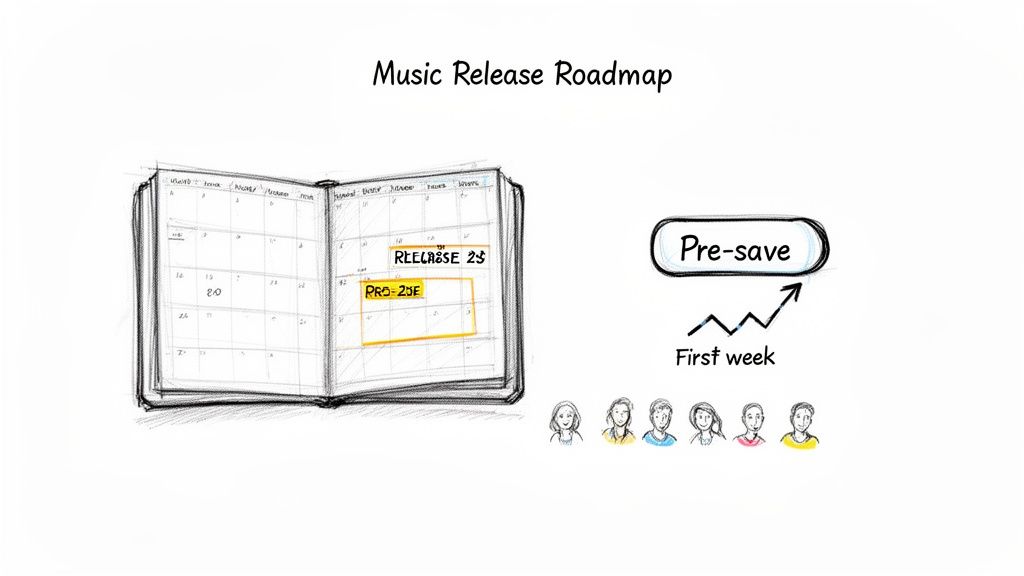
“A release without data is a shot in the dark. A data-driven campaign turns your release into a calculated launch, boosting algorithmic potential by up to 40% in the first week.”
Why and When to Use This Approach
Essential during the 4-6 weeks leading up to a release and the first 72 hours post-release
Creates a powerful signal for Spotify’s algorithms before the track is even live
Aligns marketing spend with periods of peak audience engagement for maximum ROI
Actionable Steps with Artist.Tools
Use Stream Tracker to monitor your listener engagement for 30 days pre-release to establish a baseline.
Analyze your historical data to identify which days and times your audience is most active to schedule your release.
Set up a pre-save campaign and track conversion rates to gauge initial audience excitement and forecast first-day streams.
Compare your metrics against genre benchmarks using Playlist Search to understand your competitive landscape.
Set up Stream Tracker alerts to monitor real-time performance changes in the first 72 hours and adjust promotion accordingly.
Key Performance Indicators
Pre-save to follower conversion rate
First-week stream velocity (total streams in first 7 days)
Ratio of algorithmic streams (Release Radar, Discover Weekly) to total streams
Monthly listener growth post-release
Success Examples
Major labels use data from platforms like Chartmetric to coordinate global releases, avoiding listener fatigue and maximizing chart impact.
An independent artist analyzed their pre-save data, identified low conversion, and pivoted their ad spend to a more engaged audience segment, saving their budget.
A rock band used historical data to time their release with a seasonal spike in genre interest, resulting in a 25% increase in first-month streams compared to previous releases.
This data-first mindset is one of the most effective marketing strategies for music, transforming a release from a hopeful drop into a predictable, high-impact event.
3. Bot Detection & Profile Health Optimization
What It Is and How It Works
This is a proactive quality assurance strategy focused on maintaining a clean, authentic Spotify profile by identifying and eliminating artificial streaming activity. By regularly auditing listeners and playlist placements, artists can protect themselves from algorithmic penalties, playlist removal, and potential account suspension. With Spotify actively penalizing bot-driven streams, ensuring profile integrity has become a non-negotiable part of modern marketing strategies for music.
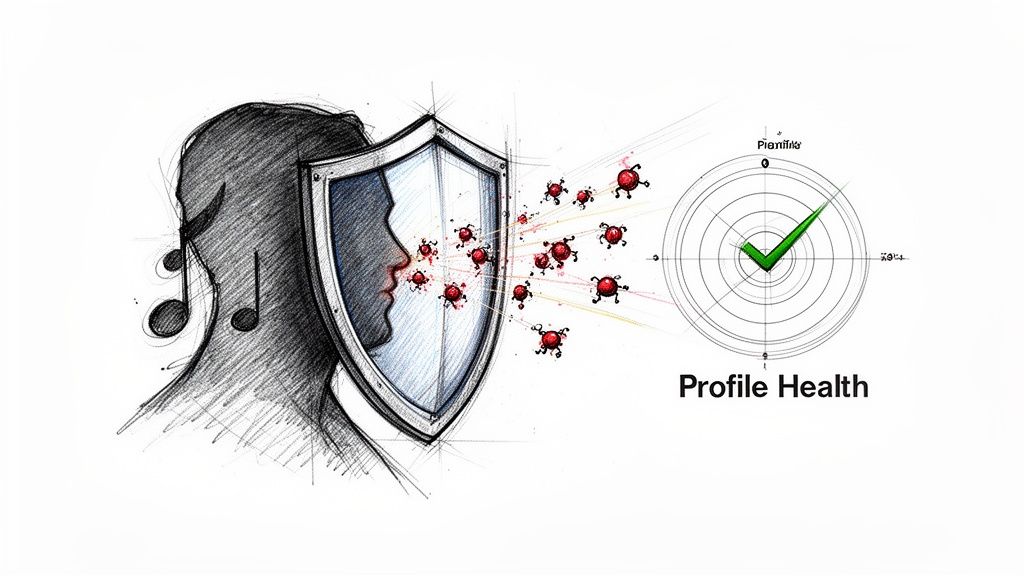
This process involves using specialized tools to analyze streaming sources and listener data for signs of fraudulent activity. For more details on the dangers of artificial streams, learn more about the risks of botted Spotify playlists on Artist.Tools.
“A clean Spotify profile is your best defense against algorithmic suppression. Bots don’t just inflate numbers; they actively poison the data that Spotify uses to recommend your music to real fans.”
Why and When to Use This Approach
Essential ongoing practice; perform audits monthly and after any new promotional campaign
Crucial before major releases to ensure a clean slate for algorithmic recommendation
Immediately after being added to unfamiliar third-party playlists
Protects your eligibility for editorial playlists and algorithmic features like Discover Weekly
Actionable Steps with Artist.Tools
Navigate to your Artist Profile page and run a comprehensive Bot Detection scan.
Review the "Bot Risk Score" for each track, investigating any song flagged as high-risk.
Use the Playlist Analyzer tool on any new playlists that have added your music to verify their authenticity before sharing them.
If bot activity is detected, immediately report the fraudulent playlists to Spotify for Artists and request that they remove the associated streams from your data.
Establish a routine to run a profile health check every 30 days to catch issues early.
Key Performance Indicators
Bot Risk Score below 10% across all tracks
Percentage of streams from authentic, human-curated playlists
Follower growth patterns without sudden, unnatural spikes
Stable save-to-stream ratio (bots rarely save tracks)
Success Examples
An indie band used regular audits to discover a fraudulent playlist placement, reported it, and avoided being removed from Release Radar the following week.
A record label implemented profile health checks as a standard pre-campaign step, ensuring their artists' releases were never algorithmically suppressed.
An artist recovering from a bot attack used detailed reports to successfully petition Spotify to have the artificial streams removed, restoring their profile's good standing.
This defensive tactic is a vital component of sustainable growth, ensuring that all your other marketing efforts build on a foundation of authentic engagement.
4. Spotify SEO & Keyword Optimization Strategy
What It Is and How It Works
This is a systematic approach to optimizing music visibility within Spotify's search ecosystem by researching and targeting high-opportunity keywords. This strategy treats Spotify not just as a music player but as a powerful search engine, enabling artists to capture listener intent and position their tracks, artist profiles, and playlists for maximum discoverability. By understanding what users are searching for, you can align your content to meet that demand directly.For a deeper dive, Explore Spotify Keyword Optimization on Artist.Tools.
“Treating Spotify like Google is a game-changer. Optimizing for just 3–5 core keywords can increase an artist profile’s search-driven traffic by up to 70%.”
Why and When to Use This Approach
Best for long-term, sustainable growth and evergreen discovery
Crucial for artists in niche or emerging genres where keyword competition is low
A powerful complement to playlisting, as it captures active, high-intent listeners searching for specific sounds or moods
Actionable Steps with Artist.Tools
Use Keyword Explorer to identify 5–10 core keywords for your niche, analyzing search volume and competition scores.
Monitor Spotify's search auto-complete suggestions to spot emerging trends like 'phonk' or 'dark academia' before they saturate.
Optimize your Spotify artist bio, playlist titles, and playlist descriptions with your target keywords to signal relevance to the algorithm.
Create themed playlists around these keywords (e.g., "Lofi Beats for Coding," "Indie Folk Road Trip") to attract search traffic.
Track your playlist and profile rankings for target keywords using Stream Tracker to measure visibility improvements over time.
Key Performance Indicators
Monthly search-driven streams to your profile
Rank position for target keywords (e.g., #3 for "cinematic epic music")
Follower growth on keyword-optimized playlists
Increase in profile visits from search sources
Success Examples
Playlist curators discovered the 'dark academia' trend early, building playlists that ranked #1 and grew to 100k+ followers
An indie electronic artist optimized their profile for "synthwave" and saw a 40% increase in discovery from search
A label created mood-based playlists (e.g., "Rainy Day Chill"), which now account for 25% of their catalog's total streams
This search-focused tactic is a vital component of modern marketing strategies for music, creating a direct path for listeners to find your sound.
5. Collaborative Playlist & Playlist Network Strategy
What It Is and How It Works
This strategy leverages interconnected curation ecosystems to amplify reach through collaborative efforts and playlist networks. It involves identifying curators with complementary audiences, building relationships, and securing placements across a series of related playlists, creating a compounding discovery effect as listeners flow between them.
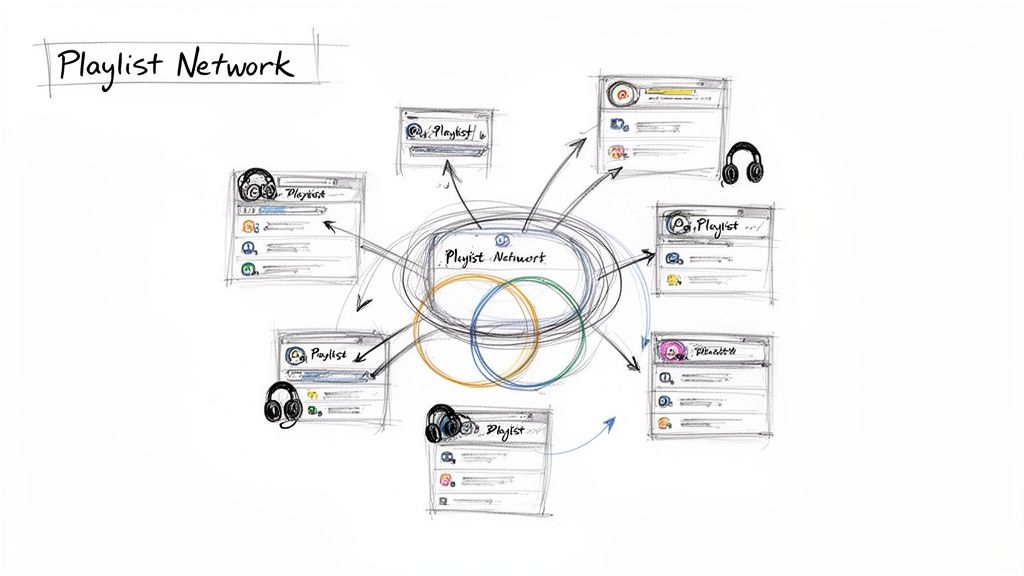
This powerful tactic, popularized by independent artist communities and niche genre collectives, transforms curation from a one-off placement into a sustained presence within a listener's trusted music ecosystem.
“Building a presence within a playlist network is like earning a permanent spot in a listener’s trusted discovery circle. It’s a move from single placements to sustained audience buy-in.”
Why and When to Use This Approach
Ideal for building long-term, sustainable growth beyond single-release campaigns.
Creates a powerful network effect, where one placement leads to another within a trusted group.
Excellent for penetrating niche genres where dedicated curator communities hold significant influence.
Actionable Steps with Artist.Tools
Use Playlist Search to identify curators operating multiple playlists within your niche, looking for complementary themes (e.g., 'Lofi Morning,' 'Lofi Beats for Study').
Run Playlist Analyzer on an entire network of playlists to verify the credibility and audience quality across the curator’s ecosystem before engaging.
Research a curator’s other playlists to understand their style and identify potential cross-promotion or swap opportunities.
Personalize outreach by mentioning your appreciation for their specific network and explaining how your track fits into their interconnected playlist family.
Propose a playlist swap or offer to feature their playlist on your social channels, focusing on building a mutually beneficial relationship.
Key Performance Indicators
Number of placements within a single curator’s network.
Follower-to-listener conversion rate from network playlists.
Audience retention and repeat listeners originating from the network.
Engagement from other curators within the same community.
Success Examples
Indie artist networks frequently cross-promote members' new releases, resulting in a collective stream boost across all participating artists.
Genre-specific curator collectives (e.g., in synthwave or phonk) create themed playlist families that guide listeners through their catalogs, increasing overall plays.
Many independent curators build a "Part 1," "Part 2" series, moving successful tracks from the first to the second to maintain listener engagement.
This collaborative approach is a core component of modern marketing strategies for music, turning individual efforts into a collective force for discovery and growth.
6. Data-Backed Financial Planning & Revenue Optimization
What It Is and How It Works
This strategy treats music promotion as a business investment by analyzing streaming metrics to forecast revenue, calculate marketing ROI, and make sustainable financial decisions. It moves beyond simply gaining streams to understanding the economic engine behind them, enabling artists to optimize their marketing spend for maximum profitability. By calculating cost-per-stream and projecting income, artists can build a financially viable career.
For a deeper dive into forecasting, use the Spotify Royalties Calculator by Artist.Tools to project potential earnings.
“Treating your music like a business starts with understanding the numbers. Data-backed financial planning transforms ambiguous marketing spend into a predictable revenue-generating machine.”
Why and When to Use This Approach
Essential when allocating a budget for any promotional campaign
Crucial for independent artists managing their own finances and seeking profitability
Use when evaluating the effectiveness of different marketing channels (e.g., ads vs. playlisting)
Helps set realistic income goals and track progress toward financial independence
Actionable Steps with Artist.Tools
Use the Spotify Royalties Calculator to project potential earnings from a target number of streams before launching a campaign.
After a promotion, cross-reference your actual payout with the calculator’s estimate to fine-tune future projections.
Monitor your campaign’s daily performance in Stream Tracker to see how marketing spend directly translates into streams and estimated revenue.
Calculate your audience acquisition cost (AAC) by dividing total campaign spend by the new followers gained.
Project 12-month revenue scenarios at 10%, 50%, and 100% growth rates to create a financial roadmap and set sustainable budgets.
Key Performance Indicators
Return on Investment (ROI) per marketing campaign
Cost-Per-Stream (CPS) and Cost-Per-Follower (CPF)
Accuracy of revenue projections vs. actual earnings
Profit margin after marketing and distribution costs
Success Examples
An indie pop artist used the Royalties Calculator to determine that a $500 ad spend needed to generate 125,000 streams to break even, allowing them to set a clear campaign goal.
A management company optimized marketing budgets across their roster by identifying which artists had the lowest AAC, reallocating funds for higher ROI.
A DIY musician projected their first-year income based on an average of 10,000 monthly streams, helping them create a sustainable release schedule.
This data-driven financial approach is a cornerstone of modern marketing strategies for music, ensuring that creative passion is supported by a solid, profitable business model.
7. Competitive Intelligence & Market Positioning Strategy
What It Is and How It Works
A strategic analysis approach where artists research competitor performance, identify market gaps, and position themselves for differentiation. By analyzing similar artists' Spotify metrics, playlist placement patterns, and audience growth trajectories, musicians can learn what works, avoid overcrowded spaces, and find unique positioning opportunities within their niche. This data-driven analysis informs all other marketing strategies for music.
“Market positioning isn’t about being first; it’s about being different. Competitive intelligence shows you where ‘different’ lives.”
Why and When to Use This Approach
Ideal during the artist development and pre-release planning phases
Crucial when a genre feels oversaturated or growth has plateaued
Informs brand identity, sound direction, and targeting for ad campaigns
Actionable Steps with Artist.Tools
Use Artist Search to identify 5-10 "competitor" artists who have recently achieved your target milestones.
Track their long-term growth using the Monthly Listeners Tracker to benchmark your progress and spot their successful campaign periods.
Analyze their top-performing playlists in Stream Tracker to understand which curators and playlist types are driving their discovery.
Compare your playlist placement success rate against theirs to identify gaps in your pitching strategy.
Identify successful niche playlists in your genre by studying competitors, then use Playlist Search to find similar opportunities.
Key Performance Indicators
Monthly Listeners growth rate vs. competitors
Follower growth rate on key platforms
Number of shared high-impact playlists with competitors
Audience overlap percentage with benchmark artists
Success Examples
An indie pop artist analyzed Olivia Rodrigo’s early growth, focusing on TikTok-to-Spotify conversion tactics to replicate similar viral momentum.
A playlist curator studied the top 10 Lofi Hip Hop playlists, identifying a gap for a "Lofi for Coding" niche, which grew to 50k followers in six months.
An emerging hyperpop artist tracked audience overlap with established electronic acts, leading to successful collaboration pitches and shared playlist placements.
This intelligence-led approach ensures your marketing efforts are not just loud but also smart, carving out a unique and defensible space in a crowded market.
8. Editorial Pitch Strategy & Playlist Curation Relationships
What It Is and How It Works
This is a targeted approach for securing placement on Spotify's official editorial playlists, which can expose an artist to millions of listeners. This strategy involves crafting a compelling pitch directly to Spotify's curation team via the Spotify for Artists platform and building a reputation for quality releases, which can foster long-term curation relationships. Success hinges on understanding editorial priorities and presenting a track’s narrative, marketing plan, and audience fit persuasively.
“A well-crafted editorial pitch is your direct line to Spotify’s tastemakers. It’s not just about the song; it’s about selling the story and the strategy behind it.”
Why and When to Use This Approach
Crucial during the pre-release phase; pitches must be submitted at least 7 days before release, but 2-4 weeks is recommended.
Maximizes initial release impact by tapping into Spotify’s most influential discovery channels.
Adds a layer of legitimacy and signals to both listeners and the algorithm that a track has significant backing.
Actionable Steps with Artist.Tools
Use Stream Tracker to research which editorial playlists have featured artists similar to you, identifying target lists like Lorem Ipsum, Chill Hits, or genre-specific ones.
Analyze your listener demographics and top-performing tracks in your dashboard to gather key data points for your pitch.
Leverage the AI Editorial Pitch Generator to create a data-backed, persuasive narrative. Input your track’s mood, genre, marketing highlights, and unique story angle to generate a professional pitch.
When submitting via Spotify for Artists, ensure your cover art is finalized, audio is high-quality, and all metadata is complete.
In your pitch, clearly articulate your marketing plan, any press coverage, social media campaigns, or tour dates to demonstrate momentum.
Key Performance Indicators
Number of editorial playlist adds on release day
Total reach (followers) of secured editorial playlists
Initial 24-hour and 7-day stream velocity
Follower-to-listener conversion rate post-placement
Success Examples
Billie Eilish’s early career was significantly boosted by key editorial placements that established her as a genre-defining artist.
The Kid LAROI’s breakthrough was accelerated by landing on high-impact playlists like New Music Friday, driving massive initial discovery.
Numerous indie artists gain their first significant traction by crafting a standout pitch that catches an editor's attention for a niche playlist.
This powerful marketing strategy for music directly connects artists with the gatekeepers of mainstream discovery, turning a great pitch into a career-defining moment.
9. Algorithmic Performance Monitoring & Campaign Optimization
What It Is and How It Works
This is a continuous optimization strategy focused on tracking real-time performance to identify effective marketing tactics and rapidly iterate. It involves monitoring key metrics like stream velocity, playlist add rates, follower growth, and listener engagement across all campaigns. By analyzing this data, artists can double down on successful efforts and cut underperforming ones quickly, maximizing ROI.For a deeper dive, Learn more about how to measure marketing campaign success on Artist.Tools.
“Real-time data isn't just a report card; it's a compass. Monitoring campaign performance as it happens allows you to steer your strategy toward what’s actually working, not just what you thought would work.”
Why and When to Use This Approach
Crucial during the first 72 hours of a release to make immediate, impactful adjustments
Essential for optimizing ad spend and promotional efforts to ensure budget is allocated effectively
Provides concrete data to validate which marketing channels deliver the most engaged listeners
Actionable Steps with Artist.Tools
Set up Stream Tracker alerts to receive notifications on significant performance changes for your tracks.
Use the Monthly Listeners Tracker to measure the direct impact of your campaigns on overall fanbase growth and reach.
Monitor playlist adds and removals daily in Stream Tracker to spot trends and understand curator behavior in real-time.
Compare the performance of new campaigns against your historical baseline data to accurately gauge success and identify anomalies.
Isolate and analyze stream sources to differentiate between organic growth and paid promotional traffic, clarifying which efforts drive genuine engagement.
Key Performance Indicators
Stream velocity in the first 24, 48, and 72 hours post-release
Daily playlist add/remove rate
Follower growth vs. monthly listener ratio
Cost per stream and cost per follower from paid campaigns
Success Examples
Major labels use first-week streaming velocity data to re-allocate radio and ad budgets for maximum chart impact.
Independent artists track real-time playlist adds after a pitching campaign to immediately see which curators responded positively.
Managers analyze listener engagement metrics from different traffic sources to identify which social media platforms drive the most valuable, long-term fans.
This data-first approach is a core component of modern marketing strategies for music, transforming guesswork into a predictable, optimizable process.
10. Genre-Specific Niche & Subcategory Targeting Strategy
What It Is and How It Works
This strategy involves positioning an artist within a specific sub-genre or listener community instead of competing in broad, saturated categories. By identifying and targeting an underserved niche, artists can build a dedicated following and dominate a smaller space before expanding. This method focuses on authentic community building and understanding the micro-ecosystems of playlists, forums, and influencers dedicated to a specific sound.
“Targeting a niche isn’t about limiting your audience; it’s about becoming a big fish in a small pond first, building a loyal base that will champion your music to a wider world.”
Why and When to Use This Approach
Extremely effective for indie and emerging artists with limited budgets
Ideal for genres with passionate, well-defined subcultures (e.g., hyperpop, lo-fi, vaporwave)
Builds a highly engaged, loyal fanbase that is more likely to support an artist long-term
Reduces direct competition with major-label artists and mainstream trends
Actionable Steps with Artist.Tools
Use Keyword Explorer to identify underserved sub-genres and related search terms with low competition but high listener intent.
Leverage Search Suggestions to find emerging niche keywords and micro-genres before they become saturated.
Filter Playlist Search by your target niche to find the most influential curators and playlists within that specific ecosystem.
Analyze listener demographics and affinities within niche playlists to ensure your music aligns with the community’s preferences.
Identify potential collaborators by searching for other artists who frequently appear in your target niche playlists.
Key Performance Indicators
Inclusion in highly specific, community-driven playlists
Engagement rate (likes, comments) on niche-specific content
Follower growth from listeners within the target sub-genre
Mentions and shares within niche online communities (Reddit, Discord)
Success Examples
Lo-fi hip-hop artists built a massive, dedicated following by creating music for the "beats to study/relax to" niche, which exploded into a global phenomenon.
Hyperpop artists first gained traction within niche Discord servers and SoundCloud communities before breaking into mainstream editorial playlists.
Vaporwave artists created a thriving, self-sufficient community entirely online, bypassing traditional industry gatekeepers.
This focused approach is one of the most powerful marketing strategies for music artists looking to build a sustainable career from the ground up.
10-Point Music Marketing Strategy Comparison
Strategy | 🔄 Complexity | ⚡ Resource requirements | 📊 Expected outcomes | 💡 Ideal use cases | ⭐ Key advantages |
|---|---|---|---|---|---|
Spotify Playlist Placement & Curation Strategy | High — deep curator research & timing | Moderate — playlist tools, outreach time | High potential streams & follower growth; variable retention | New releases seeking discovery growth | Major driver of discovery; targeted, sustainable placements |
Data-Driven Release Strategy & Pre-Save Campaigns | Medium — ongoing data collection & analysis | Moderate — analytics tools, tracking setup | Optimized first-week streams; better campaign pivots | Scheduled releases aiming for strong launch metrics | Data-informed timing; reduces launch risk |
Bot Detection & Profile Health Optimization | Medium — continuous monitoring & remediation | Moderate — bot-detection tools, audits | Protects algorithmic reach; prevents takedowns | Profiles with unusual spikes or prior fraud risk | Preserves long-term profile integrity and credibility |
Spotify SEO & Keyword Optimization Strategy | Medium — keyword research & localization | Low–Moderate — SEO tools, content updates | Improved search discoverability; niche gains | Artists/curators targeting search-driven discovery | Finds untapped keywords; long-term search visibility |
Collaborative Playlist & Playlist Network Strategy | High — relationship building & coordination | Low–Moderate — time-intensive networking | Compounded reach via network effects | Indie communities; cross-promotion campaigns | Exponential reach; repeated placements via relationships |
Data-Backed Financial Planning & Revenue Optimization | Medium — financial modeling & tracking | Low–Moderate — calculators, accounting tools | Clear revenue forecasts; optimized marketing ROI | Budgeting, campaign ROI decisions, funding requests | Financial clarity; prevents unprofitable spend |
Competitive Intelligence & Market Positioning Strategy | Medium — competitor tracking & benchmarking | Moderate — analytics platforms, research time | Identifies gaps, benchmarks, and positioning wins | Differentiation in crowded genres | Informs strategy; reveals underserved opportunities |
Editorial Pitch Strategy & Playlist Curation Relationships | High — craft pitches & build editor rapport | Moderate–High — pro assets, PR/manager time | Potential massive exposure; high variance of success | Major release campaigns seeking editorial boosts | Editorial credibility and strong algorithmic lift |
Algorithmic Performance Monitoring & Campaign Optimization | Medium — continuous tracking & iteration | High during campaigns — real-time trackers, staff time | Rapid course-corrections; improved velocity & ROI | Intensive launch windows; data-driven teams | Real-time optimization; reduces wasted budget |
Genre-Specific Niche & Subcategory Targeting Strategy | Low–Medium — niche research & authenticity | Low — community engagement, targeted outreach | High engagement and loyalty; smaller total audience | Indie artists targeting dedicated communities | Lower competition; faster organic traction in niche |
From Strategy to Streams: Your Next Steps to Spotify Growth
The journey from a finished track to a thriving listener base is no longer a matter of luck; it's a matter of strategy. We've navigated a comprehensive roadmap of ten powerful marketing strategies for music, each designed to transform your Spotify presence from a passive profile into an active growth engine. The common thread weaving through every tactic, from playlist pitching to financial planning, is the intelligent use of data. This is the modern artist's most crucial instrument.
We moved beyond generic advice, diving deep into the actionable mechanics of growth. You now have a framework for securing playlist placements, optimizing your profile with targeted keywords, and ensuring the health of your stream data by identifying and avoiding fraudulent activity. We covered how to build a data-driven release cycle, leverage collaborative networks, and pitch effectively to Spotify's editorial team. The goal is to create a sustainable career, and that requires understanding not just the creative side, but the business and analytical side as well.
The Core Takeaway: Integration Over Isolation
The true power of these strategies is unlocked when they are not treated as a checklist of isolated tasks, but as interconnected components of a holistic marketing ecosystem.
Your Spotify SEO and keyword research (Strategy #4) directly informs the language you use in your editorial pitches (Strategy #8).
Understanding your niche genre positioning (Strategy #10) helps you identify the most impactful curators and collaborative playlists (Strategies #1 & #5).
Algorithmic performance monitoring (Strategy #9) provides the critical feedback loop needed to refine your release campaigns and financial forecasts (Strategies #2 & #6).
Think of your music marketing not as a series of sprints, but as a continuous cycle of planning, execution, analysis, and optimization. Each release is an opportunity to gather more data, refine your approach, and build upon the momentum of the last. This is how you stop chasing fleeting viral moments and start building a loyal, engaged audience that grows with you.
Your Actionable Path Forward
Feeling overwhelmed by the possibilities is natural. The key is to start small, be consistent, and build from there. Don't try to implement all ten strategies at once. Instead, identify your most pressing need right now and focus your energy.
Your Next Steps:
Conduct a Self-Audit: Where are you in your career? If you have a release in three months, start with a data-driven release strategy and pre-save campaign. If you feel your growth has stalled, begin with a deep dive into your profile health and bot detection.
Choose Your Focus: Select two or three strategies that align with your immediate goals. For example, focus on Playlist Placement and Spotify SEO for your next single.
Set Measurable KPIs: Define what success looks like. Is it a 20% increase in monthly listeners? Securing placement on five user-curated playlists with over 10,000 followers? Hitting 1,000 pre-saves? Concrete goals make your efforts tangible.
Execute, Measure, Repeat: Apply the tactics, track your results using the KPIs you set, and analyze the data to see what worked. Every campaign provides a lesson for the next one.
Mastering these marketing strategies for music is about taking control of your career's trajectory. It’s about transforming yourself from a passive participant in the streaming ecosystem into an active architect of your own success. By consistently applying these data-driven principles, you build more than just a listener count; you build a resilient, engaged, and profitable music career with lasting momentum.
Ready to turn these strategies into action? artist.tools provides the data and features you need, including Playlist Search, Keyword Explorer, and Bot Detection, to execute every tactic discussed in this article. Stop guessing and start growing your music career with the industry's leading analytics platform at artist.tools.
.png)
.png)
Comments