A Modern Guide to Publishing a Song and Getting Heard
Updated: Sep 8
Putting your song out into the world is about more than just hitting ‘upload.’ To do it right, you need a professional-grade master file, all the correct metadata (like ISRCs and song titles), and a distribution partner to get it onto platforms like Spotify. Getting this groundwork right from the beginning is absolutely critical for getting paid correctly and making sure your music can actually be found by listeners.
Laying the Groundwork for a Successful Release
Before your music even touches the digital shelves of Spotify or Apple Music, a few key steps can make or break its success. Think of this phase as your pre-flight checklist. Skipping it is like trying to fly a plane without checking the fuel—sure, you might get off the ground, but you're not getting very far.
The quality of your audio and the accuracy of your data are the non-negotiable pillars of a professional launch. This initial legwork ensures your music sounds competitive and that every single penny you earn can be tracked back to you. It's the less glamorous side of being an artist, but it's absolutely essential.
Perfecting Your Sound: Mix and Master
First, let's get the terms straight. Mixing is the art of balancing all the individual tracks—your vocals, drums, synths, bass—to create a clean, cohesive sound. Mastering is the final coat of polish on that single mixed file. It makes sure the track is loud enough, sounds great on everything from AirPods to club speakers, and meets the technical specs for streaming.
A professional master is your entry ticket. Platforms like Spotify and Apple Music use loudness normalization to keep the listening experience consistent. A poorly mastered track will sound weak and thin next to major label releases, immediately flagging it as amateur to new listeners. This isn't just about volume; it’s about dynamic range, stereo width, and the overall clarity that makes a track feel finished and professional.
The Critical Role of Accurate Metadata
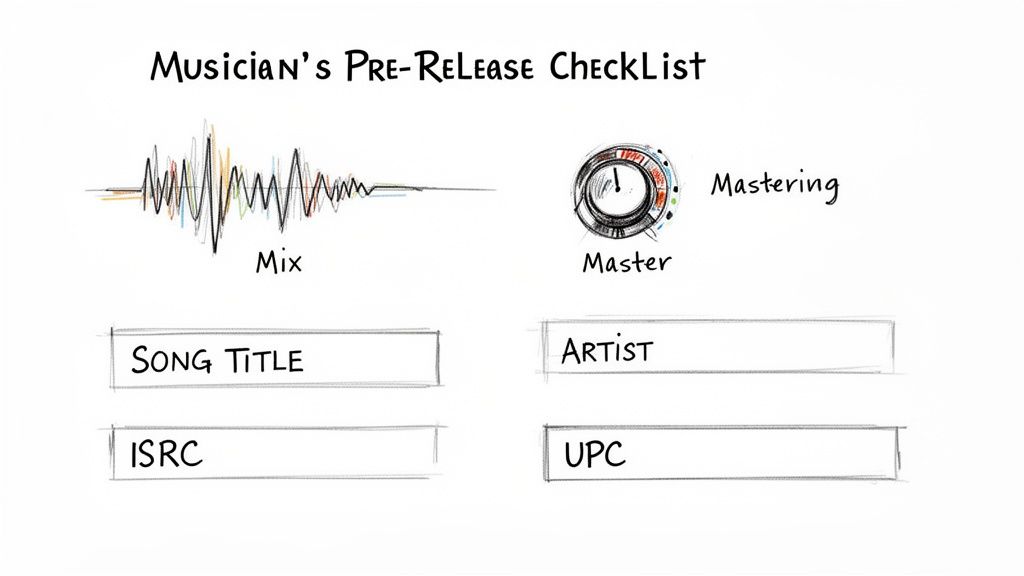
Metadata is basically the digital DNA of your song. It’s all the backend information that identifies your track, including the artist name, song title, release date, and crucial codes like ISRCs and UPCs. Nailing this from the start saves you from a world of headaches down the road.
Key Takeaway: Inaccurate metadata is one of the biggest reasons artists miss out on royalties. A simple typo in a song title or an incorrect ISRC can send your earnings into a digital black hole, making them nearly impossible to recover.
Here’s a quick rundown of the essential data points you absolutely need to have in order:
Song Title: Has to be exact, with consistent capitalization.
Artist Name(s): List all primary, featured, and remixing artists correctly.
ISRC (International Standard Recording Code): This is a unique 12-character code for each specific recording. If you don't have one, your distributor can usually assign one for you.
UPC (Universal Product Code): A unique barcode for the entire release (whether it's a single, EP, or album).
Songwriter & Publisher Credits: This is non-negotiable for ensuring mechanical and performance royalties get paid to the right people.
This visual breaks down the simple but vital workflow: first, you mix, then you master, and finally, you package it all up with the correct metadata.
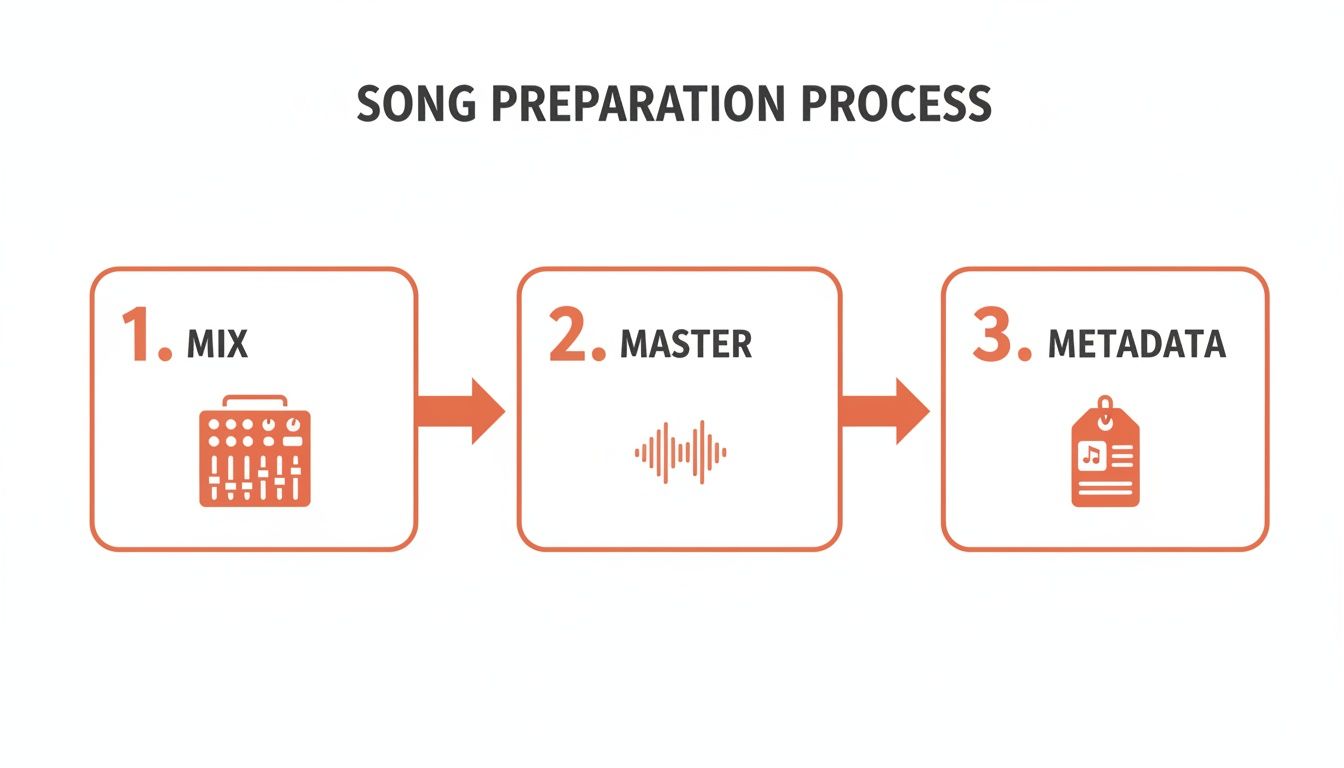
Each step builds on the last, ensuring your final product is both sonically polished and administratively ready for distribution. This is your foundation.
To make this easier, here's a simple table summarizing everything you need before you even think about distribution.
Your Essential Pre-Release Checklist
This checklist covers the absolute must-have assets and information you need ready to go before you submit your music to a distributor. Getting this organized upfront will make the entire release process smoother.
Component | Requirement | Why It Matters |
|---|---|---|
Master Audio File | High-resolution WAV file (e.g., 44.1kHz, 16-bit) | Ensures the best possible audio quality on streaming platforms. |
Cover Art | High-resolution square image (e.g., 3000x3000 pixels) | Your visual first impression; must meet platform specifications. |
Song Title | Final, correctly spelled, and formatted title | Prevents confusion and ensures your track is correctly identified. |
Artist Names | Accurate spelling for all primary and featured artists | Guarantees proper credit and linking across all platforms. |
Songwriter Credits | Full legal names of all writers and their ownership splits | Absolutely crucial for PROs to pay out publishing royalties correctly. |
ISRC & UPC Codes | Unique codes for the track and the release | The primary identifiers used to track sales, streams, and royalties globally. |
Treat this list as your go-to before every release. It’s your best defense against errors that can cost you money and visibility.
This prep work is more important than ever. The lifecycle of a hit song is accelerating at a wild pace. According to the IFPI's global report, the average time for a track to hit 1 billion streams on Spotify has dropped from 2,729 days in 2015 to a staggering 197 days today. If you want any chance of catching that kind of algorithmic wave, your foundational assets have to be perfect from day one.
Choosing Your Distributor and Getting Your Music Online
Alright, you've got your polished master file and all your metadata is lined up and ready to go. Now for the big step: choosing your gateway to the world's digital storefronts. This is where your digital distributor comes in.
Think of a distributor, sometimes called a Digital Service Provider (DSP), as the company that bridges the gap between your hard drive and the digital shelves of Spotify, Apple Music, Amazon Music, and hundreds of others around the globe. This isn't a decision to take lightly; it's one of the most important partnerships you'll form as an independent artist.
Picking the right one isn't just about grabbing the cheapest deal. It’s about finding a service that genuinely fits your long-term vision. Different distributors have different business models, and each comes with its own set of pros and cons.
Comparing the Top Music Distributors
The three names you’ll hear over and over again are DistroKid, TuneCore, and CD Baby. They all get your music online, but how they do it—and what they charge—is where they really differ. Knowing these differences is key.
DistroKid: This is the go-to for many because of its annual subscription model. You pay one flat fee each year and can upload as many songs and albums as you want. If you're prolific and constantly releasing new music, this model is a no-brainer. They're also known for super-fast delivery times and offer automatic royalty splits, which makes paying your collaborators a breeze.
TuneCore: They operate on a per-release annual fee. This can be more budget-friendly if you only plan to drop a single or two per year. TuneCore also has a solid publishing administration service you can add on, which helps chase down those tricky songwriter royalties.
CD Baby: These guys charge a one-time fee for each release. Pay once, and your music is up for good—no recurring payments. They also offer physical distribution for CDs and vinyl and have a pretty robust publishing administration service, making them a great all-in-one option.
A huge piece of the puzzle is the distributor's support and transparency. When things go wrong—and trust me, they sometimes do—having responsive, helpful customer service is a lifesaver. Check out our in-depth guide to music distribution deals for a much deeper comparison.
Navigating the Upload Process
Once you've picked your partner, it's time to upload. This is where that pre-release checklist you made becomes your best friend. You'll be prompted to upload your master audio, your cover art, and then meticulously enter all the metadata you've already prepared. Double-check, then triple-check every single field for typos before hitting submit. A tiny mistake in a songwriter's name or ISRC can cause major headaches and royalty delays down the line.
Here’s one of the most important parts: setting your release date. A classic rookie mistake is setting it for just a few days away. Don't do it. Always give yourself a lead time of at least 4-6 weeks. This buffer is absolutely critical for a few reasons:
Platform Processing: It gives stores like Spotify enough time to ingest and process your music, ensuring everything goes live smoothly without any technical glitches.
Playlist Pitching: This window allows you to submit your track to Spotify's editorial team through your Spotify for Artists account. To do this, the song has to be in their system well ahead of the release date.
Marketing & PR: It provides the runway you need to build hype, reach out to blogs and press, and get all your promotional efforts aligned for maximum impact on release day.
The music industry is beyond saturated. An almost unbelievable 106,000 new tracks are uploaded to streaming services every single day. According to this Luminate data report analysis, this flood of content means a staggering 88% of tracks get very few streams. That pre-release marketing window is your best weapon for cutting through the noise.
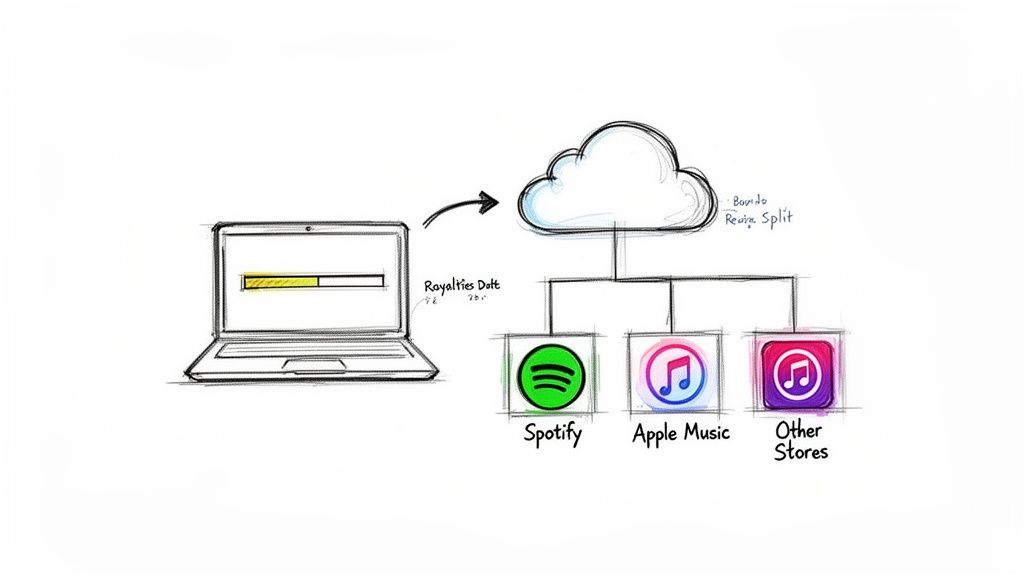
Finally, if you worked with anyone else on the track, this is where you’ll handle the royalty splits. Most modern distributors make this easy, allowing you to enter the email addresses and percentage shares for each collaborator—producers, co-writers, featured artists, you name it. This setup automates payments, so everyone gets paid their fair share directly from the source. It saves you from a world of administrative nightmares later on.
How to Secure Your Copyrights and Collect All Your Royalties
Getting your song uploaded is a huge moment. But if you're serious about building a career, that's just the first step. The real goal is getting paid for your hard work, which means diving into the world of music royalties. It can seem confusing at first, but it's actually pretty straightforward once you know the lay of the land.
Here’s the most important thing to understand: every song you create has two distinct copyrights attached to it.
The Master Recording: This is the actual audio file you uploaded. Think of it as the final, specific recording of your performance.
The Composition: This is the underlying song itself—the melody, the chords, the lyrics. It’s the musical DNA.
Grasping this difference is absolutely critical to collecting all the money you're owed. Different organizations collect royalties for each of these copyrights, and you need to be set up with all of them. If you miss a step, you're leaving money on the table. In fact, it's estimated that nearly $1 billion in royalties go unclaimed every year, much of it belonging to indie artists who just didn't know where to look.
Registering Your Compositions with a PRO
First things first, every songwriter needs to join a Performing Rights Organization (PRO). These organizations are the gatekeepers for your composition royalties. They track and collect money any time your song is performed publicly—that means radio play, TV shows, live venues, and yes, every single stream on Spotify.
In the U.S., your main options are ASCAP and BMI. You only need to join one of them. They both represent millions of songs and do the same essential job: collecting performance royalties and paying them out to songwriters and publishers. Their internal structures are a little different, but their core function for you is the same.
Pro Tip: There's a small but important difference here. If you join ASCAP as a writer, you also have to create a "vanity publishing company" (which can be as simple as "Your Name Music") to collect your full 100% share. Otherwise, you only get the 50% songwriter's portion. BMI, on the other hand, pays the full 100% directly to songwriters without this extra step.
Collecting Mechanical Royalties with The MLC
Performance royalties are only one part of the composition income stream. The other major piece is mechanical royalties. These are generated every time your song is reproduced, whether that's a physical copy like a CD or a digital one, like a stream on Apple Music or a download from iTunes.
In the United States, the streaming mechanicals are all handled by one entity: The Mechanical Licensing Collective (The MLC). Registering with them is non-negotiable. If you aren't signed up with The MLC, you are simply not collecting the mechanical royalties you're owed from U.S. streams. It's free to register on their website, so don't skip this.
Securing Digital Performance Royalties with SoundExchange
Okay, let's circle back to your master recording. While your PRO is busy collecting money for your composition's public performances, a totally different group handles the digital public performances of your recording. That group is SoundExchange.
SoundExchange collects royalties from "non-interactive" digital services. This is stuff where the listener doesn't pick the exact song playing next. Think:
Pandora radio stations
SiriusXM satellite radio
Countless internet radio streams
Unlike the PROs, SoundExchange splits its payouts between two parties: the owner of the master recording (that's you!) and the featured performers on it (also you!). To get everything you're due, you have to register with them as both the "Sound Recording Copyright Owner" and the "Performer." It’s a commonly missed step, and I know artists who have found thousands of dollars in unclaimed royalties waiting for them after finally registering.
For a deeper dive into how all these organizations work together, our complete guide on music publishing provides a comprehensive revenue blueprint.
Crafting the Perfect Spotify Playlist Pitch
Once your distributor has your track and it’s scheduled for release, a critical window opens up. This is your one and only shot to pitch directly to Spotify's editorial team—the people behind massive, career-making playlists like New Music Friday, Lorem, and POLLEN.
Think of playlists as the new radio. In that world, a killer pitch is one of the most powerful tools in your arsenal.
This isn't just about dropping a link and crossing your fingers. The pitch form inside your Spotify for Artists dashboard is your chance to tell a compelling story about your music. Editors wade through thousands of submissions every single day, so your pitch has to be tight, personal, and give them exactly what they need to pay attention.
That 4-6 week lead time we talked about earlier? This is exactly why it's so important. You can only pitch unreleased music, and you absolutely must submit it at least seven days before your release date to even be considered.
What Spotify Editors Actually Want to See
At the end of the day, Spotify's curators are music fans. But they're also professionals who look for specific signals to make data-backed decisions. They need to understand the song's context and, just as importantly, see that you have a plan. Vague, generic descriptions get skipped.
Your pitch needs to nail these points, and quickly:
The Story: What’s the song about? Is there a personal angle or a unique story behind how it was made? Give them something to connect with.
The Sound: Get specific with instruments, moods, and genres. Instead of just "indie," try something like "wistful indie-folk with dreamy electric guitar and a driving bassline."
Your Plan: What are you doing to push this release? Mention the music video you shot, your social media campaign, any press you've lined up, or upcoming shows. This proves you're invested in your own success.
Crucial Insight: Editors aren't just filling slots for this week's playlists; they're scouting for artists with real potential. A clear marketing plan shows you're a pro and signals you're an artist worth investing in for the long haul.
Using AI to Perfect Your Pitch Narrative
Let's be real: writing the perfect pitch is tough. You have to boil down your entire artistic vision into a few hundred characters, using language that resonates with industry insiders. This is where the right tools can give you a serious edge.
Platforms like artist.tools have developed AI-powered generators specifically for this. The AI doesn't just spit out generic text; it analyzes your track’s actual audio and draws on data from countless successful pitches to help you build a narrative that speaks the editors' language. It helps you find the most impactful keywords for your specific sound.
For example, the AI might analyze your song and suggest describing it as "upbeat, anthemic synth-pop perfect for a workout or a night drive." It gives you concrete, relatable scenarios that editors can immediately connect to their existing playlists. This data-driven approach removes the guesswork. For a deeper dive, check out our modern guide to Spotify playlist pitching for more advanced strategies.
Beyond Editorial Playlists
Getting an official editorial placement is a huge win, but it’s definitely not the only way to get heard. The world of independent playlisting is massive and hugely influential. These playlists, run by individuals, blogs, and brands, can drive a ton of streams and help you connect with your core audience.
But there's a catch. The independent scene is unfortunately full of "botted" playlists that use fake accounts to generate fake streams. Landing on one of these isn't just a waste of time—it's dangerous. It can get your music pulled from Spotify and put your entire artist account at risk.
This is why you have to vet every single playlist. No exceptions.
This is where a platform like artist.tools becomes essential, offering detailed analytics on millions of playlists.
The dashboard gives you access to powerful tools like the Playlist Search and Analyzer, letting you dig into a playlist's follower growth, listener engagement, and track history. Real playlists show organic, steady growth. Botted ones have suspicious, sudden spikes in followers with almost no real listeners. By using these tools, you can confidently find and pitch to real curators who will connect you with real fans, making every ounce of effort count.
Protecting Your Music After Release Day
Getting your song published is a massive win, but don't pop the champagne just yet. The work is far from over. Once your track is live, a whole new phase kicks off—one focused on monitoring its performance and protecting its integrity. These first few weeks are a critical window for gathering data and making sure your growth is real.
Keeping a close eye on your numbers isn't about stroking your ego; it's about being strategic. Watching your real-time stream counts helps you understand what’s actually connecting with listeners. Did that TikTok campaign actually move the needle? Is your editorial pitch landing? This initial feedback loop is gold for planning your next release.
Monitoring Your Post-Release Performance
Think of your Spotify for Artists dashboard as mission control. It's packed with data, from daily stream counts and top listener locations to exactly how people are discovering your music.
Pay close attention to your sources of streams. This little section tells you if listeners are finding you through your artist profile, their own libraries, or algorithmic playlists like Discover Weekly.
Another metric to obsess over is your save rate—the percentage of listeners who save your track. A high save rate is a huge green light for Spotify’s algorithm, signaling that your song has genuine staying power. Tools like artist.tools give you a detailed stream tracker that helps you monitor these trends, offering a much clearer picture of your song's trajectory.
Pro Tip: Don't just fixate on the total stream count. Dig into the audience demographics. Knowing who is listening—their age, gender, and location—lets you sharpen your marketing and target future promos with surgical precision.
These insights are how you build a real connection. If you see a sudden spike in listeners from Chicago, maybe you should route your next tour through there. This data-driven approach turns raw numbers into smart career moves.
The Threat of Artificial Streams
As you watch your numbers climb, you have to be on guard for a serious threat that plagues independent artists: artificial streams, or bot activity. Bots are just automated accounts programmed to generate fake plays. A sudden jump in streams might look great on the surface, but if it’s not from real people, it can wreck your career.
Spotify has a zero-tolerance policy for this stuff. If their system flags your track for suspicious activity, they can bring the hammer down.
This could mean:
Removing your song from the platform completely.
Withholding any royalties generated from those botted streams.
Placing a strike against your artist account, which can jeopardize future releases.
Fake streams often come from shady third-party "promotion" services that promise playlist placements for a fee. Many of these outfits use bot farms to deliver on their promises, putting your music directly in the line of fire. Real growth is almost always gradual. An overnight explosion of thousands of streams from some random source is a massive red flag.
Identifying and Responding to Bot Activity
So, how do you spot the fakes? Bot activity usually leaves a pretty obvious trail if you know what you’re looking for.
A classic sign is an unusually high stream count coming from a single, obscure playlist with very few followers. Another is a huge spike in streams that vanishes as quickly as it appeared, with no corresponding growth in your monthly listeners or followers.
This is where specialized tools become non-negotiable. The bot detection features inside the artist.tools platform are built specifically to safeguard your profile. By analyzing listener data and playlist follower growth, the system can flag suspicious patterns that scream "bots." It looks for those inorganic follower spikes and playlists with weirdly high listener-to-follower ratios—the tell-tale signs of fraud.
If you suspect your song has been targeted, you have to act fast.
Find the Source: Use a playlist analyzer tool to investigate any sketchy playlists your track has been added to.
Contact Your Distributor: Immediately get in touch with your distributor (like DistroKid or TuneCore) and report what you've found. They are your direct line to Spotify.
Request Takedown: Ask your distributor to have Spotify remove your track from the fraudulent playlists to stop the bleeding.
Taking these steps shows that you're proactively managing your artist profile and are committed to authentic growth. Successfully publishing a song means protecting it long after release day, ensuring you build a career on a foundation of real fans, not fake numbers.
Quick Answers to Big Questions About Publishing Your Music
The whole world of music publishing can feel like a maze, especially when you're just starting out. All the acronyms and industry jargon can be a real headache. Let's cut through the noise and get you some straight answers to the questions we hear all the time.
Think of this as your cheat sheet for getting paid everything you've earned. Let's dive right in.
Do I Need a Publisher to Release Music?
Nope. The short answer is you absolutely do not need a traditional publisher to get your music out there. In fact, most independent artists don't have one when they start.
Thanks to modern tools, you can now act as your own publisher. A digital distributor like DistroKid or TuneCore gets your actual song (the master recording) onto Spotify, Apple Music, and all the other platforms. Then, an administrative publisher like Songtrust or CD Baby Pro chases down the royalties for your songwriting (the composition) all over the world.
Handling it yourself means you keep 100% of your rights and have total control—a huge win for any artist building their career from the ground up.
Key Takeaway: Your distributor handles the master recording. Your PRO and admin publisher handle the composition. You absolutely need both sides covered if you want to collect all the money you're owed. Don't leave cash on the table.
Can I Be Both a Writer and a Publisher?
Yes, and you absolutely should be. As an independent artist, you are, by default, both the songwriter and the original publisher of your work. The key is to make it official.
When you sign up with a Performing Rights Organization (PRO) like ASCAP or BMI, you need to register twice: once as a writer and once as a publishing entity. Don't skip this.
Why? PROs split performance royalties 50/50 between the writer and the publisher. If you only register as a writer, you’re literally only getting half of what you've earned. Creating your own simple publishing company (it can just be something like "Your Name Music") ensures that the other 50% comes directly to you.
How Much Does It Cost to Publish a Song?
It's way more affordable than you probably think. The total cost depends on the services you pick, but getting started is well within reach for any serious artist. Here’s a rough idea of what to expect:
Distribution: This varies. Some distributors charge a one-time fee of $10-$30 per single, like CD Baby. Others, like DistroKid, offer an annual subscription for around $23 that lets you upload as many tracks as you want.
PRO Registration: This is often cheap or free. BMI is free to join as a writer. ASCAP has a one-time $50 fee to join as a writer and another $50 to register your publishing company.
Copyright Registration: To get the strongest possible legal protection for your song, you can register it with the U.S. Copyright Office. This typically costs between $45 and $65. While not strictly necessary to release your music, it's a smart move.
All in, you can get a song fully published, distributed, and protected for well under $100. It's a small investment to make sure your music is working for you.
Ready to take the guesswork out of your release strategy? artist.tools gives you the data you need to find real playlists, protect your music from bots, and craft the perfect editorial pitch. Empower your music career by visiting https://artist.tools today.
.png)
.png)
Comments