How Do Artists Get Paid on Spotify A Musician's Guide
Updated: Sep 8
If you've ever felt like getting paid from Spotify is a black box, you're not alone. But the truth is simpler than you might think. Artists get paid from a monthly revenue pool, not some fixed rate for every stream. Your earnings are simply your slice of that pie, and the size of your slice depends on your music's share of total streams across the platform each month.
Decoding How Artists Get Paid on Spotify
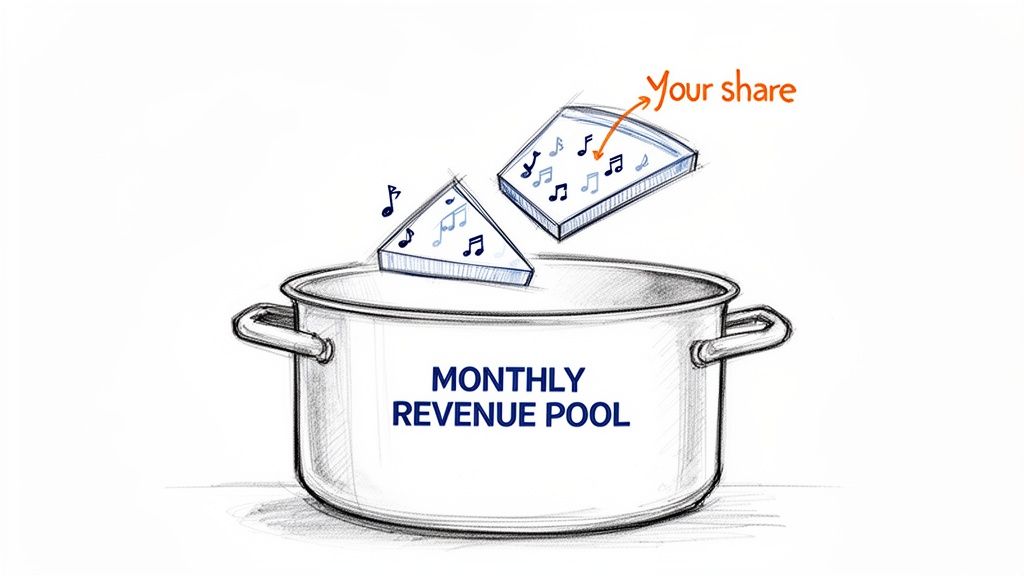
So many musicians get hung up on the idea that there's a specific dollar amount—like a penny or a fraction of a cent—that Spotify pays out for every single play. This is probably one of the biggest myths in the entire industry. The reality is a lot more fluid, all thanks to what’s known as the "pro-rata" model.
Picture this: all the money Spotify pulls in during a month from every possible source—Premium subscriptions, ads played for free users, you name it—gets dumped into one massive pot of cash. This is the net revenue pool. Before any of it goes to artists, Spotify takes its cut, which is roughly 30%, to cover everything from running their servers to paying their staff.
The other 70% is what’s left for music rights holders. This is the money that gets paid out as royalties. Your payment isn’t a flat rate; it’s a percentage of this massive pool.
To help simplify this process, here's a quick look at the key stages involved:
Quick Overview of Spotify's Payment Process
Stage | Description | Key Takeaway |
|---|---|---|
1. Revenue Collection | Spotify pools all income from subscriptions and ads for the month. | This is the "big pot" of money before anyone gets paid. |
2. Spotify's Cut | Spotify deducts its share (approx. 30%) for operational costs. | The platform takes its cut first. |
3. Royalty Pool | The remaining amount (approx. 70%) is designated for rights holders. | This is the total money available for artists, labels, etc. |
4. Stream Share Calc. | Spotify calculates your music's percentage of total platform streams. | Your share is relative to everyone else's. |
5. Payout | You receive that same percentage from the royalty pool. | Your earnings directly reflect your market share on the platform. |
This table shows how the money flows from the listener's wallet all the way to the rights holders, with the artist's final cut being determined by their "stream share."
Your Share of the Pie
So, how does Spotify figure out your specific piece of that pie? It's all about ratios. They look at your total streams in a given month and stack them up against the total number of streams for all songs on the platform in that same period.
Here’s a simple way to think about it:
Total Monthly Streams: Spotify adds up every single eligible stream from every song on the platform for that month.
Your Stream Share: It then calculates what percentage of those billions of streams belongs to your music.
Your Payout: You get paid that exact same percentage from the rights holders' revenue pool.
For example, if your songs accounted for 0.001% of all streams on Spotify in a given month, you would be entitled to 0.001% of the total money in the royalty pool for that month.
This pro-rata system is the bedrock of how Spotify pays out. It's why the so-called "per-stream rate" is always changing month-to-month and varies based on where your listeners are and what kind of account they have. A stream from a Premium subscriber in the U.S. drops more money into the revenue pool than a stream from an ad-supported user somewhere else, making that Premium stream inherently more valuable.
Wrapping your head around this is the single most important step. Everything else about your Spotify earnings—from the different royalty types to the roles of distributors and labels—is built on this fundamental model of a shared revenue pot.
The Spotify Royalty Pool: Unpacking the Numbers
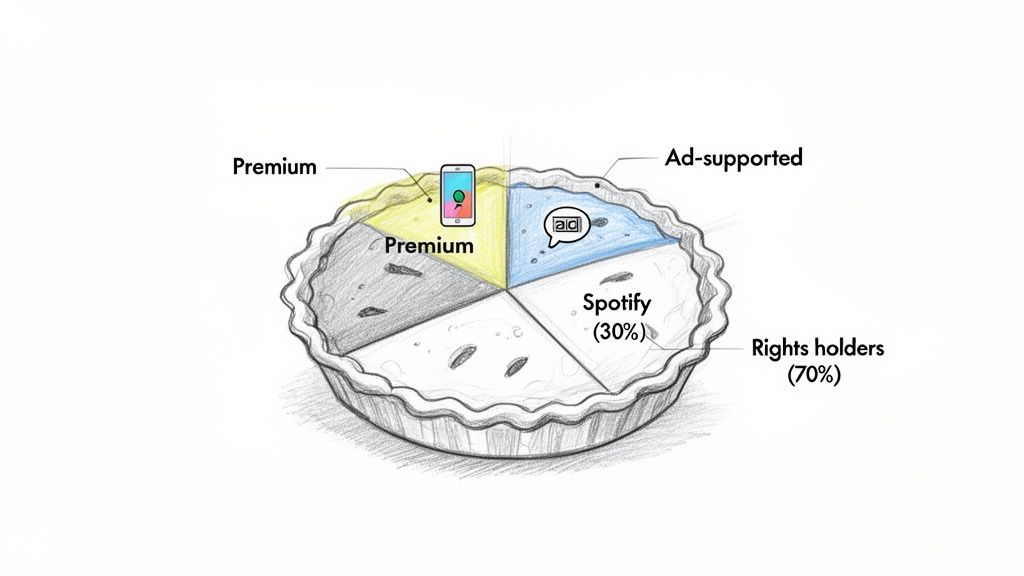
To really get how artists get paid on Spotify, you have to start where the money does: the monthly royalty pool.
Imagine Spotify bakes a giant pie every single month. Before anyone gets a slice, all the money from every possible source—Premium subscriptions, ads played for free listeners, and other income streams—gets thrown into one massive mixing bowl. This is the royalty pool.
And because not all streams are created equal, they don't all contribute the same amount of ingredients to the pie. A stream from a Premium subscriber in the U.S. adds a much bigger chunk of revenue to the pool than a stream from an ad-supported user in a region with lower ad rates. It all goes into the same pot.
How the Pie Gets Sliced
Once all the money for the month is collected, Spotify takes its cut first. This slice is roughly 30% of the total pie, which covers everything from running the platform and paying their engineers to marketing and other business costs.
The huge piece that's left over—about 70%—is what's reserved for music rights holders. This is the official royalty pool. It’s the total pot of money available to be paid out to artists, songwriters, labels, and publishers for that specific month.
So, your goal as an artist isn't just to rack up streams. It's to claim the biggest percentage of this specific pool you possibly can.
Your earnings come down to your "stream share." If your music accounts for 1% of all eligible streams in a given month, you're entitled to 1% of that month's royalty pool for rights holders.
The sheer size of this pool is hard to wrap your head around. In 2023, Spotify paid out a staggering $9 billion to the music industry, marking the largest annual payout from any single retailer in history. As Spotify continues to grow and raise prices, it keeps funneling nearly 70% of every dollar back to rights holders. For artists grinding it out, this means authentic growth is everything. Using a tool like artist.tools' Playlist Analyzer to spot real fan engagement versus botted streams is critical to making sure your royalties aren't at risk.
Why the Per-Stream Rate Is a Myth
This whole pool-based system is exactly why a fixed "per-stream rate" doesn't exist. It's a common misconception. The value of a single stream is constantly shifting based on two key factors:
The total revenue in the pool: How much cash did Spotify actually bring in that month?
The total number of streams: How many times was all music streamed on the platform that month?
If total revenue shoots up but stream numbers stay flat, the effective value of each stream increases. But if stream numbers grow way faster than revenue, the value per stream drops. This dynamic is the most important concept to grasp. We actually break this down even further in our detailed guide on how money per stream works on Spotify.
Ultimately, your focus should be on driving high-quality streams from real, engaged listeners in valuable markets. That's how you maximize your share of this ever-changing revenue pie.
Understanding Master and Publishing Royalties
Here's something every artist needs to burn into their brain: one stream on Spotify doesn't create one royalty. It creates two.
This is a game-changing concept. If you're not set up to collect both types of royalties, you are absolutely leaving money on the table. It’s that simple.
Think of your song as having two distinct halves. You have the master recording on one side, and the song composition on the other.
The master recording is the final audio file—the actual thing people hear. It's the finished product you upload to Spotify through your distributor. It’s all about the performance, the production, the final sound.
The song composition is the song's DNA. It's the underlying melody, the lyrics, the core structure. It's the song in its most essential form, completely separate from any specific recording of it.
Master Royalties: The Sound Recording
Master royalties get paid to whoever owns the sound recording itself. For most independent artists, that’s you. If you’re signed to a record label, they usually own the masters in exchange for fronting the costs.
These royalties are generated every single time your specific recording gets played.
Who Collects It? Your music distributor (like a DistroKid or TuneCore) or your record label scoops these up directly from Spotify.
Who Gets Paid? The money then flows from the distributor or label to you (the artist), any producers, and anyone else who has a piece of the master.
This is the side of things most artists are familiar with. It's usually handled by the same service you use to get your music on Spotify in the first place, so it feels pretty straightforward.
Publishing Royalties: The Song Composition
Publishing royalties are paid to the owners of the underlying song—the songwriters and their publishers. This is where things get a bit more complex, because these royalties are broken down further into types like performance and mechanical royalties.
Here's the kicker for independent artists who write their own material: you own both the master and the composition. You're entitled to collect from both revenue streams, but they are handled by completely different companies and paid out through separate channels.
This is precisely where so many artists lose out. Your distributor only takes care of the master side. To get your hands on your publishing royalties, you need a different set of partners.
Who Collects It? This is the job of a publishing administrator (like Songtrust) and Performance Rights Organizations (PROs) such as ASCAP, BMI, or SESAC.
Who Gets Paid? The money goes to the songwriters and publishers who own the composition.
Understanding this dual-royalty system is the key to unlocking how money really flows on Spotify. One stream triggers two separate payment paths. If you only have a distributor, you're only collecting from one of them.
Want to go deeper down this rabbit hole? Check out our complete guide on what mechanical royalties are and how they work.
To really nail this down, let’s put it all side-by-side.
Master vs. Publishing Royalties at a Glance
This table breaks down the two sides of the royalty coin, making it easy to see who gets what and how.
Royalty Type | What It Covers | Who Gets Paid | Collected By |
|---|---|---|---|
Master Royalties | The specific audio recording of a song. | The owner of the recording (artist, label). | Music Distributor or Record Label. |
Publishing Royalties | The underlying musical composition (lyrics, melody). | The songwriter(s) and their publisher(s). | Publisher and PROs (ASCAP, BMI). |
Making sure you have the right partners in place to collect both master and publishing royalties isn't just a good idea—it's essential for maximizing your Spotify income. Without both pieces in place, a big chunk of the money you've earned will just sit there, uncollected.
Tracing Your Money from Spotify to Your Bank
Once Spotify does its monthly math and figures out your share of the royalty pool, the money doesn't just magically show up in your bank account. Instead, it starts a long journey through a chain of middlemen, and each one takes a slice before passing the rest down the line. Nailing down this process is key to understanding how artists really get paid and why your final deposit never lines up with a simple per-stream guess.
Think of it like a river. The massive royalty pool is the source, and your bank account is the ocean. Along the way, that river flows through several dams and channels—your distributor, your publisher, your PRO—and each one diverts a portion of the water for itself.
The First Stop: Your Distributor or Label
For the royalties tied to your actual recording—the master royalties—the first stop is your music distributor (like DistroKid or TuneCore) or, if you're signed, your record label. Spotify pays this company the total master royalties earned by your entire catalog for that month.
This is where the first big cuts happen. Your distributor or label will take their fee right off the top, based on whatever deal you signed. This could be a flat annual fee, a percentage-based commission (often 15-20% for distributors, and 50% or more for labels), or some mix of the two.
Only after they’ve taken their share do they make the remaining balance available to you.
Collecting Your Other Half: Publishing Royalties
At the same time, Spotify is sending the publishing royalties to a completely different set of organizations. This money is for the songwriters and publishers who own the underlying song—the composition itself.
These royalties are collected by:
Publishing Administrators: Companies like Songtrust or Sentric collect mechanical royalties on your behalf. They’ll take a commission, typically around 15%, for their work.
Performance Rights Organizations (PROs): Organizations like ASCAP, BMI, and SESAC in the U.S. collect performance royalties. After they deduct their operational costs, they pay the rest to their member songwriters and publishers.
If you’re an independent artist who wrote your own songs, you have to sign up with these separate entities to get paid this half of your income. Your distributor doesn't touch it.
The payment chain for master and publishing royalties runs on two completely separate, parallel tracks. A distributor collects one, while a publisher and PRO collect the other. To get paid everything you've earned, you need partners on both tracks.
Realistic Payout Timelines
One of the most frustrating things for new artists is the delay between a stream happening and the money actually hitting your account. This lag is just a standard part of the industry, and it happens for a few concrete reasons.
First, Spotify has to close out its books for the month, calculate all the stream shares, and process payments to thousands of rights holders all over the world. That alone takes time. Then, your distributor or publisher has to receive that money, process it on their end, calculate your specific share, and finally update your account.
Typical Delay: Expect a 2-3 month lag. So, royalties you earned in January probably won't be available until March or even April.
This delay is crucial for financial planning. You won't see immediate cash from a track that goes viral; you'll see it a few months down the road. For a deeper dive into how your music is tracked through this system, our guide on ISRC codes and music royalties explains the backbone of this process.
Common Deductions and Withdrawal Thresholds
Finally, after all the commissions are taken and the months-long wait is over, the money is sitting in your distributor or publisher account. But you're not quite there yet. There are still a couple of final hurdles.
Most services have a minimum payout threshold. You might need to rack up $10, $20, or even $50 in royalties before you can actually withdraw the funds. If you're just starting out, this means your money could sit in their account for several months before you can touch it.
On top of that, when you do withdraw, you might get hit with bank processing or transaction fees, which can take another bite out of smaller payouts. What started as a big number from Spotify has now been chipped away by multiple parties, leaving you with the final net amount that actually lands in your bank.
Strategies to Increase Your Spotify Earnings
Knowing how Spotify's payment system works is half the battle. The other half—the part where you actually make a difference—is about taking the reins and actively managing your presence to grow your income. This is where you shift from being a passive earner to an active strategist, using real data to make smarter decisions that directly fatten your wallet.
Just uploading your tracks and crossing your fingers is a surefire way to go nowhere. To really get a handle on how artists get paid on Spotify, you need to learn how to actively increase your slice of the revenue pie by attracting the right kind of listeners. This is where data-driven tools become your secret weapon.
Forecast Your Earnings and Set Clear Goals
One of the first and most powerful things you can do is take the mystery out of your potential income. Vague hopes for "more streams" don't count as a strategy. You need actual numbers to aim for.
A tool like the artist.tools Spotify Royalties Calculator helps you get out of the guessing game. By plugging in your stream counts, you can see realistic earnings forecasts. This turns an abstract wish into a concrete financial target, showing you exactly how many streams you need to hit your next income goal.
This kind of visual forecast helps you create achievable goals and actually track your progress toward them. It makes the whole process feel real.
Target High-Value Playlists for Quality Streams
Let's get one thing straight: not all streams are created equal. A single stream from a Premium subscriber in a high-payout country like the US or UK drops way more money into the royalty pool than a stream from a free user somewhere else. This is why getting on the right playlists is so critical—it's your direct line to those high-value audiences.
But just chasing placements on any playlist can backfire. A ton of them are filled with bots or fake listeners that generate absolutely zero revenue and can even put your music at risk.
The real key is finding authentic playlists with real, engaged listeners. A Playlist Analyzer is indispensable here. It lets you vet playlists before you pitch them, looking at their follower growth and listener data to make sure your hard work results in genuine streams that actually pay out.
Protect Your Revenue from Fake Streams
One of the biggest, quietest threats to your Spotify earnings is fraud. Bot-driven streams don't just pay you nothing; they can get your tracks flagged and yanked from the platform entirely, freezing any money you've already earned.
This is the silent income killer that many artists don't even realize is happening until it’s too late.
Protecting your catalog is just as important as promoting it. Artificial streams devalue your music and can lead to devastating account penalties from Spotify, making active monitoring a non-negotiable part of your strategy.
Proactively using a Bot Detection tool is like having a security guard for your music. These tools scan your profile for signs of fake streaming activity, flagging sketchy playlists so you can get ahead of the problem before Spotify's algorithms do. It's about safeguarding your royalties and keeping your career in good standing.
Improve Discoverability with Spotify SEO
The final piece of the puzzle is making sure real fans can find you in the first place. Millions of people hit Spotify's search bar every single day looking for new music and playlists. Optimizing your presence for search is a powerful—and totally organic—way to boost your streams.
Using Spotify SEO Research tools gives you a serious advantage by showing you what listeners are actually typing into that search bar. You can analyze keywords, see which playlists are ranking for certain terms, and spot untapped opportunities.
This data allows you to:
Target Niche Genres: Find underserved keywords and build playlists around them to attract a dedicated audience.
Optimize Track Titles: Use descriptive, searchable titles that match what fans are looking for.
Enhance Your Profile: Weave relevant keywords into your artist bio to improve your search ranking.
This diagram shows the direct path your music's royalties take from Spotify straight to your bank account.
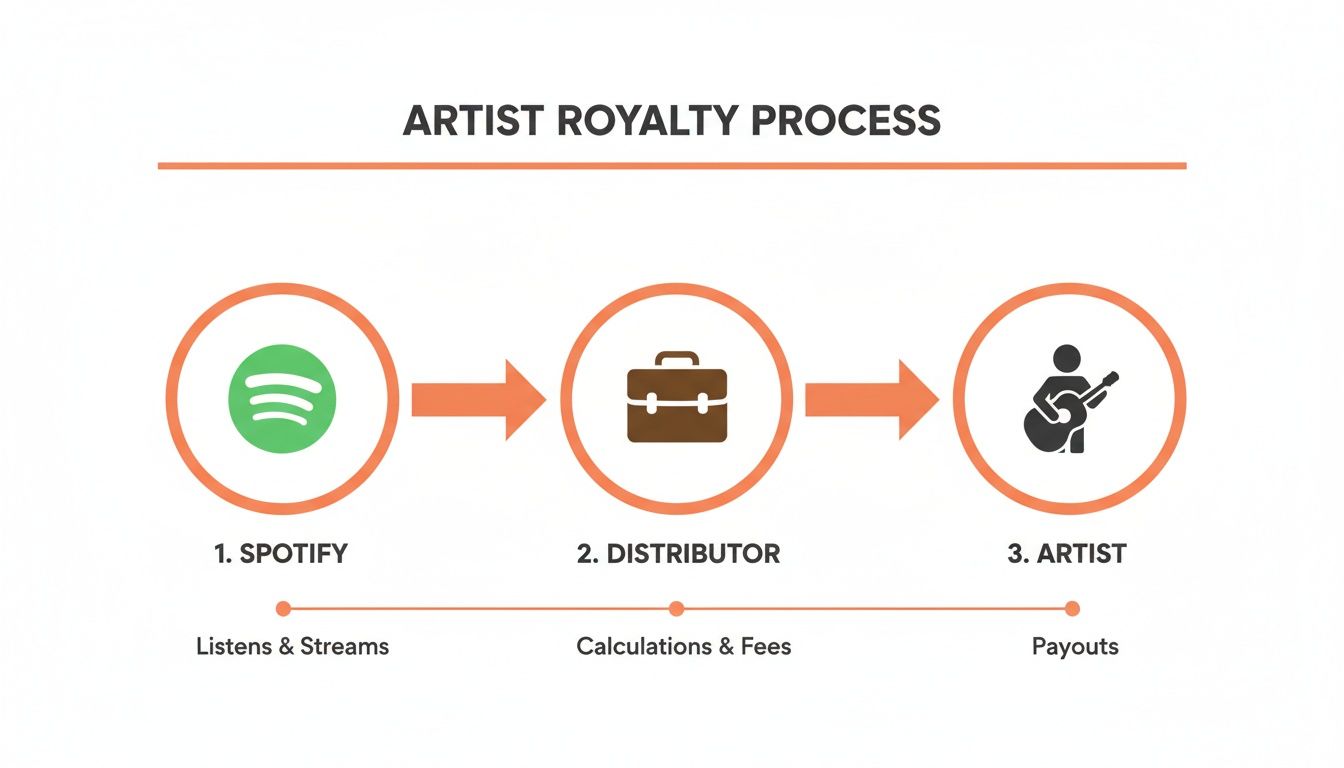
Once you understand this flow, you can see exactly how making your music easier to discover directly fuels your final payout.
Common Questions About Spotify Artist Payments
Even after you get the hang of royalty pools and payment chains, the day-to-day reality of getting paid can still feel a bit murky. For most artists, the path from a stream to actual money in the bank is often filled with confusing delays and deductions. This section cuts through the noise and tackles the most common questions head-on.
We'll break down why it takes so long to get paid, why your distributor's numbers never seem to match your Spotify for Artists dashboard, and what to do if you think you're missing money. The goal here is to clear up any lingering confusion so you can manage your streaming income with confidence.
How Often Do Artists Get Paid by Spotify?
This is the big one, but the answer isn't a simple "once a month." While Spotify sorts out and pays royalties every month, you, the artist, don't get that cash right away. There's a built-in delay.
You can typically expect a two to three-month lag between when someone streams your song and when you can actually access that money through your distributor.
So, for example, the royalties you racked up in January probably won’t be processed, reported, and available for you to withdraw until March or even April. This delay isn't arbitrary; Spotify needs time to finalize its global revenue for the month, calculate trillions of individual stream shares, and then issue statements and payments to thousands of distributors and rights holders worldwide. Then, each of those partners has to process the payment and data on their end before it finally trickles down to you.
Why Do My Stream Counts Differ Between Platforms?
One of the most common freak-out moments for artists is seeing one number in their Spotify for Artists account and a different, usually lower, number in their distributor’s royalty report. It can feel like you're being ripped off, but there are a few legitimate reasons this happens.
Eligibility Rules: Not every single play generates a royalty. For a stream to count, a listener has to play your track for at least 30 seconds. Spotify for Artists might show you plays that were shorter, but your distributor's report will only include the streams that actually met this payout threshold.
Fraudulent Activity: Spotify is constantly filtering out streams it flags as artificial or fraudulent. These bot plays might pop up on your dashboard for a bit, but they get scrubbed before the final royalty numbers are sent to your distributor.
Reporting Timelines: The data in Spotify for Artists is updated pretty frequently, giving you a close-to-real-time peek at your performance. Your distributor's reports, on the other hand, are based on the final, audited financial data for a specific month—a much slower and more methodical process.
The key takeaway is that your Spotify for Artists dashboard is a marketing and analytics tool, while your distributor's report is a financial statement. They are measuring slightly different things on different timelines, which is why the numbers will rarely align perfectly.
What Is a Minimum Payout Threshold?
So you've waited months, the money finally shows up in your distributor account... but you still can't withdraw it. What gives? This is almost always because of a minimum payout threshold.
A minimum payout threshold is simply the smallest amount of money you need to have in your account before you can request a withdrawal. This number varies by distributor, but it's often somewhere between $10 and $50.
This policy exists because it's just not efficient for distributors to process thousands of tiny payments for a few cents each. For new artists just starting to build momentum, this can mean your earnings sit in the account for several months—or even longer—until you hit that magic number. It's a really important detail to look for when you're choosing a distribution service, since a lower threshold means getting your hands on your money sooner.
What Should I Do About Missing Royalties?
If you've already accounted for the time lag, payout thresholds, and data discrepancies, but you still have a gut feeling that something's wrong with your payments, it's time to investigate. The first step is to figure out what kind of royalty might be missing.
Missing Master Royalties: If the issue is with the money from your sound recordings, your first and only point of contact should be your distributor or record label. They are the ones who get the statements and payments directly from Spotify. When you reach out, be ready with specific details: track names, time periods, and which countries you're concerned about.
Missing Publishing Royalties: If you're a songwriter and you're not seeing the money you're owed for the composition itself, the problem is elsewhere. This money doesn't come through your distributor. Instead, you'll need to contact your Performance Rights Organization (PRO), like ASCAP or BMI, or your publishing administrator (like Songtrust).
Before you send any emails, get all your documentation in order. Having clear data and a specific, well-defined question will make the process way smoother and dramatically increase your chances of getting a helpful resolution.
Navigating the complexities of Spotify payments requires not just knowledge, but the right tools. At artist.tools, we provide a full suite of data-driven solutions to help you forecast earnings, find authentic playlists, protect your revenue from fraud, and improve your music's discoverability. Stop guessing and start strategizing. Empower your music career by visiting https://artist.tools today.
.png)
.png)
Comments