How much money do artists make on spotify: A guide to royalties
- Jan 10
- 15 min read
Let's get straight to it. The first question every artist asks is, "how much money do I actually make per stream on Spotify?"
The honest answer? It's not one clean number. It's a range, usually floating somewhere between $0.003 and $0.005 per stream.
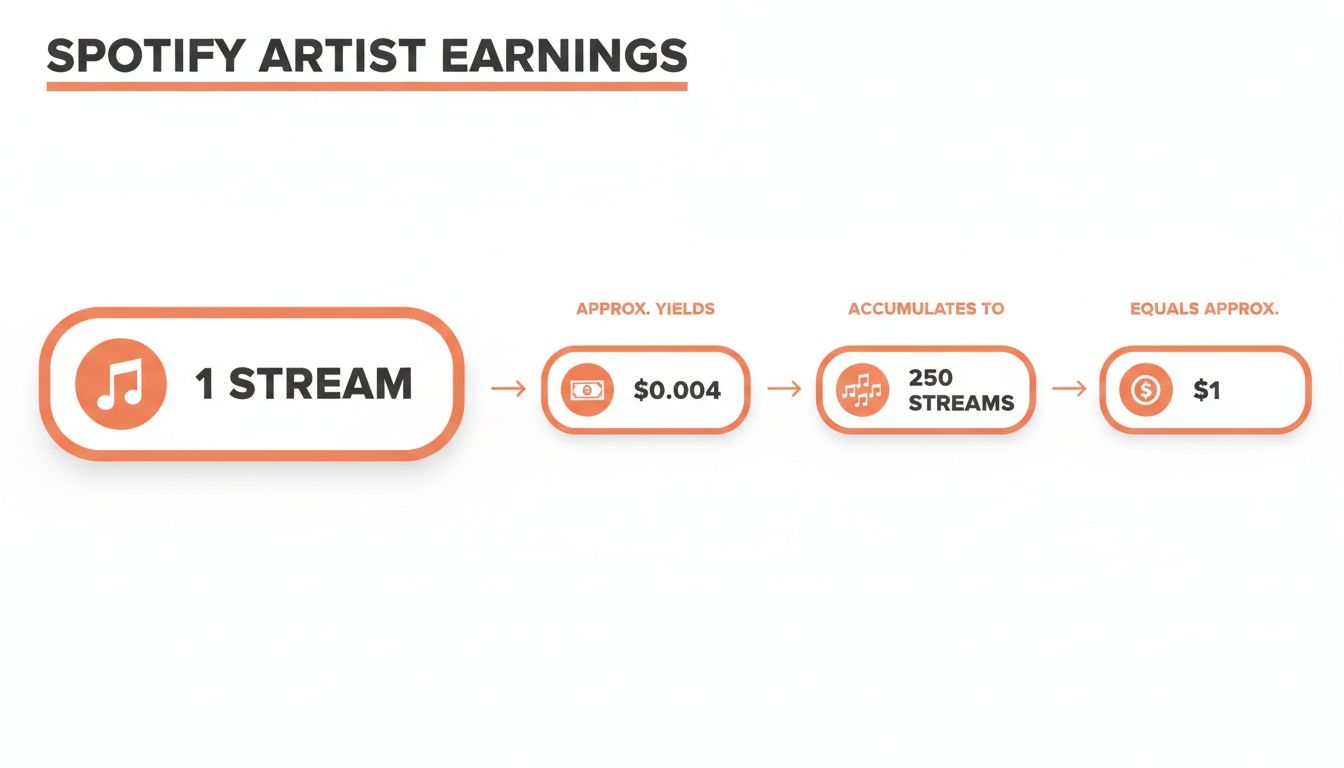
To put that in perspective, you'd need around 250 streams just to earn your first dollar. Hitting a milestone like $3,000 to $5,000 in gross revenue requires cracking nearly a million streams—and that's all before your label, distributor, or publisher takes their slice of the pie.
Your Quick Answer on Spotify Artist Earnings
While that per-stream range is a good starting point, it's critical to know it isn't set in stone. It's a dynamic figure that shifts based on a few powerful factors. Think of it less like a fixed price tag and more like a stock whose value changes with the market.
This guide will break down exactly how Spotify’s complex payment system works, show you why that per-stream rate is always changing, and give you actionable ways to actually influence it. Getting a handle on these concepts is the first step to building a real, sustainable career on Spotify.
The Numbers You Need to Know
For most artists, the journey to earning on Spotify is a slow build. The most commonly cited average payout is that $0.003–$0.005 per stream. This is grounded in Spotify's model of paying out roughly 70% of its revenue to rights holders (like you, your label, and your publisher) while keeping the other 30%.
To make it real: earning $1 takes about 250 streams. Generating $3,000–$5,000 means you need around 1 million streams. These are the foundational numbers every musician should have in their head. You can discover more about how to calculate Spotify royalties accurately in our detailed guide.
The core takeaway is that a "stream" is not a unit with a fixed monetary value. Its worth is determined by who is listening, where they are, and what kind of subscription they have.
To give you a clearer picture, here's a simple breakdown of what those numbers look like at different milestones.
Spotify Earnings at a Glance Based on Averages
This table shows estimated gross earnings at different streaming milestones based on an average per-stream payout of $0.004.
Number of Streams | Estimated Gross Earnings (Before Splits) |
|---|---|
1,000 | $4 |
10,000 | $40 |
100,000 | $400 |
500,000 | $2,000 |
1,000,000 | $4,000 |
5,000,000 | $20,000 |
Remember, these figures are just ballpark estimates before anyone else gets paid. Your actual earnings will vary based on the factors we'll dig into next.
Estimating Your Potential Earnings
Seeing these numbers in action makes them much more tangible. This is where a good Spotify Royalties Calculator becomes indispensable. It turns abstract per-stream rates into concrete financial forecasts, which is absolutely vital for planning your releases and setting goals you can actually hit.
Here’s a glimpse of how the artist.tools calculator helps you visualize your potential gross earnings.
As you can see, you just plug in your stream numbers to get an instant, data-driven estimate of your gross revenue. This simple step can bring a ton of clarity to your financial planning and help you see the path forward.
How Spotify's Royalty Pool Actually Works
If you really want to get your head around how much money artists make on Spotify, you have to look past the simple "per-stream" rate. It's a common misconception. Spotify doesn't just cut a check for a fixed amount every time your song gets played. Instead, all the money gets pooled together first, and then everyone gets a piece. This is the pro-rata model.
Think of it like a giant pizza party every single month. All the money Spotify pulls in from Premium subscriptions and ads goes into making one massive pizza. This pizza is the total royalty pool for that month.
Your goal as an artist isn't to get paid for each bite (a stream), but to claim a slice of that whole pizza. The size of your slice depends on your streamshare—basically, what percentage of the total streams on the entire platform were yours. If your tracks made up 0.001% of all streams in a given month, you get 0.001% of the pizza. Simple as that.
Who Gets a Slice of the Pie?
Now, that "pizza" doesn't all go to you, the artist. It gets divided among all the rights holders who had a hand in making and releasing the music. For any given song, there are two main copyrights at play:
The Master Recording: This is the actual audio file—the final version of your song. These rights are usually owned by the artist and their record label or distributor.
The Musical Composition: This is the song itself—the melody and the lyrics. These rights belong to the songwriter and their publisher.
Spotify carves out a slice of the pie for both of these rights holders. The money flows from Spotify to your distributor (for the master royalties) and your publisher or performing rights organization (for the composition royalties). They take their cut, and then you get paid based on your deal. This is a huge reason why the final number that hits your bank account looks so different from the initial revenue figures.
The New Rules of the Game
Spotify recently changed the rules for who gets to eat. To crack down on the flood of low-quality tracks and fake streams, they’ve rolled out new thresholds for getting paid. As of early 2024, a track has to clear two hurdles to qualify for royalties:
A 1,000-Stream Minimum: Your track needs to be played at least 1,000 times in the last 12 months before it can start earning.
A Unique Listener Threshold: Those 1,000 streams also need to come from a minimum number of different people to prove it's real engagement.
This is a big deal. It means not every single stream automatically generates cash anymore. Spotify is basically saying they only want to share the pizza with tracks that have genuine, real-world listeners.
These new policies are meant to shift millions of dollars away from tiny, almost meaningless payouts and straight-up fraud, putting it back into the pockets of artists who are actively building a fanbase. For a deeper dive into the nuts and bolts of the payment process, check out our ultimate guide to Spotify royalty payments.
Understanding this pro-rata system—the big pool of money, all the different hands in the pot, and the new rules for getting paid—is the first, most crucial step to actually building a strategy that grows your revenue on Spotify.
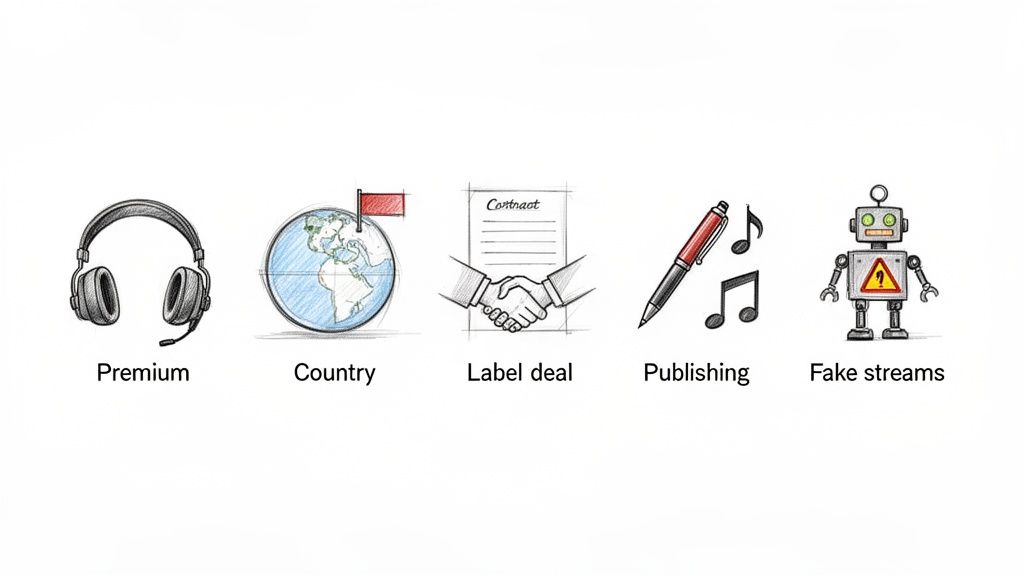
The Five Key Factors That Change Your Payout Rate
That old idea of a stream being worth a flat rate, like $0.004, is a decent starting point, but it's not the whole story. Not even close. The real value of a single stream is always in flux, pushed and pulled by a handful of powerful variables.
Getting a grip on these factors is the key to understanding how much money you really make on Spotify. Two streams of the very same song can end up paying out wildly different amounts. Think of it less like a fixed price tag and more like a dynamic market where listener behavior and location set the value. Let's break down the five levers that determine what every single play is actually worth.
1. The Listener's Subscription Type
The single biggest thing that moves the needle on a stream's value is whether the listener is a Premium subscriber or a free, ad-supported user. This one detail is fundamental to how Spotify’s royalty pool gets filled up in the first place.
Premium subscribers are tossing their monthly fees directly into the pot for their country. Because they're paying real money, their streams are worth a whole lot more. On the flip side, free users only contribute the ad revenue Spotify earns while they listen, which is just a fraction of a subscription fee.
A stream from a Premium account can be worth 3 to 5 times more than a stream from an ad-supported account. This is why a smaller, dedicated fanbase of paying subscribers can often generate more income than a massive audience of free listeners.
2. The Listener's Geographic Location
Not all countries are created equal in the Spotify world. The value of a stream is directly tied to the economic market where the listen happens. Why? Because subscription fees and ad rates are completely different from one country to another.
A Premium subscription in a place like Switzerland or Denmark costs way more than one in India or the Philippines. That means a stream from a listener in a high-cost market adds more money to the royalty pool and, in turn, is worth more to you.
Tier 1 Markets (e.g., USA, UK, Australia, Scandinavia): These countries have high subscription fees and strong ad markets, which translates to the highest per-stream payouts.
Tier 2 Markets (e.g., Southern Europe, some parts of Asia): In these regions, you'll see moderate subscription costs and ad revenue, leading to average payout rates.
Tier 3 Markets (e.g., Latin America, Southeast Asia): Lower subscription prices and developing ad markets mean streams from these areas generate the lowest payouts.
3. Your Label or Distributor Deal
Once Spotify pays out the gross revenue, the money starts its journey down the chain. The percentage that actually hits your bank account is decided entirely by the deals you’ve signed. This is where your personal net earnings take shape.
Your distributor or record label is the one collecting the master recording royalties from Spotify for you. They then pay you based on whatever royalty split you agreed to.
Distributors (like DistroKid or TuneCore): These services usually offer deals where you keep 90-100% of the royalties after their fees.
Record Labels: Traditional label deals are all over the map. A new artist might only see 15-20% of the net royalties, while an established star could command 50% or more.
This split is one of the biggest factors in your take-home pay. A million streams might generate $4,000 in gross revenue, but your cut could be anything from $600 to $4,000 depending on your deal. Our guide on how to calculate Spotify royalties accurately dives much deeper into these numbers.
4. Publishing Royalties for Songwriters
Here’s a piece of the pie that often gets forgotten in the streaming conversation: publishing royalties. These are totally separate from the recording royalties. If you wrote or co-wrote your song, you're owed money for the use of the musical composition itself—the lyrics and melody.
These royalties are collected by Performing Rights Organizations (PROs) like ASCAP and BMI, and by publishers. While this slice is smaller than the master recording side, it's a critical income stream that tons of independent artists miss out on because they aren't properly registered.
5. Artificial and Fraudulent Streaming
The last factor is a nasty one: fake streams. Artificial streaming, pumped out by bots or click farms, pollutes the royalty pool. Spotify has a pretty sophisticated system to sniff this stuff out, and when it does, those streams are demonetized. They pay nothing.
If a big chunk of your streams gets flagged as fraudulent, it won’t just tank your payout—it can lead to serious penalties. We're talking about having your tracks pulled or your entire account suspended. Protecting your profile from bot activity isn't just a good idea anymore; it's essential for keeping your income stream healthy. This is where a tool like the artist.tools Bot Detection feature becomes a career-saver.
How Many Artists Actually Make a Living from Spotify?
Knowing how Spotify's royalty system works is one thing. The real question is, how does that actually translate into a career? How many artists are really making a living wage from their streams?
Thankfully, Spotify's "Loud & Clear" initiative gives us a transparent, if sometimes sobering, look into the platform's economics.
The data points to a clear and undeniable trend: growth. More artists are hitting significant financial milestones on Spotify than ever before. This suggests a healthier, more accessible ecosystem where independent creators have a real shot at building a career without needing a traditional record deal.
But the numbers also tell a story of intense competition. While the overall pie is getting bigger, the number of artists trying to get a slice is growing even faster. Success isn't just about making great music anymore; it's about navigating a seriously crowded market where every single stream counts.
The Growing Middle Class of Musicians
One of the most encouraging signs is the rise of what you could call Spotify's "middle class"—artists who are pulling in substantial, life-changing revenue. We're not just talking about the superstars here. We’re talking about a growing wave of creators who can fund their entire careers directly from their streaming income.
Spotify’s Loud & Clear data shows that in 2024, around 22,100 artists generated at least $50,000 in recording and publishing royalties from Spotify alone. That’s a massive leap from just 7,400 artists in 2017, marking an incredible 200% increase in only seven years. It proves that earning a meaningful income is becoming a more attainable goal for a wider pool of artists. You can dig into these stats more over at Music Business Worldwide.
This isn't some random fluke. It points to a maturing streaming economy where dedicated fanbases, even niche ones, can provide a legitimate financial foundation for artists who know how to connect with them.
A Realistic Look at the Competition
While the growth is promising, it's crucial to pair that optimism with a dose of reality. The hard truth is that the vast majority of artists on Spotify earn very, very little. Success is highly concentrated at the top of the pyramid.
In 2024, there were nearly 12 million artists with music on the platform. Out of that massive number, only 71,200 artists (roughly 0.6%) managed to generate more than $10,000 for the year.
This number isn't meant to discourage you. It's meant to be a wake-up call. Organic growth alone is rarely enough. The competition is far too fierce to just upload your music and hope for the best.
This is exactly where a strategic, data-informed approach becomes non-negotiable. Knowing these numbers highlights why tools that give you a competitive edge are so vital. For independent artists and managers, this reality underscores the need for a sharp, deliberate strategy.
So, what does that look like in practice?
Data-Driven Marketing: You need to understand your audience and pinpoint exactly where your streams are coming from, then double down on what works.
Strategic Playlist Pitching: Use a tool like the artist.tools Playlist Analyzer to find legitimate, high-impact playlists and steer clear of the ones that will hurt your profile.
Fraud-Free Growth: Employing bot detection is essential to ensure your streams are real, protecting both your revenue and your standing with Spotify.
The path to making a living on Spotify isn't a lottery ticket. It’s a marathon that rewards strategy, consistency, and a deep understanding of the platform. The data shows that success is possible, but it also proves you have to be smarter and more strategic than ever to grab it.
Proven Strategies to Increase Your Spotify Revenue
Knowing how Spotify calculates payments is only half the battle. The other, more important half is actively working to push those numbers in your favor. This is what separates artists who just get by from those who build a real, sustainable career on the platform.
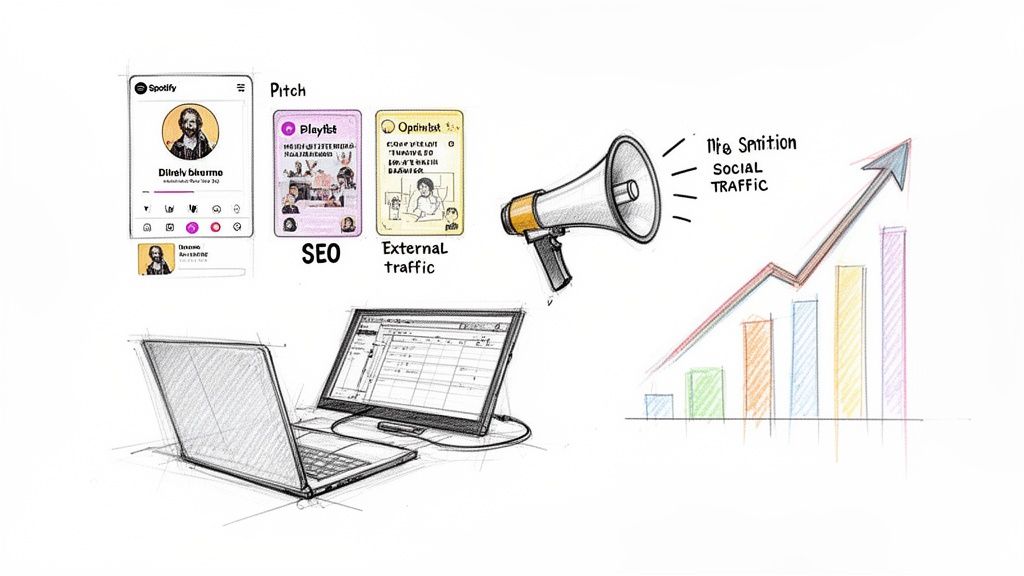
Just uploading your tracks and crossing your fingers is a sure-fire way to get lost in the noise. A better approach? A multi-pronged attack that optimizes your presence, masters the art of playlisting, and drives valuable traffic to your profile.
This isn't about finding a magic bullet. It’s about using a set of proven, data-informed tactics that create a positive feedback loop, telling Spotify’s algorithm that your music is worth pushing to brand new listeners.
Master the Art of Playlist Pitching
Playlists are the lifeblood of discovery on Spotify. A good placement—whether on an editorial or a popular user-curated list—can set off a chain reaction of algorithmic support, bringing in thousands of new streams and followers. But pitching effectively is a science, not a lottery.
The first step is finding the right curators. Don't waste your energy spamming every playlist in your genre. Instead, use a tool like the artist.tools Playlist Analyzer to vet every single opportunity. This lets you check for red flags like bot activity and see a playlist's historical follower growth, making sure you're pitching to real curators with genuine, engaged audiences.
The secret to landing on powerful algorithmic playlists like Discover Weekly often starts with getting on human-curated playlists first. Each placement is like a vote of confidence, telling the algorithm your song is connecting with real people.
Once you’ve got your targets, you need to craft a pitch that’s compelling and straight to the point. Curators are drowning in submissions. Make yours personal, direct, and explain exactly why your track is a perfect fit for their specific playlist.
Optimize Your Spotify for Artists Profile
Think of your Spotify for Artists profile as your digital storefront. If it's neglected, it signals to both fans and the algorithm that you're not fully invested. A well-optimized profile, on the other hand, is a powerful tool for grabbing attention and keeping it.
Take the time to fill out every section with high-quality stuff and a killer bio.
Professional Photos: Use high-resolution images for your profile picture and header. First impressions matter.
Artist Pick: Always feature your newest release or the track you're currently pushing as your "Artist Pick."
Engaging Bio: Write a bio that tells your story and connects with potential fans. Keep it fresh.
Social Links: Connect your other social media profiles to build a community across different platforms.
These small details add up. They create a more professional and engaging experience for anyone who lands on your page, making it much more likely they’ll hit that follow button or explore the rest of your music.
Harness the Power of Spotify SEO
A lot of artists forget that Spotify is also a search engine. People are constantly searching for music based on moods, activities, and genres. Optimizing for these searches—Spotify SEO—can open up a steady stream of organic streams from highly engaged listeners.
This is a game-changer for playlist curators, but it's just as valuable for artists naming their own playlists or even their tracks. Use the Keyword Explorer in artist.tools to figure out what listeners are actually typing into that search bar. By creating and naming public playlists on your profile with targeted keywords like "lofi beats for studying" or "upbeat indie running," you can capture that search traffic yourself.
Every stream from someone who found you through search is a powerful signal to the algorithm. These are listeners who are actively looking for what you offer, making them more likely to save your track, follow you, and trigger even more algorithmic recommendations.
Drive High-Quality External Traffic
While building your on-platform presence is vital, driving traffic from outside sources like social media, your email list, and music blogs is absolutely crucial, especially for a new release. Spotify’s algorithm pays close attention to these early signals.
When a song shows early signs of life from external sources, the algorithm is far more likely to test it with a wider audience through playlists like Release Radar and Discover Weekly. This can create a snowball effect that turns a modest release into a genuine hit.
Focus on creating high-intent campaigns. Don't just dump a link and run. Give your audience a real reason to click through and listen. Share the story behind the song, create engaging video content, or run a targeted ad campaign aimed at listeners who are already fans of similar music.
Ultimately, these strategies show that how much money artists make on Spotify isn't just luck—it's a direct result of strategic effort. Artists who reach career-sustaining income levels begin approaching $1 million per year when they hit around 4–5 million monthly listeners. Even in the middle tiers, about 20,500 artists earned at least $50,000 from Spotify in 2023. You can read more about the highest-earning artists and these financial benchmarks to find more insights. These numbers provide concrete targets and prove that a smart, tool-assisted strategy can turn streaming into a viable career.
Frequently Asked Questions About Spotify Earnings
Let’s be honest, figuring out Spotify royalties can feel like trying to solve a puzzle. You're not alone. We get these kinds of practical questions all the time from artists and managers, so we've put together some straight-to-the-point answers to help you get a handle on how your earnings really work.
How Often Does Spotify Pay Artists?
Spotify settles up with rights holders—that’s your distributor or label—every month. But that money doesn't hit your bank account right away. You’ll typically see it two to three months later.
So, for example, the cash you earned from all those streams back in January gets processed and sent to your distributor around March. They then process it and pay you on their own timeline, which usually means you’ll see it in April.
Do I Get Paid for Plays Under 30 Seconds?
Nope. A stream only counts—and only makes you money—if someone listens for at least 30 seconds. Anything less than that is invisible to the payment system. This is a hard-and-fast rule across the industry and a big reason why having a hooky, engaging intro is non-negotiable.
Understanding the rules is just the starting point. The real game is won by focusing on the quality of your streams, not just chasing a bigger number.
Which Is Better: 1,000 Streams from 1 Person or 1,000 People?
From a purely financial standpoint, 1,000 streams is 1,000 streams. The payout is the same. But when it comes to your career and getting Spotify's algorithm to notice you, 1,000 streams from 1,000 different listeners is infinitely more valuable.
Why? Because it signals to Spotify that your music has broad appeal. This is the kind of activity that gets you noticed and dramatically boosts your chances of landing on career-changing algorithmic playlists like Discover Weekly and Release Radar. Those playlists are the engines that introduce your music to tons of new fans and create sustainable growth.
How Accurate Are Spotify Royalty Calculators?
A Spotify royalties calculator is a fantastic tool for looking into the future and setting goals that are actually achievable. It uses the going industry rate—which typically lands somewhere between $0.003 and $0.005 per stream—to give you a solid ballpark figure for your gross earnings.
Think of it as a reliable guide for financial planning, not a crystal ball. Since the exact per-stream rate is always shifting based on where your listeners are and what kind of subscription they have, a calculator gives you the clarity you need to make smarter moves for your career.
Ready to stop guessing and start strategizing? The entire suite at artist.tools is designed to give you the data you need to grow on Spotify. From our Royalties Calculator to our Playlist Analyzer and Bot Detection tools, we help you make sense of your earnings and build a winning game plan. Take control of your music career today by visiting https://artist.tools.
.png)
.png)