The Ultimate Guide to Spotify Royalty Payments
It’s a massive misconception that Spotify pays a fixed rate for every stream. The truth is, your earnings are pulled from a shared pool of money. This means the value of any single stream is always changing, depending on your music's total share of streams, where your listeners are, and what kind of subscription they have.
Decoding the Spotify Royalty Pie
So, how does Spotify actually pay artists? It's a question wrapped in a lot of confusion, often mistakenly boiled down to a simple "per-stream rate."
A better way to think about it is like a giant pizza party. The total size of the pizza (the money) changes each month, and the size of your slice depends on how much of the pizza your fans "ate" compared to everyone else. This is what the industry calls the pro-rata model.
Here’s a quick look at how that money gets from a listener's wallet to yours:
The Money Pool is Created: First, Spotify collects all the revenue it makes in a month. This comes from Premium subscription fees and all the ad revenue from free listeners.
Spotify Takes Its Share: The platform takes its cut right off the top, which is about 30% of the total revenue pool. This is what they use to run the business—covering everything from salaries and marketing to keeping the servers running.
The Royalty Pool is Distributed: The remaining 70% becomes the royalty pool. This is the pot of money that gets split among all the music rights holders on the platform.
Who Gets a Slice of the Pie
That big royalty pool doesn't just land in an artist's bank account. It's paid out to the rights holders—the people and companies who legally own the music.
Every single song actually has two separate copyrights, and each one has an owner who needs to get paid.
The core concept to grasp is that you are not paid a fixed rate per stream. Instead, you are paid a percentage of a total revenue pool, determined by your music's 'streamshare' against all other music on the platform.
Understanding this is key to making sense of your royalty statements. The two rights you need to know are:
Master Recording Rights: This is the copyright for the actual sound recording—the final, mixed track you hear. It’s usually owned by the artist, a record label, or your distributor.
Publishing Rights: This copyright covers the underlying composition—the song's lyrics and melody. The songwriter and their publisher own this part.
To make it even clearer, let's break down who gets paid from that royalty pool and what they actually control in the process.
Key Players in the Spotify Royalty Chain
Rights Holder | What They Own | Typical Recipient |
|---|---|---|
Master Rights Owner | The actual sound recording of a song. | The artist (if independent), record label, or distributor (like DistroKid). |
Publishing Rights Owner | The underlying musical composition (lyrics & melody). | The songwriter's publishing administrator or a Performing Rights Organization (PRO). |
As you can see, the money takes a bit of a journey before it reaches the creators. It flows from Spotify to these different rights holders, who then pay out the shares to the artists and songwriters they represent.
How Spotify Calculates Your Royalty Payout
If you really want to get a handle on your Spotify earnings, you need to ditch the idea of a simple, fixed "per-stream rate." It just doesn't work that way. The real system revolves around a concept called streamshare, which is all about figuring out your slice of Spotify's monthly revenue pie.
Think of it like this: all the streams on Spotify in a given month are tickets in a giant lottery pool. The more streams your music racks up, the more tickets you hold. Your payout is simply your percentage of the total tickets.
This is the basic flow of how money gets from listeners to you, the artist.
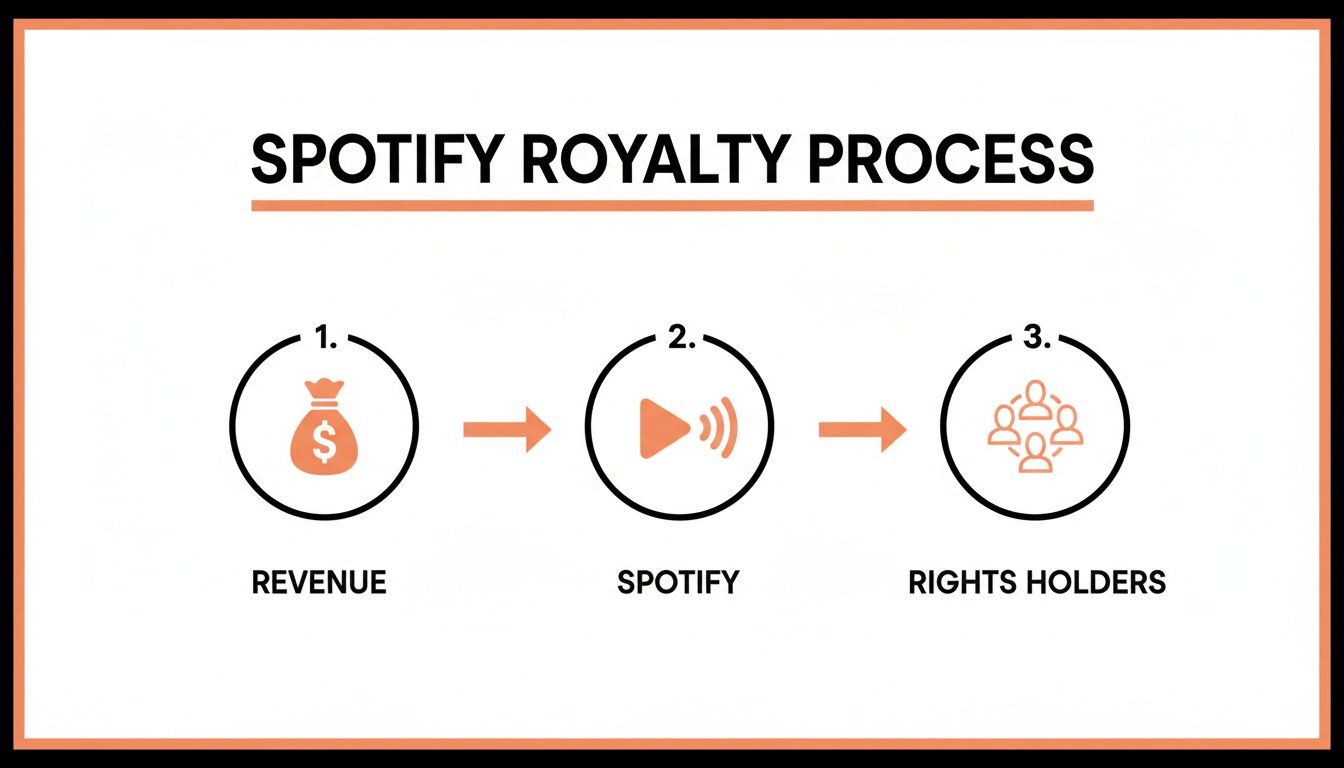
As you can see, Spotify collects all the revenue first before splitting it up and sending it down the line to the rights holders.
Breaking Down the Streamshare Formula
The actual math behind this is surprisingly straightforward. Spotify is essentially doing a big division problem to figure out your cut of the total royalty pool.
Your Streamshare = (Your Total Streams / The Platform's Total Streams) x Total Royalty Pool
Let’s walk through a simplified example for a single month:
The Royalty Pool: After Spotify takes its 30% cut, there's a pot of $10,000,000 left to be paid out to artists and rights holders.
Total Platform Streams: Everyone on Spotify combined for 1 billion streams this month.
Your Total Streams: Your new single absolutely crushed it, earning you 1,000,000 streams.
Plugging those numbers into the formula, your streamshare is (1,000,000 / 1,000,000,000), which is 0.001, or 0.1% of all streams. So, you get 0.1% of the $10,000,000 royalty pool, which comes out to $10,000. That money then goes to your rights holders (like your distributor or label) before it makes its way to you.
Why Not All Streams Are Equal
This "pro-rata" system is the exact reason why a stream isn't just a stream. The value of a single play is constantly changing based on a few key factors that affect how big that royalty pool is and who's contributing to it.
Hitting a million streams is a massive achievement, and based on current estimates, that could translate to anywhere from $3,000 to $5,000. But remember, that's not a guarantee. Spotify's model pools all the revenue and pays out based on your total streamshare—that 70% chunk left after Spotify takes its share. If you want to dive deeper, you can learn more about the factors influencing Spotify payouts in 2025.
Here are the main things that change what a stream is actually worth:
Listener's Location: A stream from someone in a country with a high subscription cost (think Switzerland or the UK) puts more money into the revenue pool than a stream from a region where subscriptions are cheaper.
Listener's Subscription Type: Streams from Premium subscribers are gold. They contribute directly to the subscription revenue pot, which is way bigger and more valuable than the ad-supported pool generated by free listeners.
Your Distribution Agreement: This is a big one. The cut your distributor or label takes directly affects what you see in your bank account. An independent artist with a good deal will keep way more of their royalties than an artist on a traditional label contract.
Understanding these moving parts is the first step to building a real strategy around your music.
The Hidden Factors That Impact Your Earnings
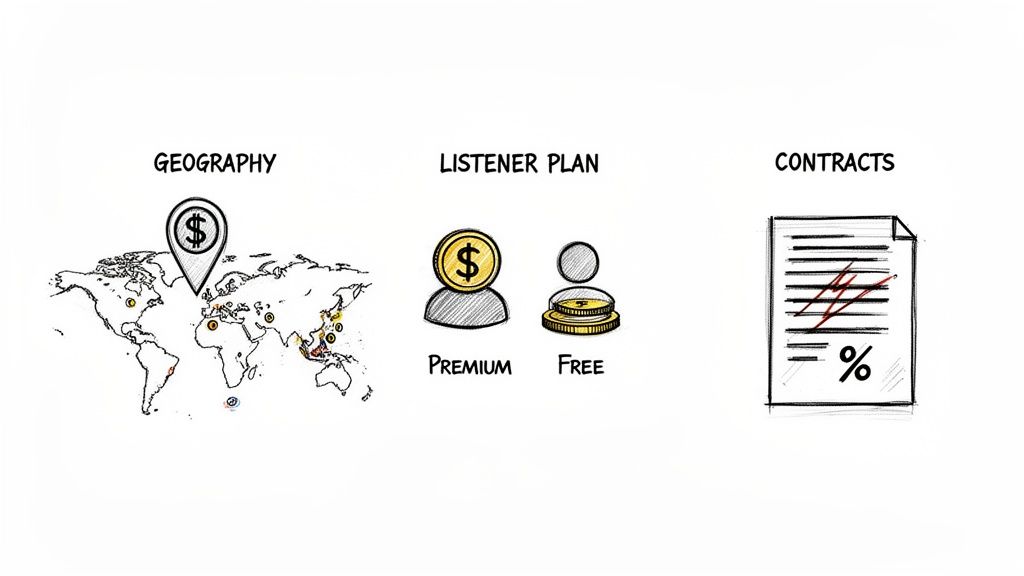
While the streamshare formula gives you the basic math, a few underlying variables can dramatically change what your streams are actually worth. It’s a hard truth, but two tracks with the exact same number of plays can earn wildly different amounts of money.
Getting a handle on these factors is the key to moving beyond just counting streams and starting to build a real revenue strategy. The value of a stream isn't a fixed number; it's a direct reflection of the listener behind it. Where they live, what plan they use, and how they found your music all play into your final payout.
Let's break down the three most important variables you need to know.
Listener Geography: The Global Pay Gap
Where your listeners are physically located is one of the biggest drivers of your royalty rates. A stream is not just a stream, because a Premium subscription doesn't cost the same in every country.
Think of it this way: a subscriber in a country with a higher cost of living and a mature digital market, like Switzerland or the United States, adds more money to their regional royalty pool. Because of that, a stream from that listener is simply worth more.
A stream from a Premium subscriber in a high-cost market like the US might pay $0.0039, while a stream from a lower-cost market like Portugal could be closer to $0.0018. This difference of over 100% shows why targeting specific geographic markets can be a powerful earning strategy.
On the flip side, a stream from a developing market where subscription fees are lower will contribute less to the pot, resulting in a lower per-stream value. This is why building an audience in North America, Western Europe, and Australia can seriously boost your earnings, even if your global stream count stays the same.
Listener Subscription Plan: The Power of Premium
The type of account your listener uses creates another major divide in stream value. Spotify has two main tiers: the ad-supported free plan and the paid Premium subscription. The difference in what they contribute to the royalty pool is massive.
Premium subscribers pay a monthly fee, creating a large and consistent revenue stream. Streams from these users are way more valuable because they're drawn from this dedicated subscription money.
Free users generate revenue through ads played between songs. This ad-based income is far less than subscription money, making streams from free listeners worth considerably less. This is actually one of Spotify’s main goals: converting free users into paying subscribers, because it grows the entire royalty pie for all artists.
Premium Streams: Directly funded by monthly subscription fees, leading to higher royalty payouts.
Ad-Supported Streams: Funded by lower, more variable ad revenue, resulting in smaller payouts.
Contracts and Policies: The Final Gatekeepers
Even after your streamshare is calculated, the money has a whole journey to take before it actually reaches you. The deals you have with your partners and Spotify's own platform policies are the final factors that determine your take-home pay.
Your distributor or record label will take a percentage of your earnings as their fee for getting your music on Spotify. These cuts can vary widely, which is why it's so important to understand the terms of your agreement. A 15% distribution fee versus a 50% label share makes a monumental difference to your bottom line. To get a better handle on this, you can explore our complete guide to the different types of royalties in music.
On top of that, Spotify has its own rules that affect eligibility. As of early 2024, a track has to meet a few new thresholds to even qualify for royalties.
1,000 Annual Streams: A track must be streamed at least 1,000 times in a 12-month period to start earning money.
Minimum Unique Listeners: To fight fraud, songs must also reach a minimum number of unique listeners.
These policies were put in place to stop bad actors from gaming the system with fake streams and to make sure royalties are going to legitimate artists. For real creators, these thresholds are pretty easy to hit, but they represent a critical final checkpoint in the payment process.
Navigating Payouts From Indie Success to Superstar Scale
Understanding how Spotify royalties work is one thing, but seeing how that actually translates into dollars and cents is what really matters. There's a massive financial gap between a chart-topping superstar and a new indie artist, but the rules of the game are the same for everyone. It all boils down to capturing a meaningful slice of that royalty pie.
The numbers at the very top are just mind-boggling, and they really put the scale of the platform into perspective. Recent data shows just how high the ceiling can be for the world's biggest artists.
The top Spotify earner in 2025 has banked an astonishing $426,409,437 from 106.6 billion streams. That shakes out to about $0.004 per stream—a figure that hammers home the earning power of true global dominance.
Artists like Taylor Swift and Drake are right behind, pulling in hundreds of millions from tens of billions of streams. And while those numbers are fun to look at, they aren't the reality for most of us. The real question is, what can an independent artist realistically expect to make?
From First Streams to Full-Time Income
For the average musician, the journey is built on smaller, more tangible wins. Let's break down what different stream counts could actually mean for your bank account, keeping in mind these are just estimates. The final payout will always swing based on factors we've covered, like where your listeners are and if they're on a Premium plan.
A recent report gives us a solid baseline for these numbers. While the top tier is astronomical, the math scales pretty predictably for everyone else. For instance, hitting 1,000 streams will typically net you around $4.37. It’s not much, but it's an important first step. You can dig deeper into the breakdown of what the highest earning Spotify artists make on routenote.com.
Here’s a look at how those earnings can grow as your audience does:
10,000 Streams: At this level, an artist might see about $43. This is often the point where a song is starting to get its first real traction.
100,000 Streams: Now we're talking around $437. This is a huge milestone, usually the result of a solid playlist placement or a growing organic fanbase.
1,000,000 Streams: Cracking the million-stream mark could generate roughly $4,370. For many indie artists, this is the goal that proves their music has found a real, dedicated audience.
These figures map out a clear path forward. They don’t account for cuts taken by distributors or publishers, but they show how consistent growth can start to build a real income stream.
The Indie Artist Advantage
It's easy to look at the superstar stats and feel a little defeated, but there's some seriously good news for independent artists. In 2023, indie artists and labels generated over $4.5 billion in royalties from Spotify alone. That's proof that a huge chunk of the platform's massive $10 billion+ annual payout pot is going directly to creators outside the major label machine.
The biggest weapon in an indie artist's arsenal? Control over your rights.
When you work with a distributor that gives you a good revenue split, you get to keep a much bigger piece of what you earn. This is where reading the fine print on your agreements becomes so important.
Keeping 85-100% of your master royalties—instead of the tiny fraction you might get in a traditional record deal—means every single stream is worth more to you. That financial control is a powerful tool. Getting the fundamentals down is step one, which is why it's so critical to understand the basics of music publishing in our complete revenue blueprint. At the end of the day, winning on Spotify isn't just about getting more streams; it's about making every one of them count.
Putting Data to Work: Strategies for Boosting Your Royalties
Knowing how Spotify royalties work is one thing. Actually using that knowledge to build your career is a whole different ball game. Just uploading your tracks and crossing your fingers is pretty much a guaranteed path to frustration. If you really want to boost your earnings, you need to stop being a passive artist and start acting like a data-savvy strategist.
This is the point where you move beyond just counting streams and start focusing on their quality. The mission is to get your music in front of the right people—listeners in high-paying countries, folks with Premium accounts—and making sure every single stream is the real deal. It’s less about being prolific and more about being precise.
With the right tools in your corner, you can turn a confusing mess of data into a clear roadmap for growing your income. It's about hunting down the playlists that actually move the needle, shielding your profile from fake streams, and forecasting your potential earnings to set goals you can actually hit.
Finding the Right Pockets of Listeners
Let's be clear: not all playlists are created equal. Getting on a massive playlist can feel like you've won the lottery, but if its audience is mostly from low-payout regions or it's crawling with bots, it won’t do much for your bank account. This is why you have to do your homework.
Using a platform like artist.tools lets you properly vet playlists before you even think about pitching. The Playlist Search feature is your first line of attack, helping you sift through millions of options to find the ones that perfectly match your genre and vibe.
Once you have a shortlist, the Playlist Analyzer is where you go deep. You can check out a playlist’s follower growth over time, get a feel for its listener demographics, and check its overall health. A sudden, massive jump in followers? That’s a huge red flag for bot activity, which is something that can get your tracks into serious trouble.
This is the kind of dashboard that lets you see a playlist's real story, from its health to its follower trends.
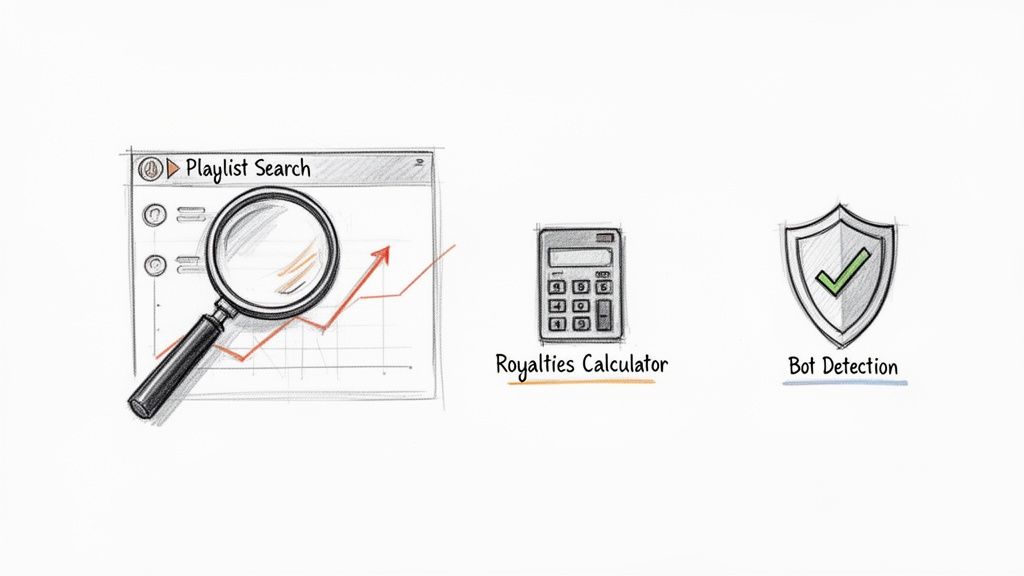
By zeroing in on playlists with real, organic growth and listeners in premium markets like the US, UK, or Germany, you make sure your promo efforts translate directly into higher-value streams.
Protecting Your Paycheck from Fake Streams
One of the single biggest threats to your Spotify income is fraud. Artificial streams cranked out by bots don't just pay you $0; they can get you slapped with serious penalties from Spotify. We're talking track takedowns and having all your royalties for that track withheld.
Protecting your music from bot activity isn't just about this month's paycheck; it's about safeguarding your entire career on Spotify. One bad playlist can put everything you've built at risk.
You absolutely have to keep an eye on your stream health. Tools built for Bot Detection are non-negotiable here. They analyze where your streams are coming from and spot weird patterns that scream "bots"—like if you've been added to a sketchy playlist without you knowing. If something looks off, you can act fast, contact your distributor, and get your music pulled before it does real damage to your account.
Forecasting and Optimizing for Real Growth
A smart strategy also means looking ahead. For any indie artist trying to build a real business, financial forecasting is a game-changer. It helps you set concrete income goals and actually measure whether your marketing is working.
For instance, a good Spotify Royalties Calculator can turn a stream count into a dollar amount. You can play around with different scenarios—what if more of my streams came from the US? What if they were mostly Premium listeners?—to see how it impacts your bottom line. It helps you answer crucial questions like, "How many streams do I really need from Germany to hit my monthly target?" You can even estimate your potential earnings with our Spotify Royalties Calculator to get a feel for it.
When you pair that forecasting power with SEO Research tools, you can start optimizing your presence in those high-value markets. You can figure out what keywords listeners in specific countries are using to find music like yours, then use that intel to tweak your playlist names, track descriptions, and branding to pull in the most valuable audience possible. It's a system for methodically increasing the value of every stream you get.
When you zoom out from the nitty-gritty of individual stream values, a much bigger story about the music business today comes into focus. A single stream might only net you a fraction of a cent, but when you add up the billions of plays happening every single day, you realize it's completely reshaped how creators get paid.
These aren't just tiny transactions. Spotify’s royalty payments are the engine of a massive, global music economy.
The sheer scale is hard to wrap your head around. In 2024, Spotify hit a massive milestone, paying out over $10 billion in music royalties in just one year. That figure has grown tenfold in the last decade, which tells you everything you need to know about the power of streaming. If you want to dig deeper into that number, Spotify laid it all out in their official newsroom announcement.
Streaming Is The New Normal
This explosion isn't happening in a vacuum. Streaming now drives a staggering 84% of all recorded music revenue in the US, making it the undisputed king. And with Spotify owning about 31% of the entire global market, their influence on artist earnings is impossible to ignore.
This is a complete flip from the old days of selling CDs and hoping for radio play. It’s blown the doors wide open for artists who never would have gotten a shot past the traditional industry gatekeepers.
The game isn't just about getting a record deal anymore. It's about carving out your piece of a multi-billion-dollar digital pie that's technically open to everyone.
This new reality is both a massive opportunity and a huge challenge. Yeah, the competition is insane because there's so much music out there. But the potential rewards are bigger and more accessible than they've ever been.
The Indie Artist Takeover
Maybe the most exciting part of this new economy is the incredible rise of the independent artist. The idea that you need a major label to build a real career is quickly becoming a thing of the past. A huge chunk of Spotify's massive royalty pool is now flowing straight to creators who are doing it all themselves.
Just look at the numbers: in 2023, independent artists and labels pulled in over $4.5 billion from Spotify alone. This isn't just a feel-good story; it's hard proof that you don't need to be a superstar to make it.
It shows that you can build a real, dedicated audience and make a living directly from your music, all while staying in control. Your tracks are part of a huge economic shift, and with the right strategy and the right data, you can claim your own successful piece of it.
A Few Common Questions
Once you get the hang of how Spotify royalties are calculated, you start running into the practical, day-to-day questions. Things like, "When do I actually see the money?" and "Why did my payment suddenly drop?"
Let's clear up some of the most common questions artists ask about their Spotify income.
How Often Do I Get Paid by Spotify?
Spotify sends out royalty payments every month, but that doesn't mean the cash lands in your bank account that quickly. There's a bit of a journey involved. First, Spotify has to calculate and pay your distributor (like TuneCore or DistroKid), which can take a month or two on its own.
After that, your distributor takes over, processes the earnings, and sends them to you. All in all, you're typically looking at a two to three-month delay. So, the money you earn from streams in January will likely hit your account around March or April.
Quick heads-up: most distributors have a minimum payout threshold. If you don't hit that number for the month (it's often around $10), they'll just roll your earnings into the next pay period until you do.
Where Can I Check My Spotify Earnings?
This is a big one. You won't find your detailed earnings reports inside your Spotify for Artists dashboard. Spotify sends all the financial statements and royalty data directly to your music distributor.
To see the real numbers, you'll need to log into your distributor’s website. It usually looks something like this:
Sign in to your distributor’s portal (DistroKid, TuneCore, CD Baby, etc.).
Look for a section called "Bank," "Money," or "Earnings."
Dive into your statements. They'll give you the full breakdown by platform, song, country, and date.
While these official reports are accurate, they’re always looking in the rearview mirror. If you want to get a sense of what's coming, a Spotify royalties calculator is a great tool for forecasting your income based on your current stream counts and where your listeners are.
Why Did My Spotify Royalty Payment Go Down?
Seeing your payment drop can be a bit of a shock, but it doesn't automatically mean your music is losing steam. More often than not, it's just the normal ebb and flow of the streaming world.
Here are a few things that could be behind a dip:
Seasonal Dips: People's listening habits change with the seasons. It's common to see a slowdown during summer holidays when people are outside more, and a pickup in the winter.
A Shift in Your Audience: Let's say you suddenly get a ton of new fans in a country with a lower per-stream payout rate. Your total stream count could go up, but your overall earnings might actually dip slightly.
More Competition on the Platform: If the total number of streams across all of Spotify grows faster than your own, your slice of the overall royalty pie—your "streamshare"—gets a little smaller.
Keeping an eye on these trends helps you tell the difference between a normal fluctuation and a real issue you need to address.
Ready to stop guessing and start strategizing? With artist.tools, you can analyze your playlists, shield your music from harmful bots, and accurately forecast your earnings to get the most out of every stream. Take control of your career at https://artist.tools.
.png)
.png)
Comments