
Indie Artist Definition: indie artist definition and what it means for 2026
Explore the indie artist definition and how independence shapes your Spotify journey, reach, and control in 2026.
Once upon a time, “indie artist” just meant you were unsigned. But today, the game has completely changed. Being indie is all about control and ownership over your music and your career.
Think of it this way: you’re the CEO of your own music startup, not just another employee at a massive corporation.
What It Really Means to Be an Indie Artist

At its heart, “indie” is short for independent, and it boils down to creative and financial freedom. An indie artist builds their career outside the traditional major label system—the “Big Three” consisting of Universal Music Group, Sony Music Entertainment, and Warner Music Group.
But being independent doesn’t mean you have to go it alone. It just means you’re the one calling the shots.
You might team up with an independent label or use a music distributor like DistroKid or TuneCore to get your music on Spotify. The key difference? You hang onto the rights for your master recordings and have the final say on all creative decisions.
This isn’t just a niche movement; it’s a seismic shift in the music economy. In 2024, indie artists drove 35% of the $127 billion in global recorded music revenues. Look at it from an ownership angle, and the numbers are even more staggering: self-releasing artists and indie labels accounted for 46.7% of the global market in 2023.
It’s clear that independence is now a dominant, viable, and powerful career path. You can see just how far the indie scene has come with these insights.
The core of being an indie artist isn’t about being undiscovered; it’s about being empowered. You are the primary decision-maker, investor, and beneficiary of your own art.
Getting this distinction right is absolutely critical. It shapes everything from your promotion strategies to how you actually get paid. For a deeper dive, check out our complete guide to independent music promotion.
Indie vs Major Label At a Glance
To make it even clearer, let’s break down the fundamental differences between the various paths an artist can take. This table gives you a quick snapshot of who controls what in each scenario.
| Attribute | Self-Released Indie Artist | Indie Label Artist | Major Label Artist |
|---|---|---|---|
| Creative Control | Full control | High, but collaborative | Often limited |
| Master Rights Ownership | Artist owns 100% | Typically shared or licensed | Label usually owns rights |
| Financial Investment | Artist funds everything | Label provides funding | Label provides significant funding |
| Royalty Split | Artist keeps 80-100% | Varies, often 50/50 | Artist keeps 10-20% |
| Marketing & Promotion | DIY or outsourced by artist | Label team handles it | Large, dedicated label teams |
| Career Autonomy | Total freedom and flexibility | High, but within label goals | Structured, guided by label |
As you can see, the trade-offs are significant. Choosing a path isn’t about right or wrong—it’s about aligning your career goals with the structure that best supports them.
Exploring the Two Paths of Independence
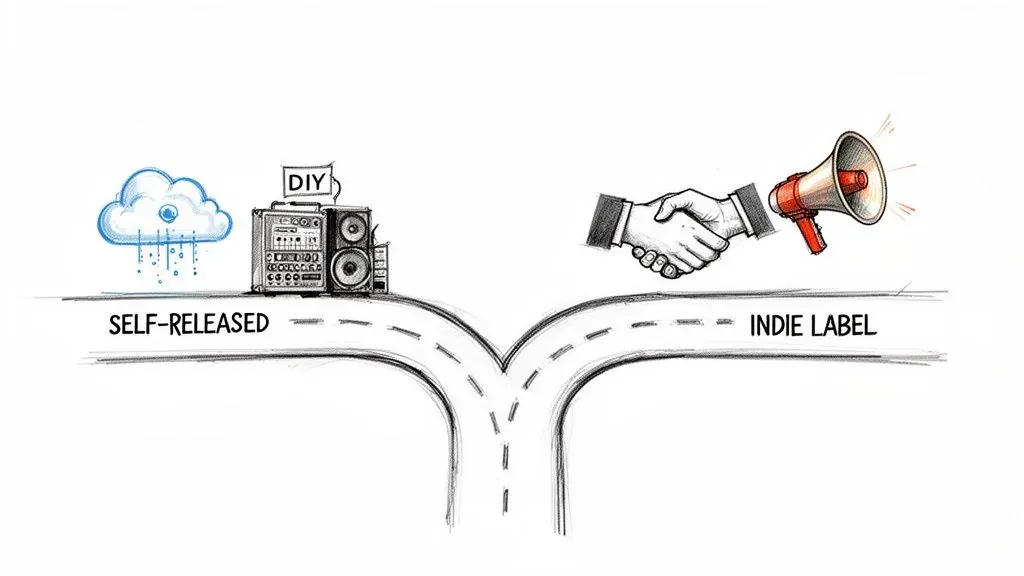
When we talk about being an “indie artist” today, it’s not one-size-fits-all. It’s really a spectrum of independence, and it generally forks into two main roads: going it alone as a self-released artist, or teaming up with an independent label. Each route has its own set of rules, rewards, and challenges.
Think of it like launching any other kind of business. You can either bootstrap the entire thing yourself, controlling every detail, or you can bring in a strategic partner who offers resources and connections in exchange for a piece of the company.
The Self-Released DIY Artist
Going the self-released route makes you the CEO, creative director, and head of marketing, all rolled into one. You call all the shots. You keep 100% ownership of your master recordings and have the final say on everything, from the song’s final mix to the cover art.
This is where digital distributors become your best friends.
Services like DistroKid or TuneCore aren’t your label; they’re your logistics team. They act like a delivery truck, taking your finished music and getting it onto the digital shelves of Spotify, Apple Music, and everywhere else. You pay them a flat fee or a small cut, and in exchange, you pocket the lion’s share of your royalties—often between 80-100%. They don’t own your music or have any say in your career.
This path gives you the ultimate control and the highest possible royalty share. The trade-off? You’re on the hook for handling absolutely everything yourself, from promotion and playlist pitching to all the tedious admin work.
The Indie Label Partnership
Signing with an independent label isn’t like getting a corporate boss; it’s more like bringing on a co-founder for your artist project. You’re trading a percentage of your ownership and future income for the label’s muscle, network, and experience.
This route provides some serious backup:
- Funding: They’ll often provide an advance to cover recording costs and a budget for marketing your release properly.
- Team: Suddenly, you have access to their in-house marketing, PR, and radio promotion specialists.
- Connections: Indie labels have spent years building relationships with playlist curators, music supervisors for film and TV, and journalists.
Sure, you give up a slice of the pie—royalty splits often land around a 50/50 split after the label recoups its expenses—but you gain a dedicated team fighting to get your music heard. Most importantly, you still maintain a huge degree of creative freedom, which is what separates a great indie deal from a soul-crushing major label contract.
Ultimately, picking a path comes down to your personal goals, your resources, and how you want to build your career in this industry.
How Indie Status Shapes Your Spotify Career
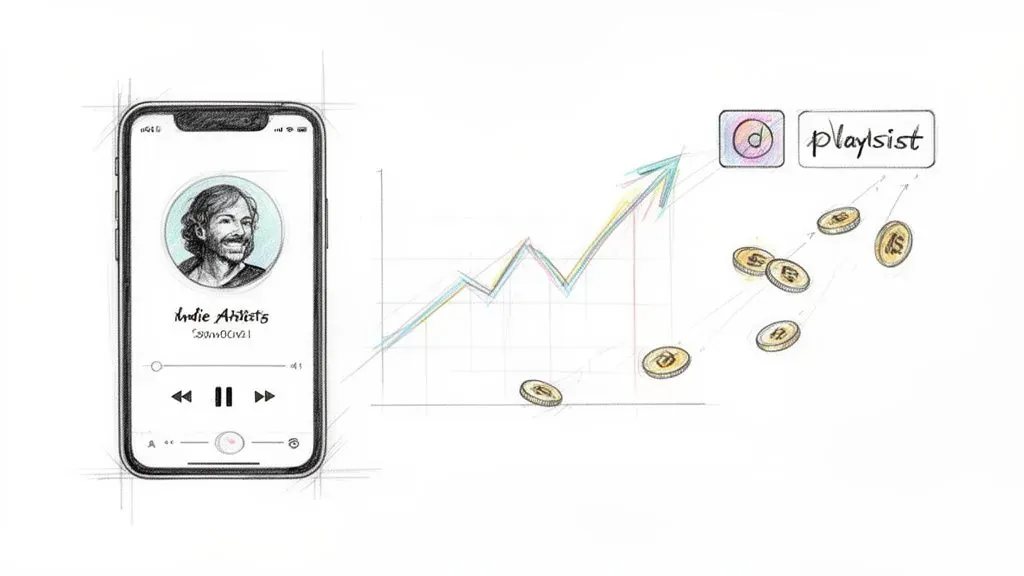
Being an indie artist isn’t just a label—it’s the blueprint for your entire career on Spotify, from the creative calls you make to how you get paid. Think of it like this: you’re not just renting a small booth in a massive market; you own the whole storefront. You get to design the layout, talk directly to your customers, and most importantly, you keep a much bigger piece of the profits.
This freedom is immediately obvious when you log into your Spotify for Artists profile. As an independent, you have the keys to the kingdom. You can change your bio on a whim, upload new photos whenever you want, and—this is the big one—personally pitch your new music directly to Spotify’s editorial team.
That direct line is something most major label artists can only dream of. Their pitches are usually filtered through busy label reps juggling dozens of other artists. Your story can get lost in the shuffle. As an indie, your personal vision and passion are front and center when you make your case to the people who build the big playlists.
Direct Access to Data and Royalties
It’s not just about creative control. Being independent means you see your data as it happens. You can track where your streams are coming from, who your listeners are, and which playlists are picking you up, all without waiting for a quarterly report from a label. This lets you move fast, turning real-time insights into smart marketing moves.
The same direct line applies to your money. When you’re indie, the cash flows straight from Spotify to your distributor, and then into your pocket. This simpler path means you get a significantly higher payout for every stream compared to the tiny fraction left over for major label artists after everyone else has taken their cut. If you want to dive deeper into the numbers, check out our ultimate guide to Spotify royalty payments.
As an indie artist, you aren’t just a creator; you’re the business owner. Every stream is more valuable, and every piece of data is an opportunity to grow your audience on your own terms.
The Growing Power of Indie Artists
This isn’t just a feeling; the numbers back it up. Independent artists are on track to control roughly 38% of global streaming revenues by 2026, a number that has been climbing steadily.
Digging into the 2024 data, it gets even clearer: a massive 62.1% of artists who hit between 1 million and 10 million streams in the U.S. were independent. This shows that indies aren’t just competing anymore—they’re carving out huge chunks of the audience, proving you don’t need a legacy label to make a real impact.
The Unstoppable Growth of Independent Music
Forget everything you thought you knew about being an “indie” artist. It’s no longer about being an outsider hoping for a big break; it’s about leading one of the most powerful movements in the entire music industry. For a huge and growing number of artists, going independent isn’t a stepping stone—it’s the end goal.
The numbers don’t lie, and they paint a picture of a massive power shift. The independent artist market is absolutely exploding, on track to smash USD 170.91 billion in 2026. And it’s not slowing down. Forecasts predict it will soar to an incredible USD 233.31 billion by 2031. This isn’t just a niche; it’s a global economic force to be reckoned with. You can dive deeper into the growth of the independent artist market to see just how big this wave is.
This boom is being driven by artists who aren’t just getting by without a major label—they’re genuinely thriving.
Where Real Growth Happens
When you dig into the data and see which artists are actually building momentum, the story becomes crystal clear. A recent analysis of mid-level artists on the rise revealed a jaw-dropping trend.
Of the artists ranked between 12,000 and 35,000 on Chartmetric who grew their audience by at least 20%, a staggering 90% were independent. In contrast, less than 10% of artists who hit that same growth milestone were signed to major labels.
Let that sink in for a minute. This isn’t just a small edge; it’s a landslide. It proves that the tools, freedom, and strategies available to indie artists are not just competing with the old system—they’re delivering far better results for career growth.
Independence gives artists the agility and the direct line to their fans needed to build a real, sustainable career on their own terms. It’s no longer a compromise; it’s a calculated, strategic move to win in today’s music world.
Your Action Plan for a Thriving Indie Career
Knowing the definition of an indie artist is one thing; building a career as one is a whole different ball game. This is where the rubber meets the road. A solid independent career is built on a foundation of smart, strategic moves—starting with getting your music out into the world.
This decision tree gives you a quick visual to see where you stand.
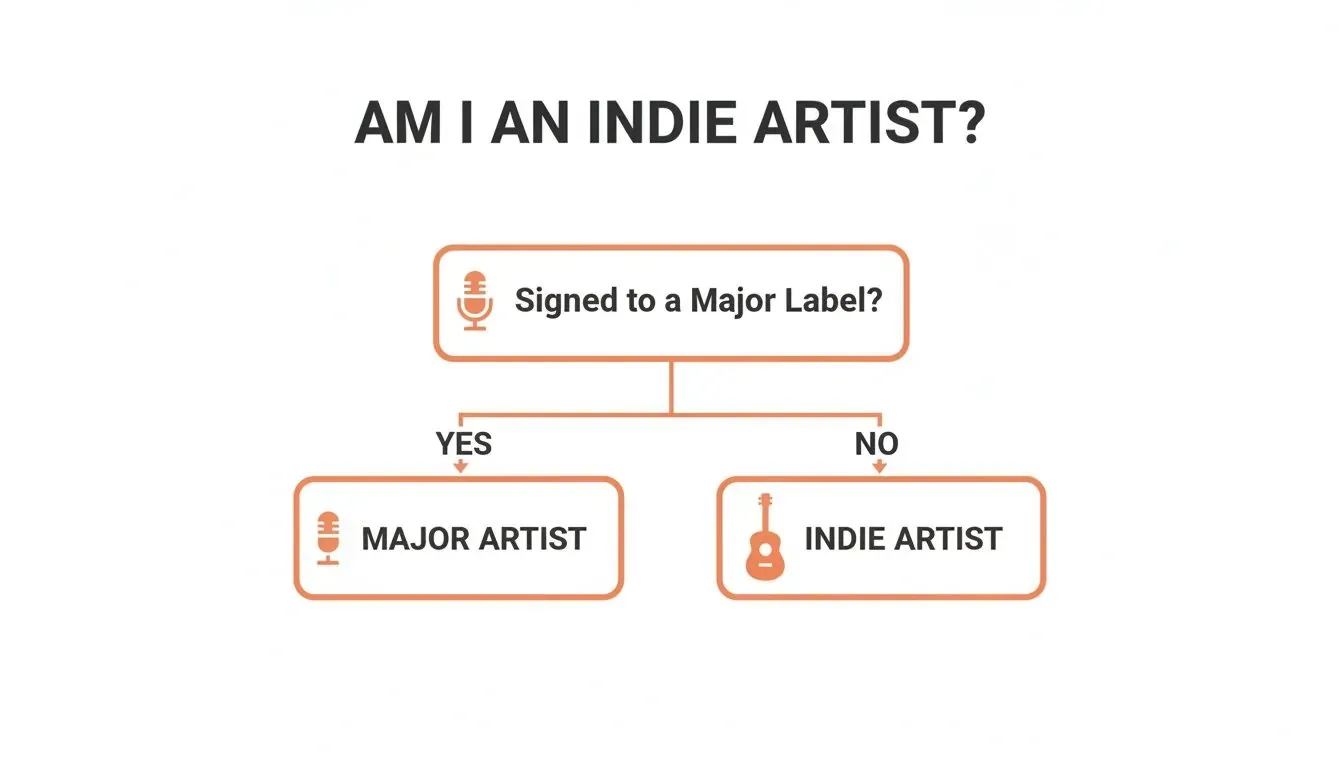
It boils down the entire complex music industry to one simple question: are you signed to a major label? If the answer is no, then welcome to the independent path.
Build Your Independent Foundation
Your journey starts with three essential steps that put you firmly in the driver’s seat. Think of these as the bedrock of your music business, getting you set up professionally right from day one.
- Choose Your Distributor: This is your partner for getting your tracks onto Spotify, Apple Music, and everywhere else. Do your homework and find one that fits your release schedule and budget. For a deep dive, check out our guide on how to distribute music on Spotify.
- Claim Your Spotify for Artists Profile: Consider this your mission control. It gives you direct access to your analytics, artist bio, photos, and the crucial tool for submitting to editorial playlists. Don’t even think about skipping this.
- Develop a Data-Driven Mindset: Your gut is great for writing songs, but data is what fuels growth. Get in the habit of tracking your streams, where your listeners are, and which playlists are adding you. This is how you figure out what’s actually working.
Execute a Winning Strategy
Once the foundation is solid, it’s time to get aggressive about growth. This means using professional tools to make sharp decisions and protect the career you’re building.
Success as an indie artist isn’t about a lucky break; it’s about making smart choices over and over again, backed by reliable data. You have to be the CEO of your own music.
A modern toolkit isn’t a luxury; it’s a necessity. Platforms like artist.tools give you the kind of intelligence you need to actually compete. With the right data, you can spot legit playlist opportunities, dodge the bots that can kill your profile, and craft pitches that grab an editor’s attention.
Ultimately, this is how you turn your independent status into your biggest strength.
Common Questions About Being an Indie Artist
Even when you think you’ve got the definition down, things can get a little fuzzy in the real world. Let’s clear up some of the most common questions artists have about where they stand in the music industry.
Can I Be Indie with a Manager or Publisher?
Yes, absolutely. Hiring a manager, publisher, or booking agent has zero impact on your indie status. These are pros you bring onto your team to help push your career forward.
Think of it this way: a manager works for you, guiding your decisions. A major label is a massive corporation you essentially work for in exchange for their investment. The core indie artist definition all comes down to your relationship with a record label. As long as you’re not signed to Universal, Sony, or Warner, you’re independent.
Are Distributors Like DistroKid My Record Label?
Nope, and this is a huge one to get right. Services like DistroKid, TuneCore, and CD Baby are distribution services, not labels. They’re the logistical partners you pay to get your music onto Spotify and other stores.
You are their customer, not their artist. You keep 100% ownership of your master recordings and get the lion’s share of your royalties. A label, on the other hand, would own your masters for a period of time and take a much, much bigger piece of the pie.
When Am I No Longer Considered an Indie Artist?
The line is crossed the moment you sign a recording contract directly with one of the “Big Three” major labels—Universal Music Group, Sony Music Entertainment, or Warner Music Group. This also includes signing to one of their hundreds of subsidiary imprints, which all operate under the major label’s corporate umbrella.
Signing with a truly independent label, no matter how big or successful, still keeps you firmly in the indie artist camp. The real defining factor is your freedom from the major label system.
Ready to turn your independent status into a strategic advantage? artist.tools provides the data and insights you need to find real playlist opportunities, protect your streams, and build a sustainable career on Spotify. Get the professional toolkit your music deserves at https://artist.tools.