
Your Guide to ISRC Code Music Royalties and Tracking
Unlock your earnings with our complete guide to ISRC code music. Learn what ISRCs are, how to get them, and why they are essential for tracking royalties.
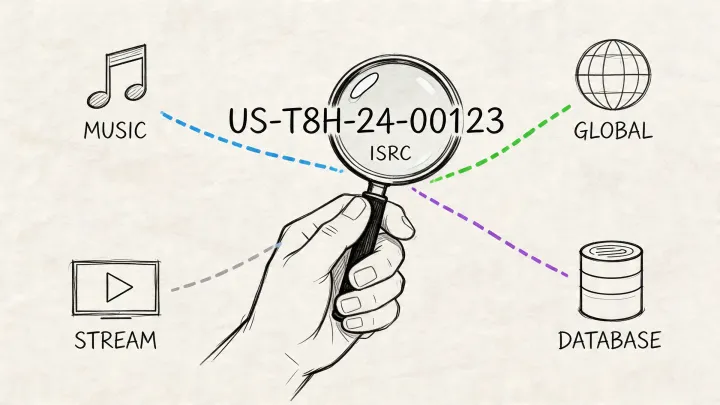
Ever heard of an ISRC code? Think of it as your song’s unique digital fingerprint. It’s a 12-character code that gets assigned to a specific sound recording, and honestly, it’s one of the most important pieces of data for any artist in the game today.
Without an ISRC, your music is basically invisible to the systems that track plays and pay out royalties. Every stream, every download, every radio spin—it all gets lost in the ether. You need one. Period.
What an ISRC Code Really Means for Your Music
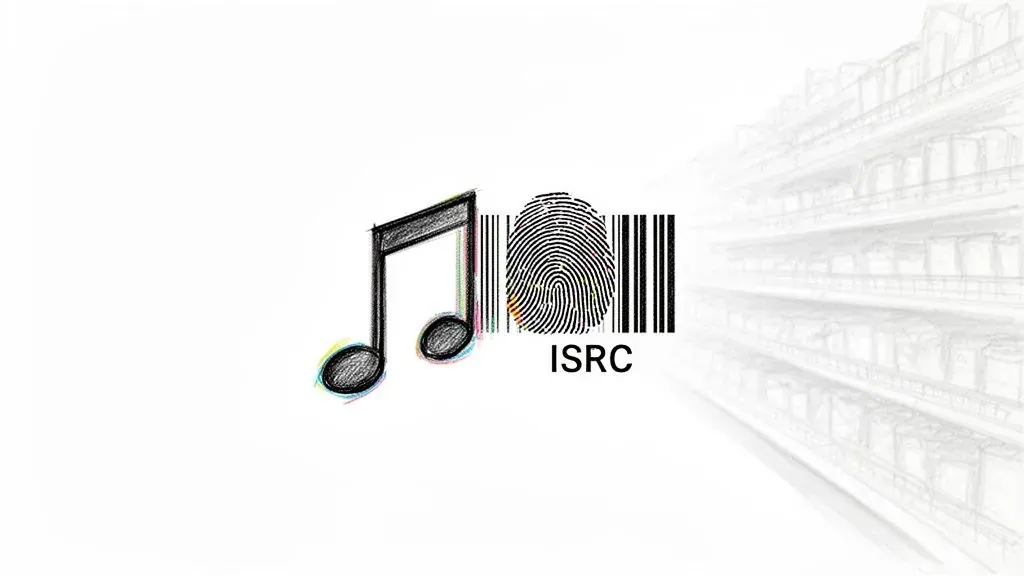
Let’s use an analogy. Picture a massive, global supermarket like Spotify, Apple Music, or even YouTube. Every day, literally billions of products—your songs—are “scanned” by listeners. So how does the store know which product was just played?
It checks the barcode. The ISRC (International Standard Recording Code) is that barcode for your track.
This code is permanently baked into a single, specific version of your recording. Whether it’s the original studio master, a stripped-down acoustic version, or that killer EDM remix, each one needs its own unique ISRC. This is super important because it ensures every single play can be identified and logged correctly, laying the groundwork for how you get paid in the modern music industry.
Let’s break it down into a quick summary.
ISRC Code At a Glance
The table below gives you a high-level look at what an ISRC is and why it’s so critical for your music career.
| Attribute | Description |
|---|---|
| What It Is | A unique 12-character alphanumeric code assigned to a specific sound recording (like an MP3 or WAV file). |
| Primary Function | Acts as a universal “digital fingerprint” or barcode for your track, enabling accurate tracking of plays across all platforms. |
| Who Needs It | Every artist, label, or rights holder who releases music digitally or physically. It’s non-negotiable. |
| Why It’s Essential | It’s the key to getting paid. Without an ISRC, platforms can’t attribute streams to you, and your royalties get lost. |
Essentially, mastering the ISRC is a fundamental step toward turning your music into a sustainable business.
The Foundation of Music Royalties
If you don’t have an ISRC, streaming platforms can’t connect a play back to you, the rights holder. That money doesn’t just disappear; it gets dumped into a massive unallocated pool of money, often called a “black box.” You’ll never see a dime of it.
This is exactly why getting a handle on ISRCs is a must-do for any serious artist.
The whole system is managed globally by the IFPI (International Federation of the Phonographic Industry), which created a universal standard for identifying recordings. This global system makes sure that a stream happening in Tokyo is tracked with the exact same precision as a radio spin in Toronto.
Why Every Single Stream Counts
The sheer scale of digital music today makes this kind of tracking an absolute necessity. In 2024, streaming made up a staggering 69.0% of total recorded music revenues, and that number just keeps climbing. Trying to manage that firehose of data without a standard identifier like the ISRC would be completely impossible.
Now, it’s easy to get these codes mixed up, so let’s clear something up. An ISRC identifies the recording (the actual audio file), while another code, the UPC, is for the entire product (like an album or a single release). They work together, but they aren’t the same thing.
If you want to go deeper on that, check out our guide on what a UPC code is and why musicians need it. Getting these codes right is a huge part of looking and acting like a pro.
How to Read an ISRC Code
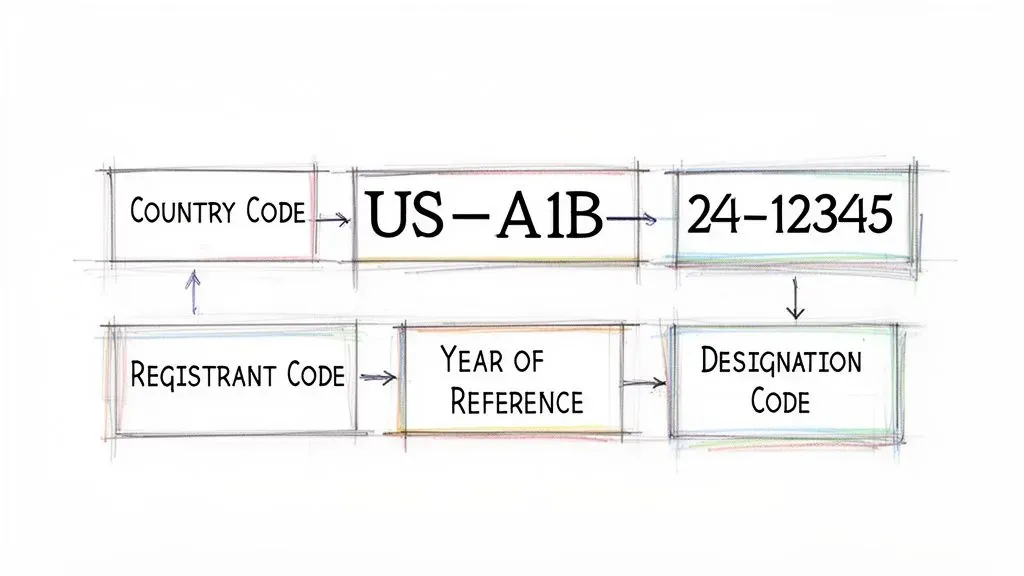
At first glance, an ISRC like US-A1B-24-12345 probably looks like a random jumble of letters and numbers. But it’s not random at all. This 12-character code tells a surprisingly detailed story about your track’s origin, and once you know the formula, you can read any ISRC in a heartbeat.
Think of it like a secret code. Every ISRC is built from four distinct parts, each separated by a hyphen. Together, they form a unique digital fingerprint for a specific recording. Understanding this structure isn’t just trivia—it’s how you verify your music’s metadata and get a much clearer picture of your entire catalog.
Let’s pull apart our example, US-A1B-24-12345, piece by piece.
Breaking Down the Four Parts
The code follows a global standard, which means its structure is always the same: Country-Registrant-Year-Designation.
- US (Country Code): This first two-letter part tells you where the rights holder who assigned the code is based. “US” is obviously the United States, “GB” is Great Britain, “CA” is Canada, and so on. Simple enough.
- A1B (Registrant Code): This is the unique, three-character alphanumeric ID for the rights holder themselves. This could be a major label like Warner Music, an indie label, or even you as an independent artist if you get your codes directly from a national ISRC agency. It’s their unique signature in the system.
- 24 (Year of Reference): These two digits show the year the ISRC was assigned to the song. Here’s a common trip-up: this is not the year the song was recorded or released. It’s strictly the year the code was generated. So, “24” means the code was created in 2024.
- 12345 (Designation Code): The final five digits are a unique number that the registrant assigns to that specific track within that year. Most labels and distributors assign these sequentially. In this case, “12345” would be the 12,345th track they assigned an ISRC to in 2024.
Learning to read an ISRC takes you from just having a code to actually understanding the story behind your music’s data. That knowledge is power when it comes to managing your catalog and making sure your metadata is rock-solid across every platform.
How to Get an ISRC Code for Your Music
So, how do you actually get your hands on an ISRC code? It might sound like some complicated technical hurdle, but it’s actually more straightforward than ever. For most independent artists, it boils down to three main paths. The right one for you really depends on where you’re at in your career, how you plan to release your music, and just how much control you want over your catalog.
Let’s break them down.
Path 1: Let Your Distributor Handle It
This is the most common route for a reason—it’s the easiest. When you upload your music through a digital distributor like DistroKid, TuneCore, or CD Baby, they will automatically assign an ISRC to each of your tracks. Most of the time it’s free, but some might charge a small fee.
If you’re just starting out or want to keep your release process as simple as possible, this is your best bet. It’s a hands-off approach that lets you focus on the music while they handle the technical details. The only trade-off is a bit of control; since the distributor generates the code, it’s tied to their system. If you ever decide to switch distributors, you’ll need to make sure you bring your existing ISRCs with you—they are permanently attached to that specific recording for life.
Path 2: Become Your Own ISRC Manager
For the serious artist, small label, or manager who wants total control over their music’s metadata, this is the way to go. You can apply to become an official ISRC Manager by registering directly with the National ISRC Agency in your country.
For artists in the United States, that agency is the RIAA (Recording Industry Association of America).
When you register with an agency like the RIAA, you’re issued a unique Registrant Code. This code becomes a part of every single ISRC you create from that point on, essentially branding every track you release as yours. It’s a major step up, giving you the power to generate your own codes and manage your entire catalog independently, forever. This option does come with a one-time application fee (it’s around $95 in the U.S.), but for lifetime control over your assets, it’s a small price to pay.
Path 3: Work Through a Record Label
The third path is the old-school, traditional one: signing with a record label. If you release your music through a label, they will almost always take care of the ISRC assignment for you.
Labels are typically registered ISRC Managers themselves. They will use their own unique Registrant Code to generate and assign an ISRC to your recording as part of the release process.
This route feels a lot like using a distributor in that it’s completely hands-off for you as the artist. The big difference is that the label, as the rights holder of the master recording, manages all this data as part of their broader responsibilities.
Deciding which path to take is a key first step. To help you choose, here’s a quick comparison of the three main methods for getting your ISRCs.
Comparing ISRC Acquisition Methods
| Method | Best For | Cost | Control Level |
|---|---|---|---|
| Distributor | Independent artists, beginners, simple releases. | Free or a small one-time fee per track/album. | Low (Distributor assigns the code). |
| Become ISRC Manager | Established artists, small labels, producers with multiple clients. | One-time registration fee (e.g., ~$95 in the US). | High (You generate and control all your codes). |
| Record Label | Artists signed to a label deal. | None (Handled by the label as part of the deal). | None (Label controls and manages the codes). |
Ultimately, there’s no single “best” way—it’s about what makes the most sense for your music and your business. Understanding these options is crucial for making smart decisions about how you manage your assets.
To dive deeper into the entire release process, check out our guide on how to distribute music and get heard by millions.
Why ISRCs Are Essential for Royalties and Tracking
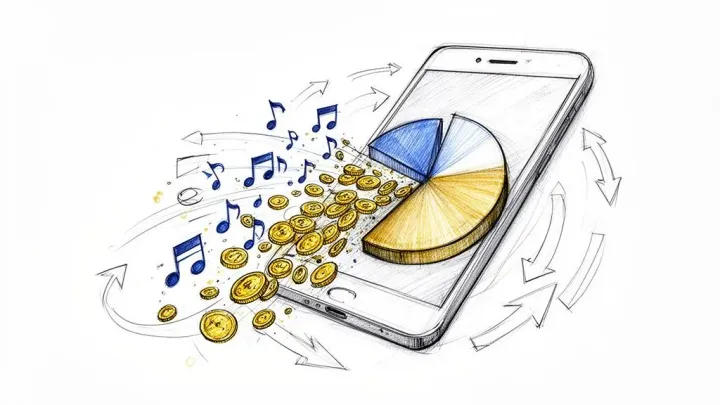
Think of an ISRC as more than just a string of technical characters; it’s the direct line connecting your music to your bank account. Every single time someone hits play, that code fires off a signal that starts a crucial, behind-the-scenes journey, making sure those fractions of a penny find their way back to you.
Without an ISRC, your song is basically anonymous—a ghost floating in a sea of digital noise.
Let’s say a fan in another country streams your new track on Spotify. For those few minutes, they’re lost in your art. But in the background, something far less glamorous is happening. Spotify’s system instantly logs that play, and the single most important piece of data it uses to identify that specific recording is its unique ISRC. That log is the very first link in the royalty chain.
This happens billions of times a day across dozens of platforms. To give you some perspective, ISRCs are the fundamental building block of a global streaming economy worth over $29 billion. Platforms like Spotify track trillions of plays every year, and this little 12-character code is the only thing stopping your hard-earned cash from getting lost in the shuffle. You can dive deeper into the global music market stats over at ifpi.org.
From Digital Plays to Actual Payouts
After a platform like Spotify or Apple Music logs all these ISRC-tagged plays, they bundle them into massive reports. These reports are then fired off to distributors, record labels, and collection societies worldwide. Those organizations use the ISRC to match the stream data back to the correct rights holders—and that means you.
Here’s how that payment flow typically breaks down:
- Play Occurs: A fan streams your track, and the platform logs the ISRC.
- Data Is Compiled: At the end of the month or quarter, the platform gathers all the plays for each ISRC.
- Reports Are Sent: This data goes to your distributor (like DistroKid or TuneCore) or your label.
- Royalties Are Calculated: Your distributor crunches the numbers using the ISRC data to figure out exactly what you’ve earned.
- Payment Is Issued: The money finally lands in your account.
If you don’t have an ISRC, this entire chain breaks at step one. The stream happens, but it has no identity. The revenue it generates usually gets swept into a massive, unallocated “black box” fund, never to be seen by the artist who actually earned it. This is precisely why properly embedding your music metadata is so critical.
Tracking Performance Beyond the Payout
Your ISRC is also a powerful tool for tracking your song’s performance, going way beyond just royalty payments. Every analytics dashboard you look at—from Spotify for Artists to your distributor’s backend—is pulling its data based on ISRCs. This is what lets you see precisely how your song is performing in different countries and on various platforms.
This chart shows a few of the common ways an artist gets their ISRC assigned.
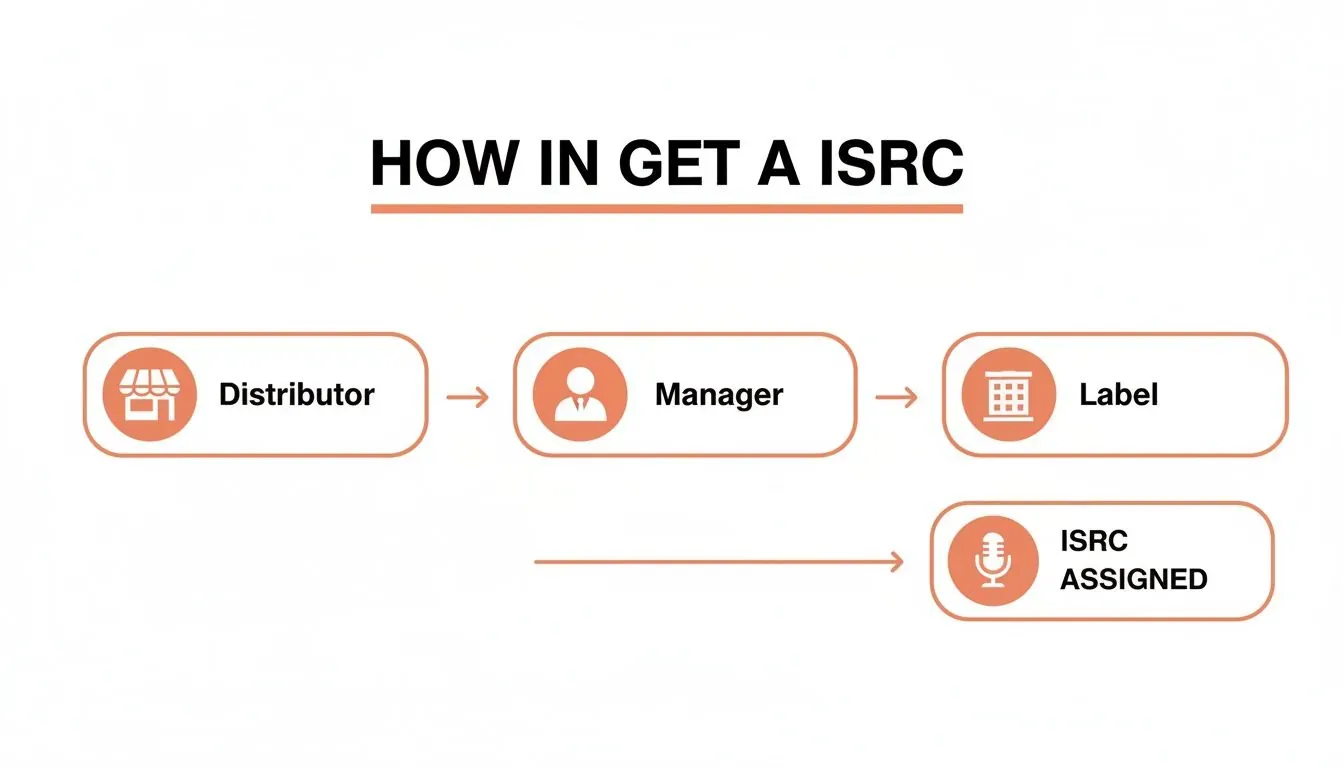
Whether your code comes from a distributor or a label doesn’t really matter—the result is the same: your music becomes trackable. This is the data that empowers you to treat your music career like a real business, making smart, informed decisions based on what’s actually connecting with listeners. Want to learn more? Check out our guide on what music metadata is in our essential guide for artists.
Common ISRC Mistakes and How to Avoid Them

Getting your ISRC code wrong can cause a surprising amount of chaos. We’re talking lost royalties, messy tracking data, and a whole lot of headaches you just don’t need.
The rules aren’t that complicated, but a few common slip-ups can trip up even seasoned artists. Let’s walk through them so you can keep your music catalog clean, professional, and—most importantly—profitable.
The absolute biggest mistake is reusing an ISRC. Just don’t do it. Ever. Remember, an ISRC is a permanent, one-of-a-kind fingerprint for a specific sound recording. If you create a new version of a song—a radio edit, a live version, a remix, or even an instrumental—it’s a brand new recording. That means it needs a brand new ISRC.
Think of it like a barcode at a supermarket. Your original studio track is one product with its own unique barcode. A remix of that same track is a completely different product on the shelf, and it needs its own barcode to be tracked and sold correctly.
Mistake 1: Reusing an ISRC for Different Versions
This is the cardinal sin of ISRC management. When you assign the same code to multiple versions of a track, all of their streaming data gets smashed together into one confusing mess. It becomes impossible to tell which version is actually performing well, and your royalties will get tangled up in knots.
- What Not to Do: You release your main single with ISRC “US-A1B-24-00001.” Then, you create a slick radio edit and a stripped-down acoustic version and give them both that same code.
- What to Do Instead: Every unique recording gets its own ISRC. The main single is “US-A1B-24-00001,” the radio edit becomes “US-A1B-24-00002,” and the acoustic version is “US-A1B-24-00003.” Simple and clean.
Every unique audio file you plan to release must have its own unique ISRC. This rule is non-negotiable and is the bedrock of accurate music data management.
Mistake 2: Confusing ISRCs When Switching Distributors
Here’s another spot where artists often get tripped up: moving your catalog from one distributor to another. A lot of people mistakenly think they need to get new ISRCs for their old tracks when they make the switch.
That’s a huge misconception. An ISRC is bonded to a recording for life, no matter who is distributing it.
When you move to a new distributor, you must give them the original ISRCs for your existing tracks. If you assign new codes to old recordings, you’re essentially creating duplicates in the global system. This splits your stream counts, breaks your data trail, and can seriously mess with your royalty payments.
For example, if your song has 1 million streams on Spotify under its original ISRC, applying a new code makes it look like a brand new track with zero streams. You’ve just erased its entire history and momentum. Always, always transfer your existing codes to keep a consistent data trail for your isrc code music catalog.
Frequently Asked Questions About ISRC Codes
Even after you’ve got the basics down, a few specific questions always seem to pop up right when you’re in the middle of a release. Getting these details right is crucial—it helps you manage your music’s data like a pro and sidestep some pretty expensive mistakes later on.
Let’s run through some of the most common ISRC questions we see from artists. I’ll keep the answers quick and straight to the point so you can find what you need and get back to making music.
Can I Get an ISRC Code for Free?
Yes, you absolutely can. In fact, the most common way artists get their ISRCs for free is through their digital distributor.
Companies like DistroKid, TuneCore, and CD Baby will usually assign them to your tracks automatically when you’re uploading your release, and they don’t charge extra for it. For most indie artists, this is the easiest and most practical route.
The alternative is becoming your own ISRC Manager. This gives you the power to generate your own codes, but it involves applying to your national ISRC agency and paying a one-time fee. For example, in the US, this costs about $95 through the RIAA.
Do I Need a New ISRC for a Remastered Track?
Yes. This is a big one, and it trips up artists all the time. A remastered track is technically a brand-new sound recording, totally distinct from the original master. Even if the sonic changes feel minor to you, it’s still a different audio file.
Think of it this way: any change to the audio itself creates a new master. That includes a remix, a radio edit, an instrumental version, or a remaster. Because it’s a new master, it must get a brand new, unique ISRC. This is non-negotiable for accurate tracking and royalty payments.
ISRC vs. ISWC: What’s the Difference?
This is probably the most common point of confusion, and for good reason—the acronyms are incredibly similar. But they identify two completely different things in the music world.
- ISRC (International Standard Recording Code): This is the fingerprint for the sound recording—the actual master audio file you upload. If you have an album version, a radio edit, and an acoustic version, each one gets its own unique ISRC.
- ISWC (International Standard Musical Work Code): This identifies the underlying musical composition—the melody, chords, and lyrics. One song (the composition) can have dozens of different recordings, but they all point back to the same single ISWC.
The simplest way to remember it is: ISRC is for the recording, and ISWC is for the song.
What Happens if I Release a Song Without an ISRC?
Honestly, releasing a song without an ISRC is one of the biggest mistakes you can make. Without that unique identifier, digital platforms like Spotify and Apple Music have no reliable way to track plays or know who to pay.
Your streams essentially become anonymous data floating in the digital void. Any money generated from those plays gets swept into a “black box” of unallocated royalties. You will not get paid for them. It’s the single most fundamental piece of metadata for any professional release.
Ready to take control of your music career? artist.tools provides the essential data and insights you need to grow on Spotify. From tracking your streams to detecting bot activity and finding the perfect playlists, our platform is built to help you succeed. Explore artist.tools and make smarter decisions for your music today.