Practical Guide: how do artist make money on spotify
- BRANLAND
- 12 hours ago
- 16 min read
So, how do artists actually make money on Spotify? The short answer is streaming royalties—those tiny fractions of a cent you earn every time someone plays your song.
But that's just scratching the surface. The real money comes from understanding the entire ecosystem, which includes not just streams but also publishing, merch sales, and even direct fan support, all funneling through the platform.
How Spotify Royalties Actually Work
Trying to figure out Spotify payouts can feel like a guessing game. It’s not as straightforward as “one stream equals X cents.” The whole system is built on what's called a pro-rata model, or "streamshare," and getting your head around this is the first step to understanding your income.
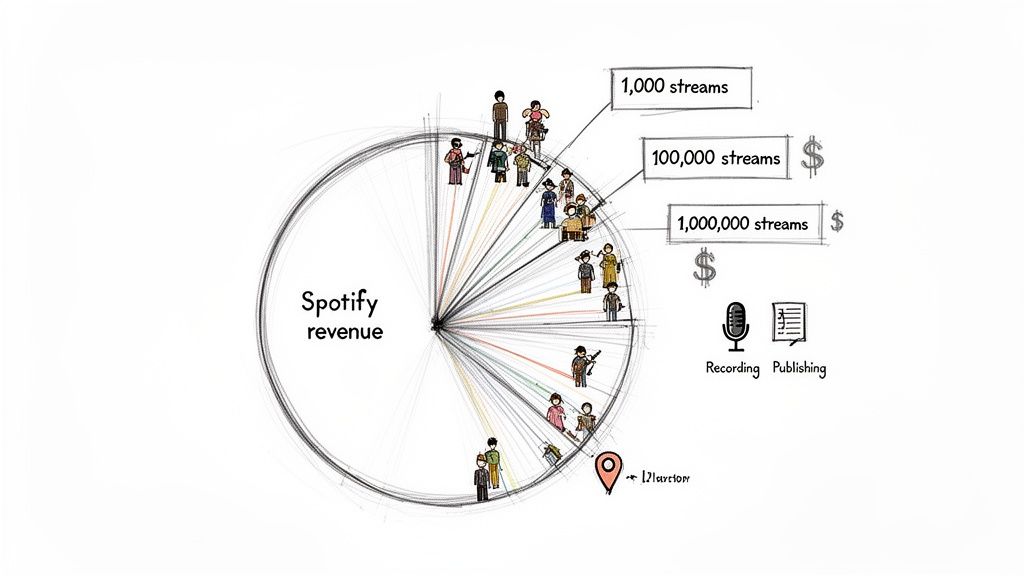
Here’s the simplest way to think about it: every month, Spotify takes about 70% of its revenue—from both Premium subscriptions and ads—and puts it all into one giant pot. Your payout is your slice of that pie. If your tracks accounted for 0.01% of all streams on the platform that month, you get 0.01% of that royalty pool. Simple as that.
The Two Main Royalty Streams
Every song has two copyrights attached to it, and Spotify pays out for both. This split is critical because the money goes to different people.
Recording Royalties (Master Rights): This is the payment for the actual recording—the final master track. The money flows to whoever owns the master, which is usually the record label. For independent artists, it’s you, paid out through your distributor like TuneCore or DistroKid.
Publishing Royalties (Composition Rights): This is the payment for the song itself—the lyrics and melody. This money goes to the songwriter and their publisher. It's then split again into performance and mechanical royalties.
This is why a songwriter earns money even if they aren't the one performing the song. If you're an independent artist writing and recording your own stuff, you're entitled to a piece of both pies. For a deeper dive, check out our ultimate guide to Spotify royalty payments.
The biggest misconception is that there's a fixed "per-stream rate." In reality, the value of a stream changes every month based on the total revenue pool and the total number of streams. It's a constantly moving target.
Factors That Influence Your Payout
Not all streams are created equal. Several key variables have a direct impact on how much you make from each play, which is why your per-stream rate is never the same from one month to the next.
One of the biggest factors? The listener. A stream from a Premium subscriber in a high-revenue country like the United States pays way more than a stream from an ad-supported user in a market with lower ad rates. Premium users simply contribute more to that monthly revenue pot.
The chart below gives you a solid idea of what potential earnings look like at different milestones.
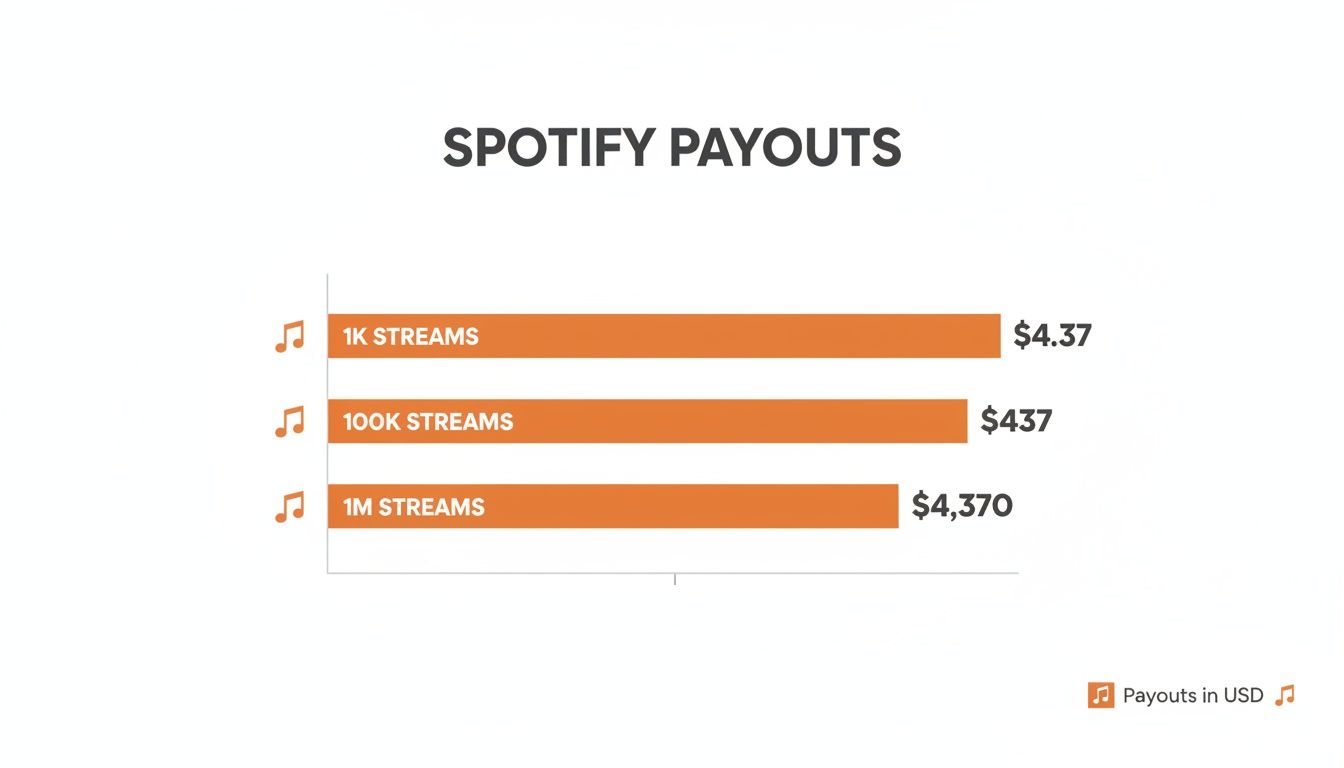
As you can see, hitting that one million stream mark can turn into thousands of dollars, making it a major goal for artists looking to build a real career from their music.
On average, Spotify's payout lands somewhere between $0.003 and $0.005 per stream. To put that in perspective, 1,000 streams will get you about $4.37, while 1 million streams could bring in around $4,370.
And real money is being made. In 2023, Spotify’s Loud & Clear report showed that over 103,400 artists earned at least $5,000 from the platform alone. It’s absolutely achievable.
To help you visualize this, here's a quick breakdown of what you might expect to earn at different stream counts. This table provides a clearer picture of the financial milestones you can aim for.
Estimated Spotify Royalty Payouts Per Stream
Number of Streams | Estimated Payout (Low-End) | Estimated Payout (High-End) | Potential Annual Income |
|---|---|---|---|
1,000 | $3.00 | $5.00 | $36 - $60 |
10,000 | $30.00 | $50.00 | $360 - $600 |
100,000 | $300.00 | $500.00 | $3,600 - $6,000 |
1,000,000 | $3,000.00 | $5,000.00 | $36,000 - $60,000 |
10,000,000 | $30,000.00 | $50,000.00 | $360,000 - $600,000 |
While these figures are estimates, they offer a tangible way to measure progress and set goals for your music career. Seeing the numbers laid out like this can be a powerful motivator to push for that next level of growth.
Playlists are the single biggest engine for driving streams on Spotify. Period. Get your track on the right one, and it's like striking gold—suddenly, your music is in the ears of thousands, maybe even millions, of potential new fans.
But this isn’t a lottery. It’s a game of strategy.
To really move the needle, you need to know the landscape. There are three main types of playlists, and each requires a completely different game plan.
The Three Pillars of Playlist Strategy
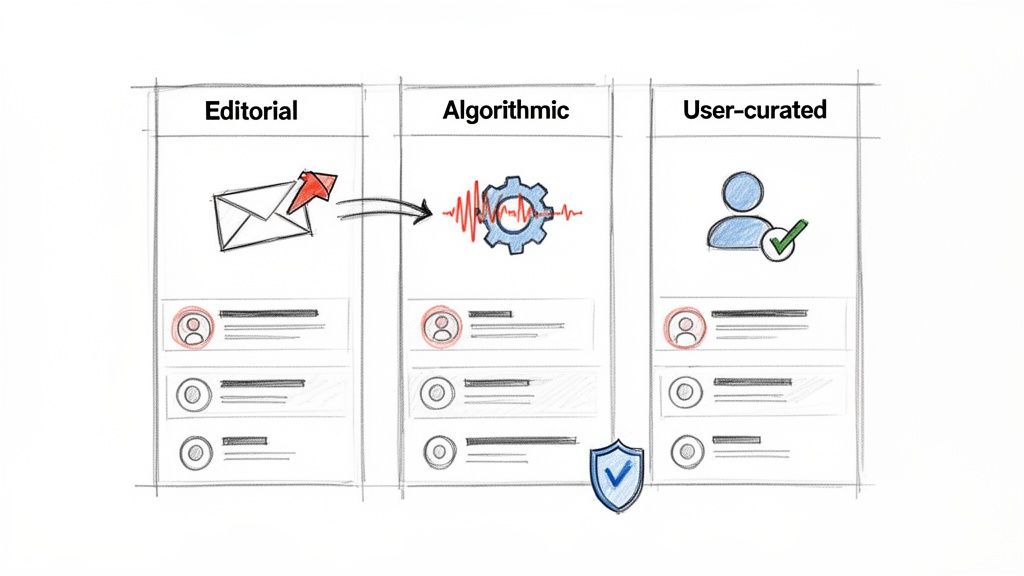
Think of Spotify's playlist ecosystem in three distinct categories: editorial, algorithmic, and user-curated. Each one is a different doorway to discovery.
Editorial Playlists: These are the big leagues—the ones curated by Spotify's own team. Playlists like RapCaviar or Lorem are the stuff of legend, capable of launching careers overnight. The only way in is by pitching your unreleased track directly through your Spotify for Artists dashboard.
Algorithmic Playlists: You've seen these before. Discover Weekly and Release Radar are tailored to each individual listener's taste. They run on data. When someone saves your song, adds it to their own playlist, or follows your artist profile, Spotify's algorithm sits up and takes notice. It then starts pushing your music to other listeners with similar habits.
User-Curated Playlists: These are the wild west, created by everyone from major music bloggers and indie labels to dedicated fans. Don't underestimate them. A solid placement on a popular user-curated playlist can send powerful signals to Spotify's algorithm, which can snowball into algorithmic and even editorial support.
The real magic happens when they work together. A grassroots push on user-curated playlists often triggers algorithmic adds, which can then get you on an editor's radar.
Crafting the Perfect Pitch for Editors
When you submit a song through Spotify for Artists, you’re doing more than just uploading a file—you’re telling a story. Editors are drowning in thousands of pitches every single day, so a generic, "Hey, check out my new song" is a guaranteed path to the slush pile.
You need to be concise and compelling. Start by nailing the genre, sub-genre, and mood. Don't just say "Indie." Get specific. Try something like, "Dreamy, lo-fi indie with a touch of shoegaze." Then, give them the hook. What's the song about? What was the inspiration? Let them know about your marketing plans, like an upcoming music video or a targeted social media campaign. It shows you’re invested.
For a full breakdown of the process, check out our modern guide to Spotify playlist pitching.
Vetting Playlists and Avoiding Bots
Now for a reality check: not all playlists are created equal. The user-curated world is full of legitimate curators who can genuinely help your career. But it's also a minefield of botted playlists offering nothing but fake streams.
Getting caught up in a botted playlist won't just fail to make you money; it can get your music kicked off Spotify entirely.
This is where data becomes your best friend. Before you even think about pitching a user-curated playlist, you have to do your homework. Look for red flags. Did a playlist gain 50,000 followers overnight with zero change in engagement? That's a bot farm. Real playlists grow organically, day by day.
Just look at this screenshot from artist.tools—it shows what a healthy playlist's growth should look like.
That steady, upward curve is the sign of real, organic follower growth. That's a playlist worth your time. This is exactly why tools like the artist.tools Playlist Analyzer are so critical. It dives deep into follower history and bot activity to make sure you’re pitching to actual human beings who can become actual fans.
Think playlists don't matter? In 2024, Spotify paid out a staggering $10 billion to the music industry. A massive chunk of that was driven by discoveries made through editorial and algorithmic playlists.
For the artists earning over $10 million a year on the platform, you can bet that viral playlist moments were part of their story. Even for an emerging artist, one good placement can be the spark that ignites a sustainable career. A smart, data-backed approach to playlisting isn't just a good idea anymore—it's absolutely essential.
Optimizing Your Profile for Discovery and Fan Engagement
Think of your Spotify profile as your digital storefront. A neglected profile doesn't just look sloppy; it signals to both fans and Spotify's algorithm that you're not really in the game. Getting comfortable inside your Spotify for Artists dashboard is non-negotiable if you want to turn casual listeners into real fans—and that's the core of making money on this platform.
Every single part of your profile is a chance to tell your story and get people to do something. It's the place where a passive stream can flip into a follower, a merch sale, or a concert ticket. Your profile isn't just sitting there; it's an active hub that tells Spotify how engaged you are.
Crafting a Compelling Artist Bio
Your artist bio is often the first real introduction a new listener gets beyond your music. It needs to be punchy, engaging, and up-to-date. Don't bore them with your life story—hook them with what makes you interesting right now.
A solid bio should do a few things, fast:
Set the Scene: Quickly define your sound. Is it "sun-drenched indie pop" or "gritty, lo-fi hip-hop"? Give them a frame of reference.
Share Your Story: What's the deal with your latest project? A short, personal tidbit connects way better than a dry list of accomplishments.
Include a Call to Action: Point them somewhere. Mention your newest single or an upcoming tour to guide their next click.
You’ve got 1,500 characters to work with, which is plenty of space to be descriptive without writing a novel. Make a habit of refreshing it with every new release or big announcement.
Leveraging Spotify for Artists Tools
Spotify for Artists is so much more than a stream counter. It's a full-blown toolkit for promotion, and two of its most powerful features are often overlooked: the Artist Pick and Canvas videos.
The Artist Pick lets you pin something—a track, an album, a playlist—right at the top of your profile. This is prime real estate. Use it to push your new single, show off a playlist you landed on, or even promote a show. It's a dead-simple way to send traffic exactly where you want it.
Don’t just set your Artist Pick and forget it. I recommend changing it up every week or two to spotlight different things. This constant activity is a great signal to both your followers and the algorithm.
Canvas videos are those short, looping visuals that play with your tracks. They're a huge opportunity to grab someone's attention. Spotify’s own data shows they increase streams, saves, and shares. A good Canvas can literally stop a listener mid-scroll, turning a passive experience into an active one. Just keep them between 3-8 seconds and make sure they loop smoothly.
Using Marquee to Amplify New Releases
Once you drop a new track, getting it in front of the right ears is everything. This is where Marquee comes in. It’s Spotify’s own ad tool, designed to serve a full-screen, sponsored recommendation of your new release to listeners who are already into your music.
This isn't just spraying and praying. Marquee targets your "reachable audience"—people who have actively streamed your stuff before. It’s a killer way to make sure your most likely fans don't miss out, giving you that initial burst of streams that can help you land on algorithmic playlists like Release Radar. Running a Marquee campaign is a direct signal to Spotify that your music has momentum, which can create a ripple effect across the platform and, ultimately, grow your earnings.
Sure, streaming royalties are a piece of the puzzle, but if that's all you're counting on, you're in for a long, tough road. The smartest artists I know treat Spotify less like a music player and more like the central hub for their entire business.
Spotify gets this. They’ve built some killer direct-to-fan tools right into your artist profile, designed to turn passive listeners into genuine, paying supporters.
Think about it. A fan discovers your song on a playlist, gets hooked, and in two clicks, they can be browsing your merch store or grabbing a ticket for your next show. It’s all about capturing that spark—that moment of connection—and turning it into real, tangible support for your career.
Selling Merch Directly on Your Profile
One of the best ways to earn more is by selling your own gear. Spotify’s integration with platforms like Shopify makes this a no-brainer.
You can connect your store and feature items like t-shirts, vinyl, hats, or whatever you've got, right there on your artist page. They'll show up right in front of the people who are most likely to buy: your fans.
Getting it set up is a breeze:
Log in to your Spotify for Artists dashboard and find the "Merch" tab.
Choose Shopify as your partner and just follow the prompts to link your account.
You can list up to three items on your profile, so make sure to pick your bestsellers or newest designs to feature.
Picture this: someone just blasted your latest single, they're feeling the vibe, and right at that moment, they see a sick t-shirt design. That’s a powerful impulse-buy opportunity you can't afford to miss.
Your Spotify profile is prime real estate. Not listing merch is like a retail store leaving its best products locked in the stockroom. You have to make it easy for fans to give you their money.
Turning on Fan Support and Ticket Sales
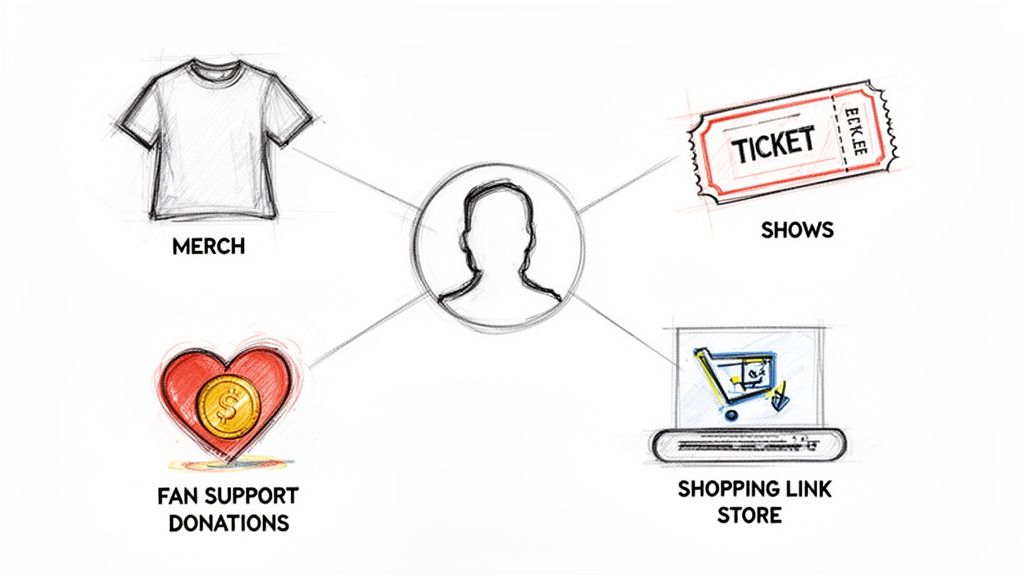
Beyond physical merch, Spotify also lets you activate direct financial contributions and push your live shows. These are crucial income streams that have absolutely nothing to do with how many streams you get.
Fan Support is basically your digital tip jar. It lets you link a payment provider like PayPal or GoFundMe directly to your profile. Your audience gets a super simple way to send you some cash. You can pin a fundraising link right to the top of your profile, so it's the first thing people see. It’s perfect for funding a new album, replacing broken gear, or just helping you cover gas money on tour.
You can also integrate ticket sales seamlessly by connecting platforms like Ticketmaster, Songkick, and Eventbrite. Once you list your tour dates, a "Find Tickets" button pops up, turning your profile into a powerful promo tool for your shows. This direct link cuts out all the friction, making it way easier for a casual listener in Austin to become a paying concertgoer next month.
These integrations are absolutely key to diversifying how you make money on Spotify. They make every single part of your artist profile work together to build a career that can actually last.
Protecting Your Royalties from Bots and Bad Data
Getting your music on Spotify is one thing; making sure you actually get paid for your streams is a whole different ball game. It’s not just about racking up plays. You have to be sure those streams are legitimate and that the money they generate can actually find its way back to you.
Two of the biggest, yet quietest, killers of an artist's income are bot streams and messy metadata. Both can sabotage your earnings without you even noticing until it's too late.
The Hidden Threat of Bot Activity
Artificial streaming, usually coming from sketchy, botted playlists, is a massive problem. These fake plays don't just pay you nothing—they can get your music flagged and even removed by Spotify. The platform has a zero-tolerance policy for this, and the consequences are severe, from having your royalties frozen to seeing your entire catalog wiped from the service.
This isn't just some far-off possibility. Countless artists have had their tracks pulled after unknowingly landing on a playlist run by a bot farm. It happens more than you think. You can dive deeper into this issue in our full guide on how to spot fake Spotify streams.
It's a harsh reality: Spotify's anti-fraud system doesn't care if you knowingly bought fake streams or were just an unlucky victim. The penalty is often the same. It's 100% on you to protect your account.
So, how do you defend yourself against something you can't always see? It comes down to vigilance and having the right data. Bot farms often disguise their playlists to look real, but a closer look reveals tell-tale signs. You might see a massive, unnatural jump in followers overnight or a playlist with tons of followers but almost no real, active listeners.
This is exactly why a specialized tool is no longer a "nice-to-have"—it's essential. Our Bot Detection feature is designed to analyze a playlist's history for these exact red flags.
This kind of analysis gives you a clear risk score, so you can vet playlists before you ever pitch to them. It’s a critical defensive move that ensures your streams are from real fans and your royalties are secure.
Why Clean Metadata Is Non-Negotiable
Just as important as clean streams is clean data. Metadata is the DNA of your track—it's all the info attached to the music file, like the song title, artist name, songwriter credits, publisher details, and ISRC codes. If any of this is wrong or missing, your royalty payments can get lost in a digital black hole.
Think of it this way: your song earns money, but Spotify has no idea who to send the check to because the address is incomplete. That money ends up in an unclaimed "black box" fund. After a while, it gets redistributed to the biggest players in the industry based on their market share. Your hard-earned cash literally ends up in someone else's pocket.
To stop this from happening, you need to be obsessive about accuracy when you upload your music. Double- and triple-check every single field in your distributor's dashboard before you hit submit.
Songwriter and Publisher Credits: Make sure every single co-writer is listed with their correct legal name and publishing info. No nicknames.
ISRC and ISWC Codes: These are the unique fingerprints for your master recording and the song's composition. They are absolutely essential for tracking and getting paid correctly.
Correct Spelling: A simple typo in a song title or your artist name can create massive headaches for payment and discoverability down the road.
Working with your distributor to guarantee 100% accuracy from day one is the most important thing you can do. It's the foundation for making sure every cent you rightfully earn actually makes it to your bank account.
To make this easier, here’s a quick checklist to run through before every release.
Protecting Your Revenue Checklist
This simple checklist can help you stay on top of the two biggest threats to your Spotify income: fake streams and bad data. Run through these steps for every release to keep your royalties safe and your artist profile healthy.
Action Item | Why It's Important | Recommended Tool/Practice |
|---|---|---|
Vet All Playlists Before Pitching | Prevents your music from landing on bot-infested playlists, which can lead to royalty withholding or track removal. | Use a Bot Detection tool to analyze a playlist's follower growth and listener activity for red flags. |
Review Your Spotify for Artists Data | Look for sudden, unnatural spikes in streams from obscure locations or playlists you don't recognize. | Regularly check your Audience and Music > Playlists tabs in your Spotify for Artists dashboard. |
Verify All Metadata at Upload | Ensures that royalties for both master recordings and publishing are correctly routed to you and your collaborators. | Double-check all songwriter splits, publisher info, and ISRC/ISWC codes with your distributor (e.g., DistroKid, TuneCore). |
Register with a PRO | A Performance Rights Organization (like ASCAP, BMI, or SESAC) is necessary to collect your performance royalties. | Sign up with a PRO and ensure your entire catalog is registered with them accurately. |
Choose a Reputable Distributor | A good distributor will have clear guidelines and support for maintaining clean metadata and handling royalty issues. | Research distributors and choose one known for transparency and artist support. |
Following these practices isn't just about playing defense; it's about building a sustainable career. By keeping your data clean and your streams legitimate, you're ensuring that the hard work you put into your music actually pays off.
Your Burning Questions About Spotify Earnings, Answered
Let's be real: figuring out how Spotify pays artists can feel like trying to solve a puzzle in the dark. Even when you think you've got a handle on it, new questions pop up. We get it.
Here are the straight-up, no-fluff answers to the most common questions we hear from artists trying to turn their streams into actual, reliable income.
How Many Streams Does It Take to Make a Living?
This is the big one, isn't it? While there's no magic number, the benchmark many independent artists aim for is one million monthly streams. Getting to that level can generate anywhere from $2,000 to $4,000 a month before your distributor or label takes their percentage.
For most artists, this isn't "quit your day job" money on its own, but it's a solid foundation. The artists who really thrive use that streaming income as a launchpad. They build on it with merch, touring, licensing deals, and direct support from their fans. Think of streaming as the engine, not the entire car.
Hitting a million streams a month is rarely about a single viral track. It's about building a catalog of songs that people keep coming back to. One song might pull 200,000 streams, another gets 50,000, and a dozen others chip in 10,000 each—it all works together.
That’s why consistency and knowing your audience inside and out are so critical. It’s about building a career, not just chasing a hit.
Do Free Users Pay Less Than Premium Users?
Yes, and it's not even close. A stream from a Premium subscriber is worth a whole lot more than one from a free, ad-supported listener. This is at the heart of Spotify's "pro-rata" royalty model.
Every month, the royalty pool is filled from two different buckets:
Subscription Fees: All the money collected from Premium members.
Ad Revenue: The cash generated from playing ads to free listeners.
Because subscriptions bring in way more money than ads, the value of a stream from a Premium user is naturally higher. Your final payout is a blend, reflecting the mix of free vs. premium listeners who played your tracks that month. If your fanbase is mostly in countries with high Premium subscription rates, you'll see a better per-stream payout.
What’s the Best Way to Land an Editorial Playlist?
There is only one official, legitimate way to get on a Spotify editorial playlist: pitching your unreleased music through your Spotify for Artists dashboard. You need to get your track submitted at least 7-10 days before it comes out. This gives the editorial team a chance to actually listen.
But just submitting isn't enough. A winning pitch tells a story. The editors are looking for amazing music, sure, but they're also looking for artists who have a plan.
Here's how to make your pitch cut through the noise:
Get Specific with Genre and Mood: Don't just pick "Pop." Is it "Synth Pop"? "Indie Pop"? "Dream Pop"? The more precise you are, the easier you make it for them to find the perfect playlist for your song.
Tell Them the Story: What's the track about? Was there a cool story behind how you recorded it? A short, compelling narrative makes your music stick.
Show You're Working It: Mention if you have a music video dropping, a social media campaign ready to go, or any press lined up. It shows editors you're serious about promoting your music, which helps them do their job.
The competition is insane, so a polished pitch that shows off both your art and your hustle is your best shot.
How Much Do the Top Artists Really Make?
The numbers at the very top are mind-boggling, showcasing the sheer scale of the platform. While most of us are grinding for a sustainable income, the superstars are in a different galaxy. In 2023, 170 artists pulled in over $5 million and 60 artists broke the $10 million mark from Spotify alone. Think about industry giants like The Weeknd and Taylor Swift—their billions of streams translate directly into millions of dollars.
But it’s not just an all-or-nothing game. Spotify's massive $10 billion payout in 2024 is also supporting thousands of emerging and mid-tier artists. In fact, over 103,400 artists earned at least $5,000 in 2023, which proves that you can make real money long before you become a household name. Getting to that living wage—that one million monthly streams benchmark—is all about mastering your playlisting strategy and optimizing every part of your profile. For an indie artist, using data to track listener growth and see what's working is the key to scaling sustainably. You can see a more detailed breakdown over at venicemusic.co.
Ready to stop guessing and start making strategic moves with your music? artist.tools gives you the entire toolkit to analyze playlists, sniff out bots, track your listeners, and build a real plan for your Spotify earnings. Take control of your music career today.