Unlock bmi music royalties: A Clear Guide to Earnings
So, what exactly are BMI music royalties?
Simply put, they are the payments you, the songwriter or publisher, receive whenever your music gets played in public. We're talking about radio spins, background music in a restaurant, a song in a TV show, a live concert performance, or a stream online. It's the mechanism that turns your music's public airtime into a real, tangible income stream.
How BMI Performance Royalties Actually Work
Think of BMI (that's Broadcast Music, Inc.) as a massive, specialized bank account for your song's performance rights. Every single time your track plays in a public setting, it technically generates a tiny fee—a performance royalty.
Now, one play might only be worth a fraction of a penny. But when you start talking thousands, or even millions, of plays? Those fractions start to add up, and they can add up to something significant.
This is where BMI steps in as the essential middleman. Let's be real: it would be an absolute nightmare for any artist to try and track down every single radio station, coffee shop, or streaming service playing their music and then send them an invoice. BMI handles this incredibly complex job for you, but on a massive scale.
The Role of a Performing Rights Organization
BMI is what the industry calls a Performing Rights Organization, or a PRO. These organizations are the unsung heroes for creators, making sure you get paid when your work is used. They do this by issuing licenses to businesses that want to play music.
Here’s a quick rundown of how it all goes down:
Licensing: Businesses—think TV networks, local radio stations, bars, and even streaming giants like Spotify—pay BMI for something called a "blanket license." This license gives them the legal green light to play any song from BMI's ridiculously huge catalog of over 22.4 million compositions.
Tracking: BMI then gets to work, using a mix of high-tech digital monitoring, serious data analysis, and old-school reporting to figure out which songs are being played, where they're being played, and how often.
Collection: They gather up all the license fees from these thousands upon thousands of sources into one giant pool of money.
Distribution: Finally, after taking out their cut to keep the lights on, BMI divides and distributes the rest of the money to their affiliated songwriters and publishers. Your share is determined by how much your music was played.
This entire system is what turns public plays into those reliable BMI music royalties. If you want to zoom out and see the bigger picture of artist revenue, we've got a whole guide on how music royalties work that breaks it all down.
To get a quick handle on these concepts, here’s a simple table summarizing what BMI does and what it means for you as an artist.
BMI Music Royalties at a Glance
Concept | What It Means for an Artist |
|---|---|
Performance Royalty | The money you earn when your song is performed publicly (radio, TV, streaming, live venues). |
PRO (Performing Rights Org) | The company (like BMI) that collects these royalties on your behalf. |
Blanket License | The fee businesses pay BMI to legally play music from its entire catalog. |
Distribution | BMI sends you a check or direct deposit with your share of the collected license fees. |
Ultimately, understanding this process is the first major step for any musician who's serious about their career. It’s not just about selling albums or merch; it's about building a sustainable income from the art you create.
At its core, a PRO like BMI solves a massive logistical problem. It connects the creators of music with the millions of businesses that use it, ensuring a fair exchange of value that supports the entire creative ecosystem.
Getting a grip on this fundamental role clarifies how your creative work can generate money well beyond the obvious sources. It's a critical piece of the puzzle for building a lasting career in music.
Decoding Your BMI Royalty Statement
Getting your first BMI royalty statement is a huge moment for any artist. It's tangible proof that your music is out there, working for you. But let's be real—it can also feel like you're trying to decipher a secret code. To really get a handle on what you're earning, you have to understand the two most important pieces of the puzzle: the writer's share and the publisher's share.
Picture all the performance royalties your song generates as a single pie. By default, BMI cuts that pie right down the middle. One half goes to the songwriter (or songwriters), and the other half goes to the publisher.
This 50/50 split isn't just a suggestion; it's a hard-and-fast industry standard set by BMI. It’s designed to make sure both the creative side (you, the writer) and the business side (the publisher) are fairly compensated for their work.
Understanding the 200% Rule
You'll often hear people in the industry throw around the term "200% rule." It sounds a little weird, but it's just a different way of talking about that whole pie. Think of it like this: the writer's portion represents 100% of what the writer can earn, and the publisher's portion represents 100% of what the publisher can earn. Put them together, and you get the full 200%—the entire royalty pie.
Now, here's the part that trips up so many independent artists. If you wrote your own song and don't have a publishing deal, you are entitled to collect both halves.
Writer's Share (100%): This is your cut for being the creative genius behind the song—the one who penned the lyrics and melody.
Publisher's Share (100%): This is the cut that goes to the business entity responsible for managing and promoting the song. If you're self-published, guess what? That's you, too.
To collect your full 200%, you must be affiliated with BMI as both a songwriter and a publisher. If you only sign up as a songwriter, you're leaving half your money on the table. It's one of the most common and costly mistakes a new artist can make.
If you want to dig deeper into the different ways your music can make money, our complete guide to the types of music royalties is a great place to start.
How BMI Calculates Your Payout
Unlike your distributor, BMI doesn't pay you a fixed rate for every stream. Instead, they use a "rate per performance" model that values different kinds of plays differently. It all comes down to how big the audience is and what the music user (like a TV network or radio station) paid for the license.
For instance, a spin during a primetime TV show on a major network is going to earn a whole lot more than a play on a tiny internet radio station. The value is all about the reach.
Here are the main things that influence how much a single performance is worth:
Platform Type: A play on a national radio network just carries more weight (and cash) than one on a local college station.
Time of Day: For TV and radio, primetime slots where viewership is at its peak will always generate more royalties than the overnight shift.
Usage Type: The theme song for a hit series is going to earn more than a quick 30-second clip of background music in one scene.
License Fee: This is a big one. The size of the check that a broadcaster or service like Spotify writes to BMI for their blanket license directly affects the total royalty pool that gets divided among artists.
BMI uses a pretty sophisticated mix of digital monitoring, sample surveys, and direct reports to track all these performances. They take all that data, crunch the numbers, and figure out your slice of the pie for that quarter.
Just be aware that there's a delay. You'll typically get paid about six to nine months after the quarter when the performance happened. BMI has a set schedule—usually sending out checks in February, May, August, and November. This lag gives them the time they need to collect all the license fees, process a mountain of data, and make sure everyone's earnings are calculated correctly.
How Spotify Streams Turn into BMI Payments
If you’re a songwriter or artist today, Spotify isn't just a place to host your music—it's one of the main engines driving your BMI music royalties. Gone are the days when radio spins and TV placements were the only game in town. Now, billions of daily streams are what fill the pot, so figuring out this connection is your ticket to turning a Spotify presence into a reliable paycheck.
Spotify doesn’t just pay BMI a flat rate for every stream. It’s a bit more complicated, based on something called a "pro rata" system.
Picture a giant swimming pool. Every month, Spotify takes a chunk of its total revenue from all sources—premium subscriptions, ads, you name it—and dumps it into this pool. This is the royalty pool.
Your slice of that pool is decided by your "stream share." So, if your tracks pulled in 0.01% of all streams on Spotify for the month, you and your publisher get 0.01% of the money in that pool. BMI then collects the performance royalty piece of that pie and pays it out based on your writer and publisher splits.
This is a huge change from the old way of doing things. Your earnings aren't fixed; they're based on how your music performs against every other song on the platform. The bigger your market share, the bigger your check.
The Journey from Stream to Royalty Check
It's helpful to trace a single stream's path to your bank account to see how it all connects. While one play is worth a fraction of a penny, the magic of streaming is in its massive scale.
This is the basic flow from a listener hitting play to you getting paid.
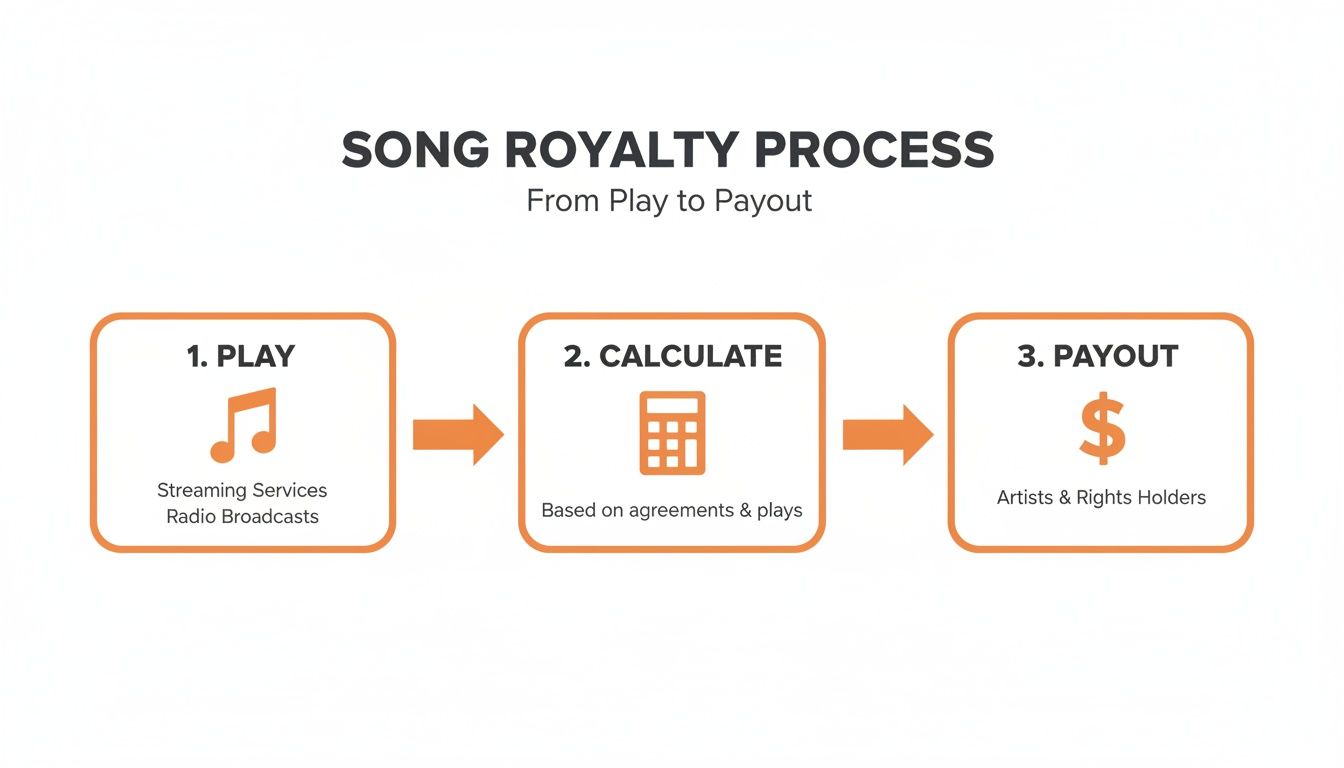
The key takeaway? Your money comes from tons of plays being calculated against that huge, ever-changing revenue pool before it's distributed.
Digital streaming is king now, making up about 65% of all the performance royalties BMI collects. That stat alone shows you just how much creators rely on platforms like Spotify. To handle this firehose of data, BMI processes over 40 billion performances every year. The per-stream rate might seem tiny, but the sheer volume is where the opportunity is.
Why Playlists Are Your Royalty Multipliers
This is where your hustle directly impacts your income. Getting your song onto a big Spotify playlist—whether it's an official editorial giant like RapCaviar or a powerful algorithmic one like Discover Weekly—is the fastest way to blow up your streams and your BMI music royalties.
Think about it like this:
Organic Growth: You drop a new track. Your core fans play it, and you get a few thousand streams. That's a nice, steady trickle of royalties.
Playlist Placement: Your song lands on a popular playlist with millions of followers. All of a sudden, your daily streams can rocket from a few hundred to tens of thousands, practically overnight.
A major playlist placement does more than just rack up plays—it massively inflates your stream share. This is how you grab a much bigger piece of Spotify's monthly royalty pool and start seeing real money.
This is why grinding away on playlist pitching and learning the Spotify algorithm isn't just for bragging rights about your "monthly listeners." It’s a direct strategy to boost your royalty checks. Every good placement is a force multiplier, turning a slow drip of streams into a serious revenue stream.
To really get into the weeds on the numbers, check out our ultimate guide to Spotify royalty payments.
Registering with BMI to Claim Your Royalties
Knowing how BMI music royalties work is one thing, but actually getting set up to collect them is a whole different ballgame. This is where the admin work starts, and trust me, you want to get this right from day one. It's all about officially joining BMI, registering your songs, and then telling them where you've performed.
Think of it like building the pipes that will carry your money from the stage and the speakers straight to your bank account. If you don't build the pipeline, those royalties just sit there, stuck in limbo, unable to find their way home to you.
Joining as a Songwriter and Publisher
First things first: you need to affiliate with BMI. As an indie artist, you’re basically running a two-person show—you’re the creative songwriter and the savvy publisher. To get paid everything you're owed, you have to register as both.
Become a BMI Songwriter: This is your personal registration. It links your name directly to the songs you write. There's a one-time fee to join, but it gives you a lifetime membership.
Establish Your Publishing Entity: This is your business hat. Even if you're a one-person operation, you absolutely need a publishing company to collect the publisher's share of your royalties. You can easily set up a "vanity" publishing company with a cool name (like "Your Name Music") and register it with BMI. This part is non-negotiable if you want to collect your full 200% of performance royalties.
Forgetting to register a publishing entity is probably the biggest mistake I see artists make. It's like willingly leaving half your money on the table.
The Critical Task of Registering Your Songs
Once you’re officially a BMI affiliate, your most important ongoing job is to register every single song you write in their database. An unregistered song is basically invisible to BMI. It doesn't matter if it gets a million plays; if it's not in their system, it can't earn you a dime.
When you're registering a song, you have to be meticulous. Bad data is the number one reason payments get delayed or disputed.
Key Information for Song Registration:* Song Title: Make sure it’s exactly the same as what’s on Spotify and other platforms. No typos!* Songwriter(s) and Splits: List every co-writer and their exact percentage share. All the writer shares need to add up to a perfect 100%.* Publisher(s) and Splits: Same deal here. List every publisher and their shares, and make sure they also total 100%.* ISWC Code (Optional but Recommended): If you have an International Standard Musical Work Code, add it. It’s like a unique fingerprint for your song that helps identify it globally.
Seriously, double-check everything before you hit submit, especially the songwriter splits. Get those percentages in writing from your collaborators. It will save you so many potential headaches and awkward conversations later on.
Claiming Royalties from Live Gigs
Your BMI music royalties don't just come from streams and radio. They also come from your live shows. Every time you play a gig, whether it's a tiny coffee shop or a huge festival stage, you're generating performance royalties that you need to go in and claim.
BMI makes this pretty easy with a tool called BMI Live. Here's the rundown:
After a show, you log into your BMI account.
You submit your setlist, along with the date and venue details.
BMI uses that info to calculate and pay out the royalties you earned from that performance.
Don't sleep on this. If you're a touring musician, the money from live gigs can really add up and become a major part of your income. Making a habit of submitting your setlists through BMI Live ensures you’re grabbing every last dollar your music earns on the road. Getting comfortable in your online portal to track these earnings is just part of being a financially smart artist.
Choosing Your PRO: BMI vs. ASCAP and the Others
Picking a Performing Rights Organization (PRO) is one of the first major business moves you'll make in your music career. It's less like filling out paperwork and more like choosing a long-term partner who's going to be in charge of your money for years. In the U.S., you've got four main players, and each one has its own way of collecting your BMI music royalties (or royalties from another PRO).
Don't rush this one. The PRO you sign with determines your contract terms, how you get paid, and even the professional community you'll be a part of. Getting it right from day one sets you up for a smooth flow of royalties that actually fits your career goals.
The Big Four: A Breakdown
The American PRO scene is pretty much run by two big non-profits, BMI and ASCAP, and two smaller, for-profit, invite-only shops, SESAC and GMR. The biggest difference is their business model, and that's the first thing you need to get your head around.
BMI (Broadcast Music, Inc.) and ASCAP (American Society of Composers, Authors and Publishers) are non-profits. At their core, their mission is to serve members—that’s you, the songwriter and publisher. Once they cover their running costs, every dollar from licensing fees goes back out to creators as royalties.
SESAC and GMR (Global Music Rights) are for-profit businesses. They do the same job of collecting and paying out royalties, but their structure lets them operate more like exclusive, boutique agencies. You can't just sign up; you have to be invited, which means they tend to work with a smaller, more established group of writers.
This is a really important distinction. The non-profit approach of BMI and ASCAP makes them way more accessible for new and emerging artists. Meanwhile, the invite-only nature of SESAC and GMR means they can offer a more hands-on, curated service, but only to a select group of top earners.
Your choice of PRO isn't just an administrative checkbox; it's a strategic alliance. You need to link up with an organization whose structure, contracts, and payment style actually make sense for where you are in your career right now.
Something else to consider is how well these organizations collect your money from overseas. If your music is online, it's global, and you need a PRO that can track that. BMI, for example, has a massive international network that processes payments every quarter after taking out a 3.6% administrative fee. They partner with PROs all over the planet to make sure you get paid when your song gets played in Berlin or Brazil. And this isn't small change—global music rights collections soared to €11.7 billion in 2023. You can read up on how BMI handles global royalty collection on their website.
Comparing Major US Performing Rights Organizations
To make this decision a bit easier, let's put the most important features side-by-side. This table cuts through the noise and focuses on what really matters when you're starting out: fees, contract lengths, and who can actually join.
Feature | BMI | ASCAP | SESAC | GMR |
|---|---|---|---|---|
Ownership | Non-Profit | Non-Profit | For-Profit | For-Profit |
Membership | Open to all | Open to all | Invite-Only | Invite-Only |
Songwriter Fee | Free | $50 (one-time) | Free | Free |
Publisher Fee | Free | $50 (one-time) | Free | Free |
Contract Term | 2 years | 1 year | 3 years | Varies |
Payment Method | Rate Per Performance | "Credit" System | Varies | Varies |
When you boil it down, most independent artists are going to be choosing between BMI and ASCAP. Both are industry powerhouses with huge song catalogs and a long track record of fighting for creators. The biggest practical differences are the one-time sign-up fee for ASCAP and the slightly longer initial contract term for BMI.
Strategies to Maximize Your BMI Royalty Checks

Simply collecting BMI music royalties isn't the whole game. If you want to grow them, you've got to stop waiting passively for a check and start thinking like the CEO of your own music catalog. It’s all about turning your creative work into a real, managed income stream.
A great first step is to treat your music like a business, which means you need to plan and forecast. Using a good royalties calculator, for example, can give you a solid estimate of what a new single or a streaming campaign could bring in. This isn't just about satisfying your curiosity—it’s about using data to set marketing budgets and realistic financial goals.
Master Your Metadata and Registrations
Your long-term royalty health lives and dies by clean, accurate data. Think of your song’s metadata—the writer splits, publisher info, ISRC/ISWC codes—as its financial DNA. A single mistake or missing piece of information can completely block your money from getting to you.
The most powerful thing you can do to maximize your BMI income is to be obsessive about immediate and accurate song registration. An unregistered song is an invisible asset. It earns you zero, no matter how many times it gets played.
Make this a non-negotiable part of your release workflow:
Register Immediately: As soon as a song is written, get it registered with BMI. Don't wait until it's out.
Verify All Splits: Get every songwriter and publisher percentage confirmed in writing with your collaborators before you submit anything.
Audit Regularly: At least once a year, log into your BMI portal and review your whole catalog. Look for errors or songs you forgot to register. This simple habit can literally uncover thousands in lost royalties over a career.
This boring admin work is the absolute foundation of your financial success. It’s what ensures every play is tracked, credited, and paid correctly.
Target Playlists and Monitor Performance
While metadata ensures you get paid for your plays, strategic playlisting is what gets you those plays in the first place. Not all playlists are created equal. Focus your energy on pitching your music to legit, high-engagement curators in your genre. Getting on just one influential playlist can blow up your stream count, and in turn, your royalty checks.
This isn't a "set it and forget it" task. You have to actively manage it. Keep an eye on your song's performance across different platforms to see what's working and what isn't.
The potential here is massive. BMI hit a historic milestone, distributing a record-breaking $1.471 billion to its members in its fiscal year ending June 30, 2025. That number has grown over 22% in just six years. With digital streaming now making up about 65% of BMI’s total collections, your Spotify strategy has a direct line to your share of that giant, growing pie. You can learn more about BMI’s record-breaking distributions on Martini.ai-3607b733b33bba5350a3278826f82789).
When you combine clean data management with a smart, targeted streaming strategy, you take full control of your BMI music royalties. This proactive approach means you’re not just getting paid—you’re actively building a sustainable and profitable career in music.
Got Questions About BMI Royalties? Let's Clear Things Up.
Diving into the world of BMI music royalties can feel like a maze, especially when you're just trying to connect the dots between your music getting played and money hitting your bank account. Let’s tackle some of the most common questions artists have with some straightforward answers.
How Long Does It Take to Get Paid by BMI?
This is where you'll need a bit of patience. BMI pays out on a quarterly schedule, but there's a pretty big delay built into the system. You can generally expect to receive your payment about six to nine months after the quarter your music actually got played.
So, if your song was getting a ton of streams back in January, February, and March (Q1), you won't see that money until a distribution much, much later in the year. This lag time exists for a good reason; it gives BMI the window they need to:
Collect licensing fees from thousands of different places (radio stations, venues, streaming services).
Sift through a mountain of performance data.
Make sure all the calculations are right before cutting checks to their members.
Do I Need a Publisher to Collect All My Royalties?
Yes—but that publisher can be you. This is a big one. To get every single penny you've earned, you have to be set up to collect both the writer's share and the publisher's share of your royalties. BMI splits all performance royalty income right down the middle, 50/50, between these two shares.
If you only sign up with BMI as a songwriter, you’re literally leaving half your money on the table. The publisher’s share will just sit there, unclaimed. The solution is simple: create your own publishing entity (often called a "vanity" publisher), register it with BMI, and you'll be able to collect 100% of what you're owed.
How Are BMI Royalties Different From My DistroKid Payments?
This is probably the most critical distinction for new artists, and it trips a lot of people up. The money you get from BMI and the money you get from your distributor (like DistroKid, TuneCore, or CD Baby) are for completely different things. They are two separate streams of income.
BMI Payments (Performance Royalties): This is money for the public performance of your song's composition—the actual melody and lyrics you wrote. Think radio spins, TV placements, live gigs, and, yes, streams on platforms like Spotify.
DistroKid Payments (Master/Mechanical Royalties): This is money for the reproduction and distribution of the specific sound recording you created. When someone streams your track, your distributor is the one who collects the royalties tied to that specific recording they delivered to Spotify.
Here's an easy way to think about it: BMI pays the songwriter for writing the song. Your distributor pays the artist and/or label for owning the recording of that song. You absolutely need to be set up to collect both to be paid in full.
Ready to turn your Spotify streams into a predictable income stream? artist.tools provides the data and insights you need, from tracking your daily streams and monthly listeners to finding the perfect playlists for your music. Make smarter career decisions with a platform built for artists. Start analyzing your music's performance with artist.tools today.
.png)
.png)
Comments