
What Is a Listening Party? Boost Streams & Engage Fans
Discover what is a listening party and how this powerful tool can boost your music streams, engage fans, and drive your release in 2026. Guide for artists &
6
- What Is a Listening Party in Modern Music Marketing
- The Strategic Benefits of Hosting a Listening Party
- Types of Listening Parties A Modern Artist Can Host
- How to Plan and Host a Successful Listening Party
- Measuring the Success of Your Listening Party with Data
- Frequently Asked Questions About Listening Parties
A listening party is a structured music-release event where an artist plays a new project for an audience before, on, or around release day, turning ordinary listening into a shared first-listen moment. That matters because music is already a constant behavior: adults listen for an average of 18 hours per week, so the format works by focusing a habit people already have into a coordinated event with attention, conversation, and intent.
Most streams happen passively. A fan puts music on while commuting, working, scrolling, or cleaning, and your release competes with everything else happening in their day. A listening party changes that. It asks people to show up at a specific time, hear the project in sequence, and react together.
That shift is why the format matters in music marketing. It isn’t just a celebration. It’s a way to create a release moment that people can notice, remember, and act on.
What Is a Listening Party in Modern Music Marketing
A listening party is not a concert. It’s a release-format event built around focused listening, usually with context from the artist, fan chat, or both. Recent coverage describes the modern version as less about performance and more about the shared experience of hearing the music together, which is why it has become such a useful launch tool for independent releases according to Dazed’s coverage of why listening parties are everywhere right now.
That framing matters because the problem most artists face is not access to audio. It’s attention. Fans can hear your music anywhere, anytime. The harder challenge is getting them to stop treating it like background sound and give one release their full focus.
Why the format works
A listening party works because it packages a familiar behavior into a scheduled event. Instead of hoping fans press play at some point during a busy week, you create a reason for them to listen together, react in real time, and attach memory to the release.
That focus is what makes the format useful inside a broader campaign. You can use it to frame the story of the project, set up merch or pre-orders, invite collaborators into the conversation, and push listeners toward meaningful actions after the playback ends.
Artists who want a stronger release framework should treat listening parties as one part of a larger launch system, not a one-off tactic. A good reference point is this modern music marketing strategy guide for artists, which helps place release moments inside a broader growth plan.
The Strategic Benefits of Hosting a Listening Party
A listening party is valuable when it serves a clear job in your release funnel. Bandcamp positions the format as an audio-first community tool that can support pre-orders and early previews, while trade coverage around release campaigns frames it as a way to gather fans, press, and industry contacts around one moment. The bigger point is simple: before you host one, decide whether the event is for conversion, community retention, or premium fan activation, as outlined in Bandcamp’s explanation of what a listening party is and how it works.
Conversion works best before or at release
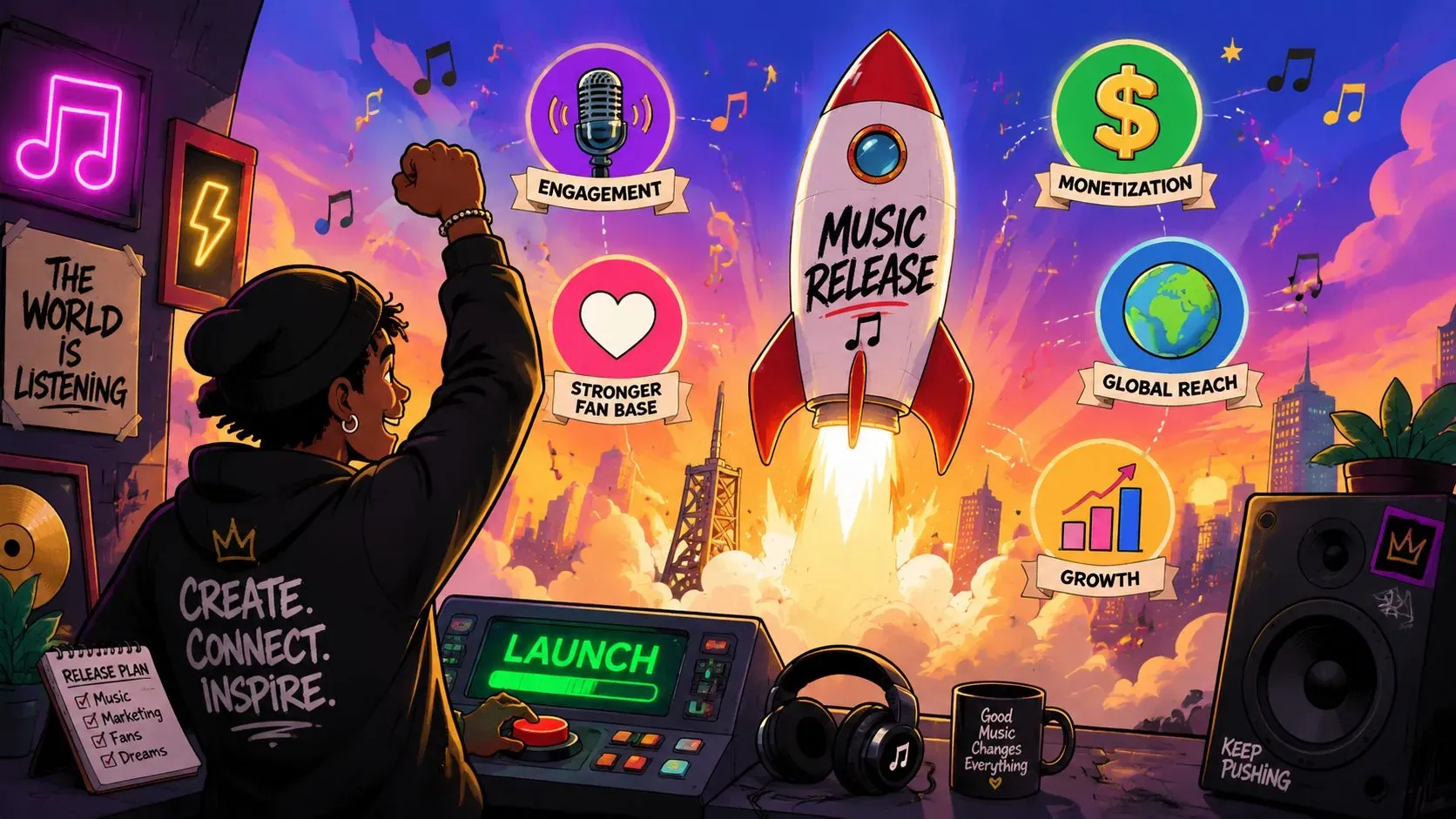
If your goal is conversion, the event should move people toward one next step. That might be a pre-order, a pre-save, an RSVP for release night, or a merch drop tied to the album story. In that setup, the listening party isn’t the end product. It’s the trigger.
Artists frequently become careless. They host an event, people show up, everyone says the songs are great, and then the campaign ends with no structured action. Good energy without a funnel is not a strategy.
Community retention works best when access feels earned
For fan retention, the value comes from proximity. A listening party lets your most engaged listeners hear the project early, ask questions, and feel included in the release process. That matters because community isn’t built by broadcasting harder. It’s built by giving people moments they can participate in.
A smaller artist can use this especially well. You don’t need a massive audience to make a listening party work. You need a group of listeners who care enough to show up and a format that rewards them for doing it.
The strongest listening parties feel like access, not advertising.
Premium fan activation needs exclusivity and structure
Some releases need a more selective approach. If the project has a premium fan segment, vinyl buyers, collectors, Patreon supporters, Discord regulars, top followers, then exclusivity can be the point. In that case, scarcity helps. A limited invite list, early playback, or private post-listen Q&A can make the event feel meaningful instead of generic.
What doesn’t work is trying to satisfy every goal at once. A press-facing event, a fan reward event, and a conversion event usually need different guest lists, different timing, and different calls to action.
A useful checklist is:
- Choose one primary goal: Decide whether the event is meant to drive orders, deepen loyalty, or reward superfans.
- Match the invite list to that goal: Press and industry audiences need a different experience than your core fan base.
- Build one obvious next step: Tell attendees exactly what to do after the final track.
- Keep the event story-led: Fans remember context, sequencing, and emotion more than generic hype.
Types of Listening Parties A Modern Artist Can Host
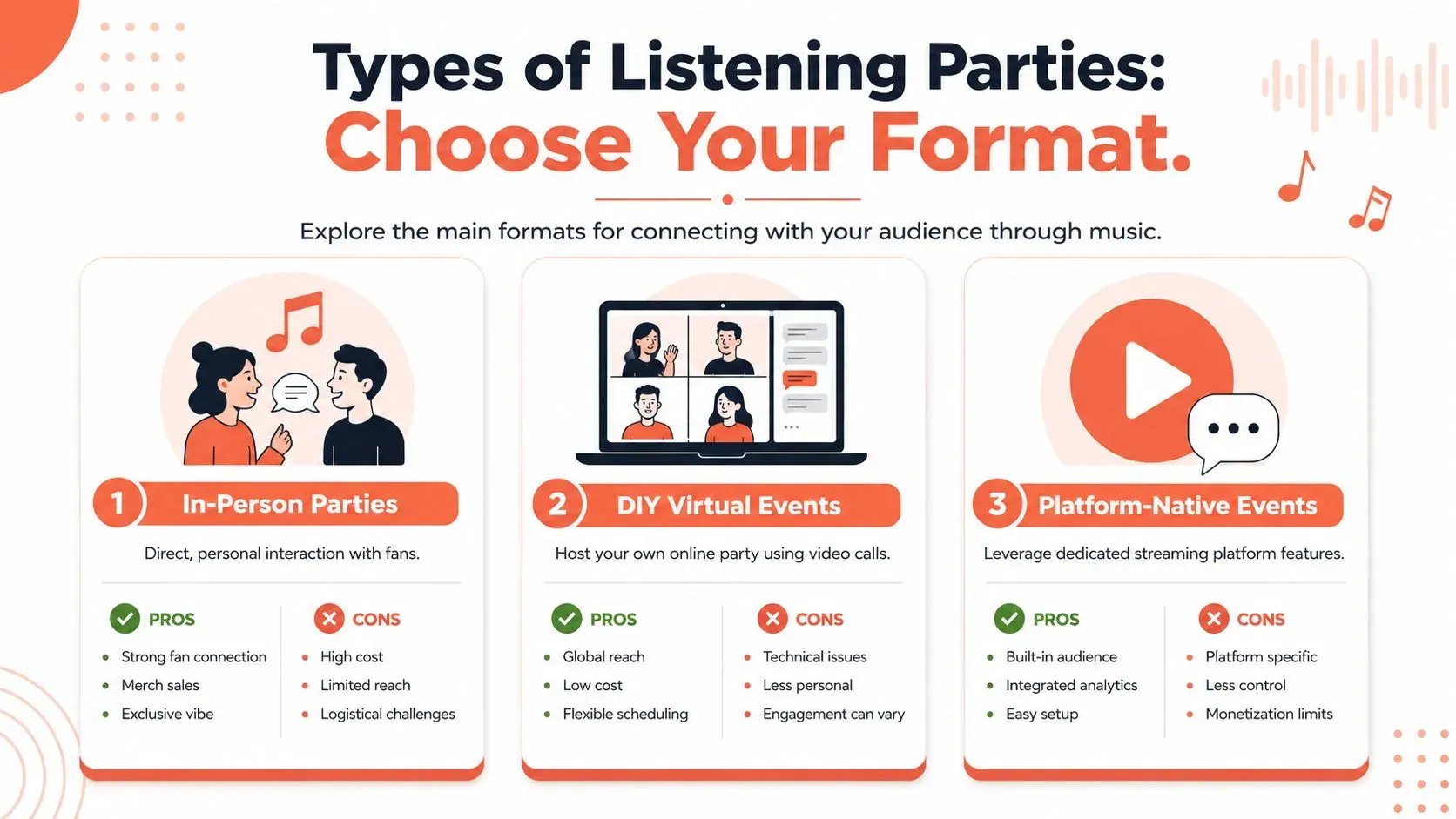
There are three practical formats most artists should consider. In-person parties, DIY virtual events, and platform-native listening parties all solve different problems. The right choice depends on your audience location, your budget, your release goal, and how much technical control you want.
In-person parties
An in-person listening party is the most tactile version of the format. Fans come to a room, hear the project on a proper system, and usually get a stronger emotional memory because the event feels social and physical.
This format is best when your audience is concentrated in one market and you want to create atmosphere. It also works well when merch matters, because people are already present and in buying mode if the setup is strong and the room sounds good.
The downside is obvious. Physical events are harder to produce. Venue logistics, playback quality, guest flow, staffing, and timing all matter. If the room sounds bad or the event runs long, the experience falls apart quickly.
DIY virtual events
A DIY virtual listening party gives you reach and flexibility. You can host fans across cities and countries, control your guest list, and build conversation around the release without the overhead of a venue.
This format is often the best fit for independent artists because it lowers production friction while still creating a scheduled moment. But the weak point is technical execution. If the stream lags, drops out, or sounds poor, the event stops feeling intentional and starts feeling amateur.
For independent virtual listening parties, the most useful operating rule is straightforward:
- Keep it tight: The ideal runtime is 45 to 90 minutes.
- Protect audio quality: Bad sound kills the point of the event.
- Prepare a backup: If the primary stream fails, switch immediately to a pre-recorded file or secondary platform.
- Create interaction between tracks: Q&A, polls, and track-by-track commentary give people a reason to stay engaged.
A virtual listening party succeeds or fails on details most fans never mention out loud. Sound, pacing, and flow.
Platform-native events
Platform-native listening parties sit inside the streaming ecosystem itself. Spotify’s native Listening Party feature is the clearest example. It gives artists a built-in environment for synchronized playback and fan participation, but it also comes with strict eligibility rules.
According to Spotify’s Listening Party support details, the feature is limited to Spotify Premium users in 22 territories, primarily across the Americas. Spotify also says the system invites an artist’s top followers first and reports that attendees stream the artist +125% more in the week following the event.
That makes Spotify’s format attractive if your audience is already strong on the platform and located in eligible markets. It is less useful if your fans are spread across unsupported countries or if a large share of your audience doesn’t pay for Premium.
Listening Party Format Comparison
| Format | Best For | Pros | Cons |
|---|---|---|---|
| In-person | Local fan activation, merch, press invites | Strong connection, controlled atmosphere, memorable release moment | Higher cost, lower geographic reach, more logistics |
| DIY virtual | Global fan reach, flexible community events | Lower overhead, broad access, full control over format | Technical risk, weaker atmosphere, harder to maintain attention |
| Platform-native | Artists with strong DSP-native audiences | Built-in platform behavior, synchronized playback, easier participation for eligible fans | Platform restrictions, less control, audience eligibility limits |
The best format usually comes down to one question. Do you need depth or reach? In-person parties usually create more depth. Virtual formats usually create more reach. Platform-native events can offer both, but only if your audience qualifies to attend.
How to Plan and Host a Successful Listening Party
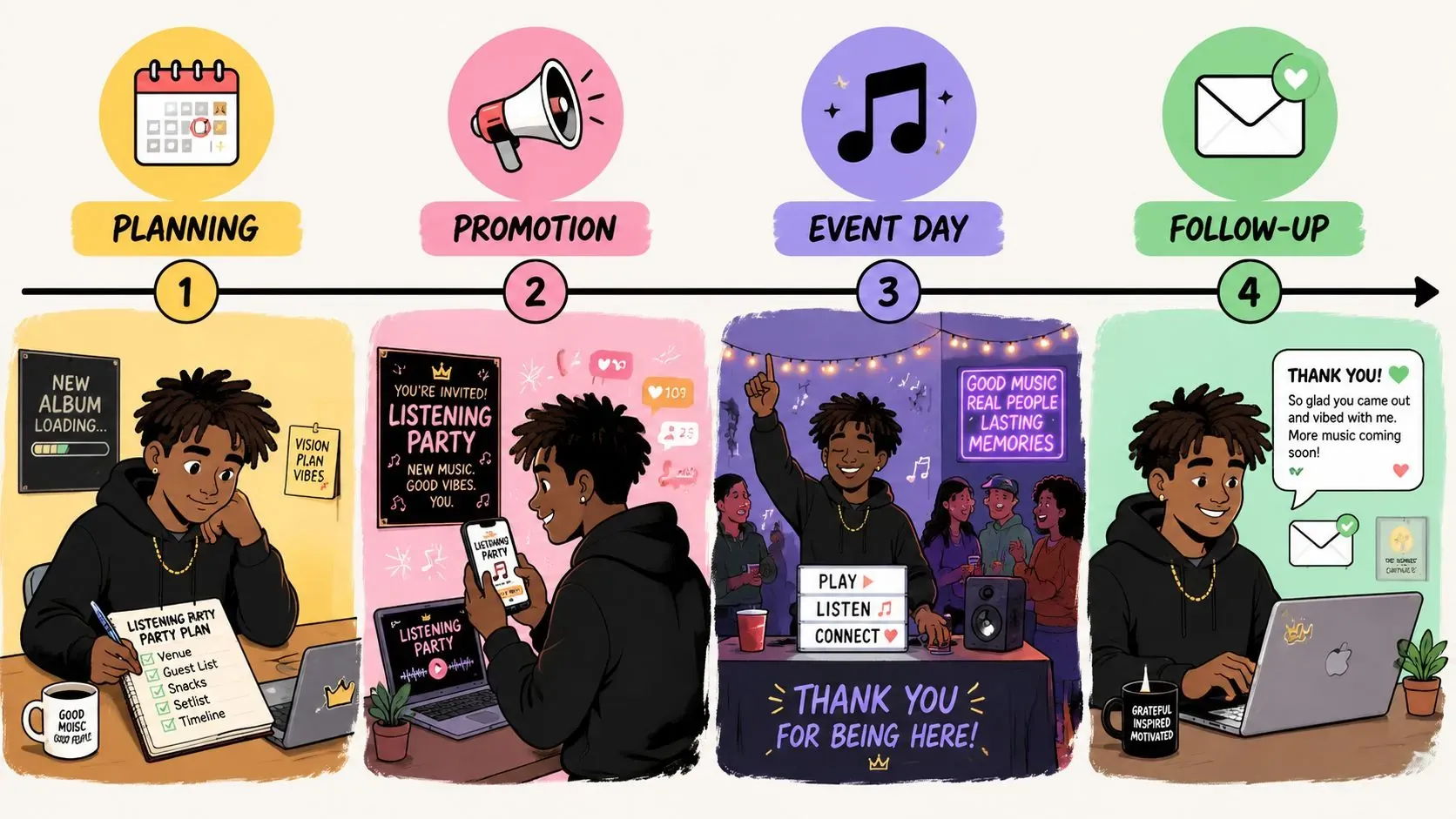
A successful listening party runs on planning, not spontaneity. The event might feel relaxed to fans, but behind the scenes it needs a clear format, a fixed runtime, and a reason for every part of the schedule.
Start with the release objective
First, decide where the event sits in the campaign. A pre-release listening party works when you want early feedback, pre-orders, or fan excitement before launch day. A release-day event works when you want one concentrated moment of attention. A post-release event works better when the album is already out and you want to deepen engagement through commentary, stories, and community discussion.
Then write a simple run of show. Don’t improvise the entire night. Know how you’ll open, when the music starts, where you’ll pause for context, when you’ll take questions, and what happens after the final track.
A clean structure usually includes:
- Welcome and framing: Tell people what they’re about to hear and why this project matters.
- Playback plan: Decide whether the music runs uninterrupted or whether you’ll speak between tracks.
- Audience interaction: Add chat prompts, polls, or selected questions.
- Closing action: End with one direct ask, not five.
Technical quality is part of the marketing
For virtual events, production quality determines whether fans stay present. The recommended window is 45 to 90 minutes, and high-quality audio is a baseline requirement. You also need a backup plan ready before you go live, such as a pre-recorded video file or a second platform, so the event doesn’t die if your primary stream fails.
The operational mistake I see most often is overprogramming. Artists try to cram in full album playback, origin stories for every track, guest appearances, fan Q&A, and merch plugs. The result feels long and uneven. Shorter, cleaner events usually land better.
Promotion matters too, but it needs to be specific. Generic posts saying “join my listening party” underperform compared with messaging that explains what attendees get. Early access, track breakdowns, exclusive questions, or a private first listen are all stronger reasons to RSVP.
A social rollout works better when each post answers one practical question:
- What is happening: Album playback, live chat, track commentary, or private preview.
- Who it’s for: Fans, supporters, collaborators, press, or top listeners.
- Why it matters: Early access, direct interaction, or exclusive context.
- What to do next: RSVP, pre-save, join the room, or watch the countdown.
If your promo needs work, this guide to social media for musicians is a useful reference for turning event announcements into actual attendance.
A quick visual primer can help if you’re building a team workflow or briefing a collaborator:
Engagement should happen between songs, not only after
The best listening parties don’t leave all interaction for the end. They create controlled moments between tracks where the audience can respond. A short explanation about production choices, a co-writer story, or a poll about favorite lyrics keeps the room active without interrupting the project too much.
Passive playback gives you very little to work with after the event. Interactive playback gives you language, reactions, and signal. That signal helps shape your next content assets, your short-form clips, and even your setlist choices if the release has a live component.
Measuring the Success of Your Listening Party with Data
A listening party becomes strategically useful when you treat it as a measurable data event rather than a vibes-only fan moment. That matters because music streaming is massive. Industry figures cited by National Public Media’s analysis of the 2025 Infinite Dial report estimate 616.2 million global music-streaming subscribers, while 79% of the U.S. population listens to digital audio monthly. Your job isn’t to reach all of that audience. It’s to focus a small, relevant slice of it on one release and then measure what happened next.
What to track right after the event
The first check is immediate consumption. Did the featured tracks show a visible lift after the listening party? If the event worked, you should see a post-event movement in streams, saves, or audience activity relative to your normal baseline.
The second check is audience growth. Did monthly listeners or followers move in the days after the event? Even when the event itself is small, it can create a larger ripple if attendees share clips, talk about the release, or drive friends into the project.
Use a simple post-event scoreboard:
- Track-level response: Watch your lead songs first, not only the full project.
- Audience movement: Check monthly listeners and followers after the event window.
- Playlist momentum: Look for new playlist adds after the listening party.
- Content spillover: Review whether social posts tied to the event drove traffic back to the release.
How to judge ROI without guessing
The mistake is judging success based on attendance alone. A packed room that produces no follow-on streaming lift isn’t as valuable as a smaller event that moves listeners into repeat behavior.
Tracking tools matter. A stream tracker helps identify whether songs accelerated after the event. A monthly listeners tracker helps show whether the release moment expanded your audience. Playlist research helps you spot whether momentum turned into fresh placements. If you’re tightening your measurement workflow, this quick guide to seeing your Spotify stats and analyzing music data is a practical starting point.
If you can’t identify what changed after the listening party, you can’t improve the next one.
The long-term value isn’t only proving one event worked. It’s learning which format, guest list, and call to action create the strongest downstream result for your catalog.
Frequently Asked Questions About Listening Parties
Do I need a big fanbase to host one
No. A listening party works with a small audience if the listeners are engaged and the event has a clear purpose. For many independent artists, a smaller room can be better because it creates stronger conversation and better feedback.
How much does it cost
It depends on the format. In-person events usually cost more because of space, playback setup, and logistics. DIY virtual events can be run lean, but they still require proper audio planning, a stable hosting setup, and time to promote.
How far in advance should I promote it
Promote it early enough that people can plan to attend, but don’t let the announcement go stale. The right window depends on your audience and the event type. The practical rule is to start once you have a confirmed format, a locked time, and a clear call to action.
Can I play unreleased music online safely
You can, but you should think through access, recording risk, and platform behavior before doing it. Private or gated environments give you more control than fully open ones. If the music is highly sensitive, keep the guest list tighter and be explicit about event rules.
Should I talk through every song
Usually not. Too much commentary breaks the listening experience. The strongest format is selective context. Speak when the story adds value, then let the music do its job.
What’s the biggest mistake artists make
They confuse attendance with impact. The event should produce a next step, whether that’s pre-orders, post-event streams, stronger fan retention, or better feedback. If nothing is measured and nothing happens after the playback, the listening party was memorable but not strategic.
artist.tools helps artists turn release moments into measurable decisions. If you’re running listening parties and want to track stream movement, monthly listeners, playlist adds, and possible bot-risk signals around your campaign, explore artist.tools to see what changed after the event.