
The 2026 State of Spotify Playlist Fraud
What 19.8 million playlist records reveal about suspicious signals, concentration, and exposure
Artificial streaming is often discussed through dramatic individual cases. Looking across millions of playlists gives a more useful picture. In this study, suspicious signals were uncommon overall and unevenly distributed. The measured rate increased with playlist size across the follower bands that had usable samples. Playlists with suspicious signals were also concentrated among a relatively small share of anonymized owners.
There are limits to what these findings can say. This report analyzes independent artist.tools risk signals and cannot determine whether a playlist, curator, artist, service, or stream committed fraud. Spotify had no role in commissioning, reviewing, or endorsing the report. Its private enforcement data was unavailable to artist.tools.
Executive summary
The study included 7,311,122 accessible, non-editorial playlists with data recent enough to apply the same screening criteria. Of those, 5,391 met the suspicious-signal criteria. That is 0.0737%, or 7.37 per 10,000 playlists analyzed.
The rate increased across the four follower bands with usable sample sizes. It ranged from 0.0294% among playlists with fewer than 1,000 followers to 2.8127% among playlists with 100,000 to 999,999 followers.
In a separate ownership analysis, the top 1% of anonymized owners accounted for 30.0% of playlists with suspicious signals.
A separate catalog analysis found that 169,816 tracks and 47,439 artists had at least one placement on a playlist identified by the broader suspicious-signal analysis. The result measures exposure. Playlist prevalence and participation in manipulation fall outside its scope.
When all 168 possible correction cases were excluded as a conservative test, the primary count fell from 5,391 to 5,223. The rate moved from 7.37 to 7.14 per 10,000 playlists, leaving the central finding largely unchanged.
Among 7.31 million accessible, non-editorial playlists with sufficiently recent artist.tools data, 5,391 met the study's suspicious-signal criteria. That is 7.37 per 10,000 playlists analyzed.
Why playlist fraud needs careful measurement
Spotify defines artificial streaming as activity that does not reflect genuine user listening intent, including attempts to manipulate streaming services with automated processes such as bots or scripts. Spotify also warns that artists can be added to artificially streamed playlists without their knowledge. It advises artists to document abnormal activity and contact their label, distributor, or Spotify. These distinctions appear in Spotify's artificial-streaming resource for artists.
The IFPI anti-stream-manipulation code draws a similar line. Suspicious circumstances can support further review. Legitimate playlist listening and promotion can also produce unusual activity, so an anomaly alone is inconclusive.
One unusual number is inconclusive. A useful analysis asks how often several suspicious signals appear together, whether the rate changes across comparable playlists, whether exposure is spread widely or concentrated, and how much the result changes when possible corrections receive more conservative treatment.
Finding 1: Suspicious signals appeared in 7.37 of every 10,000 playlists analyzed
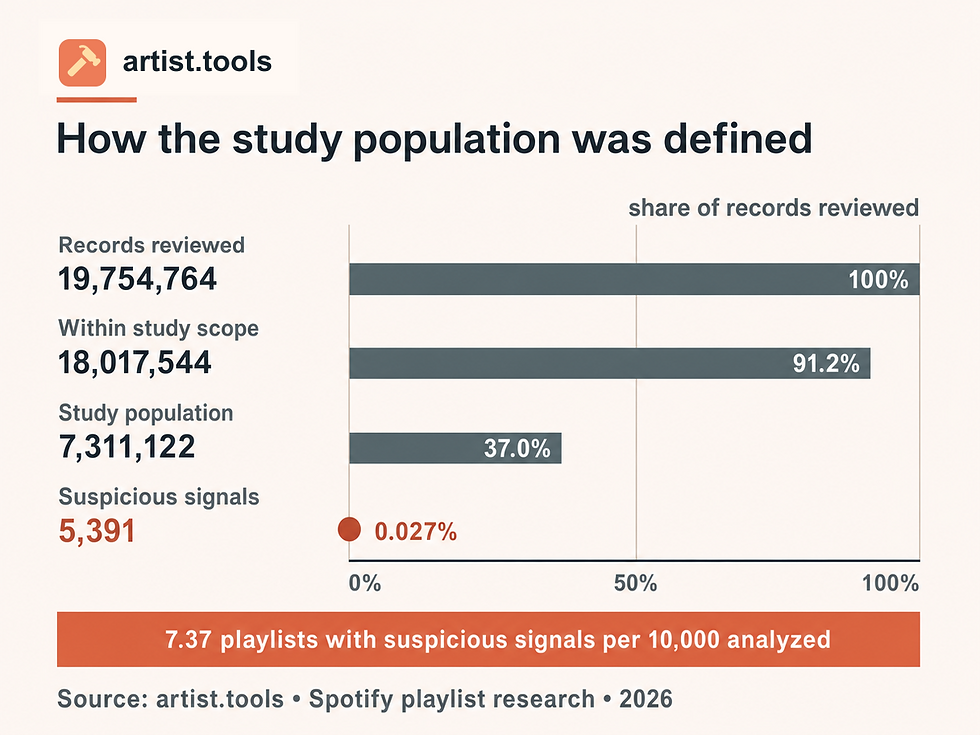
artist.tools reviewed 19,754,764 playlist records in August 2026. After excluding editorial playlists, unavailable playlists, and records that did not meet the report's inclusion rules, 18,017,544 remained. The study then focused on 7,311,122 accessible, non-editorial playlists with data recent enough to apply the screening criteria consistently. This equals 37.0% of the records reviewed. The share of all Spotify playlists is unknown.
Within this population, 5,391 playlists met the artist.tools suspicious-signal criteria. The resulting rate was 0.0737%, or 7.37 per 10,000. It applies to this defined study population. The data cannot estimate Spotify-wide prevalence, confirm artificial streams, or describe Spotify enforcement actions.
The low overall rate masks a sharp difference by playlist size.
Finding 2: The measured rate increased with playlist size
The rate rose across the four follower bands with enough playlists to support comparison:
Playlist followers | With suspicious signals | Playlists analyzed | Suspicious-signal rate |
Under 1,000 | 1,995 | 6,779,494 | 0.0294% |
1,000-9,999 | 2,032 | 454,726 | 0.4469% |
10,000-99,999 | 1,223 | 71,794 | 1.7035% |
100,000-999,999 | 141 | 5,013 | 2.8127% |
Only 95 playlists in the study population had at least one million followers, and none met the suspicious-signal criteria. That sample is too small to support a useful conclusion about the largest band.

The relationship is descriptive. The study used a non-random sample, so it cannot establish that audience size causes suspicious activity. The ownership analysis also found concentration among a smaller group of owners.
In the artist.tools study population, the suspicious-signal rate increased from 0.0294% for playlists below 1,000 followers to 2.8127% for playlists between 100,000 and 999,999 followers.
Finding 3: A small share of owners accounted for many of the playlists
A separate ownership analysis covered 5,402 playlists with suspicious signals and 2,035 anonymized owners. The top 1% of owners accounted for 30.0% of the playlists in that analysis. The largest single owner accounted for 17.5%.
The ownership comparison used slightly different inclusion rules, which explains its higher playlist count. Its results cannot provide another prevalence estimate. They are published as anonymous aggregates and make no claim about coordination between owners.

The top 1% of anonymized playlist owners accounted for 30.0% of the playlists in the ownership analysis.
Ownership concentration and catalog exposure answer different questions. The catalog analysis describes how many tracks and artists encountered these playlists.
Finding 4: A rare playlist-level signal can still reach a broad catalog
The broader catalog analysis found:
169,816 of 7,807,931 tracks in the analysis had appeared on at least one playlist identified by the broader suspicious-signal analysis. That is 2.17%.
47,439 of 309,061 artists in the analysis had at least one such placement. That is 15.35%.
Placements on those playlists represented about 0.0167% of all observed playlist placements in both the track and artist summaries.

This analysis uses a broader definition than the report's primary playlist study. Its purpose is to describe potential exposure. The different definition makes it unsuitable for estimating suspicious-playlist prevalence, and the data contain no evidence of knowing participation by affected tracks or artists.
That reach increases the cost of a false positive, so we tested whether possible one-off corrections could materially change the headline rate.
Finding 5: Possible corrections had little effect on the rate
Among the playlists with suspicious signals, 884 showed a follower increase followed by a decrease within 14 days. Playlist-follower histories allowed a measurable rise-and-fall comparison for 738 of them. In 168 cases, the decrease was between 80% and 120% of the preceding increase.
If all 168 cases are treated as possible one-off corrections, the primary count falls by 3.1%, from 5,391 to 5,223. The rate moves from 7.37 to 7.14 per 10,000 playlists analyzed.
The primary result still includes these 168 cases because a similar-sized reversal leaves the cause uncertain. We used them to test the result's sensitivity and left their classifications unchanged.

Excluding every possible correction case changed the measured rate from 7.37 to 7.14 per 10,000 playlists analyzed.
The companion report, Inside Suspicious Spotify Playlists, looks more closely at why a single spike is weak evidence and how several signals can strengthen or weaken a case for further review.
What artists, labels, and distributors can do with these findings
For artists and managers
Use a risk signal to decide when further investigation is warranted.
Keep records of promotion providers, placement dates, unexpected stream changes, and related communications.
Compare playlist-add timing with your Spotify for Artists data.
Report unexplained activity to your label or distributor and use Spotify's suspicious-playlist reporting route.
For labels and distributors
Separate artist intent from playlist exposure. A legitimate artist can be added to a suspicious playlist without asking for the placement.
Review several signals over time before acting on a third-party risk flag.
Keep an appeal or evidence-review process for ambiguous cases and possible corrections.
When communicating risk, give artists the relevant dates and source context.
For researchers and publications
Include the defined study population whenever quoting the rate.
Use the phrase "playlists meeting artist.tools suspicious-signal criteria." "Spotify-confirmed fraud" would misstate the source and meaning of the result.
Report the primary playlist rate and the broader catalog-exposure rate separately because they use different definitions.
Methodology
Study population
artist.tools reviewed 19,754,764 playlist records available in August 2026. The primary study included 7,311,122 accessible, non-editorial playlists with data recent enough to apply the screening criteria consistently. Editorial playlists, unavailable playlists, and records that did not meet those inclusion rules were excluded.
What "suspicious signals" means
A playlist enters the suspicious-signal group when the independent artist.tools analysis finds multiple indicators consistent with elevated artificial-activity risk. Exact thresholds, weights, and evasion-sensitive logic remain private. The classification is an artist.tools risk assessment. Fraud findings and Spotify determinations fall outside its scope.
Comparison and exposure analyses
The follower-band comparison uses the same study population as the primary result. The owner analysis uses anonymized ownership relationships. The track and artist figures come from a separate, broader exposure analysis and are labeled separately throughout the report.
Conservative correction test
The correction analysis used 614,847 playlist-follower observations across 1,095 playlists. It compared the 884 playlists with a nearby rise and fall against a non-exhaustive reference set of 211 previously reviewed examples. The reference set helped test the rule. Its non-exhaustive design prevents prevalence estimates.
Privacy and independence
All published findings are anonymized aggregates, and the identities of playlists, owners, curators, artists, customers, and promotion providers remain private. Spotify is a trademark of Spotify AB. artist.tools operates independently of Spotify and has no affiliation or endorsement.
Limitations
The study includes only playlists with enough artist.tools data to apply the criteria consistently. Coverage is incomplete and non-random.
artist.tools classifications can be incomplete or wrong and should be considered alongside other evidence.
The analysis uses public and historical signals. Spotify's private streaming, royalty, account, and enforcement data were unavailable.
The data covers one period and does not support conclusions about changes in artificial streaming over time.
Relationships involving follower band, owner concentration, or track profile do not establish causation.
A rise followed by a correction may reflect a bot attack, a platform adjustment, ordinary volatility, or another process. The cause remains unknown.
The track and artist exposure analysis uses a broader definition than the primary playlist estimate.
Check a playlist before taking action
The artist.tools Spotify Playlist Bot Checker can provide risk context before an artist pitches to a playlist, pays for promotion, or responds to an unexpected placement.
Use it as a screening and due-diligence tool alongside campaign records and Spotify for Artists data. Final decisions about fraud, compliance, royalties, or Spotify policy require additional evidence.

GET STARTED
Protect your music career
start for free, upgrade as your career evolves
.png)
artist.tools
A data platform providing comprehensive bot detection, playlist analysis, and curator contact info for artists, labels, and distributors to build & maintain safe & successful careers in the music industry
See why industry leaders like
DistroKid, UnitedMasters, TooLost, ReverbNation, and Ditto recommend artist.tools to their users.
Sister projects:
SubmitLink | PlaylistScaler | SERPclimber
Enterprise Solutions
Trusted Marketing Services
Resources & Free Tools
© 2026 ALW Holdings Inc. All rights reserved.
.png)