Promote your music safely, bot-free, and policy compliant with SubmitLink (10% OFF)
Is Groover Legit?
Yes, Groover is legit. It is a paid music-submission platform that connects artists with playlist curators, blogs, radio stations, labels, and other music professionals.
What Groover guarantees is a response within seven days or your credits back. It does not guarantee a playlist placement, press feature, streams, or a financial return. Whether it is worth paying for depends on your music, your targeting, and the quality of the curators you choose.

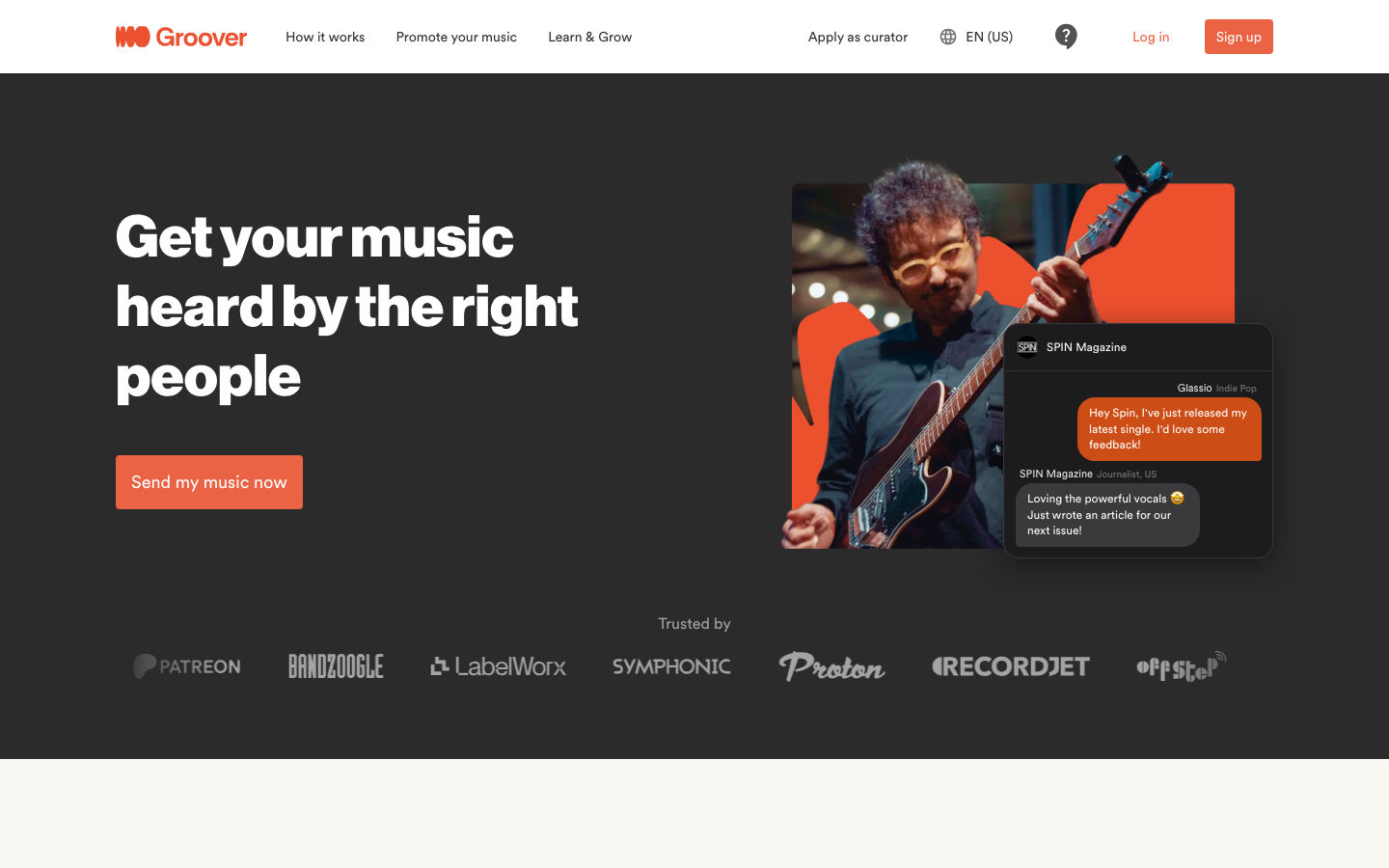
Groover Review 2026: Is Groover Legit and Worth It?
Yes, Groover is a legitimate music-submission platform. Artists pay to have selected curators and music professionals listen to a track and provide feedback. If a contact does not respond within seven days, Groover returns the credits used for that submission.
That guarantee is narrower than it can sound. You are paying for consideration and a response, not for a playlist placement, press article, radio spin, label deal, streams, or revenue. Groover can create useful opportunities, but results vary sharply by song, genre, targeting, budget, and curator quality.
Our verdict: Groover is worth considering if you have a strong release, clear promotion goals, and enough time to research the people receiving your pitch. It is a poor fit if you expect guaranteed exposure or treat playlist follower counts as guaranteed listeners.
What is Groover?
Groover is a marketplace connecting artists with more than 3,000 playlist curators, blogs, radio stations, labels, managers, mentors, and other music professionals. Artists choose who receives a track, write a pitch, and pay using credits called Grooviz.
Groover divides its contacts into three broad groups:
Visibility curators, including playlist curators, media outlets, radio stations, and video channels.
Industry partners, including labels, managers, bookers, publishers, and sync professionals.
Advice professionals, including mentors, coaches, managers, and sound experts.
That breadth is one of Groover’s strengths. It can support more than Spotify playlist pitching, but artists should choose contacts according to the result they actually want. A mentor offering production feedback is not the same product as a curator offering playlist consideration.
How Groover works
Add a track or demo and describe the release.
Choose curators and professionals whose genres, locations, and opportunities match your goals.
Write a general pitch and, where useful, personalize it for individual contacts.
Pay for the selected submissions using Grooviz.
Wait up to seven days for each response.
Receive feedback, possible opportunities, or a credit refund when a contact does not respond in time.
The platform’s promise is straightforward: the contact must respond, or you get the submission credits back. A response can still be a rejection, and a positive response does not automatically mean a meaningful placement.
How much does Groover cost?
Groover currently lists one Grooviz at €1. A standard curator or professional generally costs two Grooviz to contact, while some top-tier contacts cost four to six Grooviz. Groover advertises discounted credit packs and says artists who see the most success often contact at least 50 curators.
At the standard rate, 50 contacts is roughly 100 Grooviz before any pack discount. That is a meaningful campaign budget, especially because Groover guarantees feedback rather than placements.
When a contact does not respond within seven days, the credits for that contact return to your wallet. When a contact responds but rejects the track, the submission is complete and the credits are spent.
What independent campaign tests found
Independent campaign results show why Groover should be judged as a pitching tool rather than a guaranteed streaming service.
In Two Story Melody’s Groover review, Jon Anderson reported sending a song to roughly 40 curators and receiving 39 responses. The campaign produced 14 playlist additions and three blog posts for an estimated cost of about $75. He considered the overall coverage strong for the time and money spent, but noted that most playlists were small, some were too crowded to drive significant streams, and much of the rejection feedback was generic or contradictory.
That review included an important disclosure: Groover supplied 100 Grooviz for the test, and the article uses a discount/affiliate code. The campaign figures remain useful, but they should be read with that relationship in mind.
A newer €100 campaign test by We Rave You sent a track to 32 curators. It reported nine completed playlist additions, another four promised additions, and five nonresponses whose credits were refunded. The reviewers found the workflow easy and the targeting filters useful, while describing much of the feedback as general rather than deeply technical.
These are successful examples, not guaranteed benchmarks. Other artists receive only feedback and no placements. The music, targeting, curator pool, and campaign timing can produce very different outcomes.
What artist.tools data shows about Groover-linked playlists
artist.tools can identify Spotify playlists in its search index that publish a Groover submission link. In a September 1, 2026 snapshot, we found 42,736 Groover-linked playlists.
The size distribution is heavily weighted toward smaller playlists:
2,761 playlists (6.5%) had at least 10,000 followers.
606 playlists (1.4%) had at least 50,000 followers.
273 playlists (0.6%) had at least 100,000 followers.
That supports a point raised in Jon Anderson’s Two Story Melody test: Groover can produce real placements, but many available playlists are small. A large curator network creates choice; it does not mean every placement offers large reach.
Activity also varies. 9,287 Groover-linked playlists (21.7%) had added a track within the previous 30 days, and 14,249 (33.3%) had added one within the previous 90 days. A recent addition does not prove a playlist has active listeners, but an old last-added date is a useful reason to investigate before spending money on a submission.
The risk data does not show systemic fraud across this cohort. Of the 42,736 playlists, 42,676 appeared when artist.tools’ “exclude high-risk” filter was applied. Sixty fell outside that conservative view, including 44 that matched the stricter “botted only” filter.
Those figures need two qualifications. First, a neutral or unknown risk score is not the same as a playlist being independently verified safe. Second, this is an artist.tools index snapshot of playlists with a stored Groover contact—not Groover’s official curator count, an audit of every Groover profile, or a measurement of campaign acceptance rates.
The practical conclusion is balanced: Groover is legitimate, but its playlist inventory is a long tail. Research the individual curator, confirm the playlist is active and relevant, and assess audience quality instead of choosing recipients by follower count alone.
Use artist.tools Playlist Search to reproduce this research with the Groover contact filter and narrow the list by genre, follower size, recent additions, and quality signals.
What artists say about Groover
As of September 1, 2026, Groover’s Trustpilot profile shows a 4.2 out of 5 TrustScore from 1,566 reviews. The distribution is strongly positive but not unanimous: 81% are five-star reviews and 11% are one-star reviews.
Positive reviewers commonly mention the simple interface, access to music professionals, useful feedback, and occasional placements. Critical reviewers commonly describe generic feedback, positive comments that do not lead to promotion, small or temporary playlists, and campaigns that produce little measurable return.
Trustpilot reviews are individual anecdotes rather than controlled campaign data. The useful takeaway is not that every artist will love or hate Groover; it is that the same legitimate platform can deliver very different value depending on targeting and expectations.
Is Groover legit?
Yes. Groover clearly explains that artists pay for feedback and consideration, identifies how its credit system works, and refunds credits when a selected contact does not respond within the deadline. Curators are paid for reviewing the submission, not for promising a placement.
Groover also says it screens applicants based on their influence, content quality, supported artists, and editorial focus. That is a legitimate marketplace model and materially different from a service selling guaranteed streams or undisclosed bot traffic.
However, Groover being legitimate does not make every curator, playlist, or opportunity equally valuable. Playlist size can be misleading, streams can be minimal, feedback can be shallow, and a poorly matched campaign can spend a substantial budget without earning a placement.
Groover’s main advantages
Guaranteed response or credit refund: You should not permanently lose credits to a contact who ignores the submission.
You choose the recipients: Artists can research and select contacts instead of buying an opaque campaign.
More than playlist pitching: Blogs, radio, labels, managers, mentors, and other professionals are available.
Lower barrier than traditional PR: A small campaign can cost much less than hiring a publicist.
Possible compounding value: A strong contact can lead to coverage, a playlist placement, a professional introduction, or a relationship for later releases.
Groover’s main drawbacks
The cost adds up quickly: A campaign targeting 50 standard contacts is approximately 100 Grooviz before discounts.
A response is not a result: Rejections and generic feedback still count as completed submissions.
Playlist impact varies: A placement on a large but inactive or poorly matched playlist may create little meaningful engagement.
Targeting takes work: Sending broadly to loosely related curators is an efficient way to spend money without useful outcomes.
Financial return is unlikely to be immediate: Even a successful campaign may not earn back its cost through streaming royalties.
Is Groover right for you?
Groover is most useful for artists who:
Have a polished track with a clearly defined genre and audience.
Want playlist consideration, press, radio, professional feedback, or industry introductions.
Are willing to research every recipient rather than accept recommendations blindly.
Understand that promotion is cumulative and that one campaign is unlikely to transform a career.
Can measure success using placements, qualified listeners, saves, follows, press, and relationships—not follower reach alone.
Groover is less suitable for artists who:
Need guaranteed streams, placements, or revenue.
Have an extremely limited budget and cannot tolerate a campaign made up mostly of rejections.
Want detailed production advice but submit primarily to playlist curators.
Do not have time to verify the playlists and outlets attached to each contact.
Groover vs. SubmitHub
Groover and SubmitHub both use a pay-per-submission model in which artists compensate curators for listening and responding rather than for accepting a track. Groover emphasizes a streamlined workflow and a broad network of music professionals. SubmitHub is often preferred by artists who want more granular filtering and campaign data.
Neither platform removes the need for research. The better option is the one with more genuinely relevant contacts for your genre, location, and campaign objective. If both platforms contain the same playlist, evaluate the playlist itself rather than assuming one marketplace automatically makes it valuable.
How to use Groover without wasting money
Choose the goal before the curators. Decide whether the campaign is for playlists, press, radio, advice, or professional introductions.
Describe the song precisely. Two or three accurate subgenres are more useful than a broad genre label.
Inspect every contact. Review recent coverage, playlist activity, audience location, acceptance behavior, and the contact’s stated preferences.
Run a focused pilot. A smaller first campaign can reveal whether your track and targeting are working before you commit to Groover’s suggested 50-contact scale.
Measure downstream outcomes. Track streams, saves, listener locations, algorithmic activity, press quality, and useful relationships—not just the number of approvals.
Keep a shortlist. Save contacts who respond thoughtfully or deliver real value for future releases.
Use artist.tools Playlist Search to research playlists and find Groover contact information alongside quality and growth signals. For any playlist you are considering, open its data before submitting rather than relying only on the marketplace profile.
Vet every playlist placement
Groover’s business is legitimate, but playlist due diligence still matters. This is true for placements found through Groover, SubmitHub, direct outreach, an agency, or any other source.
Before celebrating a placement, use the artist.tools Playlist Analyzer to review growth history, estimated listeners, recent changes, and risk signals. Learn what suspicious patterns look like in the artist.tools artificial-streaming guide.
This is not an allegation against Groover. It is normal quality control for any third-party playlist placement. A legitimate marketplace can still contain playlists that are too small, too broad, inactive, or simply wrong for your audience.
Final verdict
Groover is legit, and it can be worth using. Its strongest value is direct, trackable access to curators and music professionals with a guaranteed response deadline. Independent tests show that well-targeted campaigns can earn multiple playlist placements and press mentions, while artist.tools’ snapshot of 42,736 Groover-linked playlists does not suggest systemic fraud across the cohort.
The limitation is equally clear: Groover guarantees attention, not promotion. The indexed playlist pool is a long tail, feedback quality varies, placements may have limited impact, and campaign costs can climb quickly. Artists should treat it as one part of a broader release strategy, target carefully, and verify every playlist opportunity before judging the campaign a success.
GET STARTED
Protect your music career
start for free, upgrade as your career evolves
.png)
artist.tools
A data platform providing comprehensive bot detection, playlist analysis, and curator contact info for artists, labels, and distributors to build & maintain safe & successful careers in the music industry
See why industry leaders like
DistroKid, UnitedMasters, TooLost, ReverbNation, and Ditto recommend artist.tools to their users.
Sister projects:
SubmitLink | PlaylistScaler | SERPclimber
Enterprise Solutions
Trusted Marketing Services
Resources & Free Tools
© 2026 ALW Holdings Inc. All rights reserved.
↑ RUN UNLIMITED FREE BOT CHECKS
Spotify Bot Checker
Paste your Spotify Artist URL for a bot analysis
.png)