
How Record Companies Find Artists: A Data-Driven Guide
Discover which record companies looking for artists are actively signing. This guide shows how to prove your value with data and get a record deal in 2026.
The era of sending unsolicited demos is over. Record companies looking for artists now operate like venture capitalists, using hard data to scout talent with a proven market and a clear trajectory for growth. An artist’s value is no longer on a demo tape; it is measured in consistent streaming growth, audience engagement, and the undeniable demand they build for themselves.
What Record Labels Look for in 2026
Getting signed is no longer about creative potential alone—it is about proving you are a sound financial investment. A&R scouts do not ask, “Is this music good?” They ask, “Is this artist a good investment?” They are hunting for artists who operate like a music-focused startup, tracking key performance indicators (KPIs) and building an undeniable business case long before a label ever hears their name.
This model is backed by significant capital. A 2024 ORCA report revealed that nine top independent labels—including Ninja Tune, XL Recordings, and Secretly Group—invested an average of $236,197 per artist in 2023. This figure represents 33.5% of their total revenue and generated an average return of $1.77 for every dollar spent. The full report detailing this investment strategy is available on Music Business Worldwide.
The New Metrics of a Signable Artist
Labels now focus on data points that prove an artist can build and retain an audience, which de-risks their financial commitment. They are scrutinizing metrics that demonstrate growth, engagement, and real market validation.
Here is what A&R professionals analyze:
- Consistent Monthly Listener Growth: A steady, upward trend is more valuable than a one-off viral spike, as it signals a predictable growth pattern. The artist.tools Monthly Listeners Tracker is a resource artists use to monitor this KPI.
- High Follower-to-Listener Ratio: A high number of followers compared to monthly listeners indicates strong audience loyalty, showing people are actively choosing to follow an artist’s career, not just passively discovering their music.
- Audience Demographics and Location: Labels require data showing a concentrated listener base in key music markets such as Los Angeles, New York, or London to confirm commercial viability.
- Third-Party Playlist Placements: Securing spots on influential, independently curated playlists demonstrates organic appeal and serves as a stamp of approval from outside the major label ecosystem.
The evaluation process for artists has fundamentally shifted from subjective taste to objective data analysis.
A&R Then vs. Now: Key Metric Shifts
| Metric | Traditional A&R (Pre-2015) | Modern Data-Driven A&R (2026) |
|---|---|---|
| Primary Evaluation Tool | Physical demo tapes, “the ear test” | Streaming data dashboards (Spotify for Artists, artist.tools) |
| Audience Proof | Local ticket sales, word-of-mouth buzz | Monthly listener growth, follower-to-listener ratio |
| Market Validation | College radio play, local press mentions | Independent playlist adds, TikTok usage trends |
| Geographic Focus | Strong local following in one city | Listener concentration in key global music markets |
| Growth Signal | “It feels like it’s about to pop.” | 30%+ month-over-month streaming growth |
| Engagement Metric | Fan club sign-ups, merch sales at shows | Social media engagement rates, user-generated content |
An artist’s public data profile across Spotify, Apple Music, and social media is the new demo. A&R professionals dedicate their time to analyzing streaming data, playlist adds, and audience growth charts—not opening unsolicited email attachments.
Shifting from Art to Asset
The economics of the modern music business are driven by digital consumption. Streaming accounts for 59.5% of independent labels’ revenues, while physical sales comprise just 25.9% (IFPI Global Music Report, 2024). This digital-first model means an artist’s online presence and streaming performance are their most valuable assets. Artists signed to the nine indie labels in the ORCA report saw an average 44% increase in Spotify followers between 2023 and 2025, validating the data-driven signing model.
These labels also excel at synchronization, earning 7.4% of their revenue from sync rights, compared to the major label average of 2.2%. This indicates they are actively seeking music with commercial potential for placements in films, TV shows, and advertisements. To get ahead, artists must understand how labels operate and their revenue streams; you can learn more about the modern record label structure. By tracking the right KPIs and building a clear narrative around growth, an artist transforms from a creative asking for a chance into a bankable business ready for partnership.
Finding Labels Actively Seeking Your Sound
Targeted outreach is more effective than mass, generic submissions. The key is to identify companies already invested in an artist’s specific sound and brand. A label’s primary consideration is the proof of market demand an artist has already built.
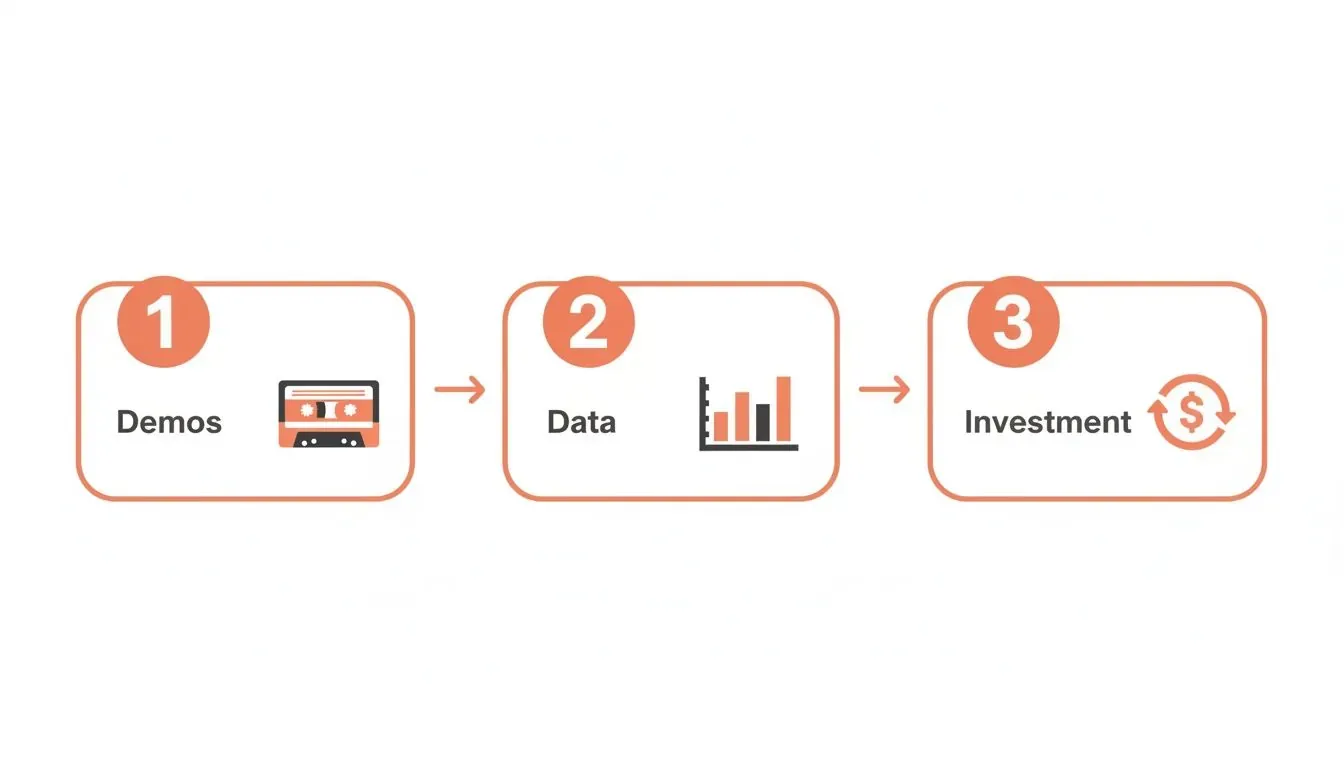
The modern A&R pipeline begins with an artist generating their own data, which then attracts a label’s attention and leads to investment. This requires artists to build their case independently first.
Analyze Rosters and Recent Signings
A label’s roster provides a map to its A&R strategy. The first step is to identify five to ten artists who are a direct sonic match and determine which labels represent them. These labels are your primary targets. A&R priorities are dynamic, so examining signings from the last 12-24 months reveals what a label is looking for now. A label known for folk music in 2019 might be exclusively signing hyperpop artists in 2024.
A label’s past successes are history; their recent signings are their current strategy. Focus your energy on labels that are actively investing in your sound right now. A platform like artist.tools allows artists to analyze the growth history of recently signed acts, revealing the specific traction benchmarks—like monthly listener counts and follower spikes—that a label considers “signable.”
Decode a Label’s Curated Playlists
A label’s curated playlists on Spotify are public declarations of its taste and commercial objectives. Indie powerhouses like Domino Recording Co. and Mom + Pop Music use these playlists to signal their A&R focus.
When analyzing these playlists, look for key patterns:
- Genre Focus: A tightly focused playlist signals a specific A&R mission, whereas a diverse one may indicate a broader strategy.
- Unsigned Artists: The inclusion of unsigned or independent artists alongside major acts is a clear indicator that the label uses its playlists for scouting and testing new talent.
- The Vibe: The overall mood—whether high-energy and cinematic or introspective and chill—helps an artist frame their pitch to align with the label’s demonstrated needs.
An artist making cinematic hip-hop like Vo Williams, who has landed over 3,000 sync placements, should target labels whose playlists feature epic, cinematic tracks. According to sync expert Ari Herstand, a single placement in a commercial campaign can generate anywhere from $20,000 to over $550,000. Labels with strong sync departments are always searching for this type of sound.
Identify the Key Players
After confirming a label is a strategic match, the next step is to find the correct A&R contact. Sending music to a generic “[email protected]” address is ineffective. Researching a label’s roster on data platforms helps connect artists to the teams behind them. This intelligence-first approach builds a hyper-targeted list of labels with a proven record of signing similar artists, dramatically increasing the chances of the music reaching the right inbox.
Building Your Case With Unignorable Data
Modern A&R scouts analyze dashboards, not just listen to demos. Before a label initiates a conversation, it requires a compelling business case built on analytics. Record companies looking for artists seek proof of commercial viability, and artists must speak their language: data.
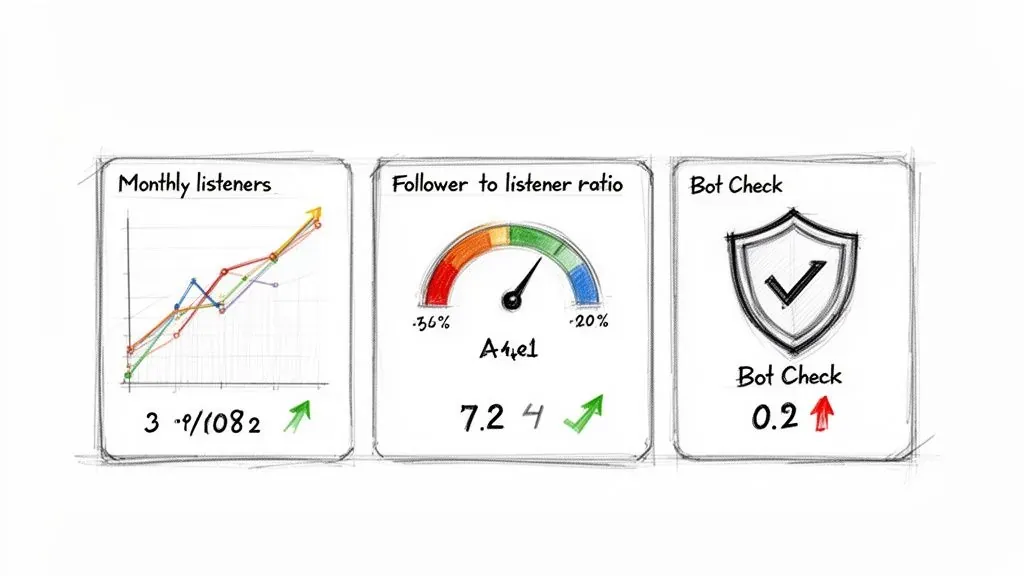
The KPIs That Secure Meetings
Labels search for signals that reduce their investment risk. They need to see a clear narrative of growth driven by real audience development and genuine market traction.
These are the core metrics that secure meetings:
- Consistent Spotify Monthly Listener Growth: A steady upward trend is more valuable than a single viral moment, proving an artist can consistently attract new listeners.
- High Follower-to-Listener Ratio: This metric is a direct indicator of audience loyalty, showing that listeners are actively converting into committed followers.
- Strategic Playlist Placements: Landing on influential third-party playlists demonstrates organic appeal and provides industry validation outside the major label system.
You’re not just building an album; you’re building an asset. A strong data profile shows a label you’ve already found your market. It turns their potential investment from a blind gamble into a calculated bet.
Data Integrity Is Non-Negotiable
Faking streaming numbers is the fastest way to be blacklisted by the industry. With global streaming revenue hitting $17.5 billion in 2023—a 10.2% increase from the previous year (IFPI Global Music Report, 2024)—labels have zero tolerance for fraudulent data and will verify all numbers. Data hygiene is critical. Artists must be able to stand behind every stream and listener. Tools like the artist.tools Bot Detection feature are essential for monitoring for artificial streaming activity and ensuring metrics are legitimate for A&R scrutiny.
The industry’s top performers demonstrate the value labels chase. Taylor Swift’s 29.10 billion streams on Spotify in 2023 exemplify long-term value and cultural relevance. A full breakdown of 2023’s top streaming artists on Chartmasters.org shows the scale of success possible.
Demonstrating Long-Term Value
A signable artist demonstrates the potential for a sustainable career, not just a one-hit-wonder. Sustained engagement and a smart release schedule are the foundations of that long-term value. Labels partner with artists who understand how to maintain momentum. This requires a strategic release schedule—a consistent flow of singles, EPs, and content—instead of dropping an album and disappearing for two years. Artists should track the performance of every release, analyze what resonates, and use that data to inform their next move. To learn more, check out our guide on mastering music data analytics for artists.
An artist’s data tells a story. It must be a compelling one about a talented and savvy operator building a career with real, durable value. That is the artist record companies are looking for.
Crafting an Industry-Standard Digital Press Kit
An Electronic Press Kit (EPK) is a professional resume for the music industry, and A&R departments now prioritize data over vibes. A modern EPK must be a living document that proves momentum through verifiable metrics. A static, outdated PDF is the fastest way to have a submission deleted.
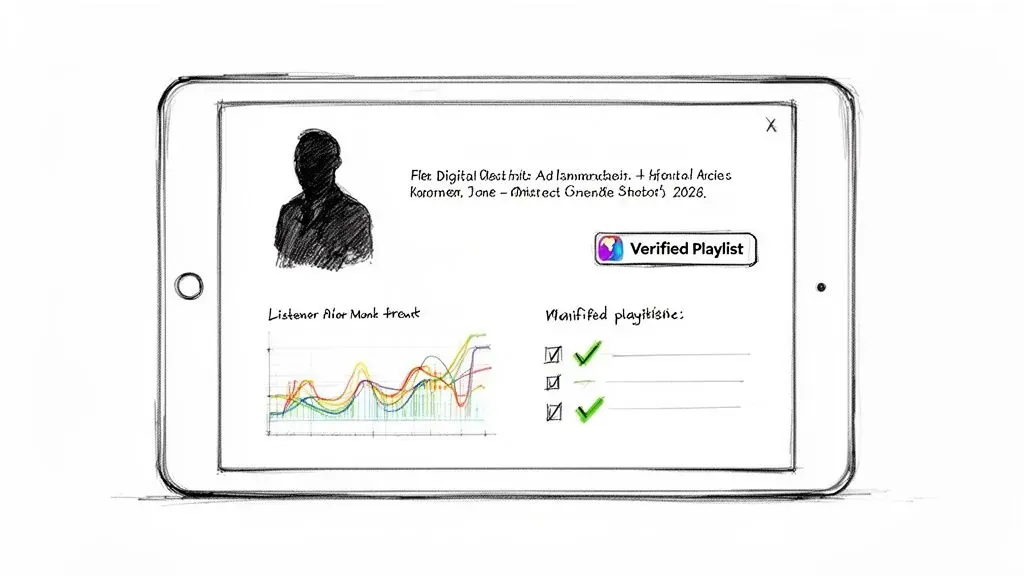
Core Components of a Data-First EPK
A successful EPK tells a clear story of growth, framed by data points that prove an artist is a smart investment. Each section should be concise and backed by verifiable proof, answering a label’s questions before they are asked.
These are the mandatory components for a modern EPK:
- Verifiable Streaming Metrics: Include screenshots or embedded widgets from your Spotify for Artists or artist.tools dashboard. Highlight your monthly listener trend, follower growth, and the listener-to-follower ratio to demonstrate a loyal, engaged audience.
- Audience Demographics: A screenshot of your top cities and countries from Spotify for Artists provides instant proof of traction in key markets.
- Legitimate Playlist Placements: List your top 5-10 third-party playlist adds, including the playlist name, follower count, and a direct link. Verifying these playlists are bot-free using a tool like the artist.tools Playlist Analyzer adds a layer of trust that most artists lack.
- Key Career Milestones: List 3-5 major achievements from the last 12 months, such as selling out a notable venue, securing a sync placement, or earning a mention from a respected publication.
This data-focused approach transforms an EPK from a creative portfolio into a business proposal, which is exactly what record companies looking for artists want to see.
Structuring Your EPK Narrative Around Growth
The story your EPK tells must be one of constant upward movement. An A&R scout needs to see a clear trajectory that makes investing in you feel like the next logical step. Instead of just stating your monthly listener number, show its growth over the past six months. Instead of just listing a press feature, pull the best quote and link to the article. Every element must build upon the last, painting a picture of an artist on the verge of a breakthrough.
An EPK isn’t just a history of what you’ve done; it’s an argument for what you’re about to do. Use your data to prove your growth is picking up speed and a label partnership would pour gas on an already burning fire. To help you build an EPK that gets noticed, check out our guide on a standout musician electronic press kit for a complete template and breakdown.
Refining Your Pitch with AI
An EPK’s core is the pitch—the unique story that makes an artist valuable. Specialized tools can provide a significant advantage in crafting this narrative. The artist.tools AI Editorial Pitch Generator, for instance, is trained on successful pitches submitted to Spotify’s editorial team. By inputting track information, marketing angles, and similar artists, it helps sharpen the story to align with industry expectations: a clear brand, a defined audience, and a forward-thinking plan. This polished narrative becomes the foundation for your EPK, email outreach, and every label conversation.
Executing Outreach That Cuts Through the Noise

Over 100,000 new songs are uploaded to streaming platforms daily (Luminate, 2023), so good music alone is not enough to secure a record deal. An artist’s outreach must be as strategic as their EPK. The goal is not just to be heard, but to start a professional conversation that leads to a partnership. Blasting generic emails to “submissions@” inboxes is a ticket to the trash folder. A data-backed, personalized pitch that frames the artist as a smart investment is required.
Finding the Right A&R to Talk To
First, identify the specific person whose job is to sign artists in your genre. Generic label websites are a dead end. Professional networks like LinkedIn are primary resources for this research. Search for titles like “A&R,” “Scout,” or “Artist & Repertoire” at your target labels and analyze their recent activity and connections to understand their focus. Industry publications like Chartmetric or Music Business Worldwide are also valuable for tracking personnel changes and A&R activity. A handful of well-researched, personalized emails to five of the right people will always outperform a generic blast to 500 of the wrong ones.
How to Craft a Data-First Pitch
Your email must immediately capture the A&R’s attention. Leading with your best data point changes the dynamic from “please listen to my song” to “here is a growth opportunity you should know about.” Your subject line must be direct and professional, such as: “Artist Submission: [Your Artist Name] - 75% Monthly Listener Growth Q2”.
Keep the email concise, scannable, and value-packed. A proven structure is:
- The Hook: Start with your key growth statistic. “My project, [Artist Name], saw a 75% jump in Spotify monthly listeners over the last three months, driven by organic playlisting and strong fan engagement.”
- The Proof: Provide all necessary information in one click. “You can see the full breakdown of our analytics, recent press, and verified playlist spots in our EPK: [Link to EPK].”
- The Sound: Help them place you by briefly comparing your sound to 2-3 known artists, preferably including one from their own roster. “Our sound is for fans of [Artist A], [Artist B], and your own [Label’s Artist].”
- The Ask: Be clear about your objective. “We’re looking for a label partner to help us scale and are impressed with what you’ve done with [Label’s Artist]. Are you the right person to discuss this with?”
The main challenge A&Rs face is finding new talent in an ocean of new music. A 2023 industry report found that only 19.16% of artists on Spotify ever break one thousand monthly listeners. With the equivalent of 42 years’ worth of music uploaded in 2023 alone, it’s no wonder they rely on data to filter through the noise. This is why a data-driven pitch is effective. You can dive deeper into these industry trends in Chartmetric’s 2023 Year in Music report.
Use Media Coverage for a Warm Intro
A cold email is one thing, but a warm introduction is on another level. Finding a shared connection through media coverage is a powerful way to achieve this. The artist.tools Press Coverage feature allows artists to search for an artist on a target label’s roster and see a list of publications that have covered them. By pitching those same journalists and securing a feature, an artist creates a warm introduction. Mentioning that coverage in an email to the label provides instant third-party validation and proves the artist is already moving in the same circles, making the pitch far more credible.
Answering Your Biggest Questions About Getting Signed
Getting straight answers, backed by real data, is the only way to navigate the industry and find the right record companies looking for artists. Let’s tackle the most common questions from artists.
How Many Monthly Listeners Do I Actually Need?
There is no “magic number.” Labels are far more interested in your growth trajectory than a static listener count. Data from 2023 showed that only 19.16% of all artists on Spotify even surpassed 1,000 monthly listeners (Chartmetric, 2023). An artist who grows from 1,000 to 10,000 listeners in six months is infinitely more compelling than an artist who has been stagnant at 20,000 for a year. One demonstrates momentum; the other, stagnation.
The mission is to show an upward trend and a highly engaged audience. You can use the artist.tools Monthly Listeners Tracker to monitor your growth and benchmark it against artists recently signed by your target labels. This provides the hard proof of a growing, active audience—your most valuable asset.
Do Labels Even Listen to Unsolicited Demos Anymore?
In short, no. Sending an unsolicited MP3 to a major or established indie label is an outdated practice. Your “demo” today is your public profile across Spotify, Apple Music, and social media channels. With the equivalent of 42 years’ worth of new music uploaded in 2023 alone (Chartmetric, 2023), A&R reps do not have the bandwidth to review unsolicited emails. They spend their time analyzing streaming data, playlist adds, and audience growth charts to find talent. Your energy is better spent building your digital footprint and preparing a data-rich EPK for when you make a professional connection.
What’s More Important: Social Followers or Spotify Streams?
Both are critically important. They tell two different but equally crucial parts of your story. Spotify streams prove there is a market for your music. Social media engagement (likes, comments, shares) proves you can build and activate a community around your brand. A&R scouts look for a healthy balance. High streams with a dead social media presence may indicate passive playlist traffic without a core fanbase. Conversely, a huge social following with low streams suggests the artist’s brand is stronger than their music.
A signable artist has strong numbers in both areas. This proves they not only have a great product (the music) but also a dedicated community ready to support it, which seriously de-risks a label’s investment.
How Can I Tell if a Record Label Is Legit?
Due diligence on any potential label partner is non-negotiable. The biggest red flag is any request for money. Legitimate record companies never ask artists to pay for distribution, marketing, or other services upfront. A real label invests its own money in your career, banking on a shared return. Use a platform like artist.tools to research a label’s roster. The data will reveal if their signed artists show healthy growth or suspicious bot activity, and whether the label has a proven history of growing careers.
Other signs of a professional operation include:
- Professional Presence: A polished website, active social media, and a clear brand.
- Verifiable Releases: A consistent catalog of releases on Spotify and Apple Music.
- Industry Affiliations: Memberships with respected organizations like Merlin (for indies), A2IM (American Association of Independent Music), or AIM (Association of Independent Music).
A real record company leaves a public footprint. If you cannot find a verifiable track record of releasing music and developing artists, proceed with extreme caution.
Ready to stop guessing and start building a data-backed case for your music career? artist.tools gives you the analytics, playlisting intelligence, and A&R research tools you need to get noticed. Start your free trial today and turn your streaming data into your next record deal.