
Playlist Radio on Spotify: A Guide for Artists
Understand how Playlist Radio on Spotify works. Learn the algorithmic signals and strategies artists can use to get featured and drive streams.
Spotify Playlist Radio is an algorithmically generated, personalized stream of about 50 tracks built from a seed such as a song, artist, album, or playlist, then shaped by a listener’s likes, skips, saves, and listening history. For artists, that matters because Spotify’s radio system isn’t a static placement. It’s a moving recommendation environment you can influence by generating the right engagement signals.
Most artists spend too much time thinking about editorial playlists and not enough time thinking about what happens after a listener hears the song. Playlist Radio on Spotify sits much closer to that moment of decision. A user starts with a seed they already like, and Spotify tries to extend the session with tracks that fit. If your song belongs in that context, Radio can introduce you to listeners who weren’t searching for you but were ready to hear music like yours.
That’s why Playlist Radio deserves a serious place in release strategy. It is one of Spotify’s most practical discovery surfaces for independent artists because it rewards fit, retention, and conversion instead of pitch emails or curator access. When artists understand the mechanics behind it, Radio stops looking like a black box and starts looking like a system with clear inputs and clear trade-offs.
Introduction Why Playlist Radio Matters for Artist Growth
Playlist Radio matters because it turns a single successful listen into a chance for repeated algorithmic exposure. Spotify Radio playlists are algorithmically generated streams containing approximately 50 tracks each, designed to personalize music discovery based on user behaviors such as likes, skips, saves, and listening history, according to Musosoup’s breakdown of Spotify Radio playlists.
Editorial playlists still matter, but they work differently. An editorial add is a placement on a fixed list curated by humans. Playlist Radio on Spotify is dynamic. The system rebuilds recommendations around a seed and a user context, which means your song can appear because it fits the listening moment, not because a curator selected it once.
That distinction changes how artists should market music. Chasing visibility alone often produces weak listeners. Radio responds better when the first wave of listeners behaves like real fans. Saves, low early skips, and strong session fit create better downstream opportunities than broad but careless traffic.
Independent artists often miss this because Radio isn’t packaged like a campaign milestone. You won’t get the same social proof as an editorial add. What you get is more valuable in many cases: contextual discovery from listeners who already signaled interest in similar music.
Why Radio is a growth engine, not a feature
Radio sits inside Spotify’s recommendation layer, which means it can scale with behavior. A song that performs well in the right contexts can keep surfacing to adjacent listeners without needing constant manual playlist outreach. That makes Playlist Radio on Spotify especially useful for artists building from niche scenes, genre clusters, or mood-based listener habits.
The trade-off is that Radio is less controllable than direct playlist pitching. You can’t force inclusion. You can only create the conditions that make inclusion more likely. That’s still good news, because those conditions are practical: stronger release planning, better audience targeting, and cleaner engagement signals.
What artists should optimize for
Artists who benefit most from Radio usually treat the release window as data collection. The goal isn’t just streams. The goal is evidence that listeners want more.
A simple way to think about it:
- Seed the right audience: Put the song in front of people who already like adjacent sounds, not random traffic.
- Protect the first listen: The opening of the track has to hold attention long enough to avoid a damaging early skip.
- Make the save feel natural: Ask fans to save the song if they connect with it, because intent matters more than empty reach.
What Is Spotify Playlist Radio
Playlist Radio is Spotify’s context-driven recommendation mode. It starts from a seed such as a song, artist, album, or playlist, then builds a listening session around what fits that choice and the listener’s behavior. For artists, that distinction matters because Radio is not a static placement. It is a system that keeps testing whether a track belongs in that listening path.
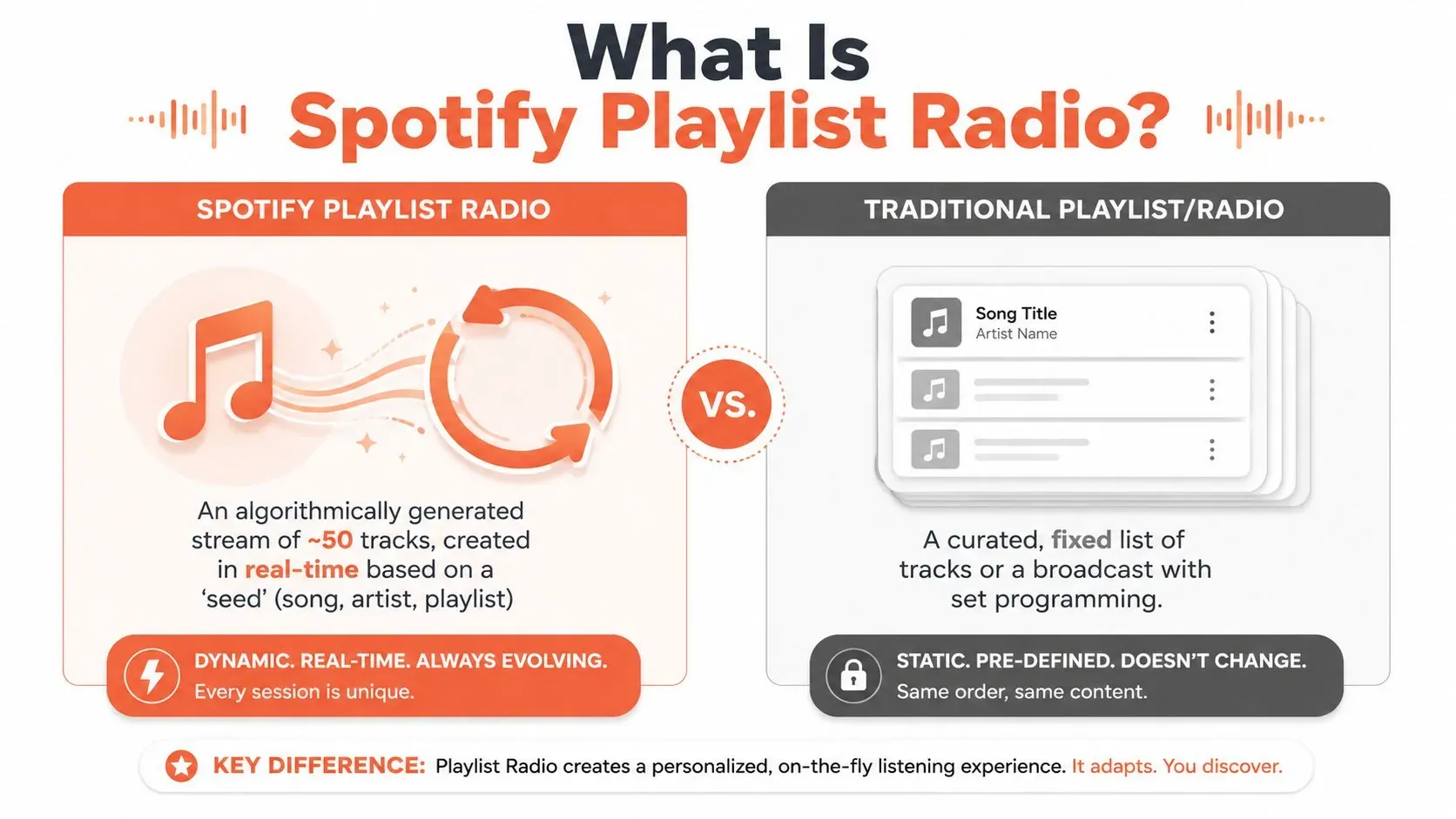
The practical difference is simple. A normal playlist is a set list. Playlist Radio is a generated session. Two listeners can start from the same playlist and still hear different supporting tracks because Spotify adjusts for taste history, skips, saves, and other relevance signals. If you want the bigger picture, this breakdown of Spotify’s recommendation system explains the recommendation layer Radio sits inside.
How Playlist Radio differs from editorial playlists
Editorial playlists are programmed by human curators. Radio is assembled by Spotify’s recommendation system in real time. That changes the artist’s job.
With editorial, the main question is whether a curator wants your track. With Radio, the question is whether your track performs well enough in the right context to keep being served. There is no visible gatekeeper and no stable slot to defend. Placement can expand or disappear based on listener response.
How it differs from Discover Weekly and Release Radar
Discover Weekly and Release Radar are also recommendation surfaces, but they solve different problems. Discover Weekly pulls from a listener’s broader taste profile. Release Radar prioritizes new music and artist-follow relationships. Playlist Radio is more immediate and more contextual. It extends the listening intent behind a specific seed.
That makes the comparison more useful than another definition:
| Surface | Built from | Experience for listener | What artists should understand |
|---|---|---|---|
| Editorial playlists | Human curation | Fixed playlist programming | Access depends on pitching and curator fit |
| Discover Weekly | Broad taste patterns | Weekly personalized discovery | Strong catalog and listener behavior help |
| Release Radar | New release activity and follow signals | New music from relevant artists | Launch velocity matters |
| Playlist Radio | A chosen seed plus behavior signals | In-the-moment contextual listening | Track fit and engagement quality matter most |
Why artists should care about the seed
The seed defines the competitive set around your song. If your track is being associated with playlists, songs, and artists that match its audience, Radio has a cleaner job to do. If your streams come from weak-fit traffic, Spotify has weaker evidence about where the track belongs.
This is the part many artists miss. Playlist Radio is less about getting added somewhere once and more about proving your song can extend a session without causing skips. That is why smart release strategy focuses on source quality, listener intent, and post-release monitoring, not just raw stream count.
How the Playlist Radio Algorithm Really Works
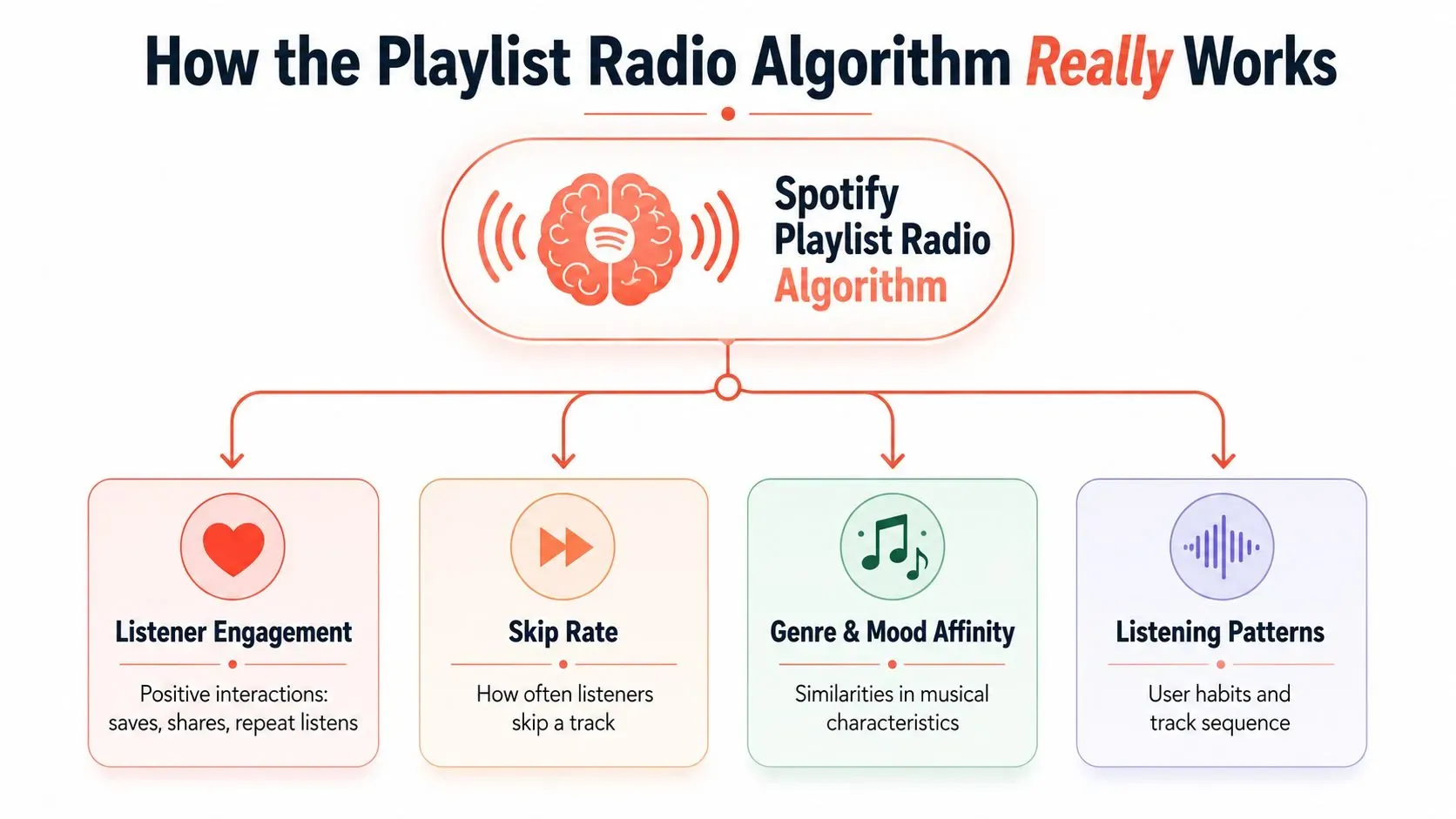
Playlist Radio responds to evidence. Spotify keeps testing a track in recommendation contexts, then increases or limits exposure based on what listeners do next. For artists, that means the system is less mysterious once you focus on the signals it can observe: completion, saves, skips, repeat listens, and whether the song fits the session it was dropped into.
The most useful way to break it down is into three parts: engagement, context, and matching.
The clearest signal-level explanation in a Radio context comes from Orphiq’s guide to Spotify algorithmic playlists. Orphiq points to save rate, listen-through rate, early skips, and follower conversion as strong inputs in whether tracks keep showing up across Spotify’s recommendation surfaces.
Engagement is the first gate
If a listener hears your track in Radio and saves it, finishes it, or comes back to it later, Spotify has a reason to keep testing that song. A save matters because it signals active intent. Passive streams are weaker proof.
Early skips create the opposite outcome. A track that loses people quickly becomes harder to place in future Radio sessions, especially if those skips happen across similar listener groups. This is one reason broad but weak-fit promotion often underperforms. It can inflate stream totals while damaging the behavior profile that recommendation systems rely on.
I usually frame this as a traffic quality problem, not a traffic volume problem. If you send the wrong audience to a song, Spotify does not care that you spent money or drove clicks. It sees low retention and adjusts accordingly.
Context shapes where the track can survive
Playlist Radio does not rank songs in isolation. It builds a listening sequence around a seed, so your track has to make sense beside specific songs, artists, moods, and use cases.
That practical detail changes how artists should evaluate performance. A song can be strong on its own and still fail in Radio if the surrounding context is wrong. A hazy downtempo track may perform well after introspective indie or ambient pop, then collapse in a brighter, higher-energy chain because listener expectations are different. Session fit matters as much as broad genre labeling.
That is also why low-quality playlist placements can create messy data. If a track gets exposure in playlists that attract the wrong listener intent, Spotify gathers weaker evidence about where the song belongs. The result is not just fewer saves. It is poorer categorization for future recommendation opportunities.
A useful supporting resource is artist.tools’ explanation of the Spotify recommendation system, which connects adjacent audience fit to how Spotify keeps serving tracks after the first test.
Strong Radio performance usually starts with a simple condition. The song reached listeners who were already likely to want that exact next track.
Matching combines listener behavior with content analysis
Spotify’s recommendation stack uses multiple systems at once. Collaborative filtering helps it find patterns in shared listener behavior. Audio analysis helps it compare sonic traits. Natural language processing helps it interpret how music is described across the web and in metadata-rich environments.
For Playlist Radio, that means similarity is not limited to tags or genre labels. Spotify can associate your track with a seed because the songs sound compatible, because similar listeners respond well to both, or because both conditions are true. The strongest Radio candidates usually satisfy both.
That creates clear actions for artists:
- Tighten the first 30 seconds: If the intro causes confusion or a fast drop-off, Radio testing gets weaker quickly.
- Target listeners with real fit: Paid traffic, influencer pushes, and creator campaigns only help if the audience is likely to complete, save, or replay.
- Keep release positioning consistent: Artwork, metadata, and content framing influence who clicks, which affects the behavior profile Spotify collects after the click.
There is a trade-off here. Narrow targeting can slow raw reach at the start, but it usually gives Spotify cleaner evidence. Cleaner evidence improves the odds that Radio places the track in stronger listening chains later. That is the mechanic artists can use.
How Artists Can Get on Playlist Radio
Artists get onto Playlist Radio by creating enough early, high-quality listener engagement for Spotify to trust the track in recommendation contexts. One commonly cited benchmark is that an artist typically needs around 3,800 streams in the first month to trigger a push on algorithmic playlists like Release Radar, with around 13,000 streams often needed for stronger sustained algorithmic visibility, according to this YouTube analysis of Spotify algorithmic thresholds.
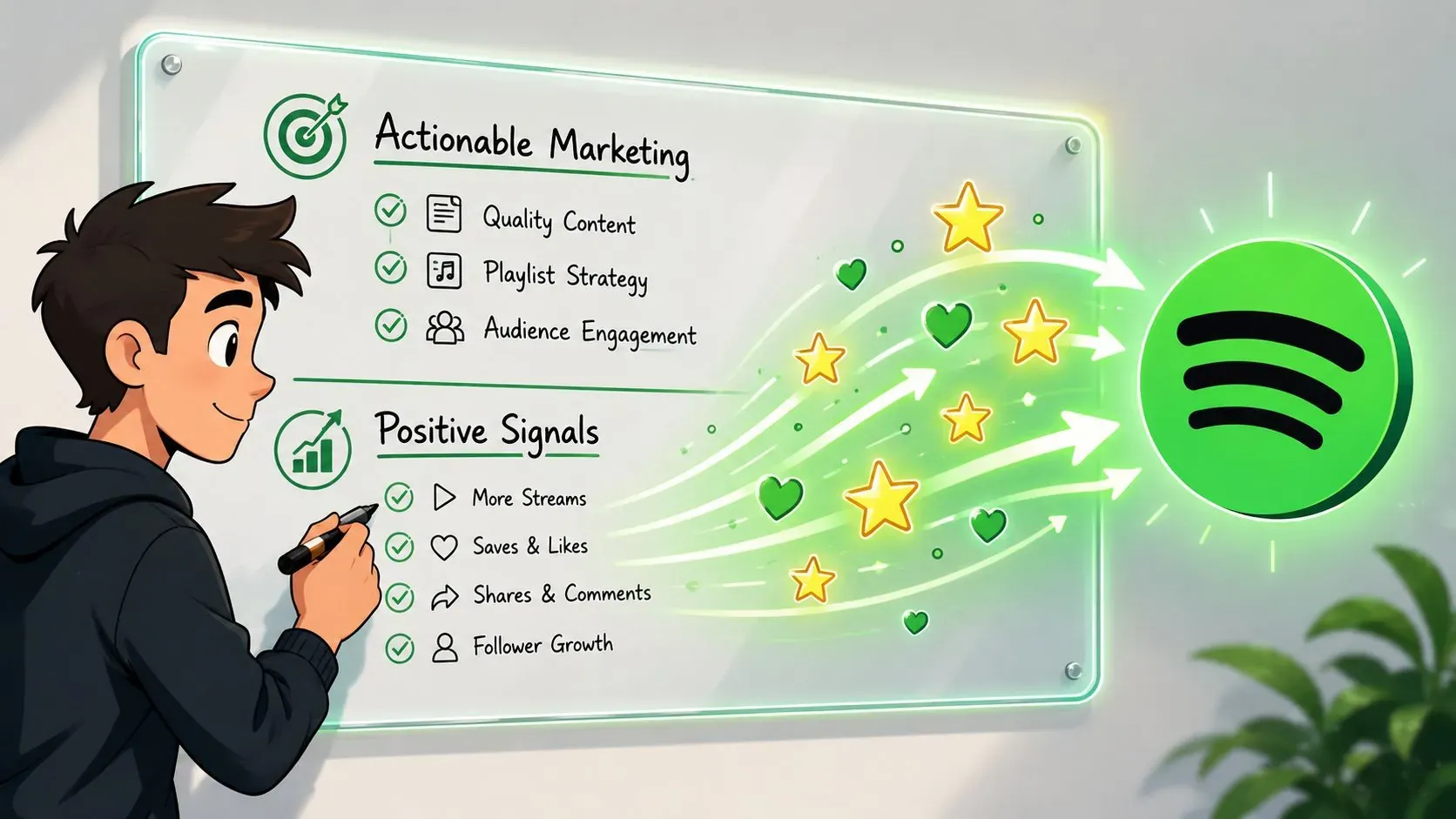
Those numbers shouldn’t be read as a magic switch. They’re better used as planning anchors. A key question is where those streams come from and how those listeners behave. Low-intent volume doesn’t help much. Strong early response does.
Start with fan concentration, not audience expansion
The first listeners should be people most likely to save the song and play it through. That usually means core fans, warm social audiences, email lists, SMS lists, Discord communities, and previous engagers. Artists often make the mistake of trying to scale before they’ve validated response.
A cleaner launch sequence looks like this:
- Prime the core audience: Give existing fans a reason to show up on release day and save the track if they like it.
- Sequence your content: Use short-form clips, story posts, and direct asks that focus on the song’s hook and emotional angle.
- Delay broad traffic if needed: If the song hasn’t proven retention with your own audience, it’s too early to push it wide.
Use playlists as accelerants, not as the strategy
Third-party playlists can help, but only when they send listeners who fit the music. A playlist with the wrong audience can spike streams and weaken the signals Radio cares about. That’s why playlist selection matters more than playlist count.
Good playlist strategy for Radio usually means:
- Prioritize relevance: Target playlists whose recent adds and listening context match your track closely.
- Watch sequencing: Songs placed beside incompatible tracks often get skipped faster.
- Avoid suspicious growth: Artificial activity pollutes your data and can create downstream problems.
For artists building a release campaign, a useful companion resource is artist.tools’ guide to Spotify playlist submission, especially if you’re balancing editorial, independent curator, and algorithmic goals.
If a playlist can’t produce real saves and real listen-through, it’s not helping your Radio odds, even if the stream count looks good.
Build the release around listener actions Spotify values
Musosoup’s algorithmic playlist guide says independent artists typically need at least 2,500 streams and 375 saves in the first few weeks post-release to secure placement on algorithmic playlists like Release Radar and Discover Weekly, according to Musosoup’s article on Spotify algorithmic playlists. That’s useful because it points to the behavior mix Spotify tends to respect: streams plus active intent.
At this stage, release planning gets concrete:
- Ask for saves, not just streams: A stream request is passive. A save request asks for commitment.
- Use content that previews the payoff: Listeners should know what kind of song they’re clicking into.
- Route traffic from high-fit channels: Genre pages, scene communities, and creator partners often outperform generic reach.
A good tactical walkthrough of release setup can help here:

Don’t optimize for empty spikes
Chartlex campaign data from more than 2,400 artist promotions in 2026 found that tracks most likely to land on Discover Weekly and Release Radar maintained a save rate above 20%, a stream-to-listener ratio of 2.5 or higher, and a skip rate under 30% within the first 30 seconds, as reported in Chartlex’s growth playbook for Spotify algorithmic playlists. While that study focuses on adjacent algorithmic surfaces, the lesson carries over to Radio: retention and intent beat vanity traffic.
That’s why some campaigns fail even when numbers look decent on the surface. They purchase reach but not resonance. Spotify doesn’t reward noise for long. It rewards songs that keep listeners in the session.
Monitoring Your Playlist Radio Performance with artist.tools
Playlist Radio usually shows up as a downstream effect, not a clean line item. The practical job is to identify which playlist placements and listener behaviors likely created the conditions for Radio exposure, then repeat what worked.
Spotify does not hand artists a simple cause-and-effect report here. You have to piece it together from timing, traffic source shifts, playlist quality, and what happens to saves, skips, and repeat listening after a placement hits. As noted earlier, recommendation systems reward strong listener response. Monitoring should focus on whether your inputs are producing that response, not just whether streams went up.
Start with the playlist that came first
Before you credit Radio for a spike, check what happened right before it. If a track starts climbing after a playlist add, audit that playlist first. Look at audience fit, curator behavior, follower patterns, and whether the playlist has a history of stable movement instead of sudden, unnatural jumps.
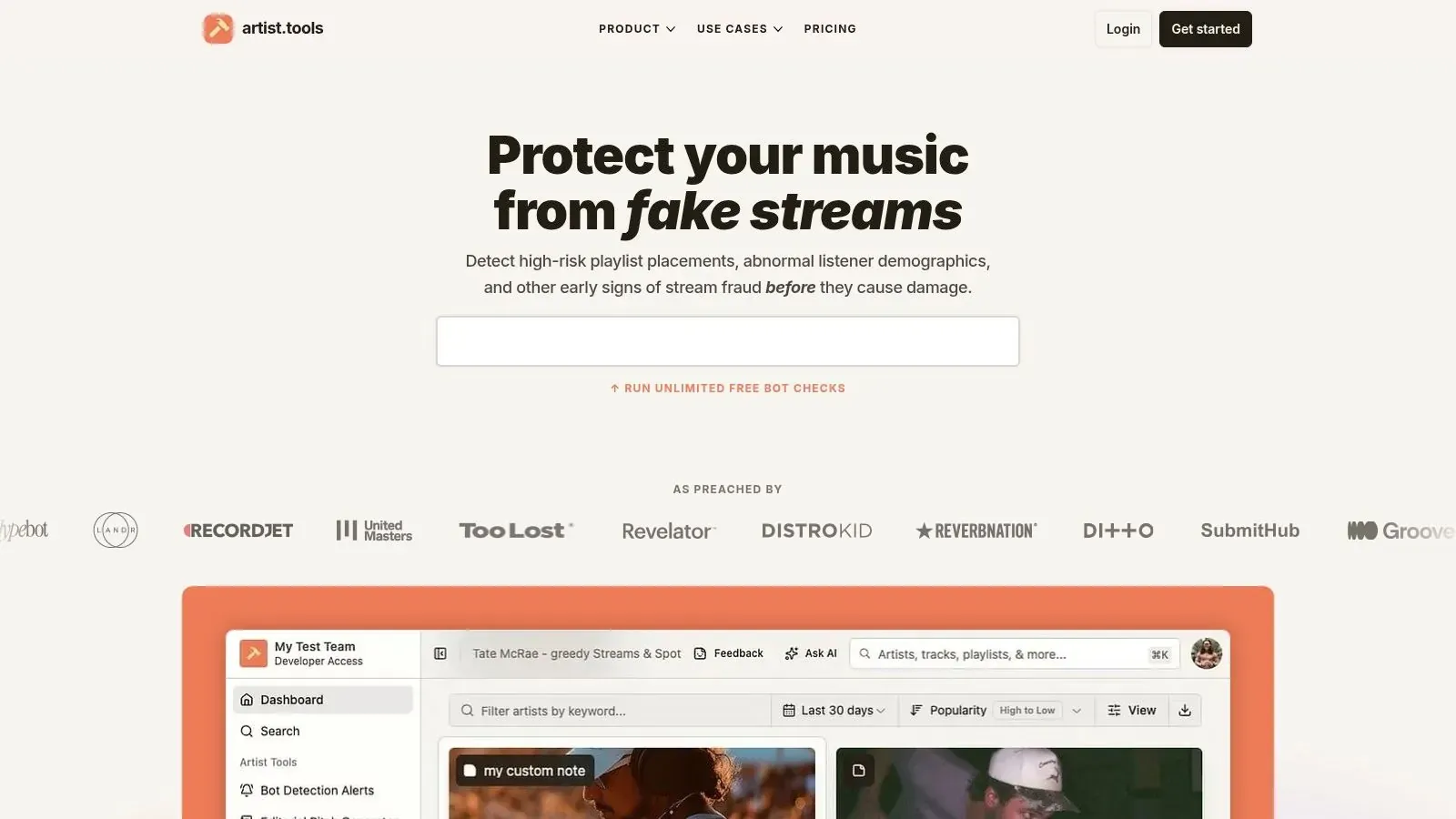
Bad source data can send you in the wrong direction. A playlist can inflate streams while producing weak saves and poor retention. If that happens, the placement may look successful in a topline report but do very little to help your track earn more algorithmic distribution.
Check the seed environment, not just the outcome
Playlist Radio is influenced by context. A strong placement does more than add streams. It places your track beside songs, artists, and listener cohorts that help Spotify classify where the song belongs and who tends to respond well to it.
That is why playlist vetting should happen before and after a campaign. Use a tool that lets you inspect historical adds and removes, follower changes, and playlist integrity over time. The playlist analytics feature for Spotify playlist tracking and vetting helps artists and managers do that work with more precision. You can quickly tell whether a playlist behaves like a real discovery source or just generates noisy traffic.
Bad playlist data wastes budget. It also muddies the evidence Spotify uses to test your song in future recommendation surfaces.
Build a review cycle you can repeat
The strongest teams treat Playlist Radio monitoring like release analysis, not a one-off check. A useful workflow is simple:
- Break out traffic sources by week: Separate fan traffic, playlist traffic, and any paid traffic.
- Audit the playlists tied to each lift: Check whether those placements came from credible, relevant playlists.
- Compare listener quality by source: Look for the channels that produce stronger saves, better completion, and more repeat listening.
- Keep or cut based on behavior: Keep sources that improve listener quality. Cut sources that only inflate stream counts.
Over time, this gives you a working model of what helps your catalog. You stop treating Playlist Radio like luck and start treating it like a measurable outcome of playlist quality, audience fit, and post-release analysis.
Frequently Asked Questions About Spotify Playlist Radio
What’s the difference between Song Radio, Artist Radio, and Playlist Radio
The difference is the seed. Song Radio starts from one track. Artist Radio starts from an artist profile. Playlist Radio starts from an existing playlist. The recommendation logic is similar, but the context changes because the seed changes. For artists, that means your song may perform differently depending on which environment introduces it.
Can you pitch directly for Playlist Radio
No. There isn’t a direct submission path like editorial pitching in Spotify for Artists. Playlist Radio on Spotify is earned indirectly through listener behavior, track fit, and the quality of contexts where the song first appears.
How long does a song stay in Radio
There isn’t a fixed public duration. Radio is dynamic, so inclusion can change as listener behavior changes and as Spotify rebuilds sessions around different seeds and users. The practical takeaway is simple: treat Radio as something you keep re-earning.
Do pre-save campaigns affect Playlist Radio
Pre-saves can help if they contribute to a stronger release-day response from real fans. They don’t influence Radio on their own. What matters is whether those listeners stream, save, finish the song, and continue engaging after release.
What should an artist focus on first
Focus on listener quality before listener scale. A smaller group of committed listeners who save and finish the song is more useful than a larger group that skips early. That principle shows up across Spotify’s algorithmic surfaces, and it’s especially relevant in Radio because the system is trying to extend a listening session without losing the listener.
artist.tools helps artists, managers, and labels make smarter Spotify decisions with playlist analytics, bot detection, stream tracking, SEO research, and historical data built for real release work. If you want to understand which playlists are helping your music and which ones are poisoning your data, explore artist.tools.