
How to Copyright Music for Free: A 2024 Guide
Discover how to copyright music for free and protect your work from creation to publication in 2026.
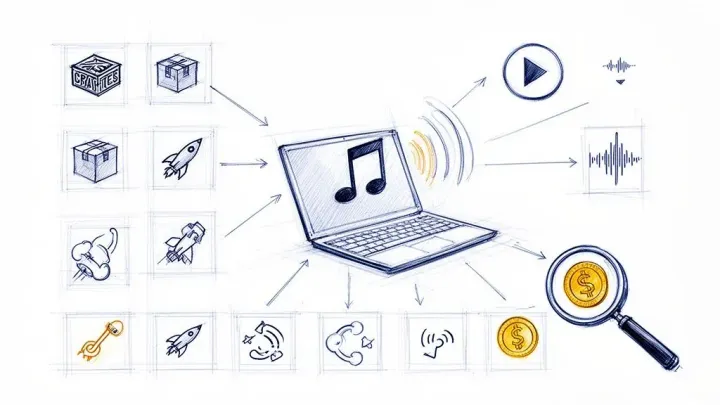
Music is protected by copyright the moment it is created in a fixed, tangible form. This fundamental right is automatic, global, and costs nothing.
Under the Berne Convention, an international agreement adopted by 181 countries, your original music receives copyright protection the instant you record a voice memo, write down lyrics, or save a session file in a DAW. This automatic protection grants you, the creator, the exclusive rights to reproduce, distribute, and perform your work without any initial cost or administrative process. However, this automatic copyright has significant limitations when it comes to legal enforcement.
Your Music Is Copyrighted the Moment You Create It
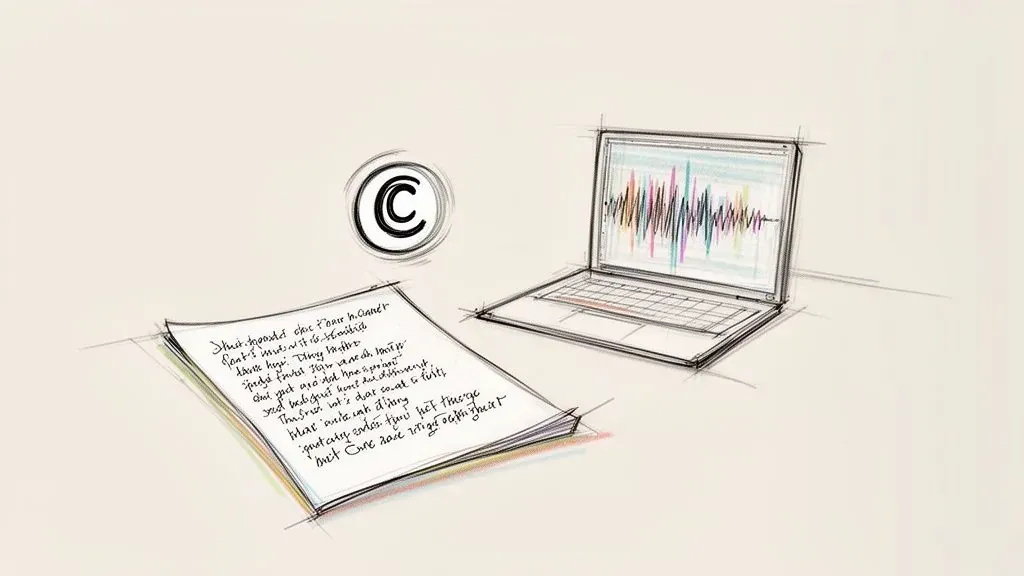
U.S. law grants copyright protection to original works of authorship as soon as they are fixed in a tangible medium of expression. This means the second you hit record, save a project file, or film yourself performing a new idea on your phone, you have established a foundational copyright. This protection is immediate, automatic, and free.
Automatic Copyright Is Your First Line of Defense
Automatic copyright serves as an initial shield, allowing independent artists to share demos with collaborators or upload private tracks to platforms like SoundCloud with baseline legal ownership. The primary challenge of relying solely on automatic copyright is proving the date of creation in a dispute. If another artist releases a similar track, the burden of proof is on you to demonstrate that your work was created first.
The Growing Value of Your Automatic Copyright
The assets you create are increasingly valuable. The global music copyright market reached $47.2 billion in 2023, growing 5.2% from the previous year, according to MIDiA Research. Within this market, recorded music generated $29 billion. For artists on Spotify, this automatic copyright ensures their new tracks are legally theirs from the moment of creation, allowing them to focus on promotion, such as pitching to playlists using a tool like the Playlist Search on artist.tools. These figures demonstrate why understanding copyright is critical; every melody is a potential asset in a rapidly expanding market.
To see the full scope of these industry economics, you can explore the full breakdown of these figures and understand their direct impact on creators.
Automatic Copyright vs. Formal Registration
The distinction between free, automatic copyright and paid, formal registration is critical for artists to understand.
| Feature | Automatic Copyright (Free) | Formal Registration (Paid) |
|---|---|---|
| How It’s Established | Instantly, when the work is fixed in a tangible form (e.g., recorded). | By submitting an application and fee to a government body (e.g., U.S. Copyright Office). |
| Cost | $0 | $45 - $65+ per application (U.S. Copyright Office, 2024). |
| Proof of Ownership | Basic. Requires the creator to prove they were the first to create the work. | Creates a public record and legal presumption of ownership from the date of creation. |
| Legal Action | Limited. You generally cannot sue for infringement in U.S. federal court without registration. | A prerequisite to filing a copyright infringement lawsuit in U.S. federal court. |
| Statutory Damages | Not eligible to claim statutory damages or attorney’s fees. | Allows suits for statutory damages (up to $150,000 per willful infringement) and recovery of attorney’s fees. |
| Best For | Initial protection for demos, works-in-progress, and early-stage sharing. | Commercially released music, high-value compositions, and legally enforcing your rights. |
Automatic copyright protects ownership, but formal registration provides the legal power to defend it effectively.
The Role of the U.S. Copyright Office
The U.S. Copyright Office serves as the official public ledger for creative works in the United States. While copyright exists from the moment of creation, formal registration is an absolute requirement to file a lawsuit for copyright infringement in a U.S. court. Registering a work creates a public record of your claim and provides significant legal advantages in the event of a dispute.
How to Create Verifiable Proof of Your Copyright for Free
While automatic copyright is immediate, it does not provide verifiable proof of when you became the owner. In a dispute, proving you were the first to create a work is essential. The “Poor Man’s Copyright”—the practice of mailing yourself a physical copy of your work—is an unreliable myth and does not hold up as evidence in court. Modern, digital methods offer free, verifiable, and timestamped records of your work.
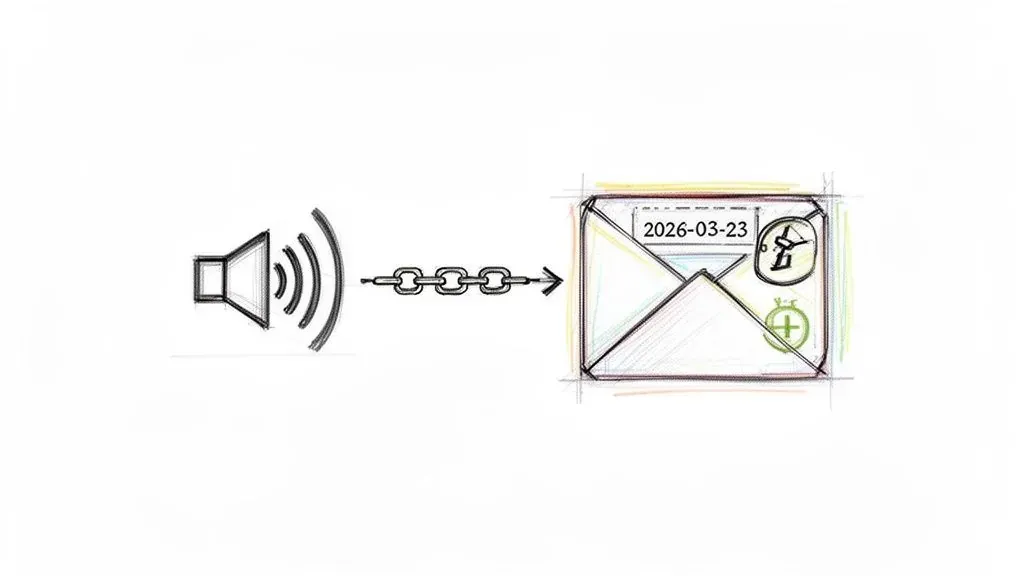
The concept of automatic copyright was solidified in the U.S. with the adoption of the Berne Convention in 1989, which eliminated the need for a formal © notice. This change is particularly relevant for the 70% of artists on Spotify who are independent, a figure reported by MIDiA Research in 2023. While large collection societies (CMOs) collected $13.6 billion in 2023 (an 8% increase year-over-year, per CISAC), individual artists must rely on their own methods to establish proof of creation. An estimated 90% of copyright disputes are settled out of court, often based on which party presents the earliest timestamped evidence. You can read more about the global music copyright market’s growth and what it means for artists.
Digital Timestamps and File Metadata
Digital Audio Workstations like Logic Pro, Ableton, and FL Studio embed creation and modification dates directly into project files. This file metadata acts as a digital fingerprint and a verifiable timestamp that a forensic expert can confirm. To strengthen this evidence, artists can export an audio file and upload it to a secure cloud service like Dropbox or Google Drive. These platforms generate a third-party, verifiable timestamp upon upload, creating a strong evidentiary record.
Using Private Blockchain Services for Free
Blockchain technology offers an immutable method for creating a verifiable record of a digital file. Several services allow artists to notarize their files for free by generating a unique cryptographic hash—a one-of-a-kind digital signature—for the audio file. This hash is then recorded on a public blockchain with a permanent timestamp. Any alteration to the audio file would produce a completely different hash, making the record tamper-proof.
Services offering free blockchain timestamping include:
- Creativechain: A platform designed for registering intellectual property on the blockchain.
- Bernstein: A service that generates a certificate for any file, linking it to the Bitcoin blockchain.
- Stampery: A service that uses blockchain technology to certify a file’s existence at a specific point in time.
Approximately 15% of independent artists utilized blockchain for proof of authorship in 2023, according to industry analysis, demonstrating its growing adoption as a secure alternative to older methods.
The Power of Public (But Controlled) Sharing
Uploading your music to a major platform using private settings can also establish a verifiable timestamp. When a track is uploaded to SoundCloud as a private link or to YouTube as an unlisted video, the platform creates a permanent record of the upload date. This method is compelling because the timestamp is generated by a large, neutral third party like Google or SoundCloud, proving the work was complete and in your possession on that date. The key is to keep the upload private or unlisted until its official release, building an evidence trail while maintaining control over public access.
Using Creative Commons to Amplify Your Reach
Copyright is a tool for strategic exposure, not just legal protection. By licensing your music for free under specific conditions, you can significantly expand its reach. Creative Commons (CC) provides a free, standardized way to grant the public permission to share, remix, and build upon your work while you retain your copyright. This strategy can turn fans and other creators into a powerful, decentralized promotional force.
The Different Flavors of Creative Commons Licenses
Creative Commons offers a menu of licenses built from four main conditions that can be mixed and matched.
- Attribution (BY): This core condition requires anyone using your work to give you credit as the creator.
- ShareAlike (SA): This “pay it forward” clause requires that any new works created using your music (e.g., a remix) must be released under the same CC license.
- NoDerivatives (ND): This restrictive condition allows others to share your original track but prohibits them from altering it in any way, including sampling or remixing.
- NonCommercial (NC): This condition permits use for personal projects but requires anyone seeking to use the music for commercial purposes (e.g., an advertisement) to obtain a separate, traditional license from you.
These elements combine to form six distinct licenses, ranging from the very open CC BY to the most restrictive CC BY-NC-ND.
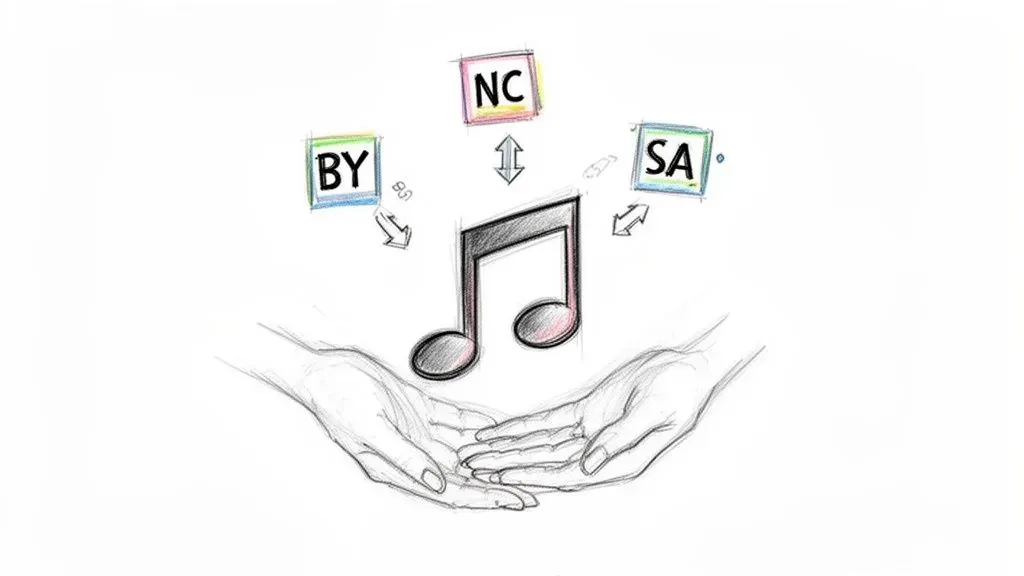
The official Creative Commons website provides a free “License Chooser” tool that helps you generate the appropriate legal text and symbols for your chosen license.
Putting Creative Commons into Practice
A popular strategy for emerging artists is the CC BY-NC-SA license. This combination allows a YouTuber to use your song in a non-monetized vlog (NonCommercial) as long as they credit you (Attribution) and allow others to use their resulting video under a similar open license (ShareAlike). This approach prevents commercial exploitation without payment while encouraging the user-generated content that drives discovery.
This strategy can significantly increase visibility. For instance, data from artist.tools shows that a robust backlink profile, which can be built through CC-licensed shares, is correlated with an 80% higher success rate when pitching to playlist curators and press. With over 602 million users on Spotify (Q4 2023) and a global creator economy exceeding 60 million people, every share is a potential connection to a new listener. Given that 1 million Spotify streams can generate approximately $4,000 (a figure verifiable with the artist.tools royalties calculator), encouraging shares is a direct investment in your career. You can see the scale of the music industry in recent reports to understand the opportunity.
A CC license is your public statement. It says, “I want you to use my music, but here are the rules.” That clarity removes all the guesswork and encourages the viral momentum that can launch a career.
Understanding the Public Domain
At the opposite end of the copyright spectrum is the public domain, which comprises works whose copyright has expired. In the U.S., this generally occurs 70 years after the death of the last surviving author. Works in the public domain are free for anyone to use for any purpose without permission or payment. For modern artists, the public domain is a source of legally free material for sampling, such as classical compositions from the early 20th century. However, a specific sound recording of a public domain work is protected by its own separate copyright. You cannot use a modern orchestra’s 2024 recording of a Beethoven symphony without permission, even though the underlying composition is in the public domain.
When You Must Pay to Formally Register Your Copyright
While copyright is free and automatic, enforcing it in the United States legal system requires formal registration. The free, timestamped proof methods are valuable for informal dispute resolution but are insufficient for litigation. To file a copyright infringement lawsuit in a U.S. federal court, the work must be formally registered with the U.S. Copyright Office. This paid, strategic action transforms your automatic copyright from a defensive shield into an offensive legal weapon.
The Power of Statutory Damages
The most compelling reason to formally register your music is to become eligible for statutory damages. If you sue for infringement without a registered copyright, you are typically limited to recovering “actual damages”—the demonstrable financial loss you suffered. For an independent artist, this might amount to only fractions of a cent per stream, making a lawsuit financially impractical.
With a timely registration, a court can award statutory damages, which are amounts set by law to punish the infringer and compensate the creator, regardless of the actual financial loss.
- Standard Infringement: A court can award between $750 and $30,000 per infringed work.
- Willful Infringement: If it is proven that the infringer acted with knowledge of their infringement, the award can increase to $150,000 per work.
This legal remedy is why music publishers and labels register all commercially released works. It transforms a minor financial loss into a significant legal and financial threat, deterring potential infringers.
Recovering Attorney’s Fees
Formal registration also allows you to recover your attorney’s fees from the losing party if you win your infringement case. Copyright litigation is expensive, with legal costs often reaching tens or hundreds of thousands of dollars. The ability to recoup these fees is a critical piece of leverage that makes legal action accessible to individual creators who lack the financial resources of a large corporation.
For a better understanding of how these different revenue streams and rights interact, our guide on music publishing rights offers smart strategies for artists.
The difference is stark: an unregistered work might yield $0.004 per stream in actual damages. A registered work, if willfully infringed, could be eligible for $150,000 in statutory damages plus attorney’s fees. It’s the difference between having a right and having a remedy.
A Strategic Framework for Registration
The decision to pay the $45–$65 registration fee (U.S. Copyright Office, 2024) is a business calculation. While you do not need to register every demo, you should register your most important works.
Consider formal registration in these scenarios:
- Before a Major Commercial Release: Register your music before a planned single or album release that includes a marketing campaign. This ensures maximum legal protection from day one.
- Ahead of a Sync Licensing Pitch: When pitching music for film, television, or advertising, registration is essential. Production companies require a clean chain of title and will often reject unregistered works to avoid legal complications.
- Immediately Upon Discovering Infringement: To take an infringer to court, you must first register the work. The 2019 Supreme Court decision in Fourth Estate Public Benefit Corp. v. Wall-Street.com affirmed that a registration certificate must be issued before a lawsuit can be filed.
- For Your Most Valuable Songs: Prioritize registering the “crown jewels” of your catalog—the tracks with the highest streaming numbers, sync potential, or fan engagement. This is a cost-effective strategy to protect your most valuable assets.
Protecting and Monetizing Your Music on Spotify

Copyright is the foundation of your music career on platforms like Spotify. Once your music is created and legally protected, the objective becomes converting that protected asset into streams and revenue. After a distributor delivers your music to Spotify, the tasks of protection and monetization become intertwined.
The IFPI’s 2024 Global Music Report documented that global recorded music revenues reached $28.6 billion in 2023. Every stream your music earns on Spotify represents a claim to a fraction of this growing revenue pool. Therefore, your promotional efforts directly impact your potential earnings.
Turning Protection into Promotion
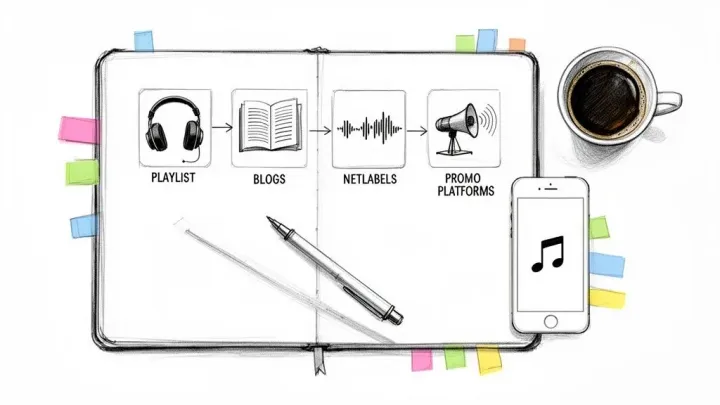
Your promotional strategy begins the moment your release is scheduled. Securing placement on Spotify’s editorial playlists remains a primary driver of discovery. Your pitch to Spotify’s editors is a critical opportunity to make an impact. Editors review thousands of submissions daily, so a compelling narrative is essential. Artists are increasingly using tools like the artist.tools AI Editorial Pitch Generator to craft effective pitches. By inputting song details, marketing plans, and sonic comparisons, artists can generate pitches that align with the language and priorities of editorial teams.
Finding Legitimate Playlist Curators
Independent playlists are a significant source of streams, but the landscape is filled with fraudulent actors offering fake plays for a fee. Differentiating legitimate curators from scammers requires reliable data. A Playlist Search tool, such as the one developed by artist.tools, allows artists to analyze millions of playlists. By examining follower growth trends and listener engagement data, artists can identify curators who have built real, organic audiences and avoid those who use bots and artificial inflation.
For a deeper dive into how those streams actually turn into cash, our complete guide on Spotify and royalties provides a full musician’s guide to getting paid.
The connection is direct: Free, automatic copyright protects your asset. Data-driven tools help you monetize that asset. One without the other leaves you either unprotected or unheard.
This flowchart illustrates the critical decision point an artist faces when their work is infringed, highlighting the strategic value of formal registration.
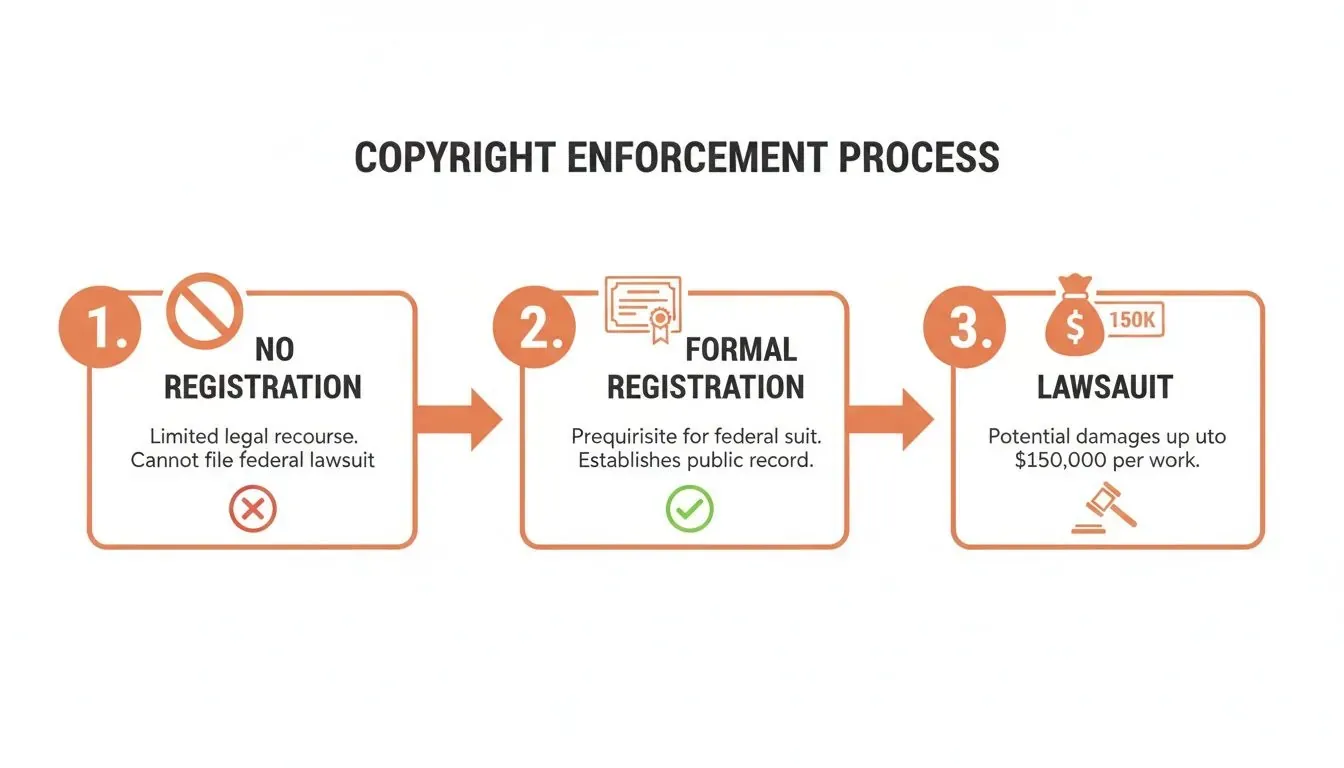
Without registration, your legal options are severely limited. Formal registration with the U.S. Copyright Office unlocks powerful remedies, including the potential for up to $150,000 in statutory damages for willful infringement.
Artist Protection and Growth Workflow
This table outlines the journey from a finished track to a revenue-generating asset, showing how each step builds upon the last.
| Step | Action | Tool/Method | Outcome |
|---|---|---|---|
| 1 | Create Your Music | Your DAW, instruments, voice | A finished song (MP3, WAV) that is automatically copyrighted. |
| 2 | Prove Authorship | Free methods (private video, timestamped files) or paid services. | Verifiable proof you created the work at a specific time. |
| 3 | Register Formally (Optional but Recommended) | U.S. Copyright Office | The legal power to sue for infringement and collect statutory damages. |
| 4 | Distribute to Spotify | A music distributor (e.g., DistroKid, TuneCore). | Your music is live on Spotify, ready to be streamed. |
| 5 | Promote Your Release | artist.tools Pitch Generator & Playlist Search. | Pitches to editorial playlists and placements on legitimate user playlists. |
| 6 | Monitor for Fraud | artist.tools Bot Detection. | Protection against fake streams and potential account penalties. |
| 7 | Collect Royalties | Your distributor and PRO. | You get paid for your legitimate streams. |
Following these steps methodically ensures you are building a sustainable business, not just creating music.
Safeguarding Your Revenue from Fraud
As your music gains traction, it becomes a target for fraudulent activity, such as artificial streams generated by bots. This fraud can lead to track removals, frozen royalty payments, and penalties against your Spotify for Artists account. Proactive monitoring of your streaming data is now a critical component of career management.
Using a Bot Detection tool is essential for modern artists. Platforms like artist.tools continuously monitor your Spotify profile for anomalous streaming patterns and flag playlists exhibiting bot-like activity. This provides an early warning, enabling you to request removal from a fraudulent playlist before Spotify’s algorithms penalize your account for activity that was not your fault. This defensive action protects your work and ensures that your earned revenue is legitimate.
Your Top Music Copyright Questions, Answered
Navigating music copyright involves understanding key legal distinctions and practical procedures.
Song vs. Recording: What’s the Difference?
Every piece of recorded music embodies two distinct copyrights.
- The musical work (or composition) is the underlying song itself—the melody, harmony, and lyrics.
- The sound recording (or master) is the specific captured performance of that song, fixed in an audio file like a WAV or MP3.
An artist who writes and records their own original material owns both copyrights from the moment of creation. This is critical for monetization, as royalties are paid separately for the composition (via publishing) and the sound recording (via master rights).
Is the “Poor Man’s Copyright” a Real Thing?
No, the “Poor Man’s Copyright” is a persistent myth. The act of mailing yourself a physical copy of your work to obtain a postmark as proof of creation date is legally worthless in a U.S. court. It is not considered tamper-proof evidence. A court will give far greater weight to a digital timestamp from a credible third-party service, a blockchain certificate, or an official registration from the U.S. Copyright Office.
The fundamental flaw of the “Poor Man’s Copyright” is its lack of independent, third-party verification. A file timestamped on a Google Drive server or a blockchain certificate provides a level of authenticated proof that a sealed envelope cannot match in a legal dispute.
Do I Have to Register Every Song on My Album Separately?
No. The U.S. Copyright Office allows you to register a collection of songs (such as an album or EP) as a single work with one application and one fee, provided you are the sole author and owner of every song in the collection. For an album of ten songs, you would pay a single fee (approximately $65 as of 2024) to register the entire work, which is significantly more cost-effective than filing ten separate applications.
Someone Stole My Music. What’s the First Thing I Should Do?
Act quickly and methodically. First, document all evidence of the infringement. Take screenshots, copy all relevant URLs, and gather any information available about the infringing party.
Next, send a formal DMCA takedown notice to the platform hosting the infringing content, such as Spotify, YouTube, or Apple Music. These platforms have legally mandated procedures for processing such claims. Do not send the notice to the infringer directly.
If the platform does not comply or the infringement is causing significant financial harm, consult a music attorney. Remember that to file a lawsuit in the U.S., you must have a formal copyright registration certificate for the work in question.
At artist.tools, we build tools that give you the data and clarity to protect your music and grow your career. From spotting bad playlists to crafting the perfect pitch for editors, our platform is your competitive edge. See how we can help you build your career at artist.tools.